A building manager arrives on Monday morning and notices that the conference room smells stale. The receptionist mentions a headache that usually fades by lunchtime, while a long-time tenant asks whether the HVAC system was recently serviced. None of these observations proves that the building has a dangerous pollutant, but together they show how indoor air quality becomes a practical property concern.
You may be dealing with a home, office, school, apartment building, or commercial facility in Los Angeles County. Understanding what IAQ means helps you decide whether you need a ventilation review, mold inspection, air sampling, VOC testing, combustion byproduct assessment, or a broader environmental evaluation. For general steps that can support a healthier home environment, J.G. Carpet Cleaning's healthy home advice offers a useful starting point.
Table of Contents
- Why Indoor Air Quality Is Something Every Property Owner Notices
- What Is IAQ and Why the Definition Matters
- The Main Pollutants and Sources That Shape Indoor Air
- How Poor IAQ Affects Health, Comfort, and Productivity
- How Professionals Measure and Test Indoor Air Quality
- Professional IAQ Testing Compared to DIY Monitors
- When Property Owners Should Consider Professional Testing
- Key Takeaways and Next Steps for Los Angeles Property Owners
Why Indoor Air Quality Is Something Every Property Owner Notices
Indoor air quality is often invisible until occupants notice an odor, irritation, stuffiness, or repeated comfort complaint. A property owner may hear that one room feels different from the rest of the building, that employees avoid a particular area, or that a tenant's symptoms appear only during occupied hours.
Those observations deserve attention, but they don't identify the cause by themselves. A musty smell may point toward moisture, while a chemical odor could relate to new flooring, paint, adhesives, or cleaning products. A stuffy conference room may reflect ventilation performance rather than a single contaminant.
A professional assessment helps separate occupant observations from environmental evidence. It can examine sources, ventilation, humidity, airborne particles, gases, mold-related concerns, and conditions connected to renovation, water damage, wildfire smoke, or combustion equipment.
What Is IAQ and Why the Definition Matters
So, what is IAQ? In everyday language, indoor air quality describes the condition of the air inside a building and how that condition affects health, comfort, and use of the space. People experience IAQ through odors, stuffiness, temperature, humidity, visible dust, irritation, and the way a room feels during occupancy.
The technical definition is broader than a single air sample. ASHRAE explains that carbon dioxide alone doesn't provide an overall indication of IAQ, because acceptable conditions depend on variables including temperature, humidity, particulate matter, and gas pollutants. Its guidance also treats carbon dioxide as a useful ventilation diagnostic. A reading far above the expected range may indicate a ventilation problem, but a lower reading doesn't prove that every other aspect of IAQ is acceptable. ASHRAE's standards and guidelines provide the recognized framework for commercial ventilation and acceptable indoor air quality, including Standard 62.1 for commercial buildings and Standard 62.2 for residential buildings.
Think of IAQ like a credit score. The score gives you a useful summary, but several underlying factors produce it. In a building, those factors include pollutant sources, outdoor air exchange, filtration, temperature, moisture, surfaces, odors, and occupant activities. A room may have an acceptable result for one pollutant and still feel uncomfortable because humidity is high, air movement is poor, or odors are entering from another area.
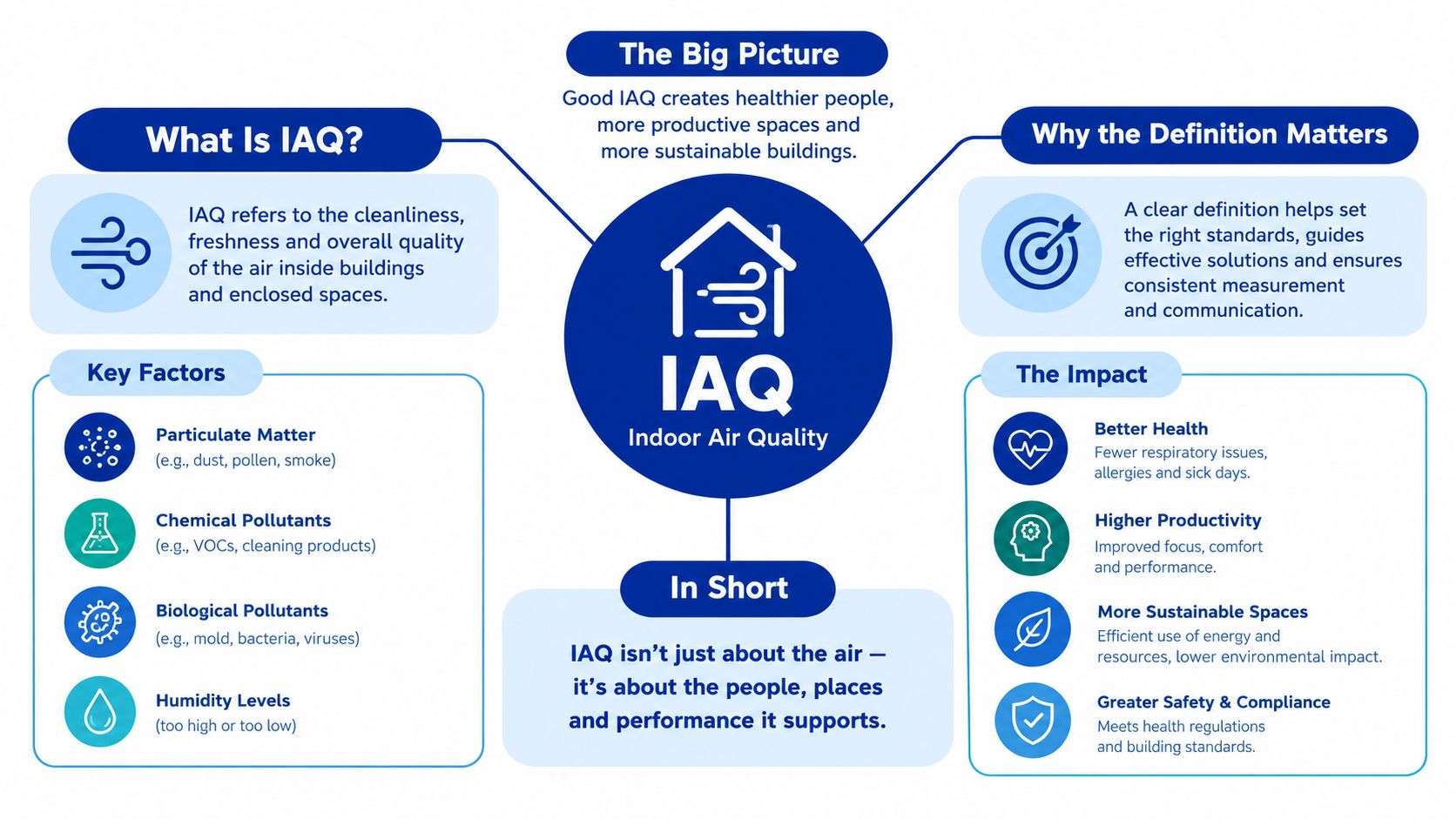
IAQ and IEQ are related but different
Indoor environmental quality, or IEQ, is an even broader concept. It may include lighting, acoustics, thermal comfort, surfaces, and other features that influence how people experience a building. IAQ focuses more specifically on the air and the conditions that shape it, although some professional frameworks consider related comfort factors together.
That distinction matters for property owners. A tenant complaint about “bad air” may involve mold, VOCs, dust, or combustion gases, but it may also involve inadequate ventilation or uncomfortable humidity. IAQ resources for Florida homeowners provide additional general background on the subject, while a Los Angeles property assessment should be customized to the building, its history, its occupants, and the decision the owner needs to make.
The Main Pollutants and Sources That Shape Indoor Air
Indoor contaminants usually have a source. EPA identifies source control as a primary strategy because materials, activities, moisture, combustion, and outdoor contaminants can release gases or particles into occupied spaces. A reliable IAQ investigation therefore asks what entered the building, where it originated, when it appeared, and how the HVAC system moves it.
Cooking can generate particulate matter. Construction and renovation can add dust from cutting, sanding, demolition, and disturbed materials. Smoke from cigarettes, fireplaces, nearby wildfire events, or other combustion can move through openings and ventilation systems. In a commercial property, vehicle exhaust from an attached garage, loading area, or nearby traffic may also affect indoor conditions.
Biological concerns develop differently. Water intrusion, roof leaks, plumbing failures, condensation, or persistently damp materials can support mold growth and allow airborne spores to move through a building. Dust mites and other allergens may also be associated with settled dust and moisture conditions. A mold inspection and targeted air or surface sampling can help determine whether a suspected moisture problem has an airborne component.
Common Indoor Pollutants and Typical Sources
| Pollutant Category | Typical Indoor Sources | Where It Is Most Common |
|---|---|---|
| Particulate matter | Cooking, smoke, renovation dust, settled dust, combustion | Homes, offices, schools, kitchens, construction areas |
| Biological contaminants | Moisture-damaged materials, mold growth, dust, damp furnishings | Water-damaged rooms, bathrooms, basements, HVAC areas |
| Combustion byproducts | Gas appliances, fireplaces, furnaces, attached garages, vehicle exhaust | Homes, restaurants, garages, industrial and maintenance areas |
| VOCs | Paints, adhesives, flooring, furniture, coatings, cleaning products | Renovated rooms, offices, schools, retail and commercial interiors |
| Inorganic gases | Radon, ozone from outdoor infiltration or some equipment, combustion-related gases | Lower levels, mechanically ventilated buildings, areas near outdoor sources |
Volatile organic compounds, or VOCs, can be released by paint, adhesives, new furniture, flooring, coatings, and cleaning products. A recent renovation may therefore create a chemical odor even when no visible dust remains. VOC sampling can help identify whether specific airborne compounds are present and whether additional investigation is justified.
Combustion deserves a separate review because carbon monoxide and nitrogen dioxide can come from gas stoves, fireplaces, furnaces, poorly vented equipment, or attached garages. A carbon monoxide detector is an important safety device, but it isn't a substitute for an industrial hygiene assessment when a property owner needs to understand intermittent exposure, equipment-related conditions, or a documented pattern.
Practical rule: Test the suspected source, not just the room where someone noticed a symptom.
A building can have several sources at once. Renovation dust, insufficient ventilation, cleaning chemicals, and moisture may overlap in the same area. That combination is why a professional assessment may involve direct-reading instruments, air samples, surface samples, moisture observations, HVAC review, and laboratory analysis rather than one universal “air quality” test.
How Poor IAQ Affects Health, Comfort, and Productivity
Poor IAQ affects people in different ways, and symptoms alone can't identify the pollutant responsible. A headache may occur in a room with an odor, inadequate ventilation, combustion concerns, or another environmental condition. Eye or throat irritation may relate to particles or chemical emissions, while respiratory discomfort can have many possible causes outside the building.
The most useful way to think about potential effects is in layers. Short-term irritation may include headaches, eye discomfort, throat irritation, unusual fatigue, odor complaints, or a sensation of stuffiness. These observations are important clues, especially when several occupants report similar experiences or symptoms improve after leaving the building.
Exposure patterns matter
Longer-term exposure concerns require more careful evaluation. Repeated contact with particulate matter, combustion byproducts, VOCs, mold-related conditions, or other contaminants may warrant investigation based on the source, concentration, duration, and occupant circumstances. Environmental testing doesn't diagnose a medical condition, but it can help identify building conditions that a physician, property owner, insurer, or legal professional may need to consider.
People with asthma, allergies, cardiovascular conditions, or other sensitivities may notice indoor conditions sooner than other occupants. Children, older adults, and pregnant occupants may also require additional care when a building has suspected contamination or persistent air quality complaints. That doesn't mean every odor or discomfort event represents a serious hazard. It means the investigation should account for who occupies the space and how long the concern has continued.
Productivity and comfort complaints are evidence to investigate
In offices, classrooms, healthcare settings, and multi-tenant buildings, occupants may report poor concentration, fatigue, odor, or discomfort before a property manager sees an obvious physical defect. Those complaints can reveal patterns. For example, reports limited to one floor may point toward a separate air-handling zone, while complaints that appear after cleaning may focus attention on products or procedures.
A measured response avoids two common mistakes. Ignoring repeated complaints can allow a source or building defect to persist, while assuming that every complaint proves a specific contaminant can lead to unnecessary testing. A structured IAQ assessment connects complaints to locations, timing, building operations, moisture history, and appropriate sampling.
How Professionals Measure and Test Indoor Air Quality
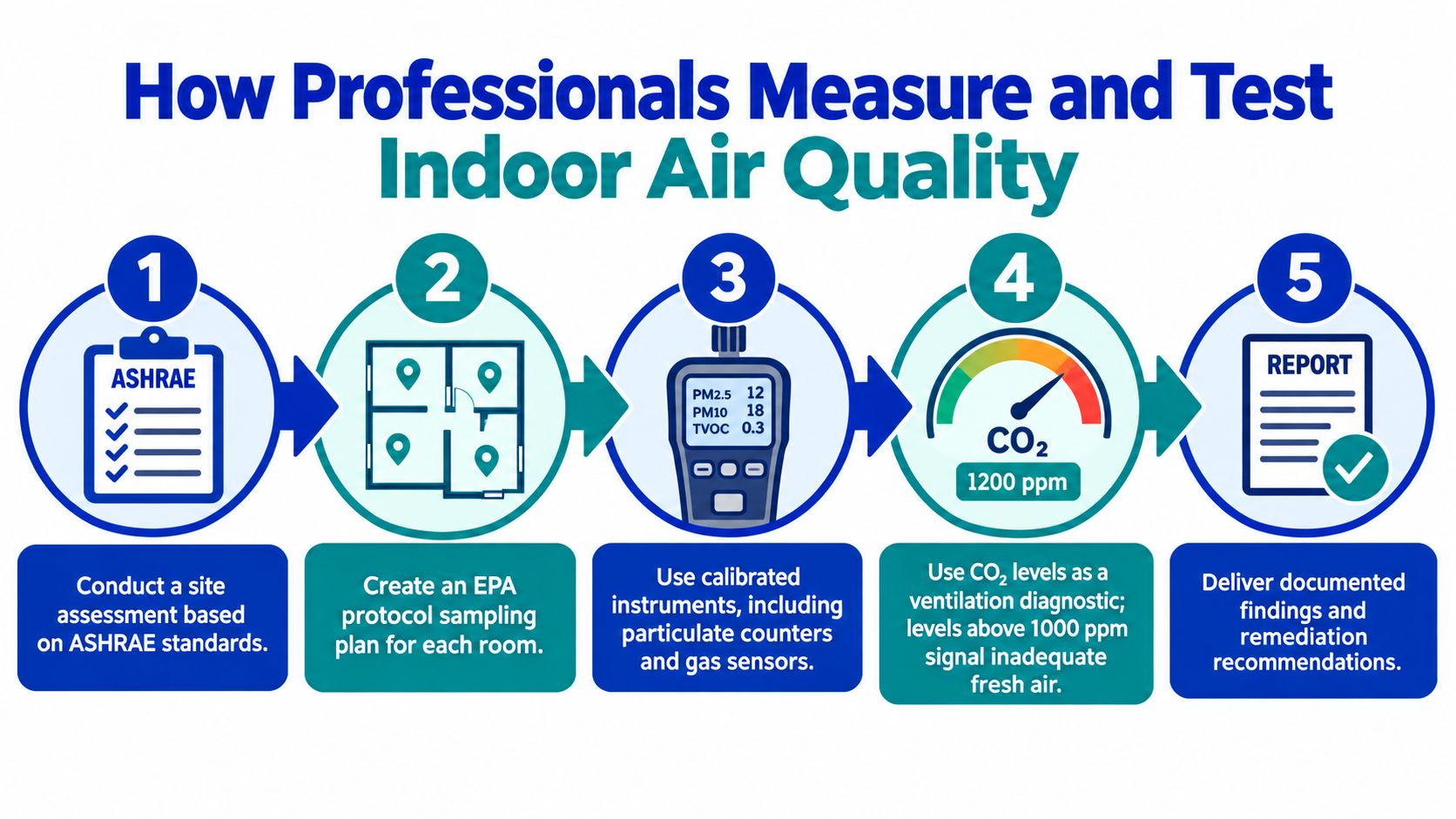
Professional IAQ testing starts with questions, not instruments. The assessor reviews the building's age, use, occupancy, HVAC layout, renovation history, water intrusion, fire or smoke exposure, cleaning practices, odors, reported symptoms, and any previous inspection results. A commercial property may need separate attention for offices, production areas, classrooms, corridors, mechanical rooms, and spaces served by different ventilation systems.
The testing plan should identify what will be measured, where, when, with which instruments, and under what conditions. EPA's indoor air quality testing specification requires a detailed plan before sampling begins, including procedures, timing, instrumentation, and sampling methods. It calls for testing after interior construction is complete and before occupancy when the specification applies. The same document requires at least one sample point per 25,000 square feet for each building portion served by a separate ventilation system, whichever is larger, and says the least-ventilated areas must be included. Samples are collected over three consecutive days, with results averaged for each air-handling zone. EPA's indoor air quality testing specification explains these mechanics in detail.
What the instruments can show
A calibrated direct-reading instrument can measure conditions such as carbon dioxide, temperature, relative humidity, particulate matter, or carbon monoxide during the inspection. CO2 is especially useful as a ventilation diagnostic, because readings that are far above expected conditions can indicate that outdoor air delivery or air exchange needs investigation. CO2 alone cannot identify mold, VOCs, asbestos, lead, or every other indoor pollutant.
Other methods depend on the question. VOC testing may use specialized air sampling and laboratory analysis. Mold-related investigations may include air samples, surface samples, moisture measurements, and visual inspection. Combustion byproduct testing may focus on carbon monoxide, particulate residue, smoke-related contamination, or other compounds associated with a fire or wildfire event.
Why documentation changes the value of testing
A defensible assessment records locations, conditions, instruments, calibration information, sample identifiers, laboratory methods, and chain-of-custody documentation where laboratory samples are collected. The final report should connect the findings to the requested scope instead of presenting unexplained numbers.
A useful report may include:
- Site observations: Areas inspected, visible conditions, odors, moisture indicators, HVAC observations, and occupant concerns.
- Sampling details: Locations, dates, durations, media, instruments, and laboratory methods.
- Results: Detected compounds, particles, biological indicators, or other requested parameters.
- Interpretation: How the findings relate to the building history and the assessment objectives.
- Next steps: Additional inspection, source investigation, maintenance review, compliance documentation, or consultation with qualified professionals.
For a property owner planning an assessment, professional indoor air quality assessment services can provide a useful reference for understanding the scope of a documented investigation.
Professional IAQ Testing Compared to DIY Monitors
A consumer monitor can be helpful, particularly when you want to observe trends. It may track temperature, humidity, carbon dioxide, or basic particulate readings in real time. A smart sensor can show that one room behaves differently from another, that conditions change during occupied hours, or that a ventilation concern appears after a building schedule changes.
That information is useful for forming a question. It isn't the same as identifying a pollutant or producing a professional environmental record.
Comparing the two approaches
| Capability | DIY Monitors | Professional IAQ Testing |
|---|---|---|
| Real-time trend tracking | Often useful for selected readings | Available through calibrated direct-reading instruments |
| Specific VOC identification | Usually unavailable or limited | Can be designed around targeted laboratory analysis |
| Mold evaluation | Doesn't identify a moisture source or confirm a building condition | May combine inspection, moisture review, air sampling, and surface sampling |
| Instrument quality | Varies by device and calibration | Selected and documented for the assessment scope |
| Building interpretation | Requires the owner to interpret the readings | Connects data to sources, ventilation, occupancy, and building history |
| Formal documentation | Usually limited to app records | Can include sample locations, methods, laboratory results, and conclusions |
| Real estate, insurance, or dispute support | Often insufficient by itself | Better suited to decisions requiring a documented assessment |
A DIY monitor may show raised readings, but it usually can't tell you whether the source is cooking, outdoor smoke, a damaged material, a cleaning product, or an HVAC issue. It also generally can't identify specific mold spores, asbestos fibers, lead-based paint hazards, or individual VOCs without specialized sampling and laboratory analysis.
Professional testing becomes more valuable when the result must support a real estate transaction, insurance claim, tenant discussion, lease negotiation, construction decision, or compliance file. Indoor air quality testing equipment and methods offer a useful point of comparison for the difference between general consumer monitoring and a scoped environmental assessment.
A monitor can tell you that a condition changed. A professional investigation helps determine what changed, where to look, and what evidence supports the next decision.
When Property Owners Should Consider Professional Testing
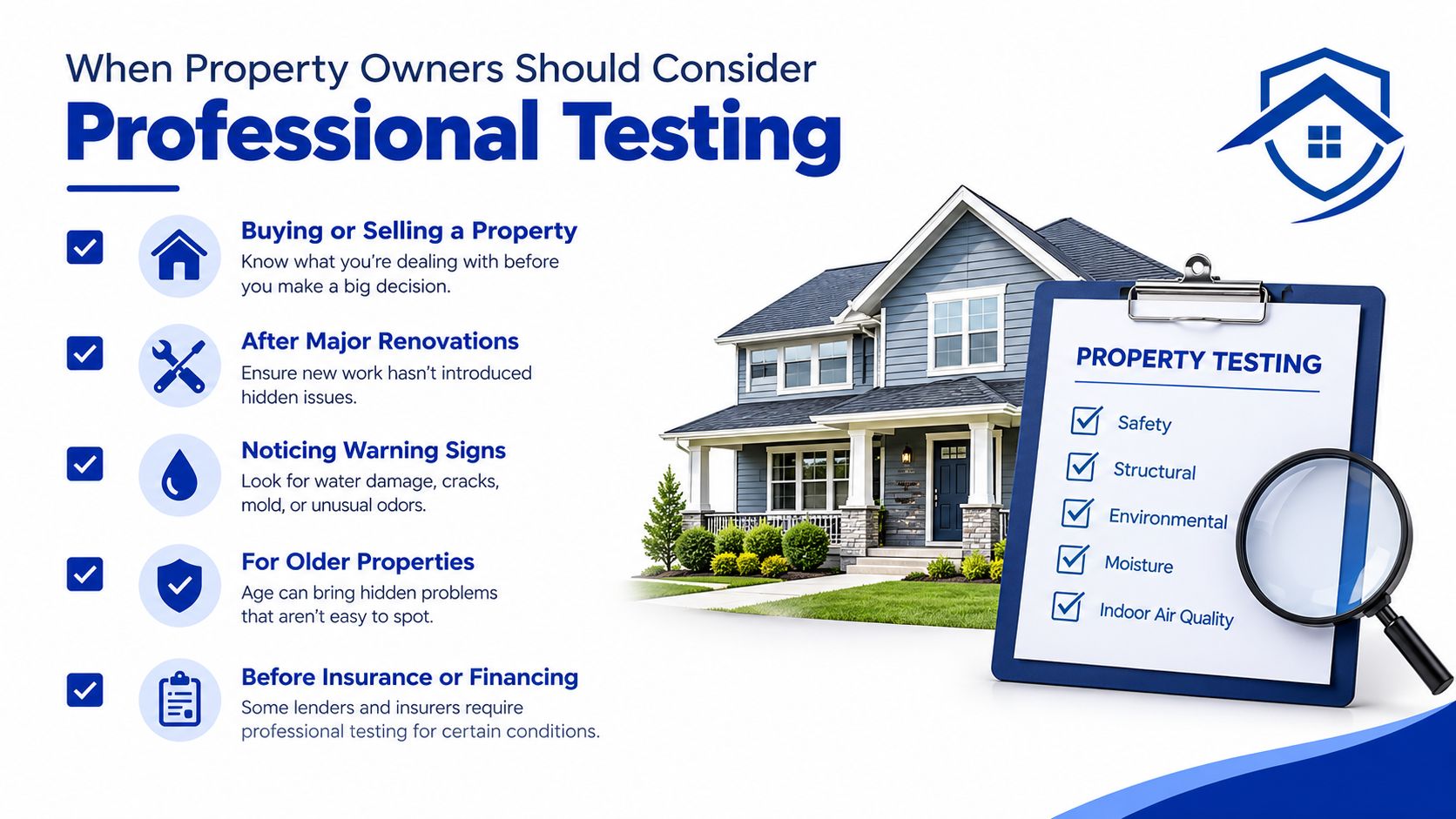
A property owner should consider professional testing when a building concern has a pattern, a potential source, or a decision attached to it. Persistent musty odors, visible mold, water intrusion, unexplained respiratory complaints, renovation dust, chemical odors, or repeated tenant reports all justify a closer look. A single off-the-shelf CO2 reading rarely answers the broader question.
Common triggers for an assessment
- Water damage: Leaks, flooding, damp building materials, or recurring condensation may justify a mold inspection, moisture evaluation, or targeted sampling.
- Renovation or demolition: Dust, odors, disturbed materials, and older finishes may require asbestos or lead testing before work proceeds.
- Fire or wildfire exposure: Ash, soot, char, smoke residue, heavy metals, and combustion byproducts may require post-fire environmental assessment and laboratory analysis.
- Occupant complaints: Repeated reports tied to a room, floor, work shift, HVAC cycle, or cleaning schedule can help define an industrial hygiene investigation.
- Real estate activity: Buyers, sellers, lenders, insurers, and property managers may need written environmental documentation rather than informal observations.
- Commercial operations: Manufacturing, maintenance, laboratories, kitchens, schools, healthcare facilities, and warehouses may need a broader review of process emissions, ventilation, and worker exposure conditions.
Los Angeles properties also present varied assessment conditions. Wildfire smoke can enter through openings or ventilation systems. Coastal communities such as Venice and Long Beach may experience different moisture and ventilation concerns from inland properties. Older buildings in Pasadena, Echo Park, and Inglewood may have aging ductwork, past renovations, or materials that warrant asbestos or lead evaluation before disturbance.
Related testing may be necessary
IAQ testing sometimes identifies a need for a related service rather than a standalone air sample. A water-damaged property may require mold inspection and sampling. A pre-renovation project may require asbestos surveys or lead-based paint inspections. A fire-damaged structure may need combustion byproduct testing for ash, soot, char, smoke residue, or heavy metals.
California asbestos requirements can also affect project documentation. Under California Rule 1403 guidance, certain asbestos disturbances, demolitions, site cleanups, and damaged Class II nonfriable asbestos conditions require specific procedures, including a Procedure 5 Approved Alternative in applicable circumstances. A positive environmental result doesn't automatically dictate one particular response. It gives the owner, contractor, consultant, insurer, or other qualified professional evidence for determining the appropriate next step.
For owners weighing the scope of an assessment, indoor air quality testing cost factors can help explain why project size, sampling objectives, laboratory methods, access, and reporting needs affect the evaluation.
Key Takeaways and Next Steps for Los Angeles Property Owners
IAQ isn't a single number and it isn't limited to mold or carbon dioxide. It represents a layered assessment of pollutant sources, ventilation, temperature, humidity, particles, gases, odors, and occupant conditions. The right testing scope depends on what happened in the building and what decision the results need to support.
Source control remains central. If a property has a moisture problem, an assessor needs to investigate affected materials and moisture patterns. If occupants report chemical odors after renovation, VOC sampling and a review of paints, adhesives, flooring, and cleaning products may be more useful than a general air screen. If a fire or wildfire affected the property, ash, soot, char, smoke residue, heavy metals, and combustion byproducts may require targeted environmental testing.
Professional testing also differs from placing a consumer monitor in a room. A defensible assessment uses a defined plan, appropriate instruments, documented sampling locations, laboratory analysis where needed, and a report that explains the findings in relation to the building. That documentation can support decisions involving property transactions, insurance, construction planning, tenant concerns, industrial hygiene, and regulatory requirements.
For homeowners, landlords, property managers, contractors, developers, facility managers, schools, healthcare facilities, and commercial tenants in Los Angeles County, Orange County, and Southern California, the next step is to define the concern before choosing the test. Note the affected areas, timing, odors, visible conditions, recent work, water or fire history, HVAC operation, and occupant complaints. Then request an assessment designed around those facts rather than a generic package.
Sensitive Environmental provides professional indoor air quality testing, mold inspections and sampling, VOC and airborne contaminant testing, industrial hygiene assessments, asbestos and lead testing, and post-fire environmental assessments in Los Angeles and Southern California. Visit Sensitive Environmental to discuss the building conditions, sampling needs, and documentation required for your property.