A tenant reports headaches after a renovation. A school administrator sees classrooms becoming stuffy by midday. A property manager notices smoke odor and higher particle readings after a wildfire event. In each case, the first mistake is usually the same: searching for one universal indoor air quality number that proves a building is acceptable.
Indoor air quality requirements are not one pass/fail threshold. They combine source control, outdoor-air ventilation, filtration, exhaust, contaminant-specific testing, and documentation. For a Los Angeles property owner, the practical question isn't only whether a building meets a ventilation standard. It's whether the right hazard was identified, the sampling method matched the question, and the resulting report can support a defensible decision.
Table of Contents
- What Indoor Air Quality Requirements Cover
- The ASHRAE Foundation from 1973 to Standard 62.1-2022
- Federal State and Local Layers in Southern California
- Ventilation Rates Exhaust and Air Distribution
- Comparing Concentration Benchmarks Across Agencies
- Common Contaminants and Their Measurement Targets
- Wildfire Smoke and the Ventilation Trade-Off
- Post-Construction and Pre-Occupancy Testing Protocol
- How IAQ Testing Connects to Asbestos Lead and Mold Work
- Documentation Chain of Custody and Reporting Essentials
- Quick Reference Matrix by Building Type and Scenario
- Next Steps and When to Schedule Professional IAQ Testing
What Indoor Air Quality Requirements Cover
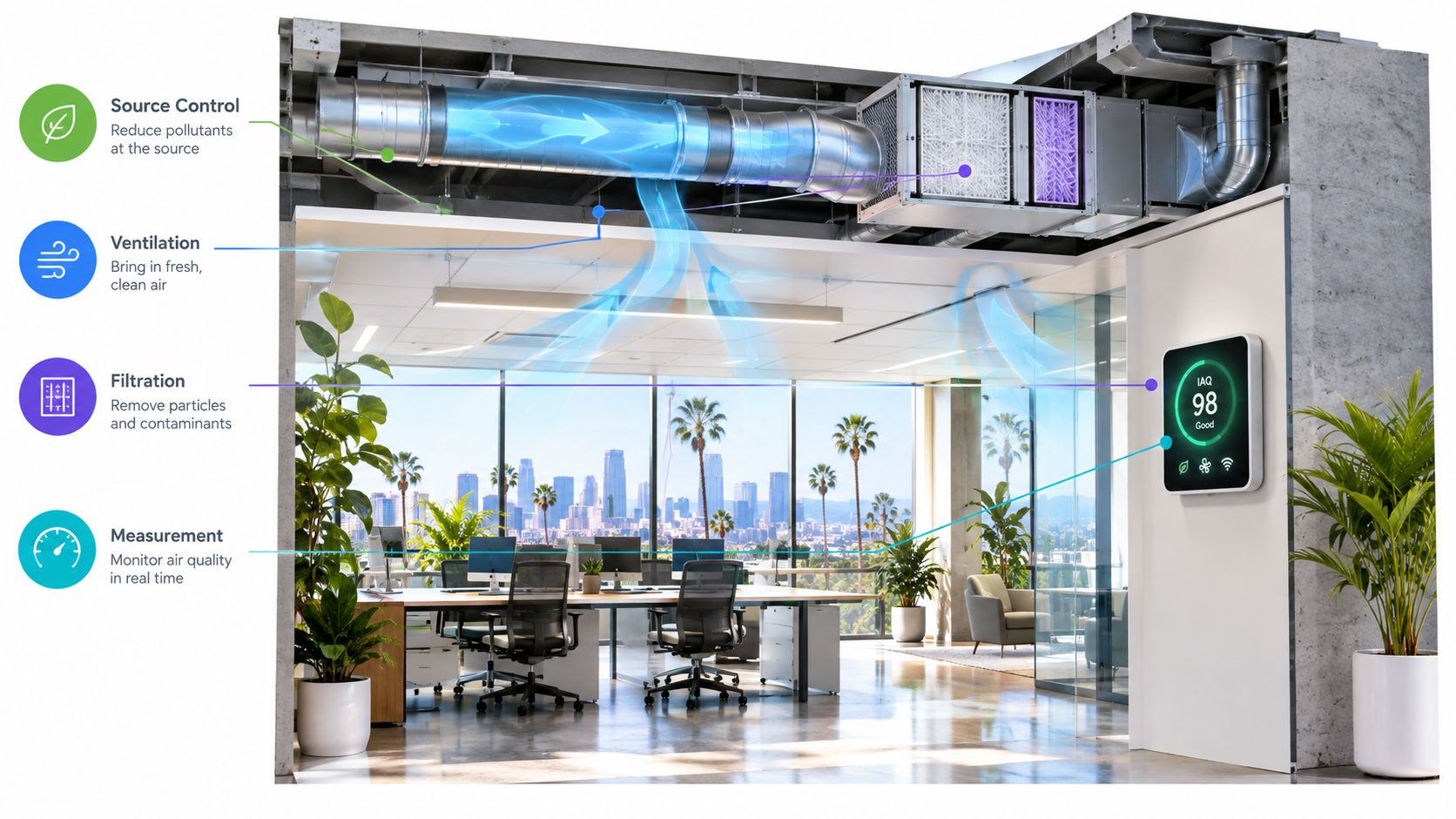
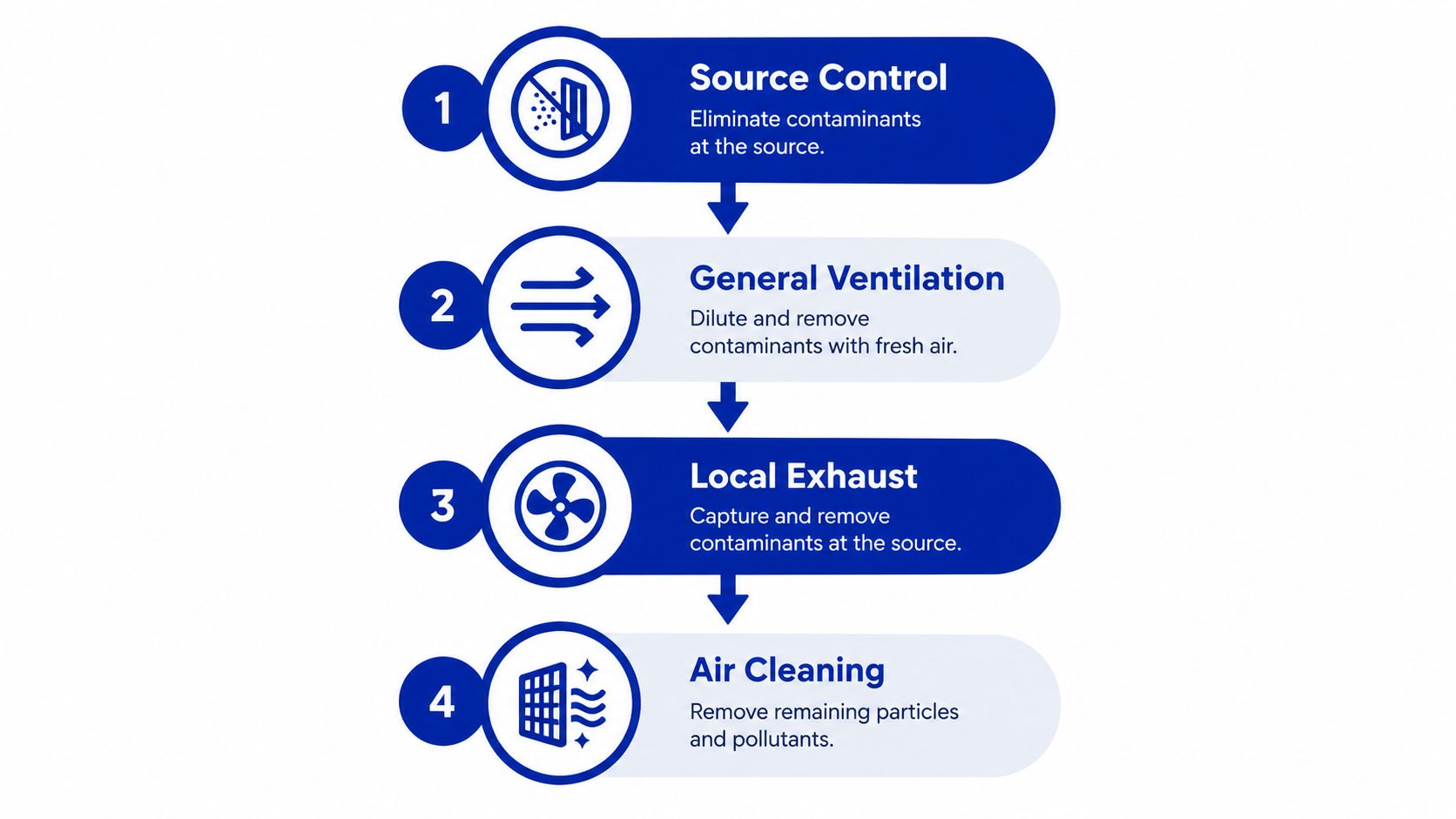
A defensible IAQ program has four connected layers, and each addresses a different decision. Start with source control: select lower-emission materials, prevent moisture intrusion, maintain combustion equipment, control construction dust, and keep chemical products out of occupied areas. Removing a contaminant before it spreads is more reliable than depending on filtration afterward.
The second layer is general ventilation. ASHRAE Standard 62.1 covers ventilation and air-cleaning-system design, installation, commissioning, operation, and maintenance. It is not a requirement to open windows. For mechanically ventilated classrooms, EPA guidance identifies at least 15 cubic feet per minute of outdoor air per occupant as a design value. EPA school IAQ guidance places ventilation, filtration, source control, and maintenance within the same operating program.
The third layer is local exhaust. Restrooms, kitchens, janitor closets, trash rooms, and other pollutant-generating spaces need exhaust that limits migration into occupied areas. A supply-air calculation cannot correct a failed exhaust fan.
The fourth layer is verification. CO2 can indicate occupant-related ventilation conditions. PM2.5, VOCs, formaldehyde, carbon monoxide, mold-related particles, asbestos fibers, lead dust, and combustion byproducts require different sampling methods and interpretations. Select the test from the property type, suspected hazard, and decision that the report must support.
Routine cleaning supports source control by reducing settled dust and residues. The Canes Cleaners indoor air guide offers a household perspective, but cleaning does not replace professional sampling after water damage, renovation, smoke intrusion, or persistent complaints. Property managers can review Sensitive Environmental's air quality resources before defining the assessment scope.
The ASHRAE Foundation from 1973 to Standard 62.1-2022
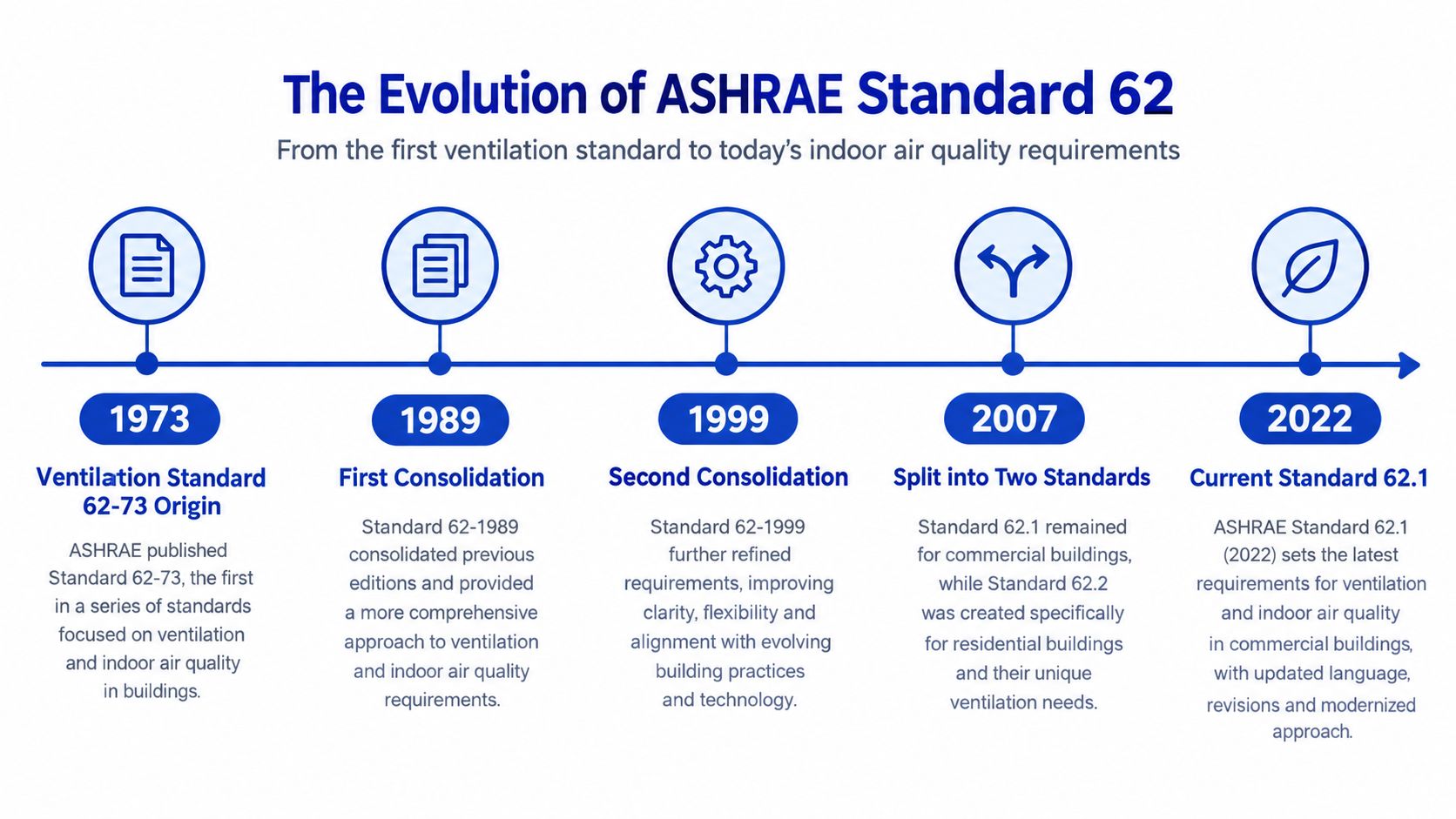
ASHRAE's framework began in 1973, when the standard was published as Standards for Natural and Mechanical Ventilation. It later evolved into Standard 62.1, Ventilation for Acceptable Indoor Air Quality, and became a principal reference for nonresidential buildings. ASHRAE's historical standard document shows why the framework is broader than a fresh-air target.
The current approach considers chemical, physical, and biological contaminants, outdoor-air quality, construction processes, moisture, biological growth, filtration, air cleaning, controls, commissioning, operation, and maintenance. That matters in Southern California because a building can receive outdoor air while still allowing smoke particles, moisture-related contamination, or construction emissions to circulate.
Standard 62.1-2022 applies to commercial, institutional, and other nonresidential buildings. Its ventilation-rate procedure considers occupancy category, people density, floor area, and zone conditions when determining required breathing-zone outdoor airflow. It also establishes separate minimum exhaust requirements for spaces that generate pollutants. The applicable edition, locally adopted code, and project specification must be verified before anyone labels a condition compliant. ASHRAE's 62.1-2022 document also distinguishes nonresidential spaces from dwelling-unit areas that may fall under a separate residential standard or code analysis.
Practical rule: Treat ASHRAE 62.1 as a design and operations framework, not as proof that every pollutant in a building has been controlled.
For Los Angeles owners, an IAQ assessment should therefore document outdoor-air delivery, supply and return balance, exhaust operation, filtration, controls, maintenance, occupancy, and contaminant measurements where the scenario warrants them.
Federal State and Local Layers in Southern California
No single agency controls every IAQ question. Federal agencies, California regulators, local building departments, air districts, and project specifications address different hazards and use different enforcement mechanisms.
EPA guidance helps building owners interpret ventilation, filtration, exposure benchmarks, schools, construction testing, and wildfire smoke response. OSHA addresses workplace exposures, including asbestos and lead, through enforceable occupational limits. WHO guidelines provide health-based reference values, but they aren't universal building-code pass or fail limits.
California and local requirements can add project-specific obligations. The South Coast Air Quality Management District may become central during asbestos work, construction, demolition, architectural-coating decisions, and combustion-related investigations. Local requirements also vary by jurisdiction and adopted code. A Los Angeles project shouldn't be evaluated using an assumption that applies only to another Southern California city.
| Authority | Primary instrument | What it controls | Applies where |
|---|---|---|---|
| EPA | Guidance, environmental benchmarks, construction specifications | Schools, construction IAQ, outdoor pollutants, smoke response | Federal programs and specified projects |
| OSHA | Workplace exposure limits | Asbestos, lead, and occupational exposures | Covered workplaces |
| WHO | Global Air Quality Guidelines | Health-based reference levels for major pollutants | Reference context, not universal code enforcement |
| California agencies | State codes, occupational rules, and product requirements | Building operation, worker exposure, materials, and construction | California projects, subject to applicable rule |
| South Coast AQMD | Air-district rules and compliance programs | Air emissions, asbestos-related work, and regional air-quality matters | South Coast jurisdiction |
| Local jurisdictions | Adopted codes and project conditions | Permitting, construction, and building-specific obligations | City or county property |
A credible compliance assessment identifies the authority, edition, occupancy, exposure period, and enforcement context before comparing laboratory results.
Ventilation Rates Exhaust and Air Distribution
A ventilation number is meaningful only when tied to the occupied zone. Standard 62.1-2022 uses occupancy category, people density, floor area, and zone conditions to determine required breathing-zone outdoor airflow. It also requires separate attention to exhaust from pollutant-generating spaces.
The rate table below is deliberately qualitative. The exact cfm values depend on the applicable occupancy category and edition, and inventing a number for a conference room, classroom, restaurant, or office would make the assessment less defensible.
| Occupancy category | People outdoor air rate | Area outdoor air rate | Exhaust rate |
|---|---|---|---|
| Office or conference space | Verify in the applicable 62.1 table | Verify by zone and floor area | Separate exhaust requirements may apply |
| Classroom | EPA identifies at least 15 cfm per occupant for mechanically ventilated classrooms | Confirm by applicable design method | Verify classroom and support-space exhaust |
| Retail | Use the applicable occupancy category | Calculate from zone conditions | Verify restrooms and service areas |
| Restaurant | Use the applicable occupancy category | Calculate from zone conditions | Kitchen and food-service exhaust require separate review |
A 2,000-square-foot Los Angeles office with 40 occupants cannot be assigned a reliable final cfm figure from floor area and headcount alone. The assessor still needs the occupancy category, breathing-zone conditions, system design, outdoor-air delivery, zone configuration, and applicable diversity calculation. The correct workflow is to calculate the design requirement, measure or verify actual delivery, inspect diffuser and return performance, and compare the result with the governing edition and adopted code.
Supply air can meet a design calculation while occupied areas remain poorly served. Blocked diffusers, failed controls, short-circuiting between supply and return, closed dampers, and unbalanced exhaust can defeat the intended design.
For a plain-language overview of HVAC-related biological concerns, property managers can review this guide to protecting your family from AC germs. It shouldn't replace an engineering review or laboratory assessment when occupants report symptoms, odors, visible growth, or contamination.
Comparing Concentration Benchmarks Across Agencies
A Los Angeles office, school, and industrial workspace should not be judged against one universal “safe” indoor number. Each benchmark answers a different question: health protection, outdoor-air quality, worker exposure, or project acceptance. Match the benchmark to the property type, the scenario, and the trigger for testing. The averaging period matters as much as the concentration.
For carbon monoxide, the EPA National Ambient Air Quality Standards use 9 ppm over 8 hours and 35 ppm over 1 hour. For PM10, the same ambient-air framework uses 50 micrograms per cubic meter as an annual average and 150 micrograms per cubic meter over 24 hours. EPA's National Ambient Air Quality Standards table provides the applicable EPA values. OSHA and NIOSH references answer a different question, focused on workplace exposure and recommended occupational controls, so they should not be presented as indoor-air pass or fail limits for every building.
WHO's 2021 guidelines identify 5 micrograms per cubic meter as an annual mean and 15 micrograms per cubic meter as a 24-hour mean for PM2.5. These are health-protection benchmarks, not universal indoor acceptance limits. WHO's air-quality guideline announcement supports comparing the result with source control, filtration, and ventilation performance.
| Strain or measure | OSHA | NIOSH | EPA NAAQS | WHO guideline |
|---|---|---|---|---|
| Carbon monoxide | Occupational exposure comparison | Occupational recommendation | 9 ppm over 8 hours and 35 ppm over 1 hour | Health-based global guidance |
| PM2.5 | No universal indoor limit stated here | No universal limit stated here | Use applicable ambient-air context | 5 µg/m³ annual mean and 15 µg/m³ 24-hour mean |
| PM10 | No universal indoor limit stated here | No universal limit stated here | 50 µg/m³ annual and 150 µg/m³ 24-hour benchmarks | Guideline depends on averaging period |
The report must identify the selected benchmark, its averaging period, and the reason it fits the property and testing trigger. A short-term reading cannot be compared casually with an annual average. Where no enforceable indoor limit applies, document the professional judgment, source-control actions, and follow-up threshold instead of inventing a pass or fail number.
Common Contaminants and Their Measurement Targets
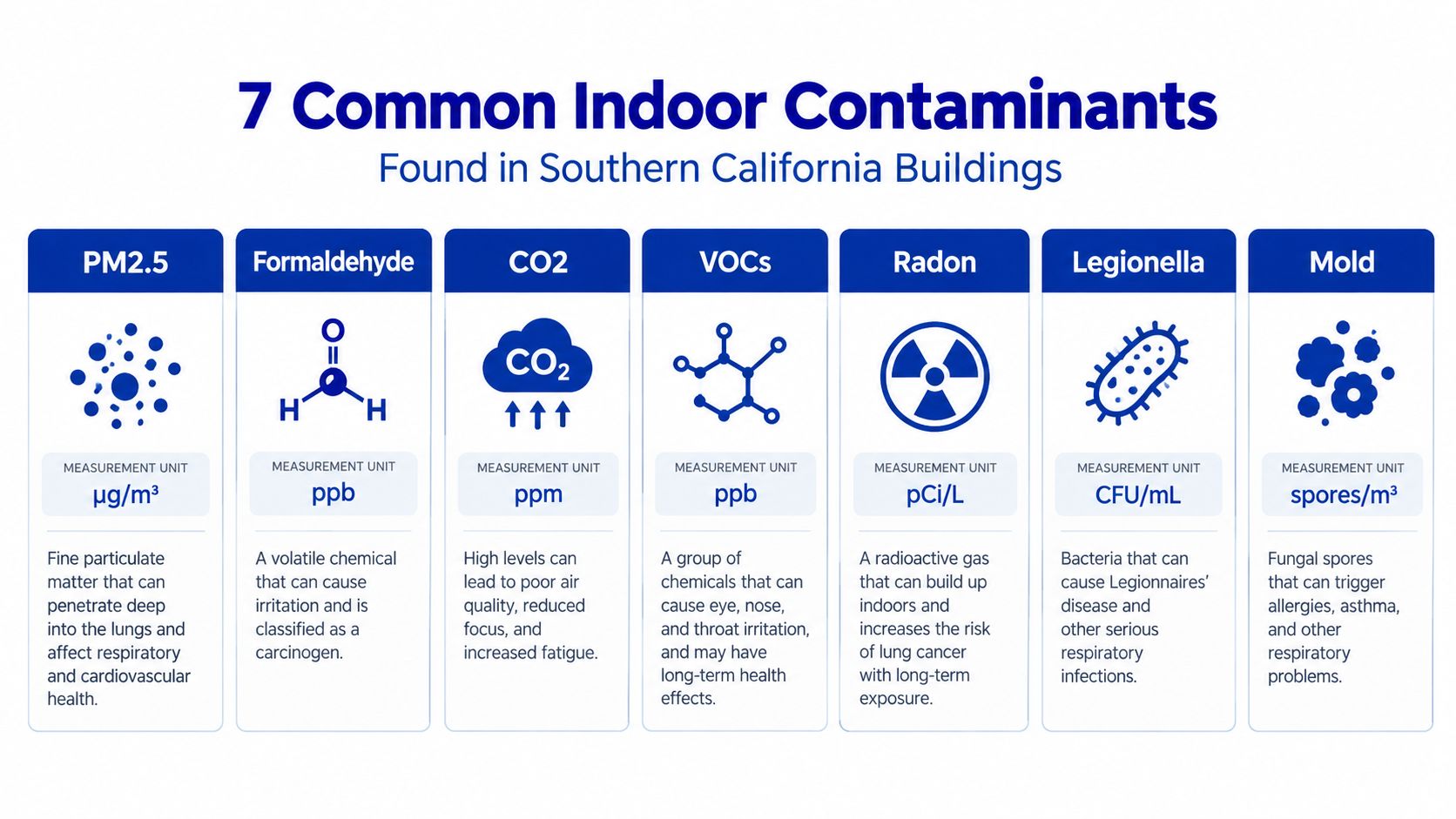
Each contaminant requires its own sampling logic. A handheld IAQ meter may screen CO2 and particles, but it can't answer an asbestos, lead, VOC, formaldehyde, radon, or mold question.
PM2.5 may be evaluated with direct-reading optical instruments or laboratory methods, depending on the purpose. The report should identify the instrument, calibration status, location, occupancy, HVAC condition, and sampling duration.
VOCs and formaldehyde need compound-specific planning. Sorbent tubes, DNPH cartridges, or other media may be selected for laboratory analysis, with indoor and outdoor conditions documented. EPA states that no federally enforceable VOC concentration standards exist for non-industrial indoor environments, so one universal VOC pass or fail limit shouldn't be invented. EPA's VOC guidance explains why product-emission testing and post-occupancy air sampling answer different questions.
CO2 is primarily a ventilation indicator. It can show that occupant-generated air isn't being diluted effectively, but a low CO2 result doesn't prove that wildfire particles, formaldehyde, mold-related particles, or other pollutants are controlled.
Carbon monoxide requires a different risk assessment because combustion sources can create urgent exposure concerns. Radon, where relevant, needs a protocol suited to long-term exposure rather than a quick snapshot. Biological sampling may include airborne mold spore sampling, but there is no universal federal mold threshold. Interpretation depends on building history, moisture mapping, indoor and outdoor comparison, species or structures observed, and the complaint.
Wildfire Smoke and the Ventilation Trade-Off
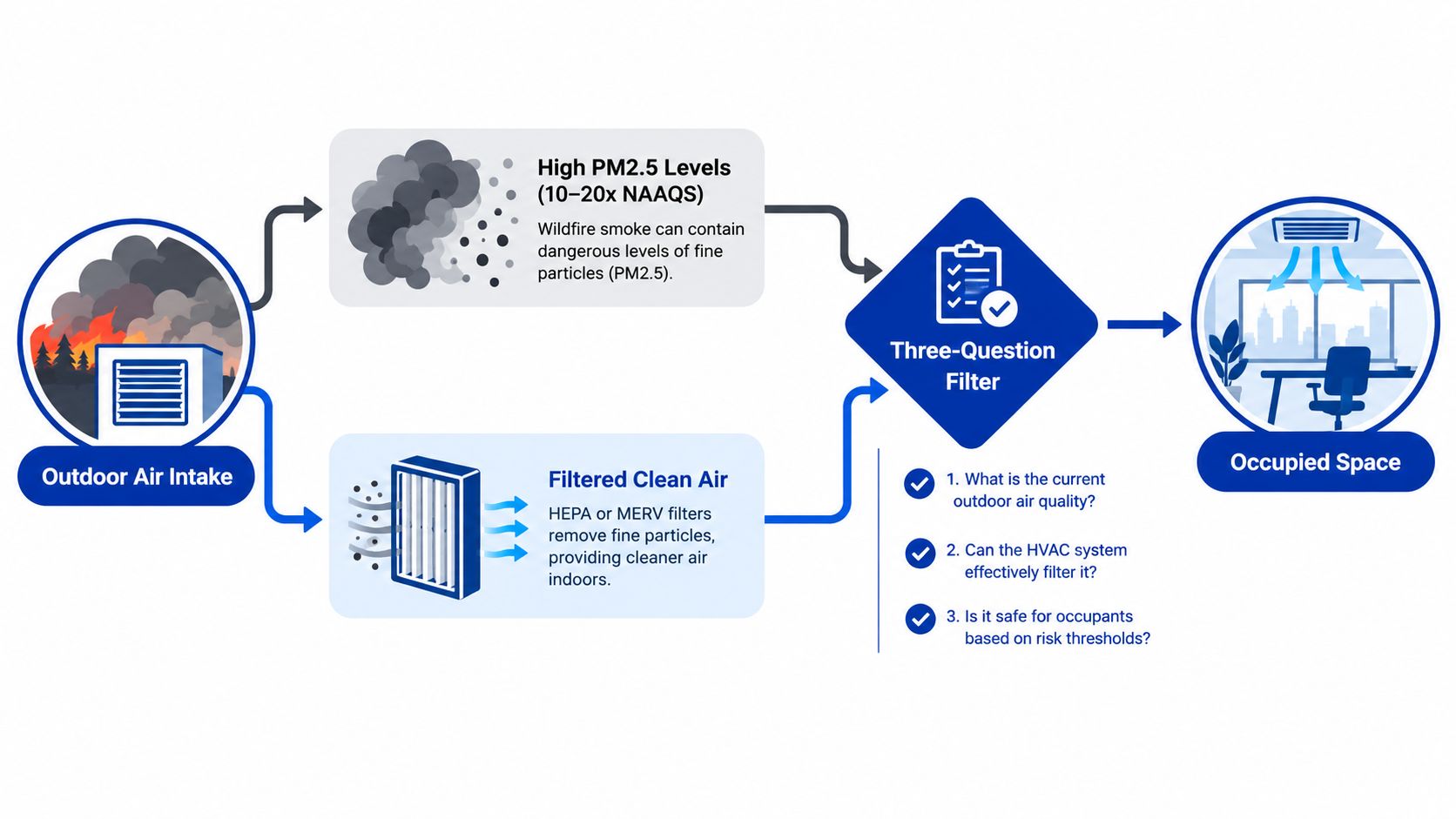
Increasing outdoor air isn't always the correct immediate response. During wildfire smoke, outdoor PM2.5 can be worse than indoor air, so opening dampers or increasing intake may increase occupant exposure. EPA's smoke guidance addresses HVAC operation, envelope leakage, portable air cleaners, and indoor sensor data, which is why a normal ventilation checklist isn't enough for smoke-mode decisions. EPA's 2025 wildfire smoke guidance should be part of the building's emergency planning file.
Use three questions:
- What are current outdoor conditions? Review official air-quality information and confirm indoor PM2.5 with appropriately placed sensors.
- What can the HVAC system do? Verify filtration, fan capacity, outdoor-air dampers, controls, pressure, and recirculation.
- Who occupies the space? Schools, healthcare spaces, apartments, and offices may require different communication and operating decisions.
Smoke-mode planning should verify higher-efficiency filtration where the equipment can support it, limit uncontrolled infiltration, manage doors and vestibules, inspect filter fit, and use portable air cleaners when appropriate. Don't disable outdoor air blindly. The decision should be documented by a qualified professional who considers combustion safety, pressure, equipment limitations, occupancy, and measured particle conditions.
Schools need clear parent and staff communication. Offices need tenant instructions that distinguish odor from measured particle conditions. Multifamily managers should document common-area readings, HVAC status, filter changes, and complaints. A fire and smoke environmental assessment resource can help property teams understand where testing fits after ash, soot, char, smoke residue, or combustion byproducts enter a building.
Post-Construction and Pre-Occupancy Testing Protocol
Post-construction IAQ testing should be planned before the contractor closes out the work. EPA construction specifications call for sampling in the breathing zone, 3 to 6 feet above the finished floor, for a minimum four-hour period during normal occupied hours. Samples are collected on three consecutive days, and each three-day cycle is averaged for compliance. EPA's construction specification also calls for outdoor formaldehyde and total VOC samples at three outdoor locations for comparison.
The specification identifies formaldehyde below 20 micrograms per cubic meter, equivalent to 16.3 parts per billion, and total VOCs below 200 micrograms per cubic meter. These are project-specification targets, not universal indoor limits for every building.
| Contaminant | Target concentration | Sampling method | Duration |
|---|---|---|---|
| Formaldehyde | Less than 20 µg/m³, or 16.3 ppb | Laboratory air sampling with outdoor comparison | Four-hour minimum sampling period, three consecutive days |
| Total VOCs | Less than 200 µg/m³ | Laboratory air sampling with outdoor comparison | Four-hour minimum sampling period, three consecutive days |
| Other project contaminants | Defined by project specification | Method selected for contaminant | Set by sampling plan |
A defensible protocol includes HVAC verification, normal operating conditions, documented sample locations, field records, laboratory qualifications, and review of construction materials. Routine occupied-building screening is different. It may investigate a complaint or trend, while pre-occupancy testing documents whether construction-related emissions and operating conditions meet the specified acceptance criteria.
How IAQ Testing Connects to Asbestos Lead and Mold Work
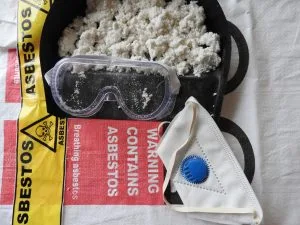
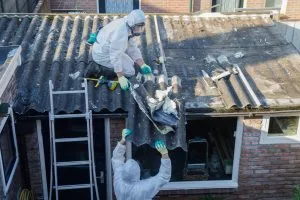
An IAQ complaint often identifies a symptom, not a contaminant. Renovation can disturb asbestos-containing materials or lead-based paint. Water intrusion can create a moisture and mold investigation. Fire damage can introduce ash, soot, char, smoke residue, heavy metals, and other combustion byproducts.
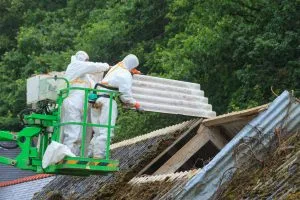
The correct scope depends on the building history and the activity. A pre-renovation or pre-demolition asbestos survey may be needed before disturbance. In the South Coast region, asbestos testing and documentation may also relate to SCAQMD Rule 1403, Notices to Comply, AQMD requirements, or Procedure 5. Lead testing may require surface, dust, paint, or personal exposure sampling selected for the property and work activity.
Laboratory results don't automatically dictate remediation or abatement. They establish what was found, where it was found, how much was present, and whether the result can be compared with an applicable requirement. A qualified consultant, contractor, building owner, and regulator then determine the appropriate next step.
Mold sampling should be paired with moisture inspection when complaints or visible growth appear. Air samples alone can't explain the source of a water problem, and a negative sample doesn't erase visible damage or building history.
Documentation Chain of Custody and Reporting Essentials
A report is only useful if another professional can understand how the result was produced. The file should connect the field observation, sample identification, laboratory receipt, analytical method, result, benchmark, and recommendation.
Expect the following:
- Chain of custody: Seals, sample IDs, collection times, laboratory receipt, and signatures should be traceable.
- Analytical method: The report should identify the method selected for the contaminant and project question, rather than using a vague label such as “air test.”
- Field conditions: Record temperature, relative humidity, occupancy, HVAC status, odors, visible conditions, and unusual activities.
- Quality control: Include applicable blanks, duplicates, calibration information, detection limits, and laboratory qualifications.
- Final deliverable: Request a signed PDF with floor plans or sample locations, results, comparison criteria, limitations, and clear recommendations.
EPA methods, OSHA methods, NIOSH methods, and asbestos-specific analytical procedures may all appear in environmental work, but the method must match the contaminant and sample type. A property manager should reject a report that presents a dashboard screenshot without location, duration, calibration, operating conditions, or interpretation.
A defensible report doesn't just state what the instrument displayed. It explains what was sampled, how it was analyzed, and what decision the result supports.
Quick Reference Matrix by Building Type and Scenario
The matrix below is a starting scope, not a substitute for professional judgment. A complaint, renovation, water event, smoke intrusion, or regulatory inquiry can expand the investigation beyond routine screening.
| Property type | Scenario | Screening measurements | Laboratory analyses | Governing standard |
|---|---|---|---|---|
| Class A office | Tenant complaint | CO2, PM2.5, temperature, humidity, HVAC review | VOCs, formaldehyde, mold or combustion residues when indicated | Applicable ASHRAE edition and project requirements |
| K-12 school | Classroom concern | CO2, PM2.5, temperature, humidity, ventilation review | VOCs, formaldehyde, mold, asbestos, or lead when triggered | EPA school guidance and applicable code |
| Medical outpatient | Odor or renovation | PM2.5, CO2, pressure, temperature, humidity | VOCs, formaldehyde, asbestos, lead, or biological hazards as indicated | Project specification and applicable workplace rules |
| Retail | Smoke intrusion | PM2.5, HVAC status, temperature, humidity | Ash, soot, char, smoke residue, or VOCs when indicated | Applicable building and air-district requirements |
| Multifamily apartment | Water intrusion | Temperature, humidity, moisture conditions, PM2.5 | Mold-related sampling, asbestos, lead, or VOCs based on building history | Residential code and project requirements |
| Warehouse | Worker exposure | CO, PM2.5, temperature, ventilation, task review | Lead, asbestos, VOCs, or combustion byproducts when indicated | OSHA and applicable California workplace requirements |
| Restaurant | Odor or exhaust complaint | CO, PM2.5, ventilation, pressure, temperature | Combustion-related contaminants or VOCs when indicated | Applicable ventilation, health, and workplace requirements |
For every scenario, document the trigger first. “IAQ testing” is too broad to be a sufficient scope of work.
Next Steps and When to Schedule Professional IAQ Testing
Schedule professional testing when complaints persist, a renovation or demolition is planned, new construction is approaching occupancy, wildfire smoke has entered the building, a transaction requires documentation, an agency has issued a citation, or an insurer requests evidence. The same applies when a property manager needs to distinguish a ventilation problem from mold, asbestos, lead, VOC, combustion, or fire-residue contamination.
A qualified engagement in Los Angeles, Orange, Riverside, San Bernardino, Ventura, or San Diego County should begin with a written scope letter and sampling plan. It should identify the building areas, contaminants, methods, duration, operating conditions, laboratory qualifications, reporting format, and expected turnaround. For projects requiring formal laboratory evidence, specify an AIHA-LAP accredited laboratory when appropriate to the analytical scope.
Use professional indoor air quality testing in Los Angeles when a decision depends on more than a handheld reading. The assessment should produce actionable documentation for property management, construction planning, insurance, tenant communication, regulatory review, or real-estate due diligence.
Indoor air quality requirements work best as a recurring verification process, not a one-time reaction. Measure the condition that matters, use the correct laboratory method, and preserve the records needed to explain the decision later.
Sensitive Environmental provides professional IAQ testing, contaminant sampling, laboratory analysis, and environmental inspection services for Los Angeles and Southern California properties. Contact Sensitive Environmental to discuss a written indoor air quality testing scope for complaints, renovation, wildfire smoke, water damage, construction closeout, or compliance documentation.