A $150 smart monitor won't give a Los Angeles property owner a complete picture of indoor air quality. It may show a useful trend, such as rising carbon dioxide during a crowded meeting, but it won't establish whether a building contains asbestos fibers, lead dust, mold contamination, combustion byproducts, or a specific volatile organic compound. A green dashboard can coexist with a serious environmental problem.
The right question isn't which indoor air quality equipment to buy. It's whether the equipment is suitable for screening, trend tracking, investigation, compliance documentation, or laboratory analysis. Those are different purposes, and confusing them can create bad decisions during a renovation, real estate transaction, tenant dispute, insurance claim, or post-fire assessment.
For Los Angeles homeowners, property managers, contractors, developers, schools, healthcare facilities, and commercial operators, consumer equipment has a limited but legitimate role. Use it to notice changes. Use professional environmental testing when you need to identify a contaminant, document conditions, evaluate a complaint, or support a defensible decision.
Table of Contents
- The Hidden Limits of Consumer Air Monitors
- Comparing Types of Indoor Air Quality Equipment
- Why Low-Cost Sensors Fall Short for Compliance
- When to Use Monitors Versus Professional Testing
- Integrating IAQ with Broader Environmental Assessments
- Selecting Professional Environmental Testing in Los Angeles
- Common Questions About Air Quality Equipment and Testing
The Hidden Limits of Consumer Air Monitors
A consumer monitor can show that conditions changed. It cannot, by itself, establish what caused the change or whether a property meets a professional or regulatory requirement. Use it for room-level awareness, not as an environmental clearance instrument.
These devices can track selected readings after cooking, cleaning, occupancy changes, or ventilation adjustments. That information helps property owners and facility managers identify patterns and decide when to investigate. It does not replace a defined sampling plan for a real estate transaction, tenant complaint, renovation, or health investigation.
The main problem is incomplete coverage. Low-cost particle sensors may miss portions of the indoor particle range, including particles below 0.3 µm and larger dust particles above 1 µm. Gas sensors can also experience cross-interference and weak sensitivity for some VOC and NO2 targets, as described in the Lawrence Berkeley National Laboratory assessment of low-cost environmental monitors.
What a dashboard can't establish
A displayed value depends on the sensor's design, placement, calibration, operating conditions, and target pollutant. It cannot automatically answer four questions:
- What is present: A particle reading does not identify asbestos, lead, ash, soot, or biological material.
- Where it came from: A change may reflect outdoor air, occupant activity, HVAC operation, construction dust, or a concealed source.
- Whether it violates a requirement: A consumer reading is not automatically suitable for a regulatory threshold, lease dispute, insurance file, or legal record.
- What action is appropriate: A high reading may justify investigation, but it does not determine remediation, abatement, containment, or clearance requirements.
Property owners comparing consumer options may encounter an air quality monitor for Living Air. Such a device can support general awareness. Read its specifications narrowly: a monitor that measures selected particles or gases does not measure every hazard in a building.
Practical rule: Treat a consumer monitor as an alarm for changing conditions, not as proof that a property is compliant or safe.
After water damage, fire, smoke intrusion, unusual odors, renovation, demolition, or occupant complaints, commission a defined inspection and sampling strategy. Depending on the concern, that work may include mold sampling, VOC testing, airborne contaminant testing, combustion byproduct testing, asbestos inspection, lead testing, or a broader industrial hygiene assessment. For Southern California properties, defensible results require the right method, locations, documentation, and laboratory or field analysis, not merely a reassuring dashboard.
Comparing Types of Indoor Air Quality Equipment
The market includes devices built for convenience, instruments designed for field investigation, and systems intended to change building conditions. They shouldn't be evaluated as if they perform the same job. The broader U.S. indoor air quality market was reported at $7.8 billion in 2015, increased to $8.3 billion in 2016, and was forecast to reach $10.8 billion by 2021, reflecting a 5.3% CAGR according to BCC Research's U.S. indoor air quality market analysis. That market includes sensing and filtration equipment, not just professional testing instruments.
IAQ Equipment Capabilities and Limitations
| Equipment Type | Primary Function | Key Limitation |
|---|---|---|
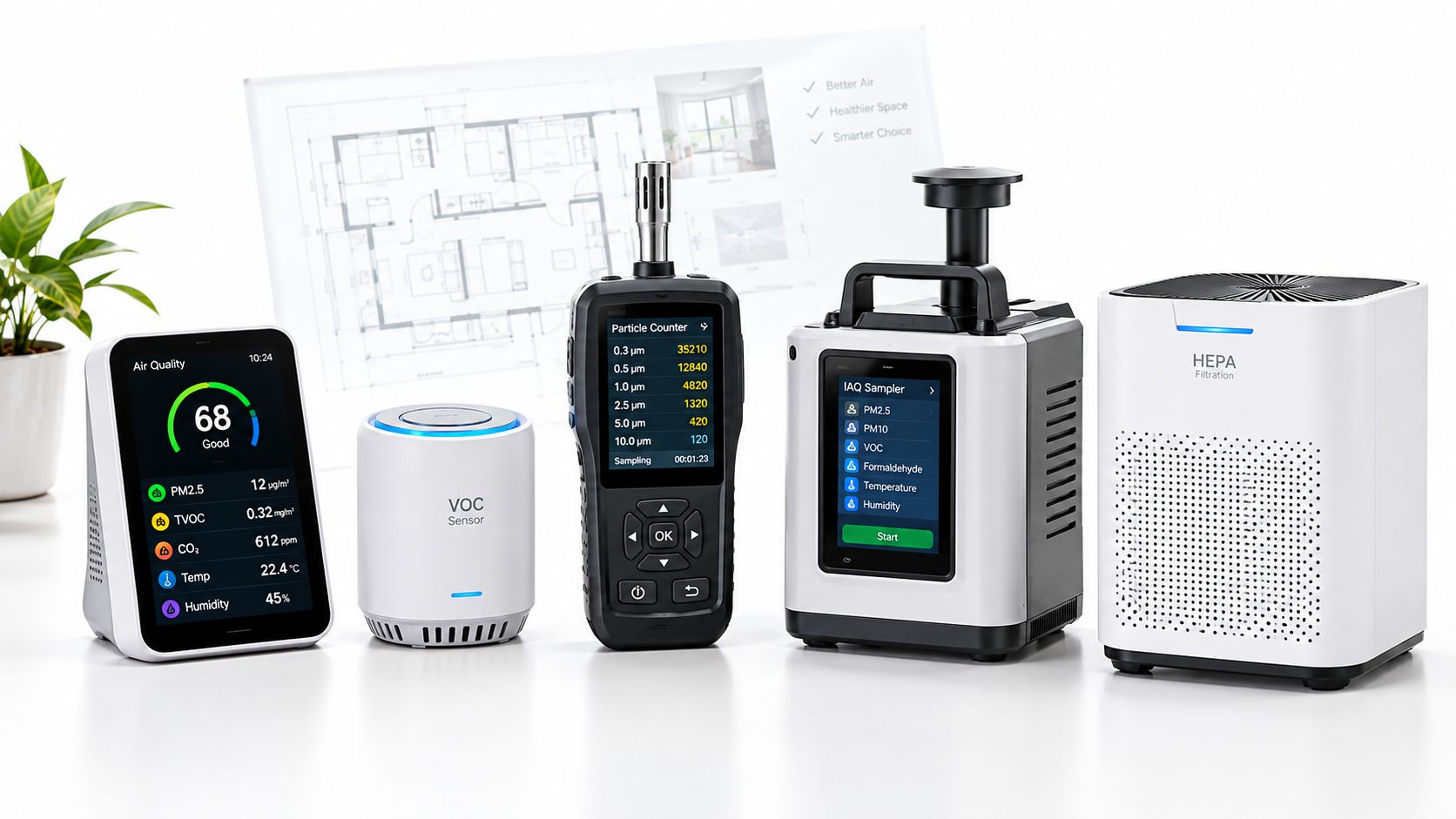
| Consumer real-time monitor | Displays selected readings such as particles, CO2, temperature, humidity, or limited gases | May not identify the contaminant, cover the relevant pollutant range, or produce defensible compliance documentation |
| Specialized VOC sensor | Screens for changes in selected volatile organic compounds or total VOC patterns | Can be affected by cross-sensitivity, calibration conditions, and weak response to particular compounds |
| Optical particle counter | Counts and sizes particles across defined instrument channels | Particle counts don't establish chemical composition or prove that a hazardous material is present |
| Professional IAQ sampler | Collects air through calibrated media or sampling equipment for targeted analysis | Requires a defined sampling plan, qualified interpretation, proper handling, and laboratory analysis when applicable |
| Portable air cleaner or filtration system | Reduces selected airborne particles by moving air through a filter | It changes airborne conditions but doesn't identify the source or document the original contamination |
| Building HVAC filtration and ventilation controls | Supports air exchange, filtration, and pressure or airflow management | Performance depends on system design, maintenance, installation, occupancy, and the contaminant involved |
Why CADR matters for filtration equipment
For portable air cleaners, Clean Air Delivery Rate, or CADR, is more informative than a filter label alone. ENERGY STAR defines CADR as the delivery of contaminant-free air from a room air cleaner in cubic feet per minute. The calculation accounts for contaminant reduction in a test chamber, natural decay, and chamber volume, and it's reported separately for dust, tobacco smoke, and pollen in the ENERGY STAR room air cleaner specification.
CADR reflects airflow and single-pass filter efficiency. A HEPA-based cleaner operating at 500 cfm with 99.97% filtration efficiency will have a CADR very close to 500 cfm, making CADR a practical sizing metric for particle removal. The relationship is explained in Public Health Ontario's portable air cleaner guidance.
Filter selection also matters. A peer-reviewed study found that changing from MERV 13 to MERV 11 reduced CADR by 43%, while power draw and noise stayed nearly unchanged, as reported in the study on DIY air-cleaner performance. The lesson for facility managers is direct. Fan wattage doesn't tell you what the system delivers.
Why Low-Cost Sensors Fall Short for Compliance
A consumer monitor can show a pattern. It cannot, by itself, support a compliance decision, property transaction, insurance claim, regulatory inquiry, or workplace investigation. Those decisions require a documented method connecting the sampling location, equipment, operating conditions, laboratory process, and interpretation.
A 2026 systematic review identified persistent limitations in low-cost IAQ devices, including methodological differences, limited validation between devices, regional bias, inadequate assessment for legal compliance, aging, and cross-sensitivity. Its conclusion is direct: these devices do not replace reference instruments for regulatory thresholds. The findings are available in the systematic review of low-cost IAQ devices.
The conditions that distort readings
Humidity and temperature can change sensor behavior. Aging can alter a device's response, while cross-sensitivity can cause a gas sensor to react to substances other than the target compound. Placement also affects results, particularly near supply registers, windows, doors, kitchens, bathrooms, or localized sources.
Automated calibration may reduce error under specific conditions, but it does not convert a consumer monitor into a reference instrument. Performance can vary across climates and humidity ranges, so calibration results from one setting should not be treated as proof of accuracy in a Los Angeles property.
A reading is only as defensible as the conditions and method behind it.
Why compliance needs a different record
A defensible investigation starts with a defined question. Is the concern mold after water intrusion, VOCs after renovation, smoke residue after a wildfire, airborne asbestos during planned demolition, or lead dust in an older property? Each issue calls for different equipment, sampling media, locations, timing, and laboratory methods.
A consumer monitor may show when conditions change, but it usually cannot identify the substance or establish a reliable concentration for a formal decision. Commercial properties may also require industrial hygiene sampling tied to a task, worker exposure, or specific location rather than one stationary device.
A useful reading can prompt an investigation. It should not be mistaken for the investigation itself.
Property managers and HOAs should retain monitor data when it helps establish timing or recurring patterns. Screenshots should not serve as the sole evidence for compliance, litigation, or a health investigation. Professional testing provides a documented chain from the reported concern through inspection, sample collection, laboratory analysis, and written reporting.
When to Use Monitors Versus Professional Testing
Use a consumer monitor for awareness, not diagnosis. It can help a homeowner observe changes in selected readings, compare rooms, or see whether occupancy and ventilation appear to influence conditions. A facility manager may use continuous monitoring to identify recurring patterns that deserve further evaluation.
Professional testing becomes appropriate when the question involves a specific contaminant, a formal document, a persistent complaint, or a consequential property decision.
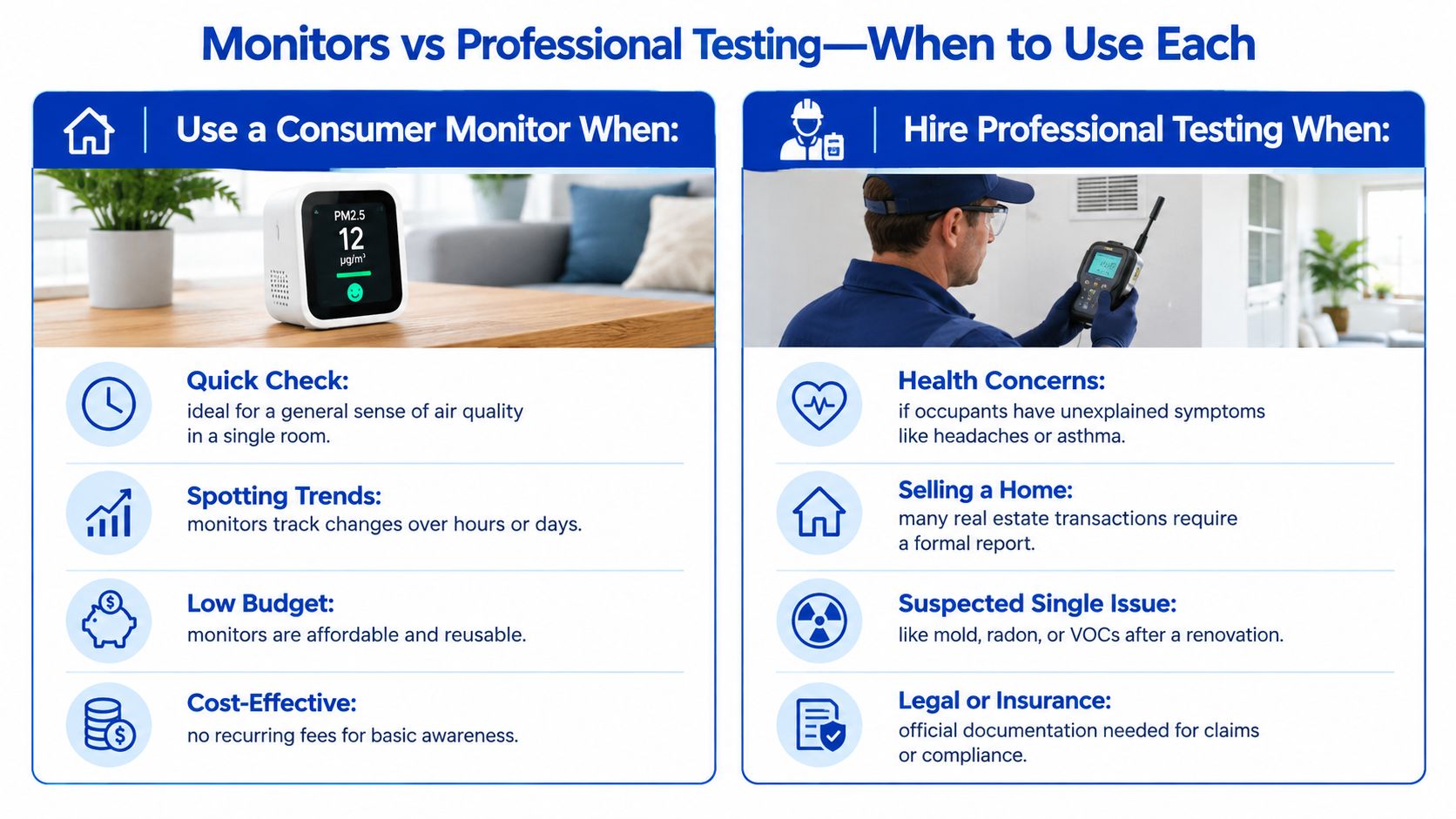
A practical decision framework
Start with the event or concern. Water damage, visible microbial growth, smoke intrusion, renovation odors, unusual dust, occupant complaints, and ventilation problems each point toward different testing approaches. Don't order a generic “air quality test” if concern is asbestos, mold, lead, VOCs, or fire-related contamination.
Use the monitor to document patterns. Record the room, date, time, operating conditions, occupancy, and notable activities. This information can help an environmental consultant decide whether additional sampling is useful, but it doesn't replace professional field notes or laboratory results.
Escalate when conditions persist. EPA guidance for single-family renovations states that if VOCs appear to be present because of odors or complaints, and source control or ventilation doesn't resolve the issue, testing by a qualified professional may be useful. The guidance is available in the EPA renovation protocols for indoor air quality concerns.
For a practical overview of household air concerns, property owners can also review how to test for air quality in your home. The next step should be based on the suspected hazard, not on the monitor with the most features.
Call a professional when the stakes are high
Arrange professional indoor air quality testing when a report may affect a sale, lease, insurance claim, renovation, demolition, workplace decision, school, healthcare environment, or dispute. Professional assessment is also appropriate after a fire or wildfire, where testing may need to address ash, soot, char, smoke residue, combustion byproducts, and heavy metals.
Mold inspections and sampling can help evaluate water-damage concerns. VOC and airborne contaminant testing can investigate persistent odors or complaints. Industrial hygiene assessments can address workplace exposure questions. A positive result doesn't automatically dictate a specific cleanup or abatement action, but it gives qualified decision-makers reliable information about what comes next.
Integrating IAQ with Broader Environmental Assessments
Air readings are only one part of a building investigation. A particle spike in an older Los Angeles property may reflect ordinary activity, construction dust, smoke residue, deteriorated materials, or disturbance of a regulated substance. The instrument can flag a condition, but material inspection and targeted sampling identify what the condition means.
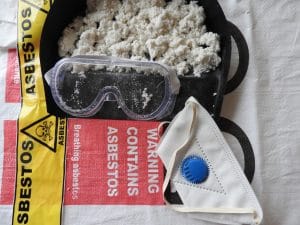
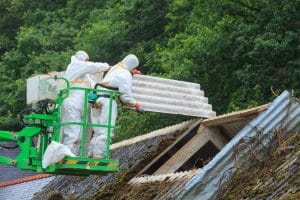
That connection is especially important before renovation or demolition. South Coast AQMD Rule 1403 requires a thorough asbestos survey before any demolition or renovation activity, including physical sampling of materials to identify and quantify friable and non-friable asbestos-containing material, as stated in Rule 1403.
Renovation changes the testing question
An airborne particle monitor doesn't replace a pre-renovation asbestos survey. Rule 1403 documentation may require inspection of affected materials, including flooring layers down to the joist level and wall or ceiling cavities when needed. The survey must be documented in writing, and the inspection must address materials that could be disturbed.
For single-unit residential renovation, the compliance guidance describes an exemption only when less than 100 square feet of asbestos-containing material is removed or stripped. Demolition has no such exception. The survey must be performed by a Cal/OSHA-certified inspector or an employee with an unexpired AHERA Building Inspector certificate from a Cal/OSHA-approved course, according to the Rule 1403 compliance advisory.
Lead concerns require a separate pathway. HUD defines lead-based paint as paint containing lead at or above 1 mg/cm2 or 0.5% by weight, as described in HUD lead-based paint guidance. Air monitoring may help assess dust conditions, but it doesn't replace lead-based paint inspection or paint and dust sampling where those are the relevant questions.
Fire and water damage need targeted assessment
After a wildfire or structure fire, environmental testing may include CBP assessment and sampling for ash, soot, char, smoke residue, and heavy metals. After water damage, mold inspection and sampling may help characterize affected areas and inform next steps. Neither situation should be reduced to a single consumer sensor reading.
Property owners planning broader due diligence can review Sensitive Environmental's environmental assessment process. General indoor air quality guidance can also be supplemented with evidence-based indoor air quality tips, but practical ventilation advice doesn't substitute for contaminant-specific testing when the building history calls for it.
Selecting Professional Environmental Testing in Los Angeles
Choose an environmental testing firm based on the investigation, not on the promise of a particular outcome. A firm should define what it will inspect, what it will sample, where samples will be collected, which laboratory will analyze them, and what the final report will address.
Sensitive Environmental provides professional environmental testing and inspection services for residential and commercial properties in Los Angeles and Southern California, including mold, asbestos, lead, indoor air quality, environmental assessments, industrial hygiene, and fire-related CBP testing. The company's role is testing, inspection, sampling, laboratory analysis, and reporting, not remediation or abatement work.
Review the technical process
Ask prospective providers whether they will:
- Define the scope: Identify the suspected contaminant, building history, affected areas, and decision the testing must support.
- Use appropriate methods: Select sampling media, instruments, locations, and procedures that match the pollutant and property type.
- Document chain of custody: Track sample identification, handling, transfer, and laboratory receipt.
- Use qualified laboratories: Confirm that the laboratory method matches the requested analysis and that results will be clearly reported.
- Separate testing from cleanup sales: Prefer an objective assessment that doesn't depend on selling removal, restoration, or abatement work.
- Explain limitations: A credible report should state what the testing can establish and what it can't.
For commercial properties, the scope may include building-wide IAQ testing, industrial hygiene sampling, ventilation review, airborne contaminants, VOCs, mold spores, allergens, or particles. Worker concerns may require a more specific sampling plan than a general comfort assessment.
Ask for a report you can use
A useful report should connect observations to samples and results. It should identify tested areas, methods, laboratory findings, limitations, and recommendations for qualified parties to evaluate. It shouldn't promise that a negative result proves a building is permanently free of environmental concerns, or that a positive result automatically requires one predetermined response.
Cost questions should also be specific. The indoor air quality testing cost guide can help property owners understand why pricing depends on the number of areas, suspected contaminants, sampling methods, laboratory analysis, and reporting requirements. Ask for a written scope before authorizing work.
Common Questions About Air Quality Equipment and Testing
Can a DIY air quality kit identify mold or asbestos?
Usually, no. A consumer particle reading doesn't identify the material producing the particles, and a generic air sample may not answer a building-material question. Mold concerns often require a visual inspection and targeted sampling strategy. Asbestos concerns require a qualified survey and physical sampling of suspect materials when renovation or demolition could disturb them.
Does a low CO2 reading prove good indoor air quality?
No. CO2 can provide useful information about occupancy and ventilation patterns, but it doesn't measure every pollutant. A low reading doesn't rule out VOCs, mold-related concerns, lead dust, asbestos-containing materials, smoke residue, combustion byproducts, or other airborne contaminants.
Can a VOC monitor identify the exact chemical?
Not automatically. Many consumer VOC devices indicate a response pattern or aggregate signal rather than identifying and quantifying each compound. If odors or complaints persist after source control and ventilation, EPA guidance supports considering qualified professional testing. The testing plan should match the suspected source and the decision the results must support.
What does professional testing involve?
A consultant typically reviews the building history and complaint, inspects relevant areas, selects sampling locations, collects samples using appropriate equipment or media, submits them for laboratory analysis when applicable, and prepares a report. The process can vary substantially for mold, asbestos, lead, VOCs, fire residues, and industrial hygiene concerns.
How quickly will laboratory results arrive?
The timing depends on the contaminant, sampling method, laboratory workload, requested analysis, and reporting scope. Ask the provider to state expected turnaround in the written proposal rather than relying on a generic promise. Urgent projects may need an agreed testing schedule before renovation, demolition, occupancy, or an insurance deadline.
A monitor can help you notice a pattern, but it can't carry the full burden of an environmental decision. If you're dealing with persistent odors, water damage, fire residue, planned construction, occupant complaints, or documentation requirements, schedule an assessment designed around the actual concern.
Sensitive Environmental provides professional indoor air quality testing, mold and airborne contaminant sampling, asbestos and lead inspections, industrial hygiene assessments, and fire-related CBP testing for properties throughout Los Angeles and Southern California. Visit Sensitive Environmental to discuss the right sampling and laboratory analysis plan for your property.