You notice a musty odor near the hallway after a plumbing leak, or you find a damp patch beneath a window in your Los Angeles home. A family member starts asking whether the air is affected, while a contractor wants documentation before opening a wall. Air sampling for mold may seem like the obvious answer, but an air cassette isn't a safety meter, and one result can't explain every condition inside a building.
Professional sampling can help answer focused questions. Are airborne mold spores present during the sampling period? How do indoor readings compare with a same-day outdoor control? Does the indoor pattern support concern about a possible amplification source? Those answers become more useful when paired with a visual inspection, moisture assessment, building history, and information about the HVAC system.
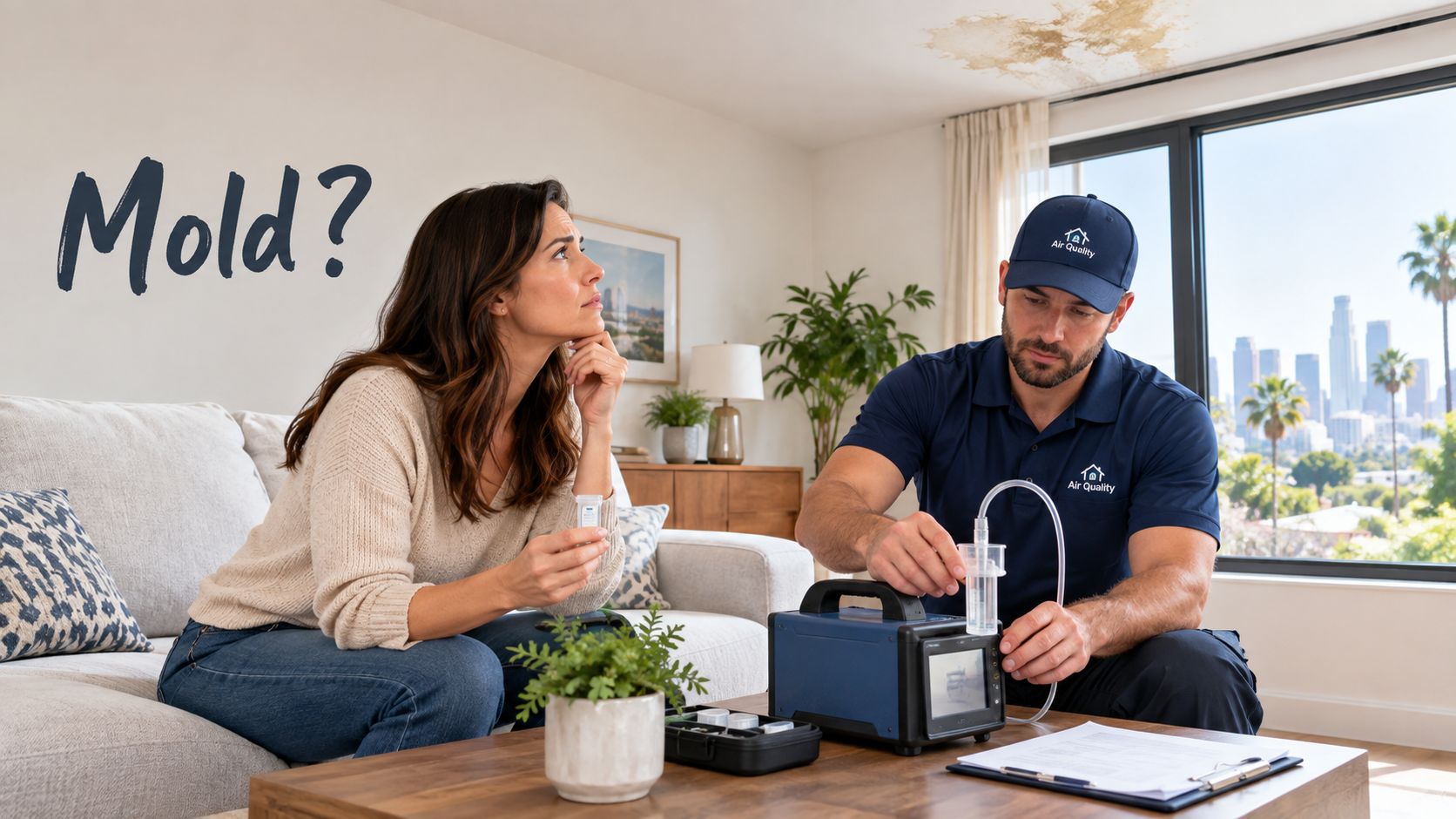
The U.S. Environmental Protection Agency does not provide a federal regulatory threshold for airborne mold contaminants, so air results aren't judged against a universal legal pass or fail number. The EPA's guidance on mold testing and sampling explains that routine sampling isn't recommended in many situations, particularly when visible mold is already present. Instead, professionals generally interpret readings comparatively and in context.
That distinction matters across Los Angeles County and Southern California, where homes, apartments, commercial buildings, schools, and facilities can have very different ventilation, filtration, occupancy, and moisture conditions. This guide explains what samples measure, how professionals collect them, how laboratories analyze them, how to read the report, and what property owners should do with the findings. Sensitive Environmental provides mold testing, inspections, sampling, laboratory analysis, and related indoor air quality assessments for residential and commercial properties.
Table of Contents
- Introduction to Air Sampling for Mold in Los Angeles Homes
- What Air Sampling for Mold Is and How It Works
- Common Air Sampling Methods Compared
- Professional Sampling Protocols That Make Results Meaningful
- How to Interpret Air Sampling Results With Confidence
- Limitations Common Misconceptions and DIY vs Professional Testing
- Next Steps for Property Owners After Air Sampling for Mold
Introduction to Air Sampling for Mold in Los Angeles Homes
A homeowner in Pasadena may call after a roof leak leaves a persistent odor in a bedroom. A property manager in Long Beach may need indoor documentation after a tenant reports dampness. A general contractor in the San Fernando Valley may want baseline information before work begins. Each situation can justify a different testing question, and the right sampling plan depends on that question.
Air sampling is often requested because mold growth isn't always visible. Spores can become airborne as materials dry, occupants move through a room, HVAC equipment operates, or affected materials are disturbed. A sample can show what was airborne at a particular location during a particular collection period. It may also help compare a questionable room with an unaffected room or with outdoor air collected under comparable conditions.
That information has practical value, but it has boundaries.
A mold air sample is evidence about a sampling event, not a complete diagnosis of a building.
The EPA's mold course guidance describes air sampling as a moment-in-time snapshot. It shouldn't replace visual inspection, moisture investigation, or evaluation of building conditions. If a professional can see mold and identify the moisture source, collecting an air sample may add little to the immediate decision.
Los Angeles homes also vary in ways that can change results. A tightly filtered, air-conditioned room may produce a different reading from a room with open windows, active construction, or recent water damage. Outdoor conditions can influence indoor readings, which is why a same-day outdoor control often provides important context.
For a homeowner, the most useful question isn't, “Did the test find mold?” It's, “What does this pattern suggest, and what should be investigated next?” That answer may involve additional inspection, moisture correction, targeted sampling, or no further testing based on the full findings. A positive result doesn't automatically dictate a particular remediation or abatement action.
What Air Sampling for Mold Is and How It Works
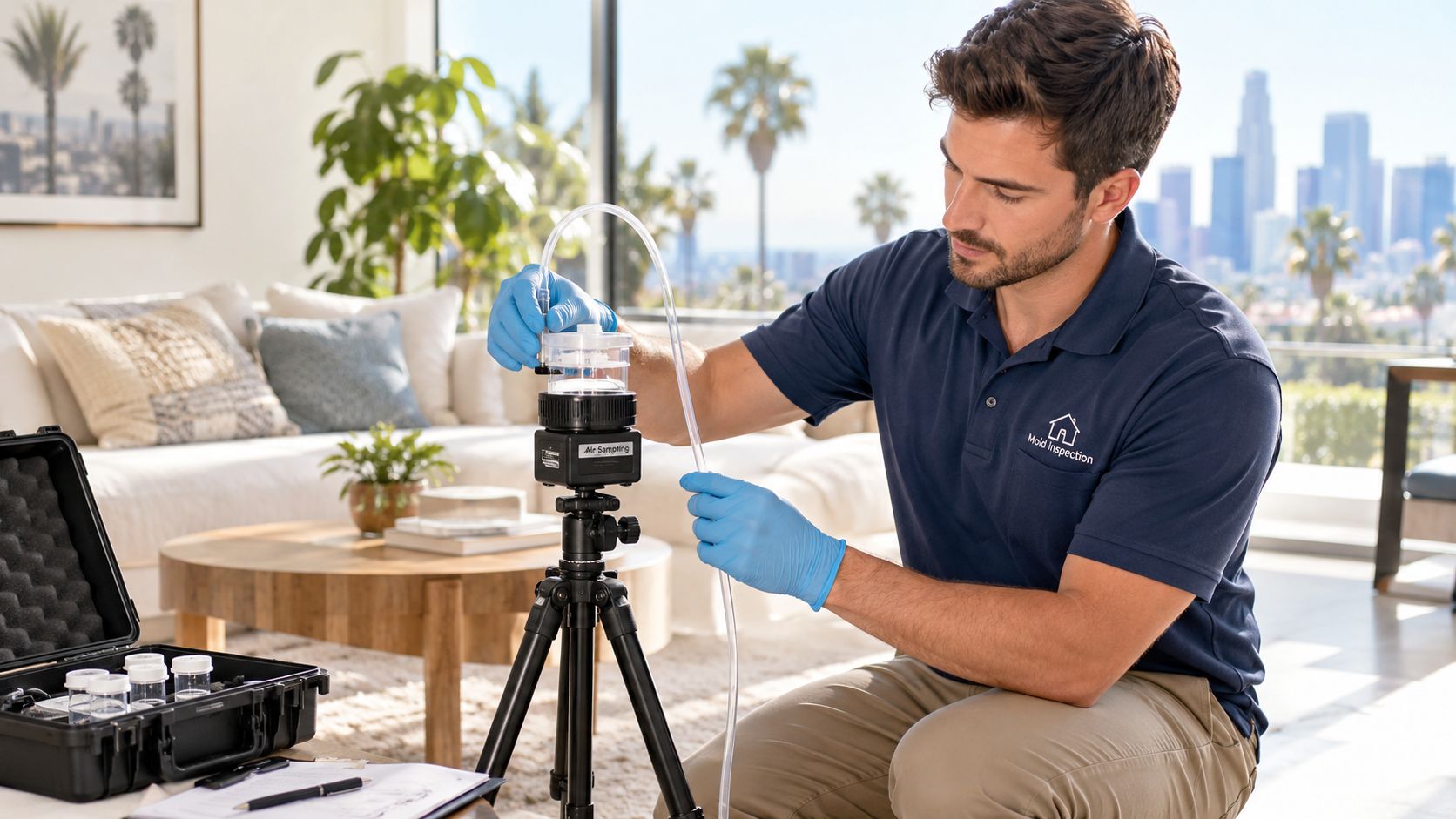
Think of airborne mold spores as fine particles moving through a room much like dust in a beam of sunlight. You may not see them under ordinary conditions, and their concentration can change as people walk, doors open, air moves through a filter, or material is disturbed. A sampling pump draws a measured volume of air through a collection device, creating a record of the particles captured during that short event.
A common device is a spore-trap cassette. The cassette contains a collection surface that catches airborne particles. A laboratory then examines the surface by direct microscopy. The federal mold assessment guidance describes spore-trap sampling as a method that collects both viable and non-viable spores for laboratory analysis, with results commonly reported as spores per cubic meter, written as spores/m³. (Federal mold assessment guidance)
“Viable” means capable of growing under suitable laboratory conditions. “Non-viable” means the spore may be dead or unable to grow, but it can still be captured and counted by a method that examines physical particles. A direct-microscopy spore trap doesn't tell you whether every captured spore is alive.
How air data differs from other evidence
A visual inspection looks for conditions such as visible growth, staining, damaged materials, condensation, plumbing problems, roof intrusion, and HVAC concerns. A surface sample collects material from a specific location, while an air sample evaluates particles suspended in the air during collection. These methods answer different questions.
A sample also doesn't automatically identify the hidden source. If indoor air contains an unusual pattern, the professional may look for moisture-damaged drywall, flooring, insulation, concealed cavities, or HVAC pathways that could explain it. The laboratory report is one part of the assessment, not a substitute for examining the property.
Why the reporting unit matters
Reporting results in spores/m³ helps normalize the finding to the amount of air sampled. The raw number of particles seen on a slide alone doesn't provide the same comparison value because sample volume and collection conditions matter. A professional can use the reported concentration to compare indoor locations with an outdoor control, while still considering the method's detection limits and the condition of the sample.
Common Air Sampling Methods Compared
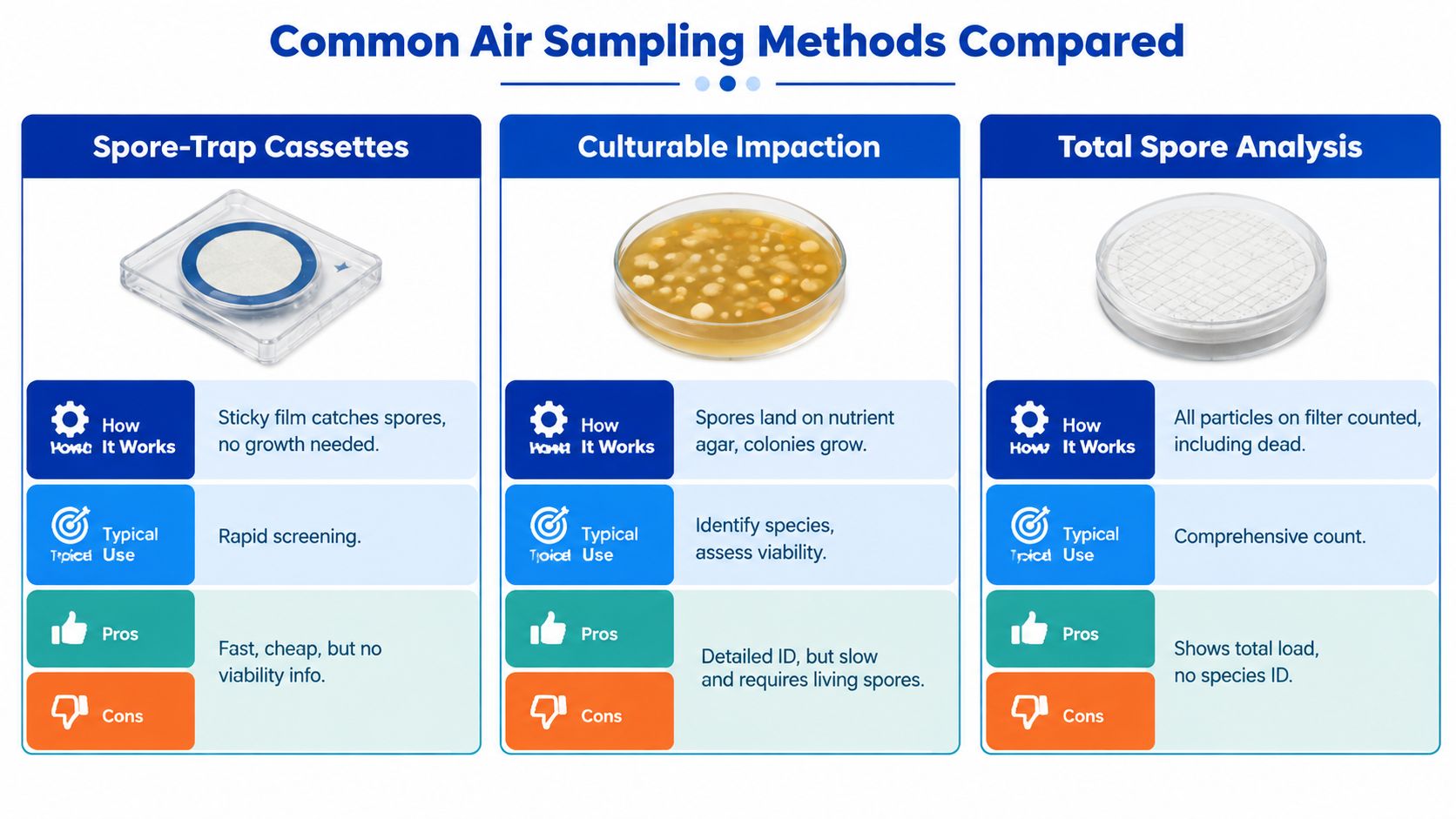
Different collection methods produce different types of information. A property owner choosing between them shouldn't ask which method is universally “best.” The better question is which method fits the decision, the building condition, and the level of identification required.
Active spore-trap sampling
A pump pulls air through a cassette containing a sticky collection surface. Spores and other particles impact onto that surface, and a laboratory examines the material with direct microscopy. Because the method captures both viable and non-viable spores, it can provide a broader snapshot of airborne particles than a method that depends on growth.
Spore traps are commonly used for screening and indoor-to-outdoor comparisons. They can help a professional identify high indoor concentrations or unusual indoor patterns, but they don't establish a health-based limit or prove that a building is safe.
Viable impaction and culture
With a culture-based approach, airborne particles impact onto nutrient media. Living organisms may grow into colonies that the laboratory can examine. This can add viability information and may support more specific identification in the right circumstances.
Culture methods require living spores and can take longer because growth must occur before the laboratory can evaluate the result. A negative culture doesn't mean no mold particles were present, because non-viable particles aren't expected to grow. The method is useful when viability or additional identification is central to the testing question.
Passive settling approaches
Passive collection allows particles to settle onto a surface over time rather than drawing a measured air volume through a pump. That can provide information about deposited material, but it isn't directly equivalent to an active airborne concentration reported in spores/m³. Air movement, surface location, disturbance, and collection duration all influence what settles.
For professional environmental testing, the sampling design should state what the method can answer and what it can't. Homeowners and managers can review the mold testing guide Tucson for additional background on air quality monitoring concepts, then discuss the project-specific method with a qualified consultant. For broader indoor air questions, Sensitive Environmental's air quality testing guide offers related context.
| Method | What It Collects | Lab Analysis | Best Use Case |
|---|---|---|---|
| Spore-trap cassette | Airborne viable and non-viable particles | Direct microscopic examination | Comparative screening and airborne pattern review |
| Culturable impaction | Particles capable of growing under test conditions | Growth on nutrient media | Viability information and selected identification needs |
| Passive settling | Particles that deposit on a collection surface | Microscopy or culture, depending on design | Deposited material questions where active pumping isn't used |
The choice should follow the objective. A contractor planning a wall opening, a landlord documenting a water-damage concern, and a facility manager reviewing HVAC conditions may each need a different combination of inspection and sampling.
Professional Sampling Protocols That Make Results Meaningful
Good results begin before the pump starts. A professional first defines the question, identifies representative locations, reviews the building history, and looks for moisture or visible conditions that could affect interpretation. The EPA mold guidance for professionals recommends using professionals experienced in sampling design, collection methods, and interpretation, with analysis following methods recommended by organizations such as AIHA or ACGIH.
Establish comparable conditions
Indoor samples are usually interpreted against a same-day outdoor control. The outdoor sample helps show what spores and particles were present in the surrounding environment when indoor collection occurred. An indoor result without an appropriate reference may be harder to interpret, especially in a region where windows, ventilation, filtration, and weather can change the relationship between indoor and outdoor air.
The professional also records sample locations and relevant conditions. Open windows, recently operated HVAC equipment, construction activity, unusual occupancy, cleaning, and movement through the room can all affect what becomes airborne during collection. The goal isn't to create an artificial room. It's to document conditions clearly enough that the report can be understood later.
Control flow and collection
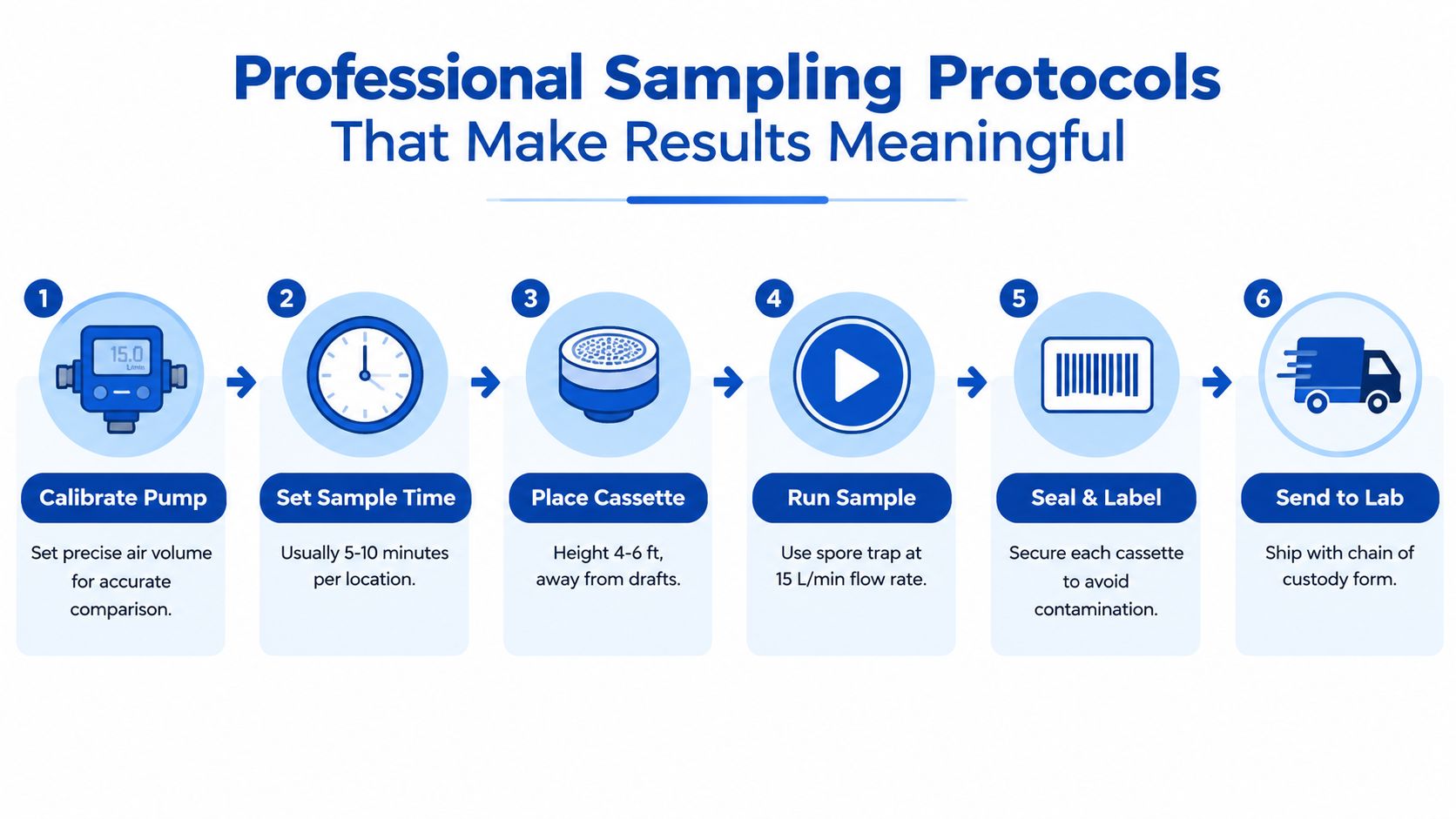
Spore-trap cassettes must be used at the manufacturer's recommended flow rate. Field guidance commonly discusses cassettes designed around 15 L/min, and it emphasizes calibration because an incorrect flow can affect particle capture and make samples less comparable. (AEMTEK mold sampling guide)
The technician calibrates the pump, attaches the cassette, positions it in a representative breathing-zone area, and records the sample identifier. The exact collection duration and locations should be selected as part of the protocol, not copied automatically from another property.
Protect the sample trail
After collection, the technician seals and labels each cassette. A chain-of-custody record connects the field sample to the laboratory submission and identifies the location, collection details, requested analysis, and transfer history. That documentation matters for insurance files, property management records, real estate due diligence, contractor planning, and disputes where the origin of a result may be questioned.
A thorough visit also includes observations that make the report useful. Ask whether the proposal identifies indoor and outdoor controls, equipment calibration, sample locations, laboratory analysis, reporting units, and limitations. The AIHA guidance on spore-trap air sampling is useful background for understanding why method selection and interpretation should match the question being investigated.
How to Interpret Air Sampling Results With Confidence
A Los Angeles homeowner may receive a report showing several mold types and wonder whether one number means the home is safe or unsafe. Air sampling does not provide that kind of verdict. Read the report as a comparison taken at one moment, then connect it to the inspection and moisture conditions.
Professionals compare indoor concentrations and spore patterns with the outdoor control. Indoor results similar to or below outdoor levels generally provide less support for a strong indoor amplification source. A substantially higher indoor concentration, or an indoor pattern that differs sharply from outdoors, supports closer investigation. Moisture damage, odors, visible growth, and HVAC conditions determine how much weight the comparison deserves.
One field benchmark treats indoor counts at or below approximately 1 to 1.4 times outdoor background as generally consistent with no strong indoor source. Higher counts can indicate possible indoor amplification. This benchmark helps organize the evidence, but it is not a federal legal limit, health limit, or pass/fail standard.
Use reference ranges carefully
Some industry guidance lists an average clean residence at under 1,800 total spores/m³, a clean residence maximum at under 3,000 spores/m³, indoor contamination present above 8,000 spores/m³, and possible indoor amplification above 12,000 spores/m³. The same reference also describes historical ACGIH classifications of results below 100 cfu/m³ as low risk, 100 to 1,000 cfu/m³ as intermediate risk, and 1,000 cfu/m³ or more as high risk. (IAQ guideline reference ranges)
These figures are reference points, not federal standards or universal health-based thresholds. They should not override the indoor-outdoor comparison, the sampling conditions, or physical evidence at the property. A single result cannot declare a Los Angeles home safe or unsafe.
Ask what the pattern suggests
When reviewing the report, ask:
- What was sampled? Confirm whether the result represents indoor air, outdoor air, or another reference location.
- How do the indoor findings compare? Review total concentration and the spore groups identified.
- Does the building support the result? Compare it with moisture readings, odors, stains, visible growth, HVAC conditions, and property history.
- What could limit confidence? Check whether debris, unusual airflow, disturbance, or other conditions affected the sample.
- What decision follows? Decide whether the evidence supports additional inspection, targeted testing, moisture correction, or no additional sampling.
Interpretation should produce a proportionate next step. A snapshot can guide a decision, but it cannot guarantee future indoor air conditions.
Limitations Common Misconceptions and DIY vs Professional Testing
A homeowner in Los Angeles may receive a reassuring air-sampling result after a leak, then notice a musty odor days later. That outcome is possible because an air sample is a comparative, moment-in-time screening tool, not a safety certificate. The Centers for Disease Control and Prevention doesn't recommend routine air sampling because short-term samples may miss actual exposure conditions, and there is no federal pass/fail limit that converts a result into a health determination. (CDC mold page)
A laboratory report also cannot locate a mold source by itself. The cassette captures airborne particles, not the wall assembly, plumbing route, roof condition, or HVAC pathway that may have released them. If visible mold is already present, EPA guidance indicates that sampling is often unnecessary because inspection evidence may already show that professional evaluation or corrective work is needed.
Why a short sample has limits
Airborne concentrations shift with occupancy, cleaning, open windows, HVAC cycling, construction, and material disturbance. A sample from one visit may not represent later conditions. A non-detect means the method did not detect a spore type within the sampled air volume and laboratory limits. It does not establish that the type is absent from the building.
The most useful comparison is usually indoor air against an outdoor control collected under similar conditions. Even then, analysts must consider where samples were taken, what was happening in the home, and whether moisture, odors, visible growth, or HVAC conditions support the result. Without that inspection context, a number can sound more definitive than it is.
DIY cassettes and home kits seem simple, but meaningful testing requires more than collecting air. Location selection, outdoor comparison, equipment setup, condition records, contamination control, chain of custody, and careful interpretation all affect the value of the report.
A kit may produce a laboratory sheet while leaving the homeowner unsure what to do next. Professional testing can provide clearer documentation for a real estate transaction, landlord-tenant concern, HOA matter, commercial review, post-water-damage assessment, or contractor's pre-work investigation. Homeowners considering a kit can review this discussion of home mold test kit reliability before choosing between self-collection and an inspector-led, laboratory-supported protocol.
Next Steps for Property Owners After Air Sampling for Mold
Start with the full record, not the headline number. Keep the laboratory report, chain-of-custody documentation, sample map, photographs, moisture observations, and notes about HVAC operation or open windows together. A property manager may also want the report attached to the work order, insurance file, tenant communication, or project documentation.
Use this decision checklist:
- Homeowners: Schedule professional testing when a musty odor, water event, visible concern, or planned renovation raises a specific question. Prepare access to affected rooms, utility areas, HVAC components, and locations with moisture history.
- Property managers and HOAs: Document the complaint, affected areas, prior leaks, and building conditions. Ask for a report that clearly distinguishes indoor samples from outdoor controls.
- Contractors and developers: Arrange assessment before disturbing suspect materials when the project could affect indoor air or concealed areas. Coordinate the sampling plan with the work scope and documentation needs.
- Real estate and insurance professionals: Request a clear explanation of what was sampled, what the results suggest, and what limitations remain. Don't treat a report as a guarantee about future conditions.
Results may support additional moisture investigation, targeted sampling, building-condition review, or consultation with qualified professionals about next steps. Testing alone doesn't automatically require remediation, removal, or abatement. For general indoor air management ideas that complement, but don't replace, a site-specific assessment, see these Sapper HVAC indoor air tips. Sensitive Environmental also provides background on mold abatement and its role when readers need to understand how testing findings may fit into a broader project.
Contact Sensitive Environmental to discuss professional mold testing, mold inspections, air sampling, indoor air quality testing, and laboratory analysis for homes and commercial properties in Los Angeles and throughout Southern California. The team can help define the sampling question, document building conditions, and provide a clear report that supports your next property decision.
Sensitive Environmental provides professional mold inspections, air sampling, indoor air quality testing, and laboratory-supported environmental assessments for Los Angeles and Southern California properties. If a leak, odor, real estate transaction, renovation, or commercial documentation need has raised questions about airborne mold, visit Sensitive Environmental to arrange a focused testing consultation.