Small renovations and single-family homes aren't automatically outside South Coast AQMD oversight. That advice is one of the most persistent and expensive misunderstandings surrounding SCAQMD Rule 1403. In Los Angeles County, the practical question isn't whether a project feels minor. It's whether the work will disturb asbestos-containing material, and whether the project crosses the separate threshold for AQMD notification.
Rule 1403 has been in place since its adoption by the South Coast AQMD Governing Board on October 6, 1989, and it governs asbestos emissions from building demolition and renovation activities, including removal, disturbance, storage, and disposal. The rule has since been amended on April 8, 1994, November 3, 2006, and October 5, 2007, reflecting a long regulatory history rather than a temporary construction guideline (South Coast AQMD asbestos demolition and removal requirements).
Table of Contents
- How SCAQMD Rule 1403 Applies in Los Angeles
- What Triggers Asbestos Compliance Requirements
- The Mandatory On-Site Asbestos Survey Process
- Survey Required Versus Notification Required
- The Truth About the Homeowner Exemption
- Navigating Notifications and Procedure Fees
- Securing Your Project with Professional Testing
How SCAQMD Rule 1403 Applies in Los Angeles
The key compliance question is whether the project needs an asbestos survey, an AQMD notification, or both. These are separate duties. Treating them as the same requirement can leave a contractor without required documentation or create avoidable scheduling problems.
SCAQMD Rule 1403 controls asbestos emissions from demolition and renovation work throughout the South Coast Air Quality Management District. It addresses asbestos-containing material, or ACM, that could release airborne fibers when workers cut, strip, break, sand, pull, drill, or otherwise disturb building components. The rule can apply to residential remodels, commercial tenant improvements, facility upgrades, and full building demolition.
Practical rule: A small scope of work can still require an asbestos survey. Project size does not determine whether inspection comes first.
The district's official rule covers ACM removal and disturbance, along with storage and disposal of asbestos-containing waste generated by that work (South Coast AQMD Rule 1403 PDF). Compliance therefore continues after material is removed. Waste handling and project records remain part of the regulated workflow.
Why owners get caught by small projects
A partial tenant improvement may open wall systems, remove flooring, disturb ceiling textures, or alter mechanical penetrations. A residential remodel can affect layered materials hidden behind finishes. Demolition creates a broader exposure because the structure itself is being dismantled.
The correct first step is an asbestos survey before renovation or demolition. Do not rely on the building's appearance, age, or limited work scope. Professional asbestos testing in Los Angeles gives the owner and contractor a documented basis for identifying materials, defining safe work practices, and determining whether the project also crosses the separate threshold for AQMD notification.
A survey requirement does not automatically mean notification is required. The survey establishes what may be disturbed. The planned work, material quantity, and regulatory thresholds determine whether the event must be reported to AQMD. That boundary is where homeowners and contractors commonly make expensive mistakes.
South Coast AQMD materials also address proposed 2026 amendments involving implementation, enforceability, exemptions, and coordination with federal, state, and local requirements (South Coast AQMD forecast materials). Check current project requirements instead of relying on an old contractor checklist.
What Triggers Asbestos Compliance Requirements
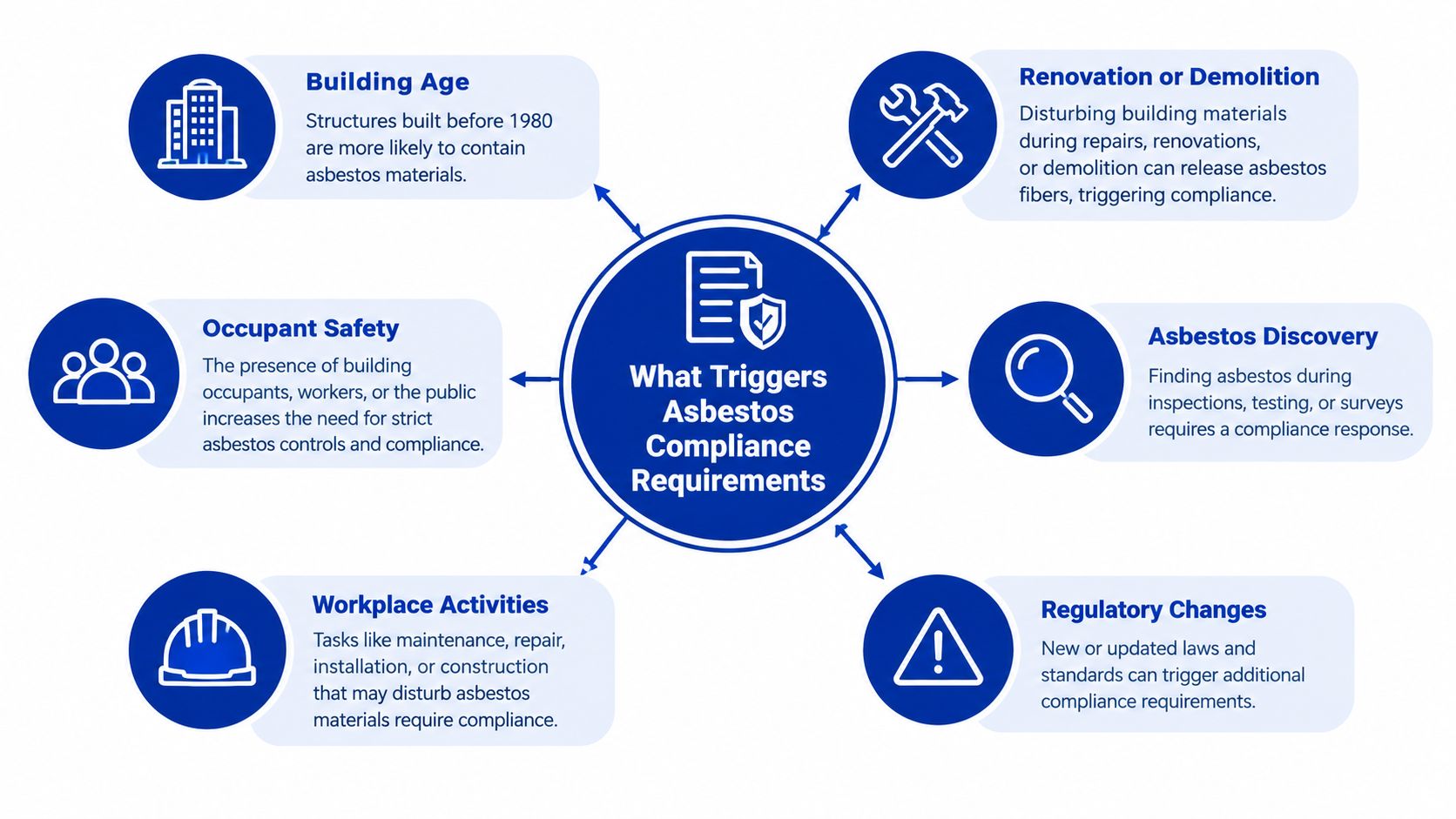
The trigger is the work, not the label on the project. Mechanical disturbance of ACM can bring Rule 1403 into play even when asbestos removal was not part of the original plan. Renovation or demolition that may disturb suspect materials requires an environmental testing workflow before physical work starts.
Rule 1403 covers activities involving the removal or disturbance of asbestos-containing materials during building demolition or renovation. It also governs the storage and disposal of asbestos-containing waste produced by that work. The Rule 1403 technical requirements define the applicable requirements.
The physical work matters
Compliance concerns can arise when workers:
- Open concealed assemblies: Cutting walls, ceilings, chases, or soffits can expose layered materials missed during a basic inspection.
- Remove finishes: Flooring, mastics, wall textures, roofing components, and similar finishes may be disturbed during routine renovation.
- Alter building systems: Mechanical, electrical, plumbing, and structural work may require drilling, cutting, pulling, or breaking materials in place.
- Take down a structure: Demolition creates widespread disturbance, so survey and documentation requirements must be addressed before teardown.
- Move or stage waste: Waste from regulated work requires controlled storage and disposal records.
- Change the project scope: Expanding a tenant improvement from one room to several areas can change the compliance analysis and requires review of the existing survey.
The practical objective is to control airborne fiber release during high-disturbance work. Testing, documentation, approved work practices, and waste records should therefore be built into the project plan before a wall is opened or flooring is removed.
A general homeowner status does not erase these project obligations. Owners should also keep real estate disclosure records separate from a renovation survey. A transaction may involve California asbestos real estate disclosure, while renovation planning requires sampling tied to the materials and areas workers will disturb. One document does not replace the other.
The Mandatory On-Site Asbestos Survey Process
A homeowner cannot treat a visual walkthrough as Rule 1403 compliance. Before renovation, the project needs a documented on-site asbestos survey. Demolition has no exception to this survey requirement. Renovation has a narrow exception for a single-unit residential structure when less than 100 square feet of intact ACM is removed or stripped, as described in the South Coast AQMD Rule 1403 compliance advisory.
That exception applies to a defined regulatory condition, not to uncertainty about the building. Owners still need accurate information about the property, suspect materials, and planned disturbance before relying on it.
What a defensible survey includes
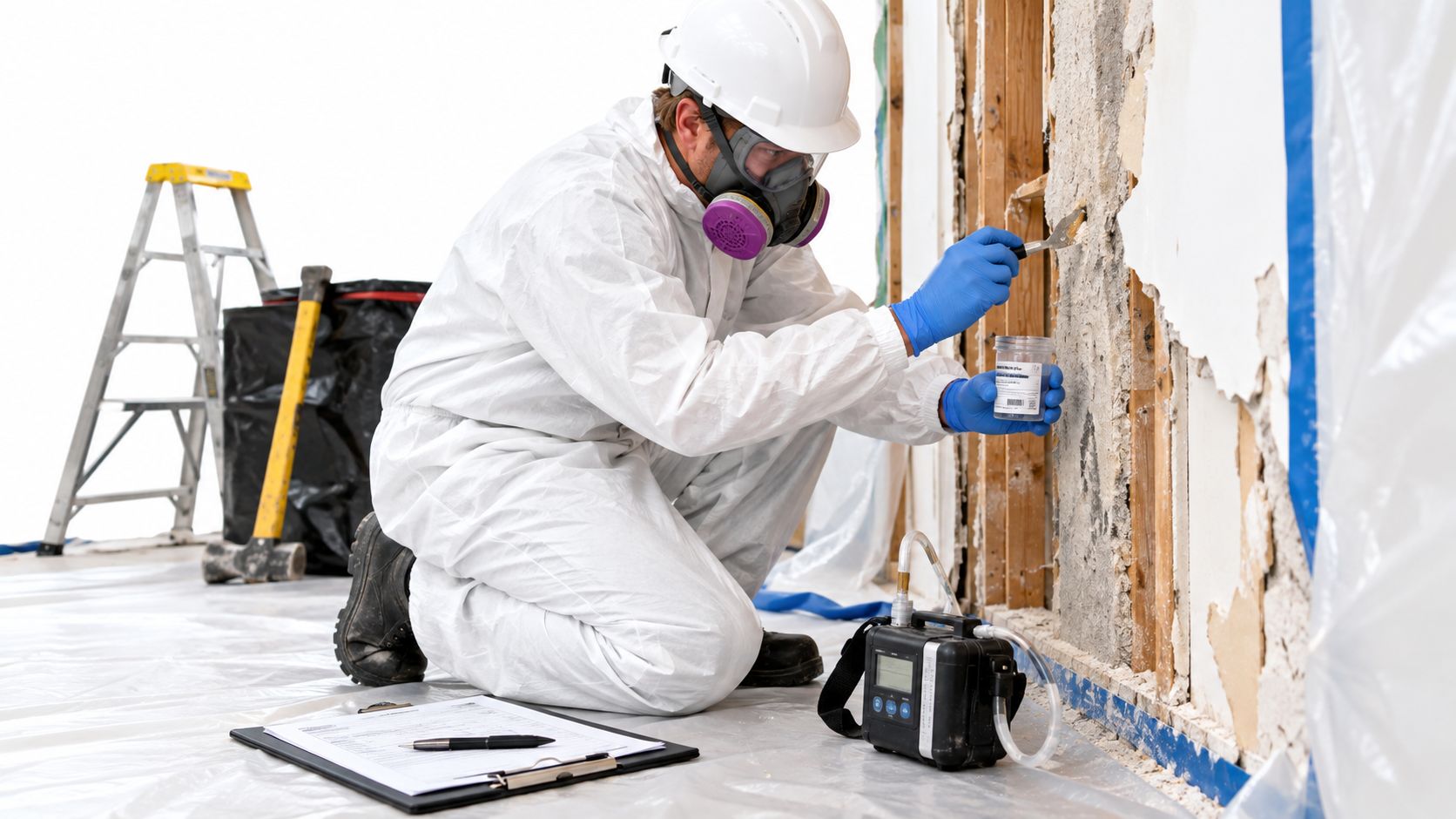
A professional survey starts with the construction scope and a systematic inspection of accessible areas. The inspector identifies suspect materials, maps them against proposed work, and collects representative samples while limiting unnecessary disturbance.
Laboratory analysis determines whether the sampled materials contain asbestos. The report should connect field observations, sample locations, laboratory findings, and the project scope. Owners, contractors, architects, and compliance personnel then work from one documented record.
A DIY kit commonly falls short in four areas:
- Coverage: One visible surface may conceal an underlying layer or leave another work area unevaluated.
- Representativeness: A single piece may not represent a homogeneous material used throughout the project.
- Documentation: A laboratory result alone may not establish which relevant areas were inspected.
- Planning value: Contractors need location-specific findings to price work and sequence construction, rather than an isolated yes-or-no result.
Professional pre-renovation asbestos testing and pre-demolition asbestos testing establish the factual baseline for project decisions. A positive result does not automatically determine the response, while a negative result applies only to materials and areas properly assessed. Qualified professionals use the report to select the next steps.
Owners who need inspection and laboratory work, rather than removal, can use Sensitive Environmental's asbestos testing and survey services for residential and commercial properties in Los Angeles and Southern California.
Survey Required Versus Notification Required
The survey and the notification are separate compliance decisions. Treating them as interchangeable is how Los Angeles projects miss Rule 1403 requirements.
A survey determines which suspect materials are present and whether the planned work will disturb them. A notification tells South Coast AQMD about a project after its facts reach the applicable regulatory threshold. The order matters. Obtain the survey first, define the scope, then determine whether notification is required.
Renovation or demolition generally requires an asbestos survey before work begins. For renovations involving no asbestos or less than 100 square feet of ACM, notification is not required under the FAQ's stated distinction (South Coast AQMD Rule 1403 FAQ). That threshold does not erase the survey duty or the need to control asbestos-containing material.
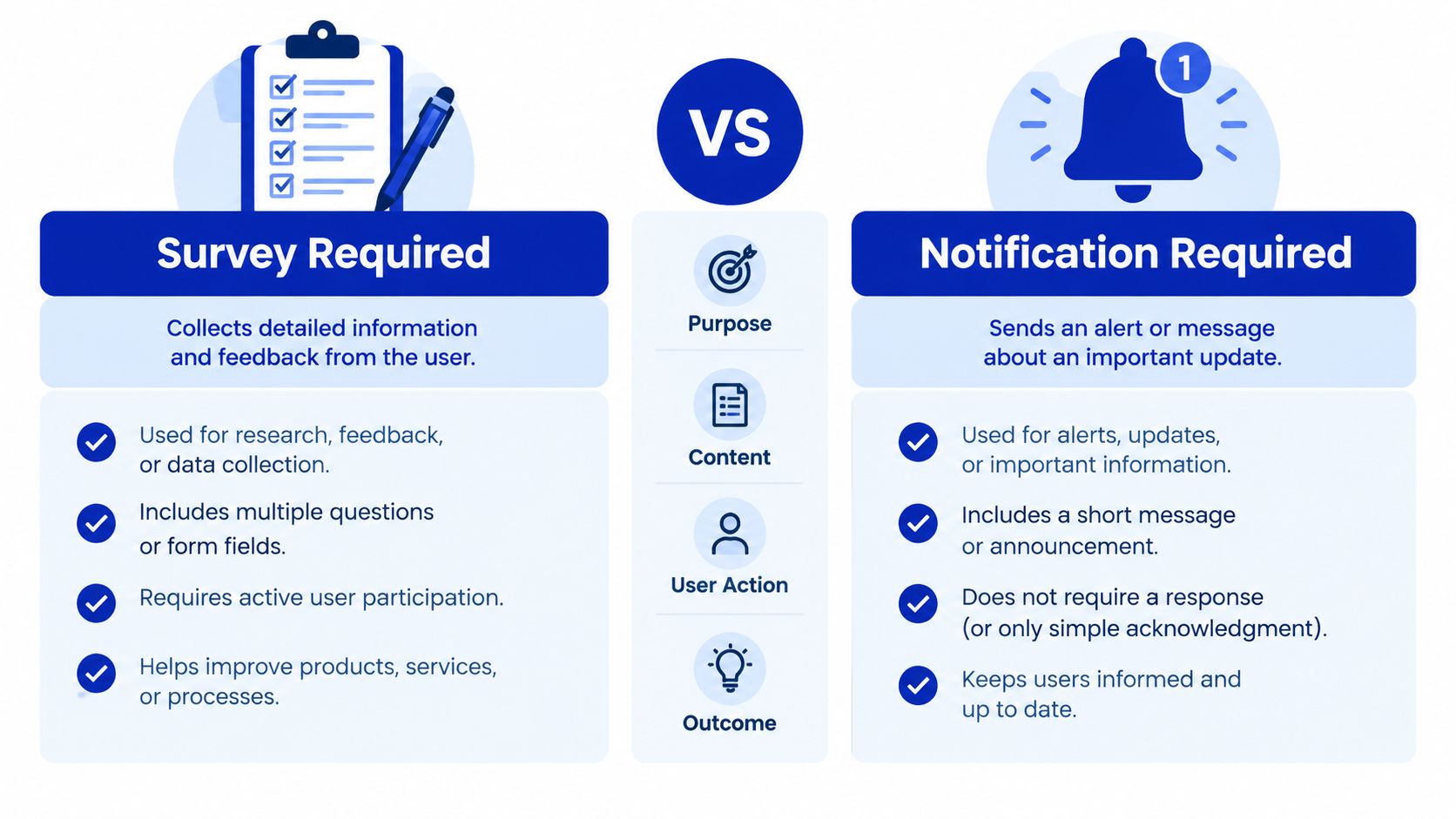
Compare the two obligations
| Project question | Survey | Notification |
|---|---|---|
| Primary purpose | Identify suspect materials and document laboratory findings before work | Give AQMD required project information when the applicable threshold is reached |
| Starting point | Planned renovation or demolition | Project facts established through the survey and defined scope |
| Main evidence | Inspection record, sample locations, and laboratory analysis | Electronic AQMD submission and supporting project documentation |
| Common confusion | Assuming no visible asbestos means no survey | Assuming every survey automatically requires notification |
| Best decision-maker | Qualified environmental testing professional | Owner, contractor, or authorized project representative applying current AQMD requirements |
Applying the boundary to real projects
A partial tenant improvement may involve flooring removal and wall openings for new utilities. The owner should obtain a survey before those activities start. If relevant materials test negative, the notification review may end there, but the survey record still documents the basis for that decision.
If ACM is identified and the renovation will disturb less than 100 square feet of it, the FAQ distinction indicates that notification is not required for that renovation scenario. The project still needs documented findings, appropriate work methods, and controls. “No notification” means only that the notification obligation is not triggered.
Phased work requires careful scope review. Separate work orders should not be used to divide a broader project that disturbs the same material or connected building areas. Review the combined practical scope when multiple trades will cut, remove, or penetrate assemblies.
Demolition requires a stricter boundary. The official compliance guidance states that demolition has no exception to the survey requirement (South Coast AQMD demolition and renovation compliance advisory). Resolve the survey and notification questions before finalizing the demolition schedule.
The Truth About the Homeowner Exemption
There isn't a broad “homeowner exemption” under Rule 1403. The actual carve-out is narrow, and many homeowners who believe they qualify don't.
The FAQ describes an exemption for a legal owner who permanently resides in a single-family dwelling and personally performs the renovation. That wording matters. The exemption is tied to the owner, the property type, residency, and who performs the labor. It isn't a general exemption for every residential remodel.
Who the carve-out does not cover
The FAQ states that there are no exemptions for condominiums, townhouses, or apartments. A landlord can't rely on the exemption because the property is residential. Neither can a condo owner assume that owner-occupancy creates a blanket exception (Rule 1403 homeowner exemption FAQ).
The labor requirement is equally strict. The exemption disappears if the owner uses a contractor, laborer, friends, or family members to perform the renovation. Even limited outside help can change the compliance position.
That means a homeowner should ask four direct questions before relying on the exemption:
- Ownership: Are you the legal owner?
- Residency: Do you permanently live in the single-family dwelling?
- Property type: Is the structure a single-family dwelling, rather than a condominium, townhouse, or apartment?
- Labor: Will you personally perform the renovation without contractors, laborers, friends, or family assistance?
If any answer is unfavorable, obtain professional guidance before work begins. Don't describe the project as “just a homeowner remodel” in a bid package and assume that label resolves the regulatory issue.
Why this misconception persists
Residential work often appears small from the owner's perspective, especially when compared with commercial demolition. Rule 1403, however, focuses on asbestos disturbance and the conditions of the applicable exemption, not on whether the owner considers the project informal.
For Los Angeles homeowners, landlords, HOAs, and property managers, the safer approach is to document the project scope, determine whether a survey is required, and verify whether the narrow exemption applies. If the work involves outside labor or a shared residential property type, treat the exemption as unavailable unless a qualified professional confirms otherwise.
Navigating Notifications and Procedure Fees
Once a project requires notification, the submission process is digital. South Coast AQMD states that all Rule 1403 asbestos removal and demolition notifications and fee payments must be submitted through its web-based application, and that November 1, 2016 marked the point when online-only submission replaced mail, fax, and email (South Coast AQMD Rule 1403 web application).
That means a contractor can't treat an email attachment or mailed form as a fallback. The project team should establish who will prepare the notification, who will verify the information, and who will retain the submission confirmation.
Build the administrative work into the schedule
A practical notification workflow includes:
- Confirm the scope: Identify the renovation or demolition areas and the materials that may be disturbed.
- Complete the survey: Keep the inspection report and laboratory results with the project file.
- Determine the notification category: Use the current AQMD requirements and the project-specific facts rather than a generic contractor assumption.
- Submit electronically: Use the Rule 1403 web application for the notification and fee payment.
- Retain proof: Save the submission record, payment evidence, survey, and supporting documents with the construction file.
- Coordinate the start date: Don't schedule regulated work until the administrative requirements have been addressed.
Understand Procedure 4 and Procedure 5 fees
The Rule 1403 fee schedule lists a Plan Evaluation fee of $916.15 for Procedure 4 and Procedure 5 plans. An additional Expedited Procedure 4 or 5 fee of $458.06 applies when the request is postmarked less than 14 calendar days before the project start date (Rule 1403 fee schedule).
These amounts should be treated as planning inputs, not as a substitute for reviewing the current fee schedule and project category. Facility managers and developers should identify the applicable procedure early, budget the plan evaluation charge, and avoid compressing the submission timeline into an expedited request.
Procedure 5 asbestos surveys and testing also need to align with the actual work scope. A report prepared without enough access to the affected assemblies may leave the project team with unresolved questions, which can create more scheduling risk than the testing itself.
Securing Your Project with Professional Testing
Rule 1403 compliance starts with a defensible survey, not a last-minute paperwork search. Arrange asbestos testing before bids are finalized and before trades open walls, ceilings, or floors. Laboratory analysis converts suspected material into project-specific evidence, while the survey establishes which work areas require closer review.
For a 1970s commercial tenant improvement in Los Angeles, flooring mastic and ceiling texture may both be disturbed. A useful report maps sample locations to the affected work areas, allowing the contractor to schedule abatement before utility rough-in instead of discovering a problem after demolition begins. That level of detail also shows whether the project has reached the conditions requiring AQMD notification.
Use the report to make decisions
Require the assessment to answer these questions:
- Where is suspect material located?
- Which materials were sampled and analyzed?
- Does the planned work affect those materials?
- Does the project require notification under the applicable Rule 1403 conditions?
- What documentation should remain in the project file?
- What additional testing is appropriate if the scope changes?
A positive result does not by itself determine the final response. The owner and qualified professionals must evaluate controls, sequencing, regulatory duties, and any additional assessment based on the material and planned disturbance.
Other hazards require separate testing decisions. Fire damage may call for CBP testing of ash, soot, char, smoke residue, or heavy metals. Water damage may require mold inspection and sampling. Occupant complaints may justify indoor air quality testing, VOC evaluation, or a broader industrial hygiene assessment. Do not treat an asbestos survey as a substitute for those services.
Sensitive Environmental provides asbestos surveys, sampling, laboratory analysis, and compliance documentation for renovation and demolition projects in Los Angeles and Southern California. Its asbestos testing guidance for commercial renovation projects in Los Angeles helps owners and contractors identify the information needed before construction activity begins.
Schedule a pre-renovation or pre-demolition survey before work starts, particularly where materials are concealed, the scope is changing, or existing records are unclear. Visit Sensitive Environmental to discuss asbestos testing, laboratory analysis, and Rule 1403 documentation for the project.