The wrong version of this question is often asked. People ask how much lead paint is toxic as if the answer should be a chip size, a percentage, or a line on a lab report.
In real homes, the risk usually isn't one dramatic mouthful of paint. It's repeated exposure to lead dust from painted windows, doors, trim, stairs, and renovation disturbance. That's why two surfaces can look similar and still present very different risk. One may have intact paint that isn't shedding dust. Another may have friction, peeling, or prior repair work that leaves settled dust where children touch, crawl, and put hands in their mouths.
That's also why there is no single universal “safe amount.” CDC states there is no safe level of lead in blood for children and uses a blood lead reference value of 3.5 µg/dL to identify children with higher-than-most exposure, while older guidance used much higher numbers in very different ways, reflecting how much public health understanding has changed over time (CDC lead prevention information).
For homeowners in Los Angeles and across Southern California, this matters most in pre-1978 housing, older rental properties, and buildings heading into repainting, renovation, window replacement, or demolition planning. The question isn't just whether paint contains lead. It's whether that paint is creating actionable dust and whether testing can document conditions clearly before work begins.
If you're trying to understand what matters, a useful starting point is learning what lead-based paint can look like. Appearance alone won't confirm lead, but it helps explain why deterioration around trim, sashes, and high-contact surfaces deserves attention.
Practical rule: Lead risk is best understood through three measurements, paint content, dust loading, and blood lead. The most important one in day-to-day exposure is often dust.
Table of Contents
- Introduction Why There Is No Single Safe Amount of Lead Paint
- How Toxicity Is Actually Measured From Paint to Dust to Blood
- Regulatory Limits That Define Hazardous Lead Paint and Dust
- Why Small Amounts of Deteriorating Paint Create Big Exposure Risks
- How Professional Lead Testing and Inspections Work in Los Angeles
- What to Do When Results Exceed Thresholds and Next Steps
- Schedule Professional Lead Testing With Sensitive Environmental
Introduction Why There Is No Single Safe Amount of Lead Paint
A wall doesn't become dangerous only when you can see thick paint chips on the floor. A painted surface can create a lead problem long before that point.
That's where people get tripped up. They hear one legal threshold for lead-based paint, another for dust, and a different number for blood lead. Those aren't contradictions. They measure different things.
Three different questions are being asked
The phrase how much lead paint is toxic bundles three separate questions together:
- Does the paint qualify as lead-based paint? This is a content question.
- Has the paint created hazardous dust on surfaces people touch? This is an exposure question.
- Has exposure shown up in the body? This is a health screening question.
A homeowner might test paint on a wall and learn it falls below the legal definition of lead-based paint. That can sound reassuring. But if the same area is deteriorating, rubbing, or being disturbed during work, dust sampling can still show a concern.
Why Southern California homes need careful testing
Los Angeles has a large stock of older housing, older multifamily buildings, and properties that cycle through repainting and renovation. In that setting, testing isn't about panic. It's about replacing assumptions with documentation.
Professional environmental testing becomes especially useful when:
- Paint is peeling or chalking
- Windows or doors stick and rub
- You're planning pre-renovation work
- A rental property needs documented conditions
- A buyer wants due diligence before escrow closes
Sensitive Environmental focuses on this kind of environmental testing work, along with asbestos testing, mold inspections, indoor air quality testing, industrial hygiene assessments, wildfire contamination testing, and other property-related sampling services used across Los Angeles County and Southern California.
How Toxicity Is Actually Measured From Paint to Dust to Blood
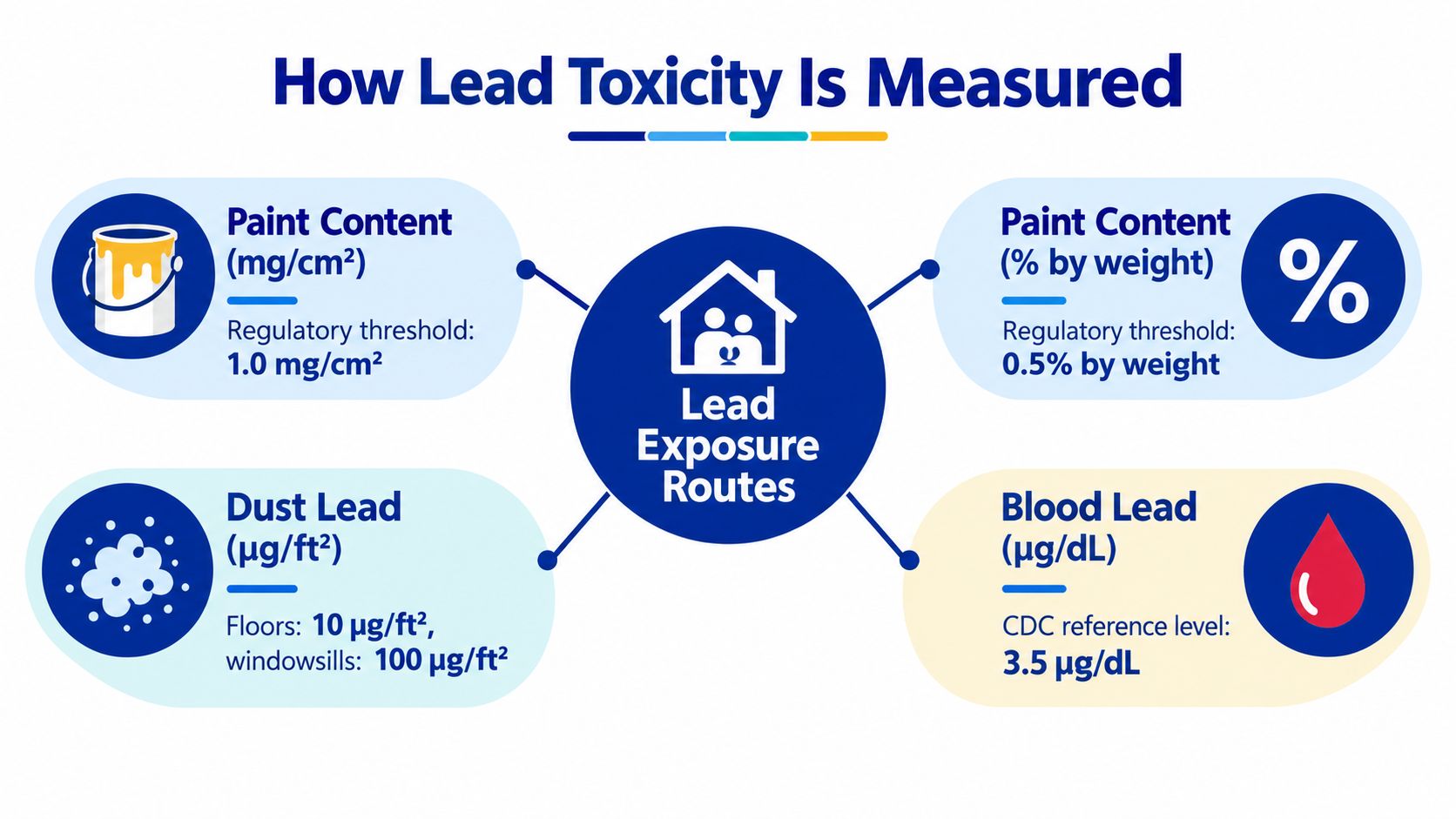
A clear way to think about lead is this. Paint is the source. Dust is the pathway. Blood is the evidence of exposure.
That framework helps make sense of why one number alone never answers the full question.
Paint content tells you what is in the coating
Under the federal HUD and EPA definition, paint is considered lead-based paint when it contains lead at or above 1.0 mg/cm2 or 0.5% by weight, which equals 5,000 ppm (HUD lead-based paint threshold guidance).
Think of that as testing the recipe of the paint film itself. It answers, “How much lead is in this coating?”
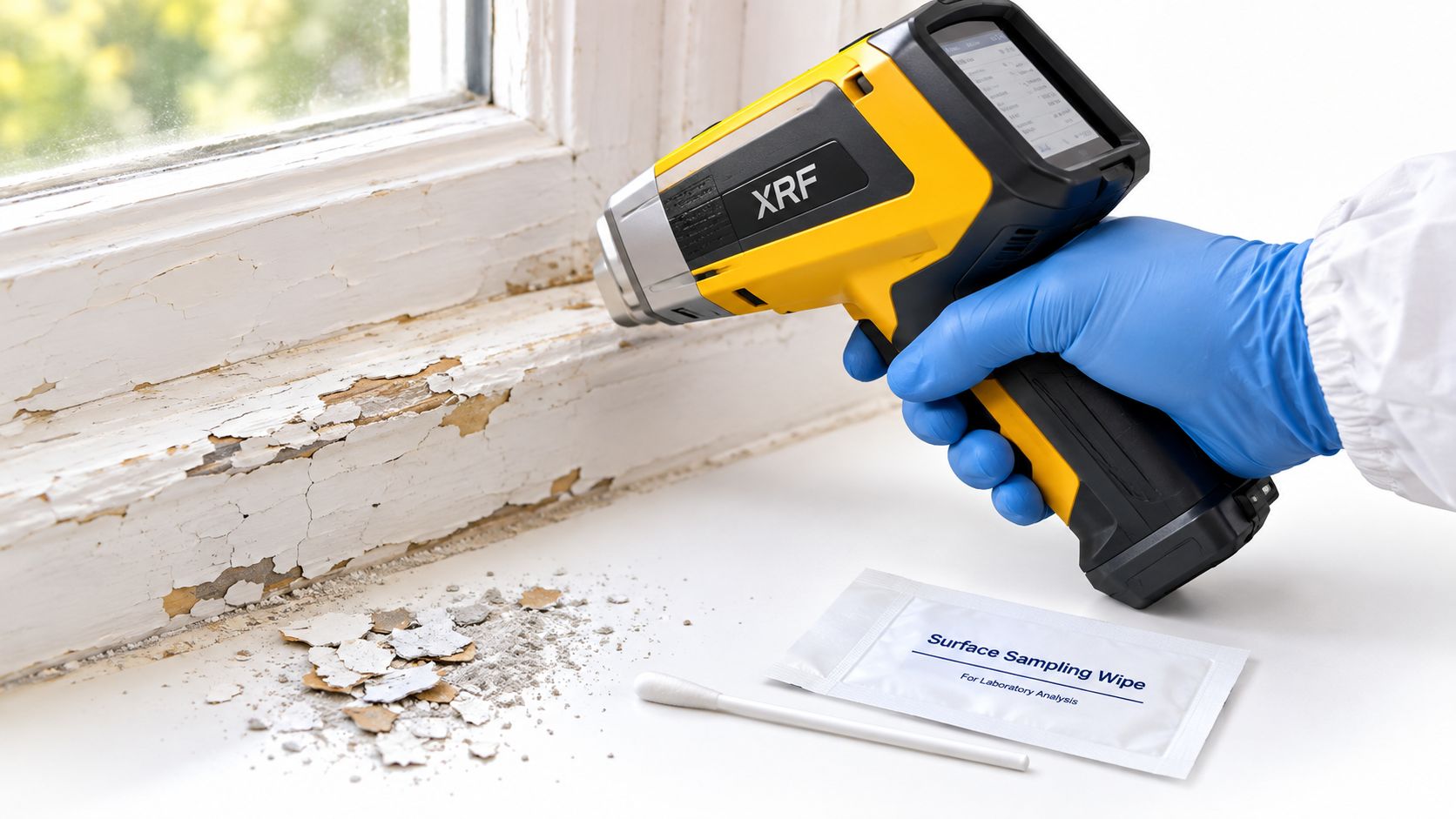
Inspectors may use XRF instruments for this kind of determination, or laboratory confirmation from paint chip analysis depending on the project and documentation needs.
Dust loading tells you what is sitting on the surface
Dust numbers are different because they measure lead that has settled on a surface area, usually reported in µg/ft2. That's less like checking the recipe and more like checking what ended up on the kitchen counter after cooking.
EPA's current framework explains how small these dust amounts can be. For later standards and post-abatement clearance, commonly used benchmarks include 5 µg/ft2 on floors, 40 µg/ft2 on interior window sills, and 100 µg/ft2 on window troughs, while older hazard frameworks used higher wipe-sample numbers such as 10 µg/ft2 on floors and 100 µg/ft2 on interior window sills (EPA hazard standards and clearance levels).
This is the point many articles skip. A surface can have modest-looking paint damage and still generate dust that matters.
Blood lead tells you exposure reached the body
Blood lead uses a different unit, µg/dL, because it measures concentration in blood. CDC states there is no safe blood lead level in children, uses 3.5 µg/dL as a blood lead reference value, and notes that medical chelation may be considered at 45 µg/dL or greater in the clinical guidance context (CDC lead guidance for blood levels).
That means a blood test doesn't tell you where the lead came from. It tells you that exposure has occurred and needs to be taken seriously.
A paint chip result, a dust wipe result, and a blood lead result are not interchangeable. Each answers a different question.
For families who are also discussing medical follow-up with a healthcare provider, resources such as affordable lead testing panels can help people understand the blood testing side of the picture. That doesn't replace property testing, but it helps connect environmental findings to personal exposure screening.
Regulatory Limits That Define Hazardous Lead Paint and Dust
Regulations create another layer of confusion because they use different thresholds for different purposes. One number identifies lead-based paint. Another identifies dust hazards. Another applies to clearance after abatement-related work.
Those are separate decisions, not competing answers.
Paint threshold and dust threshold are not the same thing
A painted wall may or may not meet the legal definition of lead-based paint. That determination uses paint content. Dust hazard rules look at what people can contact on floors and window surfaces.
HUD guidance still reflects the classic dust-lead hazard thresholds of 40 µg/ft2 for floors, 250 µg/ft2 for interior window sills, and 400 µg/ft2 for window troughs, and it separately identifies the lead-based paint screening threshold as 1.0 mg/cm2 or 0.5% by weight (HUD lead hazard guidance).
That separation matters in the field. A contractor, property manager, or buyer may hear “the paint didn't test as lead-based” and assume the issue is closed. It isn't, if dust sampling shows contamination on accessible surfaces.
The standards have tightened over time
EPA has steadily moved dust standards downward. EPA noted that about 31 million pre-1978 homes still contain lead-based paint and about 3.8 million of those homes house one or more children under age six, while dust standards historically shifted from 40 µg/ft2 on floors and 250 µg/ft2 on interior window sills to 10 µg/ft2 and 100 µg/ft2, then later to 5 µg/ft2 and 40 µg/ft2 for later standards (EPA announcement on strengthened lead dust standards).
That history explains why owners and managers often run into mixed numbers online. They may all have been real at one point, but they applied in different periods or for different regulatory purposes.
Lead Paint and Dust Thresholds at a Glance
| Metric | Threshold | Context |
|---|---|---|
| Lead-based paint content | 1.0 mg/cm2 | Federal paint-content definition |
| Lead-based paint content | 0.5% by weight | Federal paint-content definition |
| Equivalent concentration | 5,000 ppm | Equivalent to 0.5% by weight |
| Older HUD dust hazard for floors | 40 µg/ft2 | Classic hazard framework |
| Older HUD dust hazard for interior window sills | 250 µg/ft2 | Classic hazard framework |
| Older HUD dust hazard for window troughs | 400 µg/ft2 | Classic hazard framework |
| Pre-2026 EPA dust hazard for floors | 10 µg/ft2 | Hazard level before January 12, 2026 |
| Pre-2026 EPA dust hazard for interior window sills | 100 µg/ft2 | Hazard level before January 12, 2026 |
| On or after January 12, 2026 | Any reportable level | Hazard for dust on floors or interior window sills when analyzed by an NLLAP-recognized lab |
| Post-abatement clearance for floors | 5 µg/ft2 | Cleaning must continue until below this level |
| Post-abatement clearance for interior window sills | 40 µg/ft2 | Cleaning must continue until below this level |
| Post-abatement clearance for window troughs | 100 µg/ft2 | Cleaning must continue until below this level |
EPA's rule text states that effective January 12, 2026, dust-lead hazards changed from 10 µg/ft2 on floors and 100 µg/ft2 on interior window sills to any reportable level on those surfaces when analyzed by an NLLAP-recognized laboratory, while post-abatement clearance cleaning must continue until results are below 5 µg/ft2, 40 µg/ft2, and 100 µg/ft2 for floors, interior sills, and troughs respectively (40 CFR 745.65 lead dust standards).
Key distinction: A paint-content threshold tells you what the coating is. A dust threshold tells you what people may be exposed to on the surfaces they touch.
Why Small Amounts of Deteriorating Paint Create Big Exposure Risks
The most common lead problem in older homes isn't a dramatic wall collapse. It's ordinary wear in ordinary places.
The window example
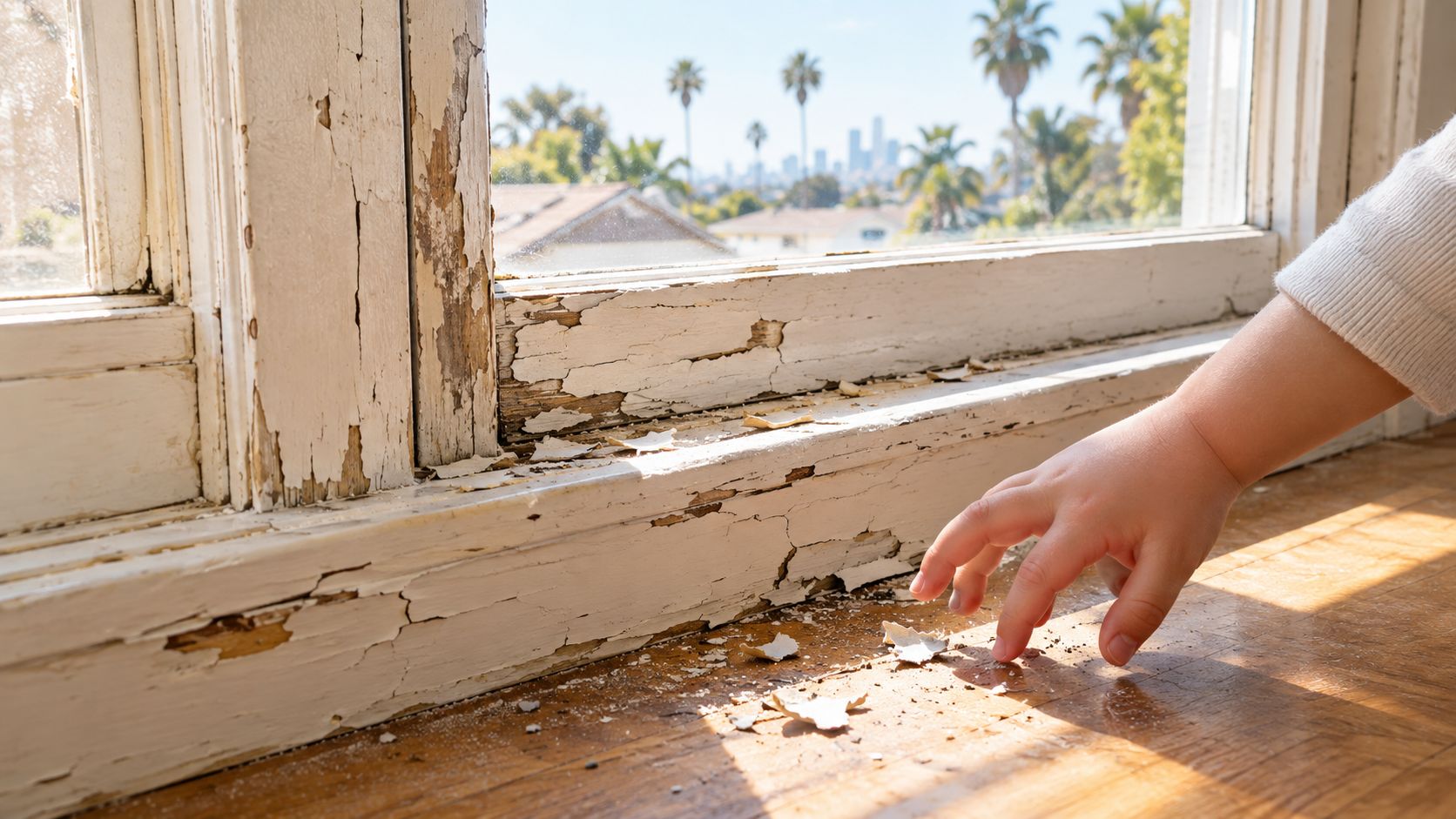
A pre-1978 Los Angeles bungalow may have painted wood windows that open and close every day. The sash rubs the frame. The frame rubs the sill. Sun, age, and moisture dry the coating out.
You may not see large chips. What you often get instead is fine dust on the sill and nearby floor. That dust can move onto hands, toys, socks, pet paws, and cleaning cloths.
The renovation example
A small repair job can change the exposure picture quickly. Scraping, sanding, demolition, or even repeated drilling around painted trim can disturb old coatings and spread residue into adjacent rooms.
This is why pre-renovation environmental testing matters, especially in older Southern California housing stock. The same logic applies across other hazards too. Before renovation or demolition, owners and contractors often need asbestos surveys, mold assessment after water damage, or industrial hygiene review for occupant-sensitive buildings. Lead testing fits that same due-diligence pattern.
The child behavior piece
Children don't need to eat visible paint flakes for exposure to happen. The practical concern is repeated hand-to-mouth behavior after touching contaminated surfaces.
One reason public health agencies focus so heavily on older housing is scale. EPA estimates that about 31 million pre-1978 homes still contain lead-based paint, and 3.8 million of those homes house one or more children under age six, as noted earlier in the regulatory discussion. Those numbers help explain why condition matters so much more than a simple yes-or-no paint label.
Watch more closely when you see:
- Peeling or cracking trim around windows, doors, baseboards, or stairs
- Sticky windows or doors that grind painted surfaces together
- Renovation dust in an older home after patching, sanding, or replacement work
- Recurring dust on sills that returns soon after cleaning
- Older rentals or child-occupied spaces with uncertain testing history
A small damaged area in a high-friction location can matter more than a larger intact painted wall that isn't being disturbed.
How Professional Lead Testing and Inspections Work in Los Angeles
DIY kits may hint at the presence of lead, but they usually don't answer the questions that matter for planning, documentation, or compliance. Professional testing is designed to identify the source, measure surface contamination correctly, and produce results that can be used in real decisions.
What an inspector looks for
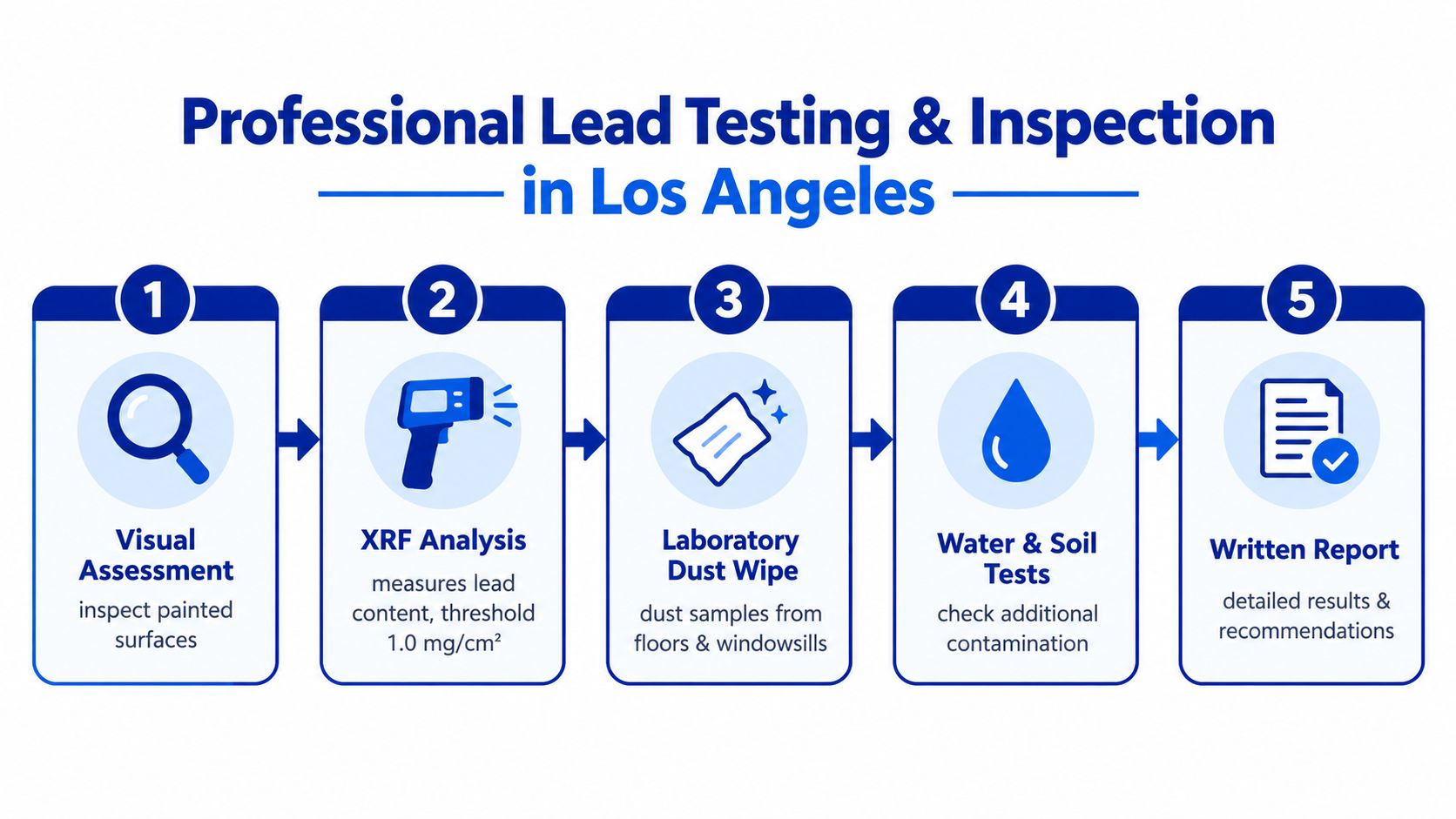
A professional lead inspection usually starts with a visual review of the property. The inspector notes surface condition, friction points, impact points, chewable surfaces, visible deterioration, and the locations where occupants are most likely to contact dust.
In Los Angeles, that often means older windows, doors, stair rails, garage-to-house transitions, exterior trim, and porches in pre-1978 structures. In rental or commercial settings, the inspection may also focus on common areas, turnover work, maintenance practices, and documentation needs.
The main testing methods
Different methods answer different questions.
XRF paint testing
This method is commonly used to evaluate painted surfaces against the federal 1.0 mg/cm2 threshold for lead-based paint. It helps map where lead-containing coatings are present without relying only on visible damage.Dust wipe sampling
This method measures settled lead dust on surfaces such as floors, interior window sills, and troughs. Samples are collected in a defined area and sent to a qualified laboratory for analysis in µg/ft2.Paint chip laboratory analysis
In some projects, paint samples are physically collected and analyzed by a laboratory, particularly when confirmation is needed for documentation or project planning.Additional environmental sampling when relevant
Depending on the property and the concern, owners may also consider soil, water, or other environmental testing through the appropriate scope of work.
Why chain of custody and reporting matter
A result is only as useful as the documentation behind it. Proper sample labeling, site notes, chain of custody, and clear reporting help owners, contractors, and managers understand not just that lead was found, but where, in what form, and in what amount.
For people who need project-specific help, lead testing in Los Angeles can include inspection, sampling, and laboratory analysis that documents paint and dust conditions before renovation, during due diligence, or after identified deterioration. In that same broader project environment, many properties also require asbestos testing, pre-demolition asbestos surveys, SCAQMD Rule 1403 asbestos testing, mold sampling after water damage, or indoor air quality testing depending on the building history.
Good lead testing doesn't just say “positive” or “negative.” It tells you which surfaces are sources, which areas show dust loading, and what that means for decision-making.
What to Do When Results Exceed Thresholds and Next Steps
A result over a threshold doesn't automatically answer every next-step question. It tells you what kind of problem has been documented.
That distinction matters because a paint-content result, a dust result, and a blood result each lead to different conversations.
Read the result by category
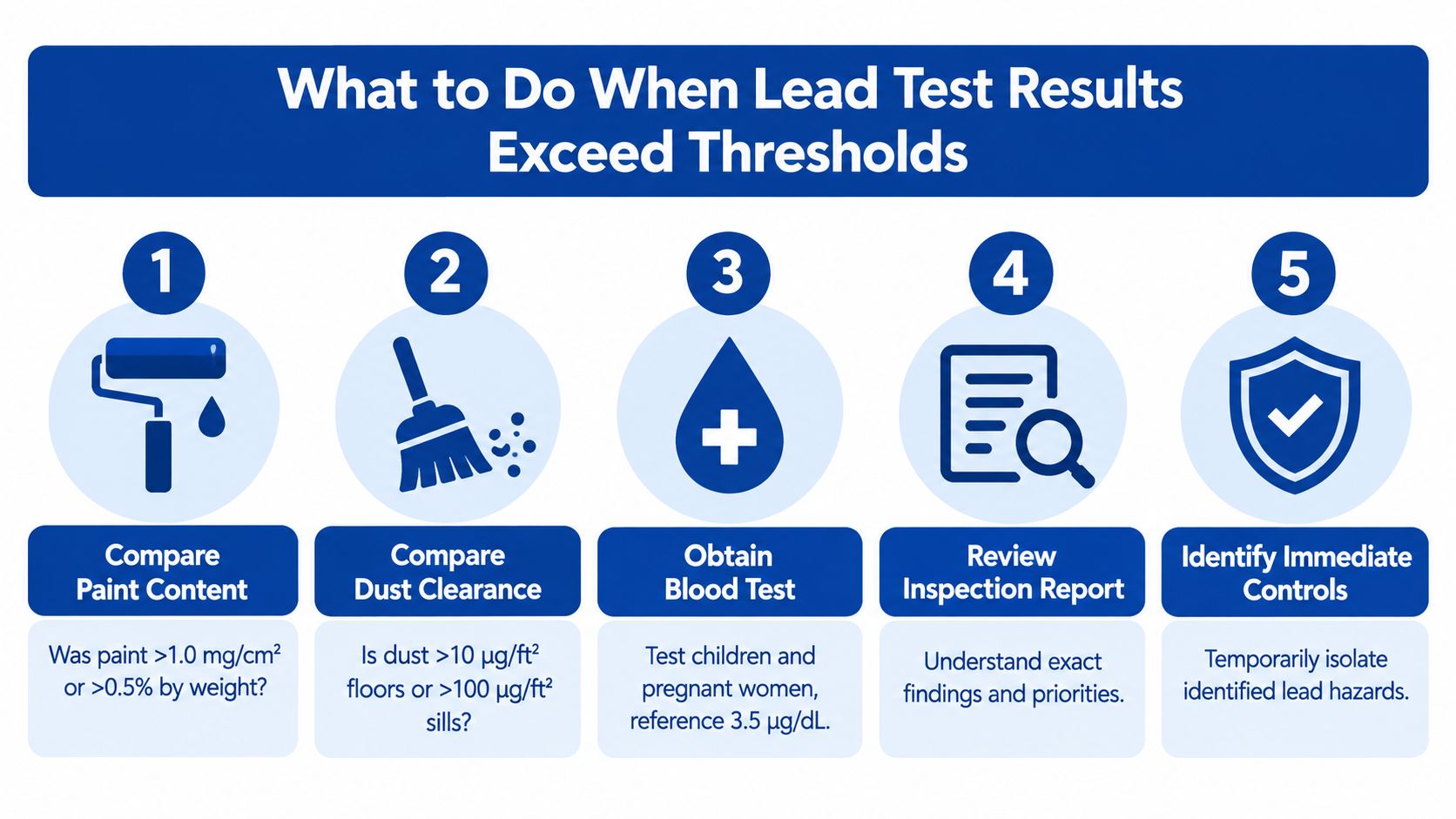
If paint meets the lead-based paint definition, that confirms the source material contains lead. It doesn't automatically tell you whether dust has spread.
If dust wipe samples exceed the applicable benchmark, that documents an exposure pathway on surfaces. In practical terms, that often becomes the more urgent operational issue because it affects cleaning verification, occupant management, and work planning.
If a child's blood lead is above CDC's 3.5 µg/dL reference value, that's a screening flag for exposure higher than most U.S. children, not a stand-alone property diagnosis. It should prompt medical guidance and careful review of potential environmental sources, including paint and dust.
Use the report to decide what kind of follow-up is needed
The next step often depends on who you are and why testing was done.
- Homeowners may need help identifying whether the issue is isolated to one friction area or more widely distributed.
- Landlords and property managers often need documentation for maintenance planning, tenant communication, and follow-up verification.
- Contractors and developers may need the findings to shape containment, sequencing, and additional pre-work environmental testing.
- Commercial owners and facility managers may need records that support due diligence and occupancy-sensitive decision-making.
A useful report should separate source findings from exposure findings. It should also note exact sample locations, methods used, and whether further assessment or clearance-style testing would be appropriate after cleaning or other corrective work by qualified parties.
Don't confuse a blog article with a scope of work
Lead decisions are property-specific. A scraped windowsill in a single-family house, dust in a child-occupied rental unit, and findings in a commercial building under renovation are not the same scenario.
For readers trying to understand where assessment ends and hazard-control work begins, lead abatement in Los Angeles and protecting occupants in older homes and buildings provides useful background on that distinction. The important point here is that testing gives everyone the same starting document, so decisions are based on measured conditions instead of guesswork.
Schedule Professional Lead Testing With Sensitive Environmental
The shortest honest answer to how much lead paint is toxic is this. There isn't one single amount that applies in every situation.
What matters is whether the paint contains lead, whether it is creating settled dust on surfaces people contact, and whether testing shows a condition that needs further evaluation. That's why owners, landlords, buyers, contractors, and property managers in Los Angeles benefit from professional lead inspections instead of relying on appearance alone.
Lead testing also fits into a bigger environmental due-diligence picture. Older Southern California properties often raise overlapping questions about asbestos before renovation or demolition, mold after water intrusion, indoor air quality in occupied spaces, or wildfire-related residue after smoke events. Environmental testing helps sort those issues into documented findings so the right professionals can decide what comes next.
If you're dealing with peeling paint, pre-1978 construction, planned renovation, tenant concerns, or real estate due diligence, schedule lead testing before assumptions turn into preventable exposure.
Sensitive Environmental provides professional lead testing, lead-based paint inspections, dust wipe sampling, and clear laboratory reporting for residential and commercial properties throughout Los Angeles and Southern California. If you need documented answers before renovation, after visible paint deterioration, or during property due diligence, visit Sensitive Environmental to discuss the right testing approach for your building.