A tenant calls to report headaches and eye irritation after moving into a Los Angeles office. Another occupant notices a musty odor near the copy room. The facility manager checks the thermostat, places a consumer monitor on a desk, and still can't explain why complaints appear only in the afternoon. The problem may involve ventilation, moisture, building materials, cleaning products, outdoor smoke, or several sources at once.
An indoor air quality assessment turns that uncertainty into an organized investigation. It combines building inspection, occupant information, HVAC review, targeted measurements, sampling when justified, and laboratory analysis when the suspected contaminant requires it. The objective isn't to produce a vague “air quality score.” It's to identify conditions that may affect the building, determine what evidence supports each conclusion, and give the owner or manager a defensible basis for next steps.
Table of Contents
- Why Indoor Air Quality Assessment Matters for Your Property
- Understanding What IAQ Assessments Measure
- The Professional IAQ Assessment Process
- Interpreting Results and Compliance Standards
- DIY Testing vs. Professional Environmental Assessment
- When to Commission an Indoor Air Quality Assessment
Why Indoor Air Quality Assessment Matters for Your Property
Property complaints rarely arrive as neatly labeled technical problems. A resident may describe a chemical smell after new flooring was installed. Employees may feel uncomfortable in one conference room but not another. A school may notice symptoms after a water intrusion, while a multifamily manager may hear concerns only when the HVAC system starts each morning. Those details matter because timing, location, and building operation often point toward the source.
Americans spend approximately 90% of their time indoors, and the EPA reports that concentrations of some indoor pollutants are often 2 to 5 times higher than typical outdoor levels. EPA exposure studies also found a dozen common organic pollutants in homes at about 2 to 5 times outdoor concentrations. These findings help explain why indoor air quality assessment has become an important building-health and environmental due-diligence practice in major U.S. markets. See the EPA overview of indoor air quality for the agency's discussion of indoor exposure and related health concerns.

The building tells part of the story
The EPA links indoor air pollution with respiratory illness, asthma, heart disease, cancer, and, in some cases, acute carbon monoxide fatalities. That doesn't mean every odor or complaint indicates a serious hazard. It does mean a property owner shouldn't dismiss repeated concerns or assume that a single reading explains everything.
A professional assessment asks practical questions:
- Who is affected: Are complaints limited to one person, one room, one floor, or a broader population?
- When symptoms or odors appear: Do they follow occupancy, cleaning, cooking, HVAC cycles, renovation activity, or outdoor smoke?
- Where conditions change: Are complaints concentrated near a return duct, fresh-air intake, damp wall, garage connection, or newly installed material?
- What the building is doing: Is outdoor air reaching occupied rooms, and are moisture or pollutant sources being introduced faster than the system can control them?
Practical rule: A useful IAQ investigation explains the building condition behind a measurement. It doesn't treat a measurement as the entire diagnosis.
Ventilation improvements may become part of a property's broader response, especially when the assessment identifies inadequate outdoor-air delivery. Owners researching system options can review this resource on energy-efficient ventilation for homes to understand how ventilation design can support indoor conditions. The testing decision should still come first, because changing airflow without understanding the source can move contaminants rather than resolve the underlying issue.
Understanding What IAQ Assessments Measure
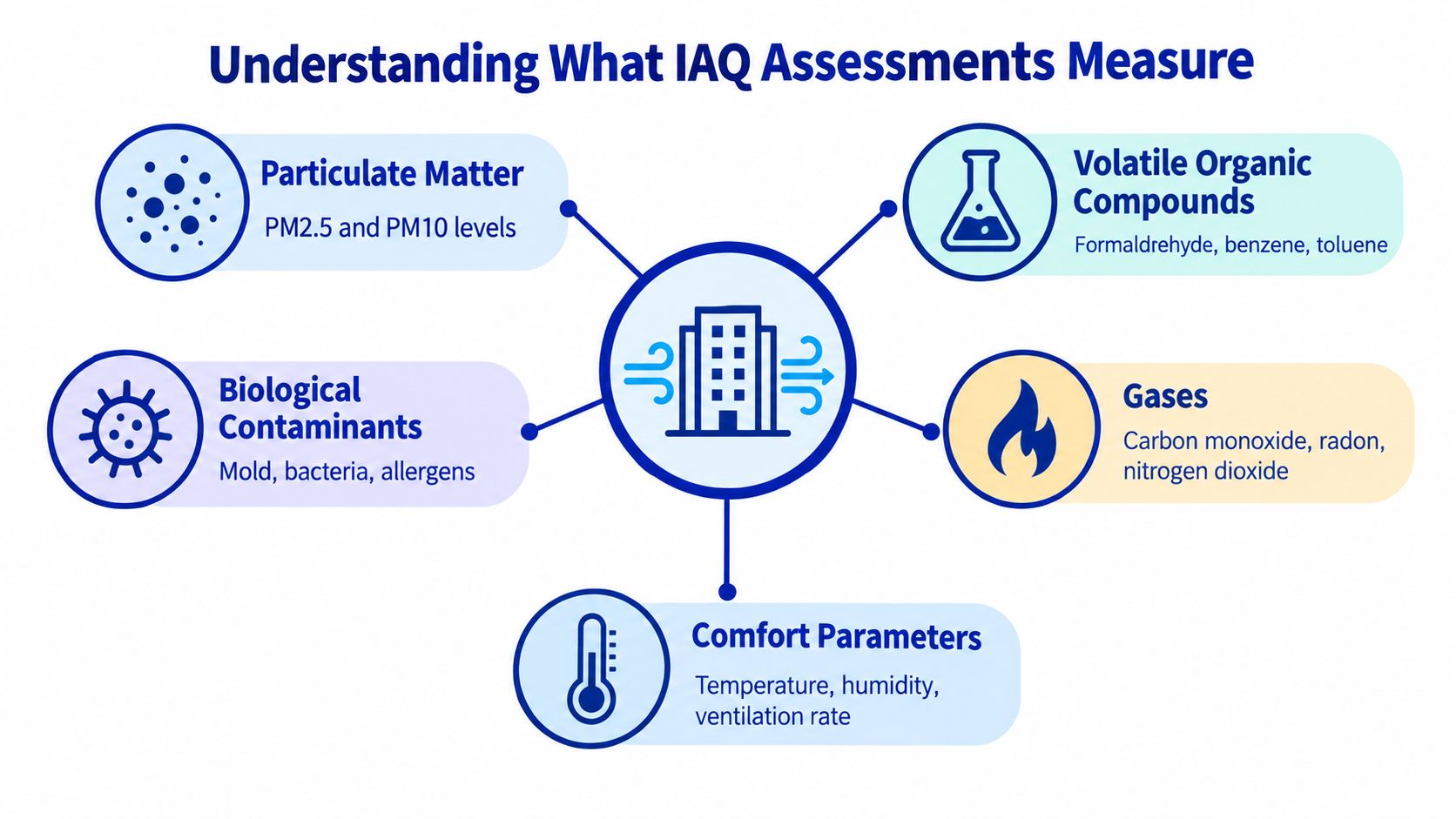
An assessment starts with the suspected problem, not a universal list of tests. EPA identifies common indoor pollutants that include particulate matter, carbon monoxide, smoke, radon, mold, and VOCs. A qualified consultant chooses measurements and samples based on the building's use, history, occupants, complaint pattern, and likely sources. The EPA technical overview of volatile organic compounds explains that VOCs are organic compounds capable of evaporating under normal indoor atmospheric conditions.
Start with the indicators that explain building operation
Carbon dioxide, or CO2, commonly acts as a ventilation proxy. ASHRAE-related guidance often treats about 1,000 ppm as a practical upper benchmark for occupied spaces, while school-focused EPA guidance cites 700 ppm above outdoor CO2 as an upper limit, usually around 1,000 ppm indoors. These figures come from OSHA's technical guidance on indoor air quality. CO2 doesn't identify every pollutant, but high readings can indicate that outdoor-air delivery is insufficient for the occupancy and operating conditions.
Temperature and relative humidity help explain comfort, condensation risk, and moisture behavior. A reading becomes more useful when paired with evidence from walls, ceilings, mechanical rooms, crawlspaces, and HVAC components. Humidity alone doesn't prove mold growth, and a comfortable temperature doesn't prove that ventilation is adequate.
Particulate matter includes small airborne particles that may come from outdoor pollution, combustion, construction, cooking, wildfire smoke, or disturbed materials. Real-time particle monitoring can show changes during activities or HVAC cycles, but it may not identify the chemical composition or source of those particles.
Add targeted contaminants when the evidence supports them
VOCs may come from paints, adhesives, furnishings, flooring, cleaning products, or other materials. Formaldehyde, benzene, and toluene are examples of compounds that may be included when the building history and symptoms justify targeted testing. A laboratory report should identify the compounds detected, their concentrations, sample locations, and the interpretation framework used.
Biological contaminants may include mold spores, bacteria, and allergens. Air sampling can help answer a specific question, but it doesn't replace a visual moisture inspection or source evaluation. A building can have a moisture problem even when a limited air sample doesn't capture a meaningful difference.
Gases may include carbon monoxide, radon, and nitrogen dioxide when combustion equipment, soil gas, garages, or other sources make those hazards relevant. The appropriate method varies by contaminant. For example, a direct-reading instrument, a passive device, and a laboratory sample don't provide interchangeable evidence.
Material choices can also contribute to the investigation. If new flooring or finishes are suspected, owners may find it useful to review information about healthy hardwood floors for Richmond homes as background on low-emitting material considerations. For a practical guide to the questions that should precede testing, review how to test for air quality in your home.
The Professional IAQ Assessment Process
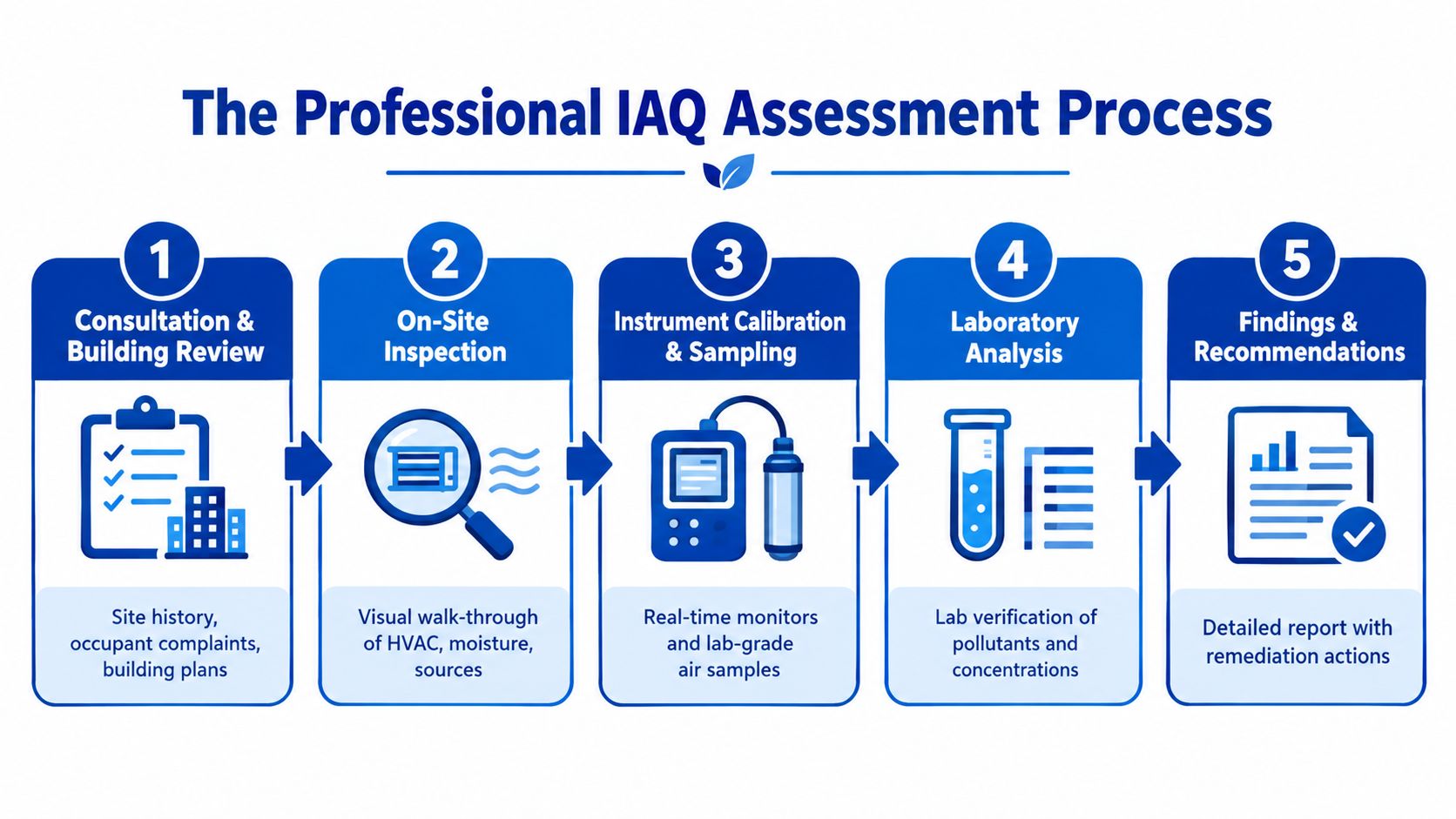
Placing an air pump in a room is only one possible part of an investigation. Health Canada states that most IAQ assessments can be completed without immediate air sampling, with sampling generally considered after walkthroughs, occupant surveys, building inspections, and operational log reviews. Its guidance for indoor air quality professionals supports a diagnostic workflow rather than a pollutant checklist.
1. Consultation and building review
The consultant begins with the property's history. Useful records may include renovation dates, water intrusion reports, HVAC service logs, chemical use, fire or smoke exposure, tenant complaints, floor plans, and occupancy patterns. The consultant also asks who is affected, where concerns occur, when they begin, and whether symptoms or odors change with weather, work activity, or HVAC operation.
This stage prevents a common error, testing the wrong room for the wrong contaminant. A complaint near a return duct calls for a different investigation from a complaint after a roof leak or a new flooring installation.
2. On-site inspection
The walkthrough examines visible moisture, staining, condensation, musty odors, damaged materials, ventilation paths, filters, ducts, air handlers, fresh-air intakes, exhaust points, and locations where pollutants may enter. The consultant may use direct-reading instruments to document temperature, humidity, CO2, carbon monoxide, and particle conditions while observing how the building operates.
The most informative sample location is often chosen after the consultant understands airflow and occupant activity, not before.
3. Operational review and targeted sampling
The consultant compares findings with building operation. Are supply diffusers delivering air? Are exhaust systems functioning? Does the complaint occur during a particular HVAC schedule? Does a pressure relationship draw air from a garage, loading area, crawlspace, or construction zone?
Sampling may then target formaldehyde, VOCs, mold-related conditions, combustion gases, particles, or other contaminants. EPA guidance used in federal facility specifications calls for baseline testing with the EPA Compendium of Methods, at least one sampling point per 25,000 square feet for each ventilation zone, and a three-day sampling cycle with averaged results. The EPA federal facility specification also lists practical indoor limits such as formaldehyde below 20 µg/m3, or 16.3 ppb, total VOCs below 200 µg/m3, and carbon monoxide below 9 ppm.
Those specifications aren't a universal prescription for every home or commercial property. The consultant must still match sampling duration, locations, and methods to the question being investigated.
4. Laboratory analysis and reporting
Samples go to an appropriate laboratory for analysis. The report should connect laboratory findings to sample locations, field notes, building conditions, and the original complaint. A result without context can be technically correct yet practically misleading.
Sensitive Environmental provides environmental testing services that may include professional inspection, sampling, laboratory analysis, and reporting for property-related environmental questions. The important deliverable is not just a lab number. It's a clear explanation of what the evidence supports and what remains uncertain.
Interpreting Results and Compliance Standards
Laboratory results need context before they can guide a property decision. A detected compound isn't automatically a dangerous condition, just as a nondetect result doesn't prove that every building area is free of pollutants. The consultant considers the contaminant, concentration, sampling method, duration, location, background conditions, building use, and whether occupants or activities could have changed during the test.
VOCs illustrate this challenge. The EPA states that no federally enforceable standards have been set for VOCs in non-industrial indoor settings. As a result, an IAQ assessment usually relies on targeted sampling, comparison with background or reference conditions, health-based guidance where appropriate, and professional interpretation rather than one federal pass or fail number. The EPA discussion of VOC impacts on indoor air quality explains why source identification and interpretation matter.
Read the report as an investigation
A useful report should answer several questions:
- What was sampled: Identify the medium, contaminant group, method, and laboratory.
- Where was it sampled: Connect each result to a room, ventilation zone, material, or complaint area.
- Under what conditions: Note occupancy, HVAC operation, weather, renovation activity, and any unusual event.
- What does it mean: Explain whether the result supports a source, ventilation concern, moisture condition, or need for additional investigation.
- What should happen next: Recommend further assessment, source control, building-system review, documentation, or consultation with an appropriately qualified professional when warranted.
For a building-level baseline, the EPA specification referenced above provides specific sampling and indoor-limit examples. A consultant may use those values as part of a project framework, while recognizing that the correct benchmark depends on the project, method, and applicable program.
Connect results to the property decision
A CO2 pattern that rises in occupied rooms may support a ventilation investigation. A VOC result near newly installed materials may justify source identification and follow-up sampling. A particle spike during wildfire smoke or construction activity may require event-based monitoring rather than reliance on a quiet-day sample.
The same reasoning applies to mold, asbestos, lead, and combustion byproducts. A positive test identifies evidence that must be evaluated in context. It doesn't automatically dictate remediation or abatement. For renovation and demolition in the Los Angeles region, asbestos findings may also affect project documentation and regulatory planning under SCAQMD Rule 1403, which requires notifications and appropriate procedures for affected work. The Los Angeles-area Rule 1403 guidance illustrates why pre-renovation and pre-demolition surveys are part of project planning, not merely optional air checks.
DIY Testing vs. Professional Environmental Assessment
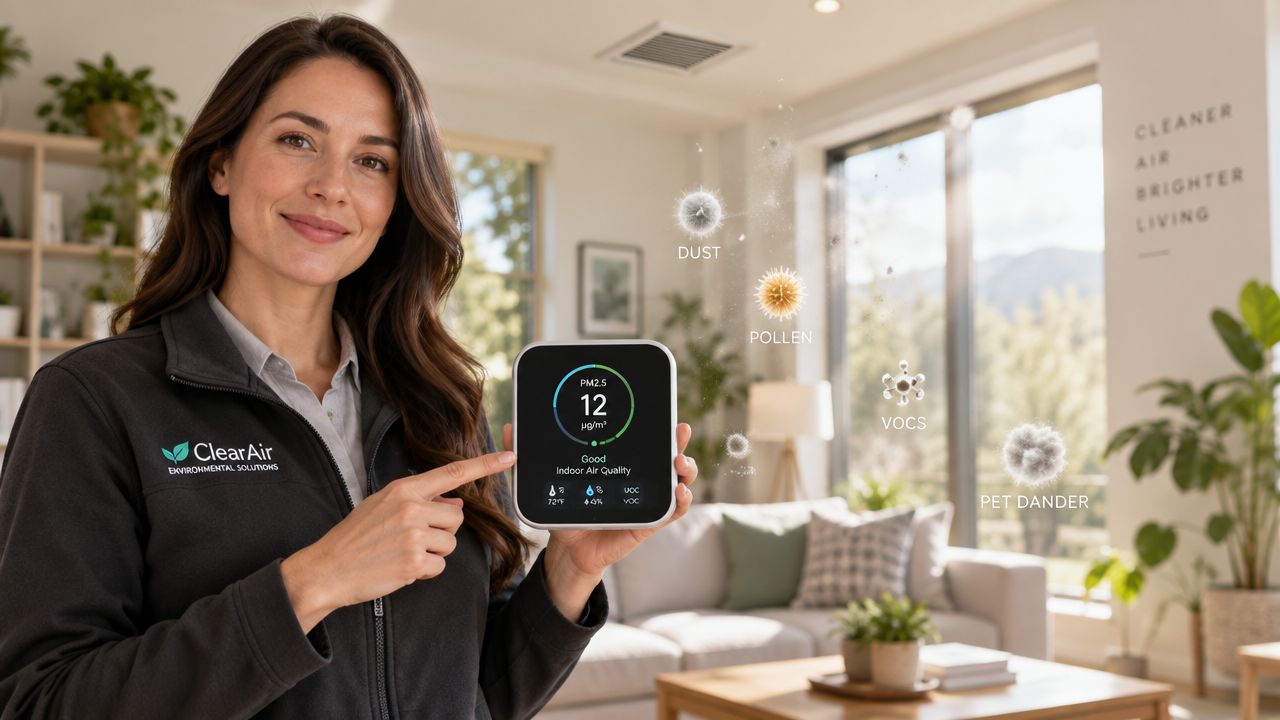
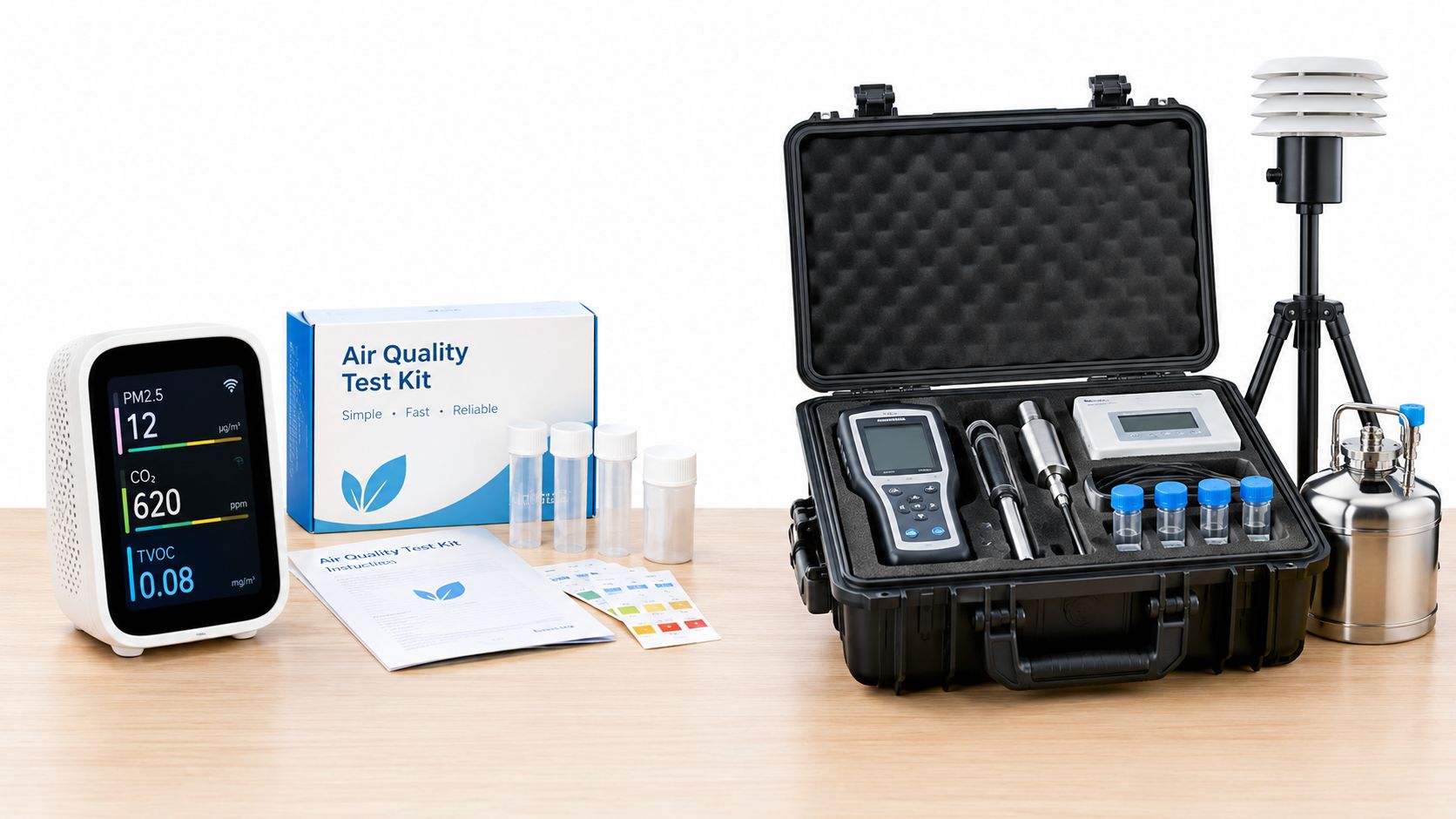
Consumer monitors can help a homeowner notice patterns. They may track temperature, humidity, carbon dioxide, carbon monoxide, particulate matter, formaldehyde, radon, or VOCs, depending on the device. EPA's technical overview of low-cost indoor air monitors explains the types of gases and particles these devices commonly target.
That usefulness has limits. A monitor may not be calibrated for the conditions in the building, may not identify a specific compound, and may not distinguish between sources. It can show that particles increased while cooking or that CO2 rose in a crowded room, but it generally can't establish whether a material, moisture condition, HVAC component, or outdoor event caused the change.
What each approach can and can't answer
| Approach | Useful for | Main limitation |
|---|---|---|
| Consumer monitor | Observing trends in CO2, particles, temperature, or humidity | May not identify the contaminant or provide defensible laboratory evidence |
| Home test kit | Screening for a selected concern | Often limited in location, timing, method, and interpretation |
| Professional field assessment | Connecting complaints, airflow, moisture, sources, and measurements | Requires a defined scope and qualified interpretation |
| Laboratory analysis | Identifying or quantifying contaminants in submitted samples | Results still require building and sampling context |
A single snapshot can miss intermittent conditions. Cooking emissions, cleaning, renovation dust, wildfire smoke, and HVAC cycles may create short-lived peaks. Newer IAQ work increasingly emphasizes multi-instrument and event-based monitoring because static samples don't always represent the exposure pattern occupants experience. A 2026-oriented assessment therefore may focus on time-resolved conditions, building operation, and occupant activity rather than one consolidated score.
Documentation changes the decision
DIY tools are especially weak when the owner needs evidence for a transaction, tenant complaint, insurance file, renovation plan, or regulatory process. A professional assessment documents sample locations, field conditions, equipment, methods, chain of custody when applicable, and laboratory findings. That record can help property owners, contractors, facility managers, and consultants decide whether additional testing or another environmental service is appropriate.
The same distinction applies to mold concerns. Before relying on a home kit, consider the limitations discussed in whether home mold test kits are reliable. A professional mold inspection may identify moisture sources and damaged materials that an isolated air sample cannot explain.
When to Commission an Indoor Air Quality Assessment
Commission an assessment when the building history or occupant experience creates a specific environmental question. The strongest trigger isn't only that a monitor displays an unusual number. It's a pattern that calls for documented investigation.
Consider professional IAQ testing or inspection in these situations:
- After water damage: Leaks, flooding, condensation, or damp building materials may justify moisture evaluation and mold-related testing when the building history supports it.
- After occupant complaints: Repeated headaches, irritation, odors, coughing, or discomfort should be documented by location, timing, affected population, and building activity.
- Before purchase or occupancy: An environmental assessment can support property due diligence, especially in older, renovated, mixed-use, or previously damaged buildings.
- After renovation: New flooring, paint, adhesives, cabinetry, or furnishings may introduce VOC sources that call for targeted evaluation.
- After wildfire or smoke intrusion: Ash, soot, char, smoke residue, and combustion byproducts may require specialized fire residue or heavy-metals testing. Los Angeles County wildfire guidance warns that ash and soot can contain hazardous particles such as heavy metals or asbestos, and recommends a heavy-metals panel including lead, cadmium, arsenic, nickel, and mercury. Review the Los Angeles County wildfire property guidance when evaluating fire-related conditions.
- Before renovation or demolition: An IAQ concern may overlap with asbestos surveys, lead inspections, or other environmental testing required for project planning.
Prepare by gathering floor plans, complaint records, HVAC schedules, maintenance logs, renovation documents, water or fire incident reports, and information about cleaning products or unusual activities. Ask the provider how the scope will address building diagnosis before sampling, which laboratories will be used, and what documentation the final report will contain.
Sensitive Environmental provides indoor air quality testing, mold inspections, asbestos surveys, lead testing, commercial environmental testing, industrial hygiene assessments, and combustion byproduct testing for properties in Los Angeles and Southern California. For a property with complaints, moisture history, renovation activity, or smoke exposure, contact Sensitive Environmental to discuss a targeted IAQ inspection and sampling plan. Their team can help document building conditions, coordinate appropriate laboratory analysis, and explain what the results mean for your next decision.