You're opening a wall in a Los Angeles home built before modern material controls were common. The contractor wants to remove a textured ceiling, replace old windows, and disturb several painted door frames. You may be asking two questions at once: what's inside the building materials, and what's on the painted surfaces?
That's where asbestos and lead testing belong in one decision framework. They're different hazards, tested with different methods, interpreted under different rules, and documented in different reports. Yet an older property can contain both, particularly when renovation reaches floors, insulation, windows, trim, ceilings, or utility spaces.
Table of Contents
- Why Asbestos and Lead Testing Often Travel Together
- What Each Test Actually Looks For
- Asbestos Versus Lead Testing at a Glance
- How Sampling and Lab Analysis Work in Practice
- California and SCAQMD Rules That Trigger Testing
- Reading Results and Deciding What Comes Next
- Getting Ready for Professional Testing in Los Angeles
Why Asbestos and Lead Testing Often Travel Together
An older Los Angeles house is a time capsule. A vinyl floor installed decades ago may contain asbestos in the tile or backing, while the door frame painted during the same period may contain lead-based paint. A bungalow in Mar Vista, Silver Lake, Echo Park, or Highland Park can therefore require separate answers for adjacent layers of the same room.
Lead-based paint became a major housing concern even after the U.S. effectively phased it out for new residential use in 1978, when the Consumer Product Safety Commission lowered the maximum allowable lead content in paint to 0.06% by weight. A Georgia environmental operations manual states that approximately 90% of homes built before 1978 contain significant amounts of lead-based paint (Georgia environmental operations and maintenance manual). That doesn't prove a specific house contains lead, but it explains why age is an important screening clue.
Asbestos follows a different history. It was used in many building products, including insulation, floor materials, siding, mastics, and textured finishes. Its presence depends on the product, installation date, renovation history, and condition. Age identifies a reason to investigate, not a laboratory result.
Practical rule: Don't treat one inspection as a substitute for the other. Asbestos testing answers a fiber-content question. Lead testing answers a paint, dust, or soil contamination question.
Ordering both assessments during the same property visit can help reduce repeated access arrangements and duplicate site coordination. The overlap is chronological and physical, not regulatory. A combined scope still needs separate sampling plans, qualifications, laboratories, and reports. For a plain-language explanation of why these hazards shouldn't be confused, see how lead and asbestos differ.
What Each Test Actually Looks For
Walk through a 1960s ranch as a consultant would. In the living room, the textured ceiling is an asbestos suspect material. In the garage, insulation around an older boiler may require asbestos sampling. Exterior transite siding, floor tile mastic, and pipe wrap behind a bathroom wall can also warrant investigation before disturbance.
Asbestos follows the material
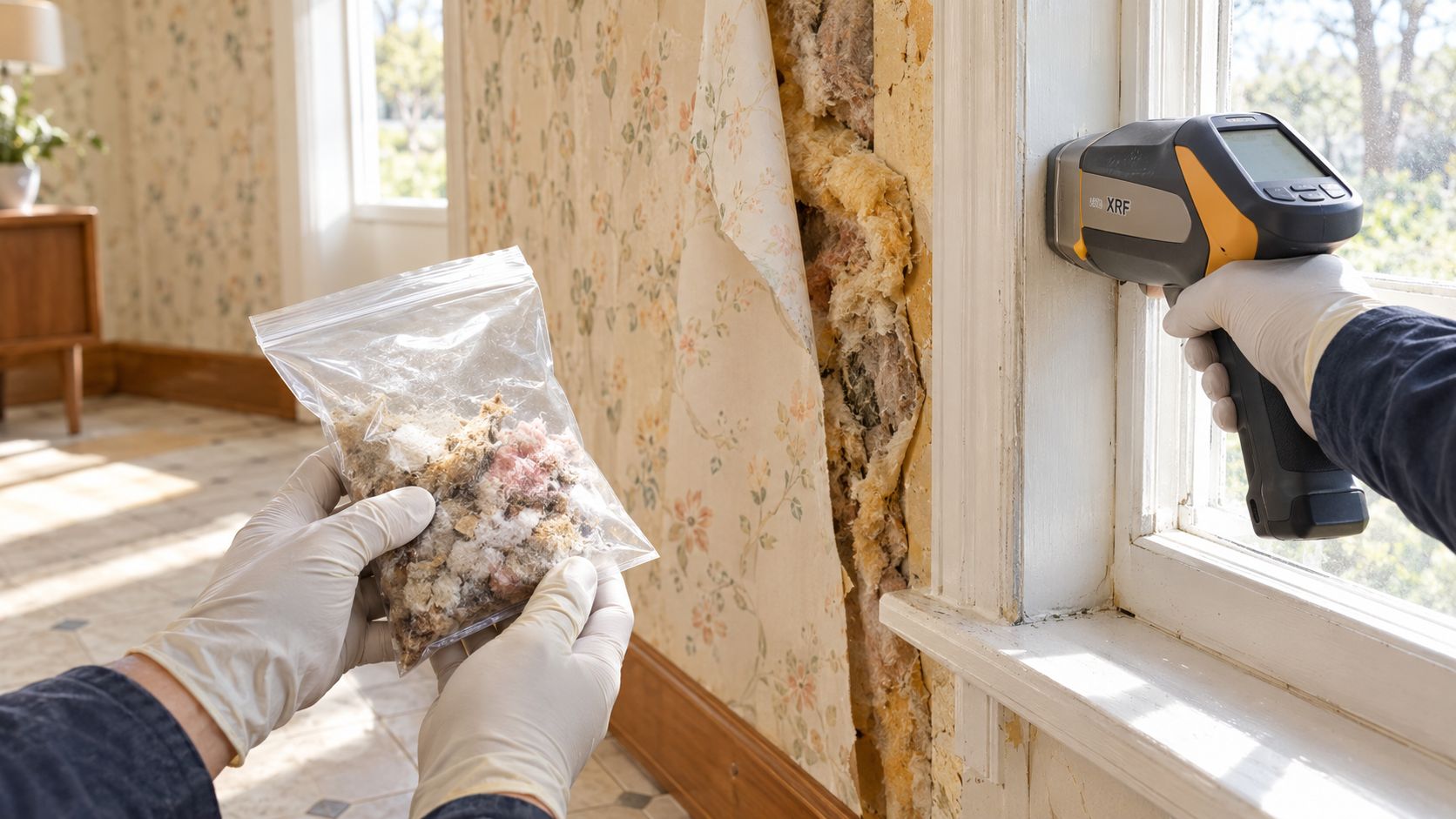
Asbestos testing generally uses bulk samples. A qualified asbestos consultant identifies homogeneous materials, collects small representative pieces, labels them, and sends them to a laboratory for analysis, commonly by polarized light microscopy, or PLM. The purpose is to determine whether asbestos fibers are present in the sampled material and to document where that material occurs.
The inspector isn't testing “the house” as one invisible cloud. A ceiling texture, pipe insulation, floor tile, and siding panel are separate materials. If they look different, were installed at different times, or have different layers, they may require separate sampling decisions.
The result also depends on whether the material is intact, damaged, accessible, or likely to be disturbed. A material hidden behind an undisturbed wall may present a different project concern from the same material being cut, sanded, drilled, or demolished.
Lead follows painted surfaces and settled contamination
Lead testing focuses on lead-based paint, and where relevant, lead in dust or bare soil. A certified lead inspector or risk assessor may use an X-ray fluorescence analyzer, or XRF, on walls, trim, doors, windows, and other painted components. XRF readings can provide field information without removing a paint layer.
Dust wipes answer a different question. They measure lead dust collected from surfaces such as floors, window sills, and window troughs. The EPA's current dust-lead action levels are less than 5 micrograms per square foot for floors, less than 40 micrograms per square foot for interior window sills, and less than 100 micrograms per square foot for window troughs (EPA dust-lead field guide).
Paint-chip samples may be sent for laboratory confirmation using techniques such as atomic absorption or ICP-MS. The important point is simple: asbestos and lead may occupy the same room, but they don't occupy the same analytical category.
Asbestos Versus Lead Testing at a Glance
The quickest way to avoid confusion is to compare the decisions side by side. Both assessments can support renovation planning, property management, real estate due diligence, and regulatory documentation, but the fieldwork and deliverables differ.
| Criteria | Asbestos Testing | Lead Testing |
|---|---|---|
| Target hazard | Asbestos fibers in suspect building materials | Lead-based paint, lead dust, and, where relevant, lead in soil |
| Common suspect materials | Textured finishes, insulation, floor tile, mastic, pipe wrap, transite siding | Paint on walls, trim, doors, windows, railings, and other components |
| Primary sampling method | Destructive or minimally destructive bulk sampling | Non-destructive XRF screening, with dust wipes or paint chips when appropriate |
| Laboratory technique | Polarized light microscopy, or PLM, for many bulk materials | Laboratory analysis may use ICP-MS or flame atomic absorption for paint or dust samples |
| Professional role | Certified Asbestos Consultant or appropriately qualified asbestos professional | Certified Lead Inspector or Risk Assessor |
| Regulatory framework | Cal/OSHA asbestos requirements, California regulations, and SCAQMD Rule 1403 where applicable | EPA and HUD requirements, California lead rules, and project-specific funding or facility requirements |
| Typical project trigger | Renovation, demolition, repair, or disturbance of suspect materials | Renovation, rehabilitation, child-occupied use, federally assisted housing, or concern about painted surfaces |
| Typical deliverable | Asbestos survey or testing report with sampled materials, locations, and laboratory findings | Lead inspection, risk assessment, dust-wipe report, or paint-testing report |
| Main decision supported | Whether suspect materials contain asbestos and how project work should account for them | Whether painted components or settled dust require further evaluation and how results affect project planning |
Where the tests overlap
A pre-1978 property undergoing renovation may need both. A contractor removing a wall could expose pipe insulation while also disturbing painted trim. A property manager planning window replacement may need lead information for the painted window components and asbestos information for adjacent caulks, panels, or interior materials.
Where they separate
Asbestos sampling asks what a material contains. Lead testing often asks what a painted component contains and whether lead dust is present at a particular surface. One negative result doesn't clear the other hazard, and one professional report shouldn't be stretched beyond the locations and materials it covers.
How Sampling and Lab Analysis Work in Practice
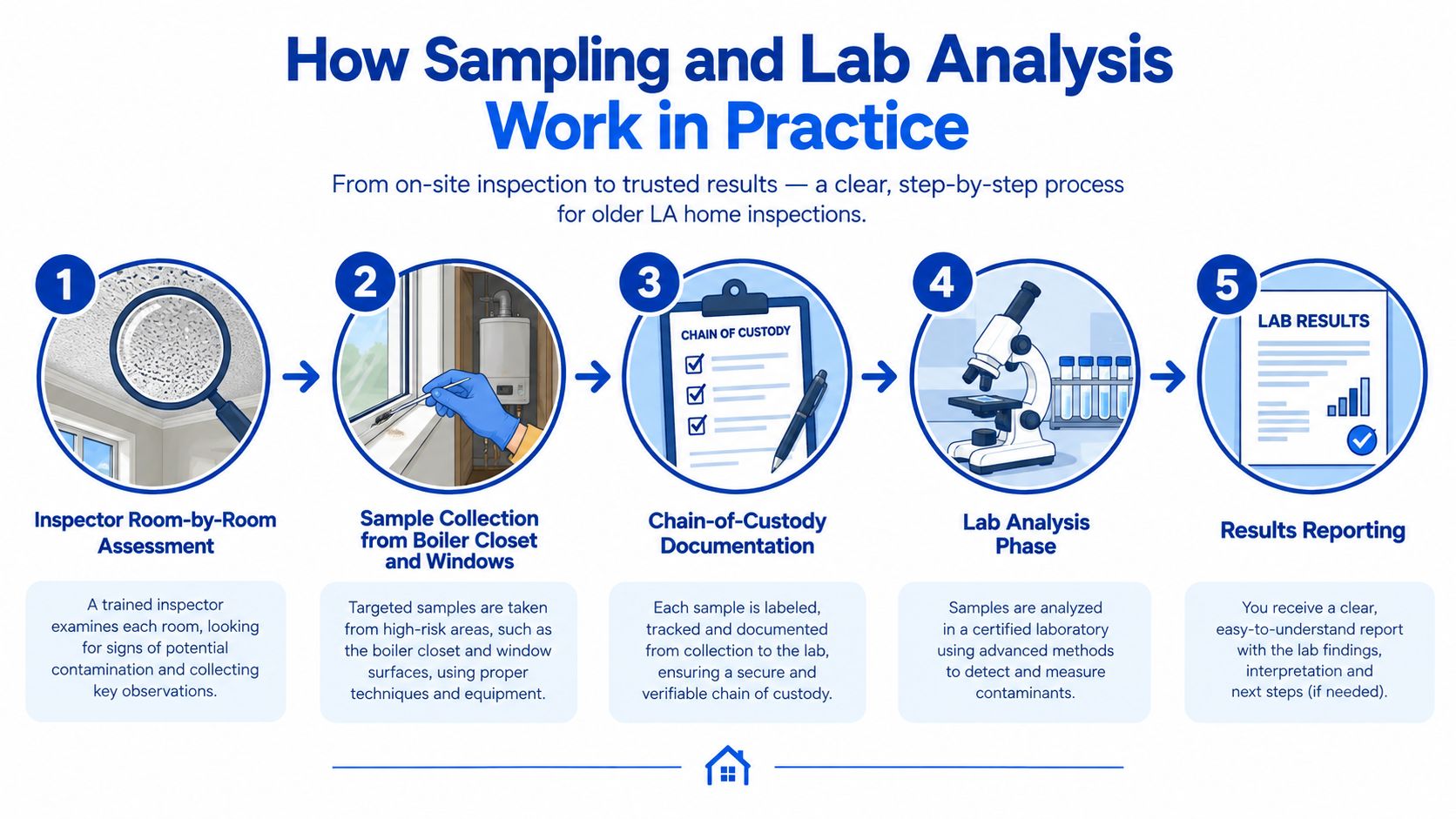
A typical older Los Angeles home inspection starts with a room-by-room walkthrough. The consultant reviews textured ceilings, original windows, boiler closets, utility rooms, floor layers, pipe insulation, and any areas marked for demolition or renovation. Existing plans and renovation records help, but the field inspection determines which materials are present and accessible.
The asbestos sample path
For asbestos, the sampler may use a coring tool or carefully chip a small piece from a suspect material. The goal is to collect a representative sample without pulverizing the material or spreading unnecessary debris. Each fragment goes into a labeled container or bag, and the sampler records the location, material description, sample identification, and requested analysis.
The chain of custody connects the field sample to the final report. It identifies who collected the sample, when it was transferred, and which laboratory received it. That documentation matters for contractors, building owners, consultants, and agencies that need a defensible record rather than an informal visual opinion.
The laboratory commonly examines bulk asbestos samples using PLM. For regulatory work in the South Coast Air Basin, SCAQMD Rule 1403 requires materials analysis using SCAQMD Method 300-91 or the PLM method in 40 CFR Part 763, Appendix A, Subpart F, and analyses for rule compliance must be performed by NVLAP-accredited laboratories (SCAQMD Rule 1403 materials analysis requirements).
The lead sample path
Lead fieldwork looks different. The inspector may press an XRF instrument against painted walls, trim, windows, and doors, recording readings by component and location. Dust wipes are collected from defined surface areas, particularly floors, sills, and troughs, when dust contamination is part of the scope.
Paint chips and dust wipes require their own labeling, preservation, documentation, and laboratory handling. Depending on the requested analysis, the laboratory may use ICP-MS or flame atomic absorption. Results therefore arrive in a different format from asbestos reports, even when both assessments take place during one visit.
The distinction protects the decision. A bulk asbestos sample isn't a lead sample, and a window-sill dust wipe isn't a substitute for paint testing. A complete scope matches the sample type to the question the owner needs answered.
California and SCAQMD Rules That Trigger Testing
Regulations become easier to follow when you start with the planned activity. A property owner doesn't usually need to memorize every provision. The practical question is whether renovation, demolition, rehabilitation, occupancy, funding, or a specific facility type creates a testing or documentation obligation.
California's construction rules address asbestos work, while the EPA Renovation, Repair and Painting framework addresses lead-related renovation practices in covered pre-1978 properties. In the Los Angeles region, SCAQMD Rule 1403 governs asbestos-related renovation and demolition activities across Los Angeles, Orange, Riverside, and San Bernardino counties.
California also provides a concrete pre-demolition trigger. A survey is required before demolition when pipe-covering insulation, steel beam and column fire protection, or HVAC duct work may be involved, and asbestos-related work must comply with the applicable California requirements under Section 1529 (California asbestos survey and demolition requirements).
| Trigger Event | Asbestos Rule | Lead Rule |
|---|---|---|
| Pre-demolition work | Survey suspect materials before demolition; SCAQMD Rule 1403 may govern regional notification, analysis, and project documentation | Evaluate painted components that will be disturbed, especially in covered renovation or rehabilitation work |
| Pre-renovation work | Identify asbestos-containing materials before cutting, drilling, sanding, or removing suspect materials | EPA RRP and project requirements may require lead-safe planning and documentation |
| SCAQMD-covered activity | Follow Rule 1403 analytical and notification requirements where applicable | Lead requirements remain separate from SCAQMD asbestos requirements |
| Federally assisted rehabilitation | Scope asbestos work according to the project and applicable regulations | HUD guidance requires dust-wipe clearance testing instead of cleaning verification in federally assisted pre-1978 housing, and painted surfaces to be disturbed must be tested for lead content. Certain CPD-funded rehabilitation projects require a lead risk assessment when costs exceed $5,000 per unit (HUD lead-based paint rehabilitation guidance) |
| Child-occupied or regulated facility | Review asbestos requirements based on building materials and planned disturbance | Apply the relevant California, EPA, HUD, or facility-specific lead requirements |
Selling a pre-1978 home doesn't automatically require a general lead inspection, but federal disclosure rules address known lead hazards for buyers and tenants. For transaction planning and disclosure context, review California asbestos and real estate disclosure considerations.
Reading Results and Deciding What Comes Next
A report should answer more than “positive” or “negative.” It should identify the material, location, sample number, analytical method, result, limitations, and relationship to the planned work.
Start with the material and location
An asbestos PLM report may identify a fiber type such as chrysotile or amosite and show the reported concentration. It may distinguish a homogeneous material from a result supported by point-count analysis. Those details help determine whether a sample represents a larger material group or only a specific layer or location.
A positive result in one patch of insulation doesn't automatically mean the entire building requires abatement. It means the sampled material contains asbestos and the project team must evaluate the planned disturbance, material condition, scope, and applicable rules with qualified professionals.
Lead reports also require context. HUD/EPA guidance uses a lead-based paint threshold of 1.0 mg/cm² or 0.5% by weight, and calls for a surface-by-surface inspection by a State- or EPA-certified lead-based paint inspector, with a report explaining the results (HUD lead-based paint inspection guidelines). A high reading on one window component doesn't condemn the property. It identifies a component and a condition that require project-specific evaluation.
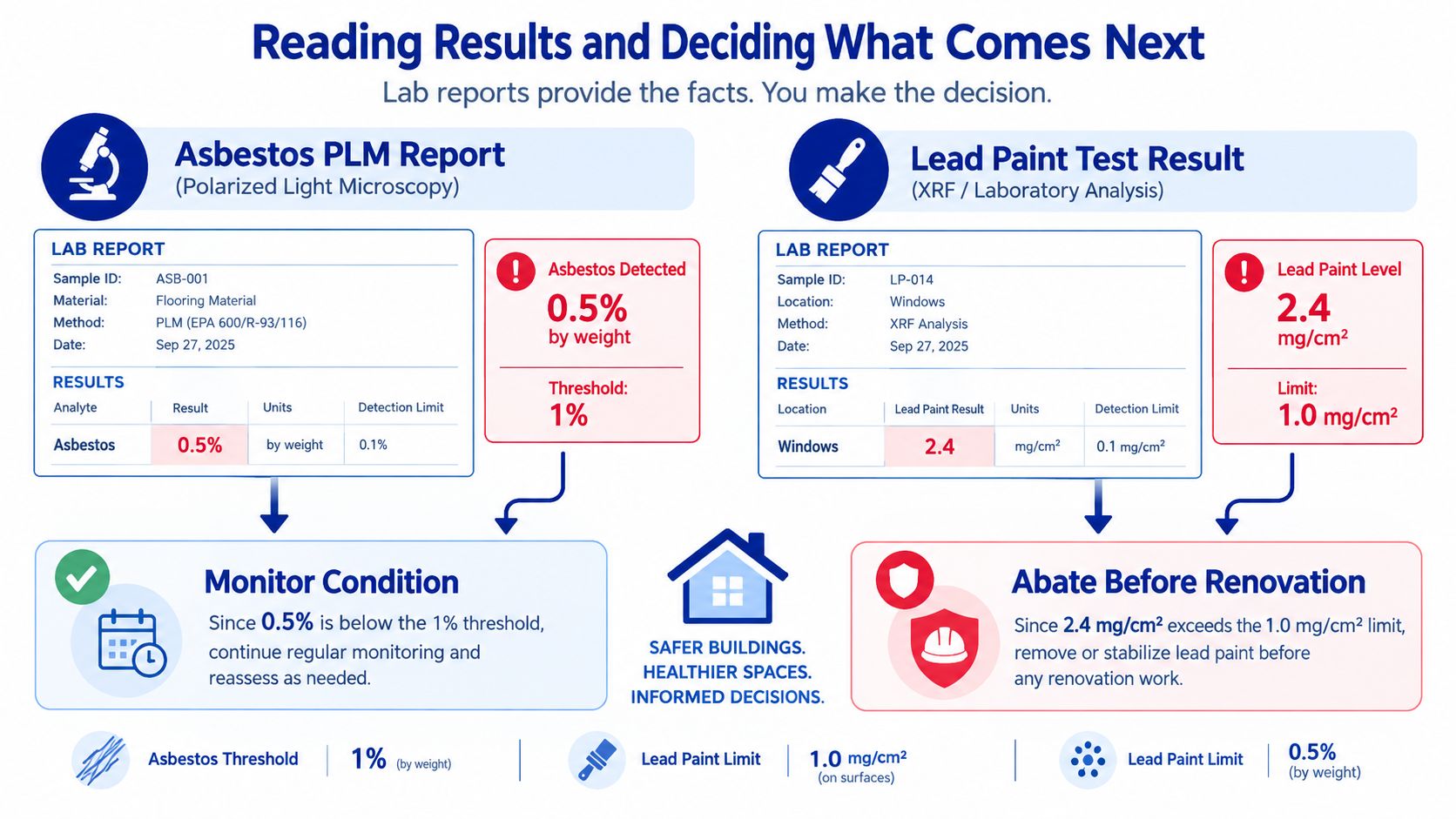
Match the result to the decision
Use the report to ask:
- What was tested? Confirm that every material or surface affected by the planned work appears in the scope.
- Where was it found? Map positive or higher findings to rooms, elevations, components, and work areas.
- What remains uncertain? Missed locations, inaccessible layers, damaged containers, or untested samples can leave the decision incomplete.
- What work is planned? A result may matter differently for routine occupancy, repair, renovation, demolition, or clearance.
A recent 2026 debris investigation reported that three asbestos-related samples weren't fully tested, while more than 24 soil samples collected over several months found measurable lead, chromium, and other contaminants (reporting on the 2026 debris investigation). The lesson is practical: a test report is only as complete as its sampling and analysis.
The next step may involve design changes, controlled work practices, additional sampling, notification, tenant communication, or consultation with a qualified abatement contractor. Testing doesn't itself prescribe a universal response, and a positive result doesn't automatically require a particular remedy.
Environmental testing also isn't medical diagnosis. CDC and ATSDR note that a chest X-ray isn't useful for detecting most asbestos exposure, while environmental testing evaluates materials, dust, air, or soil rather than a person's health status. Vermont guidance also states that pre-1978 paint must be presumed lead-based unless tested by a licensed inspector and that hardware-store lead kits can't verify lead presence (Vermont asbestos and lead requirements).
For complaint follow-up, responsibilities can differ between the Los Angeles County Department of Public Health and City of Los Angeles Department of Building and Safety. Your report provides technical information, but the agency with authority depends on the property, activity, complaint, and applicable jurisdiction.
Getting Ready for Professional Testing in Los Angeles
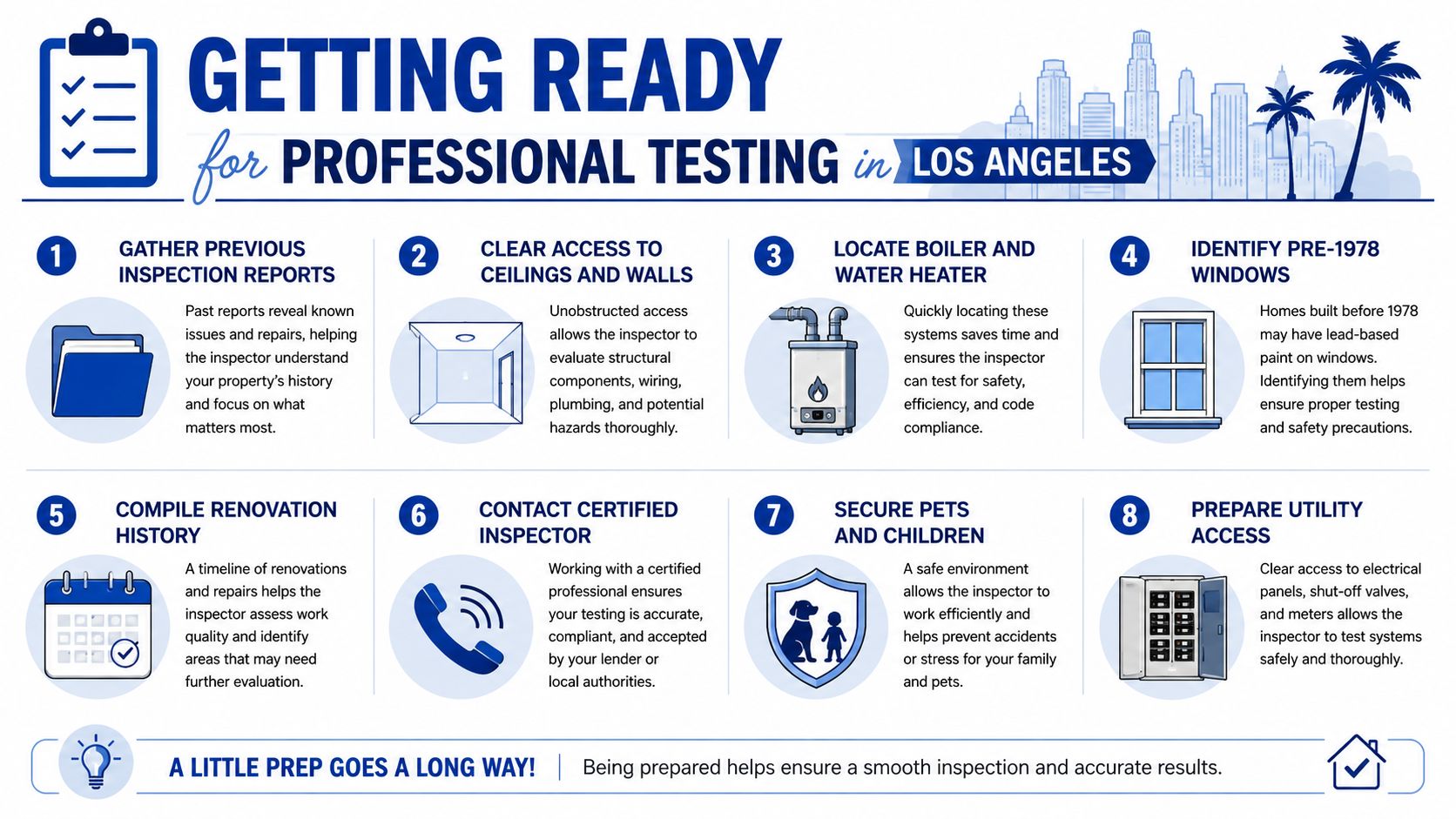
Good preparation makes the inspection more representative and the report more useful. Start by gathering the construction year, renovation history, paint records, prior inspection reports, architectural drawings, and any documentation describing original windows, flooring, insulation, or mechanical systems.
Clear access to areas that may influence the scope:
- Open ceilings and walls: Make textured finishes, wall penetrations, and planned demolition areas visible.
- Locate mechanical spaces: Identify the boiler, water heater, HVAC equipment, attic, basement, garage, and utility closets.
- Secure occupants and pets: Decide whether people, children, and animals should remain elsewhere during sampling.
- Organize project plans: Mark the surfaces contractors intend to remove, drill, sand, replace, or demolish.
- Preserve existing evidence: Don't repaint, scrape, vacuum, or discard suspect material before the consultant documents it.
Questions to ask before scheduling
Ask the firm who will perform each part of the work, which certifications apply, and whether the proposed scope covers both the materials and surfaces your project will disturb. In Los Angeles, confirm the consultant understands Cal/OSHA asbestos requirements, SCAQMD Rule 1403 documentation, Procedure 5 surveys, Notices to Comply, and relevant city or county permitting pathways.
Request clear answers about:
- Combined pricing: Are asbestos and lead scopes priced separately and explained line by line?
- Laboratory chains: Will asbestos bulk samples and lead paint or dust samples go through separate documented laboratory processes?
- Turnaround: When will field notes, laboratory results, and final reports be delivered?
- Analytical methods: Will asbestos materials be analyzed by PLM, TEM, or another method, and why?
- Lead methods: Will the inspection use XRF, paint chips, dust wipes, or a combination?
- Project coverage: Does the report address renovation, demolition, real estate due diligence, occupancy, or regulatory compliance?
Commercial owners and facility managers can also use a broader commercial property risk checklist to organize due diligence questions beyond hazardous materials. For a Los Angeles-focused scope that may include asbestos, lead, mold, indoor air quality, fire residue, ash, soot, char, combustion byproducts, heavy metals, or industrial hygiene concerns, review environmental testing services in Los Angeles.
Sensitive Environmental provides asbestos surveys, lead paint and dust testing, sampling, laboratory coordination, and clear environmental reports for homes, commercial properties, and renovation or demolition projects throughout Los Angeles and Southern California. If you're planning work in an older property, contact Sensitive Environmental to discuss a combined asbestos and lead testing scope before materials or painted surfaces are disturbed.