There was never a single nationwide popcorn ceiling ban. Federal restrictions began in 1973 for spray-applied asbestos-containing materials used for fireproofing and insulating, expanded in 1978, and made 1978 the practical cutoff for new spray-on textured ceiling products, although leftover inventory could be used later.
That answer sounds simple until you apply it to an actual house. A ceiling installed after the federal restrictions may still contain asbestos, while an older-looking ceiling may have been replaced with a non-asbestos product. The installation date, remodeling history, material condition, and planned work all matter more than appearance alone.
Table of Contents
- The Short Answer on the Popcorn Ceiling Ban
- Why There Was Never a Single Ban Date
- The Federal Asbestos Timeline From 1973 to Today
- California and SCAQMD Rule 1403 Requirements
- What a Positive Asbestos Test Actually Means
- How Professional Asbestos Testing and Sampling Works
- When to Schedule Asbestos Testing Before You Renovate
The Short Answer on the Popcorn Ceiling Ban
The most accurate answer to when asbestos popcorn ceilings were banned is that the United States never created one clean, nationwide ban date specifically for “popcorn ceilings.” The EPA first restricted spray-applied asbestos-containing surfacing material in 1973, when the agency banned its use for fireproofing and insulating purposes. The restriction expanded in 1978 to cover additional spray-applied surfacing materials that had not already been prohibited. The EPA's historical summary of federal asbestos bans explains why the regulatory change happened in stages.
For a homeowner, 1978 is often treated as the practical cutoff for spray-on textured ceiling products. That doesn't mean every ceiling installed before then contains asbestos, and it doesn't mean every ceiling installed afterward is automatically clear. Existing product inventories could remain in circulation, and old materials may have been used during a later renovation.
Think of the rules as a phased deadline rather than a light switch. The government restricted certain products first, expanded the restrictions later, and older stock could continue to affect construction projects after the regulatory change. That's why a property's date is a useful screening clue, not a laboratory result.
Three questions usually determine what you should do next:
- What is the property history? A home built or remodeled during the higher-concern period deserves closer attention, especially if the original ceiling texture remains.
- Will the ceiling be disturbed? Scraping, drilling, cutting, sanding, or demolition can turn a date-based concern into a testing and compliance issue.
- Where is the property located? In Los Angeles and nearby Southern California jurisdictions, local air-quality requirements can control the survey and documentation process before renovation or demolition.
A visual inspection can identify suspect texture, damage, and areas affected by planned work. It can't confirm asbestos content. Professional asbestos sampling and laboratory analysis provide the evidence needed for contractor planning, real estate documentation, and regulatory decisions.
Why There Was Never a Single Ban Date
People often search for the exact day popcorn ceilings became illegal because a single date feels easier to use. The problem is that federal regulation focused on specific asbestos-containing products and applications, not on every ceiling with a dimpled or sprayed appearance.
The 1973 EPA action targeted spray-applied asbestos-containing surfacing material used for fireproofing and insulating. The 1978 expansion reached additional spray-applied surfacing materials. Those rules changed what manufacturers and contractors could place into new work, but they didn't instantly remove every product already manufactured, stored, or distributed.
The leftover-stock problem
A simple analogy helps. A store can stop ordering a product while still selling boxes that are already on its shelves. Construction materials followed a similar path. Restrictions changed future supply, but existing inventories were exempt, so older asbestos-containing texture could remain available after the main federal control points.
That explains why a ceiling installed in the late 1970s, or even during a later remodel, can't be judged solely by the calendar. The date may reduce or increase concern, but it doesn't establish the material's composition.
Practical rule: Treat the installation era as a reason to investigate, not as proof that asbestos is present or absent.
The phrase “pre-1980” became useful industry shorthand because it captures the period around the 1973 and 1978 restrictions and the continued use of older stock. It's a practical screening label, not a federal legal definition that makes every earlier ceiling hazardous or every later ceiling asbestos-free.
What the date can and can't tell you
A house built in the 1960s with original spray-on texture deserves asbestos consideration before ceiling work. A home remodeled later may also require investigation if the contractor used older materials or if the ceiling's history is unknown. Conversely, a property from the higher-concern era may have had its ceiling replaced.
This is why older home popcorn ceiling concerns are best handled through a documented inspection and, where appropriate, sampling rather than assumptions based on color, texture, or age alone. This overview of older popcorn ceiling concerns can help homeowners understand why visual identification is limited, while a laboratory result answers the material question.
The Federal Asbestos Timeline From 1973 to Today
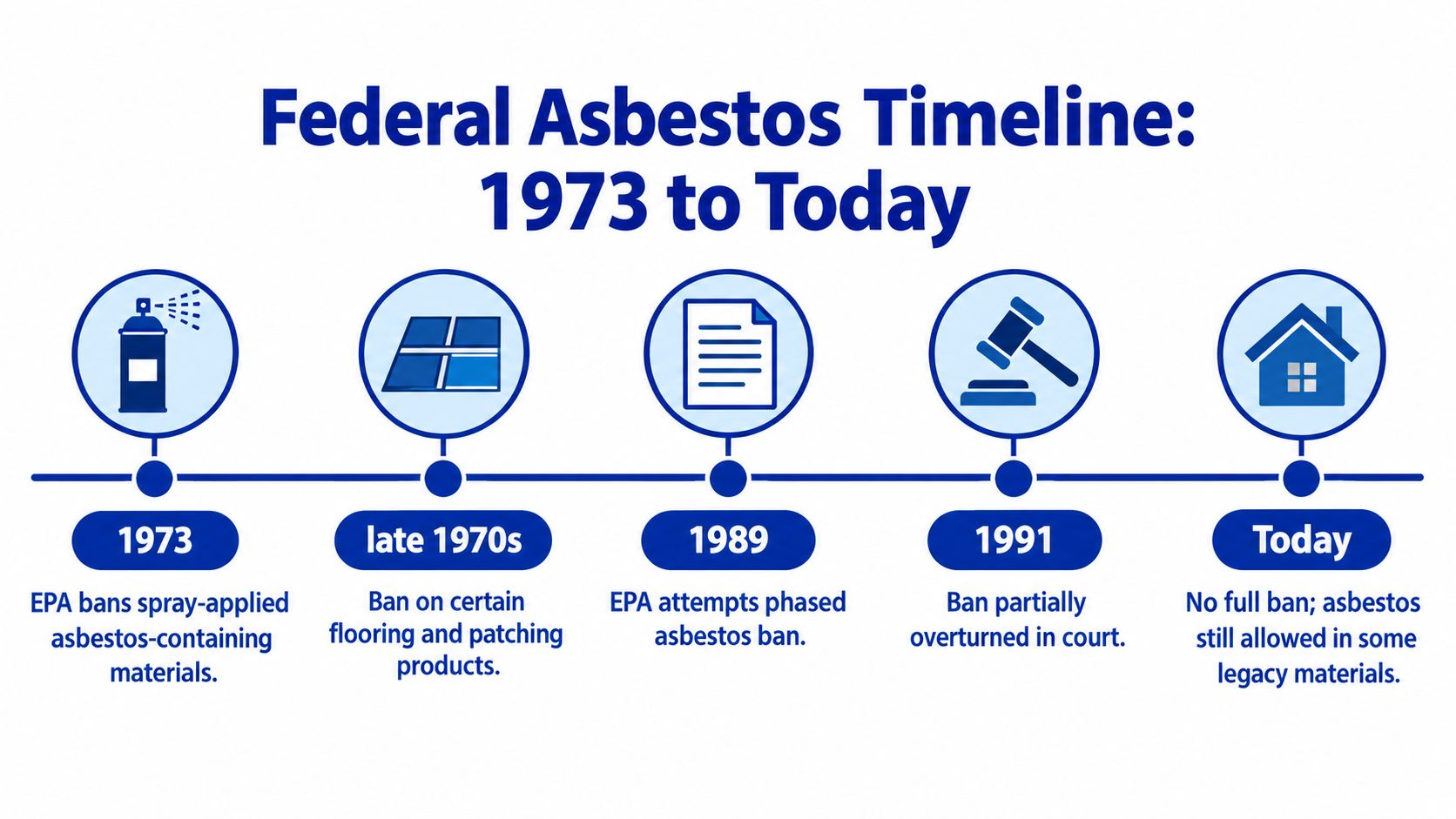
A timeline is more useful than a single date because each milestone changed a different part of the regulatory picture. Match the timeline to the property's construction records, remodeling permits, and ceiling history, then use testing to resolve uncertainty before work begins.
1973 and the first major control point
In 1973, the EPA banned spray-applied asbestos-containing surfacing material used for fireproofing and insulating purposes. Because many popcorn-style textures were applied as sprayed surfacing, this date is the first major federal reference point for ceiling concerns. It restricted new use in the covered applications, but it didn't eliminate existing stock or guarantee that every later ceiling was asbestos-free. The EPA's explanation of actions protecting the public from asbestos exposure describes this control point and its limits.
1978 and expanded restrictions
In 1978, the EPA expanded restrictions to additional spray-applied surfacing materials not already banned. For spray-on textured ceiling products, that makes 1978 the practical cutoff often used during preliminary property reviews. A home remodeled around that period still needs a closer look because construction materials and renovation dates don't always align neatly with federal rule dates.
EPA guidance flags homes and buildings remodeled between 1945 and 1978 as places where crumbly asbestos-containing material may have been sprayed or troweled onto ceilings or walls. That range should guide inspection priorities, not replace sampling.
1989 and the limits of a broad rule
On July 12, 1989, the EPA issued a final rule banning most asbestos-containing products in the United States. The rule didn't eliminate every asbestos product, and it didn't erase material already present in buildings. Existing inventories and later regulatory developments explain why an asbestos-containing ceiling could still appear in a property built or remodeled after the earlier spray-application restrictions. The EPA's current laws and regulations overview provides the broader legal context.
A useful home-era example is a property remodeled in the 1980s. Its ceiling may postdate the principal spray-application restrictions, yet the renovation records may be incomplete and older material may have been used. The only dependable way to classify a suspect ceiling is to evaluate the material and obtain appropriate laboratory analysis.
2024 and an evolving issue
In March 2024, the EPA banned ongoing uses of chrysotile asbestos. That action shows asbestos regulation is still evolving rather than being a completely closed historical issue. The discussion of asbestos exposure in homes also reinforces the need to consider the material's condition and disturbance, not just the year on a property record.
California and SCAQMD Rule 1403 Requirements
Federal history answers when restrictions developed. It doesn't by itself tell a Los Angeles contractor what documentation is needed for a specific renovation or demolition project. In the South Coast Air Quality Management District, Rule 1403 requires a thorough asbestos survey before any demolition and before renovation, subject to a narrow residential exception.
The exception applies to a single-unit home when less than 100 square feet of asbestos-containing material surface area will be removed or stripped. The SCAQMD Rule 1403 compliance advisory identifies the survey and exception requirements. Property owners shouldn't assume that a small-looking ceiling project qualifies without checking the scope and applicable rule.
What the written survey documents
A compliant survey isn't a note saying “popcorn ceiling present.” It should identify the asbestos-containing material that may be disturbed, describe its condition, and document whether the material is friable. Friability refers to how readily the material can be crumbled or reduced to powder by hand pressure, a condition that matters when planning work.
For a commercial building, multifamily property, school, medical facility, or larger renovation, the written survey becomes part of the project record. General contractors, facility managers, architects, and property managers can use it to coordinate work areas, communicate findings, and address regulatory paperwork before crews begin.
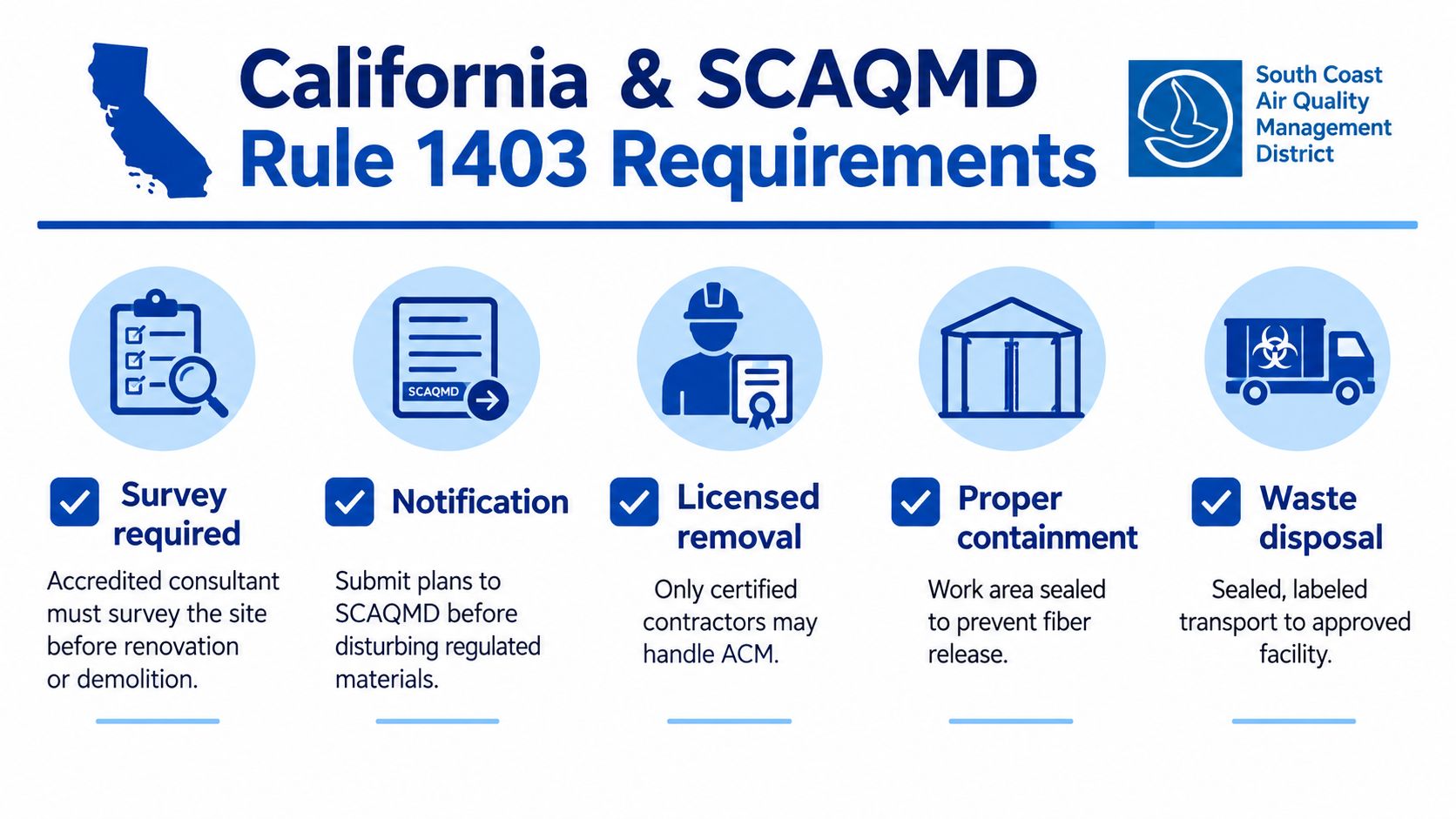
A survey also helps separate a suspected material from the material that will be affected. For example, a contractor may plan to install lighting, open a ceiling cavity, or remove a textured surface. The consultant needs to assess those disturbance locations, not just inspect an accessible corner.
Los Angeles-area owners dealing with a transaction should also consider how inspection findings affect property records and disclosures. Information about California asbestos real estate disclosure can help frame that documentation question, although legal advice should come from a qualified real estate attorney.
What a Positive Asbestos Test Actually Means
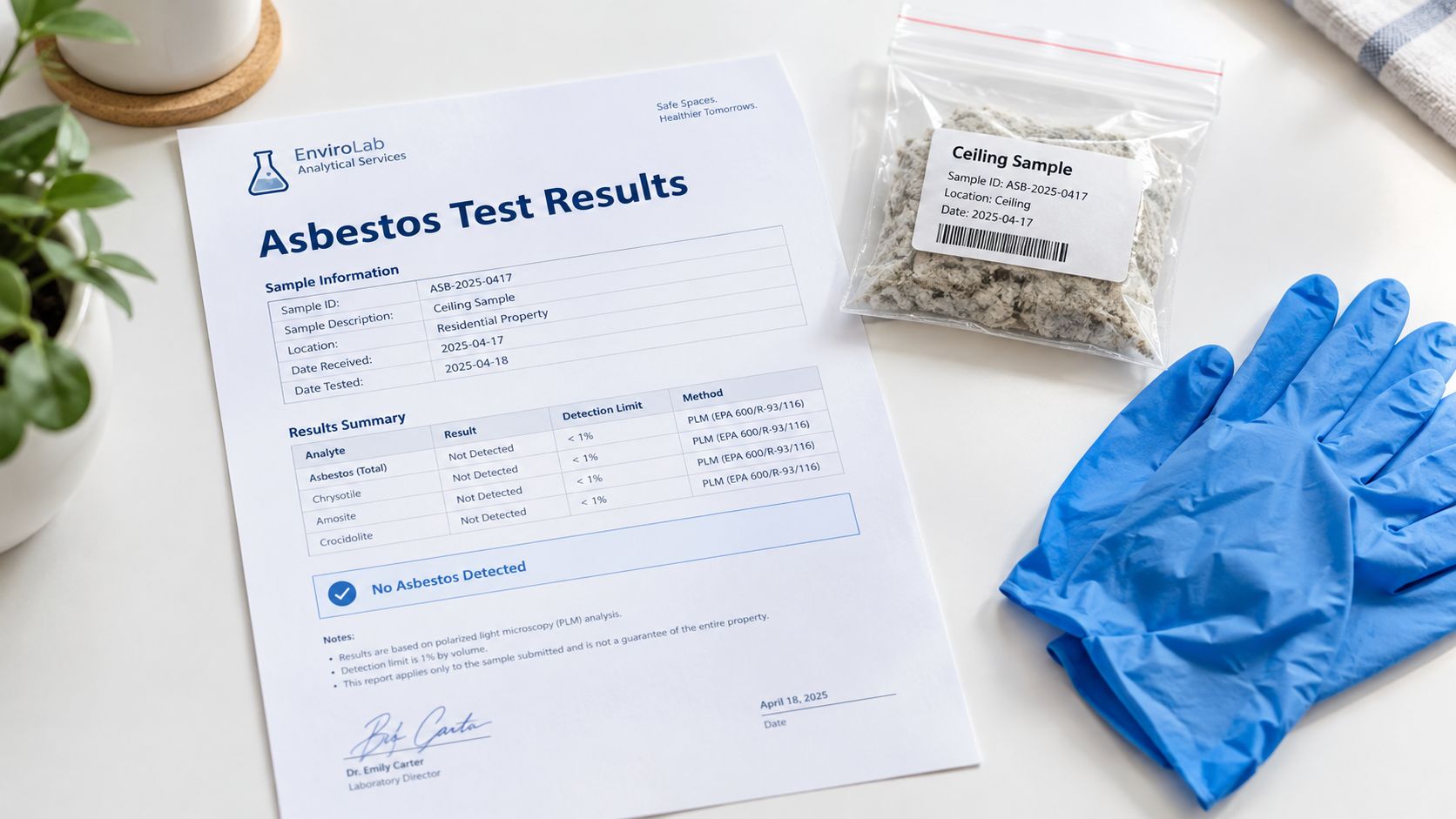
A positive asbestos result does not automatically mean that removal or abatement must occur immediately. The result establishes that the sampled material contains asbestos. Qualified professionals then consider its condition, location, accessibility, potential for disturbance, and the work planned for the property.
An intact ceiling that won't be touched presents a different project question from a ceiling scheduled for scraping or demolition. The laboratory result gives owners and contractors a factual basis for choosing appropriate next steps. It doesn't, by itself, prescribe a single response for every building.
Condition changes the decision
A consultant evaluates whether the texture is intact, damaged, water-affected, peeling, or crumbly. The inspection also considers nearby work, such as electrical penetrations, mechanical upgrades, ceiling repairs, or demolition. Those details determine whether the material can remain undisturbed, needs project controls, or must be addressed as part of regulated work.
In Southern California, Rule 1403 requires all asbestos-containing material greater than 1% to be removed before demolition. That requirement applies to the demolition context, so it shouldn't be confused with a rule that automatically requires removal from every occupied room where the material remains in place.
A test result answers what the material contains. The project assessment answers what must happen next.
If asbestos has already been damaged or disturbed, the compliance path becomes more specific. A Procedure 5 cleanup plan must be submitted to and approved by SCAQMD before asbestos cleanup begins. The SCAQMD Procedure 5 frequently asked questions explains this requirement and the greater-than-1% removal rule.
Why disturbance history matters
A ceiling that was scraped before testing may require a broader assessment than an untouched ceiling. The consultant may need to determine where material traveled, what surfaces were affected, and whether the work area requires additional sampling or documentation.
Owners should avoid making a removal decision based on fear alone. A positive result is important, but the useful outcome is a clear, documented assessment that allows the owner, contractor, and applicable authority to determine the appropriate project controls.
How Professional Asbestos Testing and Sampling Works
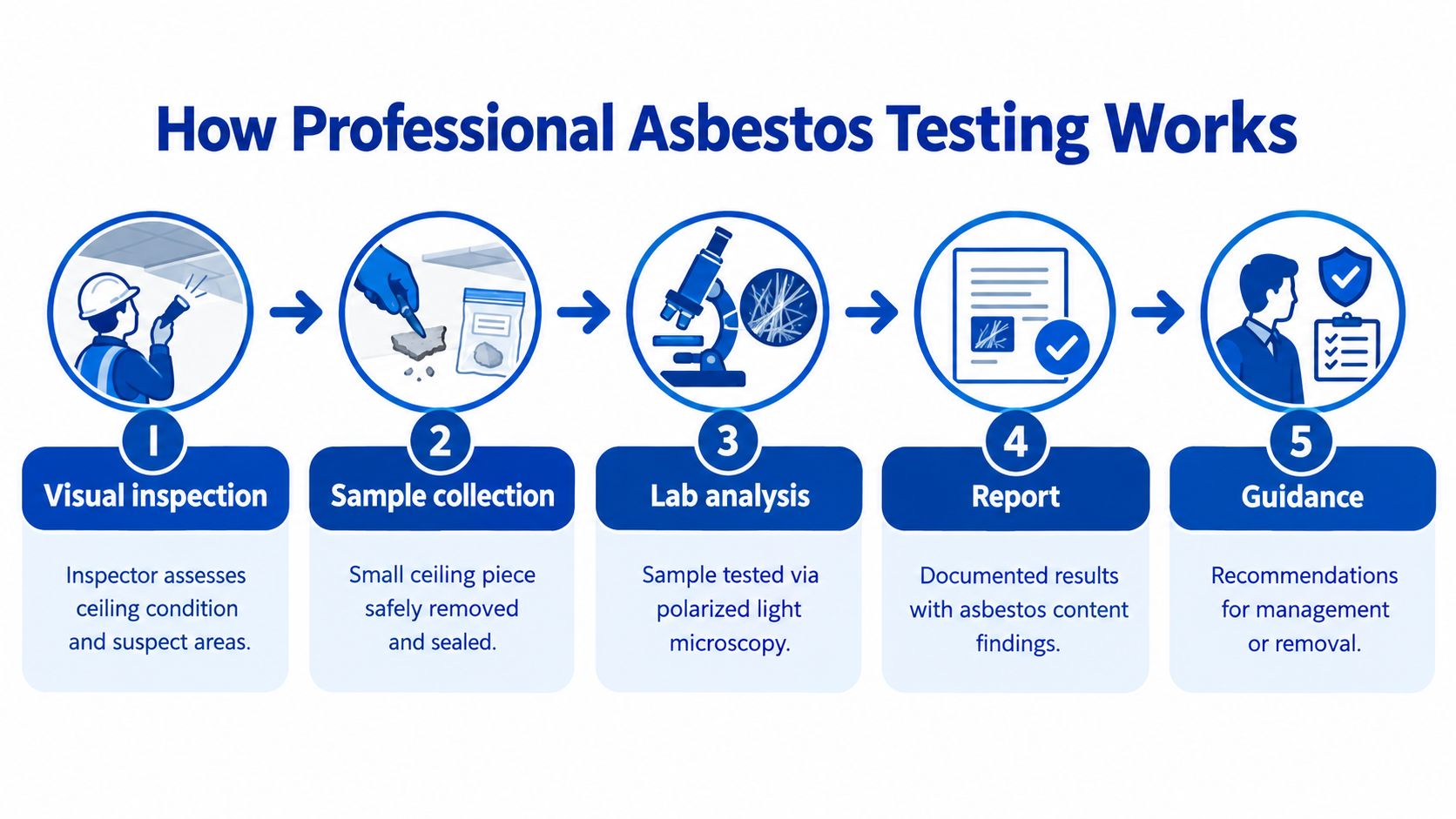
Professional testing starts with a visual inspection, not a guess based on the popcorn pattern. The inspector reviews the ceiling texture, observes its condition, checks areas scheduled for disturbance, and considers available construction or remodeling information.
If sampling is appropriate, the inspector collects a small representative portion of the suspect material using methods intended to control debris and limit disturbance. The sample is sealed, identified, and sent for laboratory analysis. The laboratory result identifies whether asbestos is present in the submitted material, giving the owner a defensible answer for the defined sampling scope.
The inspection and reporting sequence
The process generally follows this order:
- Scope review: The consultant identifies the planned renovation, demolition, repair, transaction, or compliance need.
- Visual assessment: The inspector documents suspect ceiling texture, condition, accessibility, and areas likely to be affected.
- Sample collection: Appropriate material samples are collected, labeled, and preserved for analysis.
- Laboratory analysis: The laboratory examines the samples and reports the asbestos findings.
- Written documentation: The consultant records the inspected areas, sampling information, laboratory results, limitations, and practical next steps.
For a Procedure 5 situation, SCAQMD guidance calls for a site survey report documenting sampling and analysis of suspect asbestos-containing building materials. The submission also includes a cleanup plan describing the cause of the disturbance, the extent of contamination, and the consultant's observations, findings, recommendations, and response actions. The SCAQMD Procedure 5 guideline sets out those documentation elements.
DIY kits may seem convenient for a homeowner who wants a quick answer. They may not address whether the sample represents all affected materials, whether the collection disturbed the ceiling unnecessarily, or whether the resulting paperwork satisfies a contractor, buyer, permitting process, or air district requirement. Professional asbestos testing in Los Angeles can combine inspection, targeted sampling, laboratory analysis, and a report matched to the project.
For a plain-language overview of how to test for asbestos in a popcorn ceiling, homeowners can review the sampling questions they should ask before scheduling work.
When to Schedule Asbestos Testing Before You Renovate
The safest decision framework is simple. Test before disturbance whenever the ceiling's composition is uncertain and the planned work may affect it. Don't wait for scraping, drilling, water damage, or demolition to reveal the issue after the project has started.
Testing is especially appropriate when:
- You're buying or selling an older home: A textured ceiling with an uncertain installation or remodeling history may need documented evaluation for the transaction.
- You're planning ceiling work: Scraping, sanding, drilling, cutting, patching, lighting installation, and other intrusive work can affect suspect texture.
- You're preparing demolition: A Rule 1403 survey may be required before demolition, so schedule the assessment while the project scope is still being developed.
- You received a Notice to Comply: Testing and written documentation can help define the material and address the specific compliance concern.
- You found damage: Water intrusion, impact, renovation debris, or crumbling texture warrants an inspection before anyone disturbs the affected area further.
- You manage a commercial property: A documented survey supports communication among owners, tenants, facility staff, architects, engineers, and contractors.
A pre-renovation asbestos survey can protect the project schedule because it identifies a potential constraint before crews mobilize. A pre-demolition survey can help the project team plan required documentation and avoid treating an unknown ceiling as ordinary construction debris. In either case, testing doesn't guarantee a property is free of every environmental hazard. It answers the asbestos question within the inspected and sampled scope.
The same assessment mindset applies when other conditions are present. Water damage may call for mold testing, a fire may justify testing for ash, soot, char, smoke residue, combustion byproducts, or heavy metals, and occupant complaints may support indoor air quality, VOC, or airborne contaminant testing. Those services address different questions and shouldn't be substituted for asbestos sampling.
For commercial owners and facility managers, asbestos testing before commercial renovation in Los Angeles can help frame the value of early documentation and project planning.
If you're unsure whether your ceiling falls within a Rule 1403 survey requirement, don't scrape a test area yourself. Preserve the condition, gather construction and remodeling records, and ask an environmental consultant to evaluate the planned work and sampling needs.
Sensitive Environmental provides asbestos inspections, sampling, laboratory analysis, and written surveys for popcorn ceilings and renovation or demolition projects in Los Angeles and Southern California. Visit Sensitive Environmental to schedule asbestos testing or discuss a pre-renovation, pre-demolition, Notice to Comply, or SCAQMD-related assessment for your property.