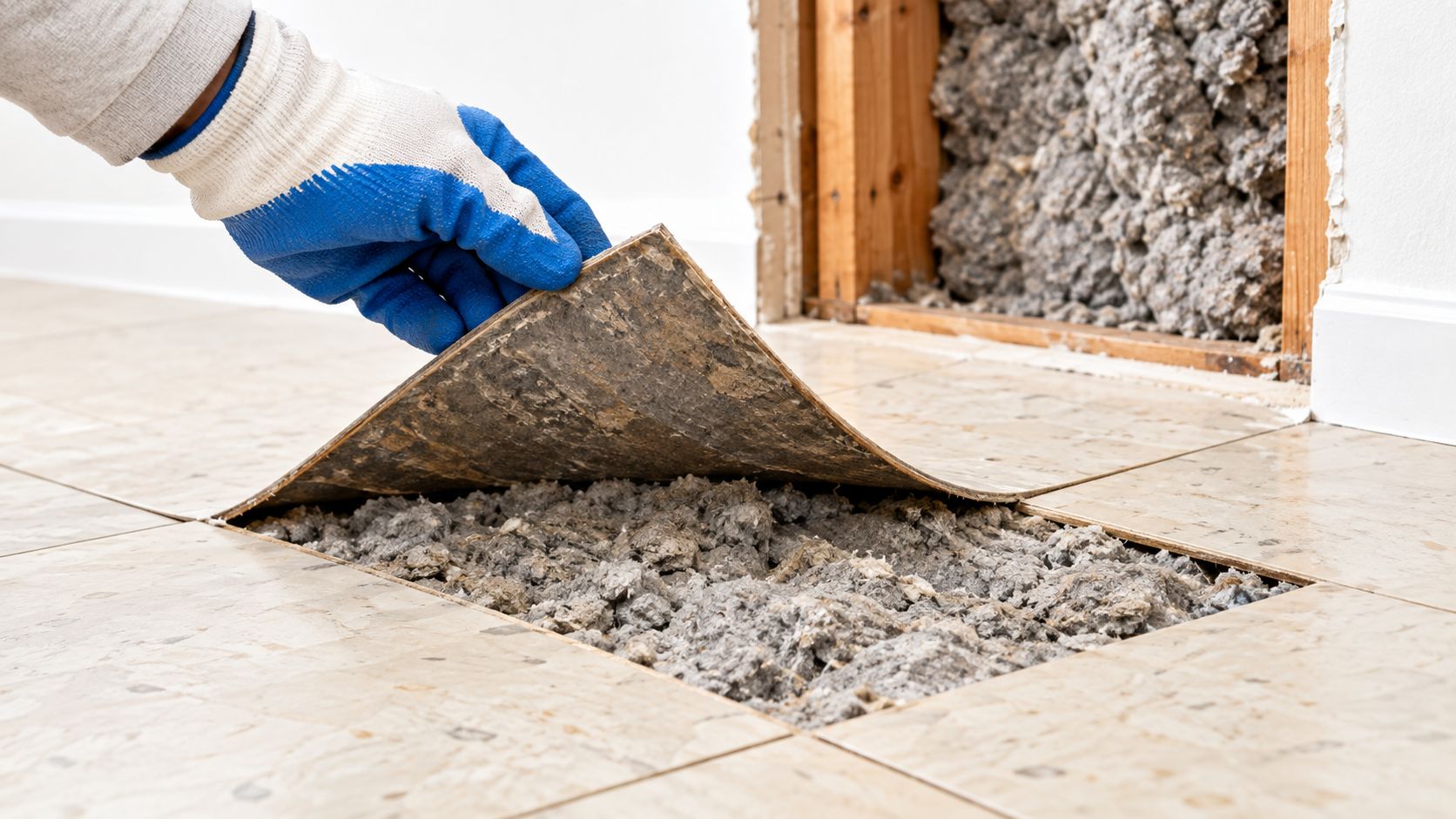
You're standing in a 1976 ranch house with renovation plans in hand. The flooring is coming up, a contractor wants to open a wall, and a chalky gray layer near the ceiling or pipework doesn't look familiar. The immediate question is simple: would a house built in 1976 have asbestos?
The careful answer is yes, it could. The construction date doesn't prove that asbestos is present, but 1976 falls within a period when asbestos-containing materials were still used in many residential products. Before sanding, cutting, scraping, drilling, renovation, or demolition begins, a professional asbestos inspection and laboratory analysis can replace guesswork with material-specific information.
Table of Contents
- Why a 1976 House Raises an Asbestos Question
- The 1970s Regulatory Picture and Why 1976 Still Matters
- Which Materials in a 1976 Home Are Most Likely to Contain Asbestos
- Presence Does Not Equal Immediate Danger
- How Professional Asbestos Testing Actually Works
- California Rules That Change the Timeline for 1976 Homes
- Practical Next Steps and How Sensitive Environmental Can Help
Why a 1976 House Raises an Asbestos Question
A 1976 home isn't automatically an asbestos house. It is, however, old enough that original flooring, ceiling finishes, insulation, roofing products, and wall materials may still reflect manufacturing practices from the late twentieth century. The possibility becomes more relevant when those materials remain in place and your project will disturb them.
Start with three questions:
- What material is involved? A floor tile, pipe wrap, textured ceiling, roofing layer, and joint compound require different inspection considerations.
- Is it original? A later renovation may have covered, removed, or replaced some suspect materials, but it may also have left older layers underneath.
- Will the work disturb it? A material that remains sealed and intact creates a different decision than one that will be sanded, broken, or demolished.
The U.S. Environmental Protection Agency describes a regulatory history in which asbestos restrictions began during the 1970s, but did not immediately remove asbestos from every homebuilding product. The EPA banned spray-applied asbestos insulation and fireproofing in 1973, then restricted asbestos in patching compounds and textured paints in 1975, while other asbestos-containing products continued to exist in the marketplace. EPA historical asbestos documentation explains why a construction year alone can't provide a definitive answer.
Practical rule: Treat the year as a reason to investigate, not as a laboratory result.
The consequences extend beyond the renovation crew. Disturbance can affect occupants, contractors, landlords, future buyers, and property managers. A documented asbestos survey can also support renovation planning, real estate decisions, and compliance discussions in Los Angeles County and surrounding Southern California communities. If you're preparing to remodel, the useful question isn't only whether asbestos might exist. It's which materials need evaluation before work starts.
The 1970s Regulatory Picture and Why 1976 Still Matters
Asbestos regulation developed in stages, so 1976 is a probability band, not a clean cutoff. Federal controls removed or restricted certain uses while other products remained available for residential construction.
The EPA banned spray-applied asbestos insulation and fireproofing in 1973. Restrictions followed for other applications, including certain patching compounds and textured paints in 1975. EPA materials also document restrictions involving asbestos pipe and block insulation during the decade, but the controls didn't eliminate every asbestos-containing product from construction.
That distinction matters because manufactured materials such as resilient floor tile, roofing products, pipe insulation, and joint compound could still be used after particular sprayed applications had been restricted. The EPA overview of actions protecting the public from asbestos exposure supports the material-specific approach: some uses were restricted, while others remained part of the built environment.
Historical guidance places the highest-use era for U.S. residential asbestos roughly from 1950 through the late 1970s, with new product use declining as restrictions expanded. The 1989 EPA asbestos rule was only a partial ban, not a complete prohibition, as summarized in this history of asbestos use in homes. A 1976 house therefore sits near the end of a major overlap period, not safely beyond it.
A builder could have installed a product manufactured before the home was completed, or used material that remained in distribution after a particular restriction. That's why visual age estimates and broad rules such as “all homes before a certain year contain asbestos” are poor substitutes for sampling.
For an owner in Los Angeles, the practical conclusion is straightforward: a 1976 completion date makes asbestos testing reasonable before renovation or demolition, especially when original finishes or mechanical insulation remain. The historical record on asbestos use and control reinforces the broader point that asbestos controls were still developing during this period.
Which Materials in a 1976 Home Are Most Likely to Contain Asbestos
A visual inspection can identify suspect materials, but it can't confirm asbestos content. In a 1976 home, inspectors commonly pay close attention to materials that combine an era-appropriate installation pattern with a realistic chance of disturbance.
Attic and wall insulation deserve early attention. Loose-fill vermiculite may appear as lightweight, flaky, pebble-like insulation, while insulation around ducts, boilers, furnaces, and heating lines may appear gray, white, fibrous, or layered. Pipe wrap can deteriorate with age, making its condition especially important during mechanical work.
Resilient flooring is another frequent concern. Older square tiles, including patterned vinyl or asphalt-style tiles, may be accompanied by dark or brown mastic. The tile itself may be relatively bonded, while scraping, grinding, or removing the adhesive can create the disturbance that changes the project's requirements.
Drywall joint compound and textured ceilings can be harder to recognize. A popcorn or stippled ceiling may look ordinary, yet the texture and the underlying skim or joint compound can require separate evaluation. Repairs, water damage, repainting, and ceiling removal can expose additional layers.
Siding and roofing should not be overlooked. Older asbestos-cement panels or shingles are typically rigid and cementitious, while roofing felts and underlayment may be concealed beneath later roofing layers. Cutting, drilling, breaking, or reroofing can create a need for a targeted pre-renovation survey.
| Material | Likelihood in a 1976 Build | Friability / Disturbance Risk |
|---|---|---|
| Vermiculite attic insulation | Plausible and requires evaluation | Loose material can be disturbed during attic work |
| Joint compound and textured ceiling finishes | Plausible, especially where original finishes remain | Risk increases with sanding, scraping, or removal |
| Resilient floor tile and mastic | Common suspect materials for the era | Removal and adhesive scraping can disturb layers |
| Boiler, duct, and pipe insulation | Plausible around mechanical systems | Damaged or fibrous insulation may be more readily disturbed |
| Asbestos-cement siding or roofing | Possible in older exterior systems | Cutting, drilling, or breakage creates disturbance |
| Later replacement materials | May be asbestos-free, but layers can remain below | Demolition can expose concealed original materials |
The material's condition and planned activity matter as much as its identity. An intact floor tile under later flooring calls for a different sampling plan than crumbling pipe insulation in a mechanical room. A qualified asbestos survey identifies homogeneous areas, evaluates condition, and selects representative samples for laboratory analysis instead of relying on color or texture alone.
Presence Does Not Equal Immediate Danger
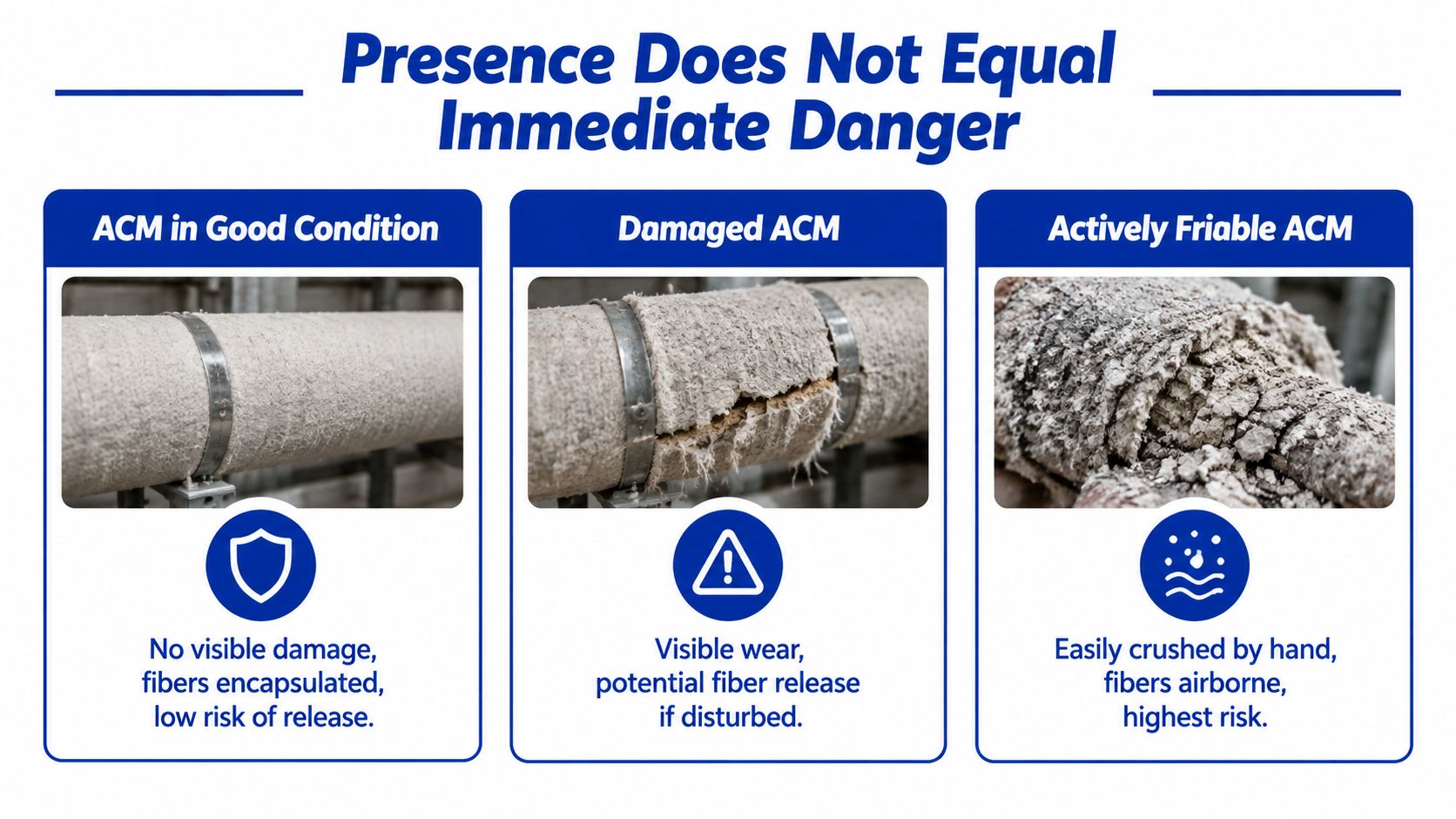
Finding asbestos in a 1976 house doesn't automatically mean the property requires immediate removal. Presence and exposure are different questions. A bonded material in good condition may release little fiber when left undisturbed, while damaged or friable material can become a more serious concern when people handle it or renovation creates airborne dust.
Consider two rooms. In one, intact vinyl floor tile remains beneath a newer finish and no work is planned. In the other, pipe insulation is frayed beside a planned demolition area. The second situation deserves faster professional evaluation because condition and disturbance make fiber release more plausible.
The EPA guidance on asbestos management and exposure supports a cautious, activity-based approach. Owners may sometimes manage undisturbed material in place through methods such as enclosure, encapsulation, documentation, and monitoring, depending on the material and project. Those decisions should follow inspection findings and applicable requirements, not visual assumptions.
The key decision is not simply “Is asbestos somewhere in the house?” It's “What material is present, what condition is it in, and will the planned work disturb it?”
Don't sweep, sand, drill, or scrape an unidentified material to get a closer look. Bulk sampling can answer the presence question, while air testing may be considered for specific conditions involving disturbance or airborne contamination. The correct service depends on the property, the scope of work, and the concern being investigated.
How Professional Asbestos Testing Actually Works
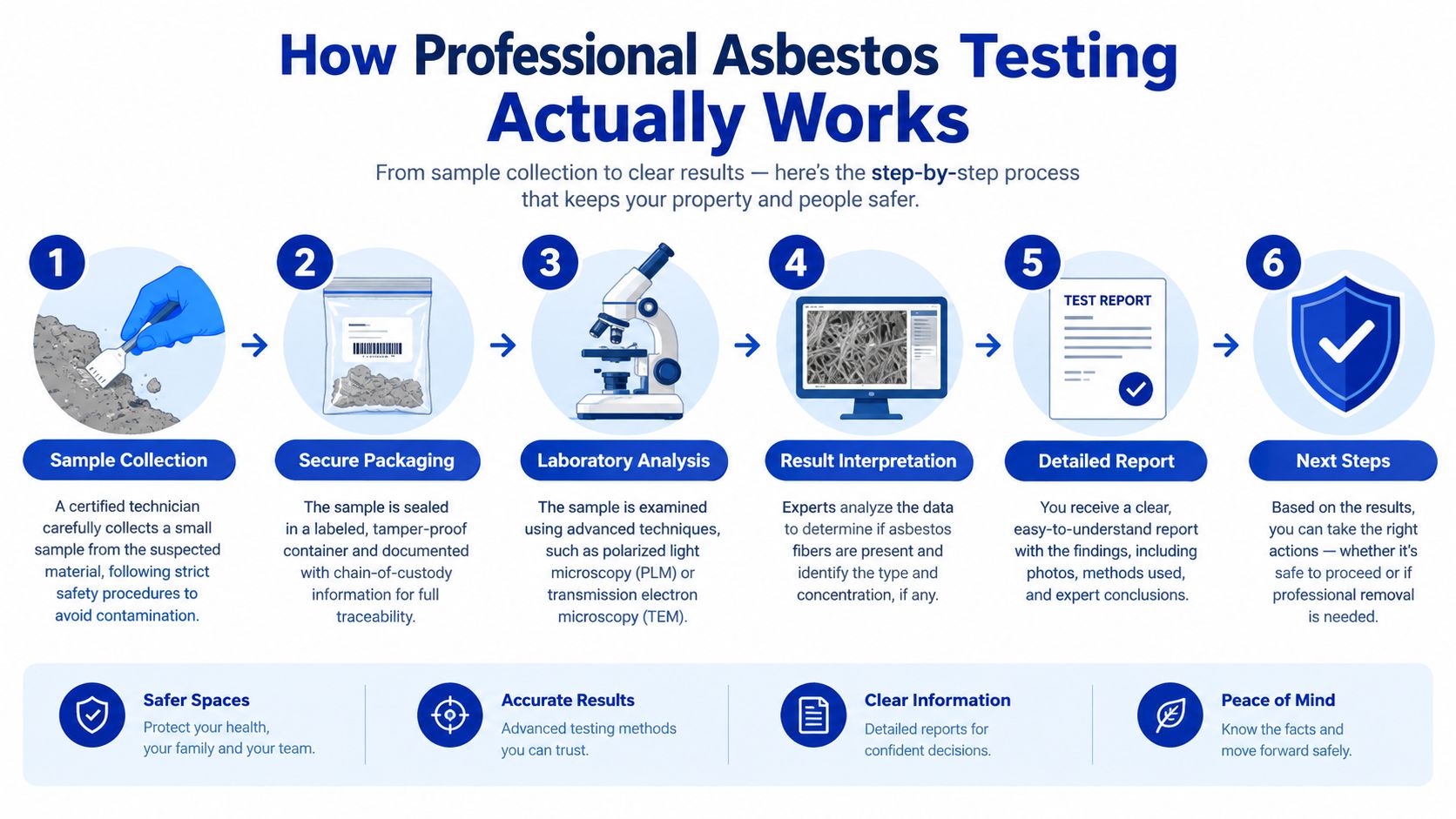
A professional asbestos survey should produce more than a handful of samples and a pass-or-fail statement. The inspector first reviews the building, renovation plans, visible materials, previous reports, and areas that contractors may disturb. In a 1976 home, that can include floors, ceilings, wall systems, attic spaces, mechanical rooms, exterior materials, and concealed layers accessible through planned openings.
Site review and sample selection
The inspector groups materials into homogeneous areas, meaning materials that appear sufficiently similar in composition, color, texture, installation, and age to be evaluated as a group. Representative bulk samples are then collected using controlled methods, which may include wetting the material to reduce dust and carefully placing samples into sealed, labeled containers.
A complete inspection should explain why samples were taken and identify areas that were not sampled. The report should also include locations, material descriptions, condition observations, sample identifiers, laboratory results, and a drawing or other clear site reference. Missing suspect areas, vague sample locations, or a report that doesn't connect samples to the renovation scope should prompt questions.
Laboratory analysis and interpretation
An accredited laboratory analyzes the samples using appropriate methods. Polarized light microscopy, commonly called PLM, is used for many bulk materials. Transmission electron microscopy, or TEM, may be needed for certain non-friable organically bound materials, including some flooring products, when the initial method can't provide sufficient resolution.
The laboratory result applies to the submitted sample, so sampling quality matters. A positive result identifies asbestos in that material, while an assumption can be used for project planning when sampling isn't practical or when a regulated decision requires the material to be treated as suspect until confirmed.
The final report should help the owner decide whether to revise the work scope, leave a material undisturbed, develop a management approach, or obtain additional project-specific documentation. It shouldn't promise that a property is universally free of asbestos.
For homeowners deciding between DIY kits and professional work, this guide to testing for asbestos at home explains why improper sampling can create uncertainty and unnecessary disturbance. A professional asbestos testing company can coordinate inspection, sample handling, laboratory submission, and written reporting as one documented process.
California Rules That Change the Timeline for 1976 Homes
For Los Angeles-area projects, asbestos testing may be more than a prudent homeowner step. South Coast Air Quality Management District Rule 1403 requires a thorough asbestos survey before renovation or demolition of an affected facility or facility component. The rule calls for inspection, identification, quantification, and physical sampling of friable and specified non-friable asbestos-containing materials. The requirement is not waived because a property is residential or because the building was constructed in 1976, as stated in the AQMD draft staff report on Rule 1403.
What a compliant survey needs to address
The assessor evaluates the planned work and the materials that could be affected. Depending on the project, the review may address regulated asbestos-containing material, Category I non-friable material, and Category II non-friable material, with thresholds and handling obligations determined under the applicable rule and project conditions.
California Procedure 5 also shapes sampling practice. The assessor should identify homogeneous areas, collect an appropriate number of samples, document locations, and use suitable laboratory analysis. Qualifications matter, especially when a report will support permits, contractor planning, or agency documentation.
Filing and project coordination
A Los Angeles project may involve several timelines at once. A Notice to Comply can be relevant when asbestos requirements apply, Cal/OSHA notification requirements may affect the employer and work, and the local building department may require demolition or renovation permits. Homes built before 1978 may also receive attention under EPA NESHAP review, depending on the project and regulatory applicability.
For specific AQMD work, South Coast AQMD Rule 1403 provides the governing survey framework. LA County's instructions state that notifications are required 14 calendar days before asbestos removal of 100 square feet or greater, or before any demolition, and that asbestos must be removed before demolition. LA County AQMD demolition instructions provide that notification anchor.
| Activity / Condition | Applicable Regulation | Trigger Threshold | Required Action |
|---|---|---|---|
| Renovation or demolition in the South Coast district | SCAQMD Rule 1403 | Determined by affected materials and project scope | Complete the required survey before disturbance |
| Asbestos removal | Rule 1403 and local notification procedures | 100 square feet or greater | Submit required notification 14 calendar days before work |
| Demolition | Rule 1403 and local procedures | Any covered demolition | Survey first and remove asbestos before demolition |
| Employee exposure during work | Cal/OSHA Title 8 requirements | Based on the work and exposure conditions | Coordinate employer notifications and work controls |
| Real estate documentation | California disclosure obligations | Based on known material conditions and transaction facts | Preserve accurate environmental reports and disclosures |
Owners and contractors shouldn't treat a survey as paperwork added after scheduling. It belongs near the beginning of scope development, before walls come down or permits are finalized. For transaction-related questions, California asbestos real estate disclosure information can help place testing results in the broader property documentation process.
Practical Next Steps and How Sensitive Environmental Can Help
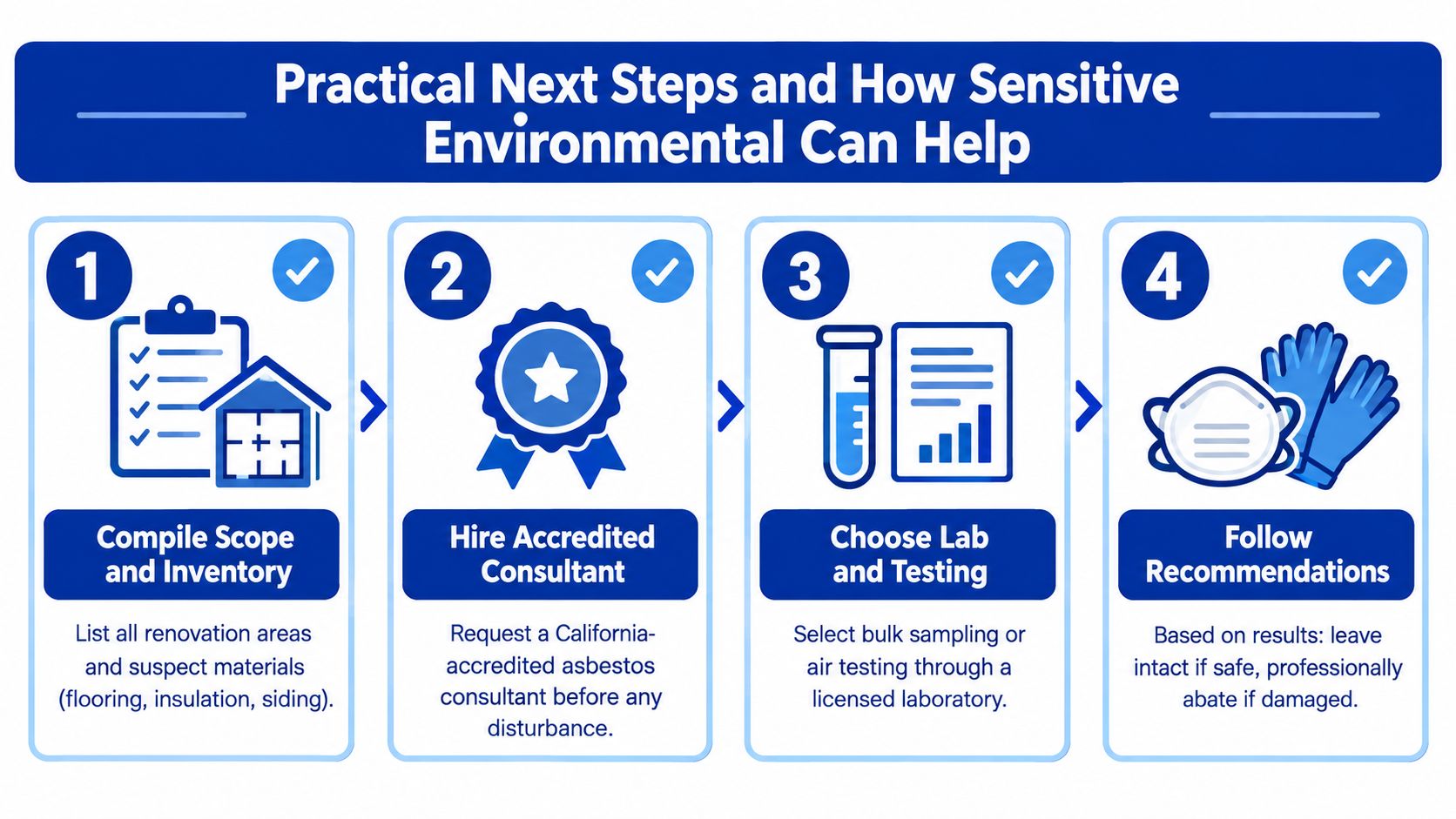
A 1976 house calls for a measured sequence, not panic and not guesswork. Begin by listing every planned activity, including flooring removal, ceiling work, wall openings, attic access, plumbing changes, roofing, siding, and demolition. Mark which materials are original, which are covered by later finishes, and which show cracking, water damage, fraying, or other deterioration.
A workable homeowner checklist
- Pause disturbance. Don't sand, scrape, drill, or break an unidentified material while deciding what it is.
- Define the scope. Give the inspector drawings, contractor notes, and the areas scheduled for renovation.
- Request a professional survey. A California-accredited asbestos consultant can evaluate suspect materials and select representative bulk samples.
- Use laboratory analysis. Bulk sampling is generally the relevant starting point for intact building materials, while air testing is reserved for questions involving airborne conditions or specific project circumstances.
- Document the outcome. Keep the survey, sample locations, laboratory report, photographs, and recommendations with the property records.
Sensitive Environmental provides asbestos inspections, pre-renovation and pre-demolition surveys, sampling, laboratory coordination, and written documentation for residential and commercial properties in Los Angeles and Southern California. Its work can also support SCAQMD Rule 1403 planning, Procedure 5 sampling, Notice to Comply documentation, and project sequencing. The company focuses on environmental testing and reporting, while qualified contractors handle any work that results from those findings.
The same decision process can apply to related concerns. Water damage may justify mold inspection and sampling, older painted surfaces may call for lead testing, and fire-affected properties may need ash, soot, char, smoke residue, combustion byproduct, or heavy-metal testing. Commercial properties, schools, healthcare facilities, HOAs, and industrial sites may also require broader industrial hygiene or indoor air quality assessments.
For a homeowner-friendly overview of the decision process, this guide to identifying asbestos in a home can help you prepare for a professional conversation. If your 1976 property is in Los Angeles County and renovation is approaching, schedule the survey before materials are disturbed, so the project team can make informed decisions from documented results rather than discovering suspect material after work has already begun.
Sensitive Environmental offers professional asbestos testing, pre-renovation and pre-demolition surveys, representative sampling, laboratory analysis, and clear reports for homes and commercial properties throughout Los Angeles and Southern California. Visit Sensitive Environmental to discuss your 1976 house, planned renovation scope, and the testing documentation needed before work begins.