You're standing in the kitchen of an older Los Angeles home, ready to remove cabinets and open a wall. The contractor is scheduled, the materials have arrived, and then someone asks the question that should have come first: when should you test for asbestos?
The answer is straightforward. Before any work that could disturb suspect material. Testing isn't a routine chore tied only to a building's age. It's a decision made before renovation, demolition, drilling, cutting, scraping, water-damage response, fire cleanup, or a regulated property transaction.
For homeowners, contractors, property managers, and developers across Los Angeles County, the sequence matters. A professional asbestos survey identifies materials that may require additional evaluation, supports project documentation, and helps qualified professionals determine the next step before workers create dust or debris.
Table of Contents
- Why Testing Is Event-Driven, Not Routine
- Before Renovation or Demolition Work Begins
- Building Age and Material Red Flags
- Real-World Scenarios That Trigger a Survey
- After Damage, Water Intrusion, or Fire
- Professional Survey vs DIY Sampling
- Your Asbestos Testing Decision Checklist
Why Testing Is Event-Driven, Not Routine
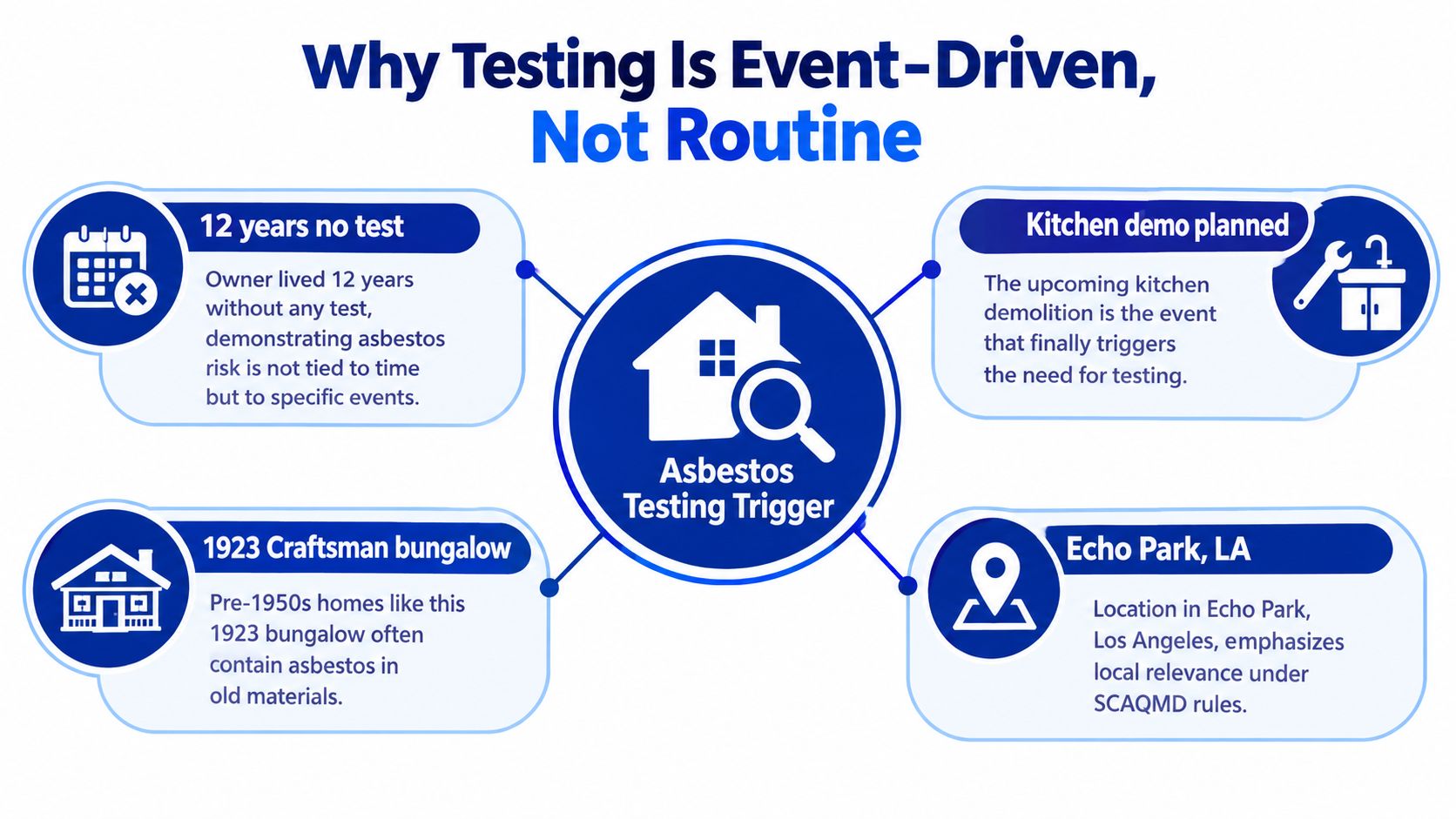
An owner in Echo Park can live in a 1923 Craftsman bungalow for twelve years without testing a single material. That history alone doesn't create a testing requirement. If the building materials remain intact, aren't damaged, and won't be disturbed, the U.S. Environmental Protection Agency says asbestos testing generally isn't needed. The decision changes the moment a kitchen demolition, ceiling repair, or wall opening is planned. EPA guidance on asbestos exposure and testing recommends testing suspect materials when they're damaged or will be disturbed by remodeling.
The practical principle is fiber release, not the calendar. A material can remain undisturbed for years without creating the same exposure pathway as a worker sanding joint compound, drilling through a textured ceiling, or removing old floor tile. Age raises suspicion, but planned disturbance creates the decision point.
Three events change the decision
Planned disturbance is the most common trigger. Renovation, demolition, remodeling, saw-cutting, drywall removal, flooring replacement, and mechanical work can disturb suspect materials. A survey should cover the areas and materials that the project could affect, not just the room where the contractor expects to begin.
Accidental damage creates a second trigger. Crumbling drywall, falling insulation, broken ceiling texture, damaged pipe insulation, or water-weakened flooring can change an intact material into a condition that deserves prompt assessment. Don't sweep, scrape, or remove damaged suspect material before an environmental professional evaluates it.
Regulatory events create the third category. Demolition and renovation rules can require a documented inspection before work starts, even when the material looks modern or the project appears small. In Southern California, South Coast AQMD Rule 1403 places pre-work asbestos surveys at the center of regulated renovation and demolition planning.
Practical rule: If the next step involves cutting, drilling, sanding, scraping, removing, or demolishing a suspect material, schedule the survey before the tool comes out.
That's why asbestos testing in Los Angeles belongs at a decision point, not on a maintenance schedule. A property owner doesn't need to sample every older material just because the building is old. The owner does need a defensible inspection before planned disturbance or after damage changes the condition of the material.
Before Renovation or Demolition Work Begins
Pre-renovation and pre-demolition asbestos testing is the most important timing decision a project team makes. EPA asbestos NESHAP guidance requires the structure, or the portion being renovated or demolished, to be thoroughly inspected for asbestos-containing material before work begins. EPA guidance for asbestos-containing materials and demolition also explains that a non-destructive survey may not be enough for demolition, where additional destructive inspection can be needed immediately before work.
In the South Coast Air Basin, Rule 1403 adds a clear compliance framework. For covered work, the affected facility or facility components must be surveyed before renovation or demolition, with suspect materials inspected, identified, quantified, and sampled as appropriate. Non-emergency notifications generally must reach South Coast AQMD 10 working days before work begins, as stated in South Coast AQMD Rule 1403.
Use the correct project sequence
A responsible project sequence looks like this:
- Define the scope. Identify every wall, ceiling, floor, mechanical chase, exterior surface, and building component that workers may disturb.
- Schedule the survey. A qualified asbestos professional performs a visual inspection and develops a sampling plan based on the construction materials and planned work.
- Obtain laboratory results. Bulk samples go to an appropriate laboratory for analysis, and the report identifies the sampled materials and findings.
- Submit required documentation. The contractor, owner, or consultant handles applicable South Coast AQMD notification and project records.
- Start destructive work only after clearance to proceed. Demolition, soft-strip work, drywall removal, and saw-cutting shouldn't begin while the survey remains incomplete.
The common Los Angeles projects that get this order wrong include ADU garage conversions, kitchen and bathroom gut renovations, attic alterations, and ceiling work in older homes. A small visible demolition area doesn't necessarily represent the full material system behind it. Joint compound, flooring layers, backing, insulation, and textured finishes can extend beyond the first surface a worker sees.
A visual inspection with limited sampling may suit a narrowly defined activity, but it won't automatically answer every question for a full demolition. A thorough survey must match the project scope. In California, the consultant qualifications, laboratory documentation, and reporting format matter because contractors, permitting agencies, owners, and regulators may need records they can rely on.
For crews and property managers building internal safety procedures, TP Training silica awareness offers additional background on silica exposure prevention and asbestos awareness. That education doesn't replace a property-specific survey, but it can help workers recognize why pre-work planning matters.
Commercial owners should also review asbestos testing before a commercial renovation in Los Angeles before authorizing a construction schedule. The order is simple: survey first, notification second, demolition last.
Building Age and Material Red Flags
Building age is a screening clue, not a laboratory result. Asbestos was widely used in residential construction through the late 1970s, and many U.S. manufacturers phased out most uses by 1980. Newer construction still shouldn't be treated as automatically clear. Some government guidance recommends sampling suspect materials before renovation, remodeling, or repair regardless of the building's construction date because documentation may be needed to establish that materials aren't asbestos-containing. Bay Area air-district asbestos requirements provides an example of that documentation-focused approach.
South Coast AQMD treats suspect material as asbestos-containing until it has been appropriately evaluated. The right question isn't, “Is this house old?” Ask instead, “Will this project disturb a material that could contain asbestos?”
Common materials worth flagging
| Material | Typical era of use | Common location | Sampling warranted when |
|---|---|---|---|
| Sprayed ceiling texture | Older residential construction, especially before 1980 | Popcorn or acoustic ceilings | Lighting, scraping, repair, removal, or other disturbance is planned |
| Resilient vinyl tile and black mastic | Older renovations and original flooring systems | Kitchens, bathrooms, halls, utility rooms | Flooring will be lifted, ground, cut, or sanded |
| Boiler and pipe insulation | Older mechanical systems | Boiler rooms, pipe chases, service areas | Insulation will be opened, repaired, removed, or damaged |
| Vermiculite insulation | Older attic installations | Attics and wall cavities | Material will be moved, removed, or disturbed |
| Transite siding and HVAC panels | Older commercial and residential components | Exterior walls, ducts, mechanical systems | Cutting, drilling, replacement, or demolition is planned |
| Drywall joint compound | Older wall and ceiling assemblies | Seams, repairs, textured finishes | Walls or ceilings will be cut, sanded, scraped, or removed |
| Roofing felts and shingles | Older roofing systems | Roof assemblies and outbuildings | Roof replacement, penetration, or demolition is planned |
A sealed, intact popcorn ceiling doesn't automatically require sampling merely because it exists. If a recessed-light installation will drill through it, the decision changes immediately. For a closer look at that common situation, see this guide to testing asbestos in a popcorn ceiling.
The same logic applies to old floor tile under cabinets, pipe wrap in a mechanical chase, and siding hidden beneath newer finishes. Don't rely on appearance. Sampling is warranted when a real activity can release fibers or when a regulator, buyer, lender, contractor, or project plan requires documentation.
Real-World Scenarios That Trigger a Survey
A 1960s kitchen remodel often begins with cabinet removal, but the disturbance rarely stops there. Workers may encounter plaster or drywall joint compound, old vinyl tile, linoleum backing, black adhesive, and material behind the sink or appliance locations. The sensible sampling priority follows the demolition plan. Test the floor assembly before pulling it up, wall materials before cutting openings, and any ceiling finish before installing new lighting or ventilation.
A Mid-Century bathroom renovation creates a different exposure path. Tile removal can fracture a ceiling texture or expose piping and backing materials behind the wall. If the project includes a plumbing chase, the survey should address the chase rather than sampling only the visible tile surface.
Match the sample plan to the work
Consider these common Los Angeles decisions:
- Recessed lighting in a textured ceiling: Sample the ceiling texture before drilling. Airborne fibers can become a concern before a large amount of visible debris appears.
- A fireplace renovation in a 1940s home: Evaluate the surrounding wall and ceiling assemblies before cutting drywall around the mantel. Insulation, joint compound, and older patching materials may be part of the work area.
- A bathroom gut renovation: Address floor tile, adhesive, wall systems, ceiling texture, pipe insulation, and any backing that the demolition sequence will expose.
- A kitchen wall opening: Sample the wall assembly, joint compound, old flooring, and cabinet backing where the contractor will cut or scrape.
- A water-damaged ceiling: Inspect the damaged finish and underlying materials before anyone removes crumbling sections or begins drying and demolition work.
The building's age helps a consultant prioritize, but the planned action determines what needs to be sampled first. A survey that ignores hidden materials in the demolition path can leave the contractor with an incomplete answer.
Schools and commercial facilities need the same activity-based discipline, with additional attention to occupancy, ventilation, and documentation. For broader indoor-air planning in educational settings, this 2026 IAQ guide for schools provides useful context. IAQ planning is related to asbestos planning, but neither replaces a project-specific asbestos survey.
The decision is especially important when several trades will work in sequence. An electrician may drill the ceiling, a plumber may open a chase, and a flooring installer may grind adhesive. Each activity can create a separate sampling priority.
After Damage, Water Intrusion, or Fire
Damage creates a new testing decision even when a property was inspected previously. Water can saturate drywall, acoustic ceiling material, flooring, insulation, and other porous assemblies. Once those materials crumble, detach, or become subject to removal, an earlier survey may not answer the present question. The inspection should focus on the damaged areas, the materials that will be handled, and the debris created by the event.
Don't allow a cleanup crew to remove suspect debris first and investigate later. A post-damage environmental assessment can coordinate asbestos sampling with mold testing, indoor air quality testing, and other industrial hygiene evaluations when the event affects multiple building systems.
Fire sites require a wider assessment
Wildfire and structure-fire properties require more than a standard pre-renovation checklist. Testing may need to address asbestos-containing materials along with combustion byproducts, ash, soot, char, smoke residue, and heavy metals. Sensitive Environmental provides fire and wildfire contamination testing that can help characterize these materials through appropriate inspections, sampling, laboratory analysis, and reporting.
South Coast AQMD guidance states that when asbestos-containing material is present in debris or damaged structures to be removed, a Procedure 5 Approved Alternative cleanup plan must be completed before cleanup proceeds, with the work performed by a registered asbestos contractor. If a consultant finds no asbestos, the same guidance indicates that cleanup may proceed without an asbestos cleanup plan or asbestos notification under that framework. South Coast AQMD asbestos demolition and removal guidance explains the role of Procedure 5 in damaged structures and debris.
A post-fire survey should document the inspection area, observed damage, sample locations, laboratory methods, and chain of custody. The consultant may recommend asbestos bulk sampling, air sampling, or additional combustion-residue testing depending on the condition of the structure and the work planned. TEM-AIR sampling and standard polarized light microscopy answer different questions, so the method should follow the project need rather than a one-size-fits-all package.
Water damage can also create a combined environmental testing problem. Mold sampling may help characterize fungal conditions, while asbestos sampling determines whether damaged building materials contain asbestos. Indoor air quality testing, VOC testing, or airborne contaminant testing may be appropriate when smoke, odors, chemical products, or prolonged enclosure conditions affect the occupied environment.
Insurance professionals, restoration companies, facility managers, and property owners should schedule the assessment before disturbance. Results don't automatically dictate remediation or abatement. They provide the information qualified professionals need to plan the next step and create defensible event documentation.
Professional Survey vs DIY Sampling
A store-bought asbestos kit seems convenient, but it doesn't solve the main problem. The difficult part isn't placing a material fragment in a package. It's identifying every suspect material in the work area, selecting representative samples, preventing cross-contamination, documenting the sample locations, and producing a report that a contractor or regulator can use.
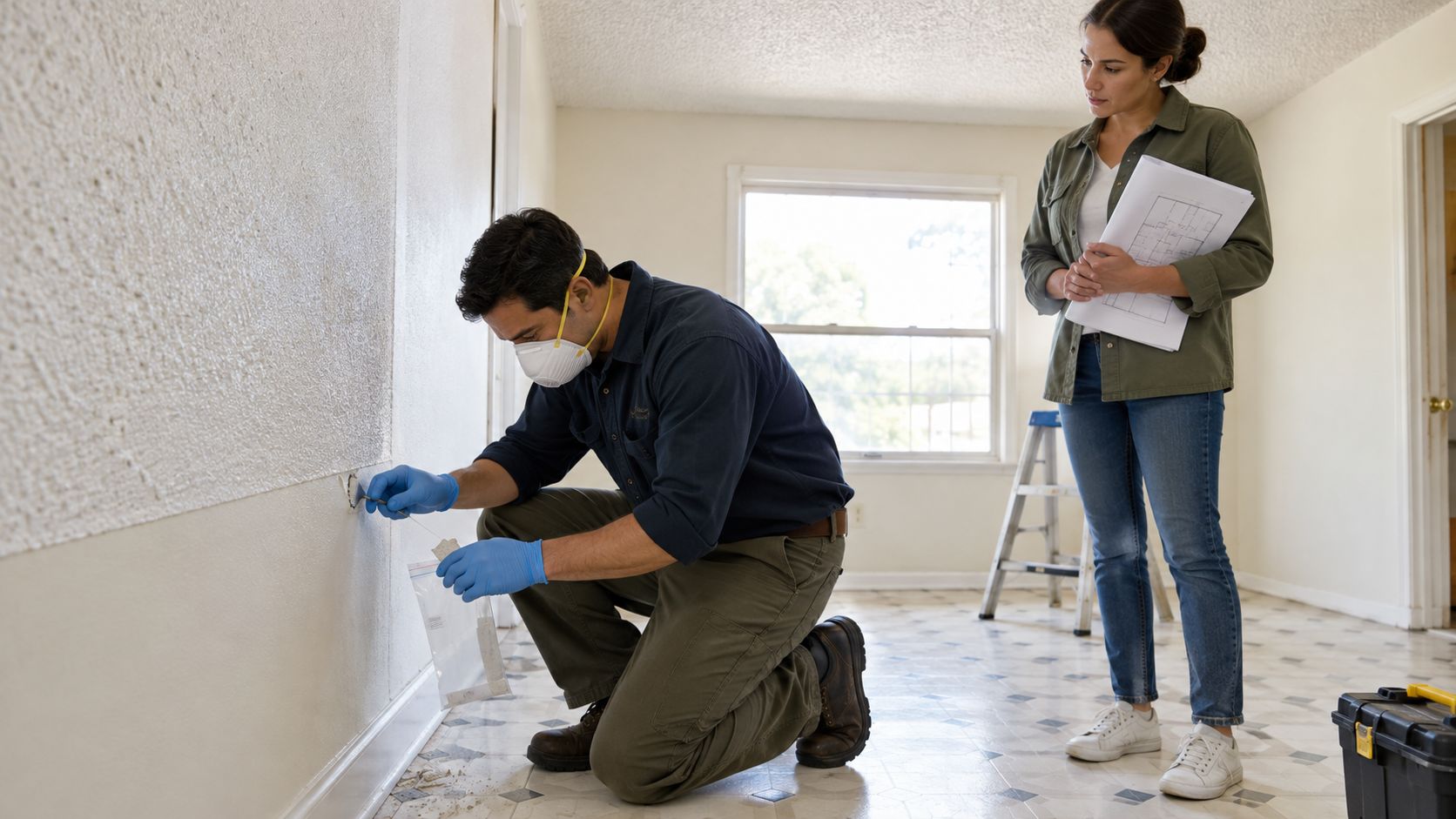
A professional survey typically begins with a visual inspection and project-scope review. A qualified California asbestos consultant develops a sampling plan, collects bulk samples using appropriate wetting and containment practices, maintains chain-of-custody records, and submits samples to a properly accredited laboratory for analysis.
What each option actually provides
| Professional survey | DIY sampling kit |
|---|---|
| Scope-based visual inspection | Usually focuses on the fragment the owner chooses |
| Sampling plan for visible and accessible suspect materials | Limited guidance on how many materials to sample |
| Controlled collection procedures | Owner may disturb material without adequate controls |
| Chain-of-custody documentation | Documentation may not satisfy project requirements |
| Laboratory analysis tied to identified locations | Results may not represent the entire work area |
| Signed report and material inventory | Usually provides only a laboratory result |
| Support for regulatory and construction planning | May be rejected by contractors, agencies, lenders, or buyers |
A $40 DIY kit can't substitute for the consultant report a demolition crew needs before starting work. The price alone isn't the important issue. The issue is that a kit generally doesn't provide accredited consultant oversight, a regulatory-compliant sampling strategy, or a complete inventory of materials that workers may disturb.
Professional deliverables may include an inspection report, material inventory, laboratory results, sampling locations, project limitations, recommendations for additional evaluation, and signed consultant certifications. A positive result doesn't automatically mean a specific response is required, but it gives the owner and qualified project professionals a documented basis for deciding what comes next.
Homeowners considering a kit should review whether asbestos can be tested at home before collecting a sample. For renovation, demolition, commercial property, multifamily housing, schools, and insurance documentation, schedule a professional survey instead of treating a mail-in result as complete project clearance.
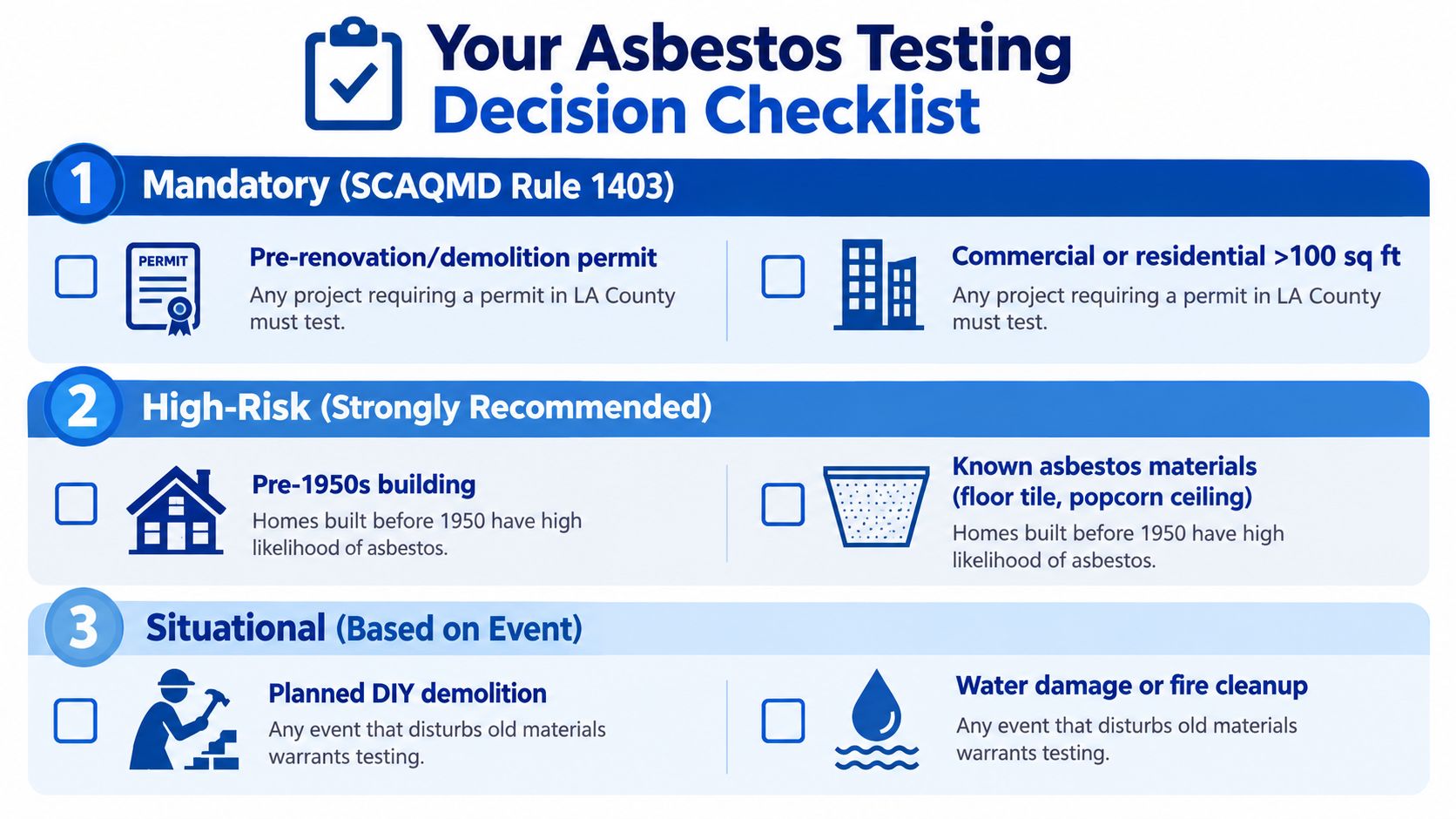
Your Asbestos Testing Decision Checklist
Use the property event, not the property age alone, as the starting point. A 1923 home with intact materials and no planned work presents a different testing decision from a newer commercial building scheduled for demolition. The strongest trigger is always the next action that could disturb suspect material.
Tier one covers mandatory project triggers
Start here when a project involves regulation, permitting, or destructive activity:
- Pre-renovation work: Arrange a survey before renovation disturbs suspect materials. For commercial buildings constructed before 1981, make the survey part of the project's initial environmental planning.
- Pre-demolition work: Treat demolition as a survey trigger regardless of the building's apparent age or the size of the visible work area. EPA NESHAP guidance requires thorough inspection before covered demolition or renovation begins.
- Regulated material quantities: Under the South Coast framework, project documentation and notifications depend on the affected facility, the material, and the work scope. Don't rely on a contractor's visual estimate of the surface area.
- South Coast AQMD notification: For applicable non-emergency projects, plan around the 10-working-day notification period identified in South Coast AQMD's Rule 1403 FAQ. The notification period gives inspectors time to schedule site inspections when needed.
The exact survey scope matters. A demolition survey may require more intrusive inspection than a limited renovation survey because hidden materials can become exposed as the structure comes down.
Tier two covers property events
These conditions call for prompt professional assessment:
- Water intrusion: Test damaged drywall, ceiling texture, flooring, insulation, and debris before removal when the materials have crumbled or become subject to disturbance.
- Fire or wildfire damage: Arrange a post-fire environmental assessment that considers asbestos, ash, soot, char, smoke residue, heavy metals, and other combustion byproducts. Procedure 5 requirements may apply before cleanup involving damaged asbestos-containing material.
- Real estate transactions: For pre-1978 housing, lead disclosure and inspection obligations create a separate environmental testing decision. EPA guidance gives buyers a 10-day period to conduct a lead-paint inspection or risk assessment before contract ratification and requires sellers and landlords to disclose known lead hazards. EPA real-estate lead disclosure guidance explains those requirements.
- Tenant turnover: In multifamily properties, inspect and document suspect materials before repair cycles, unit renovations, or maintenance work that could disturb shared building components.
Tier three covers precautionary triggers
These situations deserve a consultant's review before work is authorized:
- Vintage ceiling texture: Popcorn or acoustic finishes may require sampling before lighting, ventilation, scraping, or repair.
- Old flooring: Vinyl tile, sheet flooring, backing, and black mastic should be evaluated before removal, grinding, or sanding.
- Attic and mechanical materials: Vermiculite insulation, pipe wrap, boiler insulation, HVAC panels, and transite components need attention when workers will enter, open, cut, or replace them.
- DIY demolition plans: Stop before creating dust. A professional survey is safer and more useful than collecting a single fragment after work has started.
Sensitive Environmental provides asbestos inspections, pre-renovation and pre-demolition surveys, sampling, laboratory analysis, asbestos air testing, and documentation for Los Angeles and Southern California projects. Contact the team before your contractor starts demolition so the inspection scope, chain-of-custody records, laboratory analysis, and applicable South Coast AQMD documentation can be planned together.
If you're planning renovation, demolition, fire cleanup, water-damage work, or a property transaction in Los Angeles County, schedule an asbestos survey before anyone disturbs suspect materials. Visit Sensitive Environmental to arrange professional asbestos testing, sampling, laboratory analysis, and clear project documentation in Los Angeles and Southern California.