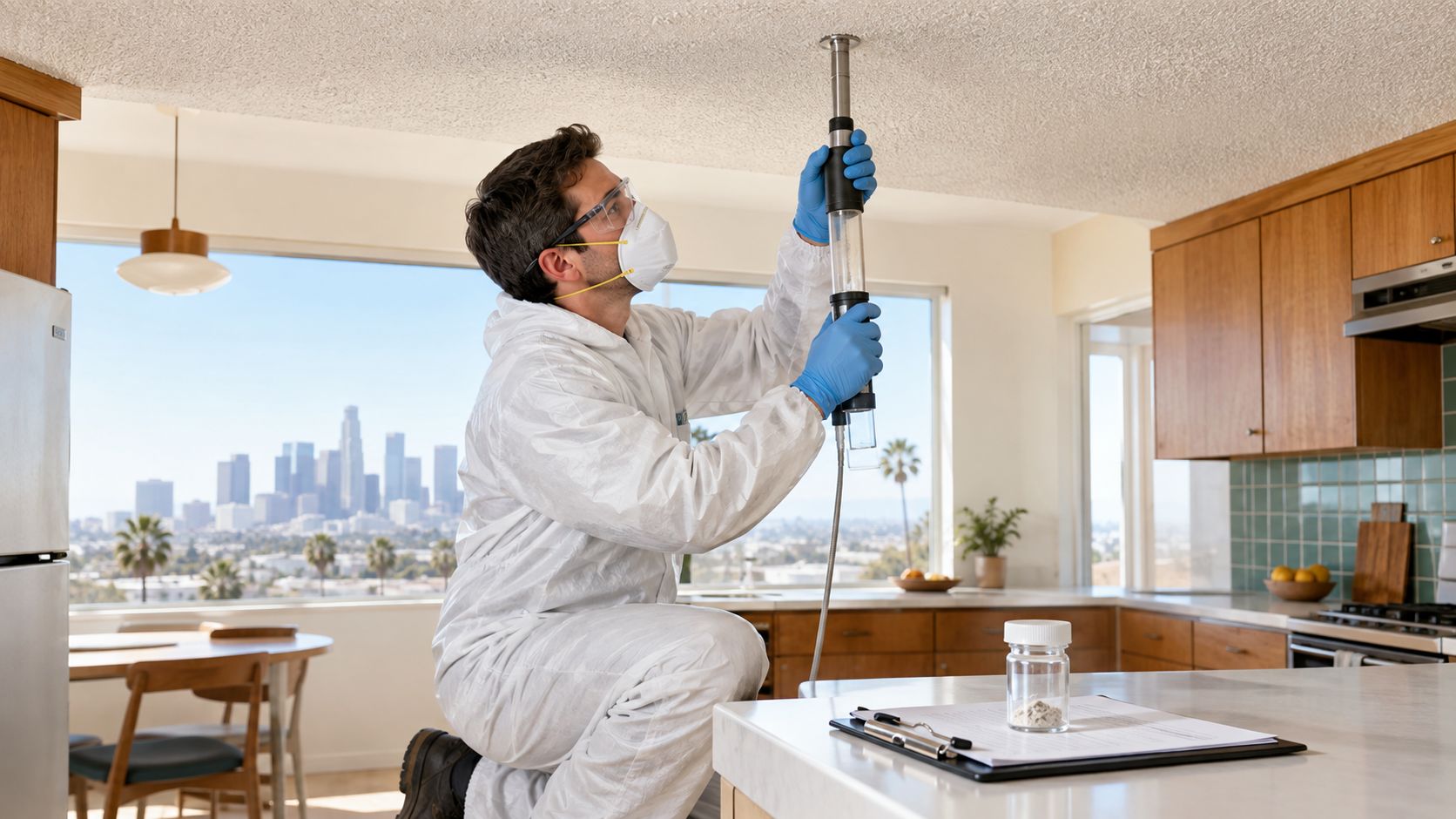
You're halfway through a kitchen remodel in a Silver Lake bungalow when the drywall comes down and a rough, popcorn-like ceiling appears above it. The house is old enough that the material could contain asbestos, but appearance alone can't answer that question. Stopping work and arranging professional asbestos testing is the responsible next move, especially before sanding, cutting, drilling, or demolition disturbs the material.
A search for asbestos testing near me shouldn't be a race to the closest handyman or the lowest quote. In Los Angeles, the useful local answer is a qualified inspector who can assess the work scope, collect defensible samples, coordinate appropriate laboratory analysis, and provide documentation that contractors and regulators can use.
Table of Contents
- Why Local Asbestos Testing Matters in Los Angeles
- What an Asbestos Survey Involves
- How SCAQMD Rule 1403 Shapes Local Testing
- How to Vet an Asbestos Testing Company Near You
- What Asbestos Testing Costs in the LA Area
- Reading and Using Your Asbestos Test Report
- Next Steps and Common Questions for LA Property Owners
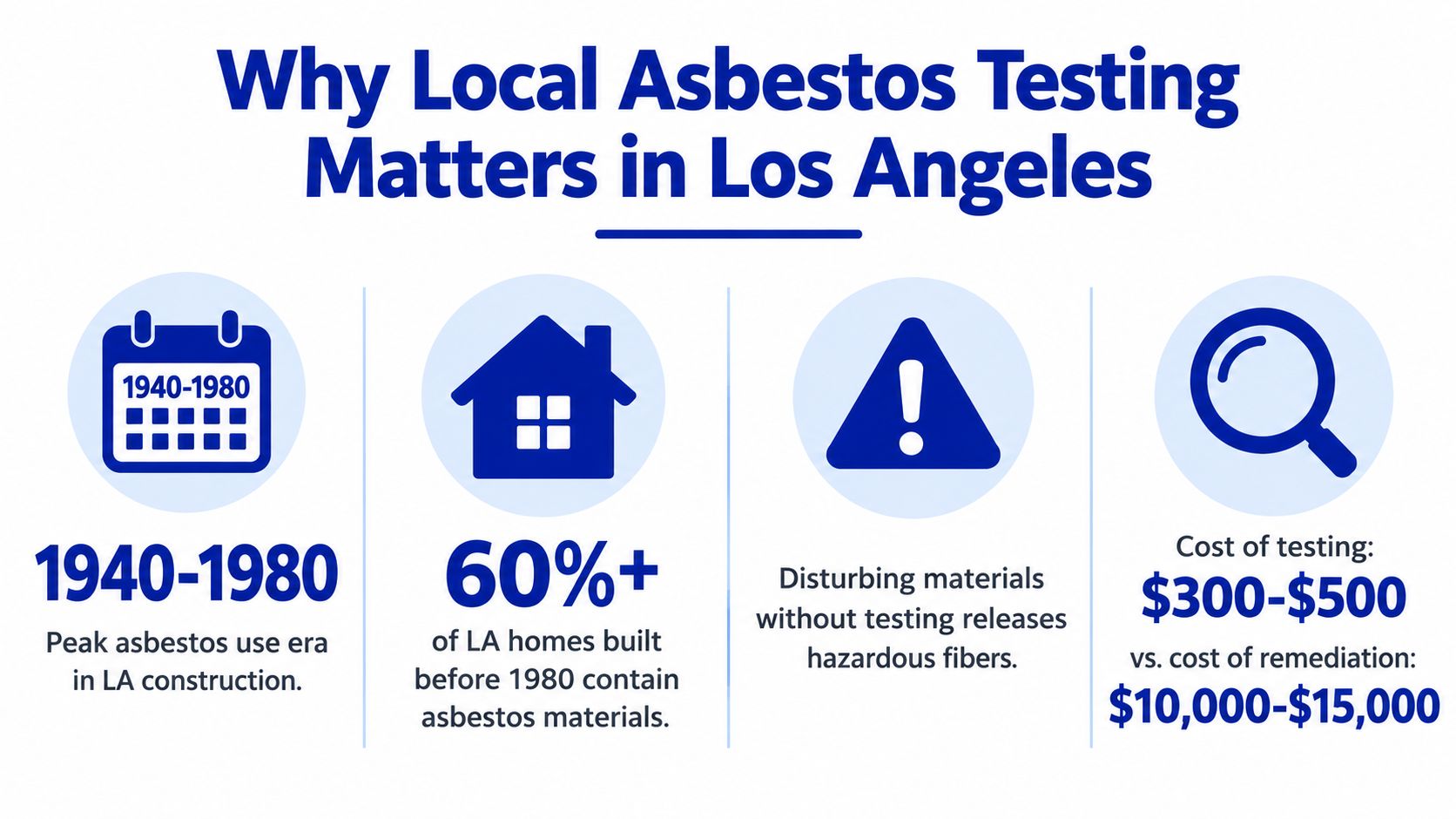
Why Local Asbestos Testing Matters in Los Angeles
Older properties across Los Angeles County can contain asbestos in textured coatings, resilient flooring, pipe insulation, HVAC insulation, sprayed fireproofing, and other building materials. The EPA's survey of 3.6 million public and commercial buildings found friable asbestos in 733,000 buildings, or 20% of the total, with 563,000 buildings containing thermal system insulation and 501,000 showing damaged asbestos-containing material. These figures describe public and commercial buildings, not a percentage of LA homes, but they show why age and disturbance matter. EPA information on asbestos exposure and older buildings
A homeowner may see one suspicious surface. A qualified inspector evaluates the material in context, including layers beneath flooring, insulation around pipes, wall and ceiling cavities, and areas that renovation will disturb. A general home inspection can identify visible concerns, but it isn't a substitute for asbestos sampling and laboratory analysis.
Local rules change the decision
South Coast AQMD Rule 1403 requires a prior asbestos survey before affected demolition or renovation work. The survey must identify and quantify friable asbestos and relevant nonfriable asbestos-containing materials through physical sampling. Demolition surveys require a broad assessment of construction materials, while renovation surveys focus on materials that the planned work may disturb. Read the South Coast AQMD Rule 1403 requirements
That distinction matters in Los Angeles, Pasadena, Long Beach, Glendale, and other South Coast Basin communities. A contractor who starts work based on a visual guess can face interruptions, documentation problems, and worker-protection concerns. A property owner who commissions a properly scoped survey gets information that can support project planning and regulatory decisions.
For real estate transactions, disclosure and documentation also deserve attention. An asbestos report can help clarify what was inspected and what remains unknown, rather than leaving the next owner with an unsupported assumption about older materials. Sensitive Environmental's California asbestos real estate disclosure information provides a related reference for property owners and transaction professionals.
What an Asbestos Survey Involves
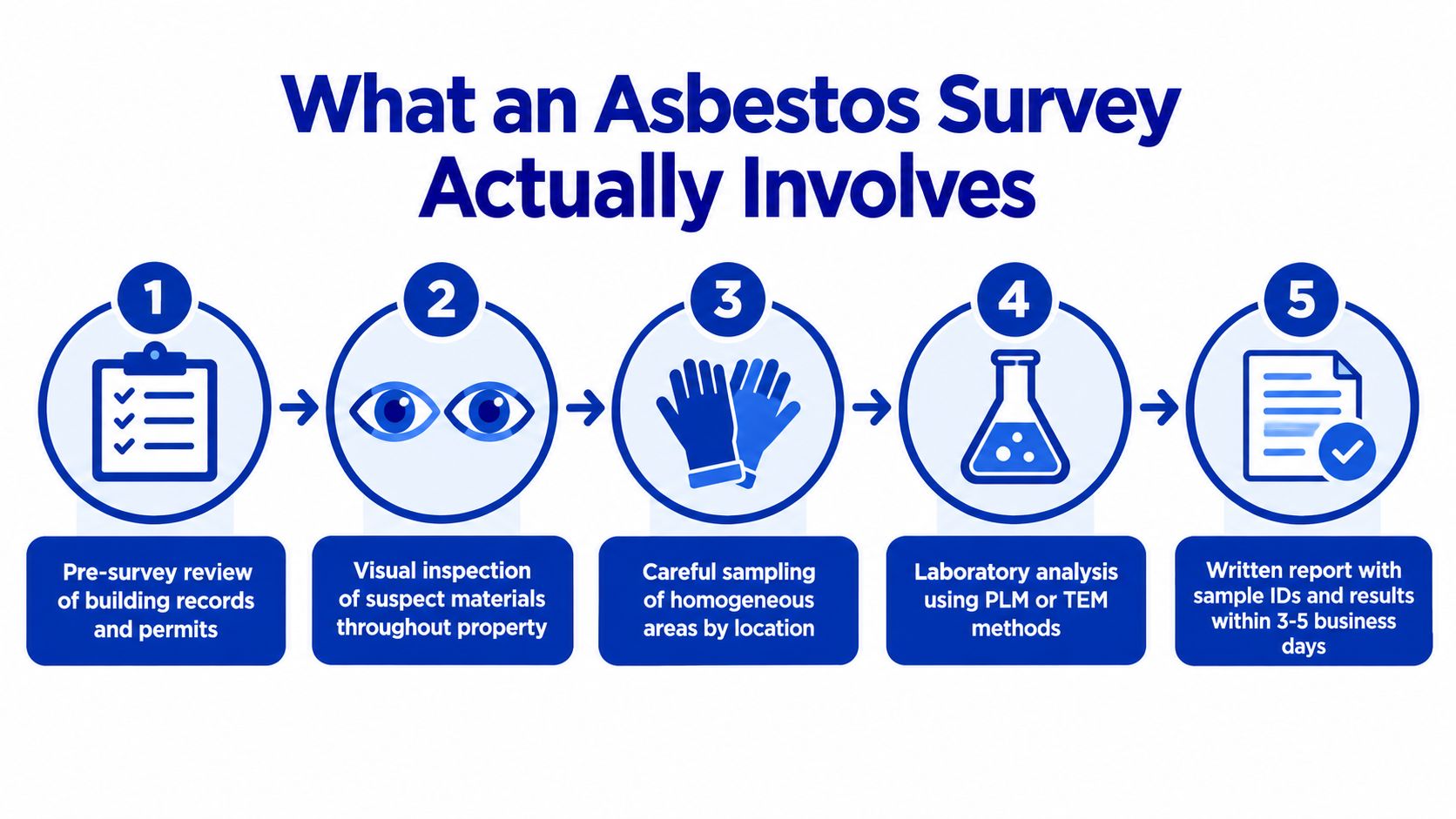
A qualified survey begins with records and project scope, not a quick visual check. The inspector reviews available building documents, renovation history, permits, construction details, and the proposed work. That information determines whether the assignment is a renovation survey, demolition survey, or another assessment, and it identifies materials the project may disturb.
During the site inspection, the inspector maps suspect materials by location, appearance, condition, and accessibility. The survey must account for hidden, layered, damaged, friable, and interconnected materials. A ceiling-texture sample cannot establish whether floor adhesive, pipe insulation, or a separate wall system contains asbestos. Each distinct material and homogeneous area requires an appropriate sampling plan.
Sampling should control disturbance
Bulk sampling involves careful cutting or coring, sealed containers, labels, field notes, and chain-of-custody records. The inspector limits disturbance, protects occupants and workers, and transfers samples securely to the laboratory. A homeowner should not treat asbestos sampling as a casual scrape-and-mail task. Read whether you can test for asbestos yourself before collecting anything independently.
Inspectors group materials into homogeneous areas, meaning areas that appear uniform in composition and use. They then select representative samples by material and location instead of taking one piece and applying the result to the entire building. The property, planned work, and material type determine the proper approach.
The laboratory method matters
Laboratory analysis commonly starts with stereomicroscope screening and polarized light microscopy, or PLM, the EPA-recognized baseline method for bulk building materials. For nonfriable or organically bound materials, or materials likely to contain very fine fibers, transmission electron microscopy, or TEM, can provide more sensitive confirmation by examining fiber size, chemistry, and crystal structure. EPA bulk asbestos sampling and analytical guidance
A negative PLM result does not always resolve the question. A peer-reviewed comparison found asbestos detected by TEM in soil samples at concentrations reported between 0.00001% and 0.01%, while government guidance favors SEM-EDX or TEM for situations involving concentrations below 0.1%. Peer-reviewed comparison of PLM and TEM asbestos detection
Your final report should identify sample locations and IDs, analytical methods, results, site conditions, drawings or sketches, and recommendations. Confirm who performs the analysis, how the laboratory is qualified, and whether the report addresses the actual renovation or demolition scope. A nearby vendor is useful only when it provides this level of documentation and laboratory access.
How SCAQMD Rule 1403 Shapes Local Testing
Rule 1403 governs asbestos emissions from renovation and demolition in the South Coast Air Basin. For property owners, its central practical rule is simple: obtain and document the required survey before regulated work begins. The survey must be performed by a Cal/OSHA-certified inspector, or in the circumstances allowed by AQMD guidance, by a facility employee with an unexpired AHERA Building Inspector certificate from a Cal/OSHA-approved course. AQMD's Rule 1403 compliance advisory
The scope depends on the project. A demolition survey must be thorough and exhaustive, including construction materials, foundations, underground utilities, and potentially hidden or inaccessible materials. A renovation survey is limited to materials that the planned work may disturb. That doesn't make renovation surveys informal. The report still needs to identify suspect materials, describe condition, determine friability, and document findings in writing.
The residential exception is narrow. AQMD guidance identifies an exemption for a single-unit residential structure when less than 100 square feet of asbestos-containing material surface area is removed or stripped during renovation. Demolition has no exception under the stated emergency and demolition guidance, and a property owner should never assume that a small-looking project qualifies without confirming the rule's application.
Rule 1403 Survey Requirements at a Glance
| Project Type | Survey Scope | CAC Required? | Notification to SCAQMD | Key Threshold |
|---|---|---|---|---|
| Renovation | Materials that may be disturbed by the planned work | Use a qualified Cal/OSHA-certified inspector or permitted AHERA-qualified facility employee | Requirements depend on the project and applicable Rule 1403 provisions | Narrow single-unit residential exemption for less than 100 square feet in the stated circumstances |
| Demolition | Comprehensive assessment of construction materials, foundations, underground utilities, and hidden areas | Yes, unless a specific regulatory provision allows another qualified arrangement | Required under applicable Rule 1403 procedures before work | No demolition exception stated in the AQMD emergency guidance |
| Emergency renovation or demolition | Survey and documentation remain necessary after sudden unexpected damage | Follow AQMD qualification requirements | Submit emergency notifications as soon as possible | Emergency conditions don't eliminate the prior-survey requirement |
LA County Public Works summarizes the demolition workflow as asbestos survey, asbestos removal, AQMD notification, and building-and-safety permit. The survey comes first because its findings influence the remaining project steps. LA County Rule 1403 instruction sheet
Contractors also need to consider worker protection under Cal/OSHA requirements, including Title 8 provisions applicable to asbestos work. The safest project schedule is built around the survey, not around a crew's arrival date.
How to Vet an Asbestos Testing Company Near You
Treat the vendor search like a credential audit. A professional asbestos testing company should explain who will inspect the property, who will collect samples, which laboratory will analyze them, and how the final report will support your project.
Start with the field professional's qualifications. Ask whether the inspector holds a current Cal/OSHA Certified Asbestos Consultant, or CAC, credential when the project requires one. For site monitoring and related field roles, ask about the appropriate Cal/OSHA certification, such as a Certified Site Surveillance Technician credential. AHERA training and the inspector's experience with the specific building type also matter.
Questions worth asking before booking
- Who performs the inspection? Get the inspector's name, role, and applicable certification information in writing.
- What will the survey cover? A kitchen remodel, roof replacement, tenant improvement, and full demolition don't require identical scopes.
- Which lab reads the samples? Ask for the laboratory name and whether it is qualified for the proposed bulk asbestos analysis.
- Which method will be used? PLM is the baseline method for many bulk materials, but the inspector should explain when TEM confirmation is appropriate.
- How is custody documented? Sample labels, sealed containers, field notes, and a chain-of-custody record should connect the property to the laboratory report.
- What does the report include? Look for site sketches, homogeneous area identification, unique sample IDs, analytical results, and a signed certification statement.
Practical rule: If a vendor can't name the laboratory that will analyze the samples, don't hire that vendor.
Be cautious with anyone who gives a firm quote without asking about the building, age, project scope, access, and materials involved. Also reject proposals that blur inspection with abatement. Testing companies may identify conditions and provide documentation, but testing isn't the same service as asbestos removal or cleanup.
A local company should understand South Coast AQMD expectations, but “local” alone isn't a qualification. Sensitive Environmental provides asbestos testing, inspections, sampling, laboratory analysis, and documentation for residential and commercial properties in Los Angeles and Southern California. Compare its proposed scope with other qualified firms, and choose the provider that can deliver a defensible field and laboratory package.
What Asbestos Testing Costs in the LA Area
There isn't one responsible flat price for “asbestos testing near me.” The inspection cost depends on the property's size, the number of distinct materials, access conditions, project scope, laboratory method, and the documentation required.
For a small residential project, request a written scope before discussing whether a quote is competitive. The scope should state the areas inspected, materials sampled, laboratory method, report format, expected turnaround, and any exclusions. A low price can reflect a limited visual visit rather than a survey that addresses the materials a contractor will disturb.
Main cost drivers
Building size and material diversity affect field time and sample planning. A simple room renovation differs from a multi-unit building with several flooring systems, pipe insulation types, ceiling textures, and mechanical areas.
Access conditions can change the work substantially. Crawlspaces, attics, wrapped piping, concealed cavities, layered flooring, and occupied commercial spaces may require additional planning and documentation.
Laboratory analysis also depends on the material. PLM is the standard starting method for many bulk building materials. TEM may be appropriate when the material is nonfriable, organically bound, or likely to contain fine fibers. The inspector should explain that choice rather than add a mysterious laboratory charge after sampling.
Typical Asbestos Testing Cost Ranges in Los Angeles
The figures below are planning estimates supplied for this guide, not verified data from the cited sources. Confirm the scope and price directly with the testing company before authorizing work.
| Property Type | Typical Survey Cost | Lab Method |
|---|---|---|
| Single-family renovation | Not stated in verified data | PLM, with TEM when appropriate |
| Multi-unit renovation | Not stated in verified data | PLM or TEM based on material and risk |
| Commercial demolition | Not stated in verified data | PLM, with supplemental microscopy when warranted |
Don't accept a bundled proposal that hides inspection inside an abatement or construction package. The testing line item should stand on its own, and the report should be usable even if a different qualified contractor handles later work.
Reading and Using Your Asbestos Test Report
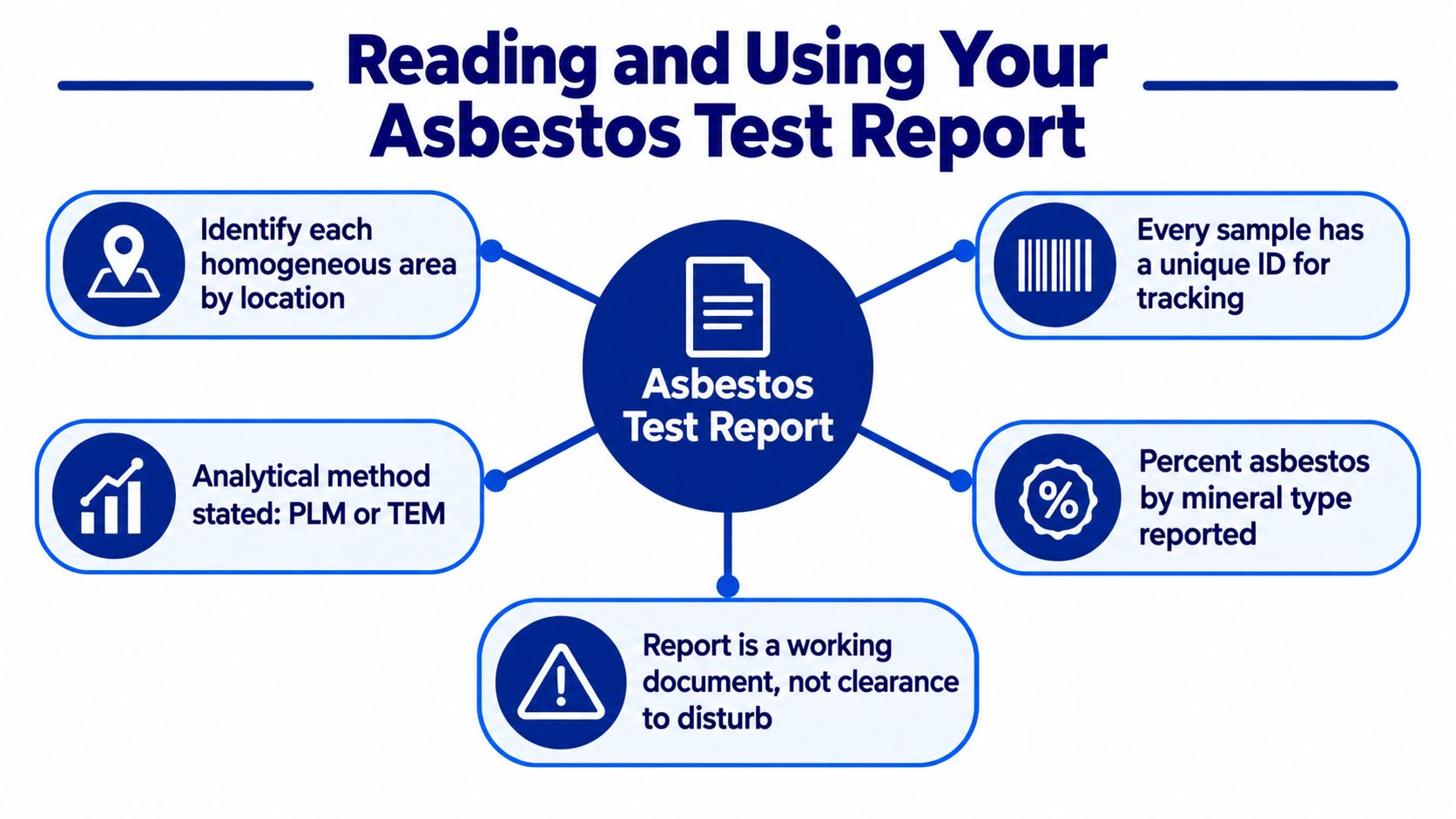
A test report is a working project document, not permission to disturb a material. Read it against the planned work. If the report doesn't show where samples came from, what each sample represents, and which method the laboratory used, it may not answer the contractor's actual question.
A useful report identifies each homogeneous area by location and material type. It assigns every sample a unique ID, states whether PLM or TEM was used, reports the analytical result, and connects the result to a site sketch or other location record. It should also include the inspector's credentials or signed certification statement when the project requires a certified consultant.
Read results by material area
Don't treat one sample as a verdict on every visually similar material in the building. A positive result can classify the associated homogeneous material area as asbestos-containing, while a clear result from a different area doesn't automatically clear it. Your contractor needs the report's material boundaries and sample locations to plan the affected work.
The report should distinguish between:
- Materials that tested negative, within the stated sampling scope and analytical limitations.
- Materials identified as asbestos-containing, requiring project-specific decisions before disturbance.
- Materials that weren't sampled or couldn't be accessed, which remain unresolved rather than automatically safe.
- Materials requiring further analysis, especially where the initial method may not resolve low-level or fine-fiber content.
A negative result is only as useful as the material, location, method, and scope behind it.
Use the report to coordinate with the architect, contractor, building department, and qualified asbestos professionals. AQMD guidance requires demolition surveys to address hidden and inaccessible construction materials, while renovation surveys focus on materials affected by the work. AQMD survey and emergency requirements
Keep the signed report with the property's environmental records. Future owners, facility managers, and contractors may need to understand what was inspected, what was found, and which areas were outside the original scope.
Next Steps and Common Questions for LA Property Owners
If suspect material is exposed, stop activities that could create dust and define the work area. Then schedule an assessment with a qualified local inspector, provide the planned renovation or demolition scope, and ask the inspector to confirm which Rule 1403 requirements apply.
The practical sequence is:
- Schedule the site visit. Give the inspector building details, project drawings, photographs, and the intended work.
- Confirm the survey scope. Make sure the inspection covers every material the crew may disturb, not only the material that first caught your attention.
- Review the written report. Check sample locations, IDs, analytical methods, results, limitations, and recommendations before work starts.
- Coordinate documentation. Give the report to the contractor and retain it for AQMD, Cal/OSHA, permitting, insurance, transaction, and future maintenance records.
- Decide next steps from the findings. A positive result informs project controls and qualified professional planning. It doesn't automatically dictate one universal response.
Common questions
Can I collect my own asbestos sample?
You shouldn't. Improper sampling can disturb fibers, misidentify the material, break chain of custody, or produce results that don't satisfy a project or regulatory review. The EPA says definitive testing requires suspect material to be sampled by a properly trained and accredited inspector and analyzed by a qualified laboratory. EPA asbestos frequently asked questions
How fast can results come back?
Turnaround depends on the laboratory, method, sample count, and service level. Ask for the expected schedule before the site visit, and don't schedule disturbance work until the report is complete and reviewed.
Does a small residential project automatically avoid Rule 1403?
No. The exemption is narrow and tied to specific single-unit residential renovation conditions. Demolition isn't covered by the same exception. Confirm the facts with a qualified inspector and AQMD guidance.
Does a positive result automatically require abatement?
Not necessarily. The result identifies asbestos in the sampled material. The appropriate next step depends on the material, condition, location, planned disturbance, applicable rules, and qualified professional recommendations. Property owners seeking background on related work can review asbestos abatement considerations in Los Angeles, while keeping the testing scope separate from removal services.
For a renovation, demolition, real estate transaction, water-damaged property, or commercial facility, book the survey before crews disturb suspect materials. A qualified local inspector can connect field assessment, proper sampling, accredited laboratory analysis, and clear reporting in one defensible package.
Sensitive Environmental provides asbestos testing, pre-renovation and pre-demolition surveys, sampling, laboratory analysis, and Rule 1403 documentation for properties throughout Los Angeles and Southern California. Contact Sensitive Environmental to schedule a project-specific asbestos assessment before renovation or demolition begins.