California never set a single all-purpose asbestos outlaw date. The practical benchmark most professionals use is 1980, with phased state and federal restrictions unfolding through 1973, 1975, 1978, 1984, 1989, 1990, 1994, and a newer EPA chrysotile rule finalized in 2024.
That's where a lot of online advice goes off track. People search for one clean answer to when was asbestos outlawed in California, but property owners in Los Angeles and across Southern California usually need a different answer: which date controls my testing, survey, or compliance duty today? For renovations, demolitions, and due diligence, that question matters more than a simple ban-year headline.
If you own, manage, design, insure, buy, or plan work on an older building, asbestos history only matters if it changes what you need to inspect, sample, document, or report. That's why experienced consultants usually frame the issue around the layered timeline and the 1980 Cal/OSHA presumption benchmark, not around a single “outlawed” date.
Table of Contents
- Why California Never Had One Asbestos Outlaw Date
- The Phased California and Federal Bans From 1973 to 1994
- The 1989 Federal Ban and the 2024 Chrysotile Rule
- Why 1980 Still Matters for California Property Owners
- How South Coast AQMD Rule 1403 Shapes Today's Surveys
- Real World Scenarios Where Legacy Asbestos Still Triggers Testing
- Common Misconceptions About Asbestos and Modern Buildings
- Turning the Timeline Into Your Next Testing Steps
Why California Never Had One Asbestos Outlaw Date
The biggest misconception is that California passed one law and asbestos disappeared. That didn't happen.
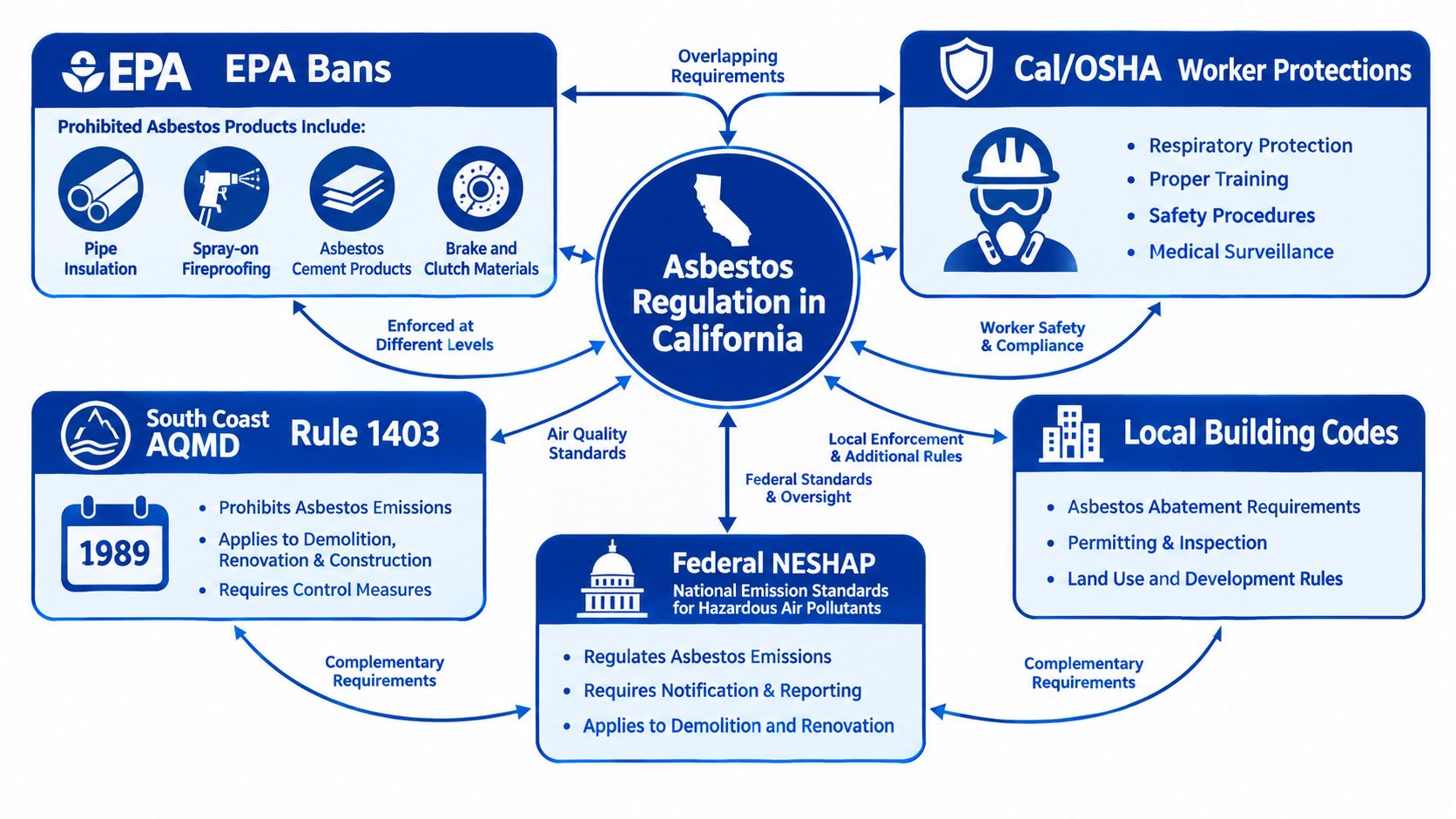
California regulated asbestos through overlapping systems. Some rules restricted specific products. Others governed demolition and renovation work. Others told employers what materials had to be presumed asbestos-containing unless testing proved otherwise. The result is a phased regulatory history, not one statewide cutoff.
Why the one-date answer is misleading
A building doesn't become asbestos-free because a later ban exists on paper. Existing materials can stay in place for decades. Imported products, stockpiled materials, and different rule types also complicate the timeline. That's why the phrase “outlawed” causes confusion for homeowners, contractors, and even some real estate professionals.
A better way to think about it is this:
- Product bans limited certain asbestos-containing products over time.
- Work-practice rules controlled how asbestos had to be handled during renovation and demolition.
- Worker protection rules required employers to presume asbestos in certain older materials unless testing showed otherwise.
The practical answer most projects use
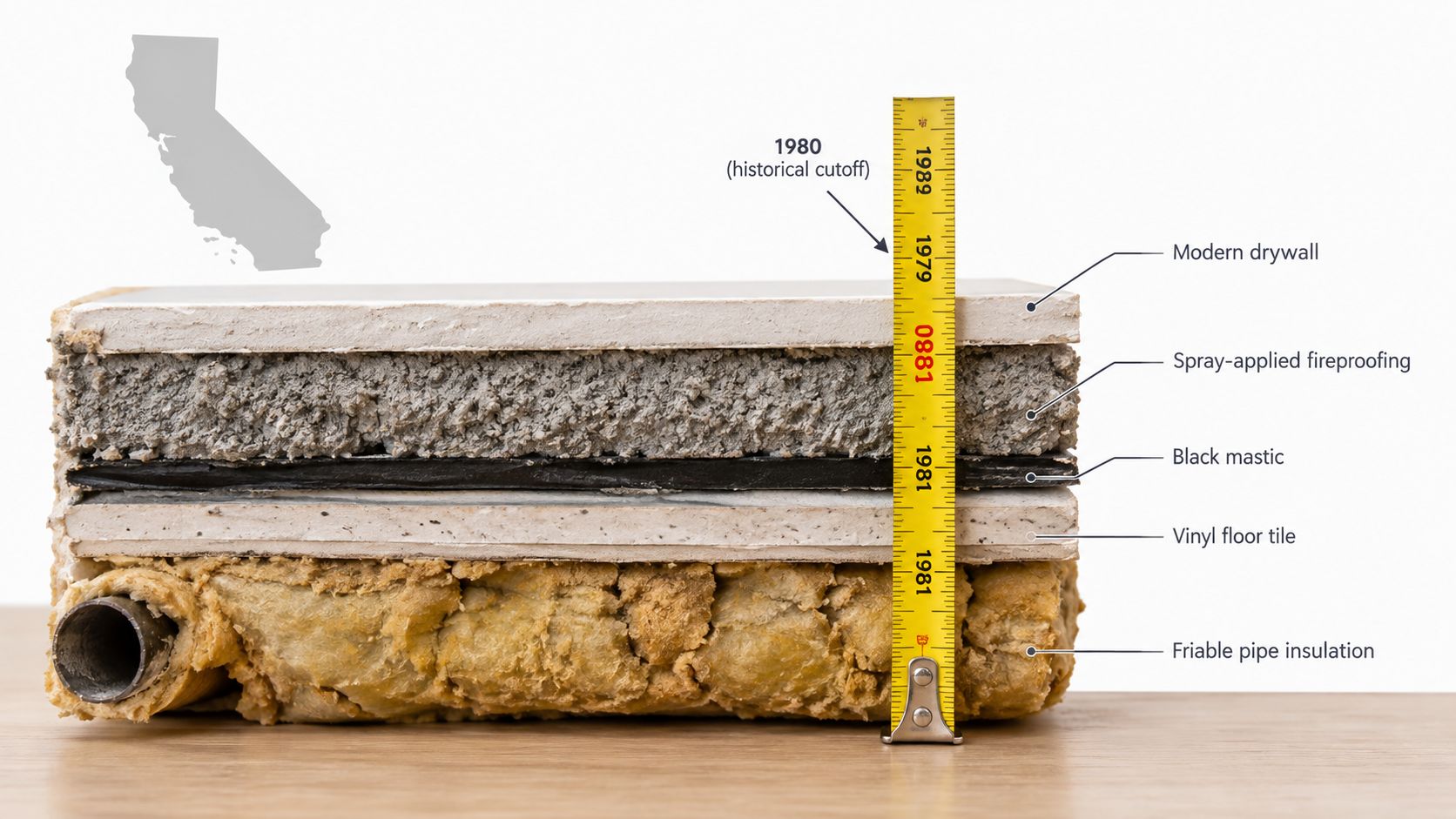
For California project planning, the most useful benchmark is the one built into Cal/OSHA asbestos standard section 1529. It says installed thermal system insulation, sprayed-on or troweled surfacing materials, and asphalt or vinyl flooring in buildings constructed no later than 1980 must be presumed asbestos-containing unless tested otherwise.
Practical rule: If your building was constructed on or before 1980, don't rely on assumptions. Treat suspect materials as asbestos-containing until a proper survey and laboratory analysis say otherwise.
That's why environmental testing companies, Certified Asbestos Consultants, project managers, and demolition planners keep coming back to 1980. In Los Angeles, Pasadena, Long Beach, Santa Monica, Glendale, Burbank, and other Southern California markets, that date often determines whether a pre-renovation asbestos survey or pre-demolition asbestos testing needs to move to the top of the checklist.
The Phased California and Federal Bans From 1973 to 1994
The asbestos timeline makes more sense when you stop looking for one ban and start looking at milestones.
Early restrictions in the 1970s
A California Air Resources Board historical summary of the federal and state NESHAP timeline shows several major milestones in the CARB historical asbestos summary. In 1973, demolition projects were included and spray-applied asbestos was banned. In 1975, renovation projects were added and wet-applied asbestos and pre-molded insulation were banned. In 1978, decorative uses such as textured ceilings were banned.
Those dates matter because they show how regulators tackled asbestos by use category, not by wiping out all asbestos at once. A contractor opening a ceiling cavity in an older Los Angeles duplex or a facilities team planning a tenant improvement in Orange County still works inside that layered framework.
How the framework tightened in the 1980s and 1990s
The same historical record lists later milestones in 1984, 1990, and 1994. Those later stages strengthened the rules that govern how asbestos is identified and managed during building work, especially for emission control and worker protection. For owners, that's why older materials can trigger not just testing, but also documentation, notifications, and defined handling procedures before any disturbance.
A related local benchmark matters in Southern California. A South Coast AQMD public notice states that Rule 1403 was adopted on October 6, 1989, and the same notice also recaps the NESHAP changes from 1973, 1975, and 1978 in the demolition and renovation context in South Coast AQMD's Rule 1403 workshop notice.
What property owners should take from this timeline
The timeline isn't trivia. It explains why modern asbestos inspections focus on both material type and planned disturbance.
- Sprayed materials often draw attention because early bans targeted them first.
- Flooring and mastics remain common survey items because they stayed in circulation long after the first restrictions.
- Decorative and surfacing materials still show up in older homes, schools, offices, and multifamily buildings.
The right question usually isn't “Was asbestos illegal yet?” It's “What materials are present, and what rules apply before this project disturbs them?”
That's the foundation for asbestos testing Los Angeles property owners need before remodels, demolitions, tenant improvements, insurance claims, and environmental due diligence.
The 1989 Federal Ban and the 2024 Chrysotile Rule
If you are looking for one headline federal date, July 12, 1989 is the closest fit. EPA issued a final rule under TSCA that targeted many asbestos-containing products in commerce, and EPA notes that new uses were barred after August 25, 1989 in EPA's asbestos regulatory actions summary.
That date helps, but it does not work like an on and off switch for every asbestos risk a California owner faces. A better way to read 1989 is as a major federal commerce milestone. It changed what could continue in the marketplace far more than it changed what was already installed in existing buildings.
Why the 1989 rule still leaves confusion
The confusion comes from what happened next. In 1991, a federal court overturned much of that rule, leaving only a narrower set of product bans in place.
For property owners, the practical takeaway is simple. A federal ban effort existed. Part of it survived. Legacy asbestos stayed where it had already been used, which is why pipe insulation, floor tile, mastics, roofing materials, and surfacing products still show up during inspections decades later.
A building works like a time capsule. Laws can stop or limit future sales, but they do not pull yesterday's materials out of walls and mechanical rooms.
What changed again in 2024
Another major federal action arrived in March 2024, when EPA finalized a rule addressing ongoing uses of chrysotile asbestos under amended TSCA. EPA has also explained on its asbestos actions page that the rule includes phased compliance dates that extend beyond the publication date.
That matters for manufacturers, importers, and some continuing commercial uses. It does not function as a blanket order requiring owners to remove all older asbestos-containing materials from existing California buildings.
Federal product rules answer a commerce question. Renovation and demolition surveys answer a disturbance question.
That distinction trips up many owners. A newer federal prohibition can exist at the same time an older apartment building, warehouse, school, or office still contains asbestos in place. If your project will cut, drill, sand, remove, or demolish suspect materials, the operational question is still whether asbestos is present in the building fabric before work begins.
That is why 1989 and 2024 matter, but neither date replaces field inspection, sampling, and project-specific asbestos review in Southern California.
Why 1980 Still Matters for California Property Owners
The year 1980 still shows up in project files because Cal/OSHA uses it as a presumption line for certain installed materials. That is the compliance benchmark many owners, contractors, and consultants rely on when deciding whether a survey is necessary before work begins.
What materials fall under the presumption
The presumption applies to categories that commonly appear in older buildings:
| Presumption Category | Suspect Materials | Typical Survey Action |
|---|---|---|
| Thermal system insulation | Boiler wrap, pipe insulation, duct insulation, fittings insulation | Inspect accessible systems, collect bulk samples where appropriate, document locations and condition |
| Surfacing materials | Sprayed-on fireproofing, plaster-like coatings, textured finishes | Inspect visible surfaces and concealed areas affected by the scope of work, sample representative materials |
| Asphalt or vinyl flooring | Vinyl floor tile, sheet flooring, associated mastics | Evaluate layers affected by the project, collect samples from flooring and adhesive as needed |
The operational effect is simple. If the building was constructed no later than 1980 and those materials are present, you don't get to assume they're clean based on appearance.
Why the date changes the burden of proof
The burden shifts to the owner or project team to confirm whether suspect materials contain asbestos. That usually means an asbestos inspection, bulk sampling, and laboratory analysis before disturbance. For renovation planning, that's very different from guessing based on age, color, or texture.
A real estate buyer dealing with disclosures may also run into this issue. Questions about suspect materials often come up long before any demolition permit is filed, especially in older housing stock. This is one reason California asbestos real estate disclosure guidance can become relevant even when no immediate abatement decision is being made.
Common places consultants still look
In pre-1980 California buildings, suspect asbestos materials often include:
- Mechanical system materials such as pipe wrap and boiler insulation
- Interior finishes such as acoustic ceiling texture and surfacing compounds
- Floor systems such as vinyl tile and black mastic
- Exterior or roof-related products such as certain felts and related assemblies
For owners in Los Angeles County, this is why asbestos survey Los Angeles searches often lead to the same advice: get the materials inspected before they're disturbed, not after the contractor has already started cutting.
How South Coast AQMD Rule 1403 Shapes Today's Surveys
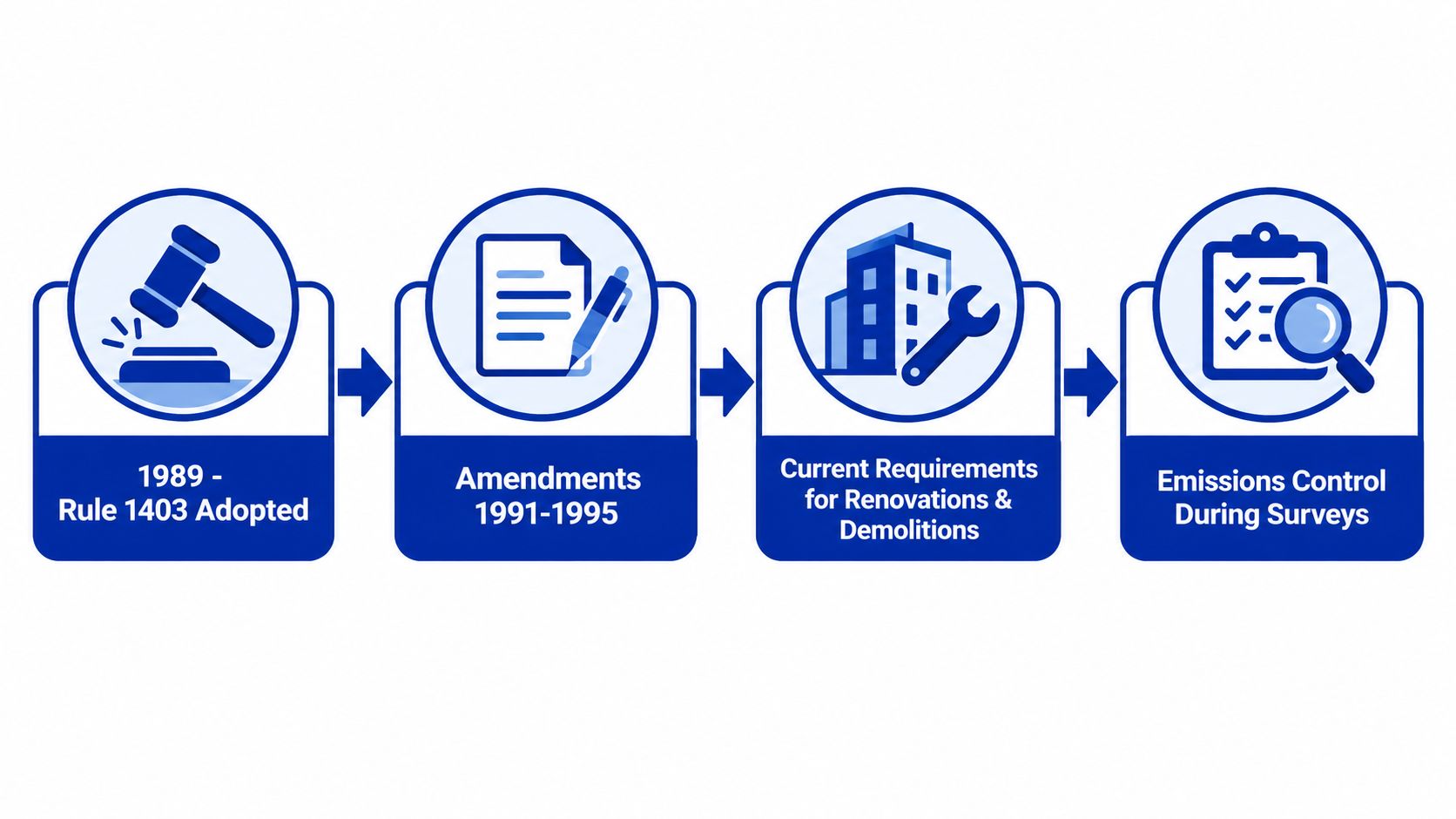
In the Los Angeles area, the rule that most directly affects demolition and renovation surveys is South Coast AQMD Rule 1403. It governs asbestos emissions for projects in the South Coast jurisdiction, which includes major parts of Southern California where many commercial and residential projects take place.
What the rule requires before work starts
Rule 1403 requires a prior asbestos survey before any demolition or renovation, and that survey must identify, inspect, quantify, and physically sample friable and Class I or Class II nonfriable asbestos-containing material, according to South Coast AQMD Rule 1403. For Los Angeles-area projects, the rule also specifies that affected materials must be evaluated, including flooring layers down to the joist level and materials inside wall or ceiling cavities as needed.
That detail catches people off guard. A visual walk-through isn't enough if the work scope affects hidden layers. Flooring replacement, wall demolition, and ceiling access often require a much more invasive survey than owners expect.
Who can sign off and what the report must contain
South Coast AQMD also says the survey report must be signed by a Certified Asbestos Consultant and must identify all asbestos-containing material that could be disturbed, describe condition, and determine friability in Rule 1403 frequently asked questions. The surveyor must observe the material in person and be able to touch it to evaluate friability.
That requirement is one reason DIY kits don't satisfy many project needs. A Rule 1403 survey is not just lab data. It's field inspection, material characterization, documentation, and compliance reporting.
For owners managing larger buildings, asbestos management in Los Angeles commercial buildings often turns into a documentation issue as much as a sampling issue.
The narrow exception people misread
Rule 1403 further states that the onsite survey must be conducted and documented before renovation or demolition begins, with a narrow renovation exception for single-unit residential structures when less than 100 square feet of asbestos-containing material surface area is removed or stripped. Demolition has no exception, as explained in South Coast AQMD's Rule 1403 compliance advisory.
Jobsite reality: If demolition is involved, don't count on a residential shortcut. The survey requirement remains in place.
That's why pre-demolition asbestos testing and SCAQMD Rule 1403 asbestos testing are routine steps for contractors, developers, architects, and property managers across Los Angeles, Orange, Riverside, and San Bernardino counties.
Real World Scenarios Where Legacy Asbestos Still Triggers Testing
Regulatory timelines become easier to understand when you apply them to actual project decisions.
A Silver Lake kitchen remodel
A homeowner in a 1960s Silver Lake bungalow wants to replace cabinets and remove old floor finishes. Underneath the visible finish, the contractor finds small vinyl floor tile and a dark adhesive layer. The issue isn't whether asbestos had been “banned” somewhere in the background. The issue is that the age and material type make the flooring system suspect.
An asbestos consultant would typically inspect the work area, collect representative bulk samples from the tile and adhesive if accessible, and document what layers are present in the remodel footprint. The lab results would then help the owner and contractor decide how the flooring can be handled before demolition continues.
An Irvine office renovation
A 1970s office park in Irvine plans a ceiling upgrade. Replacing suspended ceiling tile sounds simple until the team considers what may be sitting above the grid, including older sprayed surfacing materials or fireproofing tied to the structural deck.
That's where a Rule 1403 inspection changes the plan. The survey may need to include accessible above-ceiling materials, cavity conditions, and any affected structural components. For commercial environmental testing, this is a planning exercise as much as a compliance exercise. If hidden asbestos is discovered late, schedules, permits, and contractor sequencing all get harder.
A post-fire Pacific Palisades assessment
A fire-damaged home in Pacific Palisades creates a different problem. Burn damage can obscure original materials, and debris may include drywall residue, insulation, pipe wrap, ash, soot, and other combustion byproducts. In that setting, asbestos testing can overlap with post-fire environmental assessment, CBP testing, and screening for fire residue concerns such as ash, char, smoke residue, and heavy metals.
A consultant may need to inventory damaged materials that are still present, determine what should be sampled before demolition decisions are made, and separate asbestos questions from other wildfire contamination testing needs. The age of the structure still matters, but now the testing plan has to account for fire damage and debris conditions too.
A ban date doesn't tell you what survived inside a burned or partially demolished structure. Sampling does.
These are the situations where experienced field judgment matters. The project trigger is usually the building's original era and current disturbance, not a simplistic online date.
Common Misconceptions About Asbestos and Modern Buildings
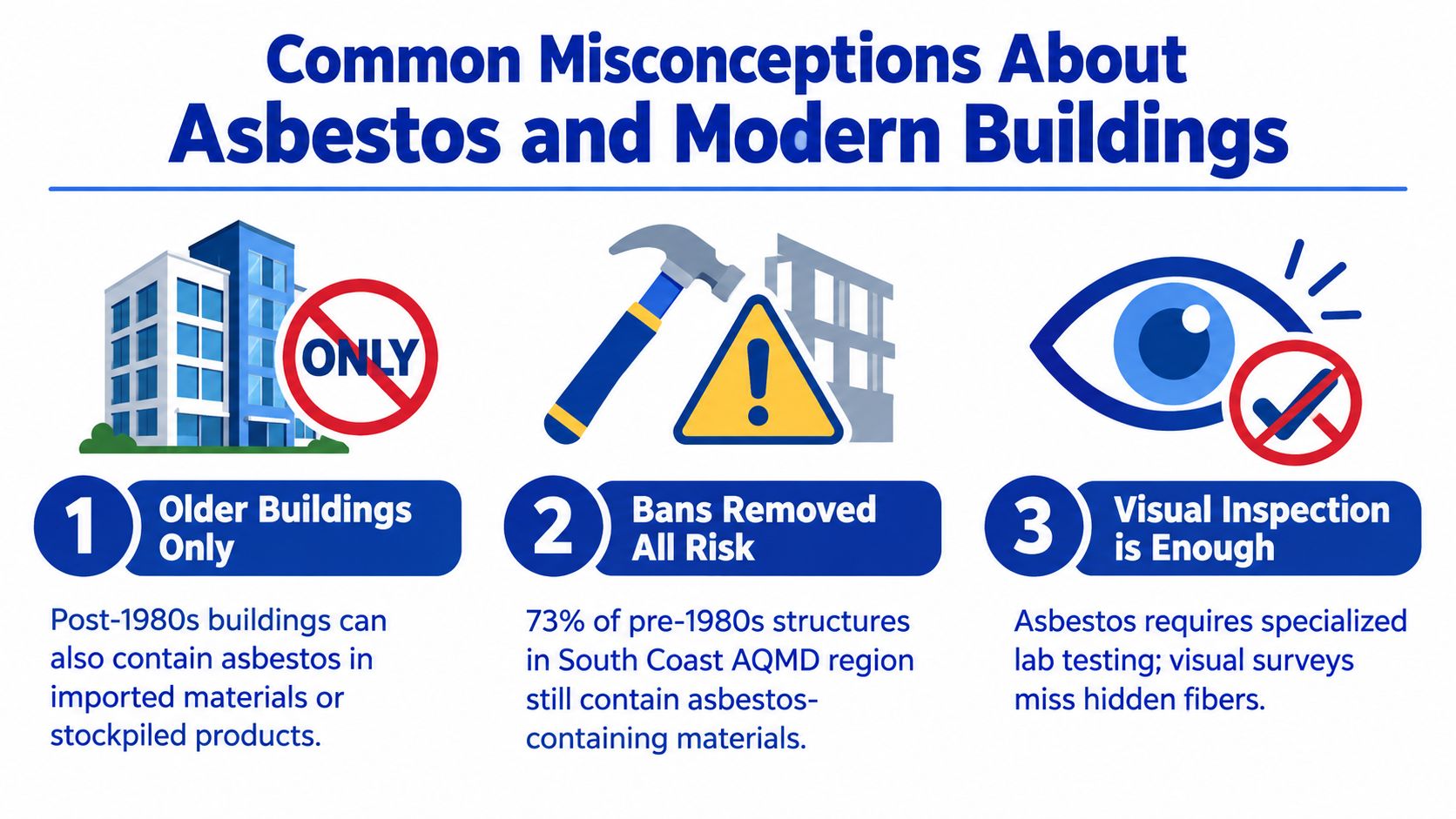
The biggest mistake owners make is assuming a later ban date means a standing building is clear. It doesn't.
Even recent California-facing guidance says there is no cut-off date where asbestos can no longer be found, and a wildfire-related report cited an estimated 73% of structures in Southern California still containing it in some form in this legacy asbestos discussion tied to wildfire cleanup. That figure is a reminder that legacy asbestos remains a present-tense issue, especially in older building stock.
Misconception one: only very old buildings have asbestos
Older buildings are the obvious risk, but they aren't the only ones worth checking. A later construction date lowers suspicion for some materials, but it doesn't eliminate it. Imported products, leftover stock, repairs from different eras, and undocumented remodels all complicate the picture.
That's why consultants inspect the actual materials in the actual work area instead of relying only on the permit history or seller memory.
Misconception two: a negative sample means the whole building is asbestos-free
A negative result applies to the sampled material, not necessarily every hidden layer in the property. If the survey didn't include a wall cavity, a roof assembly, or a buried flooring layer, those materials still need their own evaluation if later work will disturb them.
This distinction matters in commercial environmental testing, industrial hygiene testing, and phased renovation work where the project scope expands over time.
Misconception three: a home test kit is enough for compliance
For many regulated projects, it isn't. Rule 1403 requires a field survey with physical inspection and documentation by a qualified professional, and the report must address disturbance risk, condition, and friability. That is very different from mailing a fragment of material to a lab without a project-specific inspection record.
- Visual guesses fail when suspect material is hidden behind newer finishes.
- DIY kits miss scope issues because they don't define what was and wasn't inspected.
- Compliance documents matter when cities, districts, contractors, or insurers ask for support before work begins.
Don't confuse a material test with a project survey. They solve different problems.
For Los Angeles, Orange, Riverside, San Bernardino, and Ventura County properties, rumor, age alone, and visual impressions are poor substitutes for certified asbestos testing and documented survey work.
Turning the Timeline Into Your Next Testing Steps
Once you stop hunting for one outlaw date, the next move becomes clearer. You need to match the building, the materials, and the project scope to the right level of testing and documentation.
Start with building age and work scope
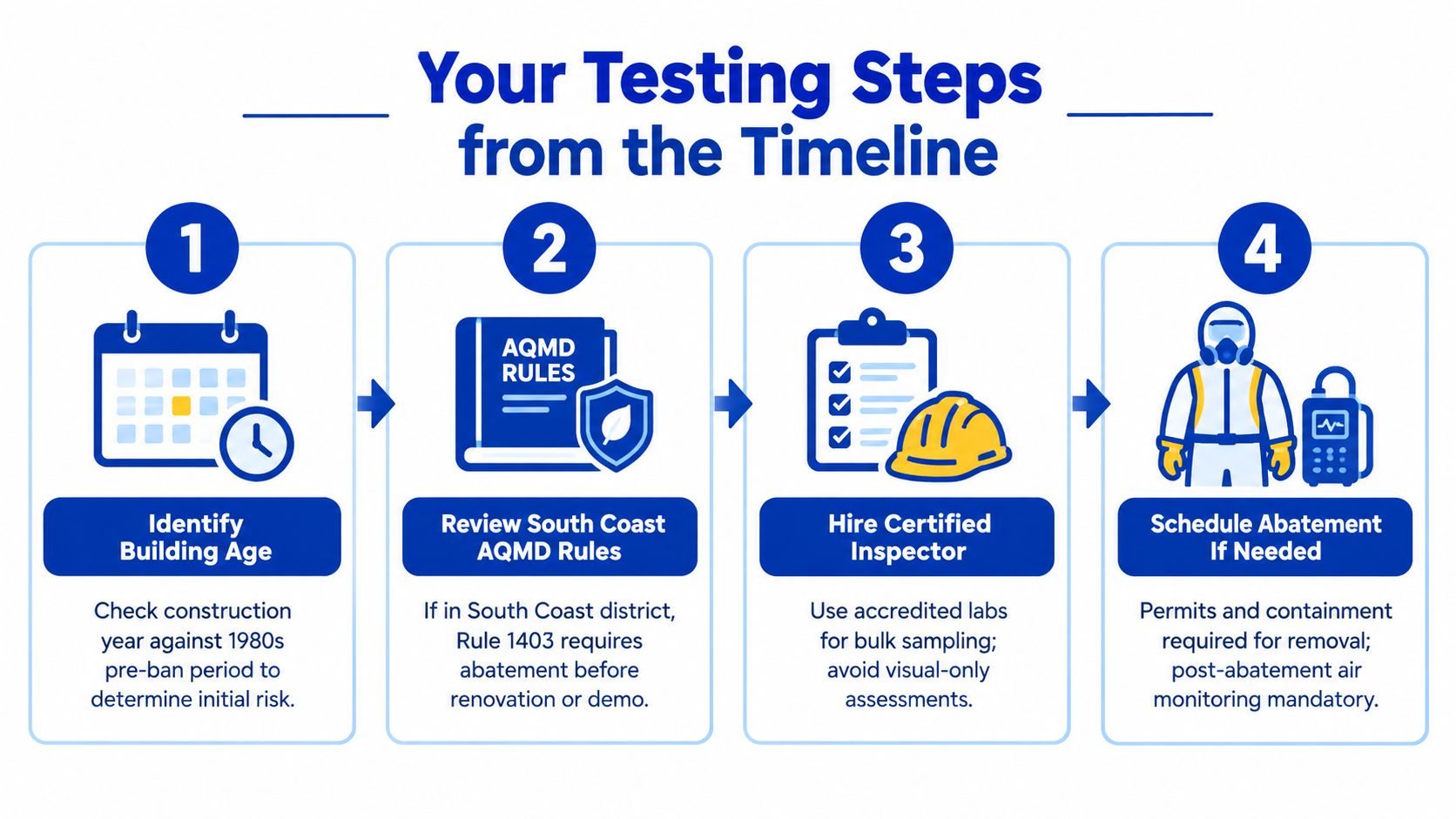
Confirm the original construction date and any major remodel periods. If the structure was built on or before the operational benchmark discussed earlier, and your work will disturb suspect materials, asbestos testing should move to the front of the project.
Then define the actual disturbance. A pre-renovation survey for one kitchen, one tenant suite, or one boiler room may look very different from a full pre-demolition asbestos survey.
Know when the survey must be broader
For projects in South Coast jurisdiction, the survey must match the scope of disturbance. That can include:
- Flooring systems down through affected layers
- Thermal system insulation on piping, ducts, boilers, or fittings
- Surfacing materials on ceilings, walls, beams, or decks
- Miscellaneous materials such as roofing, siding, sealants, gaskets, or mastics when they are part of the work area
If you need project-specific support, one option is Sensitive Environmental's asbestos testing and documentation services, which focus on inspection, sampling, laboratory analysis, and reporting for renovation, demolition, and compliance needs.
Don't wait until permit pull or mobilization
The worst time to figure out asbestos status is after demolition starts or when a permit reviewer asks for missing documentation. Early testing gives owners, contractors, architects, engineers, insurers, and restoration teams a cleaner path to sequencing work, pricing risk, and deciding what additional controls may be needed.
Use this checklist before work begins:
- Verify date: Identify original construction and later additions.
- Define disturbance: List every material the scope may cut, drill, scrape, remove, or expose.
- Order the right survey: Pre-renovation, pre-demolition, post-fire, or targeted compliance testing.
- Review the report carefully: Confirm what was sampled, what was inaccessible, and what still needs follow-up.
That's the practical answer to when asbestos was outlawed in California. The date history matters, but the testing decision comes from the building in front of you.
If you're planning renovation, demolition, due diligence, or post-fire work in Los Angeles or Southern California, Sensitive Environmental provides asbestos surveys, sampling, laboratory-based testing, and Rule 1403 documentation support that fits the actual project scope. To discuss asbestos testing for an older home, commercial building, or regulated demolition project, visit Sensitive Environmental.