Friable asbestos is asbestos-containing material that can be crumbled, pulverized, or reduced to powder by hand pressure when it is dry, and the regulatory definition generally applies when a material contains more than 1% asbestos as determined by polarized light microscopy. That physical behavior, not the percentage on its own, decides how much care a material demands before anyone cuts into it.
Two survey reports can both say "asbestos present" and send two projects in completely different directions. One material gets a note in the file and a plan to leave it alone. The other triggers containment, air monitoring and a schedule change. The word that separates them is friable, and it's the one many readers skim past.
The question worth asking about any suspect material in a Los Angeles home, school or commercial building isn't "is there asbestos in this?" It's "can fibers from this get into the air where people breathe?" Those are different questions with different answers, and the gap between them is where renovation surprises come from.
Table of Contents
- What Friable Asbestos Means in Plain Terms
- Why Crumbly Material Releases More Fibers
- Common Materials Where Friable Asbestos Appears
- Rules and Thresholds That Apply in Los Angeles
- Warning Signs and How Professional Testing Works
- Common Misconceptions About Friable Asbestos
- Schedule an Asbestos Survey Before Work Begins
- Frequently Asked Questions About Friable Asbestos
What Friable Asbestos Means in Plain Terms
Federal rules lean on one simple test: does the dry material fall apart under ordinary hand pressure? The OSHA appendix on friable asbestos defines it as asbestos-containing material that, when dry, can be crumbled, pulverized or reduced to powder by hand pressure, and notes that under the National Emission Standards for Hazardous Air Pollutants the definition generally applies to material containing more than 1% asbestos, determined by polarized light microscopy (PLM).
A cookie and a fired ceramic tile make the distinction concrete. Squeeze the cookie and it sheds crumbs across the counter. Squeeze the tile and nothing happens; you need a chisel. Both are solid objects. Both could contain the same mineral. Only one gives up particles under light pressure, and that difference is what friability describes.
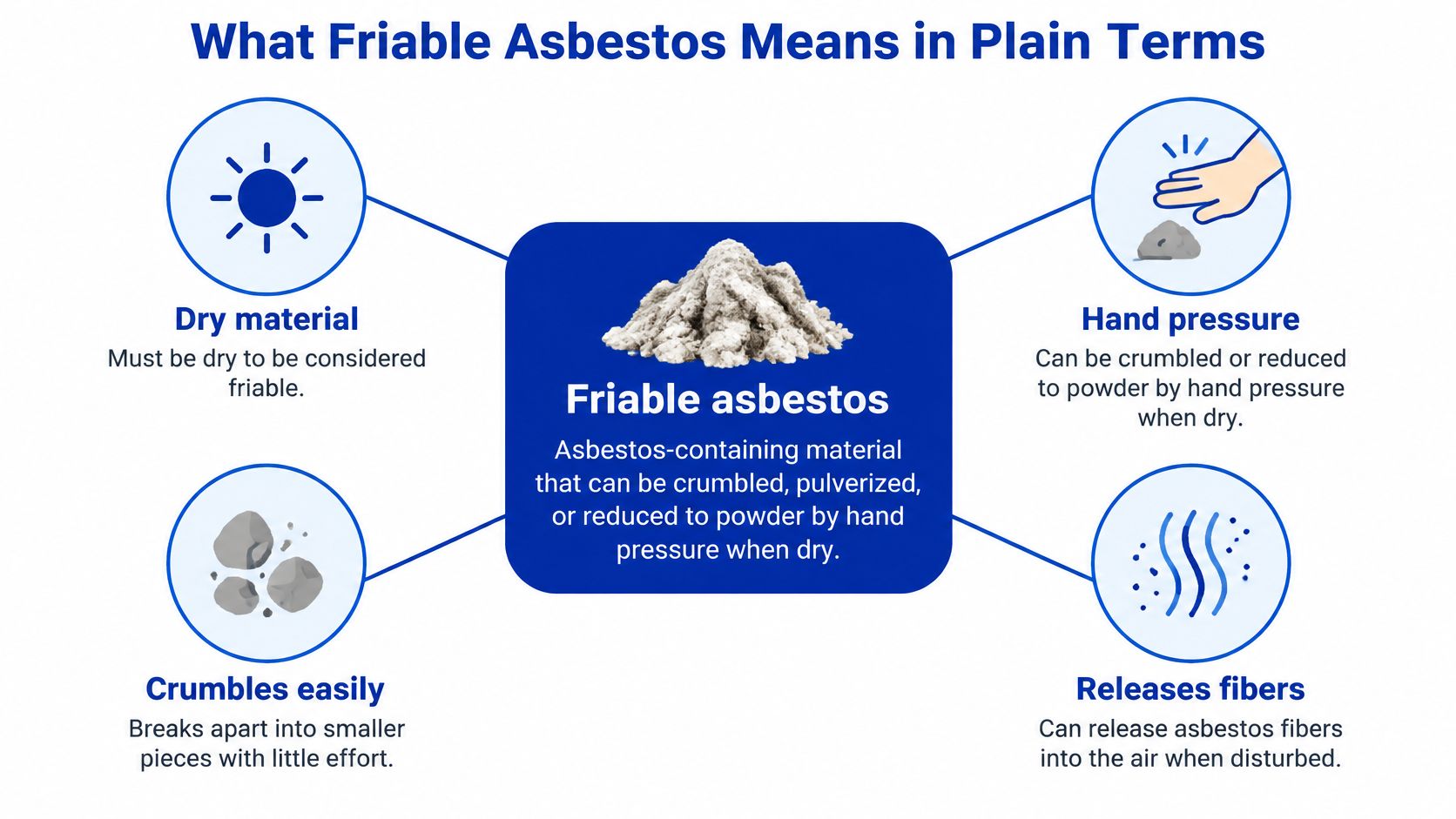
Friable describes behavior, not quantity. A material with a modest asbestos percentage that crumbles in your hand can be a bigger handling problem than a material with a much higher percentage locked inside a cement panel. The word tells you how easily the matrix lets go of what it holds.
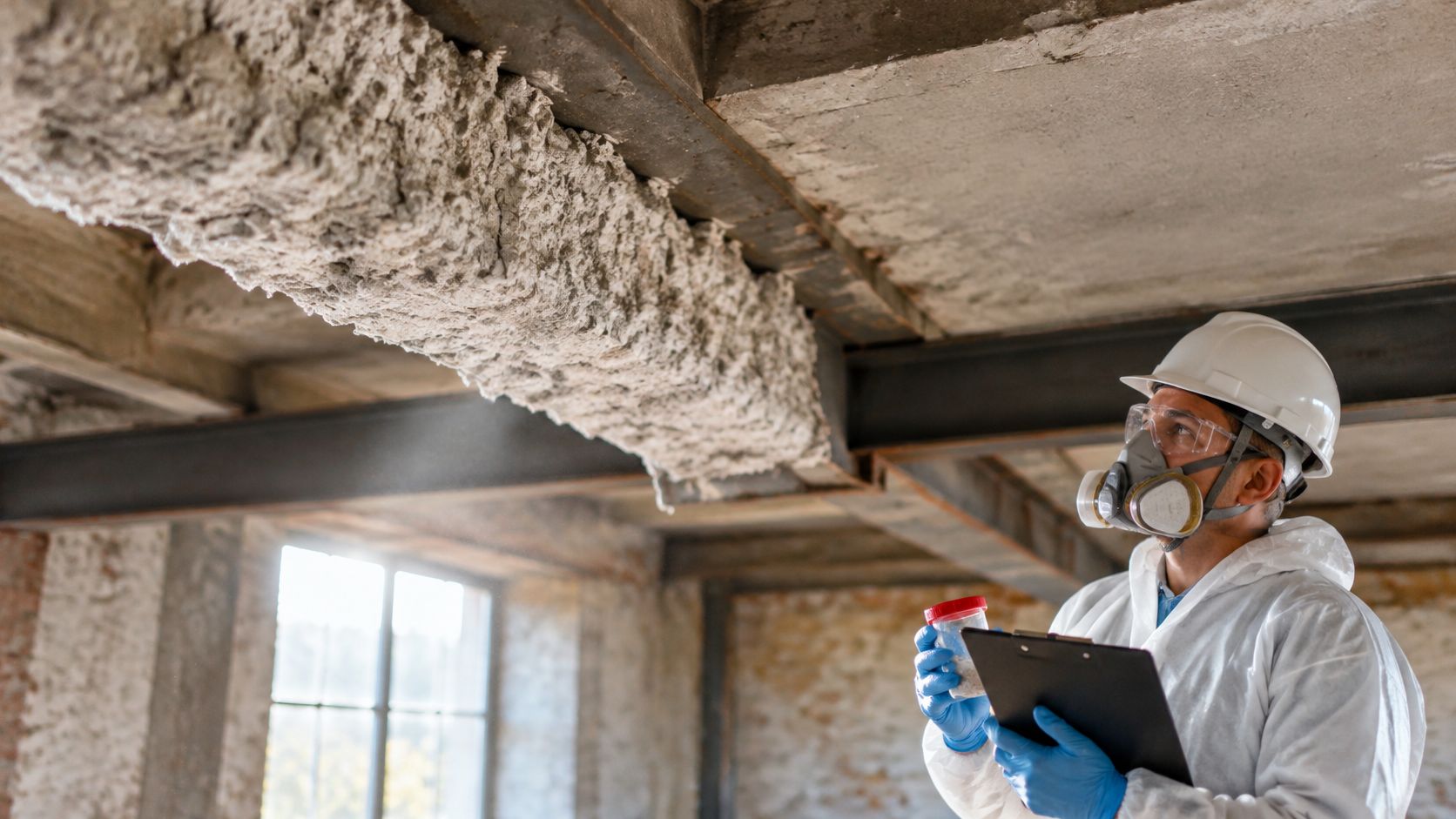
Reports usually sort suspect materials into two groups. Friable materials are soft, porous, powdery or flaky, and sprayed fireproofing, thermal pipe insulation and acoustic ceiling texture are the standard examples. Non-friable materials hold their shape, like vinyl-asbestos floor tile or asbestos-cement sheet, and they stay relatively stable while intact. Damage moves a material from the second group toward the first: sanding, sawing or grinding a floor tile turns a bound product into a dust source.
Appearance alone can't confirm asbestos content. A crumbly white coating and a crumbly fiber-free coating look identical in a photograph, and only laboratory analysis of a properly collected sample settles it.
The one-line version: friable means the material gives up particles under light hand pressure while dry, which is a statement about condition, not about how much asbestos it holds.
That's why the useful move right now is observation rather than guesswork. Note whether a suspect material looks soft, powdery, crumbly or flaking, keep your hands off it, and treat what you see as the starting point for a professional evaluation rather than a conclusion.
Why Crumbly Material Releases More Fibers
Say a facility manager at a 1968 office building authorizes a contractor to open a ceiling chase and reroute conduit. The work looks routine: a few cuts, some drilling, a shop vacuum. Two hours later a fine grey dust coats the ladder and the corridor carpet. Nobody saw asbestos. Nobody was looking for it.
That sequence has three stages, and each one raises the odds that microscopic fibers end up where people breathe.
- The binder. Asbestos fibers in a finished building product sit inside something else, usually cement, plaster, vinyl, mastic or a sprayed coating. While the binder stays intact, it holds the fibers in place.
- The weak matrix. In friable material the binder is weak by design. Sprayed fireproofing and acoustic texture are fluffy and porous because they were mixed to be light, which is exactly what makes them shed. The fibers are barely held at all.
- The disturbance. Drilling, sanding, scraping, impact, vibration from nearby equipment, or plain air movement across a damaged surface can lift those fibers loose.
A dry sponge and a sealed jar capture the difference. Squeeze the sponge and it drops crumbs every time you touch it. The jar keeps its contents until someone decides to open it.
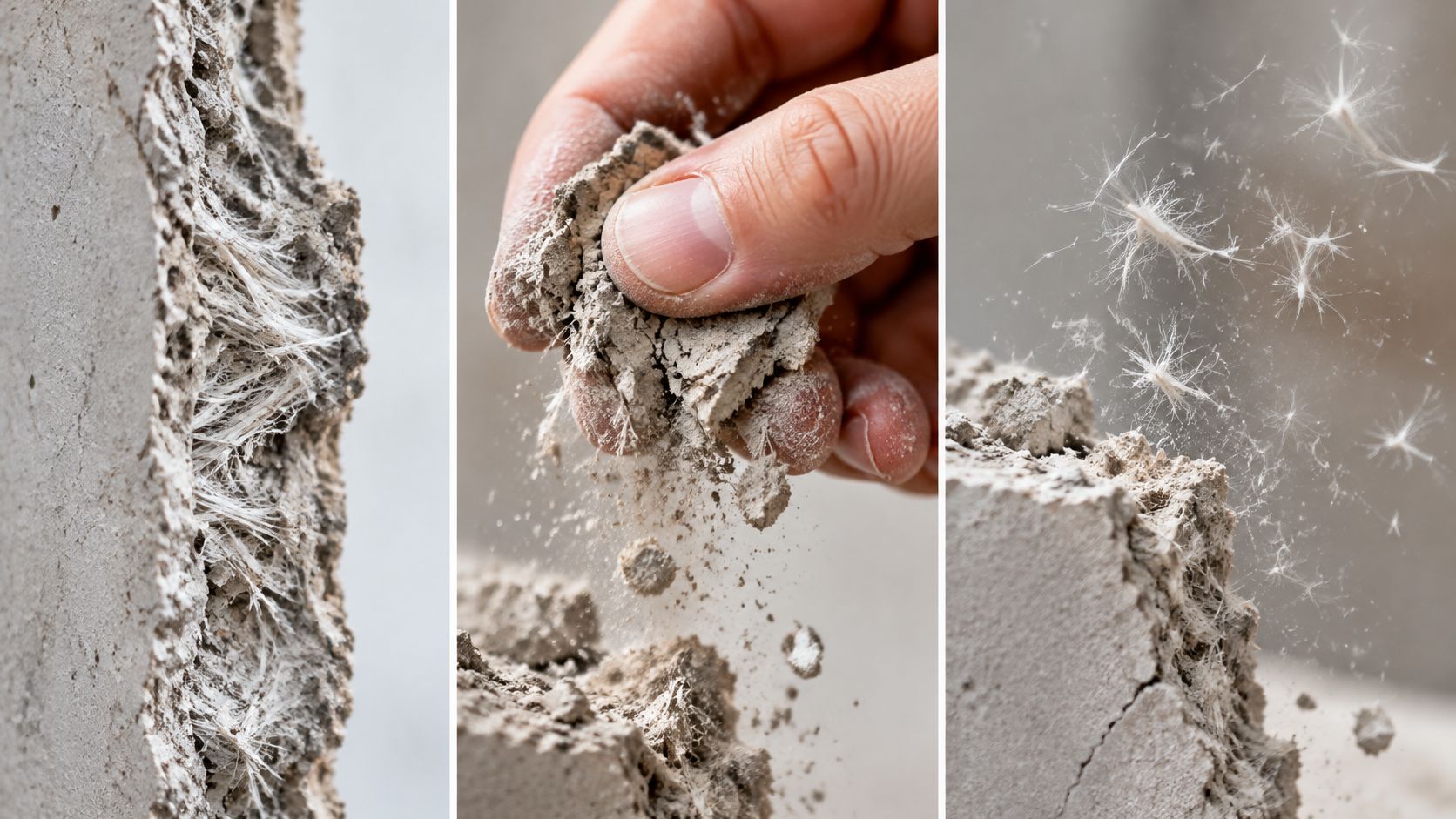
The condition of the material matters more than the label on the survey. A sound, undisturbed coating on a beam releases very little. The same coating torn open by a plumber, water-stained and flaking, or hanging loose after seismic movement is a different object entirely, even though the lab report reads the same. Damage changes the answer, and damage is one thing a competent surveyor documents.
Air movement finishes the job. Supply ducts, propped doors, fans and the negative pressure created by construction equipment all move dust through a building, which is why a small disturbance in one room can leave a trace somewhere else. The fibers that matter are the ones small enough to stay airborne long enough to be inhaled, which is why asbestos is dangerous in the first place.
What actually changes the outcome: the condition of the material on the day of the work, not the year it was installed.
The practical response is simple and unglamorous. Keep people out of the area, leave the material alone, and arrange an evaluation before anyone brings tools into that space.
Common Materials Where Friable Asbestos Appears
The materials that most often land in the friable column are the ones that were sprayed, troweled or wrapped rather than molded. Sprayed-on fireproofing on steel beams and structural members sits at the top of that list, followed by thermal system insulation on boilers, pipes and ducts, then pipe insulation on older plumbing and heating lines, and finally spray-applied acoustical ceiling finishes in offices, schools and older apartment buildings.
These materials aren't rare leftovers from an odd era. The U.S. Environmental Protection Agency estimated that friable asbestos-containing material could be present in approximately 700,000 public and commercial buildings, with about 500,000 believed to contain at least some damaged asbestos-containing material, according to EPA guidance on friable asbestos-containing material.
The table below compares the materials you're most likely to meet and how they behave.
| Material | Typically found in | Friable when intact? | Release risk when damaged |
|---|---|---|---|
| Sprayed-on fireproofing | Steel beams and structural members | Usually yes | High when disturbed |
| Thermal system insulation | Boilers, pipes and ducts | Usually yes | High when disturbed |
| Pipe insulation | Older plumbing and heating lines | Usually yes | High when disturbed |
| Spray-applied acoustical ceiling | Offices, schools and older apartments | Usually yes | High when disturbed |
| Vinyl-asbestos floor tile | Older resilient flooring | Usually no | Low intact; higher if sanded or sawed |
| Asbestos-cement sheet | Roofing, siding and panels | Usually no | Low intact; higher if cut or ground |
The bottom two rows carry a trap. Vinyl-asbestos floor tile and asbestos-cement sheet are usually the more manageable materials in a building, right up until someone decides to sand the tile to remove adhesive or cut the cement panel with a grinder. Aggressive mechanical work converts a stable product into a fiber source, which is why the method of removal matters as much as the material itself.
Where you find these things follows a pattern: attics and crawl spaces for pipe and duct insulation, mechanical rooms for boiler wrap, above suspended ceiling tiles for fireproofing overspray, and behind wall finishes for sprayed coatings. A material's location tells you nothing about its composition. Plaster in a 1950s Huntington Park bungalow and plaster in a 2005 condo can look the same in a photograph and be entirely different products.
Property owners and managers can help without taking any risk. Record the location of anything suspect, photograph it from a safe distance, and hand that list to a qualified inspector instead of pulling a sample yourself.
Rules and Thresholds That Apply in Los Angeles
A friable material finding in Los Angeles County passes through several sets of rules, and each one answers a different question. One defines what the material is. Another governs the air the removal crew breathes. A third controls what must happen before anyone touches the building. The table lays out the checkpoints in the order a project usually meets them.
| Requirement | Threshold or trigger | What it requires |
|---|---|---|
| Federal NESHAP definition | Asbestos content above the federal cutoff; crumbles under hand pressure when dry | Classifies the material as friable ACM |
| OSHA worker exposure limit | Airborne fiber concentration over a full work shift | Exposure controls and engineering measures |
| OSHA excursion limit | Short-term airborne spike during a task | Immediate controls and review of work practices |
| SCAQMD Rule 1403 survey | Before any renovation or demolition | Documented survey of friable and non-friable ACM |
| SCAQMD Procedure 5 | Asbestos-containing material damaged or significantly damaged | Cleanup plan written by a Certified Asbestos Consultant and approved before work |
How NESHAP Classifies the Material
The federal definition asks two questions at once: how much asbestos the material contains, and how it behaves under hand pressure. Friability is a physical condition, which is the part readers sometimes miss. A positive lab result tells you asbestos is present. The friability finding tells you whether fibers can get into the air. Two materials can carry the same lab result and present different planning problems: one sealed intact behind a finished wall, the other already shedding debris into a hallway. Same classification on paper, different urgency in the field.
What the OSHA Exposure Limits Actually Govern
The OSHA asbestos standard for construction sets the worker protection numbers, requiring exposure controls whenever airborne asbestos exceeds 0.1 fibers per cubic centimeter as an 8-hour time-weighted average, with a 1.0 f/cc cap over any 30-minute period. Those numbers drive a control hierarchy: regulated areas, containment, wet methods, local exhaust or HEPA-filtered collection, careful removal and prompt cleanup, with respirators as the last layer rather than the first. Covered Class I work without a negative exposure assessment must direct contaminated air toward HEPA filtration or collection equipment, and loose friable material near glovebag work has to be sealed in two layers of 6-mil plastic or otherwise stabilized.
These limits protect the crew doing the removal. They don't define a safe airborne level for the people living or working in the building.
Rule 1403 and Procedure 5 at the Project Level
South Coast Air Quality Management District Rule 1403 requires the affected facility or its components to be thoroughly surveyed before demolition or renovation. The survey covers onsite inspection, identification and quantification of friable asbestos-containing material plus Class I and Class II non-friable material, with physical sampling where needed. Its minimum scope can run through all flooring layers to the joist level and into wall or ceiling cavities when that's what it takes to identify and sample suspect materials. A quick visual walkthrough doesn't satisfy that standard if concealed or layered material could be disturbed.
When material has already been damaged or significantly damaged, a Certified Asbestos Consultant may class it as a Procedure 5, and SCAQMD's Procedure 5 guideline requires a written cleanup plan regardless of project size. Work can't begin until district staff approve the plan in writing. The submission carries a site survey with sampling and laboratory analysis, a plan describing the cause and extent of contamination with proposed response actions, and chain-of-custody records with the lab report.
Asbestos testing is required before renovations regardless of building age, and the South Coast Air Quality Management District is the agency that requires it in this region.
Cost planning belongs in the same conversation, because the survey is the inexpensive step that protects the expensive one. The sequencing logic holds in any market. Even a demolition-cost breakdown written for another market, like this guide to budgeting for your Dublin bathroom renovation, follows the same order of operations: find out what's inside the structure before pricing the work to take it out.
One caveat closes all of this. A positive result identifies asbestos-containing material. It doesn't dictate a specific action on its own. Owners and qualified professionals use the report, the condition findings and the scope of planned work to decide what happens next.
Warning Signs and How Professional Testing Works
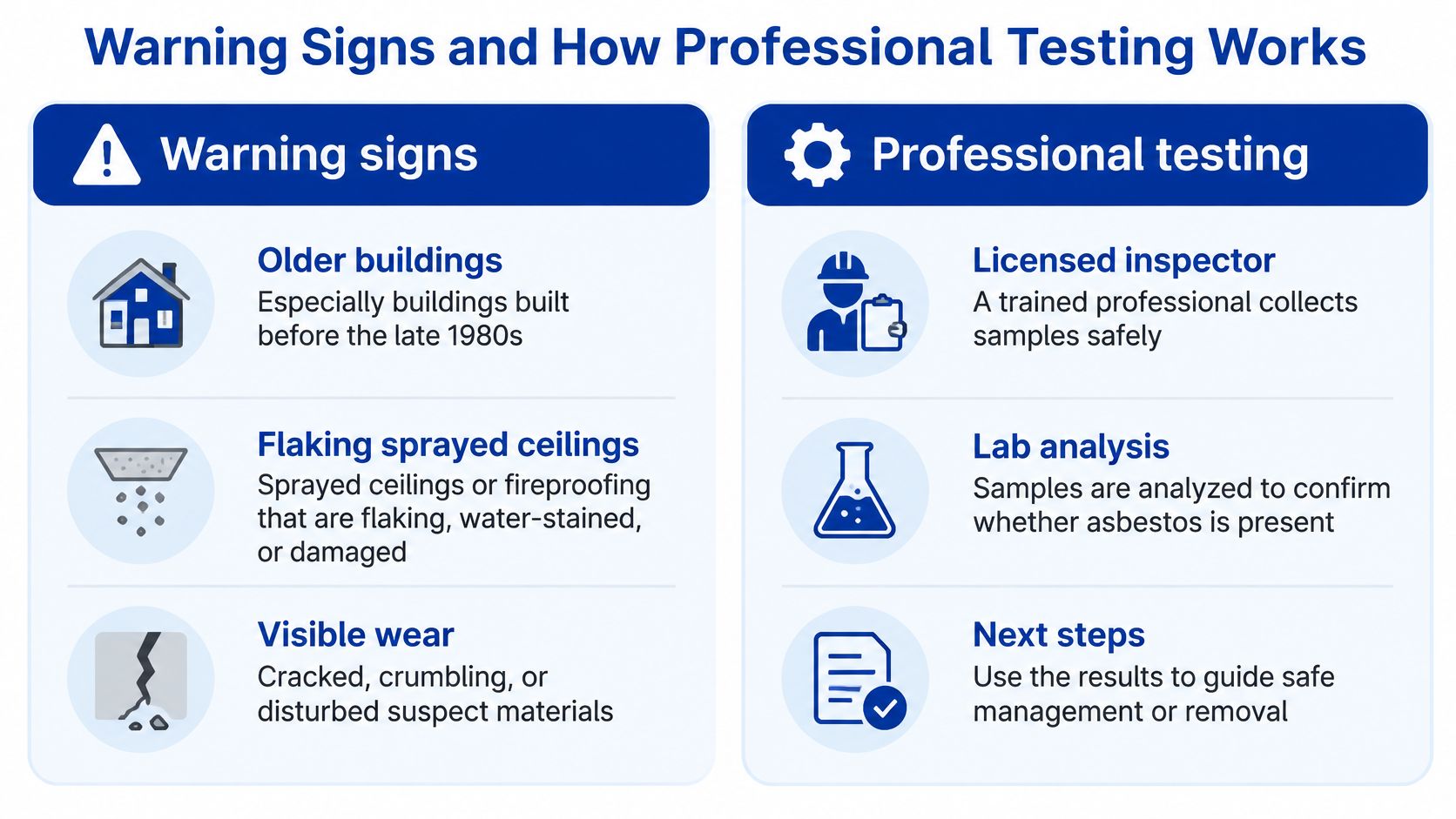
A spray-on ceiling that sheds flakes when a truck rumbles past is already telling you the important thing: the material's condition is changing without anyone touching it. Condition is what turns presence into exposure, and certain situations move a professional survey from "eventually" to "before any work starts."
- A building from before 1989. The 1989 partial ban on most U.S. asbestos uses stopped new products, and material already installed stayed where it was. Buildings from the 1950s through the 1980s are the usual candidates.
- Sprayed ceilings or fireproofing that are flaking, water-stained or crumbling on a beam, deck or ceiling plane.
- Torn or deteriorated pipe insulation, particularly where someone wrapped tape around a failing jacket and kept walking.
- A planned renovation, tenant improvement or demolition, including one that only touches a kitchen or a single tenant suite.
- Fire or water damage that has torn into finishes, ceilings or cabinetry.
- A purchase that will involve remodeling in the first year of ownership.
The survey requirement in this region is specific. SCAQMD's asbestos compliance advisory states that an asbestos survey must be conducted and documented before renovation, with a narrow exemption for a single-unit residential structure where less than 100 square feet of asbestos-containing surface area is removed or stripped. Demolition has no comparable exception. Written reports must identify every asbestos-containing material that will be disturbed, describe its condition, state whether it's damaged or disturbed, and determine its friability. That last item does the practical work, since friability describes the material's physical state: the report's real question is whether fibers from each material can become airborne once the planned work begins.
The Five Steps a Survey Follows
- Review plans, age and history. Building records narrow the sample list and flag additions, remodels and past repairs that introduced new materials.
- Walk the space with a qualified surveyor. Concealed layers, ceiling cavities and mechanical chases get opened or accessed deliberately, because a walkthrough that only sees finished surfaces misses the material a renovation will expose.
- Collect samples using controlled methods. Sampling works like a biopsy: wetting, sealed bags and careful cutting remove a small piece without turning the collection itself into a release event.
- Send samples for laboratory analysis by PLM. Composition is confirmed by instrument rather than by eye.
- Receive a written report. Expect the location, quantity, condition and friability of each material, which is the document a contractor bids from and an inspector reviews.
DIY sampling fails on three counts. It disturbs material that was stable, it misses concealed layers behind finished surfaces, and it produces a bag of debris with no chain-of-custody record behind it. In most cases asbestos can't be identified by looking at it, though it does appear on air handling systems as asbestos-insulated ducting and white asbestos tape, exactly the kind of partial sighting that leads people to the wrong conclusion about everything else in the building. For a closer look at the limits of self-testing, whether you can test for asbestos at home covers what a kit can and can't tell you.
Home buyers planning renovations should have a Certified Asbestos Consultant test all materials the work will impact. For a buyer, that survey is the difference between pricing a known scope and discovering one mid-project.
Common Misconceptions About Friable Asbestos
A lot of the confusion about what is friable asbestos material comes from two assumptions that sound reasonable and aren't.
The first is that friable material is automatically dangerous wherever it sits. Condition, location, accessibility and the likelihood that someone will disturb the material all shape the actual risk, and intact, undisturbed asbestos-containing material may not create an immediate exposure hazard, as EPA guidance on asbestos in homes and apartments points out. Friable describes a physical condition, not an exposure measurement. A sealed bag of flour on a top shelf and a bag torn open on the kitchen floor hold the same contents, but only one of them ends up on every surface in the room.
The question that changes the plan: not "is this material friable?" but "can fibers from this material become airborne in the space where people work and live?"
The second assumption is that a visual check confirms safety. It doesn't confirm content and it can't quantify airborne exposure. Inspection tells you what's there and what condition it's in. Breaking, sanding, drilling or demolition tells you what gets into the air, which is why the answer is sampling and laboratory analysis rather than a walkaround with a flashlight.
Three different services get mixed together in these conversations, and keeping them apart prevents most bad decisions.
- An asbestos survey identifies which materials contain asbestos, where they are and what condition they're in.
- Air monitoring measures fibers in the air during work, so the numbers describe a moment rather than a material.
- Clearance testing verifies conditions after work is complete and the area is ready to be released.
One more correction worth stating plainly: inhalation is the exposure route that matters for asbestos disease, not swallowing. That single fact explains why dry sweeping, ordinary shop vacuums and compressed air are the wrong tools around damaged material. Plan around the difference between presence and release instead of assuming either extreme.
Schedule an Asbestos Survey Before Work Begins
A survey belongs on the calendar before the first tool comes out of the truck. If a renovation, demolition, repair or property purchase is coming up, or you have found material that looks soft, powdery or damaged, the next step is testing rather than a guess. Sensitive Environmental arranges asbestos surveys and sampling across Los Angeles and Southern California, and the process is straightforward.
Describe the project or the suspect material, then share the building plans, the building's age and the scope of work. A free, no obligation consultation is available for environmental testing or for an existing asbestos, lead or mold problem, and you can start by choosing a problem type of asbestos, lead, mold, fire damage, water damage or other. Timing here is set by regulation as much as by caution. In Los Angeles, asbestos testing is required before renovations regardless of building age, and the South Coast Air Quality Management District requires that testing. Scheduling the survey early gives the report time to support permits, contractor bids and compliance records.
The reporting is built for people who need to act on it. Sensitive Environmental provides clear reports for contractors, property owners and inspectors on asbestos projects, including the amount and location of asbestos in the building. That level of detail lets a contractor price the job accurately and lets an owner see which materials are stable and which could release fibers once the work starts. On commercial jobs the stakes run higher, and why asbestos testing is essential before any commercial renovation project in Los Angeles explains what that testing means for contractors and property managers.
Sequence decides more than convenience. General renovation planning, including project guidance for DC area homeowners, makes the case that the order of trades decides the budget, and environmental work follows the same logic: the survey comes before the first trade arrives, not after the walls are open.
Three things you can do this week: gather whatever building plans and remodel records you have, list every area the planned work will disturb, and keep hands off anything suspect until the lab results come back. The survey turns a suspicion into documented findings, and every decision after that point gets easier.
Frequently Asked Questions About Friable Asbestos
Is friable asbestos in every building built before 1989?
No. Age raises the odds that materials containing asbestos were installed, but only sampling and laboratory analysis confirm asbestos content and friability in a specific building. Plenty of pre-1989 buildings come back with limited findings.
Can I test a suspect material myself?
Sampling by an untrained person can disturb material that was stable, release fibers, and miss concealed layers entirely. Leave suspect material alone and arrange a professional survey instead.
What does a lab report actually show?
A typical report lists each material's location, approximate quantity and condition, states whether it's damaged or disturbed, and determines whether it's friable, based on PLM analysis of the collected samples.
Does a positive result mean removal is required?
No. A positive result identifies asbestos-containing material. Owners and qualified professionals use the report, the condition findings and the planned work to decide the next step.
Is non-friable material safe to leave alone?
Intact non-friable material generally releases fewer fibers than friable material, but cutting, grinding or sanding changes that quickly. It should still be evaluated before work begins.
Sensitive Environmental tests and inspects for asbestos across Los Angeles and Southern California, from single-family homes in the San Fernando Valley to schools, warehouses and commercial tenant improvements. If a material in your building crumbles, flakes or looks damaged, schedule an asbestos survey before anyone picks up a tool and get a written report you can hand to a contractor, a buyer or a regulator. Visit Sensitive Environmental to describe your project and arrange testing.