Stop trusting the photo match. Most advice on how to identify asbestos siding tells you to compare your house to pictures online and call it answered. That's wrong, and it causes two expensive mistakes. People panic over harmless fiber cement, or they drill into real asbestos cement because it looked newer than expected. Appearance can rank suspicion. It can't confirm fiber content. Only sampling and laboratory analysis can do that.
Table of Contents
- Visual Clues That Raise or Lower Suspicion
- How to Inspect Siding Without Disturbing It
- How Sampling and Lab Results Settle the Answer
- Los Angeles Rules That Shape a Pre-Renovation Survey
- Common Questions About Testing Siding
- Schedule a Professional Asbestos Survey Before Any Exterior Work
Visual Clues That Raise or Lower Suspicion
Start with the direct rule. In most cases asbestos cannot be identified by looking at it, though it can be seen on air handling systems such as asbestos-insulated ducting and white asbestos tape. Siding is different. You're looking at a painted cement product, and asbestos and non-asbestos versions were made to look alike.
Read the Clues as a Ranking, Not a Diagnosis
Use this table from the ground. Don't climb up to pry an edge loose for a closer look.
Visual clues and what they can and cannot tell you
| Visual clue | Why it raises suspicion | Why it cannot confirm asbestos |
|---|---|---|
| Installed between the 1940s and 1970s | Matches the period when asbestos-cement siding was common | Age alone does not prove the material contains asbestos |
| Rigid, brittle shingles or panels | Cement-like rigidity fits asbestos-cement products | Fiber-cement and other non-asbestos products can feel similar |
| Wood-grain embossing | Wood-grain finishes became popular by the 1940s | Many non-asbestos products copy wood grain |
| Light green, beige or grayish-white shade | Matches common historic colors | Colors were not unique to asbestos products |
| Horizontal shingle form with weathered edges | Typical of older shingle-style siding | Shape and wear do not identify fiber content |
| Post-1980 replacement panels | Less likely to contain asbestos in most records | Asbestos can still appear in later construction when records are unreliable |
| Visible product label or markings | Can name the product and its date | Labels can be missing, worn, or unrelated to replacement panels |
The New Jersey health guidance on asbestos in the home states that asbestos-containing siding and shingles were used from about 1940 onward and remained relevant during the post-World War II building boom, commonly as hard, brittle shingles in light green, beige, or grayish-white shades. That same guidance describes fiber-cement siding as relatively thin panels, approximately 1/8 inch thick and around 8 by 4 feet, with dimensions and colors varying by manufacturer. Treat size as a screening clue, not a verdict.
Use the Timeline, Then Stop
The Cumberland design guidelines appendix on twentieth-century materials describes asbestos-cement siding as a durable, fire-resistant product that became popular in the first half of the twentieth century, with wood-grain finishes introduced by the 1940s becoming especially popular and use remaining common through the 1970s. It also notes EPA issued a final rule on July 12, 1989, banning most asbestos-containing products, and that OSHA guidance treats certain untested materials in buildings constructed no later than 1980 as presumed asbestos-containing material until proven otherwise.
That 1989 date misleads people. Banning new products didn't remove siding already nailed to houses in Pasadena, Long Beach, or anywhere else. A 1950s bungalow in Pasadena with rigid, wood-grain shingles and no replacement records ranks high suspicion. A Long Beach landlord with a 1970s duplex and windows planned for next month also ranks high, even if fresh paint makes the panels look modern. Documented full replacement decades later, with product records for every elevation, ranks low, but low isn't the same as confirmed clean.
Treat high-suspicion siding as suspect until tested, not as confirmed asbestos and not as safe to cut.
Intact asbestos cement is generally non-friable, meaning fibers are tightly bound in the cement matrix when the material is sound. That protection ends when someone cuts, saws, drills, breaks, or sands it. If the siding is intact and nothing will disturb it, you've usually got a management and documentation question, not an emergency. If work will touch it, suspicion is enough to require testing first.
How to Inspect Siding Without Disturbing It
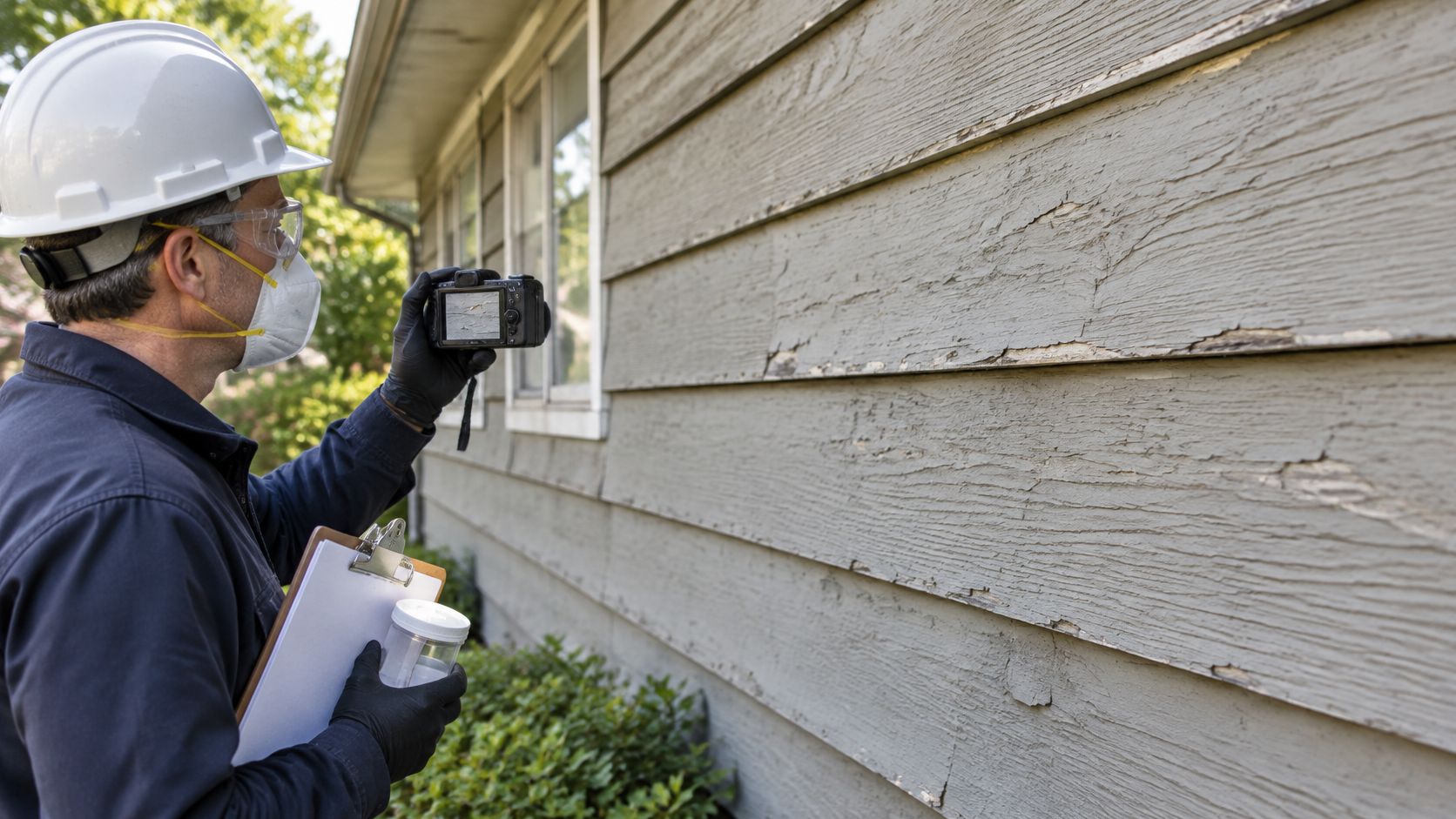
Your job here is observer, not sampler. You're building an inventory a qualified inspector can use to pick sample locations. You're not proving anything with your eyes.
A Six-Step Non-Invasive Routine
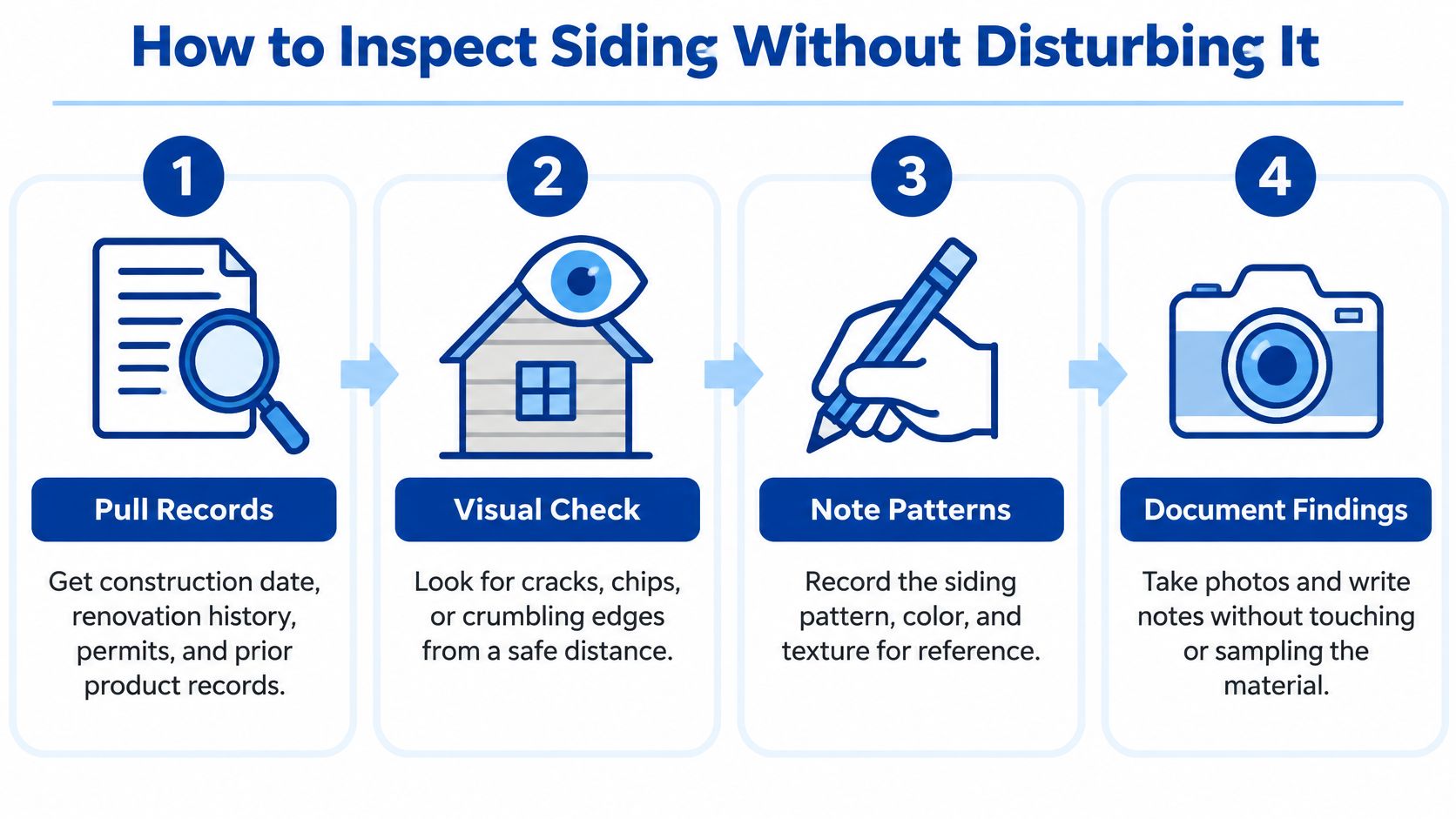
- Pull records first. Get the construction date, renovation history, permits, prior inspection reports, and any product receipts. One documented replacement can change the ranking for an entire wall.
- Photograph from a safe distance. Capture each panel profile, fastener pattern, overlap, corner detail, damaged edge, and printed label. Use binoculars or a zoom lens instead of leaning a ladder against brittle shingles.
- Map every visible difference. Separate each material, color, texture, and coating system into its own area. One house can carry original shingles on the sides, replacement panels at the back, and a different product around an addition.
- Record condition carefully. Note cracked, crumbling, water-stained, loose, or previously drilled panels, and mark exactly where they are. Damaged areas move up the priority list.
- Stop before touching anything. No scraping, drilling, sanding, breaking, sawing, or power washing. If you need a tool to check it, you've gone too far.
- Write a short inventory. For each area, list location, approximate extent, condition, suspicion level, and whether planned work could disturb it. That inventory becomes the sampling plan if testing follows.
The EPA guidance on identifying asbestos in homes states that laboratory testing by a qualified laboratory is the only dependable way to determine whether siding contains asbestos, and it supports classifying each visually distinct material as a separate potentially homogeneous area. It also warns against assuming a post-1980 building is asbestos-free, because asbestos can still occur in later construction when records are unreliable.
Mistakes That Undermine the Inventory
Don't generalize from the front elevation. Contractors often replaced only the weather-beaten side or patched around new windows, leaving mixed materials that look uniform after painting. Don't pry up a loose corner to check thickness, and don't pressure wash grime off to read a label.
For background on health concerns tied to disturbed material, see why asbestos exposure is dangerous. If you're also weighing exterior repair options, the Atomic Exteriors guide to asbestos siding gives useful context, but repair decisions should wait until you know what the material is.
Practical rule: If a panel is damaged, crumbling, or inside the work area, classify it as suspect until a lab result says otherwise.
How Sampling and Lab Results Settle the Answer
Acronyms cause confusion because air testing and bulk testing answer different questions. For siding, you need to know what's in the material, not just what fibers happen to be floating nearby on one afternoon.
Analysis methods and where each one fits
| Method | What it measures | Use for siding identification |
|---|---|---|
| Bulk PLM | Asbestos present in a bulk material sample, with fiber type and estimated concentration | Standard method for confirming siding material |
| Air PCM | Airborne fiber counts; cannot distinguish asbestos from other fibers | Not used to identify what the siding is made of |
| SEM or TEM | Fiber detail at higher magnification | Used when PLM results are ambiguous or the sample matrix is difficult |
How Proper Sampling Works
The OSHA PLM protocol in Appendix K specifies approximately 1 to 2 grams per material type, in separate sealed containers with clear location labeling, with the sampling spot sealed or encapsulated when appropriate. The laboratory then uses stereomicroscopy, polarized-light microscopy, and dispersion staining to determine presence, fiber species, and estimated concentration, with SEM or TEM when the matrix is difficult. OSHA also explains that PCM can measure airborne fiber concentrations but cannot distinguish asbestos from non-asbestos fibers.
A qualified inspector samples every distinct siding type, coating system, repair area, and suspected replacement, taking full-thickness material while minimizing dust. Each container follows a chain of custody so the lab report ties back to a specific wall, not a vague note that says exterior. Whether a home kit achieves the same thing, this breakdown of at-home asbestos testing explains the limits on documentation and representativeness.
Reading the Result Without Overreaching
A positive report identifies asbestos presence, fiber type, and estimated concentration for the areas sampled. A negative report clears only the materials sampled, which is why one panel can't represent three different products. The common failure modes are predictable: generalizing one sample to visibly different materials, sampling surface paint only, contaminating containers, and disturbing intact siding without a work-related reason.
A positive result does not automatically mean removal is required. It gives owners and qualified professionals the information needed to choose next steps, which can include leaving sound material in place and managing it. Don't let anyone sell you a scope of work before the lab report exists.
Los Angeles Rules That Shape a Pre-Renovation Survey
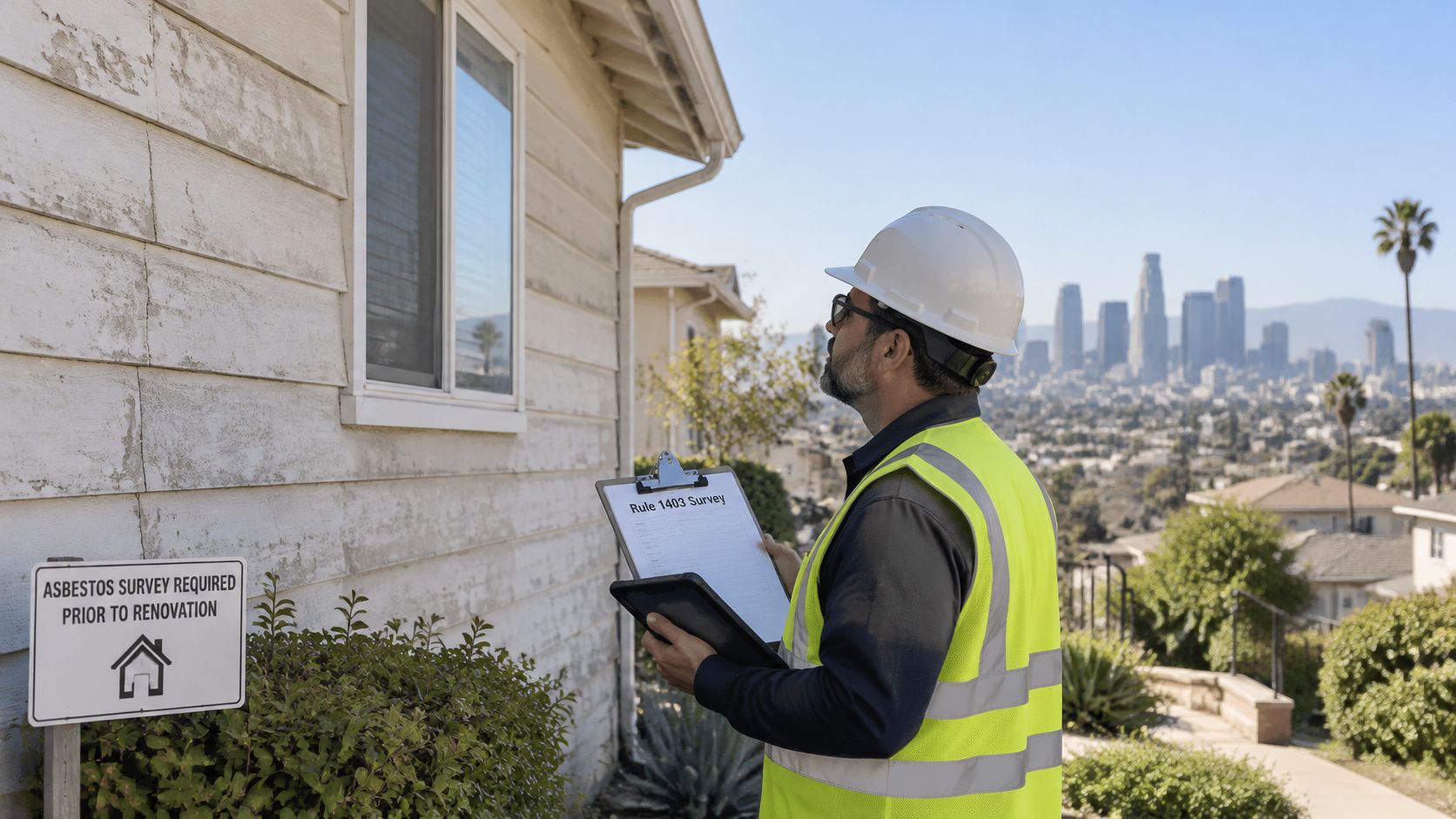
In the Los Angeles area, identification isn't just good practice. South Coast AQMD Rule 1403 turns it into documented pre-work compliance for most projects that will disturb the material.
What Rule 1403 Requires
The SCAQMD Rule 1403 compliance advisory states that a Rule 1403 asbestos survey must be completed and documented before any renovation, except for a narrow single-unit residential exception involving removal or stripping of less than 100 square feet of asbestos-containing surface material, and that demolition has no exception. The survey must be conducted by a Cal/OSHA-certified inspector or, where Cal/OSHA permits, by a facility employee holding an unexpired AHERA Building Inspector certificate from a Cal/OSHA-approved course.
The written report has to identify every asbestos-containing material that could be disturbed, describe its condition, and determine whether it's friable. That means a Venice contractor planning a siding overlay needs the full work scope surveyed before final pricing, not a guess from one accessible panel. A developer in Downey planning demolition needs the same documentation with no small-project shortcut.
Why One Sample Rarely Covers an Exterior
Surveys define homogeneous areas first, then sample representatively within each one. Original shingles, patched sections, and a later addition can each need separate coverage, and the lab results must tie to described locations and quantities. Skipping that design step produces a report contractors and regulators can't rely on.
Commercial owners face the same documentation logic at larger scale, as explained in this guide to asbestos testing before commercial renovation in Los Angeles. Get the survey done before bids, permits, and crew scheduling, while changing the plan is still cheap.
Common Questions About Testing Siding
Can I Test the Siding Myself
You can buy a kit, but that doesn't make the result equivalent. Untrained collection can disturb intact material, miss distinct areas, and usually lacks the chain of custody, representative sampling design, and written report contractors and inspectors rely on. For a single curiosity check on an undisturbed house, that's a real limitation. For renovation, demolition, a real estate transaction, or a contractor dispute, get a professional survey.
Is Intact Siding Dangerous
Sound asbestos cement holds its fibers in a hard matrix, so intact panels that nobody touches present a very different situation from panels being cut or drilled. Don't test the material casually, and don't ignore damage either. The deciding question is whether condition or planned work will disturb it, through window replacement, new penetrations, solar mounts, repairs, or demolition. If the answer is yes, testing comes before the work.
Does a Positive Result Mean It Must Come Off
No. A positive result identifies the material. It doesn't dictate a single response. Owners and qualified professionals use the report, the material's condition, and the planned scope to decide next steps, which may include leaving sound siding in place under a management approach. Anyone who tells you removal is automatic, before seeing condition and scope, is skipping steps.
Can I Paint Over It
Don't assume painting is a free pass. Coating projects often involve scraping, sanding, washing, and other prep that disturbs the surface before any paint goes on. Ask a qualified inspector to review the prep plan first. If the method generates dust, you need testing and project-specific controls before the painter starts.
Schedule a Professional Asbestos Survey Before Any Exterior Work
Use this decision rule. If the siding is intact and no planned work will touch it, keep your photos and inventory on file and reassess when condition or plans change. If it's damaged, or if windows, an overlay, penetrations, solar mounts, or demolition could disturb it, book a professional asbestos survey in Los Angeles before bids or permits move forward.
Three habits prevent most problems:
- Keep the file together: Store photos, inventory, permits, and lab reports with the property records.
- Share before pricing: Give every contractor the full survey report before they bid.
- Stop freelance testing: Never let a crew scrape, break, or sample suspect panels on its own.
Our team at Sensitive Environmental focuses on testing, not removal. Asbestos testing includes identification of asbestos-containing materials, certified sampling and laboratory analysis, pre-renovation and pre-demolition inspections, and compliance testing for regulatory requirements. We provide clear reporting for contractors, property owners, and inspectors, including a report of the inspection procedure that includes the amount and location of asbestos in a building.
If you're also budgeting replacement work outside the Los Angeles area, Fresno siding costs and contractors can help with that separate pricing question. Pricing comes after identification, not before it. Know what the siding is, then decide what to do with it.
If your siding ranks high on suspicion and exterior work is coming, schedule professional asbestos testing with Sensitive Environmental before anyone cuts, drills, or prices the job. You'll get documented sampling, accredited laboratory analysis, and a clear survey report for your property in Los Angeles County or Southern California.