The contractor has a pry bar in your kitchen, your lender wants paperwork before Friday, and the tenant in the back office keeps asking about a smell nobody can find. Three people, three problems, one phrase for all of them.
That phrase, environmental testing, covers a family of investigations that share a structure but answer very different questions. An environmental assessment is a documented investigation of a property. It combines a records review, a site inspection, and, where the question can't be settled by looking, sampling with laboratory analysis. The output is a specific answer: whether the building is ready for the renovation, whether the site carries a contamination history, whether the fire left residue in the ducts, whether the moisture inside that wall is feeding something that's now airborne.
Formal assessment has a policy lineage worth knowing, because it explains what you're buying. It became an international instrument through the European Union's first EIA Directive, adopted on June 27, 1985, which required environmental effects to be assessed before development consent was granted for public or private projects likely to have significant impacts. The original directive and its amendments were consolidated into Directive 2011/92/EU in 2011, as the European Commission's environmental assessment pages explain. The detail that traveled around the world isn't the paperwork. It's the sequence: gather the facts, evaluate the likely effects, then make the decision with those findings in hand.
That's what a good assessment gives you. Not a certificate. Evidence for a decision.
Table of Contents
- Which Environmental Assessment Service Fits Your Situation
- Warning Signs and Situations That Call for Testing
- How a Professional Environmental Assessment Unfolds Step by Step
- Common Tests and What Lab Results Actually Show
- Regulatory Requirements Across Los Angeles and Southern California
- DIY Test Kits Versus Professional Assessments
- Frequently asked questions
- Confirm the Right Assessment and Schedule Your Testing
Which Environmental Assessment Service Fits Your Situation
Most property owners arrive with a service name they heard from a contractor, an agent or a neighbor. Working backward from the decision is faster and cheaper, because the assessment type follows from the question rather than the other way around.
The sorting process involves walking the property, documenting conditions, sampling what needs sampling, and writing it down:
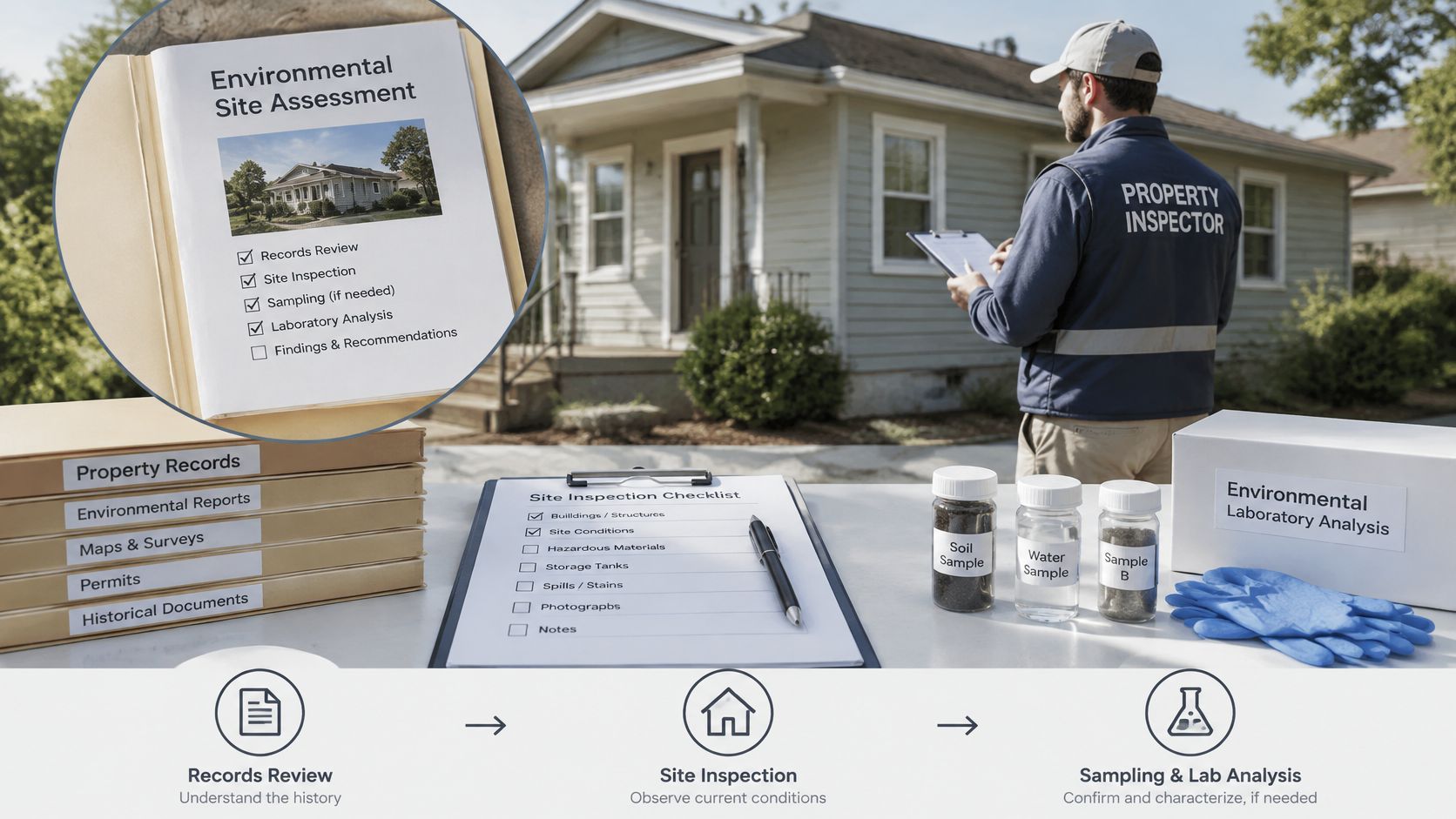
| Assessment | Typical trigger | Main output | Sampling involved |
|---|---|---|---|
| Phase I ESA | Property sale, refinancing or redevelopment | Records review and list of recognized environmental conditions | Usually none |
| Phase II ESA | Phase I identifies a concern | Field data and lab results for soil, groundwater, soil vapor or air | Yes, targeted to the concern |
| Asbestos survey | Renovation, repair or demolition | Map of suspect materials with lab results | Bulk samples of building materials |
| Lead inspection | Work on pre-1978 housing or child-occupied facilities | Results by painted component and dust | XRF readings, paint chips or dust wipes |
| Mold and IAQ assessment | Odor, moisture, water damage or occupant complaints | Moisture findings, likely sources and air or surface data | Air, surface or bulk samples as indicated |
| Post-fire assessment | Smoke, ash or soot inside or near a building | Deposit mapping and residue evidence | Surface wipes, bulk residue and air samples |
| Industrial hygiene assessment | Workplace exposure concerns | Comparison of exposures to occupational limits | Personal and area air samples |
Three properties, three different jobs.
A Pasadena homeowner had a supply line fail under the kitchen sink two winters ago. The cabinet was replaced, the floor dried, and every August since, one corner of the room smells like a wet basement. That's a mold and indoor air quality assessment: moisture readings inside the assembly, air and surface samples compared with an outdoor baseline, and a hard look at the HVAC return six feet away.
A retail tenant in Long Beach is negotiating a lease on a 1970s building and learns from a neighbor that the lot sold gasoline in the 1960s. That's a Phase I Environmental Site Assessment first, all records and observation, with a Phase II involving soil vapor or groundwater sampling only if the file leaves a question that can't be closed on paper.
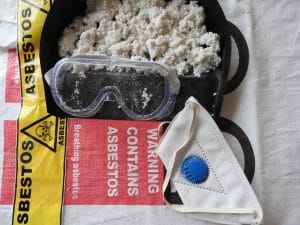
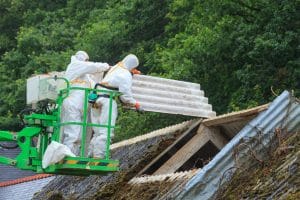
A developer taking down a 1920s warehouse near Downtown Los Angeles needs an asbestos survey before demolition, because the demolition and the materials coming out of it trigger notification and survey requirements in the South Coast Air Quality Management District's rules. Lead on the painted steel and residue from the building's former tenants get sorted in the same scoping conversation.
Three questions narrow it down.
- What decision is pending? A closing date, a permit, a reoccupancy, a lease signing. The decision sets the deadline and the standard the report has to meet.
- What property is it? A 1920s single-family home, a strip center, a warehouse, a school. Age and prior use decide which hazards are even plausible.
- What changed recently? A renovation, a water intrusion, a fire, a sale. Change is what turns a general worry into a sampling plan.
Sensitive Environmental tests across all of these categories for residential and commercial properties, and the asbestos testing in Los Angeles service page covers the survey side in depth.
Warning Signs and Situations That Call for Testing
Most assessments start because something changed, not because someone got curious. The signs below are the ones that most often justify a call, grouped by the situation that produces them.
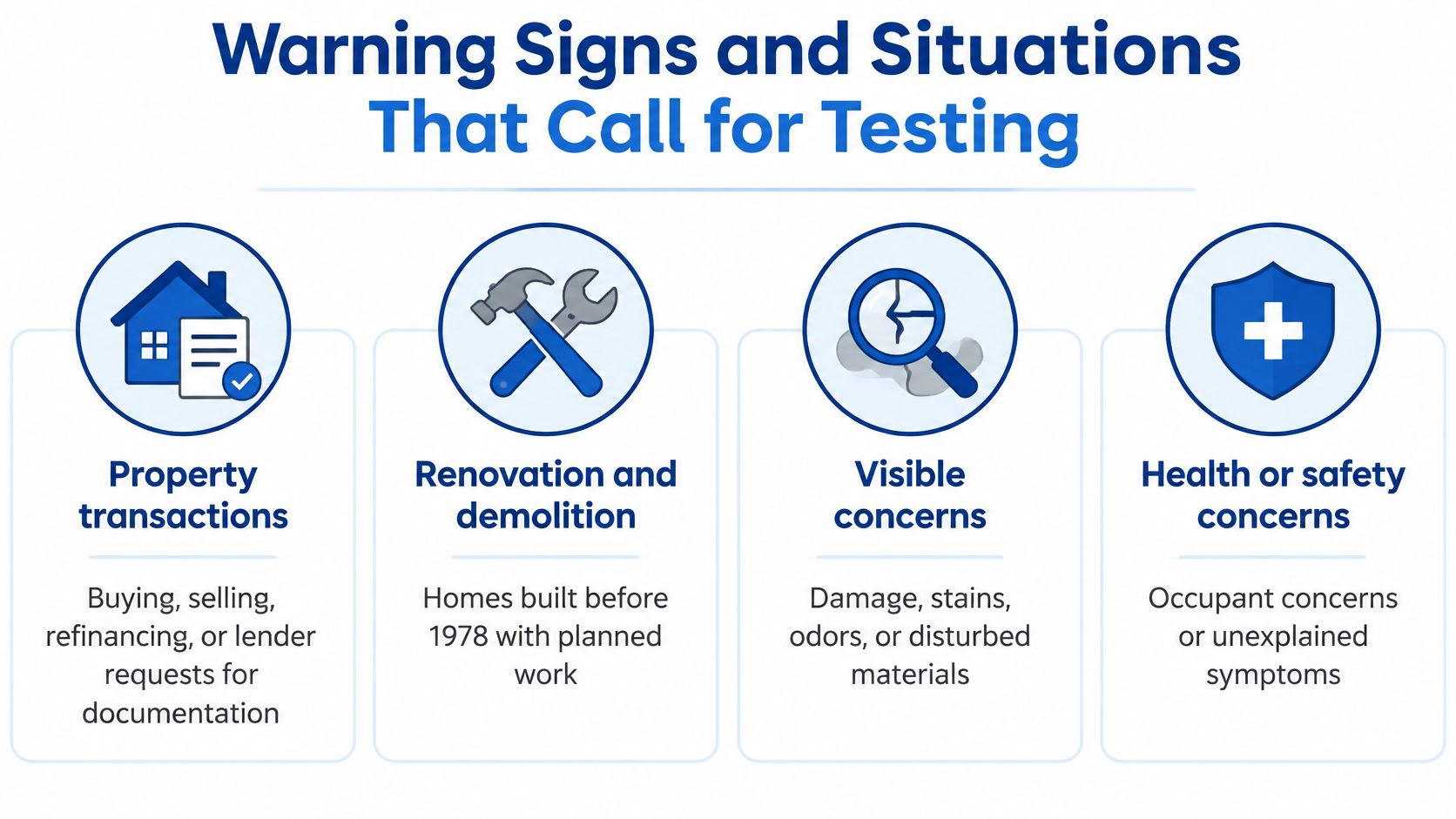
Transactions and renovations
When money moves, documentation moves with it. A sale, refinance or redevelopment often brings a lender or buyer asking for environmental records, which is Phase I territory. A pre-1978 building with painted surfaces about to be disturbed points to lead, because the federal renovation framework applies to target housing and child-occupied facilities built before 1978. Older commercial interiors point to asbestos before the first hammer swing: ceiling tile, floor tile and mastic, pipe insulation, joint compound, and the black adhesive under 1960s vinyl sheet all show up in surveys.
If you're buying a home and planning to renovate, we recommend having a Certified Asbestos Consultant test all materials that will be impacted during the renovation. It's cheaper to know before the walls open than after the debris is bagged and hauled.
Moisture, water damage and complaints
Past water intrusion, visible growth, a musty odor that survives cleaning, or occupants reporting irritation and headaches all point the same direction. A mold and indoor air quality assessment documents moisture conditions, probable sources and airborne or surface data. What it doesn't do is diagnose a health condition, and any provider who promises that is selling something other than testing. Our mold testing in Los Angeles work is documentation, not a medical opinion.
Fire, smoke and ash
Visible ash, soot or char makes the call obvious. The quieter cases matter more. Smoke odor that returns a week after cleaning, a haze on interior glass, or questions about what the HVAC pulled in during a nearby fire all justify a post-fire assessment built on surface wipes, bulk residue and air samples.
California's own research agenda confirms how much is still open. The proposed 2025 to 2030 air quality research plan identifies unresolved questions about the effects of smoke and ash on indoor air quality, the effectiveness of filtration methods, and how guidance should be deployed equitably in wildfire-prone communities. It also notes that hotter, drier conditions are contributing to larger and longer-lasting California wildfires, and that smoke carries criteria pollutants, air toxics, greenhouse gases and fine particulate matter.
Two practical consequences follow. Ash and smoke don't respect property lines, so a building that didn't burn can still take material in through windows, doors and outdoor-air intakes. And visual cleaning may not settle the question, because a negative result from one sample type can't establish that a whole building is clear.
What a checklist is for: A list of signs is a prompt for a conversation with someone who samples buildings for a living. It isn't a diagnosis you finish at the kitchen table.
How a Professional Environmental Assessment Unfolds Step by Step
Every assessment we run follows the same spine, whether the question is asbestos in a 1958 duplex or petroleum in the soil under a warehouse near the Port of Los Angeles. The steps don't change. The depth at each step does.
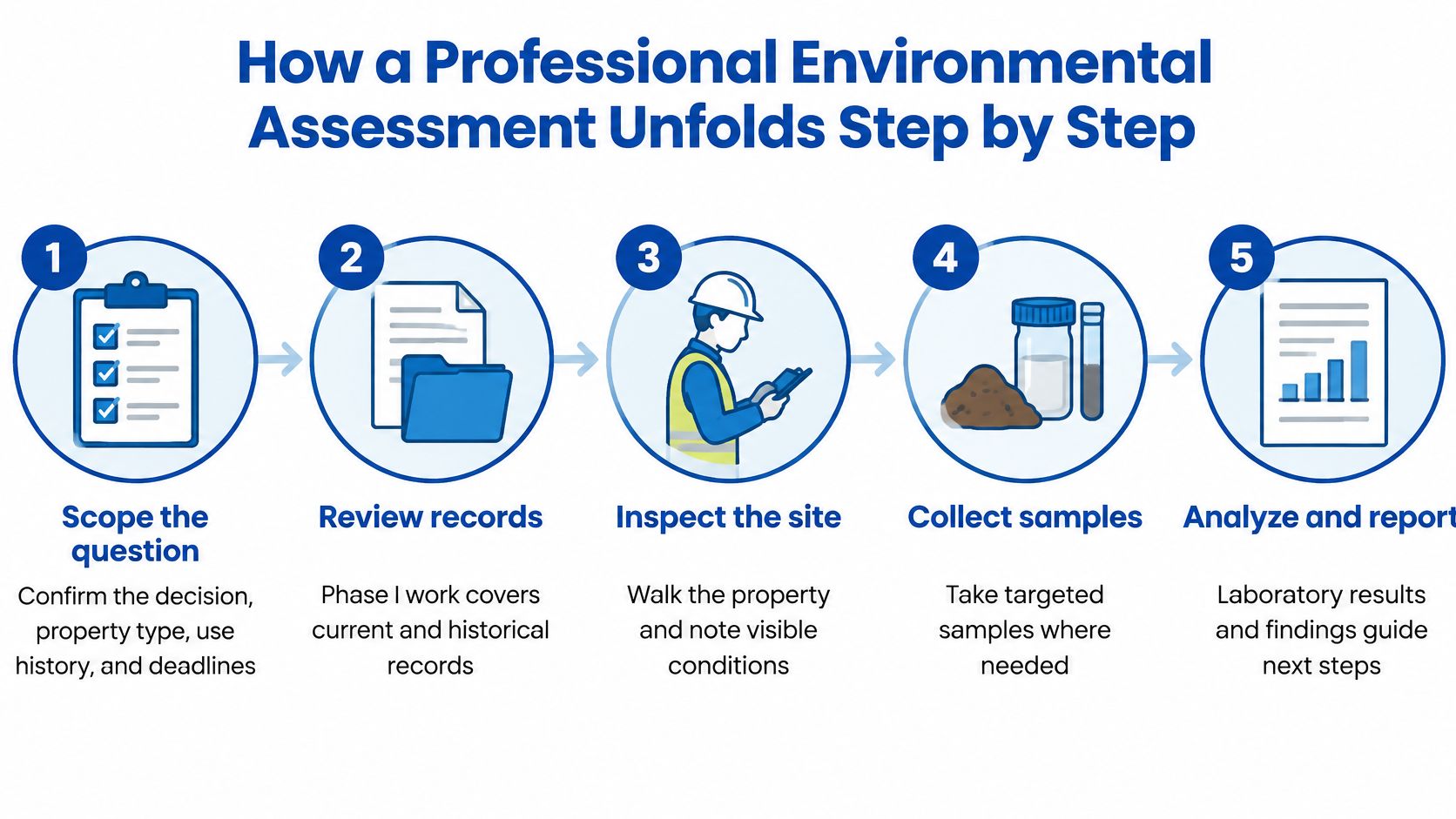
- Scope the question. Confirm the decision, the property type, the use history and the deadline. A survey for a bathroom remodel and a survey for a full demolition differ in sample count, access needs and notification requirements. Scoping errors are the most expensive mistakes in this work, because they get discovered after the samples are already at the lab.
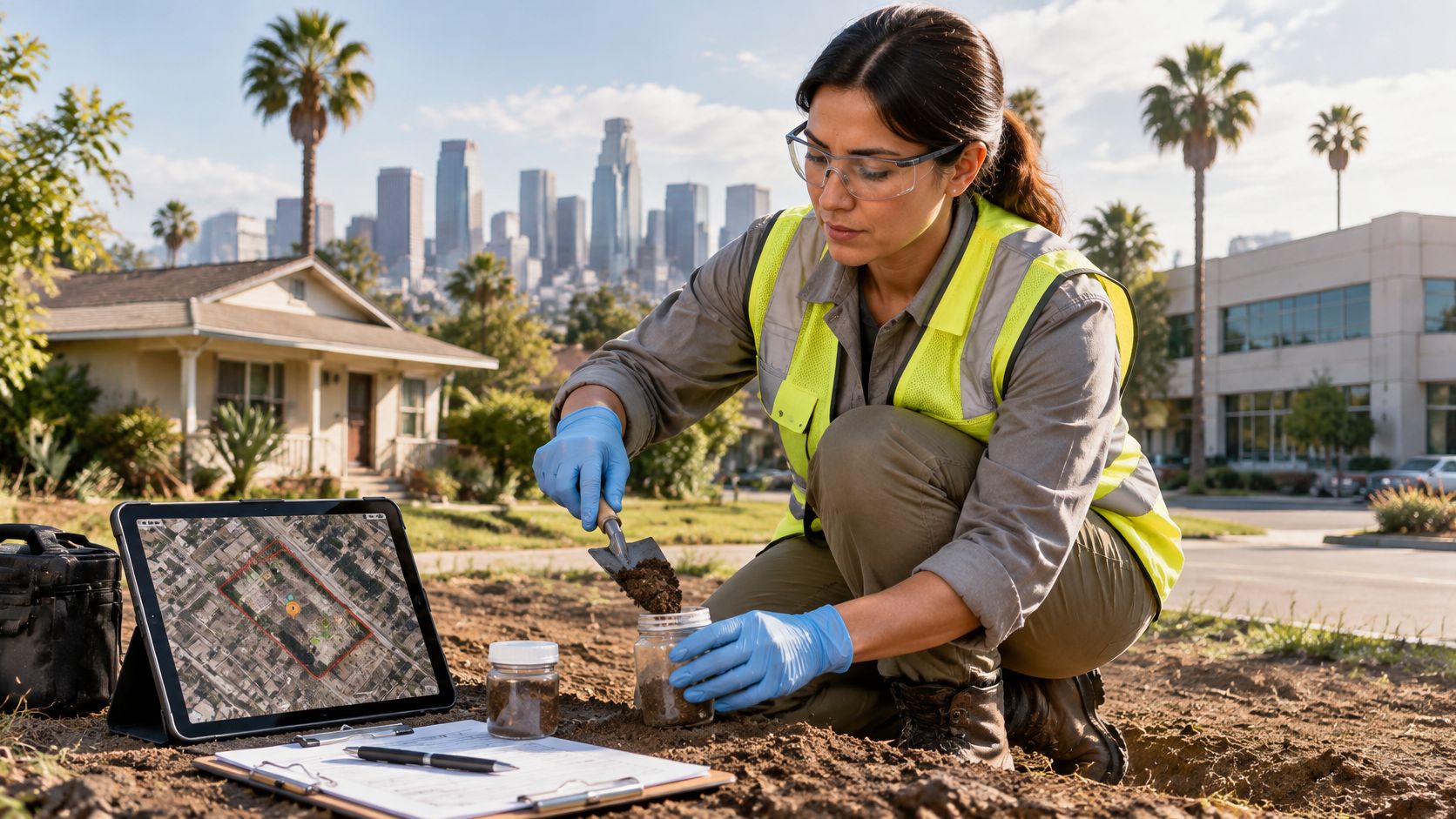
- Review the records. Current and historical uses, aerial photographs, fire insurance maps, agency files, permit history. Historical fuel storage, manufacturing, dry cleaning and waste handling are the usual suspects, because each can create a pathway from a source area to soil, groundwater, soil vapor or a building interior.
- Walk the property. Stains, odors, standing moisture, debris, HVAC equipment, pressure relationships between rooms, and materials that changed during an earlier remodel. Photograph everything and note locations, because a finding without a location is a rumor.
- Build the sampling plan. Derive it from those observations and a stated hypothesis, not a grid drawn at the office. If the odor is strongest at one wall cavity, the plan should explain why that cavity gets sampled and the hallway doesn't.
- Collect samples with chain of custody. Every container gets a unique identifier and a form that travels with it, so each result can be traced from the site to the bench.
- Analyze in an accredited laboratory. Recognized methods, quality control samples, and reporting limits printed in the report rather than buried in a phone call.
- Issue the report. Three things stay separate: what was observed, what was measured, and what the consultant recommends. When those blur, the reader can't tell evidence from opinion.
Two details in that sequence catch people out. ASTM E1527-21 defines a recognized environmental condition to include an actual release, a likely release, or a condition posing a material threat of a future release, and the federal All Appropriate Inquiries rule sets strict timing: components that require updating must be completed within 180 days before acquisition, while the remaining components generally must be completed within one year before acquisition, as EPA's All Appropriate Inquiries guidance explains. The report should also separate a current REC from a historical REC, a controlled REC and a data gap, because each classification changes whether a Phase II, a vapor assessment or an agency file review comes next.
Our own sequence matches that spine. A full property walkthrough, identification of the hazards that fit the building, targeted sampling and testing, laboratory analysis, and a report that gives you next steps rather than a data dump. On asbestos projects the report states the amount and location of the material in the building, which is the part a contractor needs in order to price the work.
Rule of thumb: If a report tells you what was found but not where it was found or which decision it supports, it isn't finished.
Common Tests and What Lab Results Actually Show
A surface sample from the wrong place can be accurate and still fail to answer the project's question. Useful results depend on three things working together: the locations selected, the laboratory method, and the decision the report is meant to support.
| Test | What it targets | Typical method | What the result shows |
|---|---|---|---|
| Asbestos bulk sampling | Suspect building materials | Laboratory analysis of collected material | Asbestos type and percentage by weight |
| Lead paint inspection | Painted components | Inspection and lead testing | Whether lead is present at tested locations |
| Lead dust and surface sampling | Floors, window sills and other surfaces | Surface sampling with laboratory analysis | Lead levels in the samples |
| Mold survey and testing | Suspect materials and indoor conditions | Targeted sampling and laboratory analysis | Mold presence, extent and potential causes |
| Indoor air quality testing | Indoor environmental contaminants | Targeted air sampling and analysis | Contaminants identified in sampled air |
| Fire residue assessment | Ash, soot, char and smoke residue | Inspection and targeted sampling | Findings at sampled locations |
| Industrial hygiene air sampling | Workplace air | Personal or area sampling | Conditions measured during the sampling period |
Start with the unit and method. An asbestos result may identify a fiber type and report its percentage by weight. The result applies to the material sampled, not automatically to every similar-looking material in the building. The report should identify the sample location and laboratory method so the result can be interpreted for the project.
Lead results also depend on the sampling approach. Lead paint inspection evaluates painted components, while lead dust and surface sampling checks specific surfaces. Sensitive Environmental's lead paint inspection and lead dust and surface sampling can help assess those conditions. A result describes the tested location; it does not establish that every painted surface or room has the same condition.
A lab result is only as useful as its reporting limit. If a report says “not detected,” that means the method did not identify the contaminant above its reporting limit in that sample. It does not prove the contaminant is absent everywhere. A clear report names the method and limit, making it possible to judge what the result can support.
Mold findings need context, too. A survey identifies the presence, extent and potential causes of mold to support remediation and prevention strategies. Sampling results should be read alongside the inspection findings, since a laboratory result represents the sample collected rather than every area in the building.
Fire residue also varies by location. A wipe from one sill describes that sampled surface, not a separate room or an unseen area. Sampling locations should reflect the questions the assessment needs to answer.
The same reading habits apply to water reports. Use this guide to decode lab water test numbers, including how to interpret units and detection limits.
Regulatory Requirements Across Los Angeles and Southern California
A test becomes a compliance document when a rule defines the deliverable. Several rules do in Southern California, and they ask for different things.
| Project or trigger | Rule or standard | What the assessment must produce | Who performs it |
|---|---|---|---|
| Asbestos renovation or demolition in the South Coast AQMD region | SCAQMD Rule 1403 | Notification, survey with sampling and lab analysis of materials scheduled for removal | Certified Asbestos Consultant |
| Asbestos disturbance requiring cleanup | SCAQMD Rule 1403 Procedure 5 | Completed notification, site survey, lab reports, chain of custody and cleanup plan | Certified Asbestos Consultant |
| Notice to Comply from SCAQMD | SCAQMD enforcement notice | Testing and documentation responding to the notice's requirements | Certified Asbestos Consultant coordinating with the testing laboratory |
| Renovation or repair of pre-1978 target housing or child-occupied facility | EPA RRP Rule | Lead testing of affected painted components or documented lead-free status | Certified renovator, inspector or risk assessor |
| Property sale, lending or redevelopment | ASTM E1527-21 with All Appropriate Inquiries | Phase I report with recognized environmental conditions and data gaps | Environmental professional |
| Post-fire reoccupancy | No single governing standard | Residue and indoor air evidence supporting clearance decisions | Qualified consultant working with the contractor |
Procedure 5 shows how specific these packages get. When asbestos has already been disturbed and cleanup is required, the submission to the district isn't a lab report with a cover sheet. It includes a completed Rule 1403 notification, a site survey documenting the sampling and analysis of suspect materials scheduled for abatement, and a cleanup plan describing the cause of the disturbance, the extent of site contamination, and the Certified Asbestos Consultant's observations, findings, recommendations and response actions, as the SCAQMD Procedure 5 guideline sets out. Sample chain-of-custody documentation and the laboratory analysis report travel with it. A Notice to Comply is enforcement correspondence from the district, and answering one usually means producing testing documentation and a description of the response on the district's timetable rather than yours.
The federal renovation rule gives you options and a paper trail. Affected painted surfaces must be tested for lead-based paint or presumed to contain it unless documentation establishes they're lead-free, and when testing is chosen, the work goes to a qualified professional. EPA's renovation rule guidance names three accepted approaches: EPA-recognized test kits used by certified renovators, X-ray fluorescence performed by certified lead inspectors or risk assessors, and paint-chip sampling performed by certified renovators, inspectors or risk assessors. Scope matters as much as method. EPA's guidance on covered renovations limits minor repair and maintenance to no more than 6 square feet per room of painted-surface disturbance for interior work, and allows representative sampling when components are selected by a documented methodology such as the HUD Guidelines.
For transactions, the standard is named rather than described: EPA states that ASTM E1527-21 and E2247-23 satisfy the All Appropriate Inquiries requirements under 40 CFR Part 312, as its brownfields assessment fact sheet notes. Post-fire reoccupancy has no single governing standard, which is exactly why the documentation has to satisfy several audiences at once. California's wildfire policy work is moving toward integrated health and exposure data, including a 2025 state proposal describing a statewide platform combining wildfire-smoke and health databases, per the Wildfire Task Force March 2025 update.
A lab report by itself doesn't make a project compliant. Sampling locations, method selection, chain of custody and the decision the report is meant to support determine whether a regulator, lender or insurer can rely on it. Sensitive Environmental provides testing and documentation for Rule 1403, South Coast AQMD requirements, Notices to Comply and Procedure 5 protocols.
DIY Test Kits Versus Professional Assessments
The instinct to buy a kit and check is a good one. It's also where a fair number of projects go sideways, not because the kit was wrong, but because the answer it produced couldn't support the decision that followed.
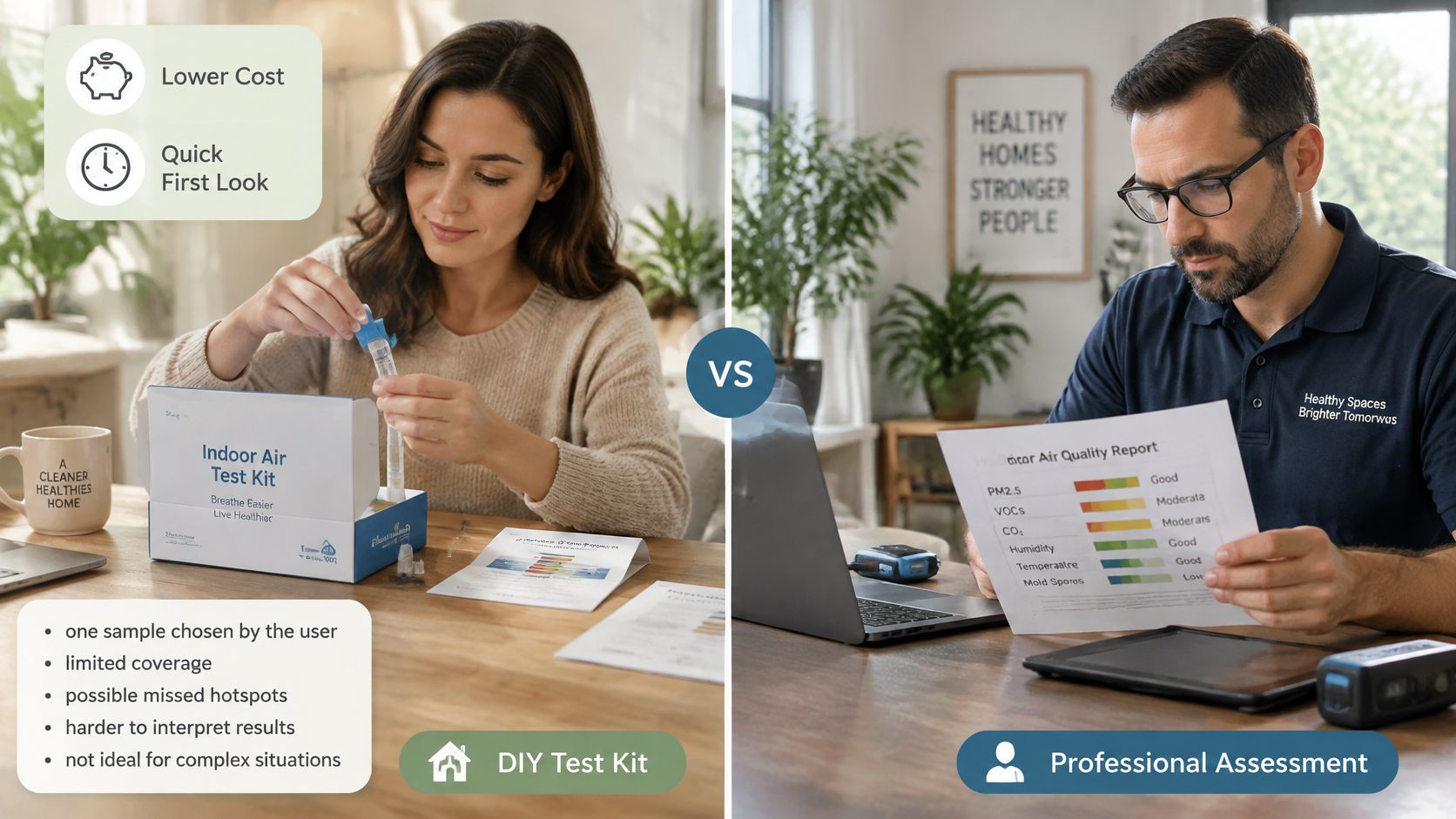
Where a kit earns its keep. A kit is inexpensive, it's immediate, and it can turn a vague worry into a specific question worth paying someone to answer. For a homeowner deciding whether the smell in the hallway deserves a phone call, that's real value.
Where it runs out.
- One sample, chosen by the person with the least information. The kit gets placed where the problem is most noticeable, not where the source is.
- No view of the building. A kit doesn't notice negative pressure in a room, a return duct drawing from a crawlspace, or the water stain on the ceiling above the sample point.
- No chain of custody. Once the sample is in your mailbox, no one can show where it came from or how it was handled.
- Laboratory accreditation is often unclear. You can't always tell which lab analyzed the sample or what method it used.
- No criterion to compare against. A number without a standard, a location and a building condition description doesn't support a decision.
- Certification gaps. Some EPA-recognized lead test kits are designed for use by certified renovators under the renovation framework, so owning a kit isn't the same as holding the credential the rule names.
The professional version differs in kind, not just in price. EPA's indoor air quality guidance recommends developing an IAQ profile of building conditions, investigating potential causes, evaluating mitigation options, and determining whether the problem has been resolved. In practice that means documenting occupancy and complaint patterns, moisture intrusion and flooding history, combustion sources, HVAC operation, pressure relationships, renovation and fire history, and the places where odors, visible growth, soot or settled dust concentrate. Sampling then follows a stated hypothesis, compared against outdoor or reference conditions, with chain of custody and laboratory quality controls intact.
What a professional report should contain:
- A sample location map with dates, so anyone can revisit the same spots
- Named methods and sampling procedures, not just results
- Laboratory accreditation and reporting limits for each analysis
- Chain-of-custody records that trace every sample
- Photographs of the conditions observed at each location
- Interpretation against regulatory or project-specific criteria
- Data gaps and limitations, stated plainly rather than glossed
When contamination turns up, the useful next question is where it came from. We help identify the source and give guidance on how to address it.
One caution belongs here. A high or positive result doesn't by itself mean material has to be removed, abated or demolished. It tells you and a qualified professional what you're dealing with, so the next step is a decision instead of a guess. No test result guarantees a property is safe.
Frequently asked questions
How long does an assessment take? Turnaround depends on the assessment type, the number of samples and the laboratory's schedule. Confirm the timeline against your decision deadline during scoping, not after samples are submitted, because a report that lands after closing helps nobody.
What drives the cost? Property size, the number of locations and samples, how much access the site allows, the depth of the records review, and whether results are needed on a rush schedule. A quote offered without an address and a description of the work is a guess.
Does a not-detected result mean the property is clear? Only for the method used, at the locations sampled, under the conditions on the day of sampling. Detection limits are what make that sentence honest.
Who should perform the work? Ask whether staff hold the certifications your project requires, such as certified renovator, inspector or risk assessor for lead work, or a Certified Asbestos Consultant for Rule 1403 projects, and ask to see a sample report before you book.
Does a positive result mean material must be removed? No. It means the decision now has evidence behind it, and a qualified professional can help you read what that evidence does and doesn't support.
Confirm the Right Assessment and Schedule Your Testing
Four steps turn a vague concern into a scoped, priced, scheduled assessment.
- Write down the decision and its deadline. A permit date, a closing date, a reoccupancy target, an insurance response date. Everything downstream gets measured against it.
- Gather the paper you already have. Previous reports, floor plans, construction and renovation dates, the date of a water event or fire, complaint logs, and any agency notices. A twenty-year-old survey from a prior owner can save you sampling, even when it needs updating.
- Match the situation to the assessment type. Then ask whether one coordinated investigation can cover overlapping requirements, since a pre-renovation project often needs asbestos and lead answered together and the same site visit can serve both.
- Ask four questions of any provider. How are sampling locations chosen, which laboratory analyzes the samples, are the staff certified for this specific work, and can you see a sample report before you commit.
Then make the call. We offer a free, no obligation consultation for environmental testing or for an existing asbestos, lead or mold problem. Reach us at 310-387-5404 or request an appointment online to schedule an inspection. Our service areas are Los Angeles, Orange County and Southern California, and if your property sits outside the areas you'd expect us to cover, ask anyway, because the answer depends on the project.
Bring the decision, the deadline and whatever paperwork you have. You'll leave the conversation knowing which assessment fits, what it samples, and what the report will and won't be able to tell you. Testing documents conditions and informs decisions. It doesn't guarantee that a property is safe.
Sensitive Environmental handles asbestos surveys, lead paint inspections, mold and indoor air quality testing, post-fire residue assessment and environmental site work for homeowners, contractors, developers and property managers across Los Angeles and Southern California. If a closing date, permit or reoccupancy deadline is driving your project, tell us the date and we'll help you scope testing that meets it without sampling for the sake of sampling. Visit Sensitive Environmental to start the conversation about what your property needs.