You've lined up a contractor, chosen new flooring, and started planning around the construction schedule. Then someone asks whether the building needs lead testing, an asbestos survey, or both. Ordering the wrong test now can leave you with a laboratory report that doesn't answer the question holding up your project.
Environmental assessment criteria are the questions that determine what should be inspected and tested before anyone collects a sample. For Los Angeles property owners, they connect the building's history, materials, occupants, and planned work to a defensible testing scope. Even perfect laboratory analysis can't compensate for an overlooked material or a sample taken in the wrong place.
Table of Contents
- The Five Criteria Behind Every Environmental Assessment
- Site History Criteria That Point to Possible Releases
- Potential Contaminants Matched to Property Type
- Exposure Pathways Between a Source and People
- Los Angeles Rules That Set Testing Requirements
- Reading Lab Results and What a Negative Result Means
- Professional Testing Compared With DIY Test Kits
- Book a Professional Assessment Before Work Begins
The Five Criteria Behind Every Environmental Assessment
Say a Glendale property manager orders a lead test before renovating an older apartment building. The results arrive, but the contractor then asks for an asbestos survey covering the flooring and ceiling materials. Nobody checked the project's assessment criteria before choosing the first test.
An assessor approaches this much like a doctor taking a patient history before ordering blood work. Site history is the medical history, showing what might have happened previously. Potential contaminants are the possible diagnoses, narrowing which substances deserve investigation.
Exposure pathways work like tracing a plumbing leak from its source to the room below. Regulatory requirements are the project's rulebook, while property use supplies the context, much as a mechanic considers whether a vehicle carries passengers or sits in storage.
Five environmental assessment criteria at a glance
| Criterion | Core question | Evidence used | What it decides |
|---|---|---|---|
| Site history | What was on this site before? | Records, historical maps, aerial photos, permits | Whether a past release is plausible |
| Potential contaminants | What could be present? | Building age, materials, prior uses, fire or water events | Which analytes to sample for |
| Exposure pathways | How could air, soil, water or dust reach people? | Site layout, ventilation, disturbance plans | Whether a source reaches someone |
| Regulatory requirements | Which rules apply to this work or property? | Project type, location, agency rules | Survey scope, notices and report content |
| Property use | How is the property used now, and who occupies it? | Current use, occupancy, sensitive groups such as children | Depth and frequency of testing |
An analyte is the substance a laboratory is asked to measure. Choosing asbestos as an analyte won't tell you whether paint contains lead, just as a cholesterol test won't measure blood sugar.
Property-level screening resources, including BatchData hazard data for underwriting, can provide context when reviewing real estate risk. That broader context doesn't replace an inspection of the actual materials, rooms, or planned disturbance.
Before ordering a test: Check each criterion against your project, rather than choosing a kit or laboratory panel first.
Use the table as a scope checklist. The answers decide where testing goes and which substances the laboratory analyzes, not what the results will say.
Site History Criteria That Point to Possible Releases
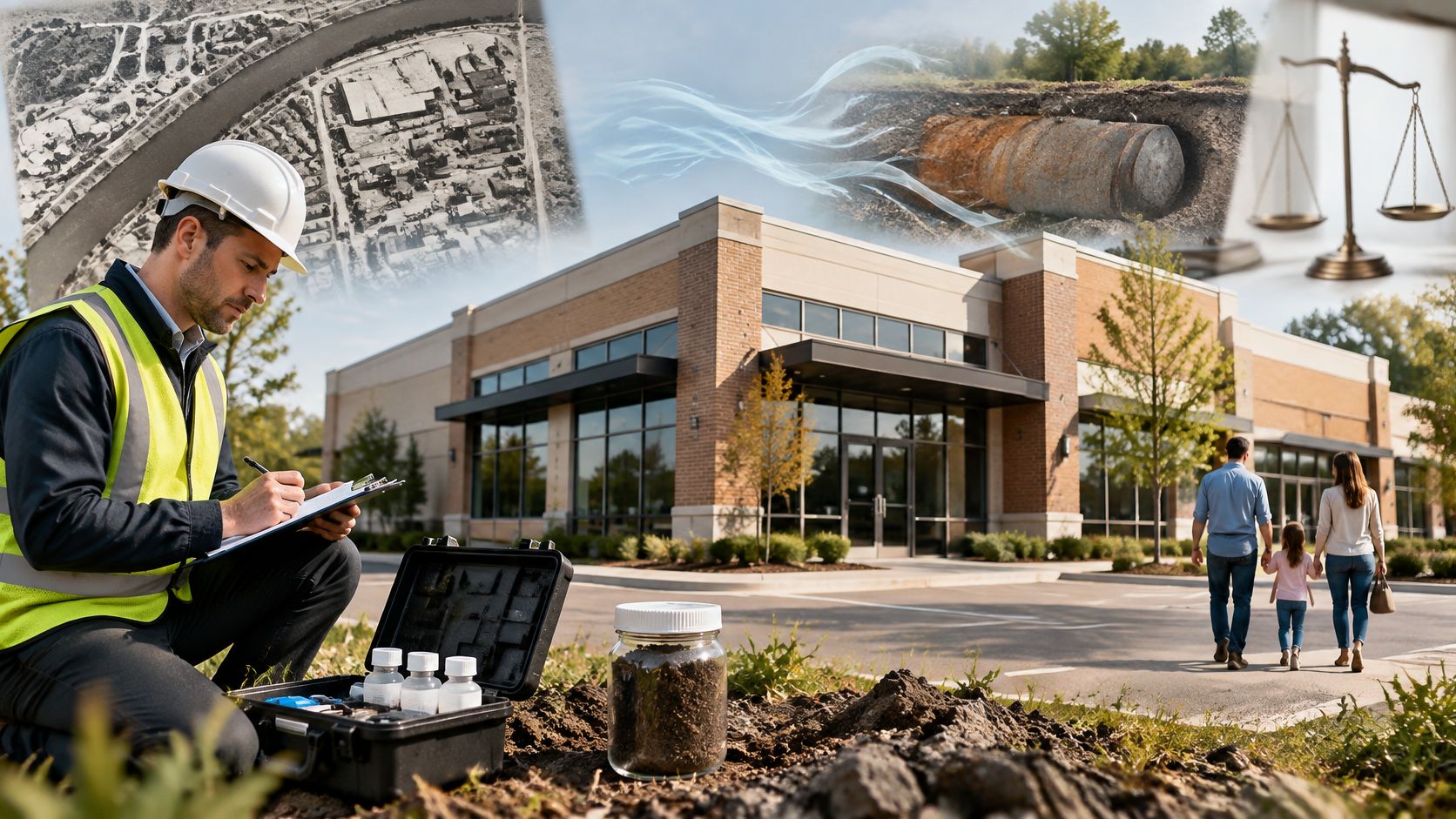
Consider a hypothetical commercial building constructed in the 1960s. It once housed a print shop and a dry cleaner, and a historical map marks an old fuel tank behind the building. Those clues don't establish contamination, but they give an assessor specific questions to investigate.
Was solvent stored near a floor drain? Was the tank removed, and is there documentation? Did neighboring operations create a possible source beyond the property boundary?
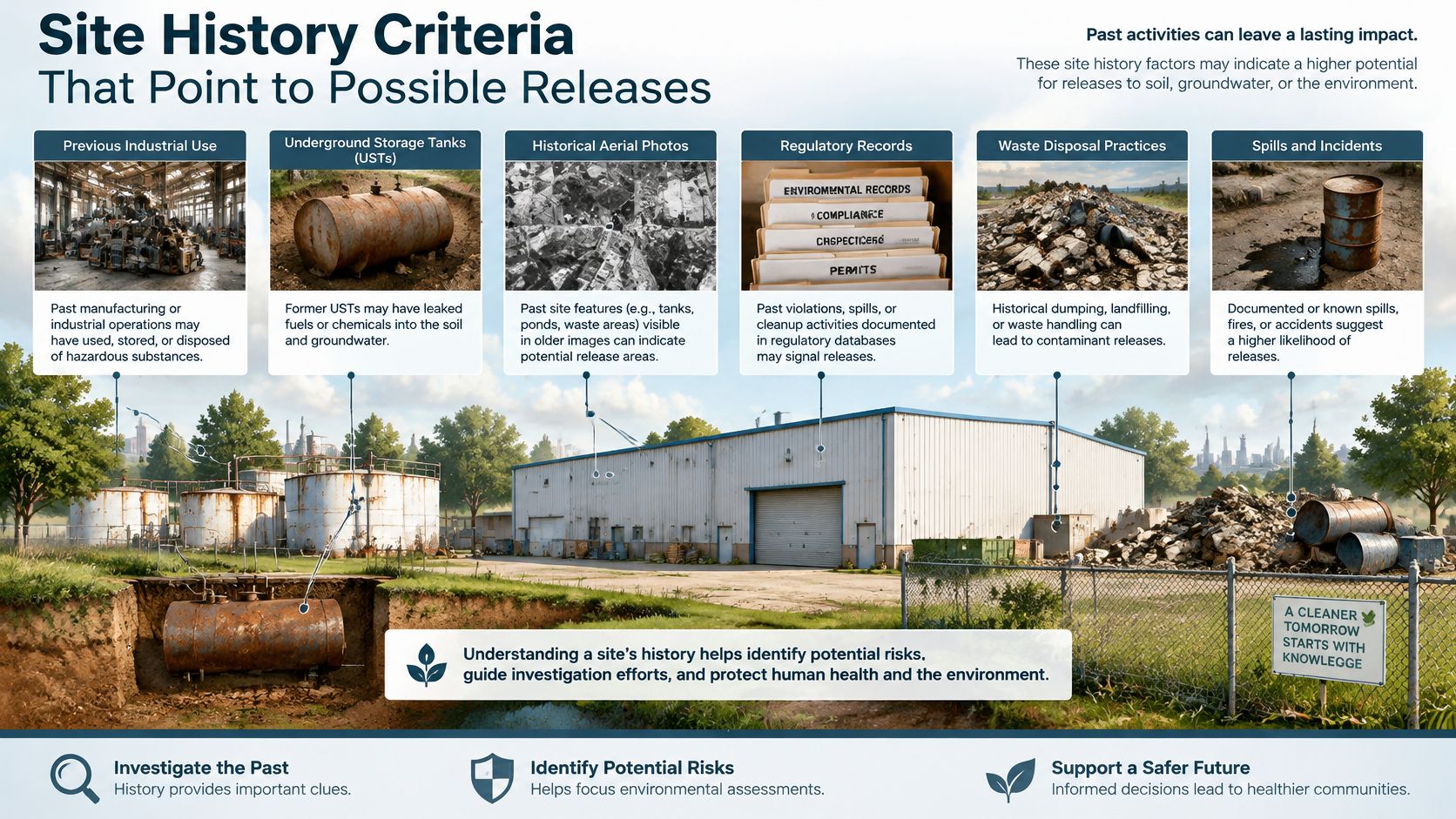
A Phase I Environmental Site Assessment evaluates these clues through records and observations rather than automatically starting with sampling. ASTM E1527-21 calls for federal, tribal, state, and local records research, inspection of the subject and adjoining properties, and evaluation of historical and operational information to identify recognized environmental conditions, or RECs.
The standard's REC definition addresses the presence, likely presence, or material future threat of a release of hazardous substances or petroleum products. A REC conclusion isn't the same as a laboratory-confirmed concentration or a determination of how far contamination extends.
Connect the records to a plausible release
Historical maps, aerial photographs, permit files, interviews, and a property walkthrough help reconstruct how the site operated. An assessor should connect those records to physical locations, such as former equipment pads, storage areas, drains, or stained pavement.
The distinction matters because a historical business name alone isn't a complete release assessment. Flagging every former industrial use without evaluating the evidence can lead to unnecessary testing. Ignoring a credible release possibility can leave owners and lenders with unrecognized liability.
Possible assessment outcomes include:
- No REC identified: The reviewed evidence doesn't support a REC conclusion within the assessment's scope and limitations.
- A REC requiring further investigation: Targeted soil, groundwater, soil-gas, or indoor-air sampling may help answer the remaining question.
- Another condition requiring attention: A condition may warrant documentation, monitoring, or specialist review without meeting the REC definition.
For the hypothetical dry cleaner, the useful next step isn't a generic indoor-air panel. It's a reasoned sampling recommendation tied to the former operation, possible release location, and movement of contaminants.
Before accepting a site-history conclusion, ask which historical records were reviewed, which past uses were treated as possible releases, and why. The report should make that reasoning understandable without requiring you to become an environmental scientist.
Potential Contaminants Matched to Property Type
Start with questions you can answer: What was the building made of, and what has happened to it since? Original construction materials suggest one set of testing needs. A roof leak, solvent-handling operation, or wildfire smoke event may introduce another.
Building age is a clue, not a laboratory result. Renovations can also leave different materials in neighboring rooms, so a sample from one area shouldn't automatically stand in for the entire property.
Contaminants by property type and typical test method
| Contaminant | Where it is commonly found | Property types most affected | Typical test method |
|---|---|---|---|
| Asbestos | Insulation, floor tile, joint compound, roofing in older buildings | Pre-renovation and pre-demolition projects | Bulk sampling with laboratory analysis |
| Lead | Paint, dust and soil near older structures | Older homes, apartments, schools and commercial buildings with painted surfaces | Paint chip sampling or dust wipes with laboratory analysis |
| Mold | Water-damaged drywall, carpet, HVAC components | Properties with leaks, flooding or condensation | Air, surface or bulk sampling with laboratory analysis |
| Volatile organic compounds | Solvents, adhesives, building products, fuels | Commercial and industrial spaces | Sorbent tube or canister air sampling |
| Fire residue (ash, soot, char, heavy metals) | Combustion byproducts on surfaces and in building materials | Post-fire and wildfire-affected properties | Surface wipe or bulk sampling for metals and combustion byproducts |
Bulk sampling means collecting a small portion of the material itself. For asbestos, the assessor identifies distinct suspect materials rather than combining unrelated flooring, adhesive, and wall finishes into an assumed building-wide answer.
Lead sampling answers a different question. A paint chip can characterize a coating, while a dust wipe evaluates dust on a defined surface; soil requires its own sampling approach. For housing built before 1978, lead testing in Los Angeles helps define which paint, dust, or soil questions should be addressed before renovation.
Match the method to the question
After water damage, a mold inspection should first locate moisture and affected materials. Air sampling may help evaluate airborne spores, while surface or bulk samples address particular growth or material conditions. An air sample alone doesn't explain why a wall remains wet.
Volatile organic compounds, or VOCs, are chemicals that can enter the air as vapors. Canisters or sorbent tubes, which collect compounds on a sampling medium, must be matched to the chemicals and sampling period of interest.
Following a structure fire or wildfire, visible soot doesn't tell you the full composition of deposited residue. Surface wipes and bulk samples can support targeted analysis for metals and combustion byproducts, including ash, soot, and char.
The laboratory panel is the requested list of analyses. A test covers only the substances and sample types it was designed to evaluate, so that list should follow the property evidence rather than a generic package.
Exposure Pathways Between a Source and People
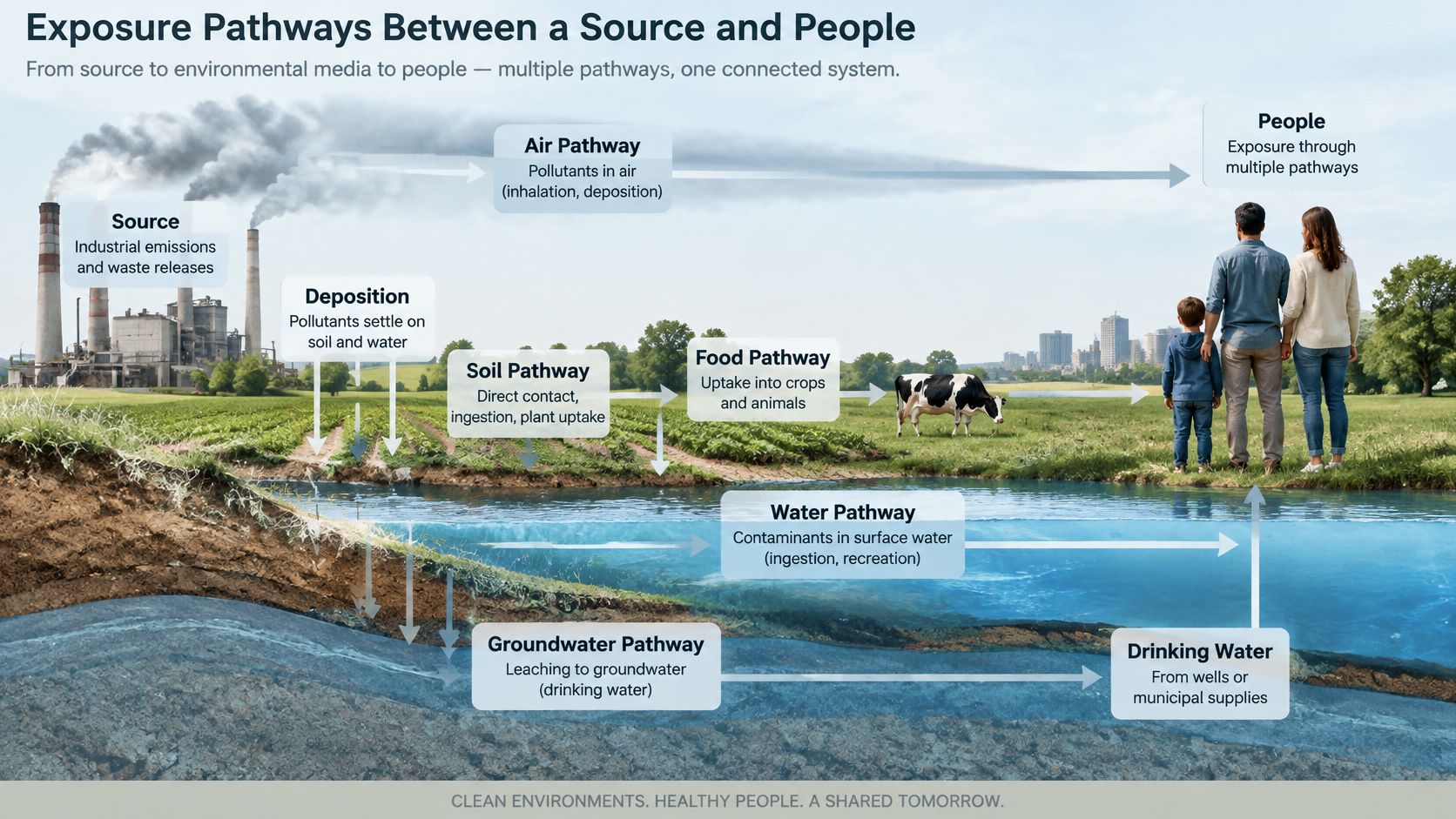
A contaminant is like spilled paint: its presence matters, but so does the route that carries it somewhere else. An exposure pathway connects a source to a person through air, dust, soil, water, or direct contact.
People may breathe airborne fibers, dust, vapors, or spores. They may touch contaminated soil or dust, or swallow contaminants through hand-to-mouth contact or affected water. These routes require different sampling strategies.
Follow the route, not just the source
An assessor asks:
- Is there a source? Identify the material, residue, or affected environmental medium.
- Can something release or move it? Consider sanding, demolition, airflow, tracking, or water movement.
- Is the route complete? Determine whether the contaminant can reach occupied areas.
- Who is the receptor? Record who spends time there, including children, older adults, or patients.
A receptor is the person or group potentially exposed. Occupancy matters because a daily-use classroom or clinic presents a different assessment question from a rarely entered storage room.
Suppose an intact floor tile contains asbestos and remains undisturbed. The material is a source, but that fact alone doesn't establish an active airborne pathway. Sanding the same tile during renovation can create a release mechanism and change the assessment entirely.
A material's condition and the planned work can matter as much as its laboratory composition.
Account for surrounding conditions
U.S. federal environmental evaluation criteria recognize that individually insignificant actions can become cumulatively significant. For a property assessment, the practical lesson is to document nearby sources and background conditions, not treat the building as an isolated box.
Repeated low-level exposure may deserve closer evaluation even when an individual result falls below an applicable comparison value. That doesn't automatically establish a violation or assign responsibility to the property owner. It means the assessor should explain combined pathways, occupant vulnerability, and uncertainty.
Before ordering tests, write down who uses the space, what work will disturb materials, and where air or water moves. Those answers help distinguish a relevant sample location from a convenient one.
Los Angeles Rules That Set Testing Requirements
For Los Angeles County renovation and demolition projects, South Coast AQMD Rule 1403 generally requires a written asbestos survey before work begins, subject to a limited residential exception. Under the Rule 1403 text, the survey must address affected materials, including flooring layers down to the joist level and materials inside wall or ceiling cavities when necessary.
A surface-only inspection may therefore miss the material a contractor will disturb. The scope should follow the construction plans, not merely the rooms that are easy to access.
Testing and documentation requirements by situation
| Situation | Rule or program | What it generally requires |
|---|---|---|
| Renovation or demolition in Los Angeles County | SCAQMD Rule 1403 | Written asbestos survey before work, covering all materials that may be disturbed, subject to the limited exception below |
| Single-unit residential, under 100 sq ft of asbestos-containing material removed or stripped | Rule 1403 exception | Prior written asbestos documentation not required for that renovation scope |
| Suspected asbestos material found damaged | Rule 1403 | Work stops, area is secured, and a qualified consultant evaluates the condition |
| Cleanup needed after asbestos was disturbed | Procedure 5 | Formal survey report with chain-of-custody records and laboratory analysis report |
| Renovating housing built before 1978 | EPA Renovation, Repair and Painting (RRP) Rule | Lead-safe work practices and certified firm requirements |
| Mold after water intrusion | Project- and agency-specific requirements | No single local numeric standard; the assessment documents conditions and applicable project requirements |
The South Coast AQMD compliance advisory limits the written-documentation exception to single-unit residential renovation removing or stripping less than 100 square feet of asbestos-containing material, not demolition, and identifies Cal/OSHA-certified inspectors or, where permitted, personnel holding an unexpired AHERA Building Inspector certificate as qualified survey personnel.
That exception isn't a general declaration that small projects are free of asbestos concerns. Confirm the actual work scope before relying on it.
Notification and disturbed-material documentation
For removal or demolition involving more than 100 square feet of intact material containing more than 1% asbestos, the South Coast AQMD frequently asked questions generally require electronic notification at least 10 working days or 14 calendar days before the activity. The same guidance calls for stopping work, securing and stabilizing the area, and qualified evaluation when suspect material is damaged.
When asbestos disturbance requires cleanup under Procedure 5, the Procedure 5 guidelines require a formal survey report with sampling and analysis, chain-of-custody records, laboratory results, notification, and supporting documentation.
For lead and mold, don't substitute asbestos paperwork for the applicable assessment. Lead-safe renovation obligations and moisture-related investigations address different hazards and decisions.
A positive result begins a decision process. Material condition, planned disturbance, applicable rules, and qualified professional evaluation determine appropriate next steps; the result alone doesn't automatically require removal.
Reading Lab Results and What a Negative Result Means
Define the decision before sampling. Asking whether a ceiling material contains asbestos requires a different plan from asking whether airborne contaminants are present during occupied work hours.
A credible assessment makes its methods visible. Scholarship published in Impact Assessment and Project Appraisal emphasizes disclosure of how data were selected, where and how they were collected, and which analytical methods were used.
Build evidence that answers the decision
- Walk the property and record conditions. Document occupancy, materials, visible damage, and moisture or residue patterns so the sampling plan reflects the actual building.
- State the question. Identify the decision the results must support, such as characterizing a material before disturbance or evaluating an occupied room.
- Choose representative and worst-case locations. Include relevant concealed or disturbed materials rather than sampling only accessible, clean-looking areas.
- Document collection and custody. Record locations, methods, sample identifiers, and transfers. Chain of custody is the record connecting collection to laboratory receipt and analysis.
- Use appropriate laboratory analysis. Use an accredited laboratory where applicable and request suitable methods, detection limits, and reporting of non-detects.
- Interpret coverage and uncertainty. Explain what the samples represent, what remains unknown, and whether confirmatory or post-work testing would answer an unresolved question.
Understand what was not detected
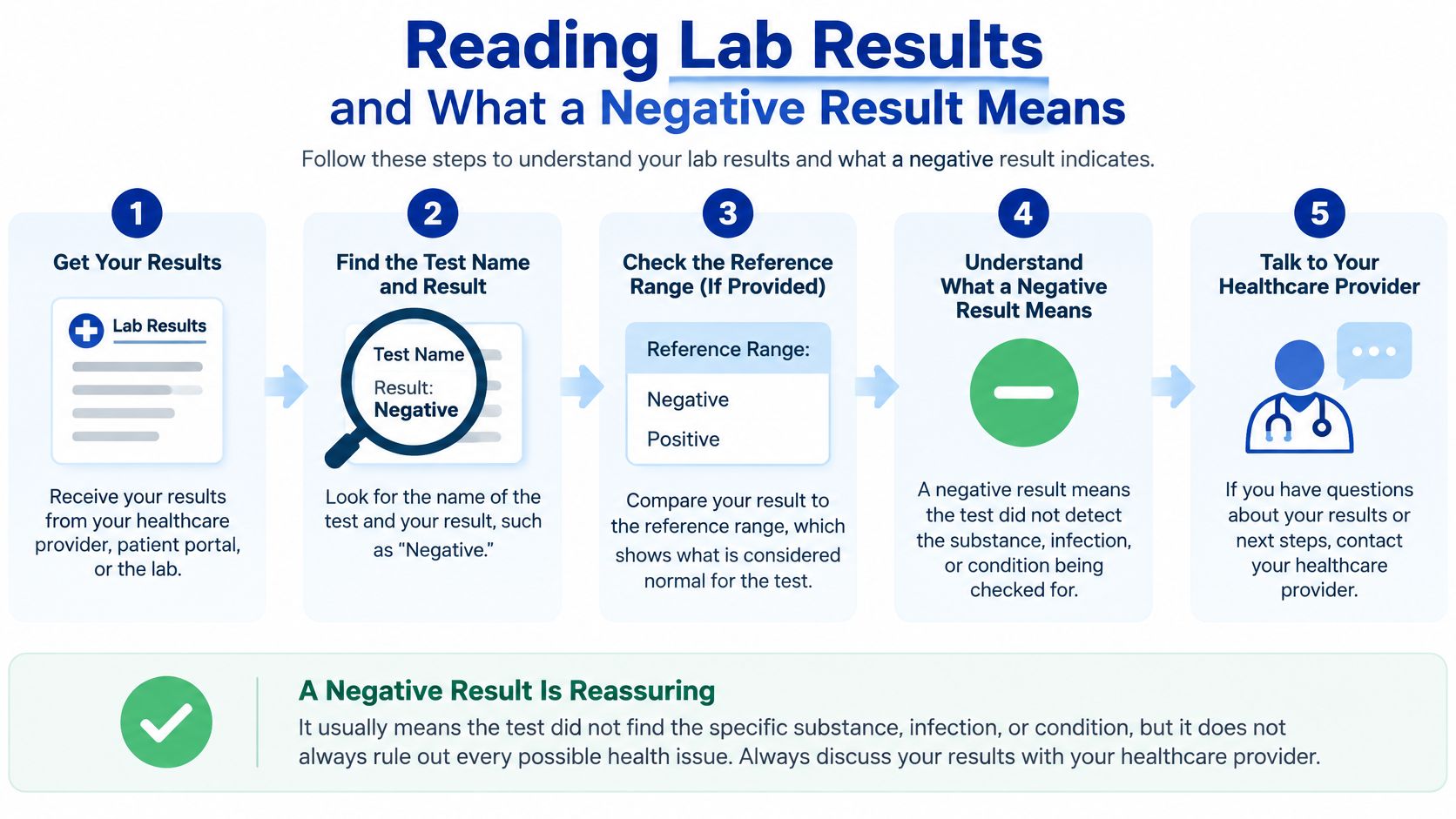
A non-detect generally means the laboratory didn't detect the analyte at or above the method's reporting limit in that sample. It doesn't establish that the substance is absent everywhere in the building.
The detection limit describes how small an amount the method can detect under its analytical conditions. If the decision requires measuring below the method's capability, the result may not resolve the question.
Consider an air sample collected on a quiet Sunday morning in a commercial building. It may accurately describe that sampling period without reflecting conditions during active production, cleaning, or construction. The laboratory hasn't failed; the timing may not match the intended decision.
A useful negative result needs adequate coverage: Appropriate timing, relevant locations, the right materials, and a complete analyte list.
A professional report should connect sample identifiers to locations, describe inspection and sampling methods, present laboratory findings, and explain limitations and next steps. Where asbestos is present, its amount and location should be clear.
Sensitive Environmental provides a report of the inspection procedure that includes the amount and location of asbestos in a building. The question to ask of any report is straightforward: What did the sample plan cover, and what did it leave out?
Professional Testing Compared With DIY Test Kits
A DIY kit can provide an initial signal about a particular substance. Professional testing addresses a broader question: whether the collected evidence represents the conditions relevant to your decision.
The difference isn't that a professional sends something to a laboratory. Sample selection, traceability, interpretation, and regulatory documentation are often the more important distinctions.
DIY test kits compared with professional environmental testing
| Factor | DIY test kit | Professional testing |
|---|---|---|
| Sample locations | Usually chosen by the user | Chosen to represent typical and worst-case conditions |
| Chain of custody | Usually absent or limited unless a mail-in service provides it | Documented from collection through laboratory analysis |
| Laboratory | Often unspecified in screening kits | Accredited laboratory analysis where applicable |
| Report | A single result with limited method detail | Written report with locations, methods and detection limits |
| Regulatory use | Usually insufficient for permits or Procedure 5 submissions | Prepared to support Rule 1403 and Procedure 5 documentation |
| Scope | Limited to the substance in the kit | Multi-contaminant scope when the criteria call for it |
A homeowner with a preliminary lead question might use an appropriate screening kit before deciding whether to arrange professional evaluation. That result shouldn't be treated as a complete assessment of painted surfaces, dust, and soil.
For suspected asbestos, collecting material yourself can also disturb the very material you're trying to evaluate. Our explanation of whether you can test for asbestos at home addresses why sample collection and survey scope deserve professional attention.
Evaluate the evidence behind the result
A user can label a sample location, and some mail-in kits include laboratory paperwork. Neither feature establishes that the location was representative or that the submission satisfies a required survey.
Our home environmental inspection process includes a full property walkthrough, identification of environmental hazards, targeted sampling and testing, laboratory analysis, and detailed reporting with next steps. Those connected activities distinguish an assessment from an isolated test result.
When reviewing a testing proposal or completed report, check for:
- A sampling plan: The locations and methods should follow the stated decision.
- Laboratory identification: Confirm the laboratory name and relevant accreditation.
- Custody records: Samples should remain traceable through analysis.
- Report detail: Look for sample locations, detection limits, limitations, and interpretation.
No test can guarantee a property is safe. It documents conditions within the time, locations, substances, and methods included in the assessment.
Book a Professional Assessment Before Work Begins
The right booking decision starts with the situation, not a request to test for everything. Arrange the assessment early enough for its findings to inform project planning, access, and documentation.
- Renovation or demolition: Schedule an asbestos survey covering potentially disturbed materials before work. For commercial planning, review why asbestos testing matters before a Los Angeles commercial renovation.
- Older painted surfaces: Arrange a lead assessment that identifies whether paint, dust, or soil sampling is appropriate before renovation.
- Water damage or musty odors: Request a mold inspection and discuss whether indoor air quality testing would answer an additional question.
- Fire or wildfire effects: Request targeted fire residue assessment for ash, soot, char, and heavy metals.
- Commercial operations or a sale: Discuss environmental site assessment or industrial hygiene needs. Buyers can also use pre-closing checks from Trail Star Development to place environmental due diligence within the transaction schedule.
We offer a free, no-obligation consultation for environmental testing or an existing asbestos, lead, or mold problem. Our team serves Los Angeles County and Southern California communities; if your community isn't listed in our service areas, contact us to ask whether inspections are available.
Share the building's age, past uses, planned work, occupancy, and any existing reports so we can apply the criteria to your property.
Sensitive Environmental offers asbestos testing and surveys, lead and mold testing, indoor air quality testing, commercial environmental testing, and combustion byproduct testing. Visit Sensitive Environmental to arrange a consultation about the inspection, sampling, and documentation your Los Angeles or Southern California property needs before work begins.