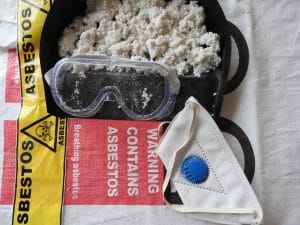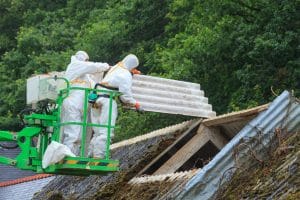
Asbestos in drywall can't be confirmed by eye or by testing only the gypsum board; each distinct suspect layer needs its own representative bulk samples analyzed by polarized light microscopy. A minimum of 3 samples per building material helps avoid basing a renovation decision on an unrepresentative piece.
You may already have a contractor scheduled to open a bathroom wall, relocate a doorway, or investigate water damage. Before that work starts, the important question isn't whether the drywall contains asbestos. It's which materials the work will disturb, including finishes that aren't visible through the paint.
Table of Contents
- Drywall Layers That Need Their Own Samples
- SCAQMD Surveys Before Walls Are Opened
- Sampling Steps and Mistakes That Ruin a Drywall Test
- What a Drywall Asbestos Lab Report Means
- Schedule Drywall Asbestos Testing in Los Angeles
Drywall Layers That Need Their Own Samples
Say you're remodeling a Los Angeles bungalow built in the sixties. The contractor proposes cutting a hole in the bathroom wall and sending a chunk of gypsum board to a laboratory. That sounds straightforward, but the sample could miss the joint compound around the opening, a skim coat beneath the paint, or a patch installed during an earlier plumbing repair.
Drywall is an assembly, not a single material. Gypsum board, paper facing, joint compound, tape, texture, and skim coat can have different compositions. Later repairs can introduce additional products that look similar after painting.
Group similar materials before choosing sample locations
An inspector first identifies homogeneous areas, meaning materials that appear consistent in composition, color, texture, installation period, and finish. A smooth bathroom ceiling and a textured hallway ceiling shouldn't automatically be grouped together. Neither should an original wall finish and a visibly different repair around a replacement shower valve.
The EPA's supplementary asbestos sampling guidance recommends a minimum of three joint-compound samples, describes at least two bulk samples per nonfriable homogeneous area under AHERA, and discusses the common use of three samples to support a non-asbestos determination. Those requirements and practices have different scopes, so an inspector must select the applicable sampling plan rather than treat the lowest number as universal.
Drywall components and typical asbestos sample minimums
| Component | Sample separately | Usual minimum | Lab method |
|---|---|---|---|
| Gypsum board | Yes, not as the whole wall | Each homogeneous area; three often used before a non-asbestos call | PLM |
| Paper facing | Yes if it is a distinct layer | Collected with all layers of that material | PLM |
| Joint compound | Yes, including hidden skim coat | Minimum of 3 | PLM |
| Texture or skim coat | Yes when color, texture, or age differs | At least 2 per nonfriable homogeneous area; 3 commonly used | PLM; TEM if the matrix hides fibers |
| Tape or patching compound | Yes, as its own material | Representative samples of that material | PLM |
The table is a planning guide, not a substitute for a project-specific survey. AHERA provisions shouldn't be presented as a universal sample-count rule for every residential wall. Material classification, project requirements, and the intended regulatory determination affect the final sampling design.
Follow the finish beyond the obvious seam
Joint compound isn't always confined to a narrow strip between boards. A finisher may have spread it across a broad surface to flatten irregularities or create a smooth appearance.
SCAQMD's asbestos frequently asked questions explain that drywall and joint compound must be analyzed separately, and that compound can extend beyond seams and nail holes beneath paint. A sample from the middle of a board therefore may not represent the finishing material elsewhere on that wall.
Practical rule: Match the sampling plan to the materials the tools will touch, not just the surface you can see.
Before arranging testing, list every finish the project will disturb: walls, ceilings, textured areas, broad skim coats, repaired openings, and transitions between rooms. Give that list to the inspector alongside the contractor's scope.
SCAQMD Surveys Before Walls Are Opened
In Los Angeles County, building age doesn't exempt a renovation from asbestos testing requirements. The South Coast Air Quality Management District requires testing before renovations regardless of building age, so a newer construction date isn't a reason to skip the survey.
Under SCAQMD Rule 1403, the survey must include onsite inspection, identification, quantification, and physical sampling of friable asbestos-containing material and Class I and Class II nonfriable asbestos-containing material. The report must document compliant sampling, laboratory qualifications, analytical procedures, and methods consistent with 40 CFR Part 763.
Renovation and demolition need different survey boundaries
For a Santa Monica condo kitchen renovation, the survey should follow the actual disturbance footprint. That may include the backsplash wall, soffit, ceiling penetrations, and surfaces opened for electrical or plumbing changes. Testing only a visibly cracked section wouldn't address intact materials that the contractor also plans to cut.
A Long Beach commercial teardown requires a broader investigation. A demolition survey can include construction materials throughout the structure, foundations, underground utilities, and potentially concealed or inaccessible materials. Access limitations need explicit documentation rather than an assumption that unopened areas contain nothing relevant.
Small repairs follow the same planning logic. The size of the hole doesn't identify the materials around it, so a patch that opens the assembly still needs its affected layers evaluated before work starts.
For owners coordinating tenant improvements or capital projects, our guidance on scheduling an asbestos inspection before commercial renovations explains why inspection belongs early in project planning.
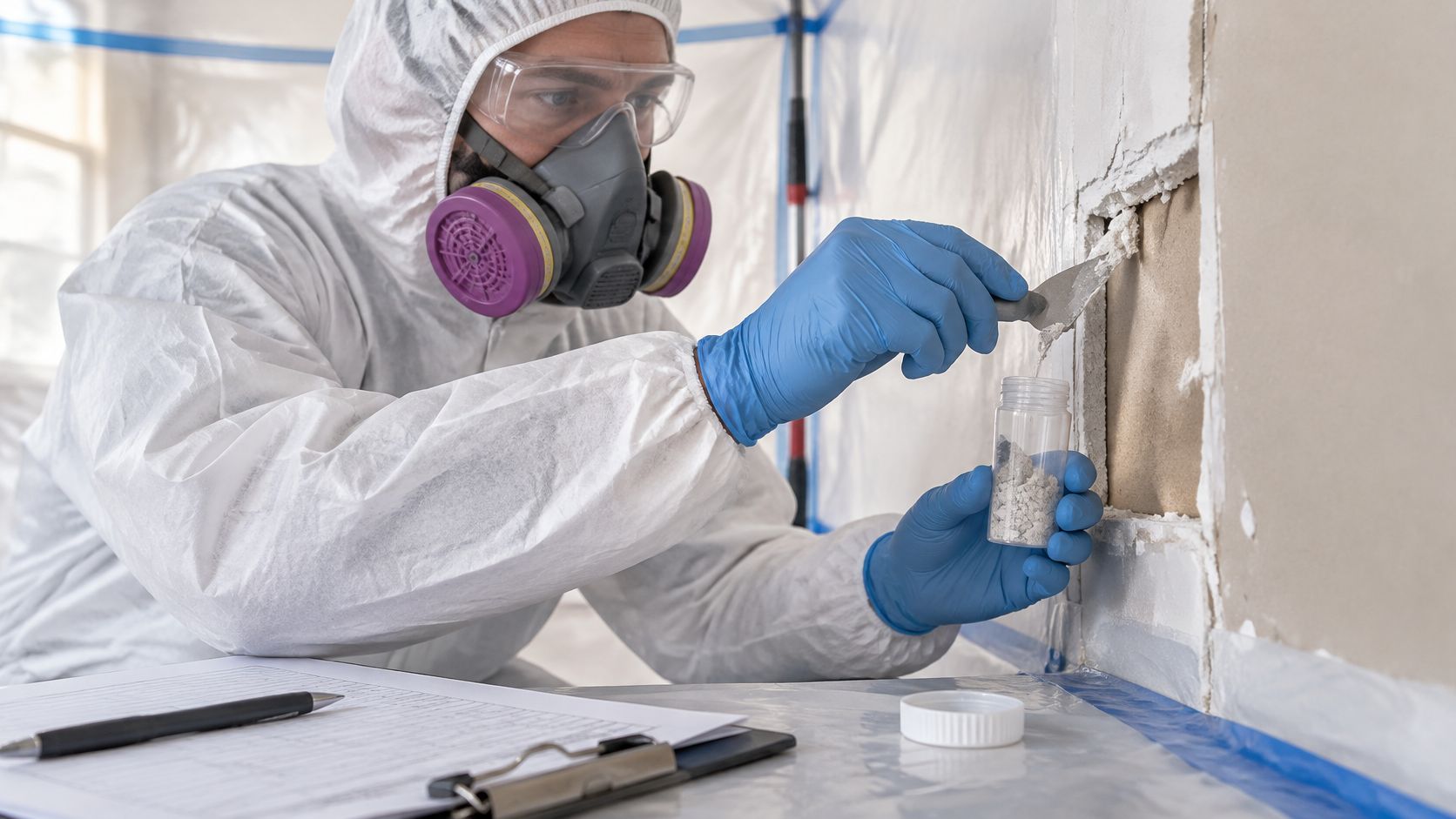
The professional workflow below illustrates how inspection, sampling, and laboratory analysis fit together. Its container illustration is schematic; the written sampling specifications and laboratory instructions control container selection.
Damaged materials require additional documentation
If a Certified Asbestos Consultant finds asbestos-containing material damaged or significantly damaged, the condition may be classified as a Procedure 5 situation, requiring a cleanup plan written by the consultant. The testing role is to establish material identity, condition, location, and assessment limitations.
SCAQMD's Procedure 5 guidance explains the survey, notification, and supporting-document requirements for disturbed asbestos-containing materials and situations where they can't be removed before demolition or renovation.
Fire, earthquake damage, or another emergency doesn't eliminate these obligations. The district's emergency asbestos guidance requires applicable surveys and notifications as soon as possible, with a Procedure 5 plan when conditions prevent a complete survey or prior removal.
- Document unsafe access: Identify rooms, cavities, or structural areas the inspector couldn't evaluate.
- Separate findings from decisions: Testing establishes conditions; owners and qualified professionals determine the appropriate response.
- Preserve the testing role: Sensitive Environmental provides assessment and documentation for project planning, not construction work under this testing scope.
Sampling Steps and Mistakes That Ruin a Drywall Test
A contractor plans to open a wall for new plumbing. The test plan must cover each material that the work could disturb, not just the drywall board. A wall is an assembly: board, tape, joint compound, texture, and later repairs may need to be identified separately.
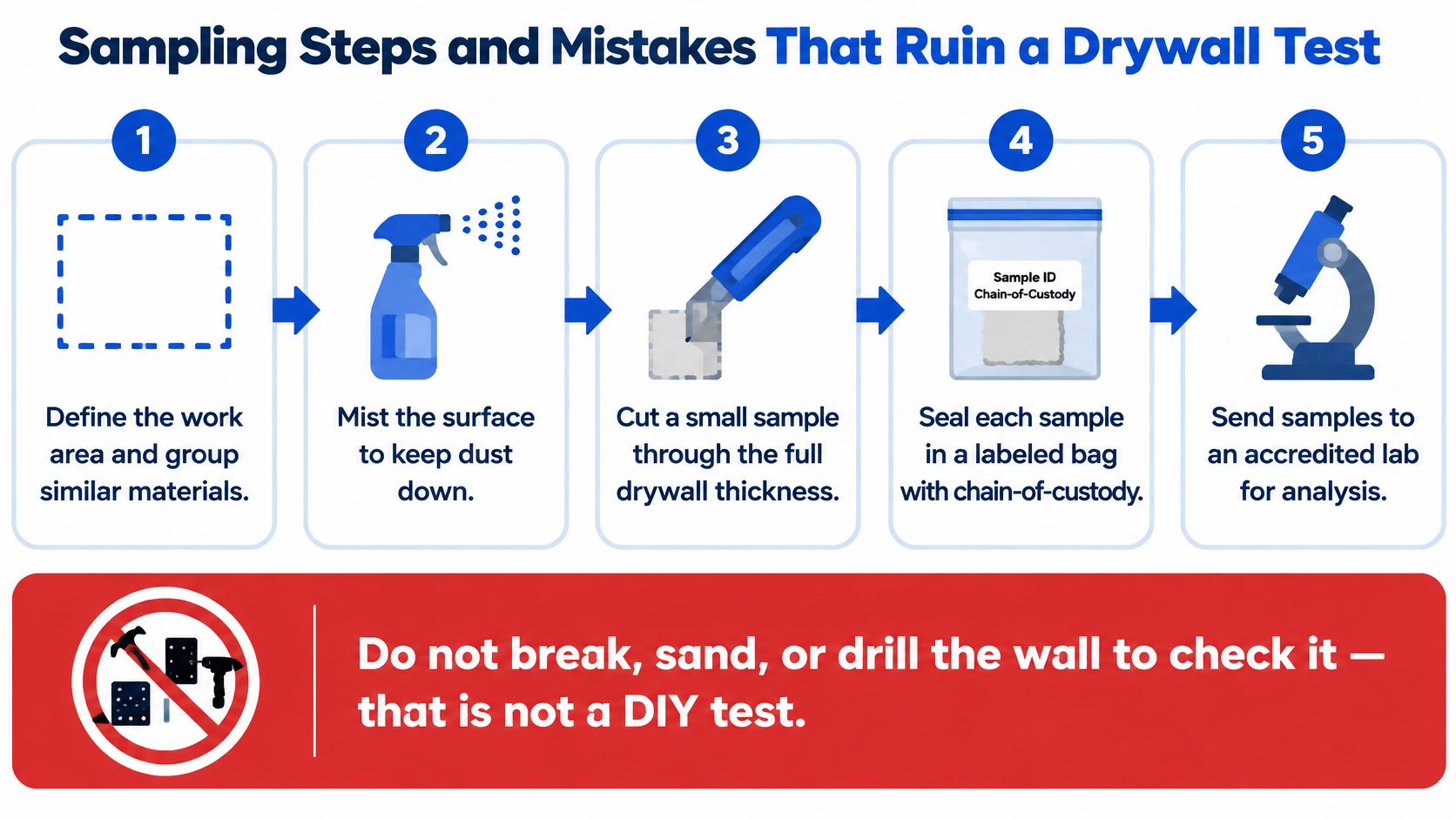
The professional sampling sequence
Define the work area and group matching materials.
The inspector reviews drawings, contractor notes, planned openings, and available renovation records. Materials are grouped by appearance and installation history, with distinct finishes or repair phases considered separately. A plumbing access patch, for example, may need a different designation from the surrounding wall.Identify each suspect layer.
The inspection accounts for the board, facing, tape, compound, texture, and other coatings the work may reach. Compound beneath paint deserves attention even when no seam is visible. Sample descriptions should name the material being characterized, rather than use a broad label such as “bathroom drywall.”Prepare a controlled sampling location.
The sampler selects an inconspicuous spot where practical, then uses wet methods, localized containment, and disposable or properly decontaminated tools. The goal is a representative specimen with limited disturbance, not an exploratory opening made with a power tool.Collect and package a representative bulk sample.
A small, representative amount of material should go into a rigid, sealed container. Keep relevant layers separate when they require separate analysis. Combining board, tape, and compound into one undifferentiated sample can make it difficult to determine which material a result describes.Close the sampling location and establish custody.
Where material remains, the sampler seals the sampling wound. Each closed container receives an identifier that matches the field notes and chain-of-custody record. This record links the sample to its location, material description, requested analysis, and laboratory receipt.Request the appropriate bulk analysis.
Polarized light microscopy, or PLM, is a standard method for bulk material. If the matrix obscures fibers, the result is trace-level, or the project needs additional analytical certainty, the consultant and laboratory can determine whether supplemental analysis, such as transmission electron microscopy (TEM), is appropriate. Air-fiber counting does not identify asbestos in a solid wall material.Map locations and compare them with the project.
Sample identifiers should match a location sketch, photographs, or precise written descriptions. The report should distinguish a seam sample from a board-field sample and identify areas that could not be accessed. Before work begins, compare the documented locations with the planned work area.
Sample counts describe materials, not just containers
Sensitive Environmental requires a minimum of 3 samples per building material. If 1 of 3 samples is positive, all of that same homogeneous material is considered positive. Negative specimens do not cancel a positive result.
This does not make every wall in a building one material. The inspector first determines which installations belong to the same homogeneous group. A sample count can meet the minimum and still fail to represent the materials the project will disturb if that grouping is inaccurate.
Common mistakes and the steps they undermine
Judging by appearance skips material identification. In most cases, asbestos cannot be identified by looking at a material. Asbestos-insulated ducting and white asbestos tape on air-handling systems may be recognizable suspect applications, but appearance alone does not confirm asbestos.
Scoring or breaking the wall skips controlled collection. Peeling back a corner or sanding texture disturbs material before a sampling plan exists. A professional's controlled sample is different from an arbitrary piece cut out by a homeowner.
Using building age alone skips product history. The OSHA interpretation addressing wallboard systems discusses the 1977 Consumer Product Safety Commission ban on consumer wall-patching compounds containing respirable asbestos fibers. It also explains that wall components capable of containing asbestos require separate analysis. That historical milestone does not establish that every earlier product contained asbestos or that every later installation is asbestos-free.
Sampling only the damaged spot skips the work footprint. A stained area may draw attention while intact walls remain untested. If the renovation will disturb those intact surfaces, the test plan should address them too.
Calling joint compound the whole board skips accurate reporting. A broad label makes it harder to tell which product was analyzed and where it occurs. The material names in the laboratory submission and final report should be consistent.
A useful sample has both a laboratory result and a clear connection to a particular material in a particular location.
Why a mail-in kit isn't a complete survey
A hardware-store kit may provide a way to send material to a laboratory, but it does not automatically include professional inspection, representative sampling, containment, or regulatory documentation. A laboratory can accurately analyze the piece it receives while other materials in the project remain uncharacterized.
The guide to testing for asbestos at home explains the difference between testing a submitted sample and assessing the materials a renovation will disturb. For home buyers planning renovations, Sensitive Environmental recommends having a Certified Asbestos Consultant test all materials that will be impacted.
What a Drywall Asbestos Lab Report Means
Read the result by material and method
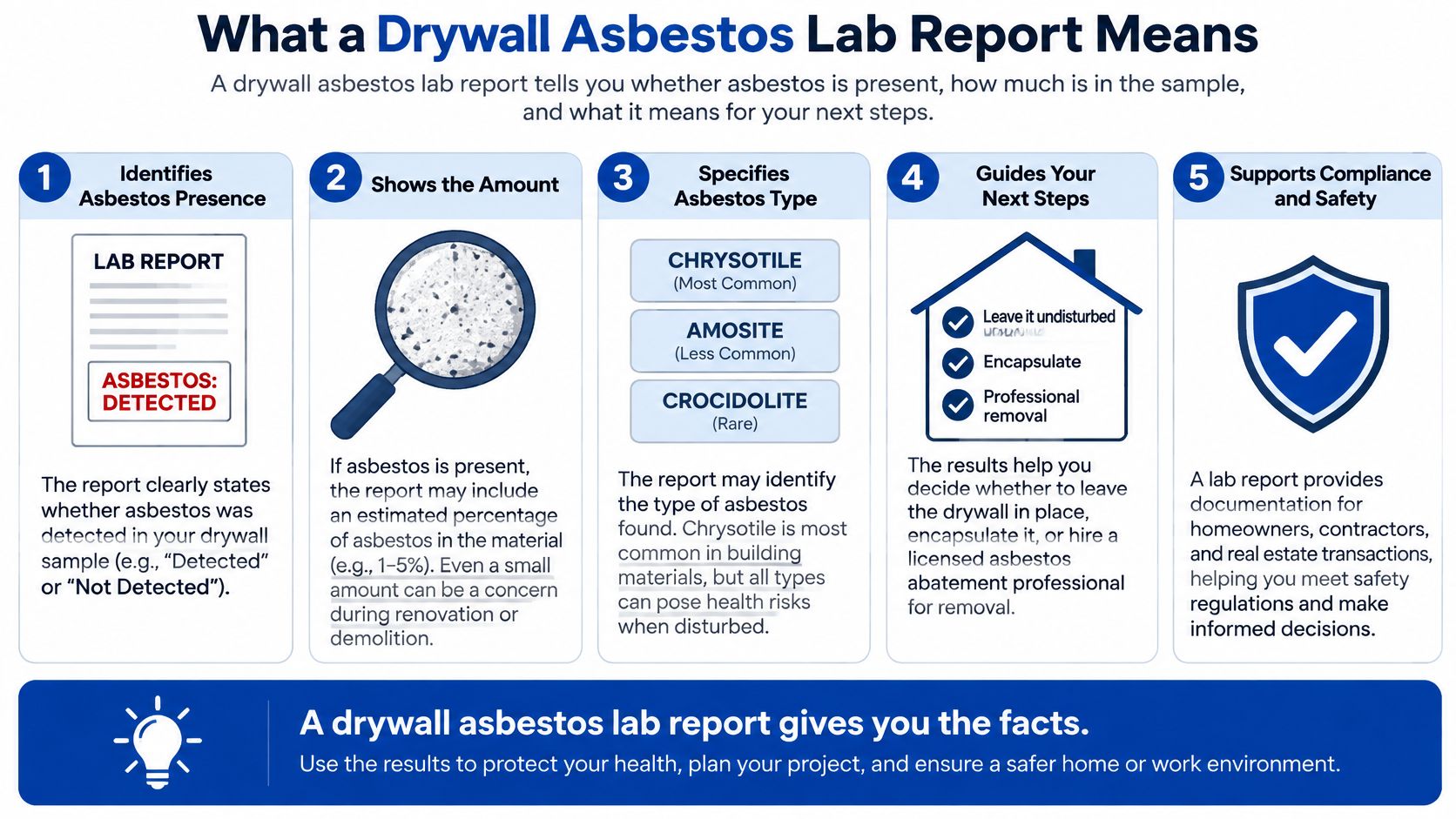
A drywall assembly is more like a stack of separate products than a single material. The report should identify which layer was sampled, where it was found, and which analytical method produced the result.
| Result | What it establishes | What it does not do |
|---|---|---|
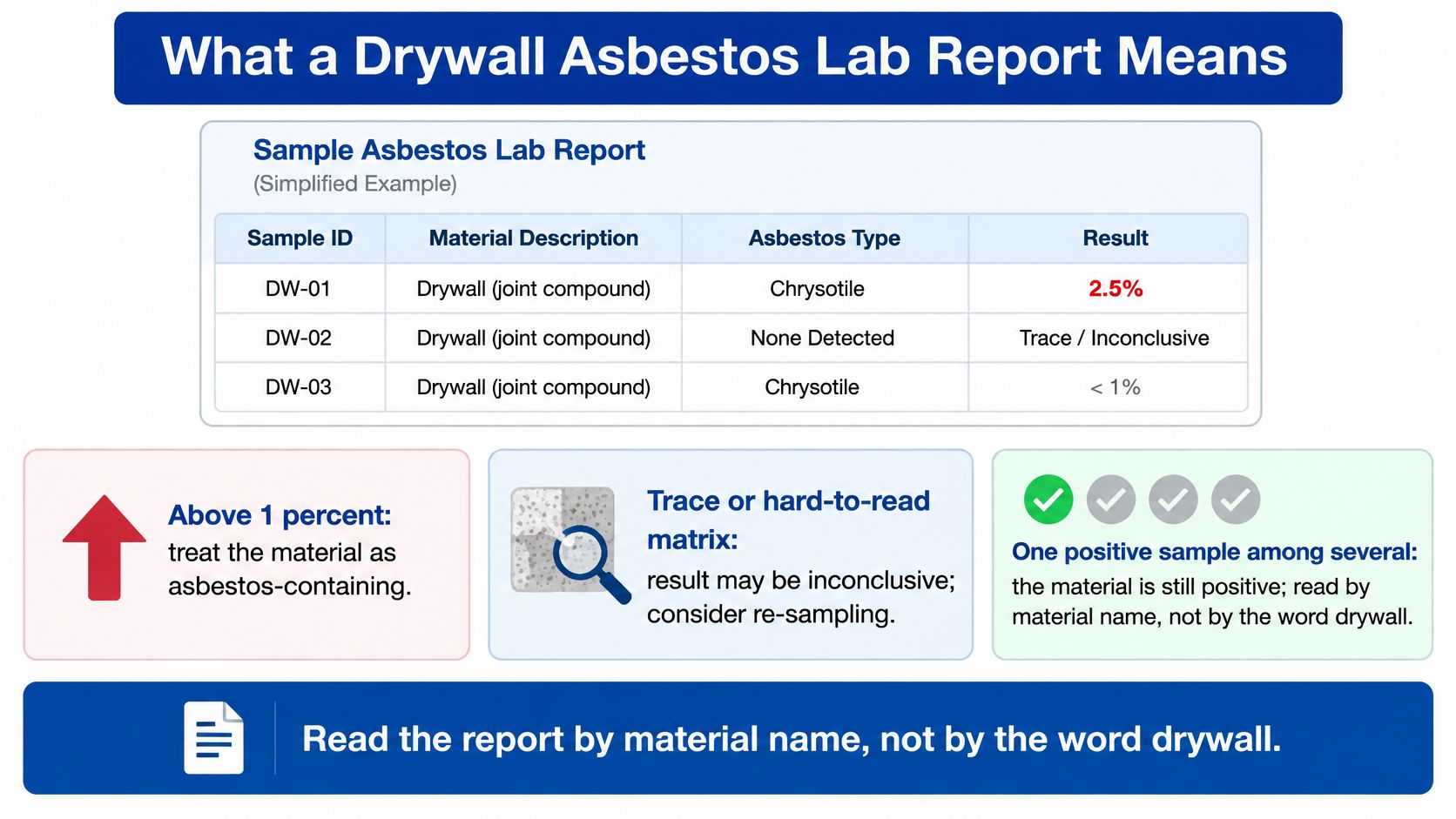
| More than 1 percent asbestos by PLM | The sampled material exceeds the stated OSHA asbestos-containing material threshold | It does not by itself order removal or show that the whole building is affected |
| One of several samples of the same material is positive | The sampled homogeneous material is treated as positive | It does not classify a visually different material in another room |
| Trace result or fibers obscured by the matrix | The result may need further interpretation or analysis | It should not be treated as a clear negative without appropriate follow-up |
| All required samples of one material are negative | The result supports a non-asbestos finding for that homogeneous material | It does not clear other layers, repair areas, or unsampled walls |
| PCM air-fiber count | The number of fibers counted in an air sample | It cannot identify asbestos in drywall or joint compound |
A positive result identifies a material condition. It does not, by itself, prescribe removal, encapsulation, or another response. The project team must consider the finding alongside the planned work.
Check the report's material name first. A result for joint compound applies to the sampled compound and its identified extent, not automatically to every gypsum panel. Likewise, a negative result for the board does not address an untested coating or texture.
The percentage is a material-classification result, not a measure of exposure during a particular task or a declaration that a building is safe or unsafe. If work will disturb the material, applicable work practices must be evaluated for the project.
A trace result needs careful reading. If the laboratory has difficulty distinguishing fibers within the sample matrix, the report may describe further preparation or analysis, such as point counting where appropriate or TEM follow-up. These methods answer different questions, so the report should clarify what uncertainty further analysis addresses.
A PCM air result answers a separate question. PCM counts fibers but cannot distinguish asbestos fibers from other fibers. An air count therefore does not establish whether drywall or joint compound contains asbestos.
Use the report to guide project decisions
A repair-method comparison, such as DIY versus professional drywall repairs, does not replace environmental characterization or local compliance review. The report helps define which materials have been identified; the project team then evaluates the work planned for those materials.
If asbestos-containing material is slated for removal, guidance on asbestos disposal explains considerations for that regulated stage. A laboratory finding alone is not an instruction to bag debris or transport it.
Before relying on the report for a project, check:
- Layer identification: Does it name the specific board, compound, texture, or coating analyzed?
- Work-scope coverage: Does the assessment address each finish the contractor plans to disturb?
- Access limitations: Does it identify concealed, unsafe, or inaccessible areas?
Schedule Drywall Asbestos Testing in Los Angeles
Schedule testing while the renovation scope is still adjustable, before a contractor opens the wall. That gives the inspector a defined project to evaluate and gives the contractor documentation to use when planning the work.
For a homeowner, that may mean marking the proposed plumbing opening on a photograph. For a property manager or facility manager, it may mean supplying tenant-improvement drawings, ceiling plans, and records of earlier repairs. A general contractor should identify not only the finish being replaced but also adjacent surfaces likely to be disturbed during access.
Budget for the survey scope rather than a generic wall test
In 2025, HomeAdvisor reported residential professional asbestos testing costs of $231–$776, averaging approximately $483. That's a national residential benchmark, not a Sensitive Environmental quote or a Los Angeles project estimate.
Local pricing reflects the number of distinct materials, the rooms involved, access conditions, laboratory needs, and required documentation. A narrowly defined bathroom investigation and a commercial pre-demolition survey shouldn't be expected to have interchangeable scopes.
When organizing the broader remodel, you can see how Ofir Engineering plans remodels for general sequencing ideas. Its Jacksonville planning discussion isn't a substitute for Los Angeles asbestos requirements, but the distinction between planning and construction is useful: environmental investigation belongs before disturbance, not after a contractor encounters an unexpected layer.
Prepare the information needed for a useful assessment
A clear request helps establish the inspection boundaries. Have the following available before the consultation:
- Planned disturbance: Describe cutting, opening, drilling, ceiling access, or full wall replacement.
- Known material differences: Identify textures, patches, additions, and rooms renovated at different times.
- Property constraints: Note occupied areas, HOA access arrangements, damaged surfaces, and inaccessible cavities.
- Documentation needs: Explain whether the report is for a contractor, property owner, inspector, or regulatory response.
Sensitive Environmental serves homeowners, property managers, general contractors, and facility managers throughout Los Angeles and Southern California. Our asbestos testing includes material identification, certified sampling and laboratory analysis, pre-renovation and pre-demolition inspections, and compliance testing, with clear reporting for contractors, owners, and inspectors.
A useful final report should let the project team locate the material, understand the sampling coverage, identify the laboratory method, and recognize unresolved access limitations. That's more actionable than a generic statement that the drywall passed.
Sensitive Environmental offers a free, no-obligation consultation to discuss drywall asbestos testing and the materials your project will disturb. Visit Sensitive Environmental to schedule professional sampling or a pre-renovation Rule 1403 asbestos survey in Los Angeles and Southern California before any wall is opened.