The advice sounds responsible, and it's the one homeowners and property managers hear most often: run an air test, read the number, and you'll know whether the building is safe. It's a tidy story. It's also the fastest way to buy false confidence before a Los Angeles renovation.
An asbestos air sample doesn't survey a building. It pulls a measured volume of air through a small filter for a set number of minutes and reports the fibers caught, in fibers per cubic centimeter (f/cc). That's a record of one interval in one place. It says nothing about the insulation inside a wall cavity, the flooring under three layers of vinyl, or what a crew will release when it cuts into either one.
The frame that works is the one a careful industrial hygienist uses on the first phone call: name the decision you need to make, then pick the sample that can answer it. Material present, worker exposure, background air, or cleanup inside a contained work area. Different tests, different paperwork, different limits. Here's how each one works, where the numbers come from, and what they can't prove.
Table of Contents
- Why a Low Air Result Is Not a Safety Stamp
- Match the Sample to the Question
- How Filters Are Collected and Counted
- Surveys Required Before Los Angeles Renovation Air Tests
- Do-It-Yourself Kits Versus Professional Asbestos Sampling
- Three Projects and the Test to Book Next
Why a Low Air Result Is Not a Safety Stamp
A low reading from a hallway pump that ran for six hours is a real measurement of those six hours in that hallway. The pump drew a known volume of air through a filter, the laboratory counted the fibers the filter caught, and the report states the result in fibers per cubic centimeter of air (f/cc). Read it as a description of one interval in one place, not as an inventory of the building.
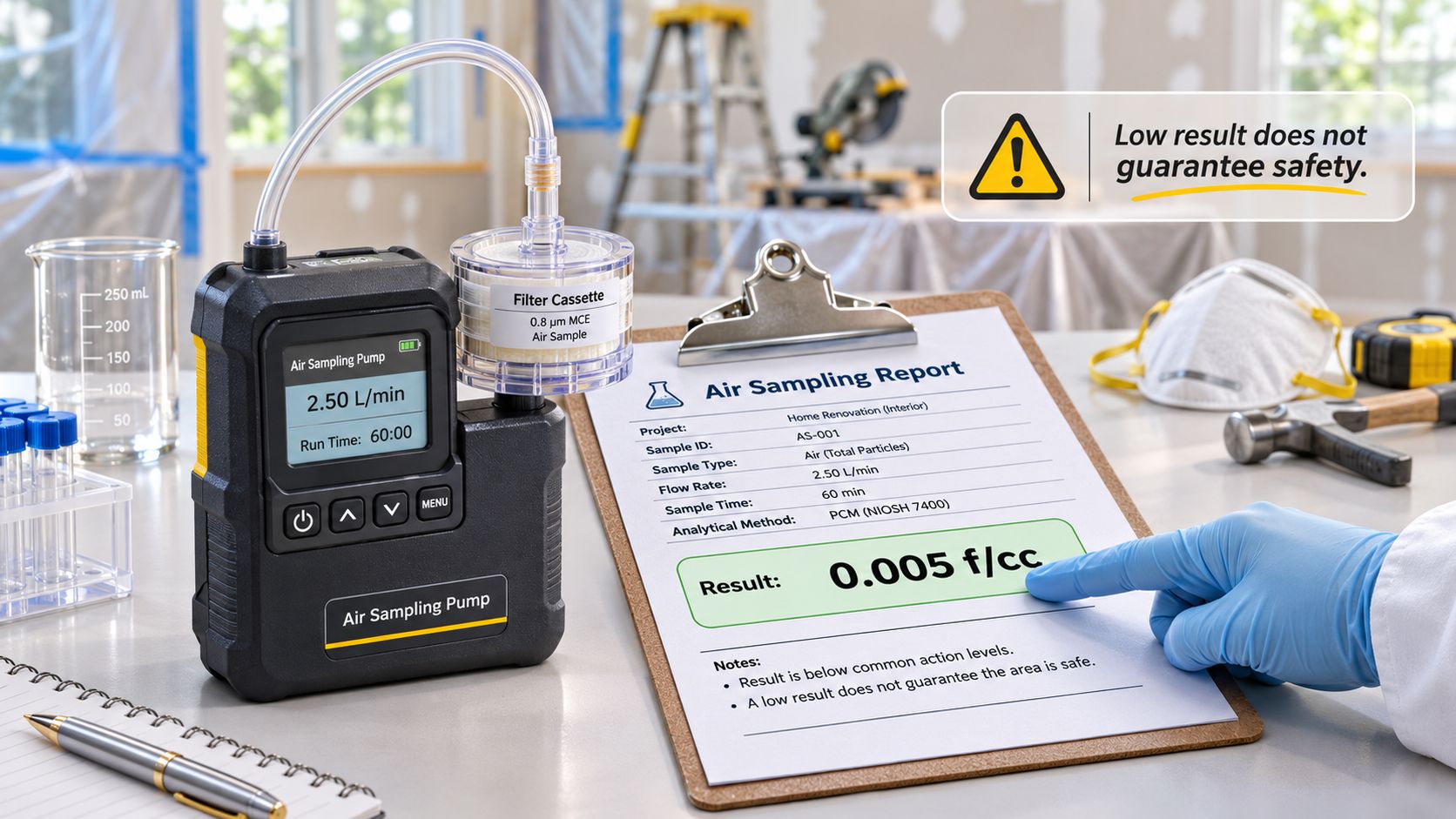
That narrowness is built into the method's history. Air sampling became the foundation of modern occupational asbestos control when regulators moved from measuring total dust to counting airborne fibers, and early surveys used impinger instruments that reported millions of particles per cubic foot without distinguishing asbestos from anything else in the air. In 1969 the British Asbestos Research Council recommended membrane-filter counting and the U.S. Bureau of Occupational Safety and Health published a filter-membrane method, a shift OSHA's 1994 asbestos standard traces in detail. The filter-and-microscope model has been the backbone of the field ever since.
What air sampling cannot see inside a wall
Bulk sampling answers the other question: whether a material contains asbestos at all. Air results and bulk results don't substitute for each other, and the gap matters most in older Los Angeles housing stock, where a material can hold asbestos without releasing the same airborne concentration under every condition. Cutting, sanding, breaking or prying it out changes what's in the air substantially, which is why a board that sits behind a wall for decades can produce a very different picture under a saw.
You usually can't identify the material by looking, either. In most cases asbestos cannot be identified by looking at it, though it can be seen on air handling systems such as asbestos-insulated ducting and white asbestos tape. That's why the survey, not the glance, is the document that counts.
Why regulators call air monitoring supplemental
EPA's position is worth stating plainly. The agency describes an operations-and-maintenance air-monitoring program as only supplemental to a thorough visual and physical inspection and reinspection program, and it's direct that sampling cannot reliably prove asbestos-containing material is absent or that a future disturbance won't release fibers, per EPA's guidance on monitoring asbestos-containing material.
The distinction worth keeping: ordinary supplemental sampling describes conditions during the sampling period. Aggressive sampling, which uses fans or blowers to stir settled dust deliberately, is generally reserved for the completion of an abatement project inside containment, not for routine building evaluation.
Three misreadings show up in almost every project file, and each one turns a useful number into a wrong decision.
- "A low result means the building is clear." It means the air at that location held that concentration while the pump ran. Whether asbestos-containing material exists is a bulk-sampling and inspection question, answered with material samples, not with air.
- "A fiber count means the material has to come out." A result informs the owner and the qualified professionals planning next steps. Whether work follows depends on the material's condition, its friability, what the project will disturb and which rules apply.
- "One good number covers the whole job." Drilling, HVAC work, demolition and later deterioration each change what becomes airborne, and none of them were happening while the pump was on.
Condition drives a lot of this. If a Certified Asbestos Consultant finds asbestos-containing material damaged or significantly damaged, it may be classed as a Procedure 5, which requires a Procedure 5 clean-up plan written by the consultant. No air number replaces the walkthrough that finds the damage in the first place. For the health side of the equation, read why asbestos is dangerous.
Match the Sample to the Question
They call it an air test, and the first useful move is to stop treating it as one thing. Nearly every inquiry about air sampling for asbestos in Los Angeles fits one of five questions, and each question carries its own sample type, its own paperwork and its own ceiling on what the result can support.
| Question | Sample to use | What the result shows | What it does not show |
|---|---|---|---|
| Is asbestos in this material? | Bulk samples, at least three per suspect material | Whether that material contains asbestos, often judged above 1 percent by weight | Air concentration or what a future disturbance will release |
| What is a worker breathing during this task? | Personal sample in the breathing zone | Fiber concentration over the sampled task or shift, compared with occupational limits | The identity of every fiber, or conditions after the work changes |
| What is in the air during ordinary use? | Area sample during occupancy | Conditions only while the pump ran | Drilling, demolition, HVAC work or later deterioration |
| Was cleanup inside containment complete? | Aggressive clearance air sampling | Airborne fibers after deliberate disturbance with fans or blowers | Whether the rest of the building is suitable for routine use |
| What is happening during a smoke or ash event? | Longer area or outdoor air monitoring | A trend for the monitored interval | Whether building materials contain asbestos |
Pick the row before you book the pump
A material question comes first on almost every renovation project. A positive bulk result on old floor tile or joint compound tells the owner what the project has to plan around. It doesn't order removal, and it doesn't describe what that tile will release when a crew grinds it. Both facts are real, and they come from different tests.
A worker-exposure question is a different purchase entirely. It needs a personal sample in the breathing zone, worn by the person whose exposure you're documenting, across the task or shift being evaluated. A pump on a windowsill is an area sample, and an area sample doesn't become an exposure record because it sat near a worker for a while.
The occupancy question is the one homeowners usually mean. A short area sample during ordinary use describes those hours, those activities and that airflow, and it stops there.
Ask for the decision, not the test. Material present, worker exposure, background air, or cleanup inside containment. Once the question is fixed, the sample type and the report format stop being a matter of opinion.
What a bulk result should come with
Bulk sampling is where the material question gets settled, and the paperwork around it carries as much weight as the laboratory count. EPA's guidance on bulk sampling identifies regulated asbestos-containing material as material containing more than 1 percent asbestos by weight and describes bulk sampling as the method used to document that condition. The same source notes that a minimum of three samples may be required for a suspected friable material, and it describes a district survey checklist calling for a sample list, a location sketch, documentation of the laboratory used, the lab's NVLAP approval number, the 763.86 sampling protocol and the analytical method.
That documentation is what makes a report usable by a contractor, an inspector or a district reviewer. A count with no location, no method and no custody trail is difficult to act on and harder to defend six months later, when the crew has changed and the finish schedule has moved.
How Filters Are Collected and Counted
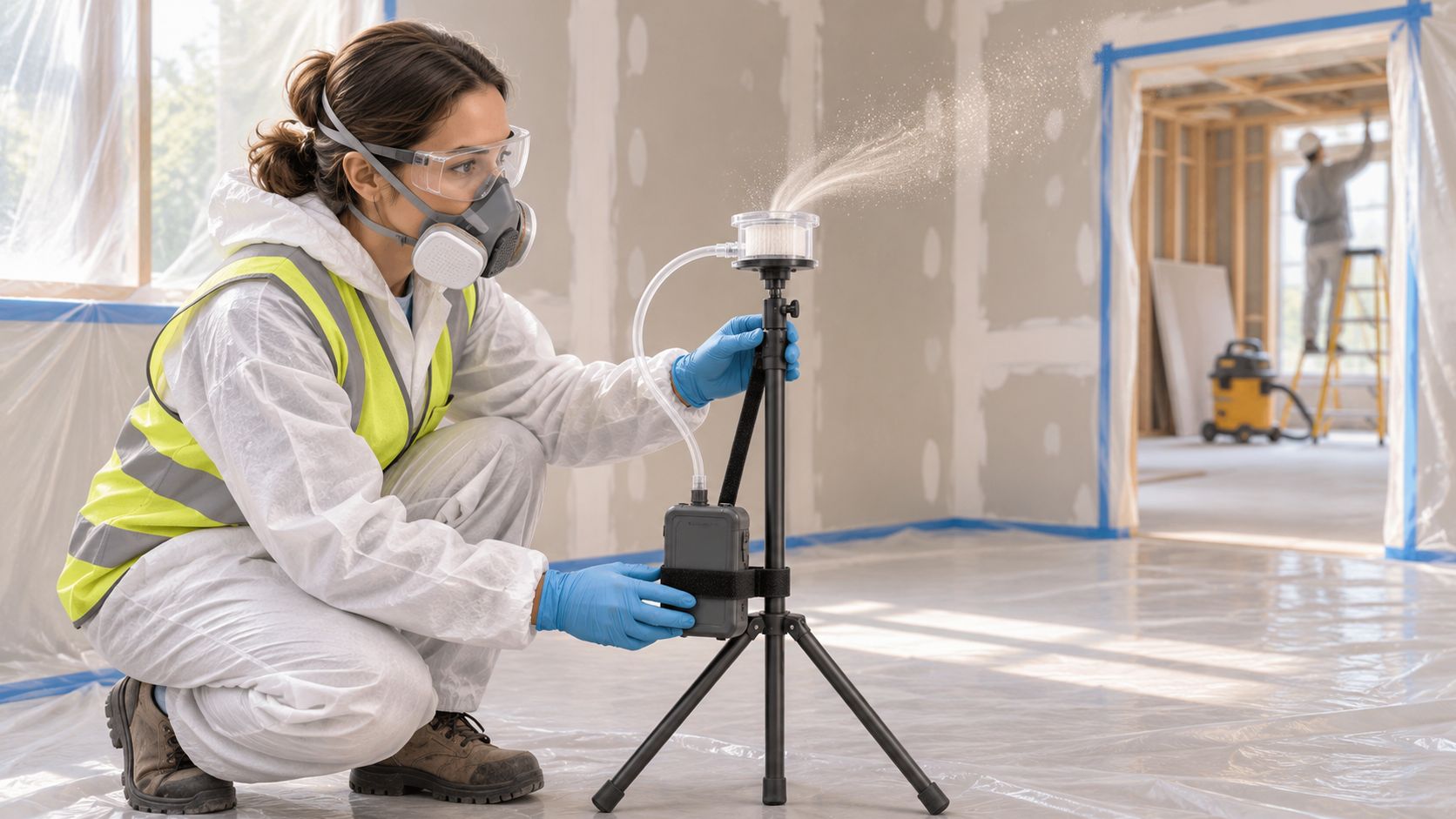
Collection is unglamorous, and it decides whether a result exists at all. A PCM result is a fiber count divided by an air volume, and the volume comes entirely from flow rate multiplied by time. Lose the flow rate and there's no reportable number, however clean the filter looks when it comes out of the cassette.
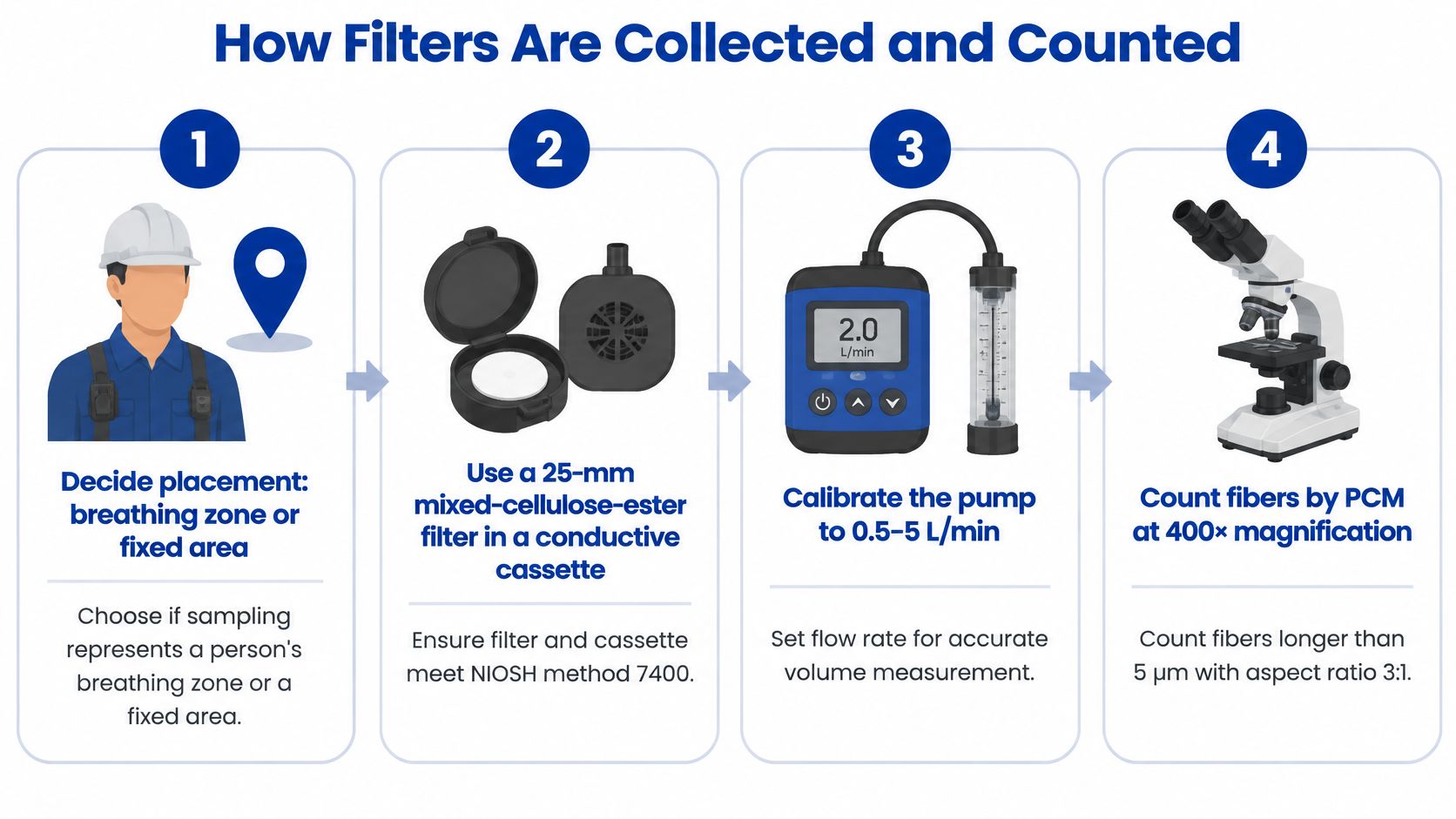
Six steps from pump to report
- Decide what the pump represents. A person's breathing zone, clipped near the collar, or a fixed position standing in for a space or a containment exhaust. These produce different documents with different evidentiary weight.
- Fit the cassette. A 25-mm mixed-cellulose-ester filter in a conductive cassette, with the cowl facing down so settled dust can't drop onto the filter face.
- Set flow and duration together. Typically 0.5 to 2.5 L/min, with the run length chosen so the filter ends up holding roughly 100 to 1,300 fibers per square millimeter.
- Shorten the run rather than overload the filter. Dusty air is the enemy of the count, so cut the time and start a second cassette instead of hoping.
- Record everything at the sampling point. Start time, stop time, calibration readings before and after, location, and who wore the cassette.
- Count and report. Phase-contrast microscopy, with the result expressed in f/cc.
Those parameters, and the comparison benchmarks below, come from OSHA's technical manual chapter on asbestos sampling.
| Check | Reference value | Why it matters |
|---|---|---|
| Filter and cassette | 25-mm mixed-cellulose-ester filter in a conductive cassette | Collects fibers for microscopic counting |
| Flow rate | Typically 0.5 to 2.5 L/min | Sets a known air volume |
| Filter loading | About 100 to 1,300 fibers/mm² | Too little or too much dust makes counting unreliable |
| Microscopy | Phase-contrast microscopy (PCM) | Counts fibers but does not identify asbestos |
| 8-hour limit | 0.1 f/cc time-weighted average | Benchmark for a full-shift construction exposure |
| Short-term limit | 1.0 f/cc over 30 minutes | Benchmark for a brief high-exposure task |
Where samples get lost
Excessive dust loading can obscure fibers and compromise counting, so flow rate and duration should be reduced or split across multiple samples when visible particulate loading is likely. This is the single most common way a sample becomes unusable, and it usually happens on exactly the jobs that most need monitoring: demolition, insulation stripping, dry removal of flooring.
A short, low-activity sample can also substantially understate exposure during disturbance, removal or cleanup. When the work varies across a shift, sequential samples can be combined mathematically to represent the full shift, which is far better than one quiet afternoon standing in for a loud morning.
What the microscope can and cannot tell you
The count is dimensional. Phase-contrast microscopy tallies fiber-shaped objects the way a turnstile tallies people, without checking names.
PCM does not positively identify fiber type, so fibrous interferences such as fiberglass, cellulose and refractory ceramic fibers should be documented and may require more specific analysis. A high count on a drywall-heavy job isn't automatic proof of asbestos, and a low count doesn't prove its absence. That ambiguity is also why indoor air quality testing, which evaluates mold spores, VOCs, allergens and ventilation, is a separate service from asbestos fiber counting rather than a substitute for it.
Surveys Required Before Los Angeles Renovation Air Tests
In the South Coast Air Quality Management District, the first compliance question on a renovation is what the work will disturb. Asbestos testing is required before renovations regardless of building age, and the South Coast Air Quality Management District requires that testing. An air test ordered as the opening step answers a question nobody has scoped yet.
SCAQMD Rule 1403 requires a facility or affected component to be thoroughly surveyed for asbestos before renovation or demolition begins. The survey identifies and quantifies friable asbestos-containing material, along with Class I and Class II non-friable material, and it includes physical sampling wherever materials are suspected of containing asbestos. The survey answers "which of these materials contain asbestos," while an air test can only answer "what fibers were airborne while the pump ran."
What the survey has to reach
The rule calls for more than a walkthrough. Affected materials have to be identified, including all flooring layers down to the joist level and materials inside wall or ceiling cavities when that's necessary for identification and sampling. In practical terms, a crew pulling vinyl and underlayment in a Mid-City fourplex needs the layers underneath documented too, because the mastic and the original tile belong to the same assembly.
Sampling follows fixed arithmetic. A minimum of 3 samples is required per building material, and if 1 of 3 samples is positive, all of that material is considered positive. Three small samples stand in for an entire material, and one positive result decides for the whole. That conservatism is deliberate: treating a single hit as representative costs far less than guessing wrong on a material a crew is about to cut into.
The federal layer underneath
The federal Asbestos NESHAP requires a thorough inspection before demolition or renovation activities covered by the regulation. That inspection addresses the building or the portion where work will occur and includes both Category I and Category II non-friable material, per EPA's asbestos demolition and renovation compliance monitoring guidance. Owners and operators may also have to notify the appropriate state or local air authority, conduct a thorough self-inspection and use work practices that prevent visible emissions. EPA compliance inspections can include reviewing notification documents, walking the job site and collecting physical evidence.
Before the pump comes out: on a Rule 1403 project the survey is the first document, and air sampling is a later, narrower tool aimed at a question the survey already scoped.
Air sampling still earns its place afterward, either as personal monitoring during disturbance or as clearance sampling for a contained cleanup. A clean hallway reading says nothing about the mastic under the tile the crew is about to pull, because the air number is a snapshot of one interval and the survey is a map of the material.
Phased work complicates the file. Some projects decant occupants into modular workforce housing and offices while wings or floors are renovated in sequence, and each phase still needs survey coverage of the materials being disturbed before work starts. The survey, notifications and results belong in one project record, not split across folders.
Owners and contractors in Pasadena, Long Beach, the San Fernando Valley and across Southern California should order pre-renovation or pre-demolition asbestos testing, with Rule 1403 documentation, before treating an air test as the project file. Why asbestos testing is essential before any commercial renovation project in Los Angeles covers how that sequencing plays out on occupied commercial buildings.
Do-It-Yourself Kits Versus Professional Asbestos Sampling
A kit and a professional sampling visit can both produce a laboratory number. The difference lives in the decisions around the number, and those decisions are where a project file is made or broken.
| Factor | DIY kit | Professional sampling |
|---|---|---|
| Sample placement | Chosen by the homeowner from instructions | Chosen by a trained inspector from suspect materials and the planned task |
| Breathing-zone exposure | Usually not addressed | Personal sample in the breathing zone over the relevant task or shift |
| Filter loading check | Not checked | Flow and volume adjusted to avoid dust overload |
| Chain of custody | Often missing | Documented with times, flow rates and locations |
| Fiber identity | Not determined | PCM count with interfering fibers documented |
| Project file | Basic count only | Sample list, sketch, laboratory and NVLAP approval number |
Why placement decides the answer
A homeowner with a kit follows a diagram and samples whatever looks suspicious. An inspector works from a list of suspect materials tied to the planned work: the joint compound under 1970s paneling, the sheet vinyl and its backing, the mastic beneath it, the textured ceiling in the hallway. Materials the crew will touch get sampled first, and materials staying in place get noted rather than guessed at.
Breathing-zone exposure is the second gap. A kit result is an area concentration at best, and it rarely tells you what a person inhaled during a specific task. Filter loading is the third: a trained sampler watches the cassette and cuts the run before particulate buries the fibers and makes the count impossible.
Placement questions surface constantly around finishes. A contractor matching an existing knockdown or orange peel texture after a repair needs to know what the original coat contains before anyone sands it, because sanding is exactly the activity that turns a stable material into an airborne one.
Chain of custody, sample logs, a location sketch and the laboratory's NVLAP approval number are what let a report travel from a homeowner to a contractor to a district reviewer without anyone wondering where it came from. For how far a home test can reasonably go, read can you test for asbestos at home. When the result has to support a survey or a project file, order professional sampling.
Three Projects and the Test to Book Next
Three Southern California projects follow the same order every time: the tempting test, the better test, and the decision the better test supports.
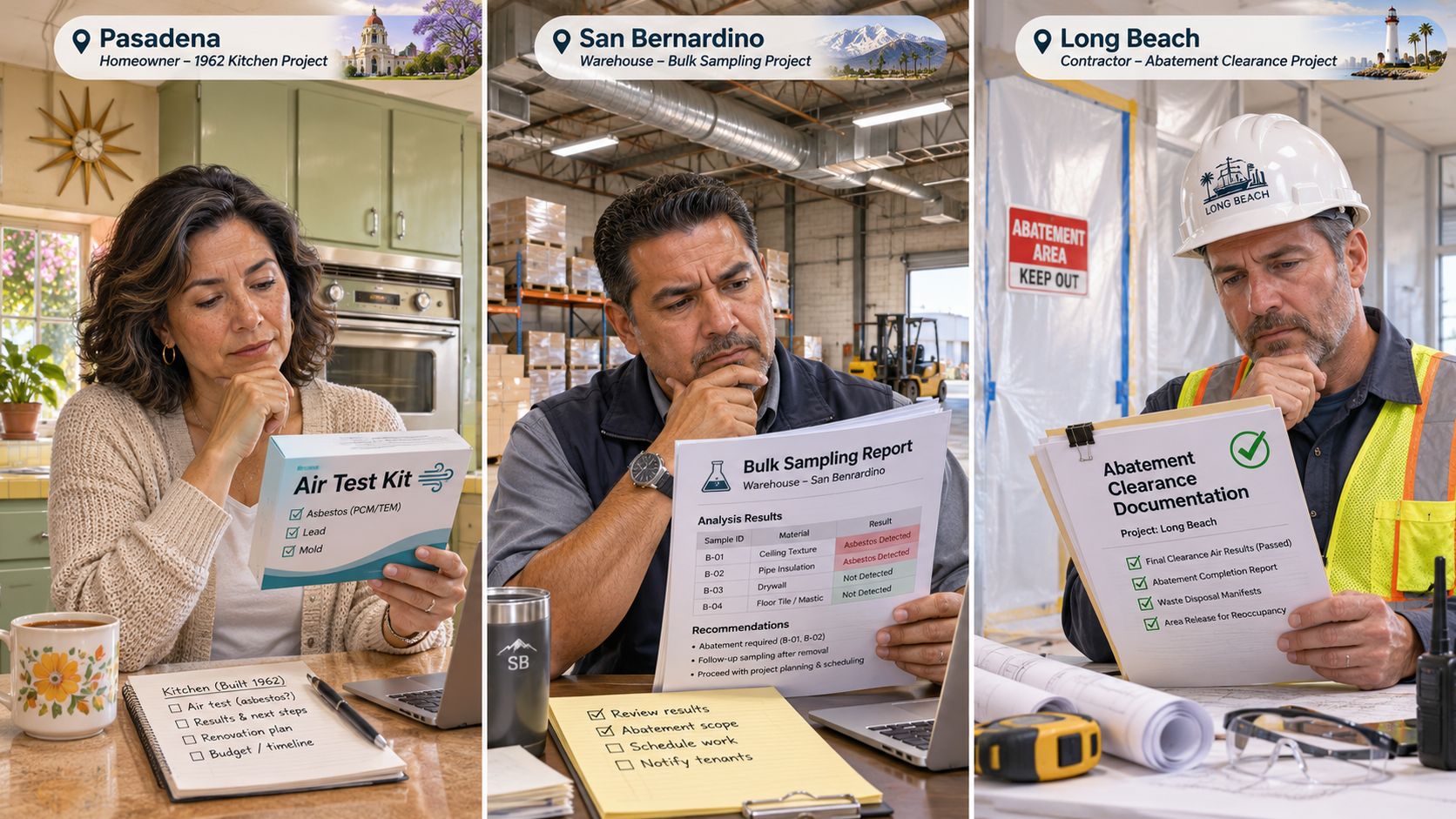
A 1962 kitchen in Pasadena
Tempting: an air test, because the kitchen looks clean and nothing is visibly dusty. Better: a pre-renovation survey scoped to what the remodel will touch, including the flooring layers, the joint compound behind the backsplash and the textured ceiling if the plan takes it down. The decision it supports is which materials need bulk sampling before the first pry bar goes in. Remodel plans move quickly, and a survey done after demolition starts documents a building that no longer exists.
A downtown Los Angeles office demolition
Tempting: an area sample left running in an unoccupied corridor, because it's inexpensive and it produces a page for the file. Better: the survey and bulk results first, since the demolition file turns on them, then personal breathing-zone samples worn by the crew during the dusty phase. The decision it supports is a genuine exposure record for the people doing the work. A corridor pump documents an empty hallway at two in the morning and says nothing about what a laborer inhaled at ten with a saw in hand.
A Santa Monica property manager after a wildfire
Tempting: reading regional air data as an answer about one building. In 2025 the South Coast Air Quality Management District collected 220 asbestos samples during its wildfire response, with asbestos air monitoring conducted every three days using continuous 24-hour sampling, per SCAQMD's 2025 wildfire response. That's a district-wide picture of an event. It doesn't describe the ash banked against a courtyard wall or the soot inside an air handler.
Better: fire residue testing of settled ash, soot, char and smoke residue on surfaces and in HVAC components, with combustion byproduct testing for heavy metals where the fire burned older structures, and air monitoring used as context rather than verdict.
The test to book, by situation
- Before renovation or demolition: an asbestos survey with bulk sampling and Rule 1403 documentation.
- During a defined dusty task: personal air sampling in the breathing zone, sized to the task and the shift.
- Inside containment after abatement work: aggressive clearance sampling evaluated against the project's criterion.
- After smoke or ash: fire residue and combustion byproduct testing of what settled, not only of what's airborne.
If you're not sure which of those you need, that's the conversation to have before work starts. We offer a free, no obligation consultation for environmental testing or for an existing asbestos, lead or mold problem, and the point of it is to match the sample to the decision before anything gets booked.
Sensitive Environmental provides asbestos testing, surveys and air sampling throughout Los Angeles and Southern California, including pre-renovation and pre-demolition surveys, SCAQMD Rule 1403 documentation, Procedure 5 sampling and post-work air monitoring, with laboratory analysis and reporting that contractors, property owners and inspectors can use. If a project is on the calendar and you're not yet certain whether the question is materials, worker exposure or cleanup, start with that question. Visit Sensitive Environmental to schedule a consultation before the work begins.