A clean laboratory page is not a safety certificate. The most common advice, “if the report says not detected, the building is fine,” treats a printout as if it had walked the rooms, timed the work, and opened the walls. It has not. Industrial hygiene labs turn a collected sample into a method-specific identification or a number. They do not prove what was never sampled, and they do not replace the inspection that decided where the sample came from.
Owners, property managers, and contractors in Los Angeles usually need an answer to a narrower question. Does this layer contain asbestos? Is this dust lead? Is this air carrying mold or combustion particles? Is the renovation file complete enough to stand up to a review? A low number can be the right answer to one of those questions and the wrong basis for the next one. The rest of this walk-through pairs each common test with the decision it can support, then with the field facts it still cannot prove.
Table of Contents
- Common Tests Industrial Hygiene Labs Run
- How a Sample Becomes a Defensible Number
- Accreditation Custody and the Right Scope
- When a Low Result Still Leaves Questions
- How to Read the Report Before You Act
- Los Angeles Surveys That Need the Lab File
- Plan the Test Before the Sample Is Taken
Common Tests Industrial Hygiene Labs Run
Start with the decision, not the bottle. A homeowner in Los Angeles County, a general contractor, a property manager, or a facilities manager is usually trying to settle one of four things: whether a material contains asbestos, whether dust contains lead, whether air carries mold or combustion particles, or whether a renovation file is complete. The laboratory is the analytical partner that turns that collected sample into an identification or a number. It is not a removal or cleanup contractor.
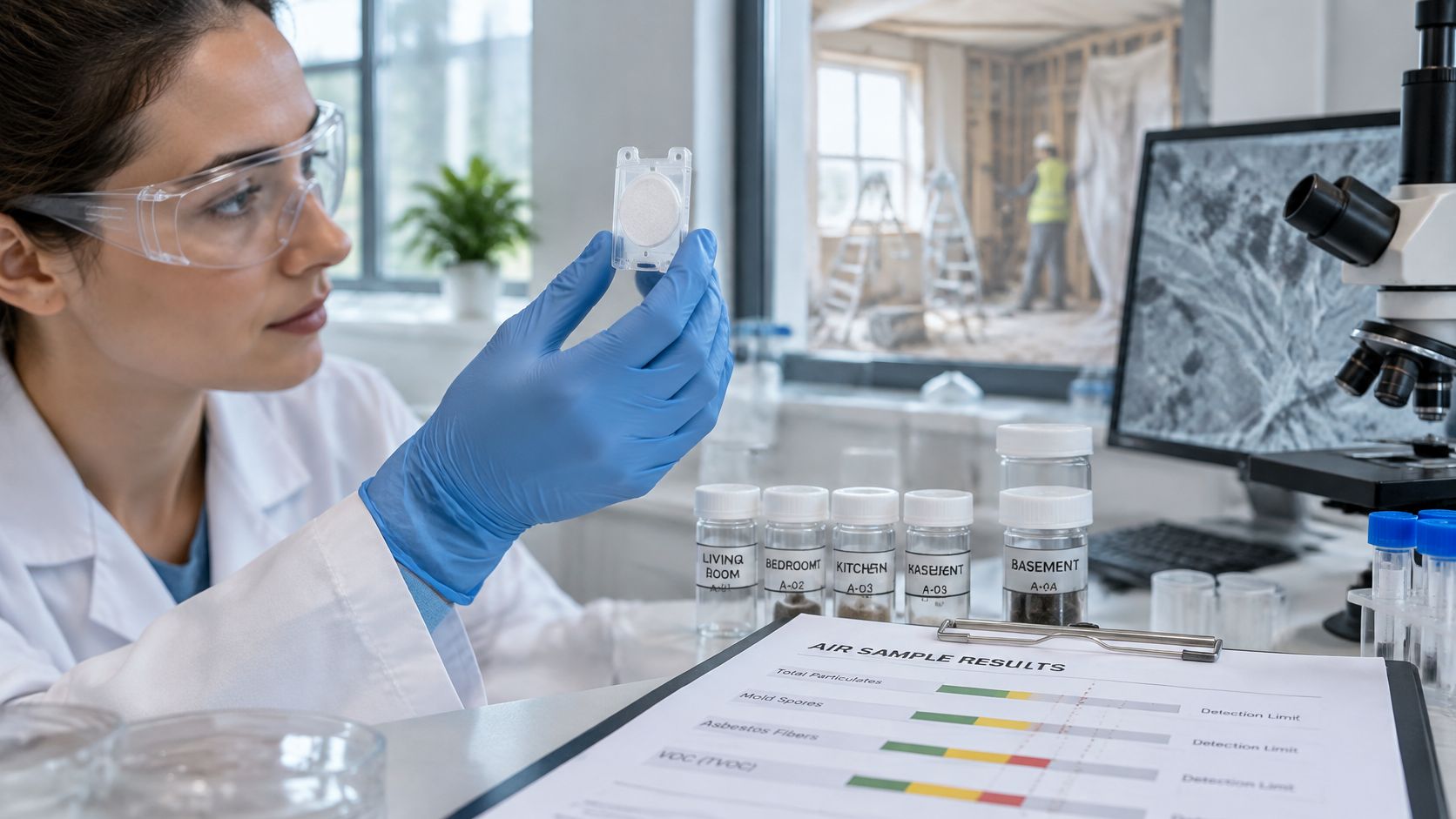
Industrial hygiene testing is the field half of the same job. A walkthrough, targeted sampling, laboratory analysis, and a written report belong together. A kit from a hardware store is screening at best. Those kits rarely record air volume, field blanks, mapped locations, or chain of custody, so a later reviewer cannot tell what the number describes.
| Test | Sample | Method family | Can support | Cannot by itself prove |
|---|---|---|---|---|
| Asbestos in materials | Bulk layer of building material | Polarized light microscopy aligned with 40 CFR 763 | Whether that sampled layer is asbestos-containing | Airborne exposure or layers that were never sampled |
| Airborne asbestos | Air cassette | PCM fiber count or TEM | Fiber level at the sampled time and place | That the rest of the building or a later disturbance is clear |
| Lead in paint | Paint chip | Laboratory chemistry rather than an XRF reading alone | Lead in the coating that was chipped | Lead dust on floors or lead in soil |
| Lead dust | Surface wipe | Metals analysis | Loading on the wiped area | Whether paint elsewhere is lead-based |
| Mold | Air cassette or surface | Spore trap, culture, or direct exam | A snapshot compared with outdoors or a control | That the property is mold-free |
| VOCs and particles | Air sample, sometimes with a meter | Validated sorbent or particle method | Named compounds above the reporting limit | Every odor source or long-term exposure |
| Silica and metals in air | Personal or area sample | Validated NIOSH or OSHA method | Exposure for the sampled task if volume is adequate | Unsampled tasks, shifts, or trades |
| Fire residue | Dust, wipe, or air | Microscopy for ash, soot, and char plus metals | Whether combustion particles are present in the sample | That odors, cavities, or HVAC are clear |
Read across one row before you collect anything. A paint chip that is positive for lead supports a finding about that coating. It does not tell you the floor loading in the next room. An air cassette can support a fiber level at one hour in one place. It cannot clear a later cut, a different floor, or a cavity that was never opened.
A handheld meter is a different tool from a laboratory method. If you want a continuous read of particles or gases while you decide where to sample, you can find an air quality monitor and use it as a locator, not as the compliance record. The defensible file still comes from mapped samples and a laboratory report.
Our environmental testing services are built around that pairing: the decision first, then the sample that can answer it. Pick the row that matches the decision before a cassette, wipe, or bulk bag is labeled.
How a Sample Becomes a Defensible Number
A result is defensible only when the method, the detection capability, and the quality system match the decision. OSHA's sampling and analysis guidance recommends validated OSHA or NIOSH methods whenever possible, and it expects the laboratory to check that the detection limit stays low enough after sample volume and recovery are accounted for.
Five steps from question to number
Write the decision limit first. Name the question in writing. An asbestos survey for South Coast AQMD Rule 1403 is a different target from a comparison with an occupational exposure limit. If nobody writes the target, the laboratory will still produce a number, and that number may sit above the level that would have changed the project.
Select a validated method, then test the limit against volume. Pick an OSHA or NIOSH method when one fits the analyte and the matrix. Then ask whether the detection limit still works after the air volume you can collect and after recovery. Too little air, or poor recovery from a dusty wipe, pushes the limit upward. If that limit sits above the decision, change the method or the volume before the visit. Do not discover the mismatch after the crew has left the site.
Give every sample a unique identity. Each container needs a unique ID, an exact location, the date, the time, and the matrix. “North wall” is not a location if the building has four wings.
Preserve and ship inside any holding time. Temperature, media, and time limits are part of the method. A sample that arrives late or warm is not the same sample you collected.
Log, control, review, then release. The laboratory logs receipt, runs blanks and standards with the method, and has the result reviewed before it leaves the bench. A documented quality system covers methods, personnel competence, equipment, traceable standards, uncertainty, records, corrective action, and reporting.
“Not detected” is incomplete unless the report names the reporting limit or the detection limit. A result below that limit can mean the hazard was absent, or it can mean you did not collect enough mass or enough air to see it. Think of a gauge that only moves once the level passes a high mark. A needle sitting at the bottom does not prove the tank is empty. It proves the level is somewhere below the mark.
Practical rule: For renovation, demolition, or post-fire work, the field team and the laboratory should agree, before anyone samples, that expected concentrations in that matrix will actually be measurable.
If the limit on the quote sits above the decision you need to make, stop. Change the method or increase the volume, then schedule the visit.
Accreditation Custody and the Right Scope
A certificate, a custody record, and a test within scope answer different questions. A lab may hold accreditation, yet the specific analyte or method you need may not be covered.
Accreditation and proficiency
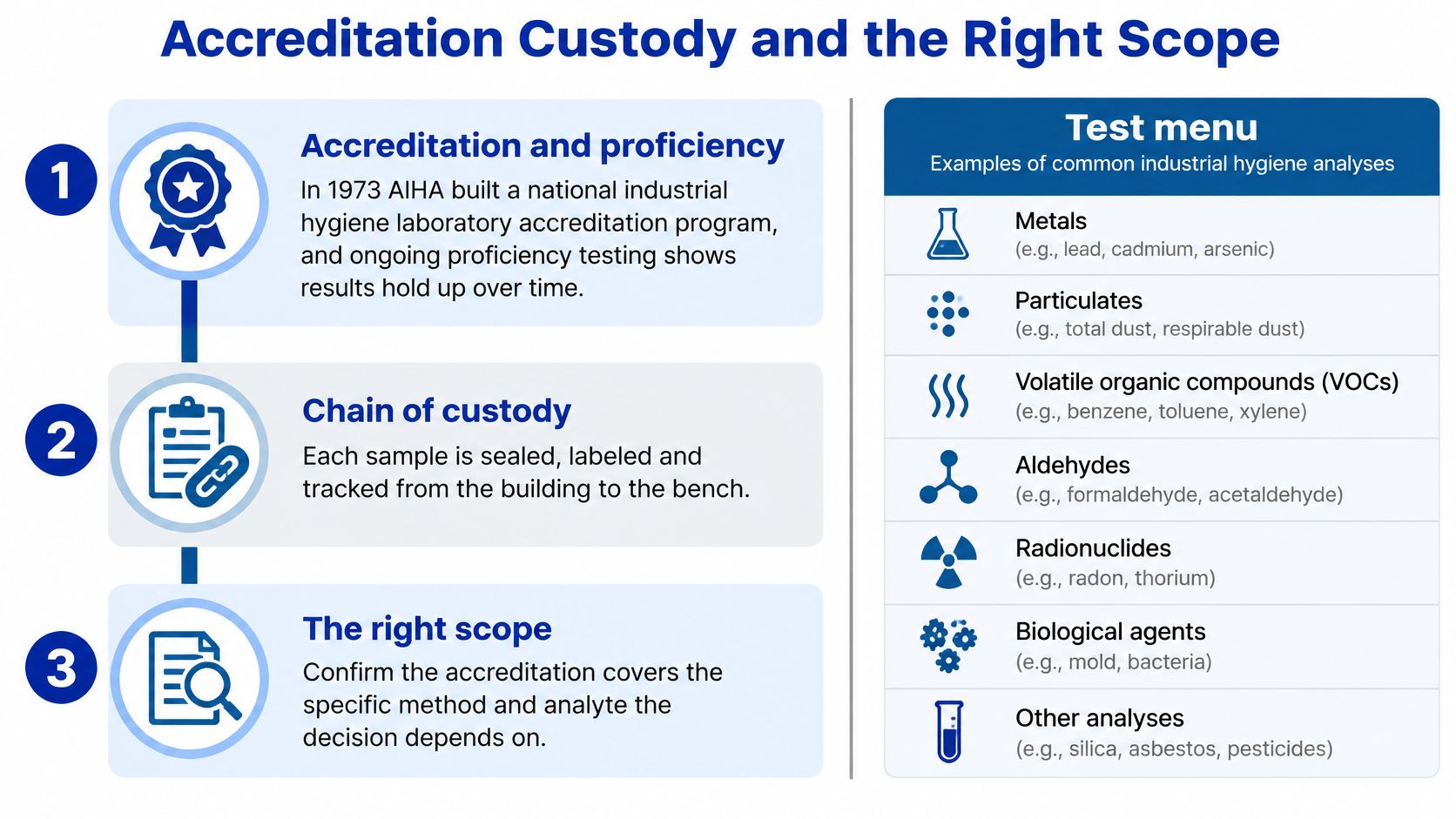
In 1973, the American Industrial Hygiene Association established a national industrial hygiene laboratory accreditation program. The following year, working with NIOSH, OSHA, and CDC, it began accrediting laboratories and running proficiency testing. AIHA's history of the program records about 26 laboratories accredited in its first year.
Accreditation assesses a laboratory's systems and technical capability. Proficiency testing checks how laboratories analyze comparable samples. It gives clients another way to assess laboratory performance, especially when small differences in results could affect a compliance decision or project plan.
Chain of custody
Custody documents the sample's path from collection to reporting. AIHA's industrial hygiene accreditation materials describe technical assessment, management-system review, and required proficiency testing. They also list approved external testing categories, including asbestos, silica, metals, organics, beryllium, and diffusive samplers.
For schools, hospitals, insurance files, and commercial buildings, check that the record identifies:
- The sample: a unique ID, precise location, collection date and time, and sampler's name.
- The requested analysis: the method, sample material, and any preservation requirements.
- Handling and condition: custody transfers, relevant temperature or holding-time checks, and written explanations of deviations.
- Applicable formal custody steps: where required, records of collection, shipment, laboratory receipt, analyst transfer, review, and release, along with tamper-evident seals.
The right scope
A general accreditation statement does not establish that every method or analyte is covered. Ask whether the laboratory's approved scope includes the specific material and analysis you need. An instrument cannot correct a mislabeled sample or a contaminated blank.
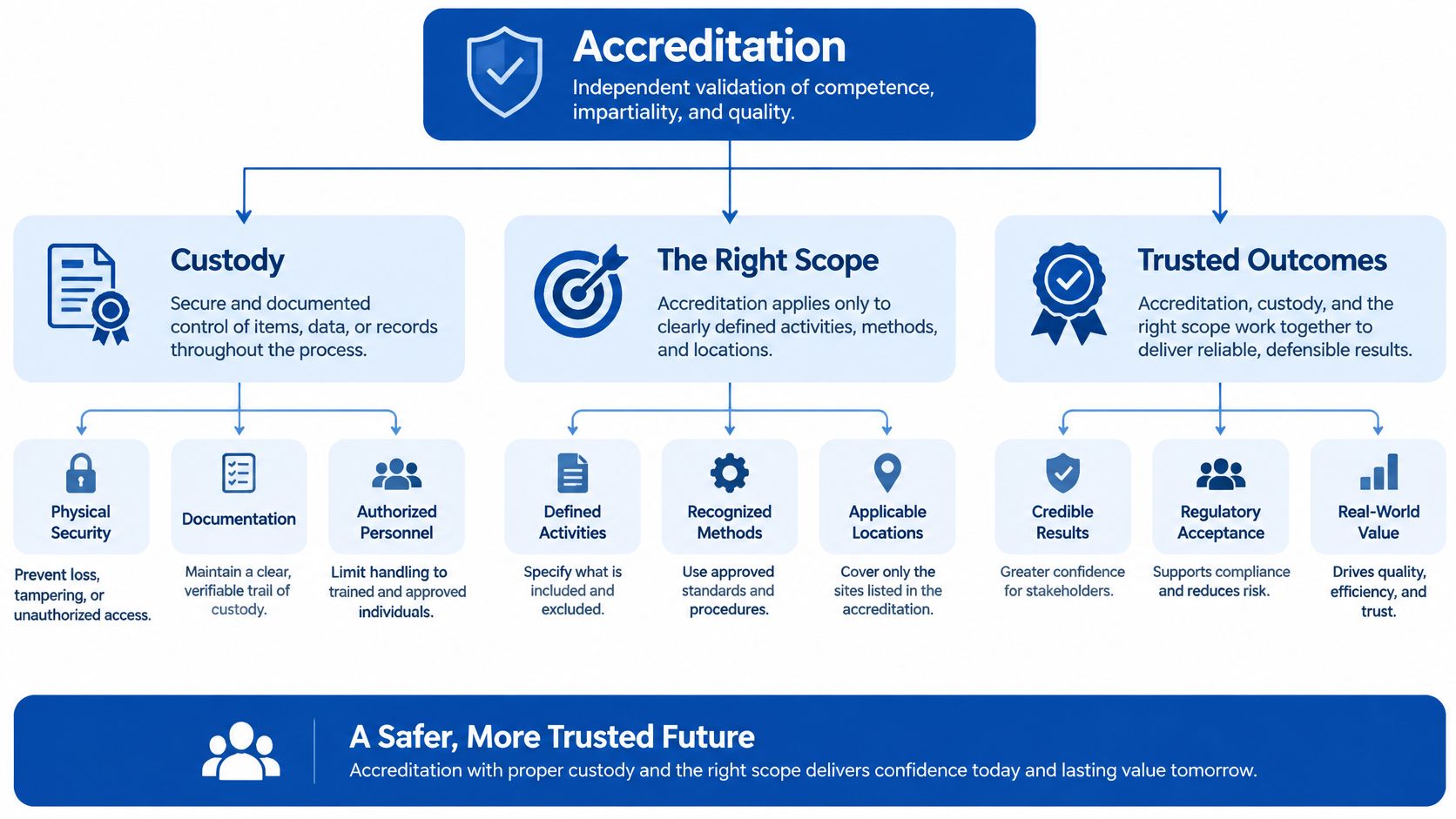
For Los Angeles County project files, keep these checks distinct: accreditation, the relevant analyte and method, and the sample's custody record. Together, they help establish how much weight a laboratory result can support.
When a Low Result Still Leaves Questions
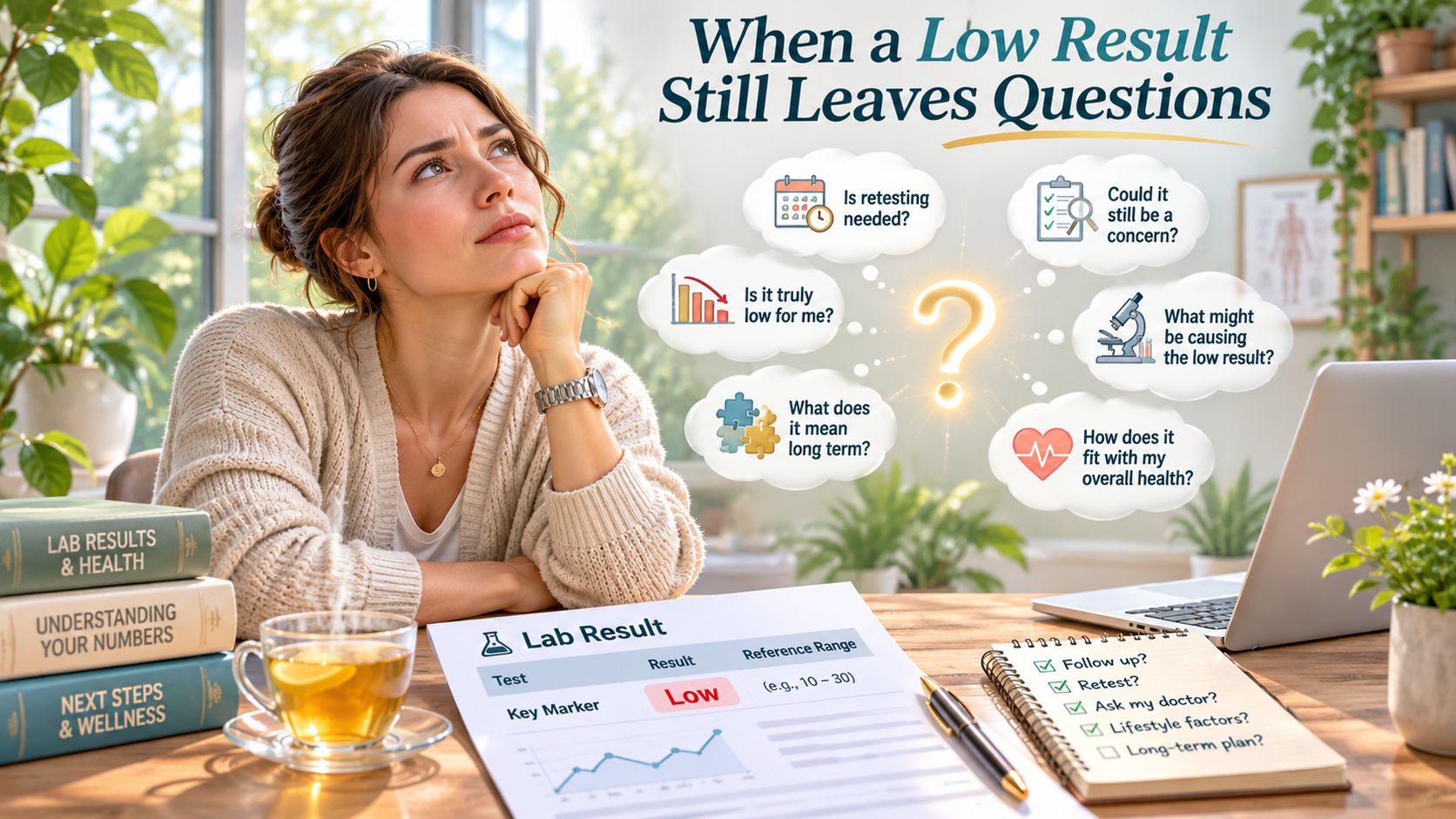
A low laboratory result can be accurate and still leave the exposure question unanswered. The sample may have missed the relevant task, time, surface layer, or enclosed space. A number describes what was collected under specific conditions, not everything happening throughout a building.
Interpretation depends on where and when sampling occurred, how the task varies, ventilation and occupancy, and whether the sampled material represents what will be disturbed. A result also needs to be compared with a decision threshold that fits the question.
Six checks before you treat a low number as an answer
Match the sample to the activity. Check whether air sampling covered the occupancy and work that matter. A short, intermittent task, such as a saw running during part of the day, may not occur while a stationary sample is collecting.
Separate material composition from breathing-zone exposure. A bulk sample can identify what a material contains. It cannot establish what someone inhaled while the material remained undisturbed or was being cut.
Compare the reporting limit with the decision point. “Not detected” means the amount was below the method's reporting limit, not necessarily absent. If that limit is higher than the level that would change the project decision, the result cannot resolve the question.
Keep post-work conclusions within the sampled area and time. Check whether rooms, cavities, and HVAC were included. A conclusion about unsampled spaces goes beyond what the sample map supports.
Reconsider the test when odor remains but the VOC result is low. The target list may not include the odor-causing compound. A broader analysis or inspection of potential sources may be needed.
Treat visible ash and low metals results as separate observations. A metals result does not identify ash, soot, or char. Those findings require methods suited to the material being investigated.
A single air sample documents one interval. A bulk sample documents composition. Neither establishes a building-wide exposure history.
Place occupancy, ventilation, the activity, and any outdoor mold comparison alongside the result before sharing conclusions. State which locations and times were sampled, and whether more sampling, including personal sampling, may be appropriate. Home mold kits can leave similar gaps: without sample volume, an outdoor comparison, and a location map, a low spore count has little context. Learn more about whether home mold test kits are reliable.
How to Read the Report Before You Act
You do not need to be an industrial hygienist to refuse a weak file. Read six lines, in this order, and stop when a line fails.
| Report line | Question to ask | Red flag |
|---|---|---|
| Decision stated | What exact question was this sample meant to answer | A stack of numbers with no decision named |
| Method and analyte | Does the method match that question | A generic scan with no method identification |
| Reporting limit | Is the limit below the level that would change the decision | Not detected printed with no limit |
| Sample map | Are locations, layers, times, and volumes listed | One result offered for a whole building |
| Qualifications and custody | Are sampler, lab scope, and transfers documented | No custody record and no analyte-specific scope |
| Recommendations | Do findings stay separate from next steps | Language that certifies the property safe or orders removal automatically |
Why the order matters
Start with the decision because a correct method for the wrong question still wastes the sample. A silica method will not tell you whether floor tile is asbestos-containing. Next, match method and analyte. Then look at the reporting limit before you look at how small the number feels. A tiny number above a tiny limit is usable. A blank cell labeled not detected, with no limit beside it, is not.
The sample map is where whole-building claims usually break. Locations, layers, times, and volumes should be listed. One cassette in a lobby cannot stand for a warehouse, a roof, and a mechanical room. Qualifications and custody come next: who sampled, whether the laboratory's scope includes that analyte, and whether transfers are written down.
Recommendations are the line people skip into first, and they are the line that most often overreaches.
The report describes the tested samples, not every room for all time.
A positive result does not automatically require remediation or abatement. It gives the owner, the contractor, the insurer, or another qualified professional evidence for a next step. That step might be more sampling, a revised survey, work controls, or a separate decision about removal made by the people licensed to make it. A stack of non-detects does not guarantee that a property is safe.
A DIY kit with no air volume, no blank, and no mapped location fails the middle four lines before you ever reach a recommendation. Send the report back if units are missing, if not detected appears without a limit, or if one result is being asked to stand for a whole building.
The property owner uses the file for a transaction or a repair plan. The contractor uses it before disturbance. The facilities manager uses it when an occupant asks what was tested.
Los Angeles Surveys That Need the Lab File
Say a contractor is about to open walls in a commercial building in Los Angeles after a small fire scorched one office. Someone wants to start demo on Monday. The laboratory page, by itself, is not the survey the South Coast district expects.
South Coast AQMD Rule 1403 requires the affected facility or components to be thoroughly surveyed before demolition or renovation. The survey includes inspection, identification, quantification, and physical sampling of friable asbestos-containing material and Class I and Class II nonfriable material. Scope reaches every flooring layer down to the joist, and materials inside wall or ceiling cavities when identification and sampling require it. A visual walk that stops at the finish floor can miss a second layer, or a pipe wrap behind gypsum.
What a Procedure 5 file actually contains
If suspected asbestos-containing material is damaged, of any amount, AQMD's Rule 1403 questions and answers say activities stop and the site is secured and stabilized. A Certified Asbestos Consultant assesses the damage and surveys for asbestos-containing and asbestos-contaminated materials. Notification and an approved Procedure 5 plan are required before asbestos cleanup. Surveys are expected for abatement projects regardless of size, with a narrow exception for a single-unit dwelling where less than 100 square feet of asbestos-containing surface material will be removed or stripped. That exception is a regulatory boundary. It is not advice to skip testing on a house that is about to be opened up.
A Procedure 5 plan needs more than a work description. Attachments include a site survey with sampling and analysis of suspect materials, a cleanup plan that explains the cause of the disturbance and the extent of contamination, and the sample chain of custody with the laboratory report. Survey documentation has to line up with Rule 1403, 40 CFR 763 Subpart E, and California Business and Professions Code section 7180.
South Coast AQMD's survey instructions require the report to identify the scope, the requesting party, the facility or site, the inspection date and time, inspector and sampler qualifications, inspection and assessment results, and the Certified Asbestos Consultant's findings and response-action recommendations. The consultant must confirm in writing that the sampling method, laboratory qualifications, analytical procedures, and analytical method complied with Rule 1403 and 40 CFR Part 763.
Cleanup and abatement, when they are warranted, are performed by others after that testing file is clear. The same habit of a documented laboratory result applies when the question shifts to lead paint chips, mold after water damage, indoor air quality, or post-fire ash, soot, char, and heavy metals. For commercial work, the reason to test before walls come down is laid out in our note on asbestos testing before a commercial renovation in Los Angeles. A positive-or-negative line, without locations, qualifications, and a named method, will not carry a renovation, a demolition, an insurance review, or a compliance file.
Plan the Test Before the Sample Is Taken
A useful test starts with a decision: identify what needs to be known, then choose samples that can support that decision. Property owners, managers, contractors, insurers, and design professionals in Los Angeles and Southern California can contact Sensitive Environmental for industrial hygiene testing and inspection. Testing can identify environmental concerns and document conditions; it does not, by itself, certify a building as safe.
Plan the inspection around the property and the question at hand. Sensitive Environmental's process includes a walkthrough, hazard identification, targeted sampling, laboratory analysis, and a report with findings and next steps. For renovation or demolition, asbestos testing before a commercial renovation in Los Angeles can help project teams identify asbestos-containing materials and meet applicable testing and documentation requirements. The report should make clear what was sampled, where, and which methods were used.
Sensitive Environmental offers testing and documentation as well as asbestos abatement, lead paint removal, mold remediation, and fire, smoke, and odor restoration services. A test result can inform what to do next, but the appropriate response depends on the finding and the project. For guidance on an existing asbestos, lead, or mold concern, the company offers a free, no-obligation consultation. Call 310-387-5404 or request an appointment online to schedule an inspection.
Sensitive Environmental serves residential and commercial properties throughout Los Angeles and Southern California. Start with the decision the test needs to support, not a general request to “test everything.” A laboratory result is useful evidence about the samples analyzed, not a safety certificate for every part of a building.