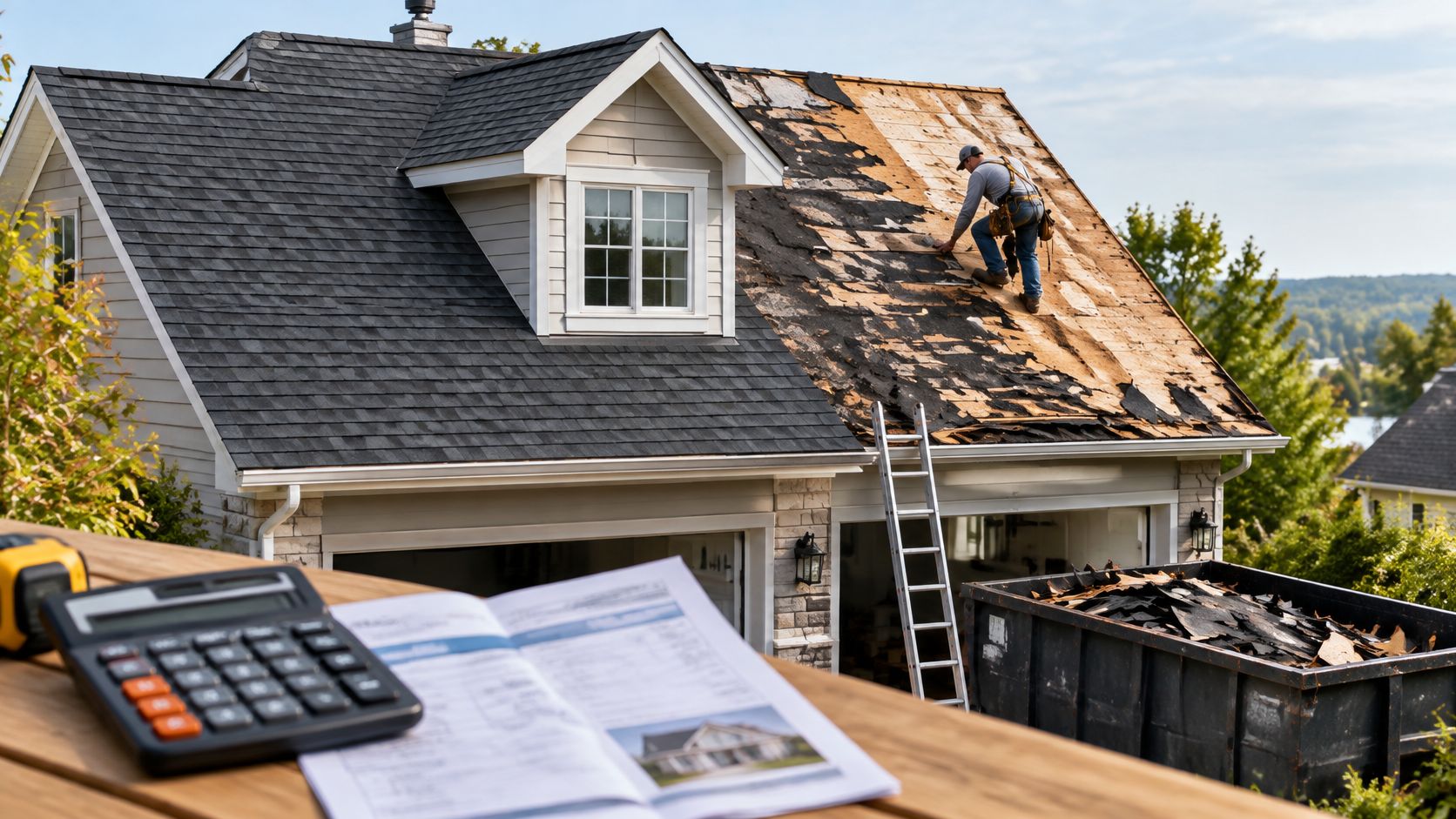
In 2026, roof tear-off runs about $1 to $5 per square foot, or $100 to $300 per roofing square, with testing, disposal and permit charges added on top of the base where they aren't already included. Those benchmarks describe different scopes, so they aren't interchangeable quotes.
For Los Angeles property owners, the important distinction is between ordinary tear-off and work involving regulated materials. A contractor can price visible shingles without knowing what's in the felt, mastic or concealed layers beneath them. Environmental inspection and sampling help establish that scope before a removal budget becomes a construction commitment.
Table of Contents
- Typical Roofing Removal Costs by Roof Size and Material
- When Asbestos Testing Is Required Before Roof Work
- How Layers, Slope and Roof Condition Change the Estimate
- Disposal and Permit Charges to Include in Your Budget
- Why the Cheapest Roofing Removal Quote Can Cost More
- Confirm Testing Before You Lock In a Removal Budget
Typical Roofing Removal Costs by Roof Size and Material
Published removal benchmarks range from $1 to $5 per square foot, depending on roofing material and scope. HomeBuddy's 2026 guide puts asphalt-shingle removal at $1 to $3 and tile removal at $2 to $5 per square foot. These figures describe ordinary tear-off; testing and regulated asbestos handling need separate budget lines.
2026 roofing removal cost benchmarks
| Estimate basis | Typical range | Source |
|---|---|---|
| Asphalt-shingle tear-off, per square foot | $1 to $3 | HomeBuddy 2026, linked above |
| Tile tear-off, per square foot | $2 to $5 | HomeBuddy 2026, linked above |
| Tear-off, per roofing square | $100 to $300 | National Roofing Directory 2026 |
| Single-layer asphalt tear-off and disposal, per roofing square | $100 to $200 | National Roofing Directory replacement guide 2026 |
| Single-layer removal, per roofing square | $100 to $150 | UseCalcPro 2026 |
| 15 to 30 square roof, modeled total | About $3,000 | National Roofing Directory tear-off guide, linked above |
| 2,000 sq ft tear-off only | $1,500 to $3,000 | The Roofing Brief 2026 |
| 2,000 sq ft single-layer architectural asphalt, labor and disposal | $3,000 to $4,500 | Roofing Calculator HQ 2026 |
The estimates reflect different scopes. The Roofing Brief gives a tear-off-only range, while Roofing Calculator HQ includes labor and disposal for a specified asphalt roof. The per-square figures also differ in whether disposal is included. None of these benchmarks prices asbestos testing or regulated handling.
Convert the roof into a comparable scope
Use the roof's measured surface area, not the building's interior floor area. A roofing square equals 100 square feet, according to The Roofing Brief's tear-off pricing guide. Divide the roof area by 100 to get the number of squares, then compare rates that match the material, layers and included services.
Keep replacement costs separate from removal. Verisk's State of America's Roofs report reports average residential roof replacement costs of $17,631 in 2025 and average repair costs of $4,699. Those are broader claims costs, not isolated tear-off prices.
Before comparing quotes, check what each rate includes:
- Labor: Which materials and layers are crews removing?
- Container and hauling: Is mobilization included?
- Disposal: Does the price cover ordinary debris only?
- Testing: Is a survey included, excluded or pending?
A removal allowance is not a complete environmental scope. If testing is excluded, keep it as a separate, unresolved budget line rather than treating it as a zero-cost item.
When Asbestos Testing Is Required Before Roof Work
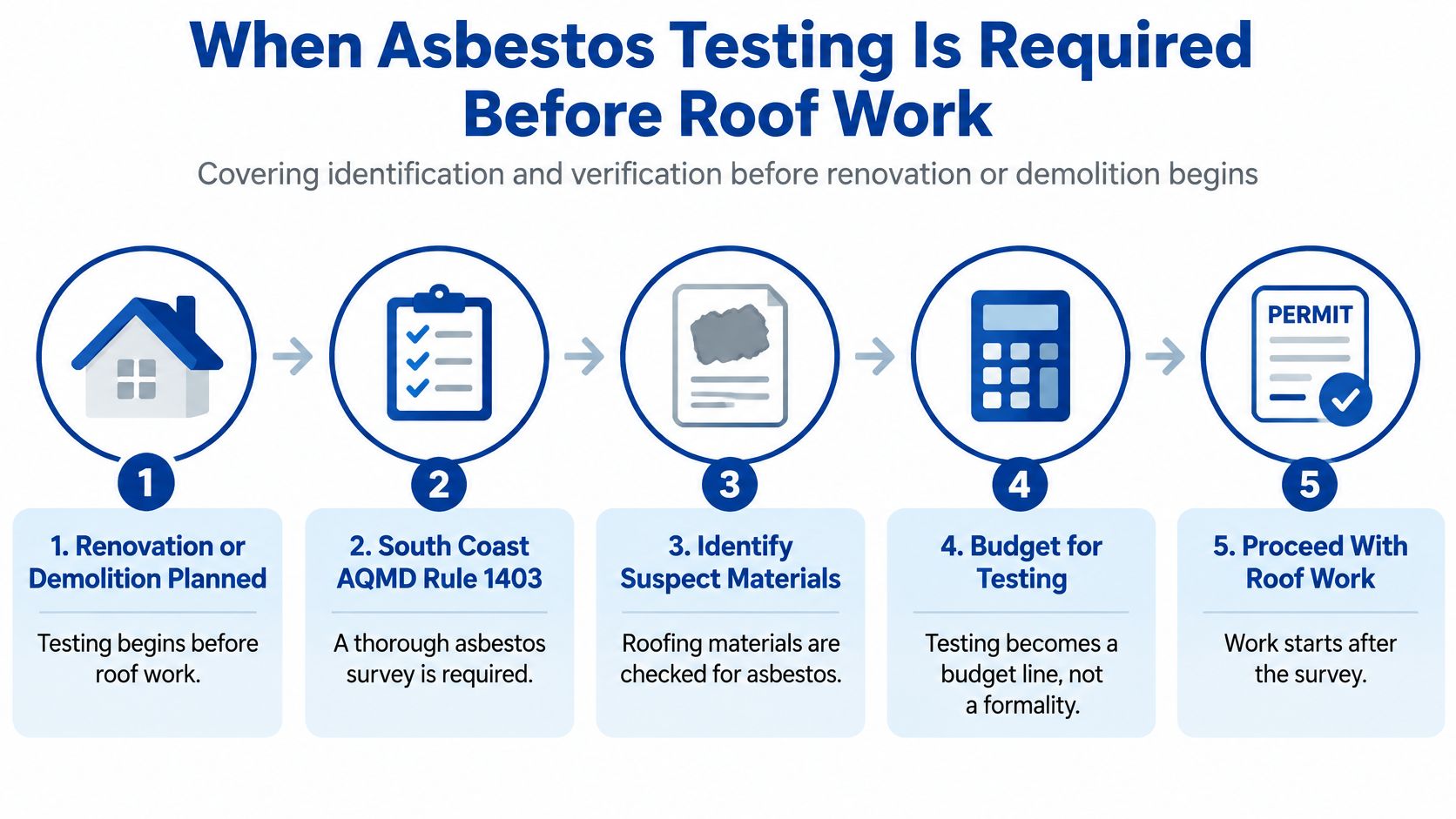
For Los Angeles-area projects, building age alone doesn't eliminate the pre-renovation asbestos-testing requirement. South Coast AQMD requires testing before renovation regardless of building age, subject to its narrow exceptions.
South Coast AQMD Rule 1403 requires a thorough survey of the affected facility or component before renovation or demolition. The survey identifies and quantifies friable and specified non-friable asbestos-containing materials, with physical sampling where appropriate.
When asbestos testing is required for roof work
| Project case | Requirement | Testing step |
|---|---|---|
| Single-unit residential, under 100 sq ft of intact material removed | Narrow survey exception may apply | Confirm the exception with a consultant before work |
| Single-unit residential, larger scope or damaged material | Pre-renovation asbestos survey required | Certified consultant sampling and laboratory analysis |
| Demolition, any size | Survey required, no exception | Pre-demolition asbestos survey |
| Suspect material found damaged mid-project | Work stops, area secured and stabilized | Consultant condition assessment and sampling |
| Disturbed asbestos-containing material needing cleanup | Procedure 5 cleanup plan approved before cleanup | Site survey, laboratory reports and chain-of-custody records |
| Roofing project under 160 sq ft, federal NESHAP threshold | Federal rules distinguish this scope; demolition notification remains required where applicable | Confirm federal applicability with the consultant |
The AQMD Rule 1403 frequently asked questions describe the exception for a single-unit residential renovation removing less than 100 square feet of intact, undamaged material, no demolition exception, and stop-work procedures for damaged suspect material. The EPA roofing guidance distinguishes roofing projects below 160 square feet under federal NESHAP provisions, but that federal distinction doesn't replace local requirements.
For disturbed asbestos-containing material, AQMD's Procedure 5 guidance requires an approved cleanup plan before cleanup begins, supported by survey findings, laboratory reports and chain-of-custody records.
What professional testing involves
Our asbestos testing includes material identification, certified sampling, laboratory analysis, pre-renovation and pre-demolition inspections, and regulatory compliance testing. For home buyers planning renovations, Sensitive Environmental recommends having a Certified Asbestos Consultant test all materials the work will affect.
- Document the assembly and work boundary. Record accessible layers, penetrations, coatings and areas scheduled for disturbance.
- Collect representative samples using controlled methods. The consultant selects materials and locations rather than relying on a single loose fragment.
- Submit samples to an accredited laboratory. Chain-of-custody documentation connects each sample to its collection location and analysis.
- Review the written report. Findings should identify material locations, types, quantities and condition, alongside laboratory results and survey limitations.
Our guide to testing for asbestos at home explains why DIY sampling isn't equivalent to a professional compliance survey. A positive result doesn't automatically require abatement. It gives the owner and qualified professionals information to evaluate the planned disturbance and appropriate next steps.
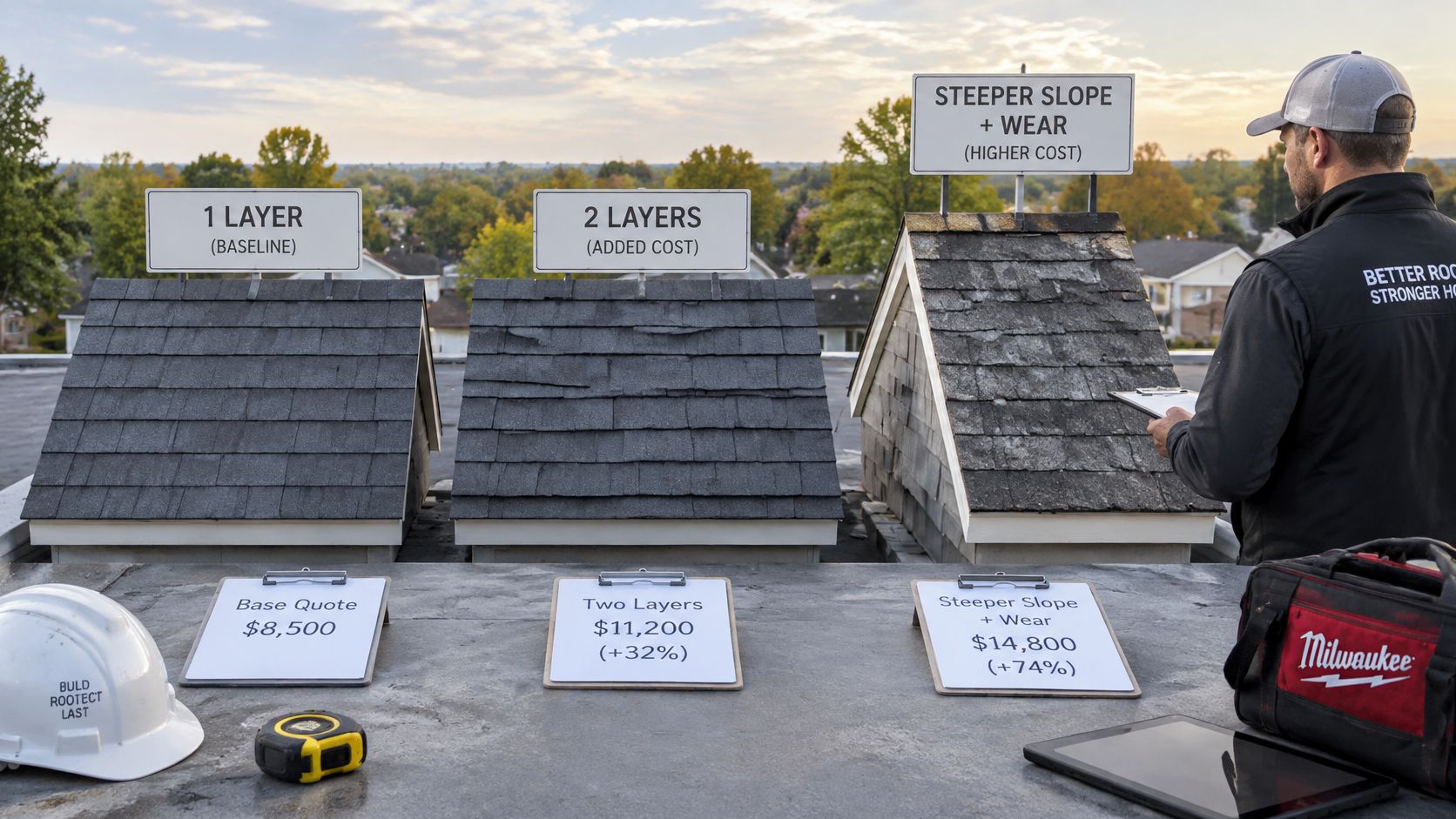
How Layers, Slope and Roof Condition Change the Estimate
The surface covering doesn't define the full testing scope. An environmental consultant needs to understand which layers the contractor intends to disturb, including underlayment, coatings and materials around roof penetrations.
UseCalcPro's 2026 calculator estimates single-layer removal at $100 to $150 per roofing square, with a second layer adding approximately $50 to $100 per square. Those are ordinary-removal allowances, not prices for asbestos characterization or regulated handling.
A worked example without invented environmental fees
Consider a hypothetical 2,000-square-foot roof with two existing asphalt layers, using the single-layer and additional-layer rates published by UseCalcPro:
| Budget component | Hypothetical calculation | Result |
|---|---|---|
| Base removal | 20 roofing squares × $100 to $150 | $2,000 to $3,000 |
| Additional existing layer | 20 roofing squares × $50 to $100 | $1,000 to $2,000 additional |
| Ordinary two-layer removal allowance | Base plus additional layer | $3,000 to $5,000 |
| Planned upgrade to new tile | Separate replacement-design and installation scope | Obtain a separate proposal |
| Suspected-material testing | Survey scope, sample selection and laboratory work | Obtain a written testing quote |
| Regulated handling, if applicable | Findings and approved work methods | Price after characterization |
The calculated amounts illustrate the published layer rates; they aren't a project quotation. A planned tile upgrade doesn't turn existing asphalt tear-off into tile removal. If tile is already on the roof, the bidder must instead price the existing heavier, brittle material and its handling requirements.
Slope and restricted access also need explicit assumptions. A steep roof, rooftop equipment or a difficult sampling location can change how the consultant accesses materials and how the contractor organizes work. Neither a surface-area calculation nor a photograph establishes the composition of concealed layers.
Condition changes the investigation
Deteriorated flashing, exposed felt and damaged decking warrant different questions. Flashing and felt may introduce additional suspect materials within the work boundary; decking damage may require a separate construction assessment. Don't treat an environmental survey as a structural certification.
Split the estimate into ordinary tear-off, suspected-material testing and regulated handling. That separation lets owners see whether a price change comes from more construction work or an environmental finding.
Ask every bidder: Which layers are included, and what happens if the deck is damaged? Ask the consultant whether opening that area would extend the survey boundary before anyone disturbs an unassessed material.
Disposal and Permit Charges to Include in Your Budget
Disposal planning starts with identifying the material, not ordering a dumpster. Ordinary shingles and regulated asbestos-containing waste don't share an interchangeable disposal scope, and a facility's acceptance conditions should be confirmed before hauling.
CalRecycle's construction-and-demolition guidance estimates that California landfills approximately 1.2 million tons of asphalt roofing shingles annually. California disposal examples include a $68-per-ton minimum for qualifying roofing-shingle loads, but that benchmark isn't a hazardous-waste price or a Los Angeles-wide rate.
Disposal and permit charges by Southern California example
| Charge | How it is assessed | Example amount |
|---|---|---|
| Roofing-shingle landfill minimum, California facility | Per ton, qualifying loads | $68 per ton minimum, California disposal benchmark above |
| Roof tear-off benchmark, San Diego waste fee schedule | Within the city's waste-management fee schedule | $200 |
| Construction and demolition performance security deposit, San Clemente | Per covered re-roofing project with tear-off | $250 |
| Waste-management plan processing fee, San Clemente | Per covered re-roofing project with tear-off | $60 |
The Southern California municipal examples accompanying San Diego's waste-management guidance include San Diego's $200 roof tear-off benchmark, plus San Clemente's $250 performance security deposit and $60 processing fee for covered projects. These examples aren't universal tipping fees or building-permit prices.
Separate fees from money held as security
A performance security deposit shouldn't automatically be treated as a permanently spent fee. Confirm its release conditions, documentation requirements and refundability with the administering city. Likewise, ask whether a quoted permit allowance includes waste-plan administration or only the building permit.
Request these separate budget lines:
- Removal labor: Existing material, roof squares and layer count.
- Mobilization: Dumpster delivery, truck access and hauling.
- Weight-based disposal: Accepted waste category and load documentation.
- Municipal administration: Deposits, plan fees and permit allowances.
- Construction inspection and closeout: Deck inspection and final magnetic nail sweep.
- Environmental work: Sampling, reporting and any separately contracted regulated handling.
A container suitable for asphalt shingles may not suit tile or mixed debris. Confirm capacity and weight limits with the hauler rather than selecting by volume alone.
For suspect materials, our explanation of asbestos disposal requirements provides context for the questions testing must resolve. Check the project city's requirements before scheduling, since Los Angeles County and neighboring Southern California jurisdictions don't administer every waste requirement identically.
Why the Cheapest Roofing Removal Quote Can Cost More
A low roofing removal quote can leave costly work outside the price. The key is to compare what each bidder includes, especially when asbestos testing or regulated handling may apply.

Compare responsibility, not just allowances
Ask each bidder to state in writing:
- Testing: Is a professional survey included, or must the owner arrange it separately?
- Notifications: Who determines which requirements apply and submits any required agency documents?
- Waste handling: How will regulated waste be packaged, transported and accepted at the disposal site?
- Records: Who provides laboratory reports, survey documentation and disposal records?
If these responsibilities are left unclear, they can lead to a change order, a rejected load or a work stoppage when suspect material is discovered. Testing helps establish known conditions for pricing, though it cannot resolve every uncertainty before work begins.
Not every roofing material contains asbestos. Requirements can vary, so confirm federal, state and local applicability with a Certified Asbestos Consultant. For asbestos abatement, the cheapest bidder is usually not the way to go. First establish whether abatement is needed, then compare qualified bids against the same scope.
If a Certified Asbestos Consultant finds asbestos-containing material damaged or significantly damaged, it may be classed as a Procedure 5, requiring a consultant-written cleanup plan. That changes the scope from routine removal of an intact assembly. This guide to safe asbestos removal explains the process and considerations for planning asbestos-related work.
Confirm Testing Before You Lock In a Removal Budget
Set the environmental scope before accepting a removal proposal. A written survey quote gives the owner something more useful than an arbitrary testing allowance: a defined inspection boundary, sampling approach and reporting deliverable.
Establish a budget that matches the property
Document what will be disturbed. Have the roof measured and the existing layers identified. Include underlayment, flashing, coatings and planned openings, not just the exposed covering. Provide photographs without climbing onto the roof or disturbing suspect material yourself.
Confirm the applicable compliance path. Determine whether the work requires a pre-renovation survey, pre-demolition inspection, agency notification or assessment of disturbed material. Bring any Notice to Comply or inspection correspondence so the consultant can address the actual agency concern.
Request a testing-inclusive project scope. Keep inspection, sampling and laboratory fees separate from contractor labor. Ask for clearly described exclusions and a contingency for conditions that can't be established before access is available.
Testing fees depend on the sampling scope, access and requested turnaround, so obtain a written quote rather than applying a generic removal rate to environmental services. When comparing commercial terms, you can understand pricing commitments with GetBill, then check the actual proposal's assumptions, exclusions and change-order provisions.
Bring the information the consultant needs
Sensitive Environmental provides asbestos testing, surveys and pre-demolition inspections across Los Angeles and Southern California, with certified sampling, accredited laboratory analysis and clear written reporting. Bring the roof's known age, layer information, photographs, planned work date and any permit or inspection notice.
Customers can request a free consultation, selecting asbestos, lead, mold, fire damage, water damage or other as the problem type. For a roofing project, identify the planned disturbance and any damaged suspect materials first. Test results guide the next decision with a qualified professional; they don't, by themselves, determine the outcome.
Sensitive Environmental offers professional asbestos inspections, surveys, sampling and laboratory analysis to help define the environmental portion of roofing removal costs. Visit Sensitive Environmental to request a roof-related asbestos testing consultation in Los Angeles or Southern California before you lock in the removal budget.