You're standing in a living room in Los Angeles, looking up at a bumpy ceiling you want gone before painters arrive. Your contractor won't scrape it until you test it, and now you're searching for popcorn ceiling asbestos testing near me and getting prices that don't match. That mismatch usually isn't dishonesty. It's scope. One provider's quoting a single lab sample, another's quoting a documented survey, and buying the wrong one can leave you paying twice or holding paperwork your permit office won't accept.
Table of Contents
- Popcorn Ceiling Testing Costs and Turnaround Times
- Warning Signs and Build Years That Call for Ceiling Testing
- Matching the Scope to Your Project
- How a Popcorn Ceiling Sampling Visit Works Step by Step
- Vetting Providers and Verifying Lab Accreditation and Chain of Custody
- Reading Lab Results, Notice Timing and Choosing Your Next Step
Popcorn Ceiling Testing Costs and Turnaround Times
A ceiling test quote can cover a lab result alone or a visit, sampling, and written report. Check which one you are buying before comparing prices. The reported 2025 estimates vary: Angi lists professional testing at $230 to $770, The Asbestos Institute reports $250 to $850 total, and a Philadelphia abatement firm gives an average of $250 to $800, with $300 to $600 typical for residential work. Those are separate estimates, not one universal price.
For textured ceilings, one 2025 cost guide lists about $100 per sample and 3 to 5 samples for a whole-house project, or $300 to $500. Treat that as a budgeting example, not a fixed package. The needed number depends on whether ceiling areas have different textures, layers, or repairs. A patch may be a different material from the surrounding ceiling, much like a replacement tile may not match the original batch.
Reported Professional Asbestos Testing Costs, 2025
| Source | Reported Cost | Scope Included | Notes |
|---|---|---|---|
| Angi 2025 professional asbestos testing range | $230 to $770 | Not specified | General professional testing range, not a per sample quote |
| The Asbestos Institute 2025 testing cost breakdown | $250 to $850 total; $300 to $600 lab | Bulk sample laboratory testing of one to three areas | Lab analysis is the largest share of the total |
| Philadelphia asbestos abatement firm 2025 testing prices | $250 to $800 average; $300 to $600 typical residential | Residential projects | Quoted by an abatement contractor, so treat as indicative |
The ranges differ partly because quotes cover different work. Some include laboratory analysis only; others add a site visit and written report. The Philadelphia estimates come from a company that also sells abatement, so compare the listed scope with the services you need. Testing and removal are separate costs.
Practical rule: Ask whether the quote includes an extra sample if a repair patch or ceiling layer differs from the rest.
For timing, the cited cost sources do not give a verified standard PLM turnaround range. Ask the lab how long analysis usually takes after it receives the sample, whether that estimate includes delivery of the written report, and whether rush service is available and costs extra. Get the expected dates in writing before scheduling work that depends on the result.
Warning Signs and Build Years That Call for Ceiling Testing
You find a crack in the popcorn ceiling while planning a renovation. The home's age can help you decide whether to test, but appearance alone cannot confirm or rule out asbestos. EPA material identifies buildings constructed or remodeled between 1945 and 1978 as potentially containing friable, crumbly asbestos-laden ceiling materials, as described in EPA's asbestos fact material on 1945 to 1978 ceiling materials. The year range is a reason to investigate, not a test result.
Concrete Triggers Worth Acting On
- Build or remodel date in range: the home was built or remodeled between 1945 and 1978.
- Crumbly texture: material flakes, sheds, or crumbles. Avoid touching it to check.
- Water history: staining, sagging, or repairs may indicate that the ceiling has been disturbed.
- Mismatched patches: repairs can contain different materials from the original texture.
- Damage already done: fire, smoke, or water may have affected the surface.
- Work planned: sanding, scraping, drilling, renovation, or demolition could disturb it. An accidental disturbance is also a reason to seek advice.
These clues help you choose whether to ask about testing; they do not identify asbestos. A quick chip test answers whether the sampled ceiling material contains asbestos. It may not document other materials a project will disturb or satisfy a permit or contractor's survey requirement. Confirm the required scope before booking so you get the right kind of service.
If you're checking beyond the ceiling, this guide to recognizing possible asbestos in a home describes other materials to consider. For commercial owners and property managers, permit or contract requirements may prompt testing even when there are no visible warning signs. Only analysis of samples from the relevant materials can confirm what they contain.
Matching the Scope to Your Project
This is the decision most readers get wrong, and it's worth making before you book anything. A ceiling only test answers one narrow question, does this suspect material contain asbestos. A pre-renovation or pre-demolition survey answers a broader one, which materials will this specific project disturb, and what are they made of.
In the South Coast Air Basin, SCAQMD Rule 1403 was adopted on October 6, 1989, and it drives that distinction for asbestos testing Los Angeles projects. SCAQMD guidance states an onsite asbestos survey is required before renovation, except for a single unit residential structure where less than 100 square feet of asbestos containing surface area will be removed or stripped, and there's no exception for demolition, per SCAQMD's Rule 1403 compliance advisory on survey exceptions. The same guidance requires the survey report to identify every asbestos containing material that'll be disturbed, describe its condition, and determine whether it's friable.
Think about what sits around your ceiling. Joint compound, drywall systems, insulation, and flooring can all be disturbed by the same job that removes a texture. A single ceiling chip says nothing about those materials, so it can't support a project that touches them.
Where the Exemptions Actually End
The residential exceptions are narrower than they sound. The single unit exception above turns on surface area. The owner occupant exemption is narrower still, covering an owner personally performing work on their own single family home without contractors, laborers, or helpers.
Hiring a contractor, using a handyman, or renting the property out takes you outside that protected lane. SCAQMD also requires online notification before work involving asbestos containing material, damaged or disturbed material cleanup, or demolition, according to the advisory linked above. A lab result by itself isn't a complete compliance package.
Say you're planning a kitchen remodel. Expect the kitchen ceiling, and any other room the work touches, to be reviewed as part of one scope, not covered by one sample pulled from a bedroom. Before you compare quotes, read what at home asbestos testing can and cannot document so you know why a mail in chip rarely satisfies a contractor.
Three Steps Before You Book
- List the work: write down every room and material the project will touch.
- Share the context: send the build year, photos, and any plans or permit paperwork.
- Get scope in writing: ask the provider to name each material they'll sample.
How a Popcorn Ceiling Sampling Visit Works Step by Step
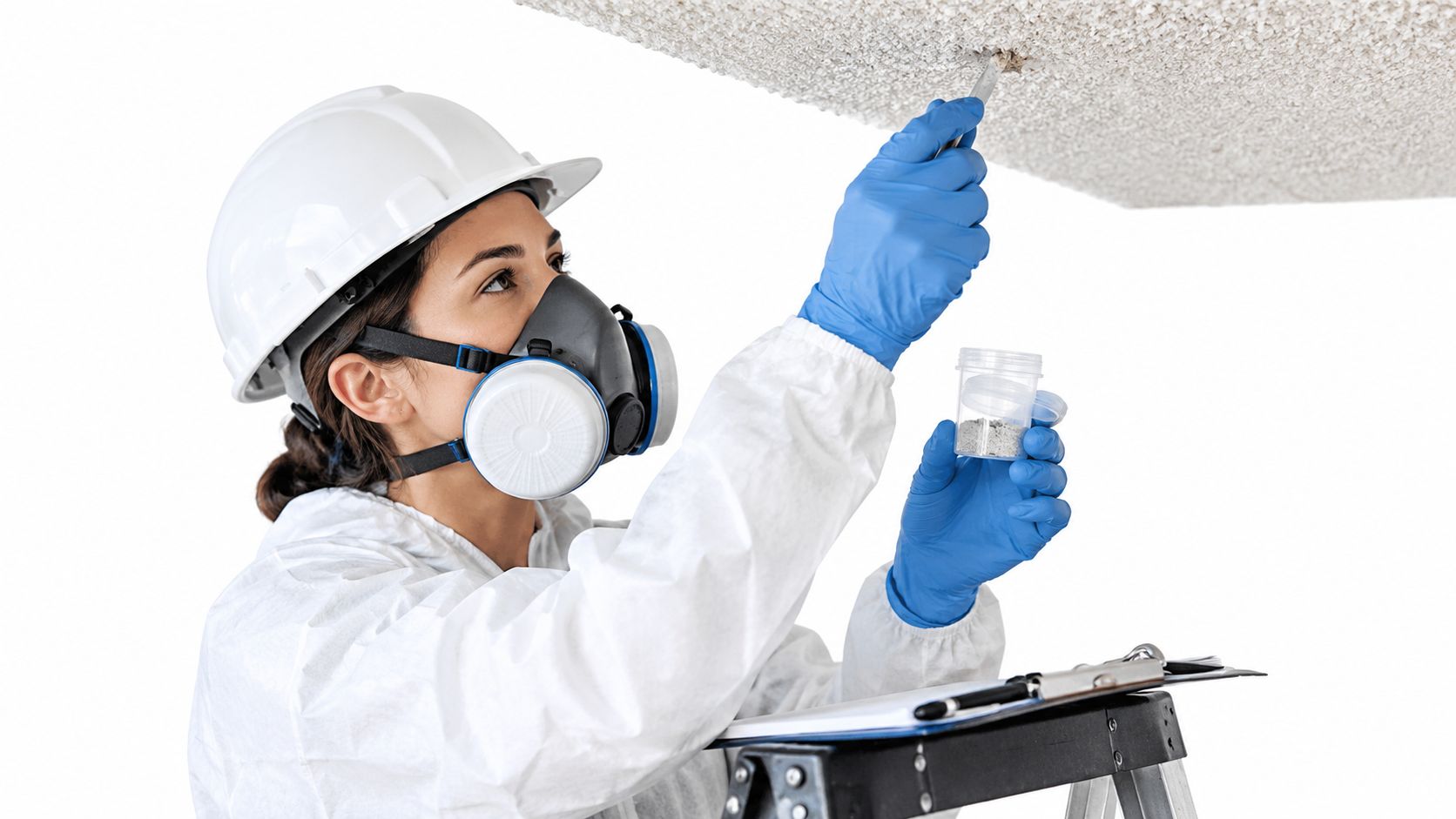
A professional visit is methodical for a reason. Each step either protects the room from fiber release or protects you from a result that doesn't represent your ceiling.
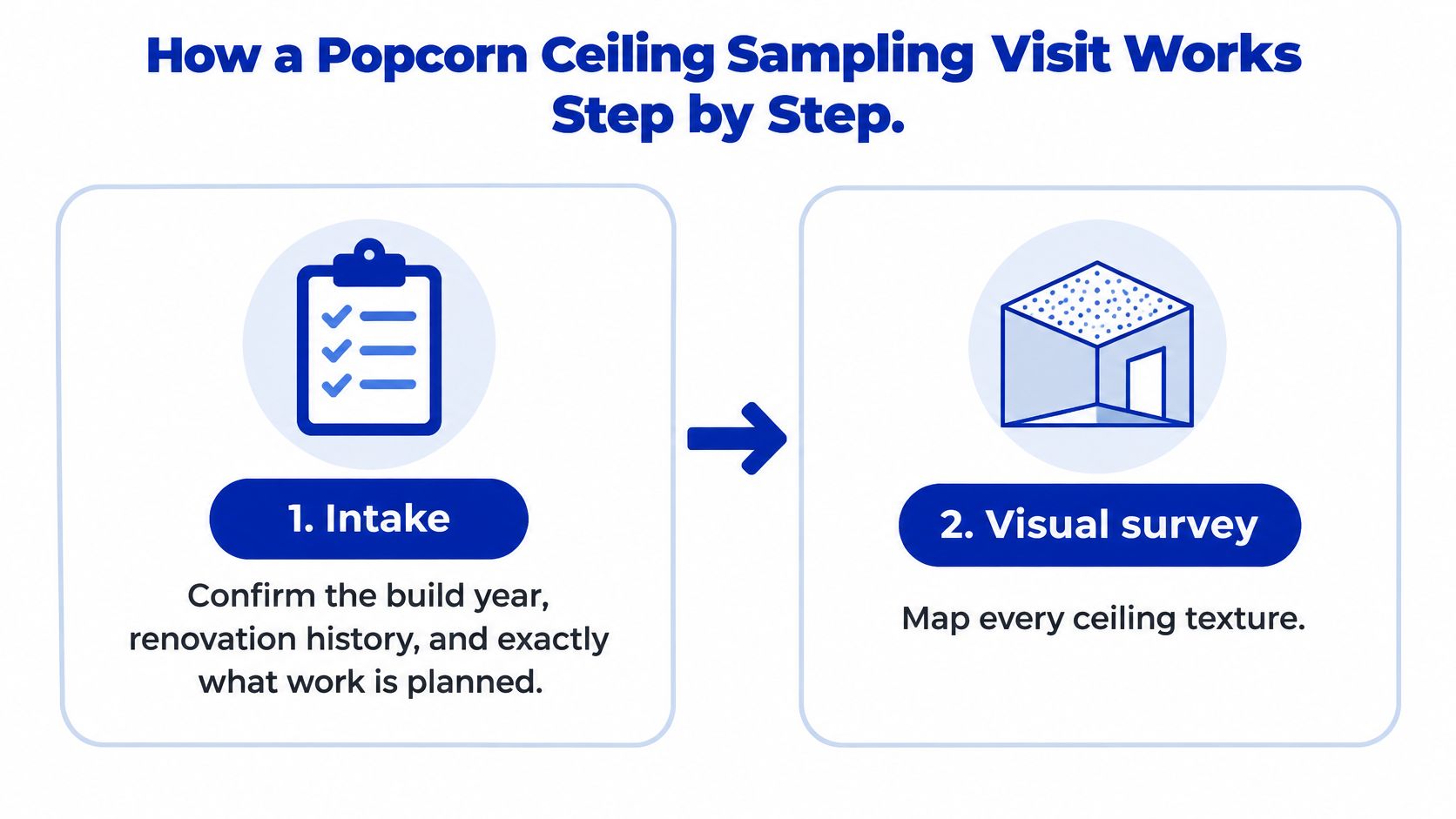
- Intake: the sampler confirms your build year, renovation history, and exactly what work you have planned. This determines whether you need a limited test or a full survey.
- Visual survey: every ceiling texture, color, repair patch, and room gets mapped. The sampler notes cracking, water staining, and loose material, because condition belongs in the report.
- Setup: the room is closed off, HVAC supply to the area is shut down, and the sampler puts on appropriate protective equipment. Air movement is what carries fibers beyond the work area.
- Wetting: the sample point is lightly misted with water. Wet material releases far fewer fibers when cut.
- Collection: a small cross section comes out, including the textured coating and underlying layers. A surface only scrape can miss asbestos containing joint compound or an older layer beneath newer texture, which is how false negatives happen.
- Sealing and labeling: each sample goes into a sealed container marked with its location. That label becomes the thread connecting your ceiling to the lab report.
- Patching: the small opening is sealed so the spot doesn't keep shedding material.
- Field documentation: the sampler completes a signed, dated field log with photographs. EPA inspection procedures call for standardized sampling with contemporaneous signed and dated field documentation and supporting photographs, as set out in EPA's asbestos inspection guidance on sampling documentation.
- Chain of custody shipment: samples travel to the lab under documented custody for analysis.
For South Coast renovation or demolition work, analysis must follow SCAQMD Method 300-91, under the Rule 1403 framework described in the Rule 1403 text requiring Method 300-91 analysis. Ask your provider up front whether your job falls under that requirement.
How This Differs From a DIY Kit
A mail in kit typically returns one chip you collected yourself. There's no layer mapping, no field log, no photograph record, and no documentation a survey can rely on for permits or contracts.
Don't sand, scrape, or drill the texture to get a sample. Disturbance can release fibers and undermines the undisturbed condition your report needs to describe.
Professional sampling also means someone trained decides how many samples your ceiling needs. One negative from a single spot doesn't clear a ceiling with three different textures and a patched corner.
Vetting Providers and Verifying Lab Accreditation and Chain of Custody
Treat your first call as a short interview, not a price check. A provider who can't answer the first two questions below clearly should be screened out before you schedule anything.
Questions to Ask a Testing Provider
| Question | Strong Answer | Red Flag |
|---|---|---|
| Is the laboratory accredited for asbestos bulk analysis? | Names the accreditation program and lab number you can look up | Says only that the lab is certified, with no verifiable detail |
| Who collects the samples and what training do they have? | A trained, documented sampler, with a Certified Asbestos Consultant for projects that need one | A salesperson with no sampling record |
| Will you sample every distinct texture, color, and layer? | Yes, with a sampling map that lists each area | One scrape from a single spot for the whole house |
| What does the written report include? | Layer by layer results, method, reporting limits, photos, signature | A single yes or no line |
| Is a ceiling only test enough for my project? | Reviews the planned work and explains which materials it will disturb | Says one test covers everything |
| How soon will results arrive, and is rush service available? | States a turnaround range and the rush fee in writing | Gives no timeline |
Notice the pattern in the strong answers. Each one gives you something you can verify independently: a number, a name, a document. Vague reassurance isn't documentation, and documentation is what you're buying.
Verifying the Paperwork Yourself
- Look the lab up: search its name in the accreditation directory for asbestos bulk analysis and confirm the scope covers PLM.
- Confirm the credential: where your project requires a California Certified Asbestos Consultant, ask for the certificate number.
- Trace the chain of custody: each sample ID should match the field log, with collector name, date, time, location, and a signature on lab receipt.
- Read the report closely: sample numbers match the log, each layer carries its own result, and the method, analysis date, and reporting limits are stated.
That last check matters because quantification has real limits. EPA's archived NIOSH 9002 guidance warns that point counting is quantitatively reliable only when the microscope preparation is sufficiently homogeneous and uniformly thick, a condition that's difficult with heterogeneous textured coatings, per EPA's archived NIOSH 9002 guidance on point counting limits. Point counting is generally more dependable than visual estimation at low concentrations, but no counting method fixes a poorly collected sample.
Second opinion trigger: mismatched sample numbers, missing signatures, or one combined result for a multi layer ceiling.
A clean package doesn't prove your building is safe. It proves the result can stand up in front of a permit office, a contractor, or a buyer, which is the standard that matters for pre-renovation asbestos testing and pre-demolition asbestos testing across Southern California.
Reading Lab Results, Notice Timing and Choosing Your Next Step
A popcorn ceiling report usually gives one of three results. None detected means the lab found no asbestos in the sample tested. Trace or below the reporting limit means the method could not reliably measure the amount, if any. A percentage result identifies the asbestos type and its concentration in a specific layer. The result applies to that sample, not automatically to every ceiling in the home.
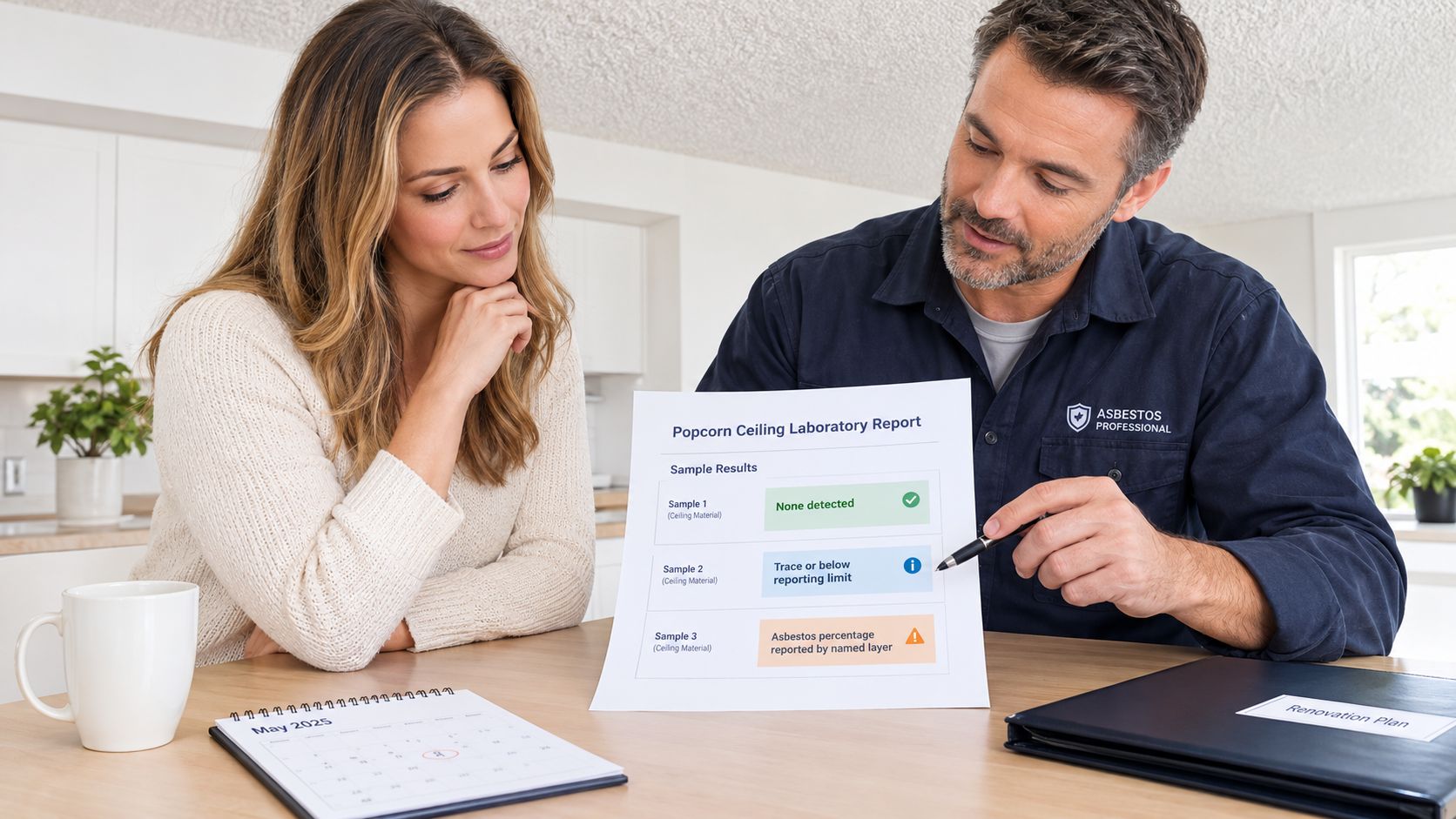
A positive finding confirms asbestos in the tested material. It does not, by itself, mean removal is required. A negative result from one room does not clear another room if its ceiling has different materials or repair layers.
Branching by What Happens Next
If the ceiling is intact and no work is planned, keep the report with your property records. It can document the material's condition for a future project or transaction. For a sale, guidance on asbestos findings during a real estate inspection explains how buyers and sellers may handle a finding.
For planned renovation or demolition, choose the right kind of testing before setting the schedule. A quick ceiling-chip test answers whether asbestos was detected in that sample. A project-specific survey documents the materials and scope needed for contractors and permitting. Under the Rule 1403 text on survey and notification requirements, Rule 1403 generally requires notification to SCAQMD at least 10 working days before demolition or renovation, except in specified emergencies. The rule also requires a survey that identifies and quantifies friable material and Class I and Class II non-friable material, with physical sampling when needed. Check the project's requirements before agreeing on a start date. SCAQMD's asbestos demolition and removal compliance overview provides additional compliance information. If a positive result changes your plans, budgeting for asbestos testing and disposal can help you consider the costs involved.
Damaged or disturbed material calls for a different process. Before cleanup begins, a Procedure 5 cleanup plan must be submitted and approved. The submission includes a completed Rule 1403 notification and a site survey report documenting sampling and lab analysis, according to SCAQMD's Procedure 5 guideline on damaged material. Arrange the appropriate testing or survey before permits and contracts are finalized, so the findings can inform the work plan.
For a remodel, tenant improvement, or demolition in Los Angeles County or Southern California, ask whether you need a sample test or a Rule 1403 survey. Sensitive Environmental can discuss the project scope and arrange asbestos testing with documented, layer-by-layer lab reporting for your contractor and permit office.