
Environmental compliance is the documented, ongoing process of meeting federal, state, and local environmental laws through permits, inspections, sampling, monitoring, recordkeeping, and corrective action, not merely owning a permit or avoiding fines. In the United States, this framework covers approximately 1.2 million regulated facilities, local governments, and other entities.
You may encounter it while planning a bathroom renovation, preparing a commercial building for demolition, or deciding what to test after wildfire smoke and ash enter a property. The immediate question isn't just whether a contaminant is present. It's what your project requires you to investigate, document, and do with the findings.
Table of Contents
- Why Environmental Compliance Matters for Los Angeles Property Owners
- Defining Environmental Compliance in Practical Terms
- Federal, State, and Los Angeles Regulatory Layers
- Who Must Comply and Which Testing Applies
- Compliance in Practice Across Common Los Angeles Scenarios
- Why Testing Alone Does Not Equal Compliance
- Consequences of Non-Compliance for Property Owners and Contractors
- A Practical Compliance Roadmap and Next Steps
Why Environmental Compliance Matters for Los Angeles Property Owners
A Los Angeles homeowner has hired a contractor to replace a bathroom ceiling. Before anyone opens it, the project team needs to establish whether the work could disturb asbestos-containing material and what documentation must exist before construction begins. A building permit and an informal assurance about the ceiling don't answer those questions.
The same distinction matters to a property manager assessing wildfire residue or a facility manager responding to indoor air complaints. Environmental testing supplies evidence for a decision, but the decision must address the actual activity, applicable requirements, and conditions at the property.
Start with the project, not the test
Ask what's about to happen: Will workers disturb building materials? Has water damaged an occupied space? Has fire residue entered the building? Is a buyer requesting environmental due diligence?
Those circumstances help an environmental consultant define an inspection and sampling scope. Ordering an unrelated test because it is inexpensive can leave the important question unanswered.
Practical rule: Describe the planned work and the affected areas before asking which laboratory test to purchase.
Environmental compliance also extends beyond private homes. The EPA and its state partners oversee approximately 1.2 million regulated entities, and compliance assurance includes inspections, monitoring, training, records, and measures that return facilities to compliance, as described in the Government Accountability Office's environmental compliance review.
For Los Angeles owners and contractors, the practical lesson is to plan for evidence before work changes the property. A useful project file should explain the original conditions, the investigation performed, the results, and the decisions that followed. Understanding what is environmental compliance means connecting those records to the people responsible for the project, rather than treating compliance as an isolated laboratory purchase.
Defining Environmental Compliance in Practical Terms
“Following environmental laws” is a useful starting definition, but it leaves out the work of demonstrating that requirements were met. A regulator may need to examine what you inspected, how you sampled, which results you relied on, and whether you submitted the necessary reports.
Compliance is a requirement-to-evidence system. A permit establishes conditions. An inspection evaluates the property. Sampling investigates a defined question. Laboratory analysis produces findings that the consultant interprets within the project's scope.
Use a compliance matrix
A compliance matrix is a working table connecting an obligation to its responsible person, verification method, timing, acceptance criterion, and retained record. It doesn't need to be complicated to be useful.
| Working question | What the project team records |
|---|---|
| What requirement applies? | Relevant rule, permit condition, or agency direction |
| Who is responsible? | Owner, contractor, consultant, or facility representative |
| How will it be verified? | Inspection, sampling, measurement, or document review |
| When is verification needed? | Before disturbance, during operations, or after specified work |
| What happens if findings differ from expectations? | Review trigger and appropriate follow-up |
| What evidence remains? | Report, laboratory results, notification, and supporting records |
This approach reflects the EPA's use of inspections, investigations, and reviews of permits, operating data, reports, and other documentation to evaluate compliance status through compliance monitoring.
Compliance and remediation aren't interchangeable. Testing identifies conditions; remediation changes conditions through separate work when appropriate. A positive result doesn't automatically establish that removal is required, and a negative result doesn't establish that every project obligation has been satisfied.
The consultant's report should connect the findings to the question investigated. That connection is what makes sampling evidence useful to owners, contractors, and agency reviewers.
Federal, State, and Los Angeles Regulatory Layers
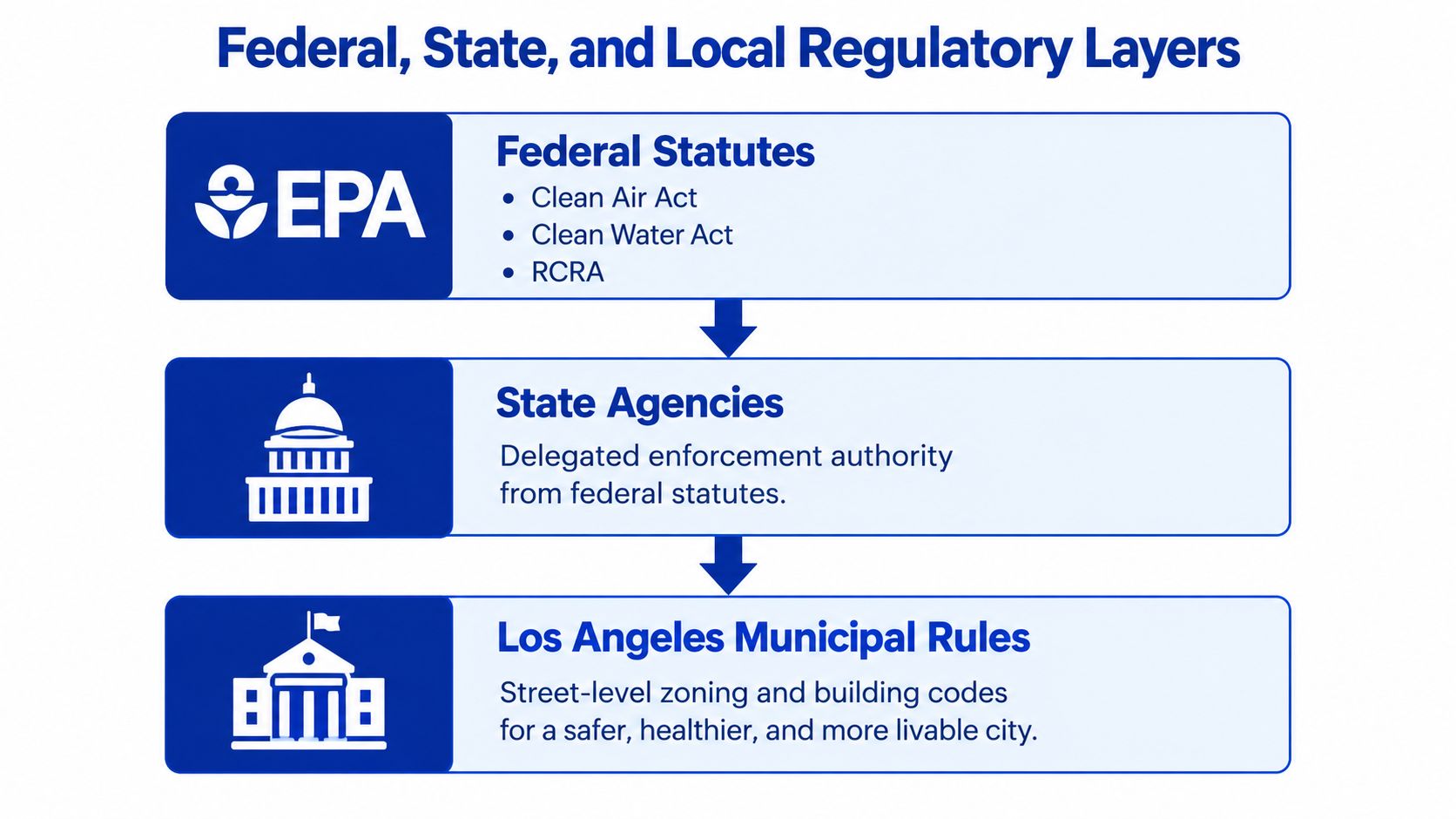
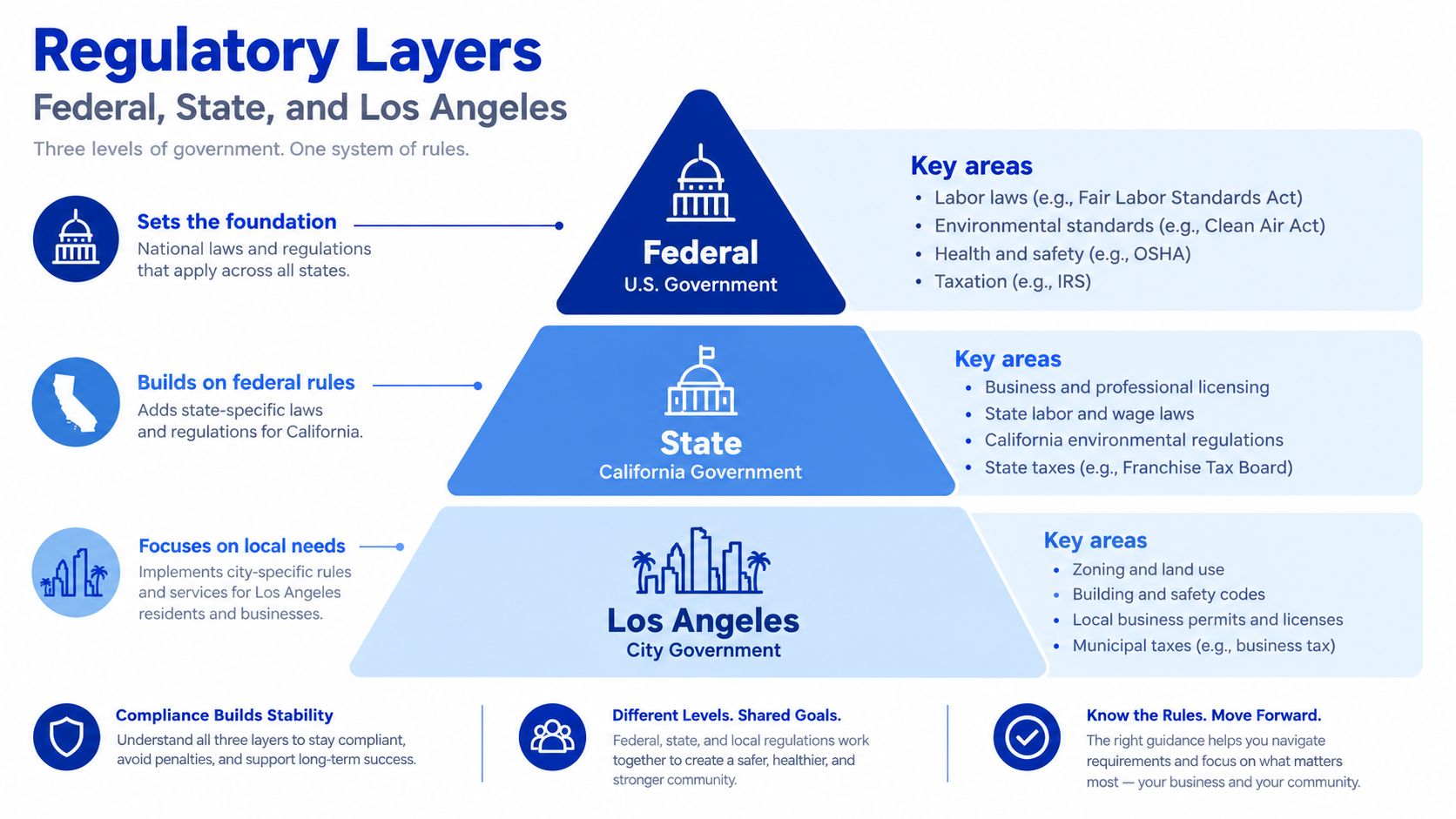
A project can fall under several regulatory layers at once. The federal framework includes the Clean Air Act, Clean Water Act, Resource Conservation and Recovery Act, Safe Drinking Water Act, and Toxic Substances Control Act. EPA's Enforcement and Compliance History Online overview explains how inspection, violation, and enforcement information is integrated across major programs.
For a property owner, these names are a starting point, not a complete project checklist. The consultant must determine which requirements relate to the activity and material being investigated.
Translate the layers into project questions
In California, ask the project team to evaluate the relevance of Cal/OSHA construction standards, DTSC hazardous-waste requirements, and Title 24 building-code requirements. Worker exposure, waste characterization, and building approval are different questions. Don't assume an environmental laboratory report resolves all of them.
The Los Angeles-area worked example is South Coast Air Quality Management District Rule 1403. Its advisory requires a documented asbestos survey before renovation that may disturb asbestos-containing material and before every demolition, without a demolition exception. The survey must identify affected asbestos-containing materials, describe their condition, and determine friability, meaning whether the material is readily crumbled.
Online notification is required before demolitions, renovations affecting asbestos-containing material, and cleanup of damaged or disturbed asbestos-containing material. The renovation notification exemption applies only when less than 100 square feet of total asbestos-containing surface area is involved, according to the SCAQMD Rule 1403 compliance advisory.
- Check jurisdiction: Confirm which air district and building department govern the address.
- Separate approvals: Don't substitute a building permit for an asbestos survey or air-district notification.
- Define the disturbance: The materials and work scope matter more than an informal description such as “minor remodel.”
Who Must Comply and Which Testing Applies
Responsibility depends on the activity, jurisdiction, and project arrangements. A homeowner, contractor, consultant, and property manager may each perform different tasks, but someone must coordinate the evidence and confirm that required actions are completed.
Use your role as a starting point for selecting testing, not as proof that every listed service is legally mandatory.
Match your situation to an investigation
- Homeowners and landlords: Planned material disturbance can call for asbestos surveys or lead-based-paint inspections. Water damage, visible suspected mold, or recurring indoor complaints can justify mold inspections, mold sampling, and indoor air quality assessments.
- Commercial owners and facility managers: Commercial environmental testing and industrial hygiene assessments can investigate airborne contaminants, evaluate complaint patterns, and support decisions about building operations.
- Contractors and developers: Define the pre-renovation or pre-demolition asbestos survey scope before scheduling disturbance. If an asbestos-related Notice to Comply or disturbance has occurred, request testing and documentation matched to that agency issue.
- Schools, hospitals, and HOAs: Specify the affected spaces, occupants, planned work, and documentation needs when commissioning an assessment.
- Insurance professionals and restoration companies: Post-incident investigations can characterize water-damage conditions or fire residue without treating appearance alone as a testing conclusion.
For larger properties, commercial environmental testing in Los Angeles can help coordinate inspections, sampling, laboratory analysis, and reporting around the actual project.
Assign ownership of the paperwork
Put a named person beside each notification, report, and follow-up task. Don't leave the owner assuming the contractor submitted something while the contractor assumes the consultant handled it.
For readers comparing general renovation-planning resources, H-Towne & Around Remodelers, Inc.’s 2026 remodel permit tips offer a separate Houston-focused resource. They aren't guidance for Los Angeles environmental requirements or a substitute for checking the agencies governing your property.
The useful self-check is simple: Who will create each required record, and who will verify that it's complete?
Compliance in Practice Across Common Los Angeles Scenarios
Different projects need different evidence. The comparison below identifies likely testing tracks; whether a test is required depends on the applicable rule, project conditions, and agency direction.
Testing Triggers and Required Documentation by Project Type
| Project Scenario | Primary Concern | Required Test | Compliance Document |
|---|---|---|---|
| Renovation or demolition | Suspect asbestos-containing materials | Survey and bulk-material sampling appropriate to the scope | Survey report, laboratory results, applicable notification |
| Lead-related renovation | Paint and residual lead dust | Paint inspection and clearance dust sampling when applicable | Inspection and clearance reports |
| Commercial office complaint | Indoor air conditions or worker exposure | Targeted IAQ, VOC, or industrial hygiene sampling | Assessment report and measurement records |
| Wildfire-affected property | Ash, soot, char, and impacted soil | Targeted fire-residue and soil analysis | Assessment, sampling records, laboratory findings |
Follow the evidence through each scenario
A home remodel: Inspect the materials that the planned work could disturb. The resulting asbestos survey supports project decisions and applicable notifications, not an unrestricted guarantee that all future work can proceed. Commercial owners can also consult this discussion of asbestos management and compliance risks in Los Angeles buildings when planning investigations.
A child-occupied property: Lead clearance involves dust sampling and laboratory analysis, not visual inspection alone. Historical EPA guidance identifies hazardous dust-lead levels of 40 micrograms per square foot on floors, 250 on interior window sills, and 400 in window troughs, with cleaning and retesting when applicable limits aren't met (EPA lead guidance). These historical figures shouldn't be used as a current project specification without verifying the applicable requirements.
A commercial office: Record complaint locations and operating conditions before choosing IAQ or industrial hygiene measurements. The report should distinguish what was measured from what remains uninvestigated.
A wildfire-affected property: Ash may contain metals including lead, cadmium, nickel, and arsenic, as well as asbestos and other contaminants. California guidance also describes confirmation soil sampling after debris removal on a 10-by-10-foot grid, with a state-certified laboratory analyzing CAM 17 heavy metals using EPA Method 6010B (California wildfire ash guidance). That protocol isn't automatically the sampling plan for every indoor soot investigation.
Why Testing Alone Does Not Equal Compliance
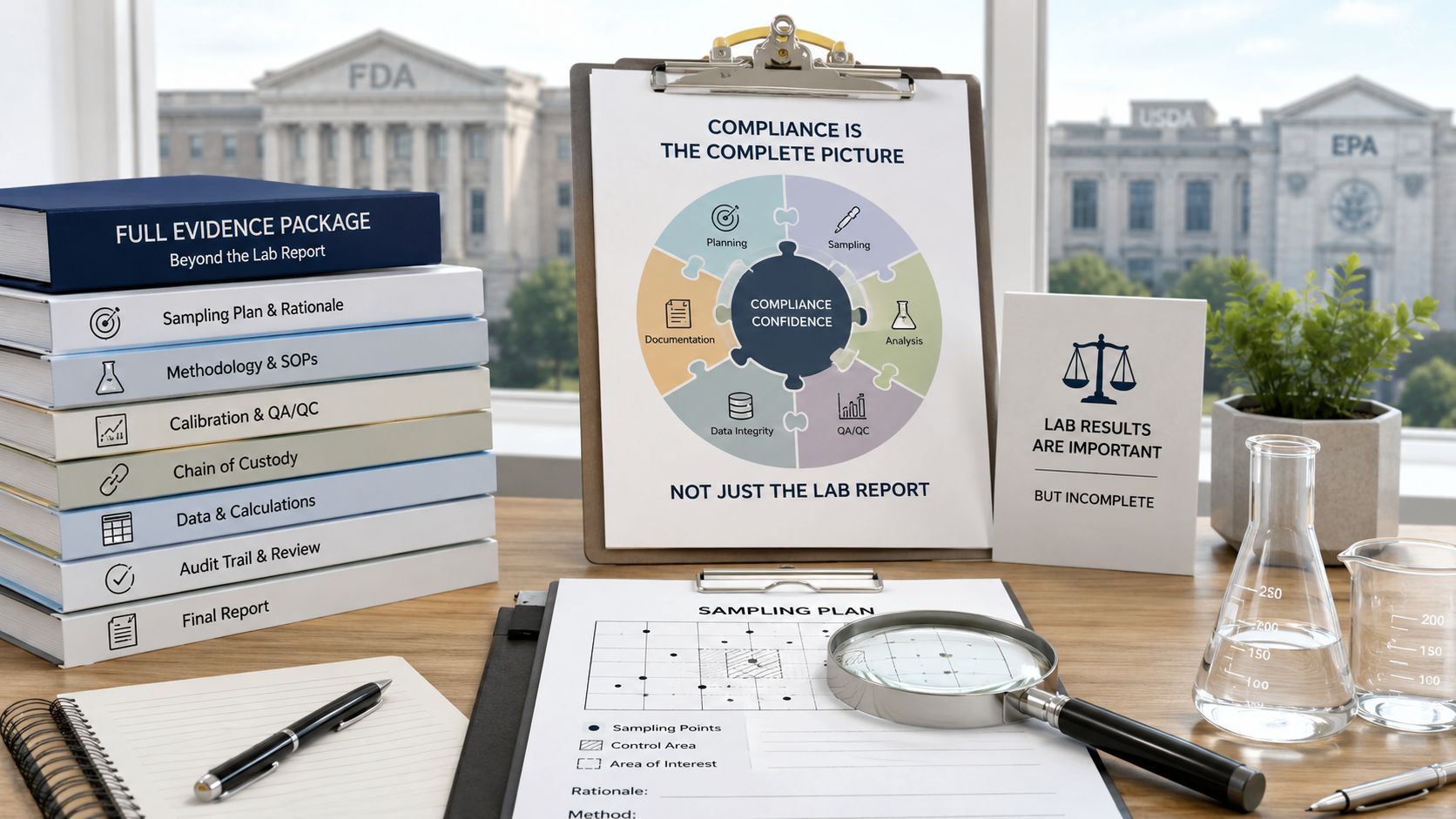
A laboratory report answers questions about the submitted samples. It doesn't establish that the consultant sampled every relevant location, that the scope matched the project, or that required notifications were filed.
The distinction becomes especially important after asbestos-containing material has been damaged or disturbed. Procedure 5 documentation is more than an asbestos test result.
Match the report to the regulatory purpose
SCAQMD requires a Procedure 5 submission to include the notification, a site survey documenting suspect-material sampling and analysis, and a cleanup plan addressing the disturbance and contamination extent. Supporting survey records include chain of custody, laboratory reports, a site map, and annotated photographs when available; cleanup can't begin until written plan approval is received (SCAQMD Procedure 5 guidance).
That requirement applies to the specified disturbance situation. A positive asbestos result alone shouldn't be treated as proof that Procedure 5 applies to every project.
A defensible report explains what the samples represent and what they don't.
Professional sampling design should distinguish:
- Screening: An initial investigation to help orient further assessment.
- Regulatory characterization: Sampling designed for a specific filing or compliance question.
- Worker protection: Industrial hygiene measurements addressing exposure during defined activities.
- Waste characterization: Testing intended to inform material-handling decisions.
These purposes can require different locations, methods, and records. Asbestos surveys, lead testing, mold assessments, VOC sampling, and combustion byproduct testing should therefore begin with a clearly stated objective.
A DIY kit may return a result for the material submitted. It doesn't, by itself, provide a professional survey, representative sampling strategy, agency documentation, or interpretation of the entire project.
Consequences of Non-Compliance for Property Owners and Contractors
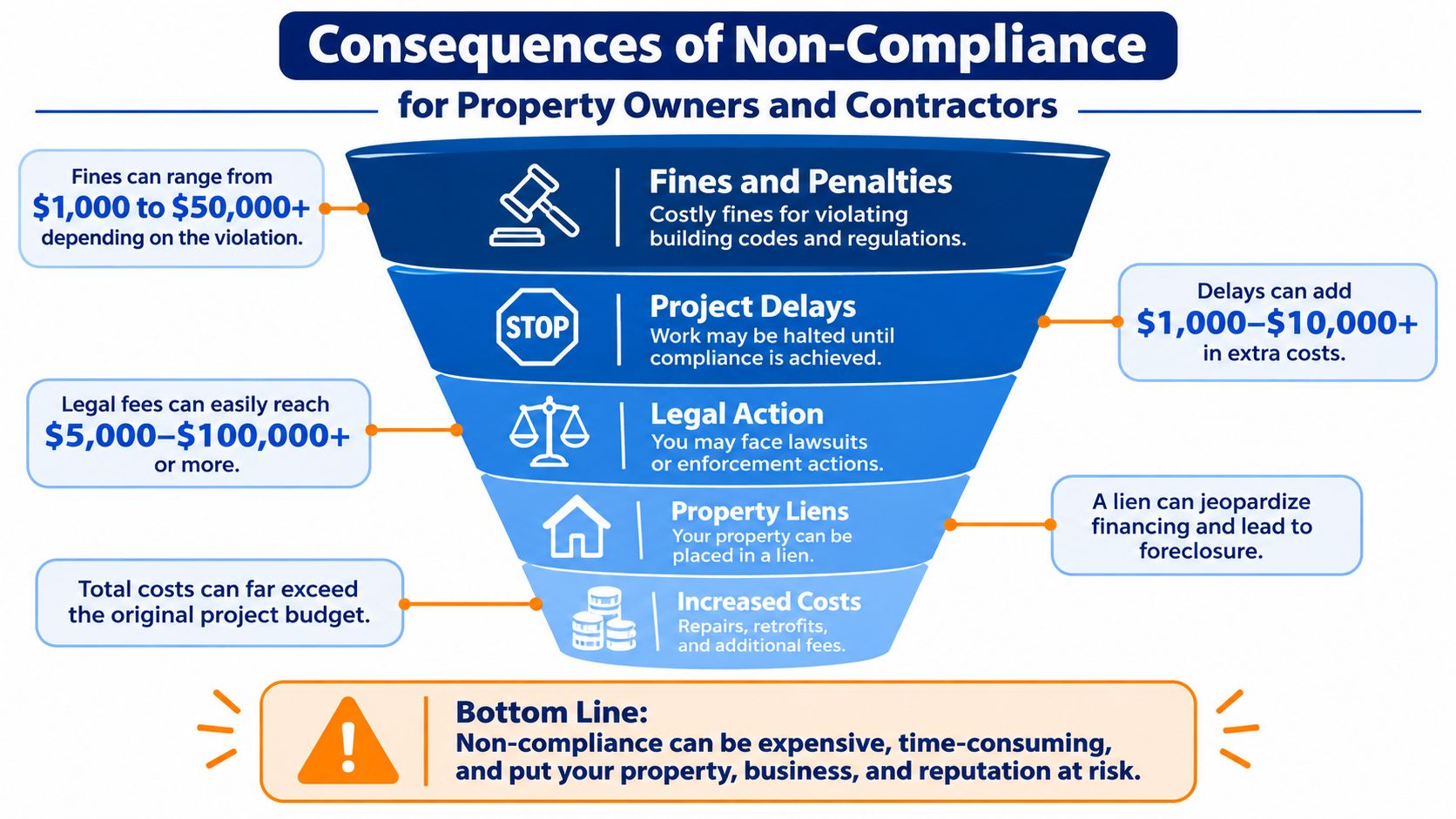
Environmental oversight involves active inspections and records review, not just responses to visible pollution. In fiscal year 2025, EPA conducted more than 14,000 compliance-monitoring activities and nearly 8,300 inspections, concluded 2,127 civil enforcement cases, and assessed more than $1.2 billion in civil penalties, criminal fines, restitution, and court-ordered relief, according to its annual enforcement and compliance report.
Those national totals aren't a forecast of what a particular Los Angeles property owner would pay. They demonstrate the scale of oversight and the importance of being able to answer a compliance inquiry.
Treat an agency notice as a specific assignment
An inquiry may involve an information request, inspection, or examination of existing records. Depending on the finding and legal authority, responses can include warning letters, notices of violation, administrative orders, litigation, or penalties. Don't assume every matter follows the same enforcement ladder.
If you receive a Notice to Comply, have the project team identify exactly what testing or documentation the notice requires. A generic asbestos sample may not answer an agency request for a survey of the affected work area.
- Preserve the evidence: Keep reports, correspondence, photographs, and relevant project records.
- Clarify the missing item: Determine whether the issue concerns sampling, notification, reporting, or another obligation.
- Coordinate the response: Assign the consultant and project representative clear responsibilities.
Unresolved questions can complicate scheduling, demolition planning, transactions, and insurance discussions. Stop-work restrictions or permit consequences depend on the governing authority and circumstances, rather than following automatically from a positive test.
Early, documented investigation is preferable to discovering missing evidence after disturbance. It supports an organized response, but it doesn't erase a violation or guarantee an enforcement outcome.
A Practical Compliance Roadmap and Next Steps
Begin with a written description of the activity and the affected property areas. “Renovation” is too broad if the consultant needs to know whether the contractor will disturb flooring, wall finishes, insulation, or ceiling materials.
Then organize the investigation around decisions rather than ordering a standard bundle of tests.
Build a usable project file
- Identify the activity: Specify renovation, demolition, water-damage investigation, wildfire assessment, an indoor air complaint, or transaction due diligence.
- Map the applicable requirements: Ask which federal, California, air-district, and local requirements need verification. Include any agency notices already received.
- Commission an appropriate investigation: Request inspections and documented sampling tied to the project scope, followed by laboratory analysis where needed.
- Retain the complete record: Keep the report, sampling documentation, laboratory findings, applicable notifications, correspondence, and evidence of follow-up together.
For lead-related planning, Northpoint Construction's discussion of lead paint removal for property owners is a separate construction resource, not a clearance-testing standard. First establish the findings and applicable requirements before deciding what work should follow.
Likewise, this discussion of testing considerations around complex property challenges should be read with a clear distinction between environmental assessment and work performed by separate qualified remediation contractors.
Before scheduling work: Ask whether the report addresses the entire planned disturbance area and whether any required agency action remains outstanding.
Practical FAQs
Do DIY kits satisfy SCAQMD asbestos requirements?
A mailed sample result alone isn't the documented survey described in the Rule 1403 advisory. Confirm that the investigation and report satisfy the requirements for your actual project.
How often should documentation be refreshed?
There isn't a universal interval for every environmental report. Reassess when the work scope, property conditions, affected areas, applicable requirements, or agency direction changes, and follow any specific monitoring or retention obligations.
How does testing fit into a real estate transaction?
Environmental site assessments and targeted testing can help buyers and owners investigate identified concerns. Define the scope around the property's history, observed conditions, proposed use, and transaction questions rather than assuming a single test resolves all due diligence.
The next step should name the investigation: an asbestos survey before disturbance, Procedure 5 assessment after an applicable asbestos incident, lead clearance sampling, water-damage-related mold testing, or an IAQ investigation. For fire-affected properties, discuss ash, soot, char, smoke residue, heavy metals, and other relevant combustion byproducts with the consultant.
Sensitive Environmental provides environmental inspections, appropriate sampling, laboratory analysis, and clear reporting for Los Angeles and Southern California properties. Visit Sensitive Environmental to discuss a Rule 1403 asbestos survey, Procedure 5 documentation, lead testing, mold or indoor air quality assessment, or post-wildfire contamination testing matched to your project's compliance questions.