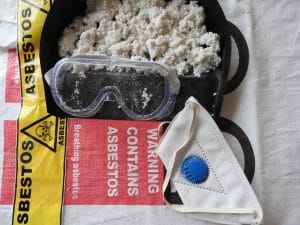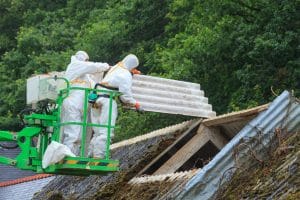
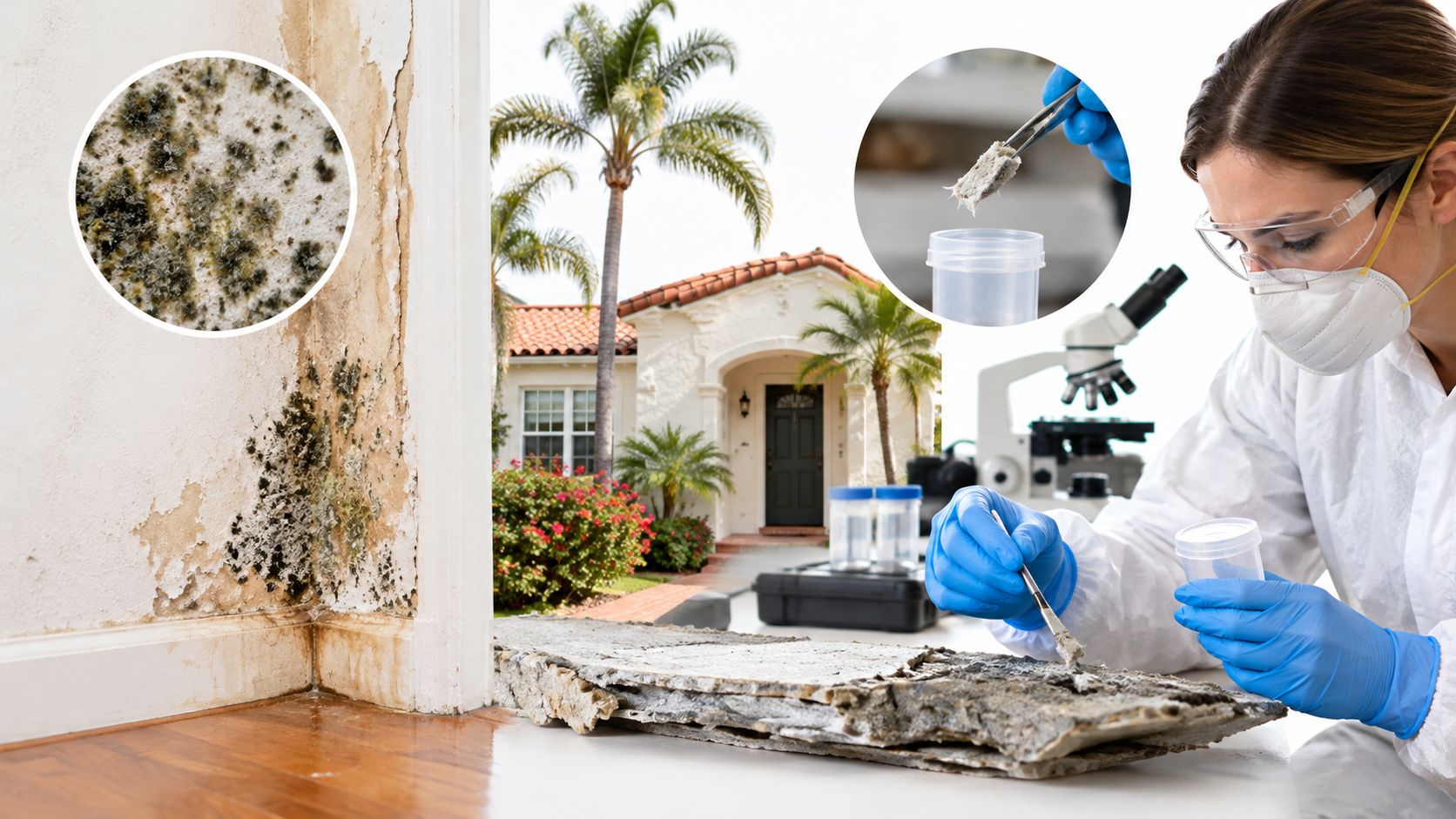
A plumbing leak has stained your ceiling, and the contractor wants to open the wall before starting repairs. Then someone asks whether the old flooring contains asbestos and whether the musty smell means mold. You need answers before the project moves forward, but ordering a general test without defining the problem can leave you with laboratory results that don't answer your questions.
Asbestos and mold testing require different decision paths. For Los Angeles homeowners and facility managers, the useful starting point isn't choosing a test package. It's identifying what materials might be disturbed, what building conditions need investigation, and what documentation the project requires.
Table of Contents
- Why These Two Tests Get Confused
- What Each Contaminant Actually Is
- When Each Test Is Actually Needed
- How Professionals Collect the Samples
- Reading Results Without Overreading Them
- California and LA Regulatory Considerations
- Where Testing Alone Is Not the Whole Answer
- Practical Next Steps for Property Owners
Why These Two Tests Get Confused
Consider a hypothetical apartment bathroom with a leaking supply line, damaged wall finishes, and flooring scheduled for replacement. The property manager might reasonably request asbestos and mold testing during the same visit. Yet the consultant would be investigating separate concerns, not looking for interchangeable contaminants.
For the flooring, the question is whether the material scheduled for disturbance contains asbestos. For the damp wall, the question is where water traveled, which materials were affected, and whether targeted mold sampling would help resolve an uncertainty.
Similar paperwork, different questions
Both investigations can involve photographs, sample labels, laboratory reports, and recommendations. That shared workflow makes them look alike to someone comparing proposals. The difference is what the evidence needs to establish.
- Asbestos investigation: Identify suspect construction materials within the project area and determine how the findings affect planned disturbance.
- Mold investigation: Assess moisture-related conditions and decide whether sampling would provide information beyond the inspection.
- Coordinated assessment: Examine both concerns under a shared property scope while keeping their methods and conclusions separate.
A proposal that lists an asbestos sample and a mold air sample may leave important questions unanswered. Which flooring layers are included? Will the consultant investigate the damp wall or only collect air in the room? Does the report cover the contractor's entire work area?
Practical rule: Define the decision before selecting the sample.
Bundling the site visit can make operational sense, especially when owners need coordinated access or project documentation. It shouldn't mean treating the laboratory reports as equivalent verdicts.
For owners comparing services, the strongest question is straightforward: What will this investigation help me decide? A useful scope should connect the inspection area, sampling approach, and reporting to a specific property decision rather than offer an unexplained collection of tests.
What Each Contaminant Actually Is
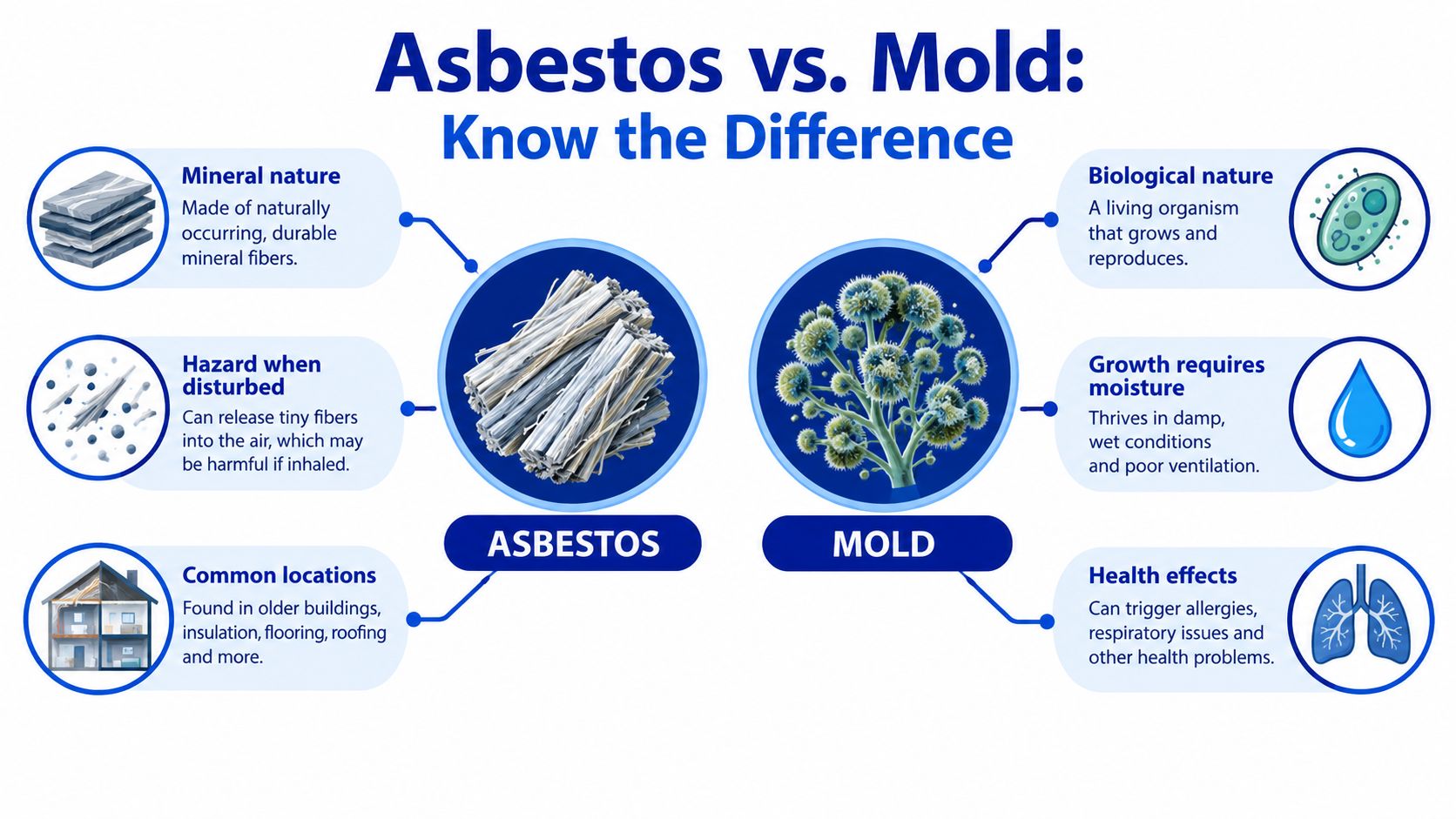
Asbestos is mineral-based; mold is biological. That distinction explains why consultants approach the same building materials differently.
Asbestos was incorporated into construction products. Mold is investigated in relation to dampness, water intrusion, and affected building conditions. A ceiling can therefore raise an asbestos question because of its construction material and a mold question because of a leak, without either finding proving the other.
Asbestos belongs to the material investigation
Older insulation, fireproofing, flooring products, and other construction materials can contain asbestos that isn't identifiable by appearance. The EPA describes extensive school-building use from World War II through the 1970s, particularly 1946 through 1972, and explains how material condition affects the potential for fiber release in its guide to asbestos in schools.
The practical distinction is friability: whether material can readily crumble and release fibers, rather than remain firmly bound. A consultant evaluates both material identity and condition because a laboratory finding alone doesn't describe how the material exists in the building.
Building age provides context, not a substitute for inspection. Neither a photograph nor a finish's familiar appearance establishes whether a suspect material contains asbestos.
Mold belongs to the moisture investigation
For mold, the consultant needs a building-condition explanation. Where did the water originate? Which surfaces or concealed spaces became damp? Are there odors, visible growth, or affected materials beyond the original stain?
The NIOSH mold-testing guidance supports investigating water intrusion, dampness, and related building conditions rather than relying on an isolated airborne measurement. The working model is simple: follow the moisture, then decide what evidence is missing.
This distinction also prevents a common misunderstanding. A building's age may help frame an asbestos investigation, but a mold assessment should focus on its water history and present conditions, not whether the property looks old or new.
When Each Test Is Actually Needed
A planned disturbance is a strong reason to discuss an asbestos survey. A water event or unexplained musty odor is a reason to discuss a mold assessment. Neither situation automatically calls for the same sampling package.
For an owner seeking asbestos testing in Los Angeles, the consultant should first understand the work boundaries. Removing flooring, opening walls, or demolishing a structure raises different scope questions from evaluating an undisturbed room during a purchase.
Asbestos Testing vs Mold Testing at a Glance
| Contaminant | Common Trigger Events | Primary Concern | Who Orders It |
|---|---|---|---|
| Asbestos | Renovation, demolition, damaged suspect materials, transaction due diligence | Identifying materials that could be disturbed and supporting project compliance | Owners, contractors, developers, property managers |
| Mold | Leaks, water damage, musty odors, visible growth, unresolved building complaints | Understanding moisture conditions and whether targeted sampling changes the response | Homeowners, landlords, facility managers, insurers |
| Both | Water-damage repairs involving suspect construction materials or post-event reconstruction planning | Coordinating separate material and moisture investigations | Owners, restoration teams, general contractors |
When an inspection matters more than another sample
Visible growth and an obvious moisture problem don't necessarily require routine mold testing to establish that the conditions need attention. A Massachusetts public-building review discusses the limitations of mold sampling and notes that EPA generally doesn't recommend routine testing where visible growth or moisture problems are already evident.
Targeted sampling may still be useful when the consultant needs to investigate suspected hidden contamination or document specific conditions. The question is whether the result could change a decision.
- After a leak: Ask for an assessment of the affected materials and moisture distribution, not just a room air sample.
- Before a transaction: Define which uncertainties matter to the buyer or lender rather than assuming a general inspection resolves every environmental concern.
- After occupant complaints: Record the location, timing, and building conditions. An environmental assessment and a medical evaluation answer different questions.
For schools, healthcare facilities, commercial buildings, and HOAs, reporting needs deserve attention at the outset. Identify who will use the findings, what areas they need covered, and whether the objective is due diligence, repair planning, regulatory documentation, or evaluation after completed work.
How Professionals Collect the Samples
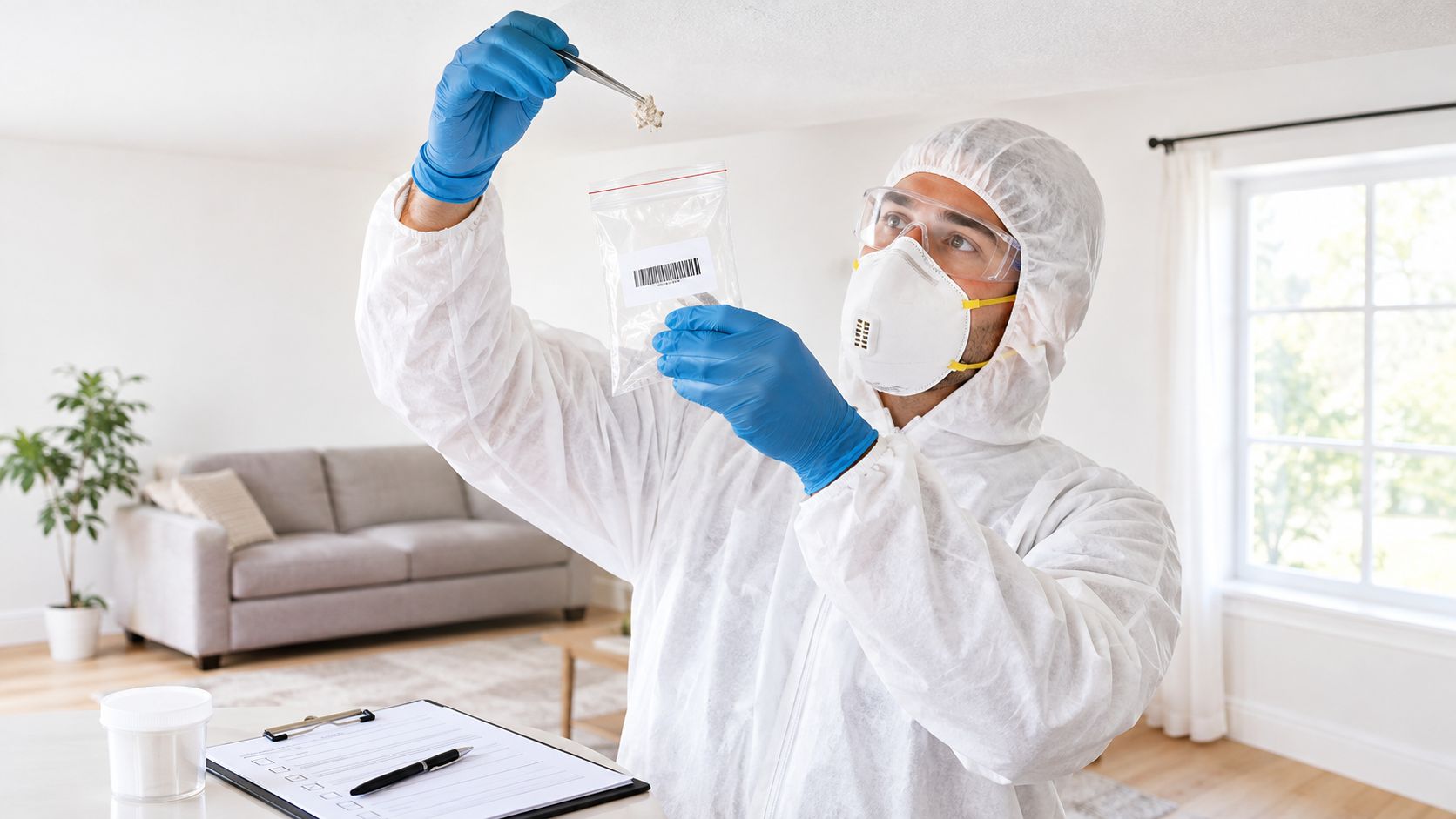
A professional visit should begin with a review of the property history and project scope, followed by an inspection. Sampling locations should reflect what the consultant observes and what the report must support, not a predetermined sample count.
Asbestos sampling separates materials and layers
For bulk sampling, the consultant collects representative portions of suspect construction materials. Homogeneous material means material treated as consistent in composition and appearance within the assessment, but visually adjacent products aren't necessarily the same material.
Floor covering and adhesive, for example, need separate consideration. So do wallboard and joint compound. Combining distinct layers into an undifferentiated result can obscure what a contractor will encounter.
The applicable asbestos sampling and analytical requirements specify bulk sampling under 40 CFR Part 763.107, permit SCAQMD Method 300-91 or the specified polarized-light microscopy, or PLM, procedure, and require National Voluntary Laboratory Accreditation Program, or NVLAP, accreditation for compliance analyses.
Air monitoring answers a different question from bulk testing:
- PLM: Characterizes collected building-material samples.
- Phase-contrast microscopy, or PCM: Counts airborne fibers but can't reliably distinguish asbestos from non-asbestos fibers.
- Transmission electron microscopy, or TEM: May be needed when fiber identity or sensitive clearance interpretation is consequential.
The same analytical guidance supports these distinctions. The consultant should select the method for the decision, not treat the methods as interchangeable.
Mold sampling follows the inspection question
A mold assessment may include moisture detection, mapping, examination of affected surfaces, and investigation of accessible HVAC components or concealed-source indicators. Where sampling is justified, a consultant may select air spore traps, swabs, or tape lifts to address a defined question.
Spore traps examine what was captured from air. Surface methods focus on the sampled location. Laboratory analysis may involve microscopic examination or culture, depending on the method, so the proposal should explain what the selected approach can establish.
DIY collection doesn't replace a representative survey or professional interpretation. Before disturbing suspect material yourself, review the practical issues discussed in whether you can test for asbestos at home, then ask how professional sampling would cover your actual project.
Reading Results Without Overreading Them
A laboratory report describes the submitted samples. The consultant's report should explain how those findings relate to the inspected property, the sampling boundaries, and the decisions under consideration.
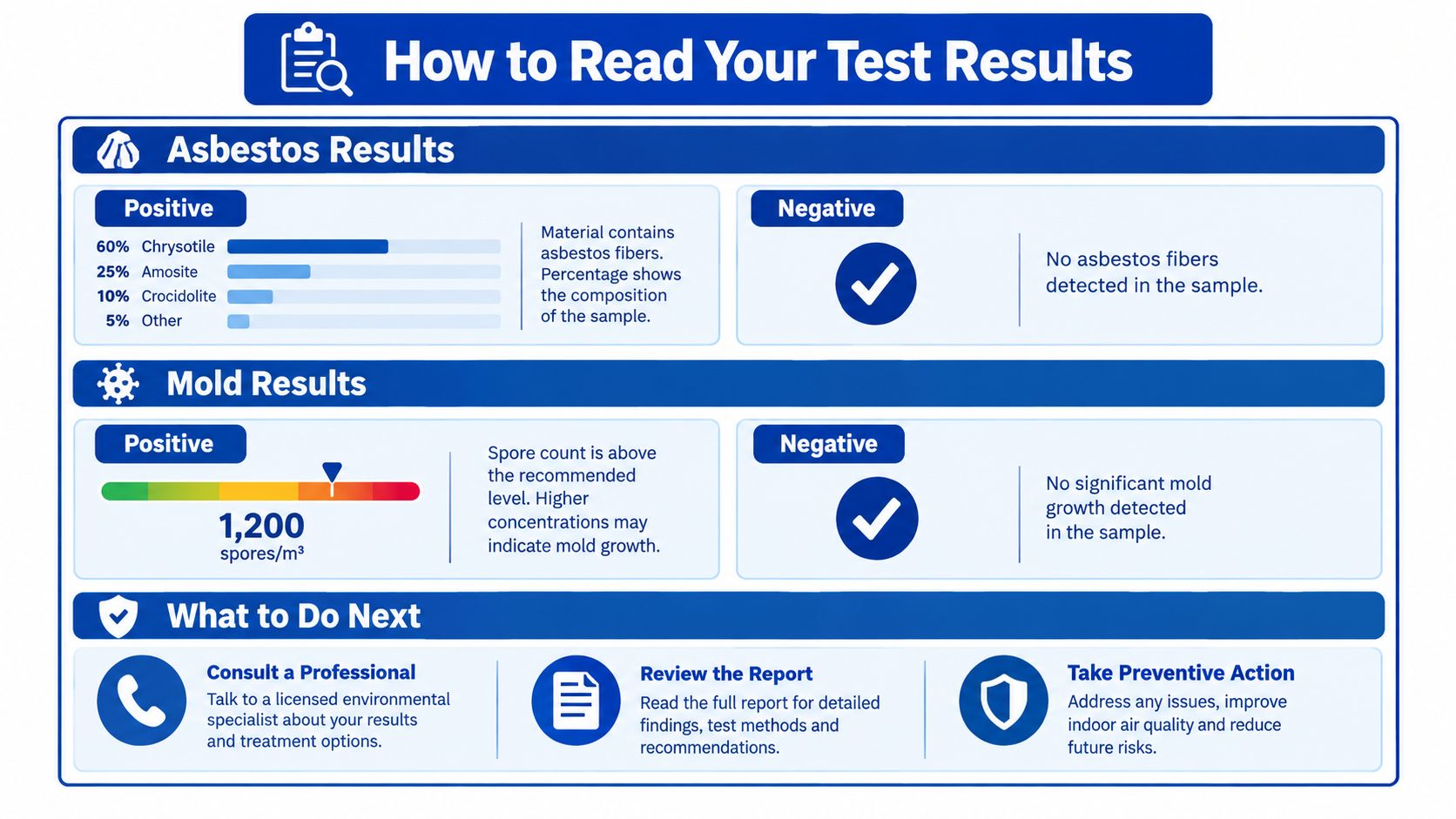
For asbestos, a reported composition or percentage belongs to a particular sample and material layer. It isn't a building-wide percentage, and it doesn't independently describe the material's condition or every location where that product may exist.
Read the sample description before the conclusion
Start by matching the laboratory identification to the consultant's sample location and material description. Then check whether the relevant layer was analyzed, whether any suspect materials were inaccessible, and whether the report distinguishes tested materials from assumptions.
- A detected finding: Establishes asbestos in the analyzed sample, subject to the method and report details. It doesn't automatically mean removal is required.
- A nondetect finding: Describes the analyzed sample and method. It shouldn't be expanded to materials outside the sampling scope.
- A project recommendation: Should connect the findings to condition, planned disturbance, and applicable requirements.
Mold results aren't universal health grades
There's no universally accepted health-based threshold for indoor mold concentration. CDC/NIOSH guidance on mold testing and remediation states that health-based indoor-air standards don't exist for mold and doesn't recommend routine short-term air sampling as the primary building-evaluation method.
Consequently, a spore count or culture result can't independently diagnose illness or certify that a property is safe. Brief samples may not represent actual exposure, and an indoor-outdoor comparison needs interpretation alongside weather, building conditions, inspection findings, and sampling limitations.
The infographic's positive and negative labels should therefore be read as sample summaries, not property-wide verdicts. A low result doesn't erase an observed moisture problem, while a high result doesn't establish the cause of someone's symptoms.
Treat laboratory results as evidence for a decision, not a substitute for the investigation.
For readers comparing consumer products, the reliability of home mold test kits is a useful companion topic. The key question remains whether the collection method and interpretation answer the property concern, rather than merely produce a result.
California and LA Regulatory Considerations
For regulated projects, an asbestos laboratory report isn't the same as a completed asbestos survey. Los Angeles-area contractors need documentation that connects identified materials to the work they plan to perform.
Establish the survey and notification requirements
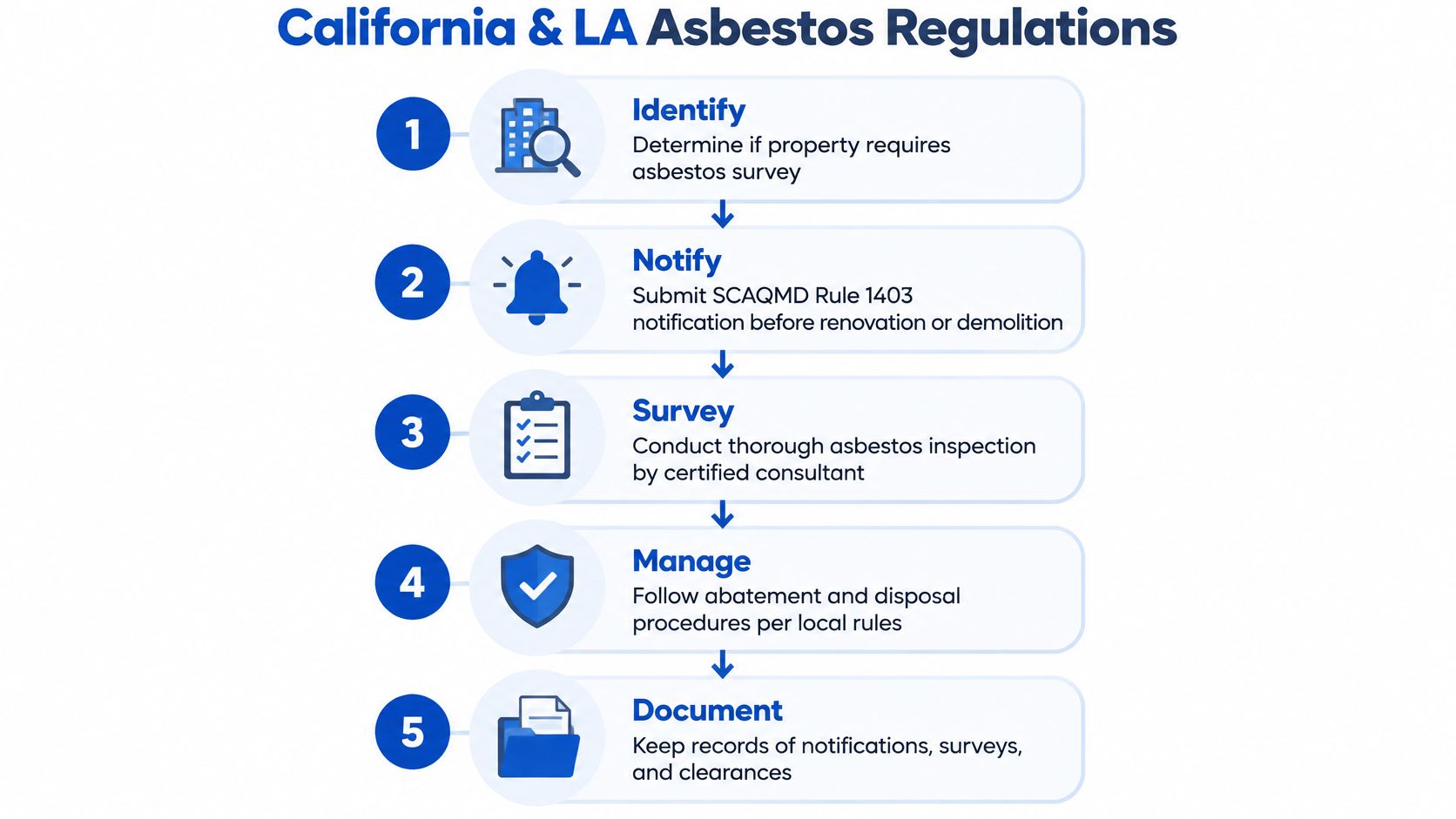
The SCAQMD Rule 1403 compliance advisory requires a documented survey before renovation or demolition. Its principal limited exception concerns a single-unit residential structure where less than 100 square feet of asbestos-containing material will be removed or stripped; demolition has no exception.
The survey must identify asbestos-containing materials that could be disturbed, describe their damaged or disturbed condition, determine friability, and include physical sampling where appropriate. Don't apply the residential exception to a different property type or assume it eliminates other obligations.
Under the District's Rule 1403 requirements overview, contractors must have a survey performed by a Cal/OSHA Certified Asbestos Consultant, and notification is generally required at least 10 working days before demolition or renovation, subject to specified exceptions.
Match the documentation to the project
Use the graphic as a checklist of responsibilities, not a universal chronological sequence. Obtain the survey information needed to support accurate notification and work planning.
The same District overview identifies Procedure 5 as an approved alternative involving damaged or disturbed asbestos-containing material. It belongs to a project-specific regulatory process, not a generic testing package.
- Notice to Comply: Provide the actual notice to the consultant so the assessment can address its stated issues and deadlines. Don't assume an unrelated sample closes the matter.
- Real estate documentation: Distinguish project surveys from transaction concerns, including those discussed in California asbestos real estate disclosure.
- Remodel coordination: Planning resources such as the Epic Remodeling restroom remodel process can provide a construction-planning reference, but environmental survey requirements need separate confirmation.
Keep the survey, laboratory findings, notifications, and relevant correspondence together. The project team should be able to trace the compliance decision back to the inspected materials and intended work.
Where Testing Alone Is Not the Whole Answer
A negative sample from accessible flooring can't resolve the composition of inaccessible insulation. An air sample can't describe every material in mixed demolition debris. These aren't minor reporting details: they determine whether the evidence supports the proposed next step.
Sampling scope matters as much as the laboratory finding. A defensible assessment states what was inspected, what was sampled, what couldn't be accessed, and which assumptions remain unresolved.
Debris changes the investigation
Post-fire properties and partially demolished buildings may no longer have recognizable, consistently distributed materials. In those settings, ask whether the consultant can relate samples to distinct materials or debris areas, and whether additional investigation will be needed as access changes.
Material characterization and airborne-fiber monitoring also serve separate purposes. The project may need both, but one shouldn't be presented as a replacement for the other.
- Survey boundary: Does the report cover the structure, selected rooms, debris areas, or only submitted samples?
- Access limitations: Which concealed or unstable areas remain unassessed?
- Method selection: Is the analytical method suitable for the material and the intended decision?
- Changed conditions: Will newly exposed materials require supplemental inspection?
For fire-damaged structures in the South Coast basin, owners and operators remain responsible for an asbestos survey and emergency demolition or renovation notification. If asbestos-containing material is found, SCAQMD's emergency asbestos guidance requires a Procedure 5 approved-alternative cleanup plan prepared by a Certified Asbestos Consultant, a registered asbestos-abatement contractor, and electronic removal notification through the Rule 1403 application.
Before authorizing work: Ask which unresolved conditions could change the report's conclusions.
Post-fire environmental assessments may also involve separate questions about ash, soot, char, smoke residue, combustion byproducts, or heavy metals. Those concerns need their own assessment scope; they aren't answered by asbestos or mold results.
The objective isn't to collect every conceivable sample. It's to identify which uncertainties matter and obtain evidence suitable for resolving them before contractors, insurers, or owners rely on the conclusions.
Practical Next Steps for Property Owners
Start with a plain-language description of the decision you're facing: opening a water-damaged wall, replacing flooring, evaluating a tenant complaint, or planning reconstruction after a fire. That description is more useful than requesting a generic environmental testing package.
Then assemble the records that help the consultant define the investigation. You don't need a complete building archive, but relevant plans, photographs, and prior reports can prevent avoidable gaps.
Prepare a useful project summary
- Property information: Provide the address, property type, approximate construction period, and known renovation history.
- Work boundaries: Identify the rooms, surfaces, and concealed areas the contractor expects to disturb. Include drawings or marked photographs if available.
- Water or fire history: Describe the event, affected areas, observed odors or staining, and any work already performed.
- Existing documentation: Share prior surveys, laboratory reports, insurance requests, and regulatory correspondence, including any Notice to Comply.
- Decision and timing: Explain who needs the report, what it must support, and any actual project or agency deadlines.
Ask the proposed testing firm to distinguish the inspection, sampling, laboratory analysis, and reporting portions of its scope. The proposal should also explain how access limitations and newly discovered suspect materials will be handled.
Can both inspections happen during the same visit?
Ask whether coordinated scheduling suits the property's access, condition, and project requirements. A shared visit shouldn't collapse the investigations into a single conclusion, and some areas may require additional access or follow-up.
Before accepting the final report, check that you can locate each finding, understand the limitations, and identify the recommended decision-maker for unresolved issues. For commercial environmental testing, this also means making sure the contractor, facility manager, and owner are working from the same assessment boundaries.
The useful endpoint is a documented basis for the next property decision, not just a folder of laboratory certificates. Clear scope and interpretation help you understand what's known, what remains uncertain, and what additional professional input may be appropriate.
Sensitive Environmental provides asbestos surveys, mold inspections, appropriate sampling, laboratory analysis, and clear reporting for residential and commercial properties in Los Angeles and Southern California. Contact the team to discuss a coordinated asbestos and mold assessment for planned renovations, water damage, regulatory documentation, or a post-fire environmental evaluation suited to your property.