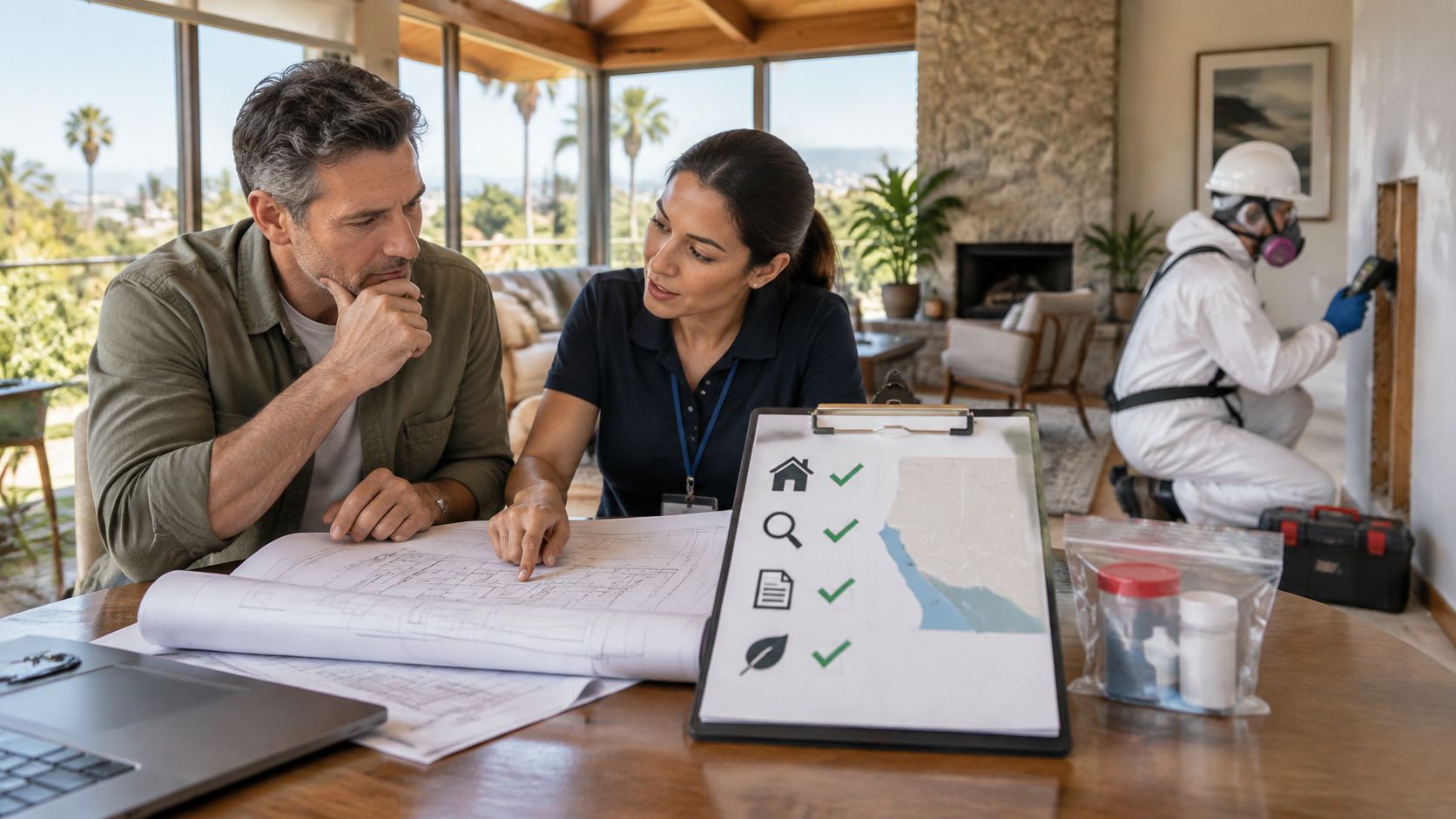
You're a landlord planning a kitchen remodel in an older Los Angeles building, and the contractor wants to start opening walls. For asbestos, the core requirement is South Coast AQMD Rule 1403, which governs asbestos emissions during demolition and renovation in the South Coast Air Basin. Before you book the crew, you need to establish what materials the work will disturb, whether they've been surveyed, and which documentation applies.
The common mistake is assuming a small project falls outside SCAQMD rules. In practice, ownership, who performs the work, and the condition of the material can matter more than the size of the repair.
Table of Contents
- SCAQMD Rule 1403 and Its Five Procedures at a Glance
- Who Must Comply and When an Exemption Applies
- Survey and Notification Deadlines to Plan Around
- When Procedure 5 Applies to Damaged Asbestos
- What to Do When Untested Material Turns Up
- Confirm Your Compliance Path Before Work Begins
SCAQMD Rule 1403 and Its Five Procedures at a Glance
Rule 1403 makes asbestos identification a preconstruction responsibility, not paperwork to assemble after demolition. The District adopted it on October 6, 1989, and substantially amended it on October 5, 2007, establishing requirements for surveys, notifications, removal practices, cleanup, waste handling, storage, and disposal, as explained in South Coast AQMD's asbestos demolition and renovation guidance.
For a Los Angeles-area project, the practical starting point is the disturbance scope. A kitchen remodel might involve more than the visible finish materials. The consultant needs to understand which components the contractor intends to cut, strip, drill, or demolish.
Asbestos-containing material, abbreviated ACM, is the material the rule addresses. The survey also documents condition and friability, meaning whether material can crumble under hand pressure when dry. Those findings help qualified professionals determine the appropriate compliance approach.
Match the procedure to documented conditions
The following reference summarizes the approaches described in the District's Rule 1403 procedure and planning document. Procedure selection should follow the survey findings and applicable requirements, not whichever method happens to fit the contractor's equipment.
| Rule or procedure | What it covers | When it applies | Approval needed |
|---|---|---|---|
| Rule 1403 | Asbestos surveys, notification, work practices, cleanup, and waste handling | Covered demolition and renovation | Advance notification |
| Procedure 1 | Total enclosure with HEPA-filtered negative pressure | Removal in enclosed work areas | Standard method, notification applies |
| Procedure 2 | Glovebag removal | Localized removal using glovebag containment | Standard method, notification applies |
| Procedure 3 | Adequate wetting during removal | Removal using wet methods | Standard method, notification applies |
| Procedure 4 | Approved dry-removal alternative | Dry removal instead of wet methods | Written SCAQMD approval |
| Procedure 5 | Approved alternative for damaged or disturbed ACM | Damaged or disturbed asbestos, regardless of project size | Written SCAQMD approval before cleanup |
The distinction between a standard method and an approval-based alternative matters. A field crew shouldn't treat dry removal or an alternative control approach as an automatic substitution when conditions become inconvenient.
Practical rule: Identify the material and document its condition before deciding how the work will proceed.
Testing and removal are separate scopes. An environmental consultant inspects, samples, interprets laboratory findings, and prepares documentation. The contractor responsible for regulated work uses that information to develop an appropriate work approach.
Who Must Comply and When an Exemption Applies
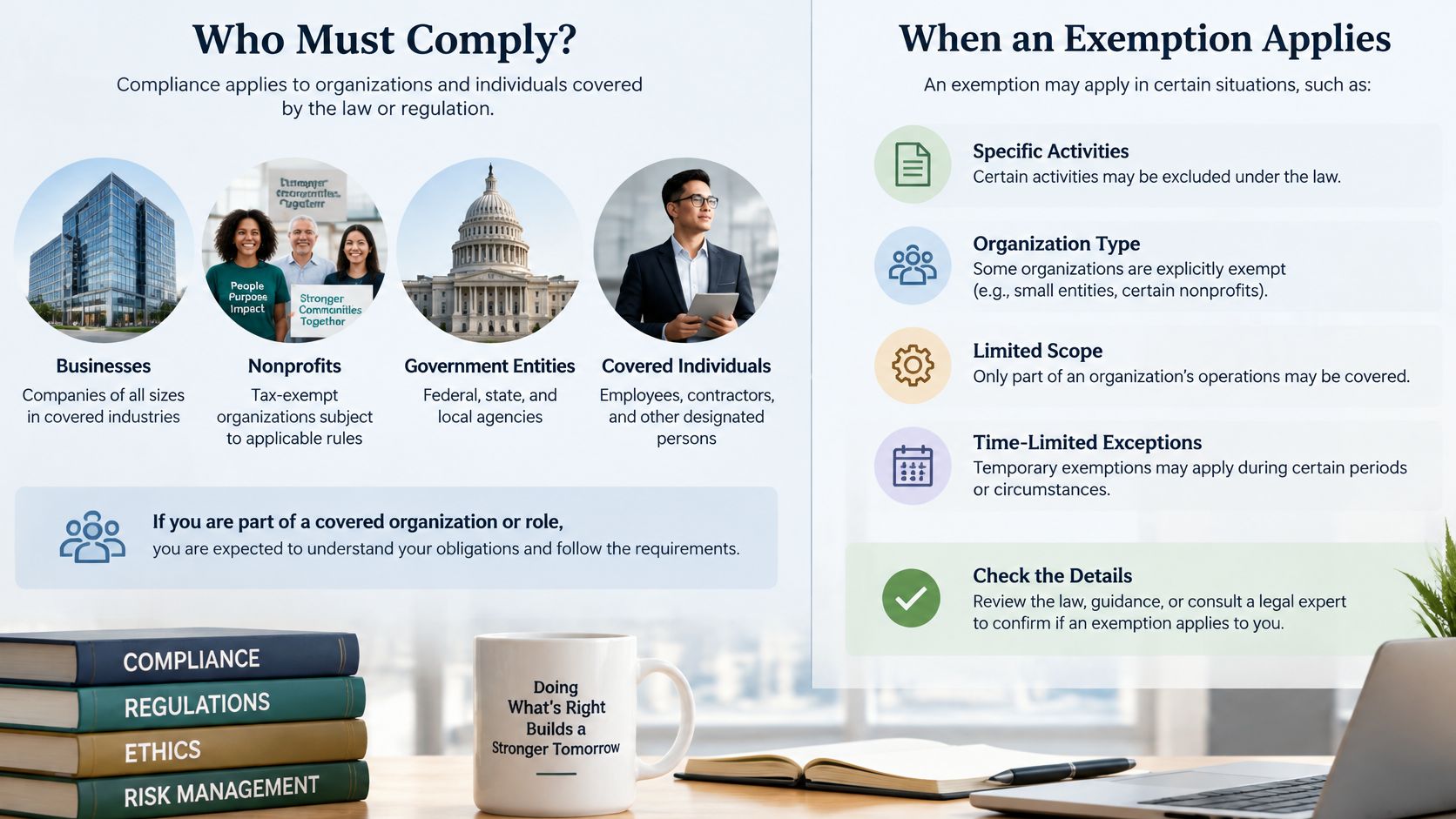
Square footage alone doesn't establish an exemption. The residential exception depends on the property, the person performing the work, the activity, and whether asbestos has already been damaged or disturbed.
The Rule 1403 homeowner FAQ published by the City of Rialto describes a narrow exception for the legal owner of an occupied, single-unit family dwelling who personally performs qualifying renovation involving less than 100 square feet of ACM. The owner can't hire or receive help from contractors, laborers, friends, or family and still rely on that exception.
Compare the property and worker together
The applicability distinctions below follow that homeowner FAQ. Notification entries describe covered asbestos work; limited small-renovation recordkeeping treatment must still be checked against the applicable rule conditions.
| Scenario | Survey required? | Notification required? | Procedure 5 plan? |
|---|---|---|---|
| Owner-occupied single-unit house, owner personally performs qualifying work below the residential threshold | Exempt if every condition is met | Exempt if every condition is met | Required if ACM is damaged or disturbed |
| Owner-occupied house, owner hires a handyman or crew | Yes | Yes for covered work; verify limited recordkeeping provisions | Required if ACM is damaged or disturbed |
| Investor-owned single-family rental | Yes | Yes for covered work; verify limited recordkeeping provisions | Required if ACM is damaged or disturbed |
| Condominium, townhouse, or apartment | Yes | Yes for covered work; verify limited recordkeeping provisions | Required if ACM is damaged or disturbed |
| Any demolition | Yes, no size exemption | Yes | Required if ACM is damaged or disturbed |
| Damaged or disturbed ACM, regardless of project size | Yes | Yes | Yes, written approval before cleanup |
The first distinction is owner-performed versus hired work. A homeowner who qualifies while working alone shouldn't assume the same exemption survives once a handyman joins the project.
The next distinction is owner occupancy versus rental ownership. An investor-owned house doesn't become eligible merely because its physical layout resembles an owner-occupied house. Likewise, an individual condominium owner shouldn't equate ownership of a unit with ownership of a qualifying single-unit dwelling.
Finally, renovation and demolition aren't interchangeable categories. The FAQ requires a survey before every demolition, without a size exemption. Existing damage also changes the analysis rather than merely adding another item to the contractor's punch list.
Write down the exemption facts
Before buying materials or booking labor, answer these questions:
- Property and activity: Is this renovation or demolition, and what is the property's legal dwelling classification and occupancy?
- Owner and worker: Who legally owns it, and will anyone help perform the work?
- Material condition: What will be disturbed, and is any suspect material already damaged?
These answers give the District or an environmental consultant something concrete to evaluate. A borderline exemption should be confirmed, not assumed from a room measurement.
Survey and Notification Deadlines to Plan Around
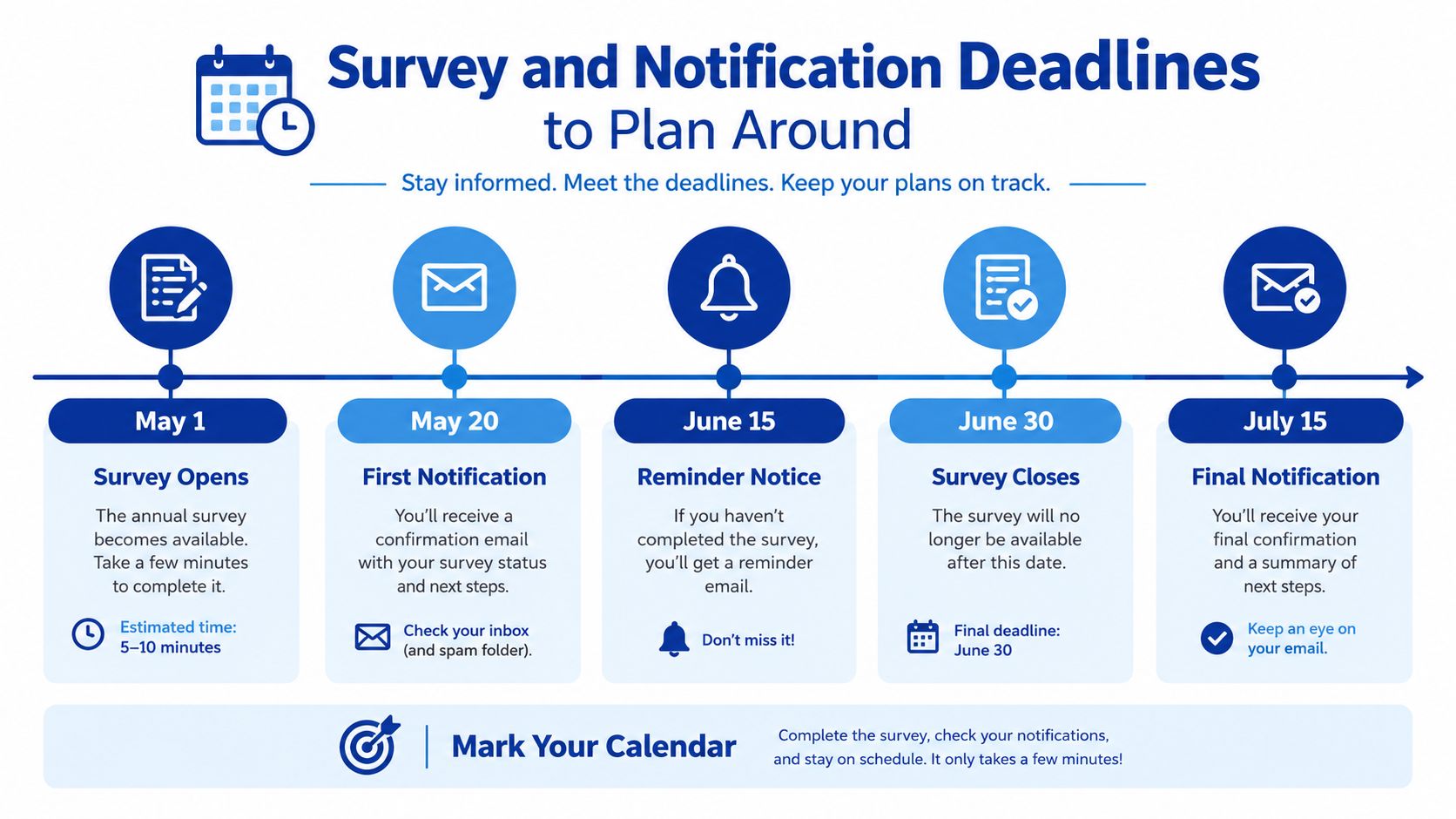
Build the schedule around documented conditions rather than a hoped-for start date. The working sequence is survey, reporting, notification, field reconciliation, and updates when the scope changes.
- Complete the survey. Have the consultant evaluate every component the planned work may disturb, with access limitations clearly identified.
- Record the findings. Document material type, quantity, location, condition, and friability so the report supports the actual construction scope.
- Submit the required notification. The standard interval is 10 working days before work begins under the adopted Rule 1403 text; planning materials also cite 14 calendar days, but verify the operative wording and calendar with the District rather than treating the counts as interchangeable.
- Reconcile field quantities. Compare what the contractor encounters with the survey and notified scope instead of waiting until the end.
- Update when required. A 20% or greater change in notified affected-asbestos quantity requires an updated notification under that adopted rule.
The notice interval allows the District to review the project and schedule inspections. A late filing can therefore affect more than the asbestos work, especially when other trades depend on opening the same area.
Turn the requirements into schedule milestones
Use the adopted rule and the procedure distinctions already identified to assign responsibilities before mobilization.
| Milestone | Requirement | Planning step |
|---|---|---|
| Pre-demolition survey | Required before every demolition | Complete early enough to coordinate the permit sequence |
| Pre-renovation survey | Required unless the narrow residential exception applies | Cover every material the work may disturb |
| Standard notification | Submit within the advance interval described above | Reserve the notice period in the project schedule |
| Quantity change | Update when the adopted rule's change threshold is reached | Reconcile measured quantities during work |
| Newly found ACM to be disturbed | Survey and address notification revisions | Stop disturbance while the finding is evaluated |
| Procedure 4 or 5 use | Obtain written approval before using the alternative | Allow time for preparation and District review |
For demolition, the adopted rule requires asbestos removal before structural demolition proceeds. That sequence should be reflected in the construction plan, not discovered during the permit handoff.
For commercial properties, planning asbestos testing before a Los Angeles renovation helps connect the survey scope with tenant improvements, contractor access, and permit milestones. Ask the consultant to flag inaccessible areas explicitly so the team can plan controlled access rather than mistake a limited survey for complete coverage.
A survey report is useful only when the contractor's planned disturbance matches the areas and materials the consultant actually evaluated.
When Procedure 5 Applies to Damaged Asbestos
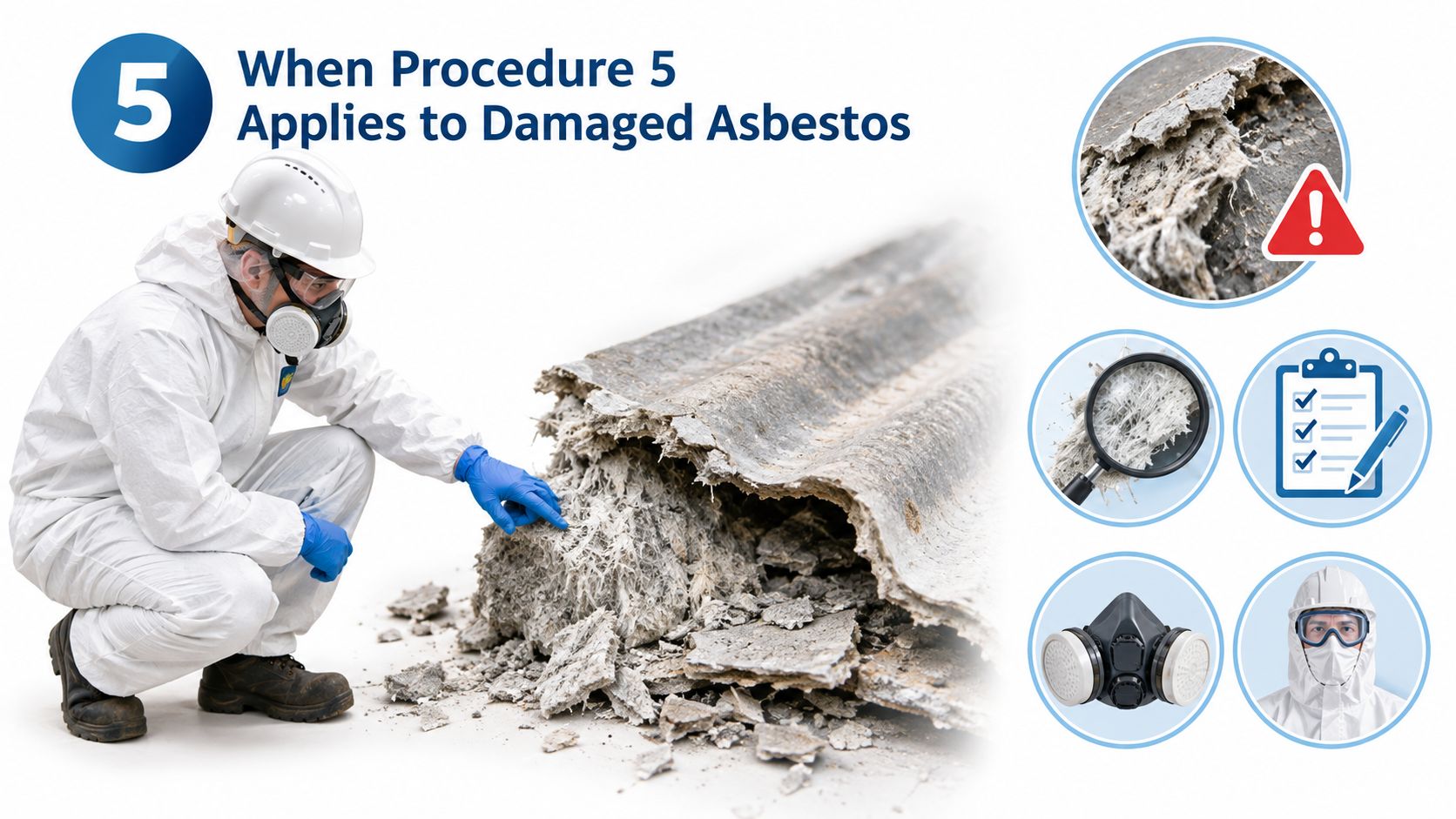
A fire-damaged property presents a different testing problem from an intact building awaiting renovation. Materials may already be broken, scattered, or mixed with debris, so the consultant must document both the suspect materials and the extent of disturbance.
Procedure 5 requires prior written SCAQMD approval before cleanup or abatement involving damaged or disturbed ACM begins, regardless of project size. The District's Procedure 5 submission guidelines call for a notification, a site survey with sampling and laboratory analysis, and a site-specific cleanup plan.
What the submission needs to establish
The documentation should explain the site conditions and proposed response clearly enough for regulatory review:
- Cause and extent: Describe what happened, where disturbance occurred, and the observed contamination boundaries.
- Survey and laboratory findings: Identify samples, analytical results, consultant observations, and recommendations.
- Material inventory: Record ACM type, condition, quantity, and locations.
- Work-area preparation: Describe containment, entry and exit arrangements, and access controls.
- Migration and emission controls: Explain how the proposed work will limit movement beyond the affected area.
- Decontamination: Document the arrangements for personnel and equipment.
- Waste management: Address handling, transportation, and disposal.
- Air monitoring: Specify proposed monitoring types and clearance levels.
- Post-removal cleanup: Describe completion measures and the supporting documentation.
The District's Procedure 5 planning information also identifies circumstances such as disaster-affected materials, open-air work, site cleanup, demolition with asbestos left in place, and alternative engineering controls. These conditions call for site-specific evaluation rather than a generic plan copied from another address.
Where professional testing fits
Bulk sampling means collecting representative pieces of suspect material for laboratory analysis. The laboratory findings help identify which sampled materials contain asbestos, while the consultant's inspection establishes location, condition, and the relationship to the disturbance.
Neither part replaces the other. A laboratory result without a documented location is difficult to apply to a work area; photographs without analysis don't establish material composition.
A positive result doesn't automatically dictate removal. It helps the owner and qualified professionals evaluate the planned disturbance and applicable requirements. Understanding testing before asbestos removal decisions can help keep assessment, regulatory planning, and contractor responsibilities separate.
What to Do When Untested Material Turns Up
A crew opens a wall and exposes pipe wrap that wasn't accessible during the original survey. The existing report doesn't establish what that newly exposed material contains, and continuing to pull it apart won't resolve the uncertainty.
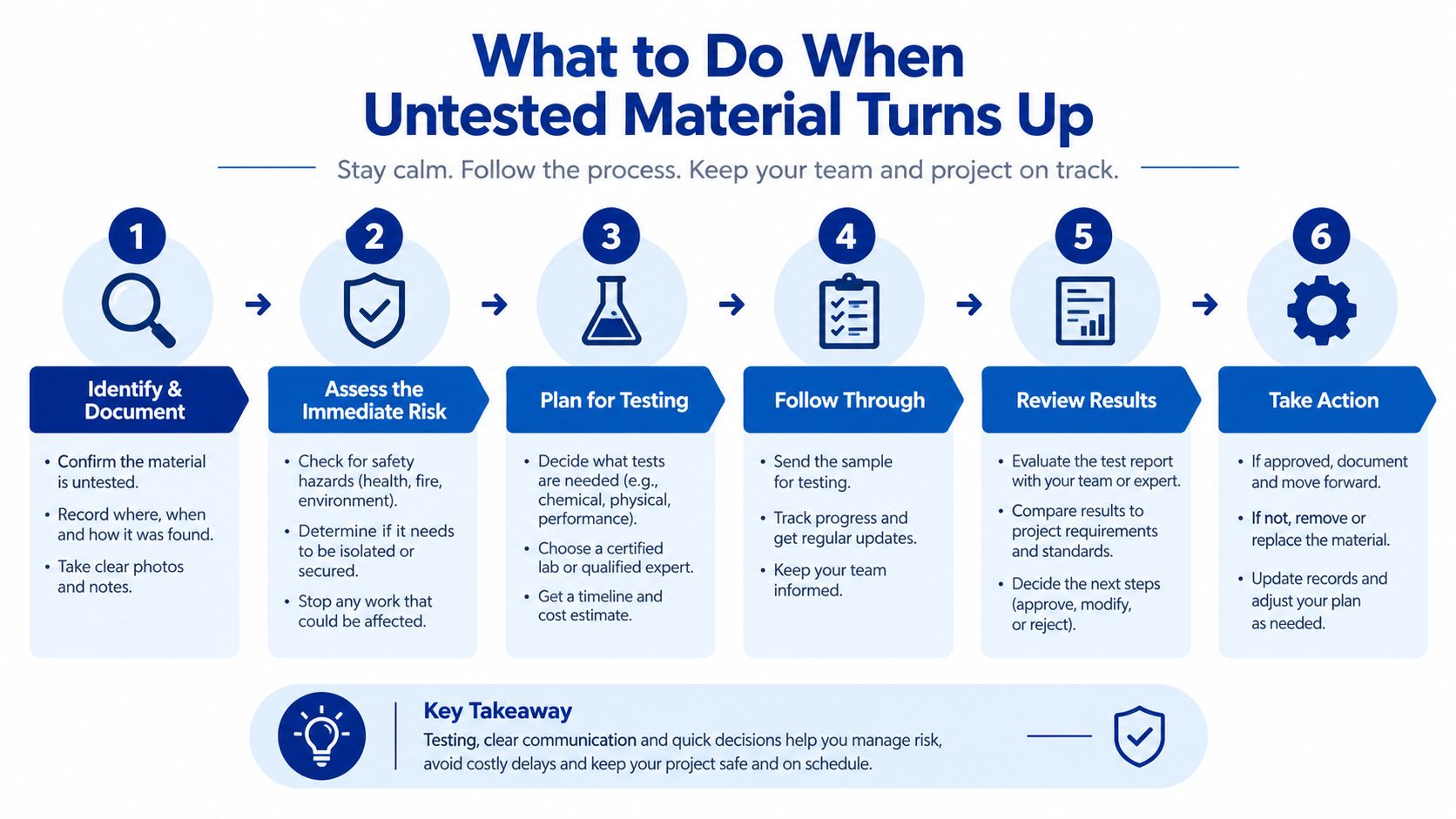
Treat the discovery as a pause in the affected work, not permission to make a visual judgment. The response should preserve the material's condition and give the consultant enough information to evaluate the changed scope.
Use a documented discovery response
- Stop disturbing the material and isolate the area. Avoid creating additional damage while its composition remains unknown.
- Limit access and prevent spread. Keep people from tracking material out, and leave dust-control decisions to qualified personnel rather than improvising with ordinary cleaning equipment.
- Document the discovery. Record the location, date, photographs, and work already performed so the consultant can reconstruct the sequence.
- Arrange representative sampling. Have a qualified professional collect samples for laboratory analysis instead of asking the crew to select a convenient fragment.
- Extend the survey and evaluate notification changes. If the newly identified material is ACM that will be disturbed or removed, address the revised scope with the District.
- Evaluate Procedure 5. If ACM has been damaged or disturbed, prepare the required site-specific documentation before corrective work.
- Secure approval for an alternative procedure. Don't substitute an approval-based method in the field without the required written authorization.
Distinguish draft guidance from adopted requirements
SCAQMD's draft FAQ for proposed Rule 1403 amendments expressly discusses surveying newly discovered materials and revising notifications when newly identified ACM will be disturbed. It is proposed guidance, not a substitute for the currently effective adopted rule.
Date the discovery checklist and identify the adopted requirements used to make the decision. If the team consults draft material, label it as draft in the project file so a contractor doesn't later mistake it for an enforceable instruction.
Finding an untested material doesn't necessarily invalidate every earlier result. It does mean the team must evaluate the newly exposed material before extending the work into it.
The practical trade-off is between a controlled pause and an undocumented expansion of disturbance. A focused supplemental inspection can address the discovery while preserving the distinction between previously surveyed areas and the new condition.
Confirm Your Compliance Path Before Work Begins
Start by opening the adopted rule, checking its revision and effective-date information, and recording which version the project team used. Date the compliance checklist, survey scope, and project memo so later reviewers can distinguish original decisions from revisions.
Then compare the contractor's scope with the proposed inspection. “Kitchen renovation” isn't enough detail for a survey proposal if the contractor also intends to open a ceiling, replace piping, or remove adjacent finishes.
Prepare the information the consultant needs
Give the testing provider a useful project package before the site visit:
- Property background: Available construction history, occupancy information, and prior environmental reports.
- Drawings and scope: Marked plans showing components to be cut, drilled, stripped, or demolished.
- Access limitations: Locked rooms, concealed spaces, occupied areas, and components that can't yet be reached.
- Schedule: Permit milestones, proposed mobilization, and dependencies between trades.
- Incident history: Known water damage, fire damage, previous repairs, or earlier material disturbance.
- Regulatory correspondence: Any Notice to Comply or District communication, including the issue requiring a response.
For a Notice to Comply, ask the consultant to tie the testing scope and report directly to the documented issue. Don't assume a generic inspection report answers a specific regulatory request.
Keep lead testing separate from asbestos testing
Asbestos findings don't answer whether painted components contain lead. For covered renovation in pre-1978 homes and child-occupied facilities, EPA's framework requires affected painted surfaces to be tested or presumed to contain lead-based paint, as described in its Renovation, Repair and Painting steps booklet.
Testing methods and professional roles differ. Under EPA's contractor guidance, a certified renovator may perform authorized component testing, but only a certified lead-based-paint inspector or risk assessor may conduct a formal inspection and prepare that inspection report. Testing records may also have real-estate disclosure implications, so preserve them with the property documentation.
A visual check doesn't replace analytical identification. An authorized lead test kit has a defined purpose, but it doesn't replace an asbestos survey, and it shouldn't be presented as a formal lead inspection report.
Ask for a report the project team can use
A useful asbestos deliverable connects sampling locations, laboratory results, material quantities, condition, and friability observations to the planned disturbance. It should identify inaccessible areas and explain limitations rather than imply that unsampled spaces were evaluated.
Ask prospective providers about applicable qualifications, the laboratory they use, the report format, and how findings will support notification and permit coordination. Clarify who prepares filings and who remains responsible for submitting them.
For occupied commercial properties, asbestos management documentation should remain accessible to facility managers and future project teams. Keep survey revisions and supplemental sampling with the original report rather than in separate contractor email threads.
Other concerns require their own testing questions. Fire residue assessment may address ash, soot, char, or heavy metals; water-damage investigations may call for mold assessment; and indoor air quality concerns may require a targeted sampling scope. None should be treated as automatically covered by an asbestos inspection.
Results guide decisions within the documented scope. They don't guarantee that an entire property is free of asbestos or other contaminants, and a positive finding doesn't by itself determine every next step.
Sensitive Environmental provides pre-renovation and pre-demolition asbestos surveys, Procedure 5 testing and documentation, and lead testing for properties across Los Angeles County and Southern California. Visit Sensitive Environmental to discuss your work scope and schedule the appropriate inspection before committing crews or finalizing the permit sequence.