Vinegar can suppress some surface mold under narrow conditions, but it isn't reliable for porous materials, hidden growth, or extensive contamination: household vinegar containing 4.0–4.2% acetic acid inhibited one tested fungus but not another. An inspection answers the more important property question, whether the moisture problem extends beyond the visible mildew.
A cleaner-looking surface can be reassuring without providing much evidence about the condition of a building. For Los Angeles homeowners, landlords, and facility managers, the useful distinction is between a household cleaning result and a documented environmental assessment.
Table of Contents
- The Question Most People Are Really Asking
- What the Laboratory Evidence Shows About Vinegar and Mold
- When Vinegar Can Be Used Safely on Surfaces at Home
- Why Porous Materials Change the Calculation Entirely
- When Vinegar Stops Being Enough and Testing Becomes the Next Step
- A Practical Decision Aid for Los Angeles Property Owners
- Why Professional Mold Testing Matters in Los Angeles Buildings
The Question Most People Are Really Asking
A homeowner notices mildew on shower tile, reaches for white vinegar, and expects a straightforward answer: will this fix it? A renter facing recurring bathroom growth may have a different concern, whether cleaning will resolve the condition before another conversation with the landlord.
Both are reasonable questions. Neither can be answered by looking only at the cleaning product.
The question “does vinegar kill mold and mildew?” combines several separate decisions. A treatment might inhibit a particular fungus, improve the appearance of a surface, or physically remove visible material. Those outcomes aren't interchangeable, and none automatically establishes the condition of concealed building materials.
The organism and the material matter
The laboratory evidence identifies fungal species as a meaningful variable, while building guidance identifies material porosity as another. Vinegar's effectiveness also depends on concentration, contact time, and whether growth is superficial or embedded, as explained in this review of vinegar's species-dependent limitations.
For a property owner, that creates a more useful set of questions:
- What's affected? A cleanable tile face and the material behind it require different evaluations.
- What caused the moisture? Cleaning isn't a substitute for investigating a leak or recurring dampness.
- What decision needs support? Routine housekeeping, a tenant dispute, and a renovation project don't require the same documentation.
Consider the difference between mildew confined to a shower's glazed surface and staining on the adjacent wall after a plumbing leak. These are hypothetical examples, not case studies. The first may fit a narrow household-cleaning situation; the second raises questions about material condition and concealed moisture.
Practical rule: Judge the problem by the affected material and moisture history, not by how quickly a stain disappears.
An environmental inspection doesn't need to begin with a promise to identify every organism. It should begin with the building question that matters: what's affected, why is it wet, and what evidence would support the next decision?
What the Laboratory Evidence Shows About Vinegar and Mold
The strongest reason to question vinegar's universal reputation is the contrast between organisms tested under controlled conditions. In the controlled antifungal study, household vinegar containing 4.0–4.2% acetic acid produced a mean 15 mm inhibition zone against Penicillium chrysogenum, but no measurable inhibition against Aspergillus fumigatus.
An inhibition zone measures an area where fungal growth was suppressed under the test conditions. It doesn't measure successful treatment of an occupied building, penetration into drywall, or complete removal of contamination. The vinegar also reduced spore production in both tested organisms, which illustrates why growth inhibition, spore production, and eradication are different endpoints.
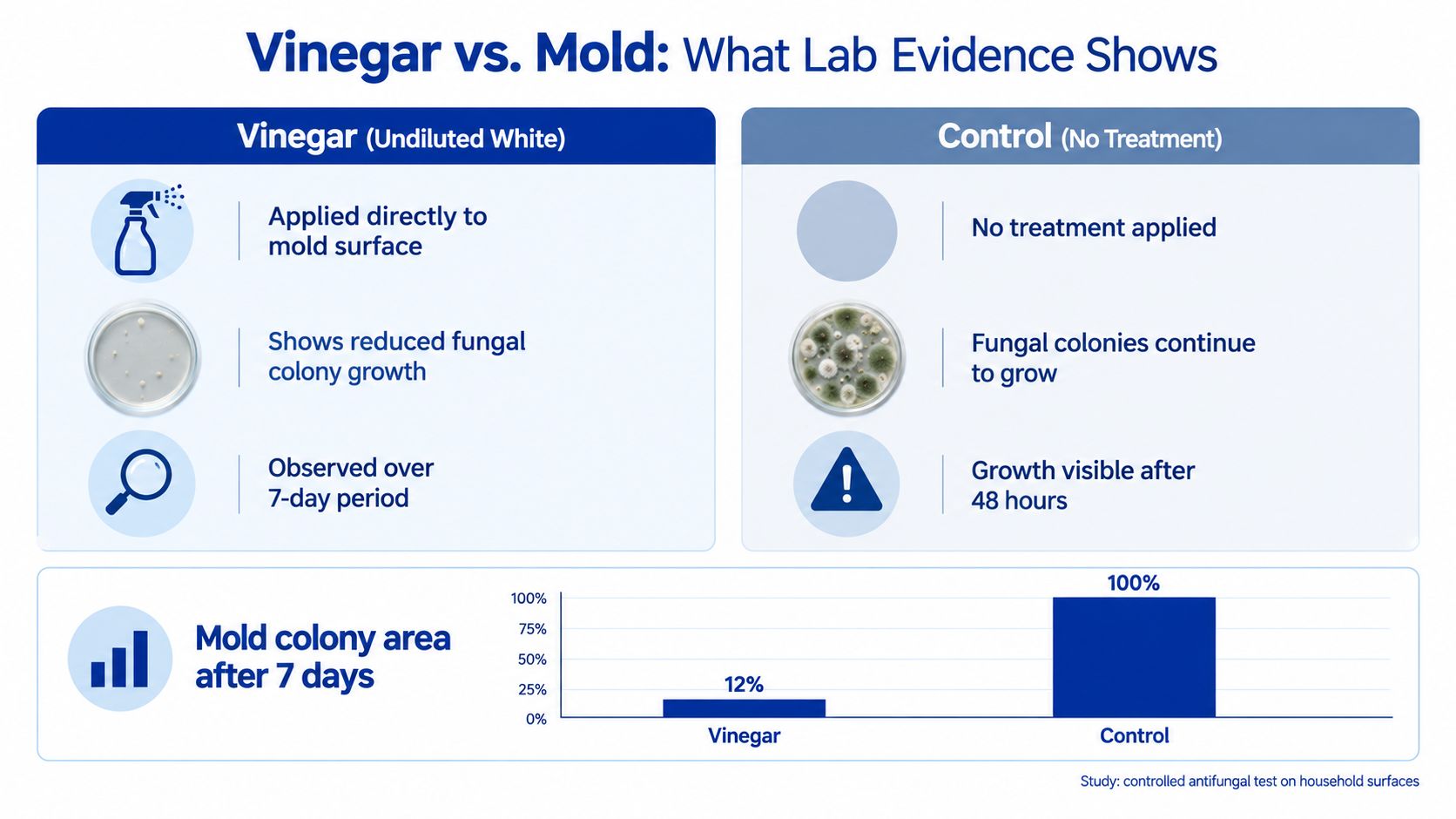
The illustration shouldn't be treated as a quantitative summary of that study. Its colony-area comparison and household-surface framing aren't established by the laboratory findings discussed here; the supported comparison is the species-specific inhibition result.
What the experiment doesn't establish
Acetic acid suppresses fungal growth through acidity and organic-acid toxicity. However, a controlled growth medium isn't a bathroom wall, carpet assembly, or ceiling cavity. Surface debris, temperature, moisture, contact time, and the material itself can change performance.
| Laboratory finding | Reasonable interpretation | Unsupported conclusion |
|---|---|---|
| Growth inhibition against a tested organism | Vinegar can suppress that organism under those conditions | Vinegar works against every household mold |
| Reduced spore production | The treatment affected a measured fungal process | All contamination was eliminated |
| A measurable inhibition zone | Growth suppression occurred in the test medium | The treatment penetrates building materials |
The frequently repeated claim that vinegar kills 82% of mold species isn't an established general statistic, as the species-dependent evidence review cited earlier explains. Applying it to every surface and cleaning condition gives readers confidence the available evidence doesn't justify.
The analytical conclusion is narrower but more useful: vinegar has some antifungal activity, not a demonstrated universal building-treatment capability. A cleaner appearance can't tell you which laboratory outcome, if any, occurred on your surface.
When Vinegar Can Be Used Safely on Surfaces at Home
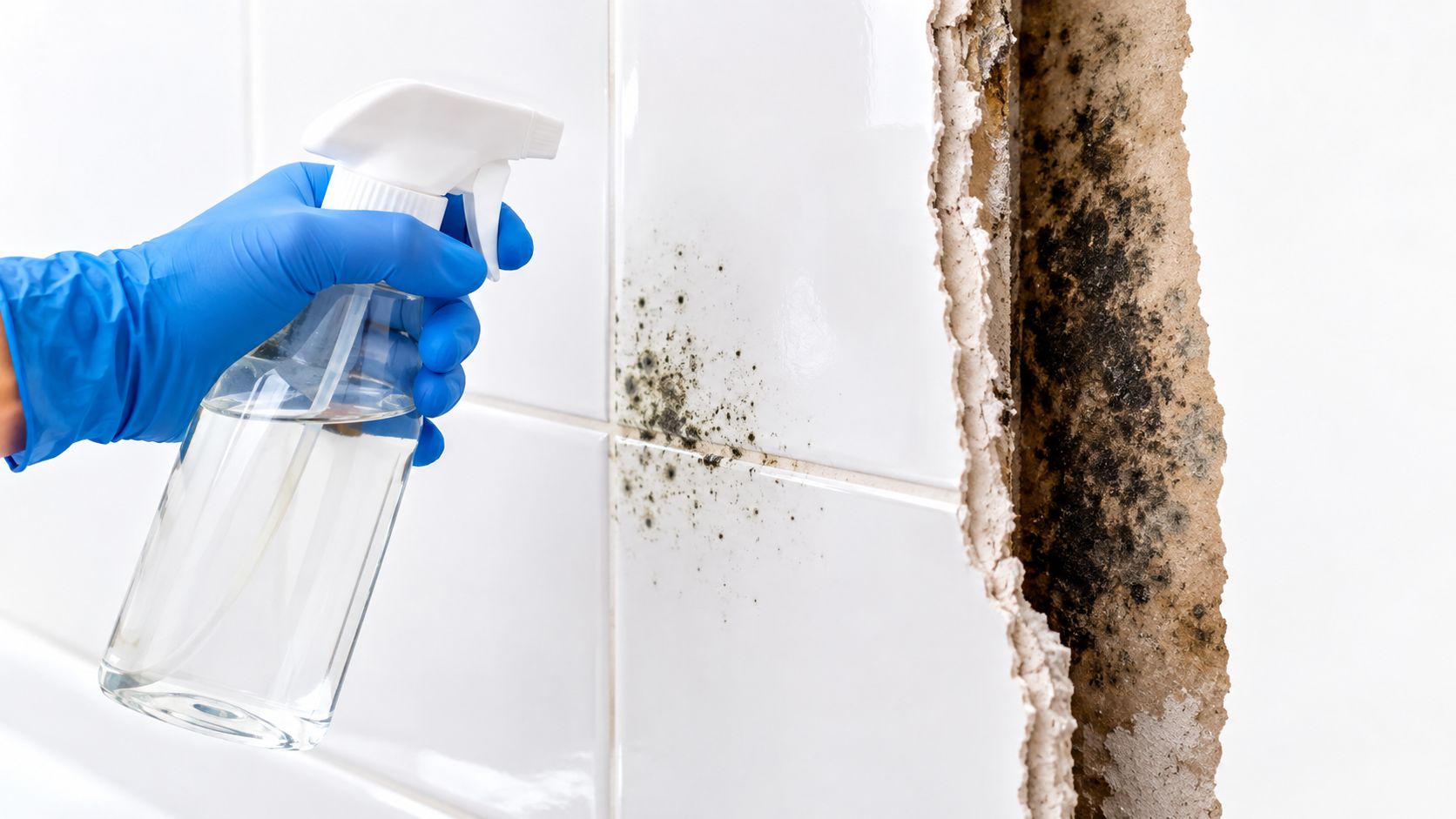
A limited use case exists: small, recent surface growth on a clean, nonporous, compatible material such as glass or glazed tile. Undiluted white vinegar may provide limited suppression when followed by physical wiping and complete drying, but that isn't the same as validated disinfection.
Before choosing a cleaning method, establish whether you're dealing with an isolated surface condition or evidence of water damage. Persistent growth, hidden contamination, and extensive affected areas belong in an assessment conversation, not an escalating series of household chemical experiments.
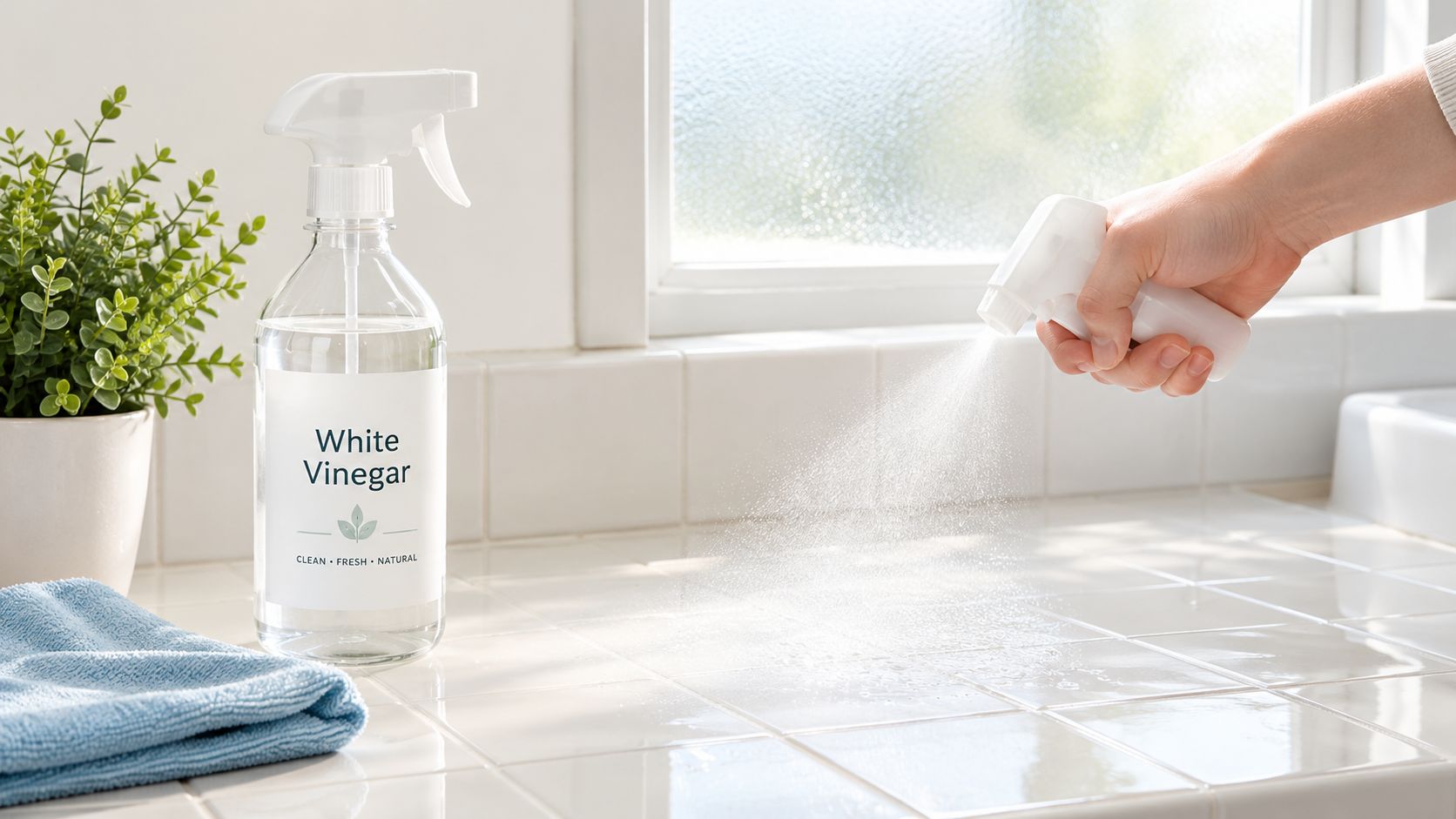
Keep the application narrow
- Confirm compatibility first. Check the surface manufacturer's cleaning guidance rather than assuming every hard finish tolerates acidic cleaners. Glazed tile doesn't establish the suitability of adjacent grout, sealants, or backing materials.
- Don't invent a dilution recipe. Dilution changes the acid concentration. The evidence doesn't establish a household dilution ratio that guarantees mold control.
- Avoid a universal contact-time promise. Allowing contact matters, but there's no supported dwell time here that proves complete eradication across species and surfaces.
- Use physical cleaning and drying. Don't interpret spraying alone as removal of the affected material. Examine the area afterward and investigate recurrence.
As practical handling precautions, wear protective gloves, provide ventilation, and follow applicable product instructions. These precautions don't expand the situations in which vinegar is appropriate.
Chemical warning: Never mix vinegar with chlorine bleach. The combination can generate hazardous chlorine gas.
That mixing prohibition, along with the limits of household treatment, is explained in this discussion of vinegar, bleach, and mold assessment.
For an inspection-sensitive situation, document the condition before altering it where practical. A landlord, insurance professional, or environmental consultant may need to understand what was originally visible. Household cleaning can be a reasonable maintenance action in a narrow setting, but it shouldn't erase the evidence needed to evaluate a larger problem.
Why Porous Materials Change the Calculation Entirely
A stain on a ceiling tile after a bathroom leak raises a different question from growth on glass. The relevant issue isn't whether a chemical can affect the visible fungus. It's whether the material can be evaluated and cleaned throughout its affected structure.
The EPA's guide to mold and moisture in homes explains that mold can grow into the pores and crevices of absorbent materials. Carpet, ceiling tiles, and other porous materials may have to be discarded because complete removal can be difficult or impossible. EPA also emphasizes scrubbing hard surfaces with detergent and water, drying them completely, and controlling moisture rather than routinely relying on mold-killing biocides.
Evaluate the assembly, not just the exposed face
Consider a Los Angeles rental with staining beneath a sink, a commercial suite with affected ceiling materials, or carpet associated with a water-damage event. These examples illustrate assessment questions, not predetermined findings.
An inspector needs to distinguish among the exposed surface, underlying material, and adjoining areas. A cleaned wall face doesn't establish the condition of insulation or a concealed cavity. Likewise, a dry-looking carpet surface doesn't provide drying verification for the assembly beneath it.
- Material identification helps determine whether surface cleaning is a plausible response.
- Moisture investigation addresses whether the original cause has been corrected.
- Extent assessment helps establish whether the visible patch represents the full affected area.
For owners evaluating a leak or flooding history, this guide on how to check for mold after water damage provides a relevant starting point for organizing an inspection.
If vinegar makes mold disappear, how do I know it isn't inside?
You can't establish that from appearance alone. The answer depends on material type, moisture history, drying verification, and whether the inspection identifies reasons to investigate concealed areas. Sampling may support a defined question, but it isn't automatically necessary.
Facility managers coordinating subsequent work may also consult WipesBlog.com's commercial mold removal guide for facility managers as a separate operational resource. Cleaning guidance should remain distinct from the environmental assessment used to characterize conditions and document decisions.
The important conclusion is not that every porous material must be removed. It's that a surface treatment can't establish its suitability for continued use. Owners and qualified professionals need material-specific evidence before selecting next steps.
When Vinegar Stops Being Enough and Testing Becomes the Next Step
Persistent growth after cleaning is a reason to investigate, not proof that a stronger chemical is needed. Lingering odors, water-damage history, suspected hidden growth, or reported occupant symptoms also warrant a closer evaluation. Symptoms should be documented without assuming mold is their cause.
A professional response doesn't have to mean collecting air samples immediately. CDC/NIOSH guidance on mold testing discourages routine mold air sampling because short-term samples may not represent actual exposure and indoor mold concentrations can't be interpreted against health-risk thresholds. There are no health-based standards for mold in indoor air.
Inspection first, sampling for a reason
A documented visual and moisture assessment should establish the observed condition and the question that remains unanswered. If sampling is justified, the consultant should explain why a surface, bulk-material, or air sample is appropriate for that question.
For example, identifying suspected growth on a particular material differs from investigating a broader indoor-air concern. Neither task is answered by purchasing a test kit and receiving a laboratory result. The location, material, method, and building observations determine what that result can reasonably mean.
A laboratory result is evidence about a sample, not a verdict on an entire property.
Documentation becomes particularly important when other people must rely on the findings:
- Landlords and tenants may need a clear record of observations, moisture conditions, and actions.
- Commercial and healthcare facility managers may need an assessment scope that supports accountable decisions.
- Insurance and restoration professionals may need findings connected to the water-damage history and affected materials.
- Real estate participants may need an investigation that addresses a specific due-diligence concern rather than a general reassurance.
Results should inform decisions, not dictate them automatically
A positive result doesn't automatically mean remediation is required. Its significance depends on the inspection findings, material condition, project objectives, and the interpretation of qualified professionals.
For owners considering subsequent work, when mold remediation is required is a related decision topic, not a reason to presume every test leads to removal.
The next step after vinegar becomes inadequate is therefore a better-defined investigation, not necessarily more sampling. Testing adds value when it resolves an uncertainty that affects what the owner or project team should do.
A Practical Decision Aid for Los Angeles Property Owners
Choose the next step according to the condition and the decision you need to make. A renter documenting recurrent bathroom growth, a property manager inspecting a vacated suite, and a contractor preparing to open a water-damaged wall face different responsibilities.
The comparison below isn't a clearance standard. It's a way to distinguish a limited maintenance situation from one that needs professional evaluation.
Vinegar vs Professional Testing, When Each Applies
| Situation | Reasonable Next Step | Why |
|---|---|---|
| Small, recent growth on compatible glass or glazed tile, with the moisture cause corrected | Careful surface cleaning, complete drying, and monitoring | A narrow household-cleaning situation may be appropriate |
| Growth involving drywall, carpet, insulation, or ceiling materials | Professional material and moisture assessment | Surface appearance doesn't establish the full material condition |
| Growth that returns or an odor that persists | Investigate the source and extent before further treatment | Repeated cleaning doesn't answer the underlying building question |
| Suspected concealed growth after a leak | Documented inspection, with sampling if it serves a defined purpose | Visible conditions may not resolve uncertainty about concealed materials |
| A school, medical office, tenant dispute, or insurance investigation | Establish a written assessment scope | Other decision-makers need interpretable documentation |
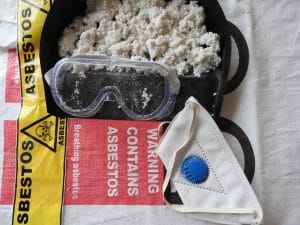
| Renovation or demolition affecting suspect building materials | Evaluate asbestos survey requirements separately | Mold assessment doesn't establish asbestos status |
Renovation introduces a separate compliance question
In Los Angeles-area projects, a concern that begins with mildew may lead to proposed disturbance of building materials. That changes the regulatory conversation.
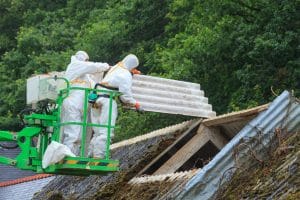
SCAQMD Rule 1403 requires an affected facility or component to be thoroughly surveyed for asbestos before demolition or renovation. Its requirements address identifying and quantifying applicable asbestos-containing materials, physical sampling, specified analytical methods, and analysis by laboratories accredited through the National Voluntary Laboratory Accreditation Program.
Asbestos testing and mold testing answer different questions. A mold observation doesn't establish asbestos content, and vinegar doesn't satisfy asbestos survey requirements.
For contractors, architects, and property managers, the practical recommendation is to define the intended work before disturbing materials. An environmental consultant can then evaluate the assessment scope and applicable compliance obligations rather than treating a visibly clean surface as permission to proceed.
Why Professional Mold Testing Matters in Los Angeles Buildings
Useful environmental testing produces a traceable explanation of conditions. It should show what the inspector observed, where samples came from, why those samples were collected, and how the laboratory findings relate to the property question.
U.S. Navy industrial-hygiene guidance summarizing CDC, EPA, AIHA, and OSHA recommendations advises using experienced professionals, documented sampling protocols, and an AIHA-accredited environmental microbiology laboratory or equivalent. Routine sampling is generally discouraged, while surface or bulk sampling may be appropriate when there's a specific need to identify visible growth.
What a defensible investigation should contain
- A defined scope. State the question being investigated and any limits on access or evaluation.
- Recorded building observations. Connect visible conditions, material types, and moisture findings to the investigation.
- Purposeful sample locations. Explain why each sampled location is relevant rather than treating collection as an end in itself.
- Traceable laboratory handling. Document chain of custody and analytical methods.
- Integrated reporting. Interpret laboratory findings alongside the inspection, with appropriate limitations and recommended next steps.
Household cleaning can change or remove material at a location that later testing needs to interpret. Where documentation matters, preserving a record of pre-cleanup conditions helps the consultant explain what was assessed and what had already been altered.
Clarity without a safety guarantee
For owners seeking professional mold inspection in Los Angeles for a home or business, the service should provide decision support, not an unsupported certification that the property is safe. Laboratory findings can characterize sampled material; they can't independently resolve every question about a building.
A report should also distinguish environmental findings from medical conclusions and from the scope of any subsequent contractor work. Post-work verification, when appropriate, needs defined criteria rather than a promise based on appearance alone.
Vinegar's limited antifungal activity is useful context. Professional assessment becomes valuable when an owner needs to know what remains uncertain, which evidence matters, and what action that evidence supports.
Sensitive Environmental provides professional mold inspections, appropriate sampling, laboratory analysis, and clear reporting for properties in Los Angeles and Southern California. If growth returns after vinegar treatment, porous materials were affected, or a leak has left unanswered questions, contact the team to discuss a documented mold and moisture assessment before choosing your next step.