A musty house smell most often comes from persistent moisture feeding mold and other microbes, which release musty microbial chemicals into the air. That smell alone doesn't name a mold species or prove that any growth is visible.
The usual advice starts in the wrong place. You're told to bleach what you can see, open windows, light a candle, or buy a stronger air freshener. If the odor fades for a day, you're expected to call it solved.
Treat the smell differently. It's a building clue, not a diagnosis. A fresh coat of paint can look spotless while a slow plumbing leak wets the back side of the same wall. A fragrance can lower what your nose notices while damp insulation keeps doing exactly what it was doing before. The useful question isn't how to cover the odor. It's where water is staying long enough for microbes to use it, and how that air reaches the room you're standing in.
Table of Contents
- What Causes a Musty House Smell
- Where Musty Smells Start Room by Room
- Why Musty Odors Return in Southern California
- Health Signs That Call for a Closer Look
- How Mold and Air Testing Works
- Schedule Musty Odor Testing in Los Angeles
What Causes a Musty House Smell
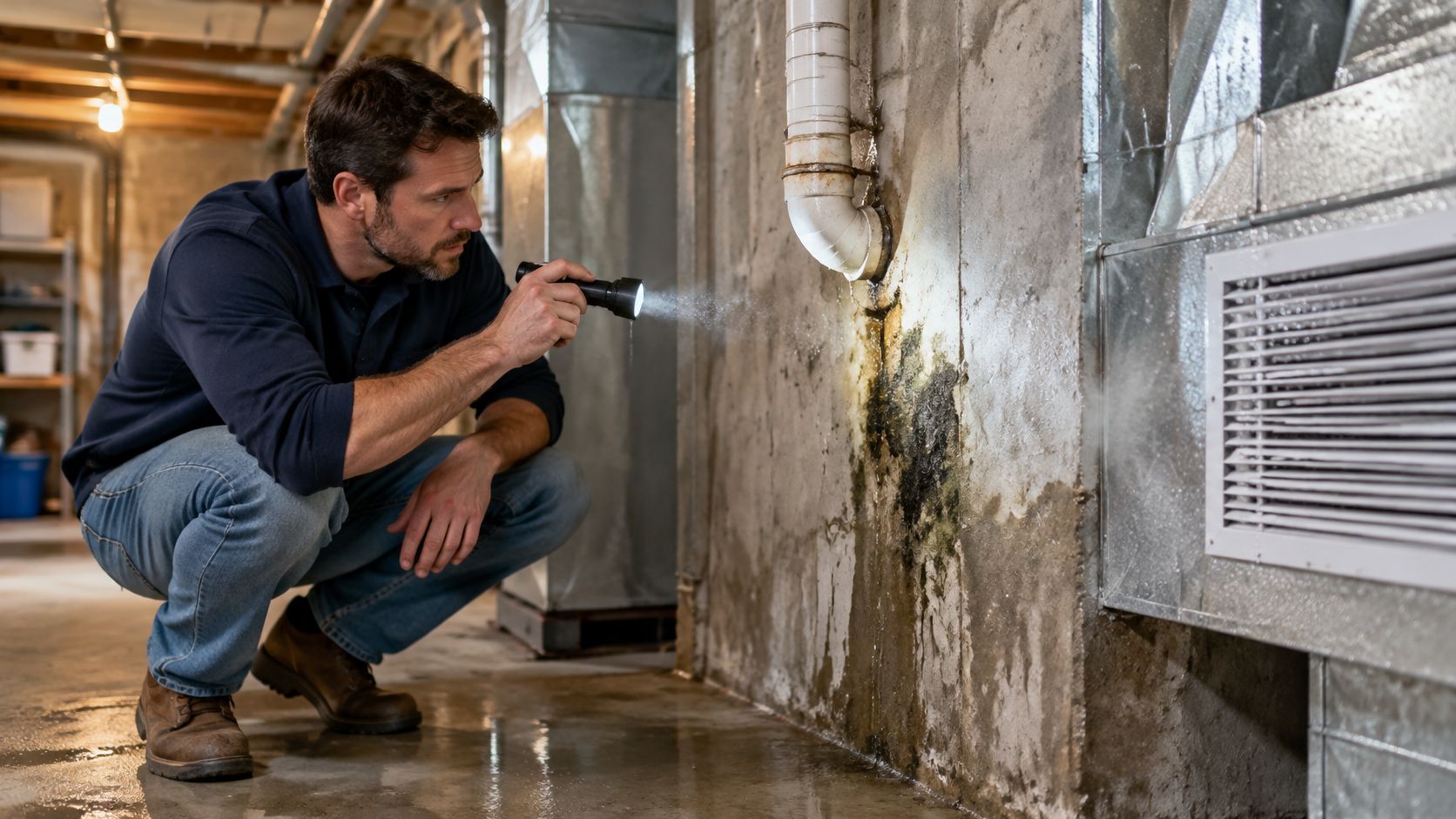
Say you walk into a Los Angeles bungalow after it's been closed up for a weekend. The living room smells faintly earthy. The back bedroom smells stronger, especially near the closet. There's no black patch on any wall, no puddle on the floor, and the paint looks fine. That pattern doesn't rule out a moisture problem. It tells you where to start looking for one.
Mold spores are common indoors under ordinary conditions. They become a problem when they land on material that stays wet enough for growth to begin. The everyday water sources are unglamorous: a leaking roof, window, or pipe, flooding that wasn't dried fully, wet carpet, a damp basement or crawl space, condensation on cold surfaces, and a bathroom where shower steam lingers because ventilation is poor. According to the CDC mold overview, mold can grow where moisture collects around roofs, windows, pipes, walls, plant pots, and flood-damaged areas, it may smell musty even when growth is hidden or barely visible, and keeping indoor relative humidity no higher than 50% throughout the day helps limit growth.
What Your Nose Actually Detects
You're not smelling the mold colony itself. You're smelling gases it gives off while it grows. Think of bread baking in a closed kitchen. You can smell it from the hallway because small airborne compounds travel, not because the loaf is in front of you. Microbial growth works on the same principle, with far less pleasant results.
Those compounds are called microbial volatile organic compounds, or mVOCs. The EPA mold course chapter on basic mold facts identifies mVOCs as a source of the characteristic moldy odor and says a moldy smell warrants investigation for concealed growth. The emissions can travel from wall cavities, beneath flooring, inside ceiling assemblies, around plumbing leaks, or within damp HVAC components, so the room where you notice the odor isn't always the room where growth is occurring.
Air movement shapes the pattern. A supply register can pull odor from a wet crawl space into a bedroom. A bathroom exhaust fan, a kitchen range hood, or a closed door can change which room smells strongest at a given hour. That's why a careful inspector tracks odor against weather, shower use, and HVAC operation instead of treating one sniff at the front door as a map.
Why the Smell Outlasts a Dry-Looking Surface
Porous materials hold the story longer than hard ones. Drywall paper, insulation, carpet padding, ceiling tile, wood framing, and upholstered furniture can retain moisture deep inside while the exposed face feels dry to your hand. They can also retain microbial residues after the surface has been wiped. A wall can therefore look clean, feel dry, and still emit odor from material on its back side.
The World Health Organization's 2009 indoor-air-quality guidelines describe microbial pollution as a major component of indoor air pollution and state that hundreds of species of bacteria and fungi can grow indoors when moisture is available. You don't need to memorize any species names to use that fact. It means a damp building supports a mixed microbial community, and no one can identify what's growing there by smell alone.
Practical rule: A strong smell doesn't measure a large problem, and a faint smell doesn't measure a small one.
Odor strength is a poor yardstick. A small, active, moisture-damaged area can produce a noticeable odor because it's actively growing and well connected to room air. A larger area that's dormant or sealed inside a poorly ventilated cavity may smell weaker. If you rank rooms by odor alone, you can easily chase the loudest smell and miss the wettest material.
Sorting the Cause Before You Test Anything
Use this table to place your odor in a group. It won't identify a species or locate hidden growth, but it tells you which building system deserves attention first.
Common causes of a musty house smell
| Cause group | Typical clue | What sustains it |
|---|---|---|
| Moisture and active mold | Earthy smell stronger in one area or after rain | Leaks, condensation, or wet porous materials |
| Damp HVAC components | Smell spikes when the system runs | Wet drain pans, coils, ducts, or crawl-space air |
| Stored or porous materials | Closet, garage, or furniture holds the odor | Damp cardboard, carpet pad, books, or upholstery |
| Pests and organic debris | Localized odor, sometimes with droppings | Dead rodents or nests in walls, attics, or crawl spaces |
| Smoke or fire residue | Smoky-stale mix after a fire | Ash, soot, char, or smoke residue in cavities |
Notice what the table can't do. It can't tell you whether growth is active or dormant, how far it extends, or which organism is present. What causes musty smell in house investigations go wrong when people skip that limit and jump straight to a generic air test or a stronger deodorizer. The smell signals that a moisture question needs answering. Inspection and moisture measurement supply the answer, and sampling decisions come after those findings, not before them.
Where Musty Smells Start Room by Room
Start with comparison, not demolition. Walk room to room and note where the odor is strong, faint, or absent. Then repeat the walk with the HVAC system off and again while it's heating or cooling. Add timing to your notes, such as after showers, after rain, during laundry, or first thing after the house has been closed overnight.
That simple map separates building-wide sources from local ones. If every room smells the same only while air is moving, the HVAC condensate path or duct system moves up your list. If one bathroom smells stronger an hour after a shower, local ventilation and wet drywall move up instead. If the odor appears two days after rain, look at roof and window interfaces rather than at the furniture.
Reading the Pattern in Each Space
Where a musty smell often starts
| Location | Odor pattern | First thing to check |
|---|---|---|
| Bathroom | Stronger after showers and slow to fade | Exhaust fan use, wet drywall, and failed caulk |
| Kitchen or laundry | Smell near cabinets or the washer | Slow supply leaks and damp toe-kicks |
| Bedroom closet | Stale odor in clothes or storage | Exterior-wall condensation and cardboard on the floor |
| Crawl space or basement | Smell at floor level or registers | Ground moisture, standing water, and wet insulation |
| Attic or ceiling | Smell after rain | Roof or window leaks and stained ceiling tile |
| HVAC system | Smell only while heating or cooling runs | Drain pan, coil, and duct moisture |
| Garage or storage | Earthy smell in boxes and furnishings | Damp stored goods and pest debris |
| Attic, wall, or crawl-space voids | Sour or musty smell with droppings or chewed insulation | Rodent nests, droppings, and dead animals |
Every check in that table is observational. You're looking for staining, bubbling paint, soft drywall, warped baseboards, standing water in a drain pan, droppings, or chewed insulation. You're also collecting history, such as a dishwasher leak last spring or a roof repair that never quite stopped a ceiling stain from growing. Those observations decide where a pin or pinless moisture meter should be used. They aren't repair instructions, and they don't require opening a wall on a hunch.
The Clean Room That Proves Very Little
A freshly cleaned room is weak evidence that a source is gone. Surface wipes reach the face of painted drywall, not the paper backing inside the cavity. Air fresheners compete with odor in room air, not with moisture inside carpet padding. If the smell drops after cleaning and returns when the house closes up, you've learned something useful. The source probably sits in a concealed or porous material that cleaning didn't reach.
Stored goods deserve the same skepticism. Cardboard boxes set directly on a damp garage slab wick moisture upward and hold it against books, clothing, and upholstered pieces. The boxes then smell musty even if the garage walls are dry. Moving the boxes tells you whether the odor travels with the contents or stays with the building, which is a useful diagnostic step.
Pests create a different signature. A rodent nest in an attic or wall void produces a sour, stale odor that's often strongest in one small area and may come with droppings, urine staining, or insulation that's been tunneled and packed down. A dead animal in a crawl space can mimic a moisture smell for weeks. If your notes point to a void and you find droppings, treat pest debris as a separate hypothesis rather than forcing every odor into a mold explanation.
Record the pattern before anyone samples anything. Write down room, time, weather, HVAC status, and recent water use for a few days. If there's been a leak or flood, the sequence in our guide to checking for mold after water damage shows how those observations connect to moisture measurement. A sample collected without that pattern is a number without an address. A sample collected because a meter found wet drywall behind a specific cabinet answers a question someone can act on.
Why Musty Odors Return in Southern California
People in Los Angeles ask a fair question. If the climate is dry, why does the smell keep coming back after cleaning? The usual answer is moisture stored in porous materials or recurring condensation, not a deodorizer that wasn't strong enough. Dry regional air doesn't cancel wet microclimates inside a building.
Two benchmarks keep this grounded. The EPA mold course chapter on moisture control recommends drying wet areas within 24 to 48 hours and maintaining indoor relative humidity below 60%, ideally 30 to 50%. It also names moisture sources people overlook, including indoor activities, cold surfaces, leaking or condensing pipes, poorly managed HVAC drain pans, and unsealed or uninsulated ducts.
Three Local Scenes That Look Nothing Alike
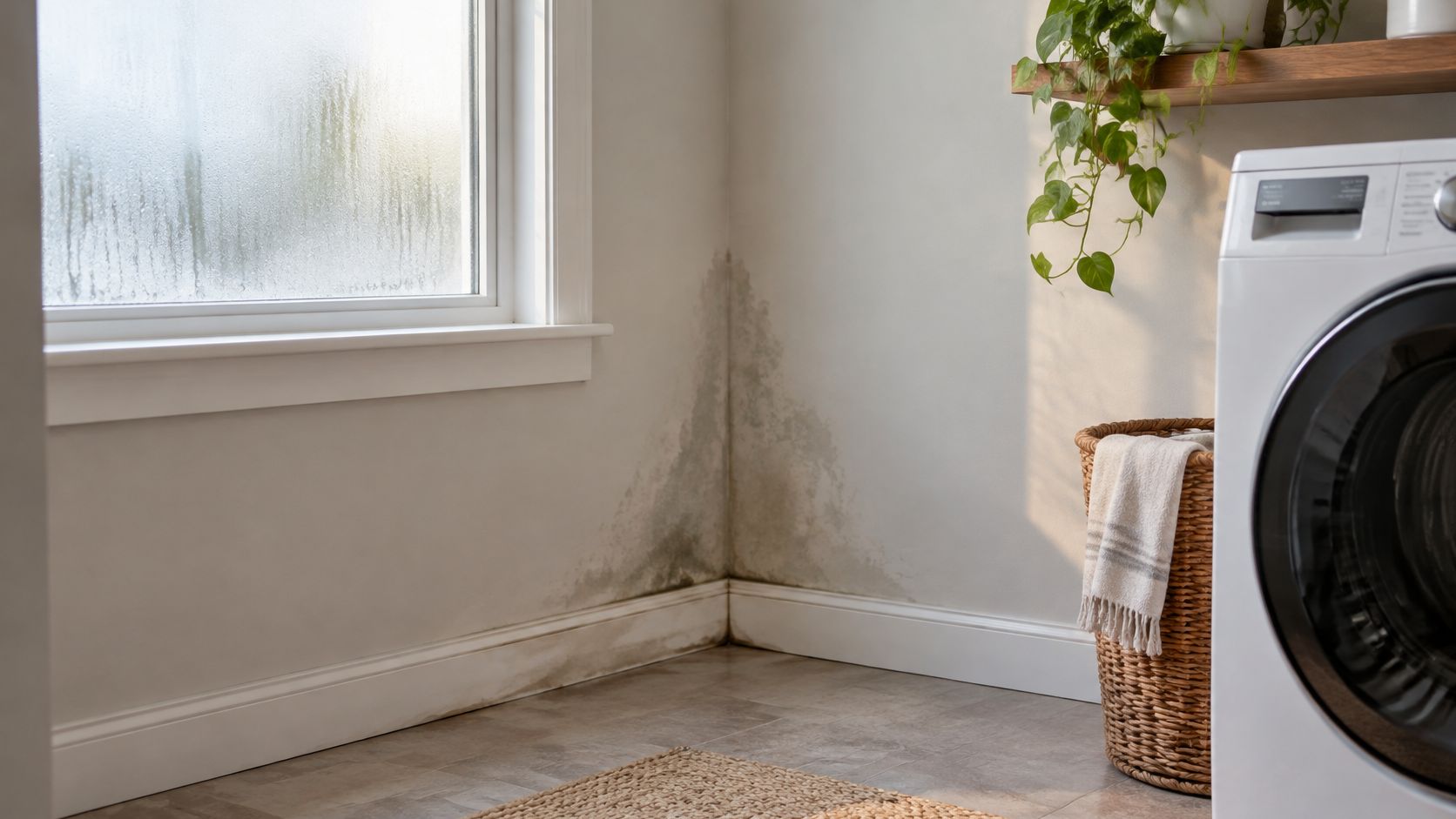
In a Santa Monica or Long Beach bathroom, marine air drifts in through an open window while shower steam hits a cool exterior wall. The mirror clears, the tile dries, and everyone assumes the room is fine. The drywall behind the vanity, shaded and slow to warm, can stay damp far longer. Repeat that cycle daily and the closet on the other side of the wall starts to smell like wet cardboard.
In a San Fernando Valley home, the problem runs in the opposite direction. Air conditioning chills supply ducts and ceiling surfaces during a heat wave. A partially clogged condensate line lets water sit in the drain pan and occasionally overflow onto the closet ceiling below. The stain looks minor. The insulation above it stays wet, and the odor arrives only when the system runs, which makes occupants blame the air itself rather than the water path.
In an older Pasadena or South Los Angeles bungalow, the crawl space does the work. Bare soil releases ground moisture, a disconnected duct spills conditioned air under the house, and floor registers draw that stale air upward. The living rooms can be spotless. The smell still greets you at floor level because its source sits below the floor, not in it.
Source Control Is Not Odor Control
Wiping a hard surface can remove residue from that surface. It does nothing for damp carpet padding, drywall, insulation, ceiling tile, or concealed framing that continues to emit odor. That's the distinction between source removal and odor removal, and confusing the two is why so many musty smells return on a predictable schedule.
Ventilation dilutes a smell. It doesn't dry a wall cavity, unclog a condensate line, or repair a leaking supply fitting.
Opening windows can even work against you during warm, humid spells by bringing more moisture indoors. That's why a hygrometer reading in the affected room tells you more than another round of fragrance. Log the humidity alongside which rooms smell and whether the HVAC system is running. If a wall was wet, verify that it's dry with meter readings before anyone repaints it. Paint over damp drywall doesn't end the story. It just gives the next chapter a cleaner cover.
For property managers and facility teams, that log becomes documentation. It shows whether an odor tracks with occupancy, weather, or equipment cycles across multiple units. It also prevents the most common waste in odor complaints, which is repeating cosmetic treatments in a unit whose real problem sits in a shared plumbing wall or a neglected drain pan two rooms away.
Health Signs That Call for a Closer Look
A musty odor belongs in a health conversation, but it isn't a diagnosis. It can't tell you which organism is present, whether exposure explains a particular symptom, or whether a building is safe. What it can do is point at dampness, and dampness has a documented track record worth taking seriously.
The WHO indoor air quality guidelines announcement from 2009 reports that approximately 20 to 30% of households in many European Union countries had problems with dampness. Its evidence review covered more than 100 studies and concluded that occupants of damp or moldy buildings had up to a 75% greater risk of respiratory symptoms and asthma. WHO materials also estimate that damp indoor environments affect roughly 10 to 50% of indoor environments across Australia, Europe, India, Japan, and North America. This isn't a wet-climate curiosity. It shows up across building types and regions, including dry ones.

Why Symptoms and Smell Don't Line Up Neatly
The odor comes from a mixture of volatile chemicals released by microorganisms plus odors absorbed into damp materials. Bacteria, fungi, spores, cell fragments, and microbial metabolites can all contribute to that earthy, stale character. Because porous materials retain contamination, a smell can remain after growth has stopped. Because growth can hide behind walls, under flooring, around HVAC systems, or inside insulation, a smell can also persist while every visible surface looks normal.
That cuts both ways. A lingering odor doesn't prove that hazardous mold is present or show how far contamination extends. A fading odor doesn't prove the building dried out. Anyone who promises that a smell, or a single test, settles the health question is selling certainty the building can't provide.
Triggers That Justify Investigation
Move from monitoring to professional investigation when you see a pattern like one of these.
- Returning odor: The smell comes back after the area was cleaned and supposedly dried.
- Known water event: A leak, flood, or overflow preceded the odor, even months earlier.
- Material changes: Staining, swelling, soft drywall, or lifting flooring appears near the smell.
- HVAC tracking: The odor arrives or intensifies when heating or cooling runs.
- Symptom pattern: Coughing, wheezing, or asthma flares ease when occupants leave the building.
That last trigger needs care. A symptom pattern is a reason to investigate the building and to talk with a clinician about the person. It isn't proof that mold caused the symptoms. If you're weighing that distinction, our overview of whether black mold can make you sick explains why species names and symptom lists don't substitute for medical evaluation.
Landlords, HOAs, schools, and facility managers should document before they sample. Record the complaint, the rooms involved, prior leaks, and any repairs already attempted. Professional follow-up then connects the odor to moisture mapping, visual inspection, and a ventilation review. Targeted sampling enters the picture when those findings justify it, not as a reflex purchase after the first complaint.
How Mold and Air Testing Works
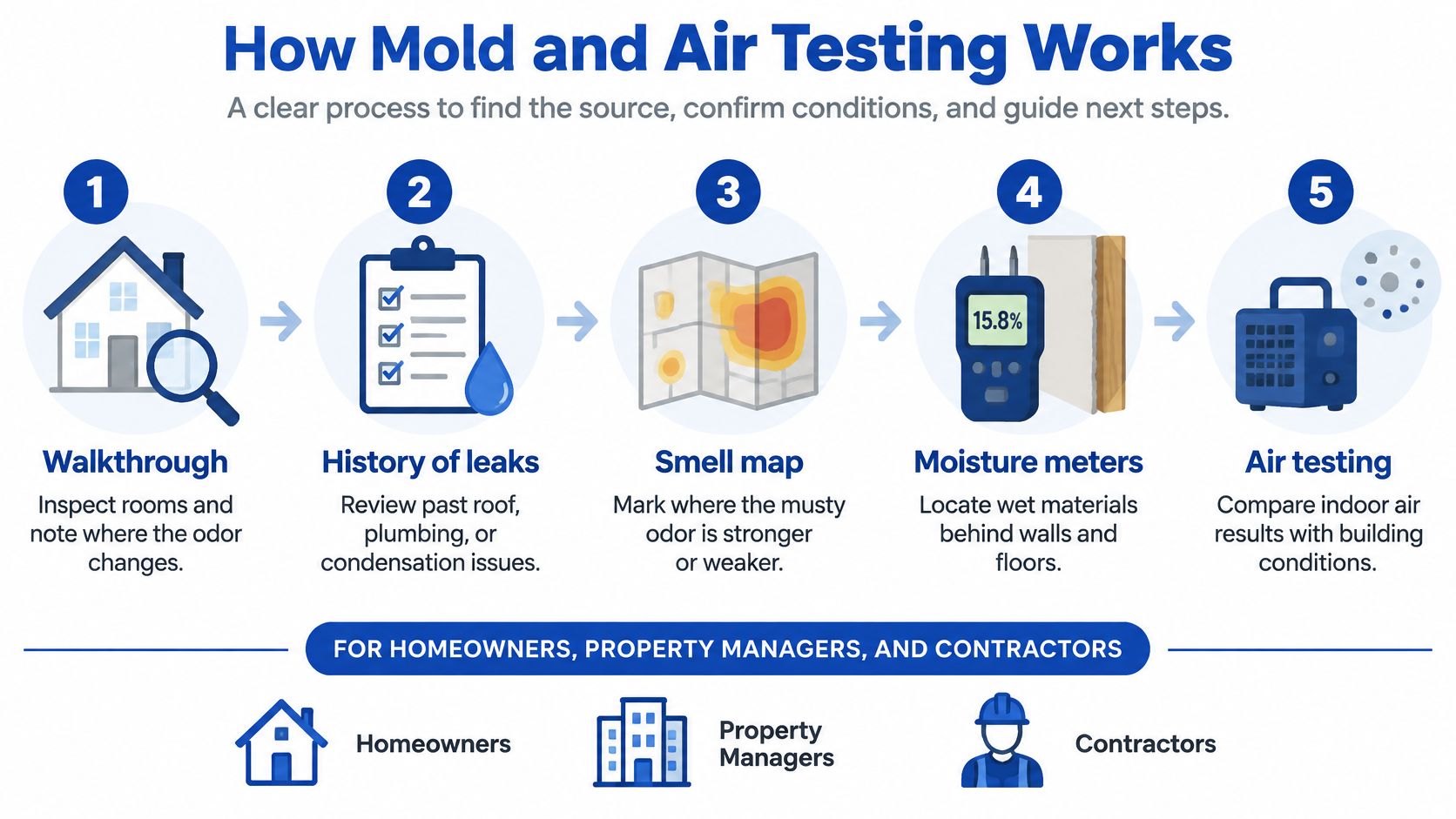
Order matters more than any single instrument. A sound investigation starts with a walkthrough, a history of leaks, and a map of where the smell changes. Sensitive Environmental puts it plainly. If you smell mold, see it, or have a water leak, there may be mold. That possibility earns an inspection. It doesn't yet earn a conclusion.
Our home environmental inspection process follows a set sequence: a full property walkthrough, identification of environmental hazards, targeted sampling and testing, laboratory analysis, and detailed reporting with next steps. Each stage narrows the next one. Sampling locations get chosen because a room smelled stronger, a wall showed staining, or a meter found moisture, not because a kit contained a fixed number of cassettes.
Moisture First, Then Samples
Moisture meters locate wet building materials behind walls or under floors without opening everything up. A pin meter reads moisture inside wood or drywall at the probe points. A pinless meter scans a wider area to show whether dampness is a small spot around one fitting or a broad pattern across a wall. Mapping those readings room by room shows the shape of the problem.
Visual inspection comes before air sampling, and there's a firm reason. The EPA mold course chapter on sampling explains that air sampling describes airborne conditions only at the moment of collection, that it shouldn't replace visual inspection, and that a negative sampling report must not substitute for a visual survey. Air changes by the hour. A closed window, a running air handler, or a door left open can all shift what a cassette captures.
What a sample can say: Surface and air samples can help identify certain mold types, distinguish mold from soot or dirt, or assess whether indoor concentrations are comparable to local outdoor air.
Those are real uses, and laboratory analysis should follow recognized professional analytical guidance so results can be interpreted consistently. But notice the boundaries. A sample identifies what was collected at a location and time. It doesn't certify that a house is mold-free, and it doesn't locate the leak that fed the growth. That location work belongs to the inspection and meter readings that came first.
Store Kits Versus Professional Testing
DIY kits versus professional mold and IAQ testing
| Factor | DIY kit | Professional testing |
|---|---|---|
| Moisture location | Not mapped | Moisture meter readings and mapping of wet materials |
| Visual inspection | None or limited to what the user can see | Documented walkthrough of walls, floors, HVAC, and water history |
| Sampling locations | Chosen without inspection findings | Chosen from inspection findings and moisture data |
| Laboratory analysis | Method often not stated | Recognized analytical guidance with clear reporting |
| What it can support | Limited observation | Written report of findings, sampling locations, and results |
A kit can't inspect your HVAC condensate path, can't tell a damp toe-kick from a dry one, and can't explain why one cassette should represent a whole house. It's a snapshot without a scene around it. Professional mold testing in Los Angeles documents the scene: where moisture was found, what conditions were visible, where samples were taken, and what the laboratory reported.
That report supports decisions without dictating them. A positive result doesn't by itself require remediation or abatement. It gives owners and other qualified professionals documented findings for choosing next steps, which might include drying verification, targeted repairs, further sampling, or work by a separate contractor. Our role stays on the inspection, sampling, analysis, and reporting side of that line.
Two service paths branch from here. Mold testing fits when inspection finds moisture, staining, or a suspect material worth identifying. Indoor air quality testing in Los Angeles fits when the question is broader, covering airborne particles, ventilation behavior, and how air moves odor through the building. If you want the mechanics of that second path, our walkthrough of how to test air quality in your home covers what gets measured and why. One exception deserves a mention. When an odor is smoky rather than earthy, especially after a fire, ash and soot testing answers a different question than mold sampling does, and the inspection should say so plainly.
Schedule Musty Odor Testing in Los Angeles
Start with the pattern you have documented, not the strongest suspicion. A smell that persists, returns after an area was dried, follows a leak or flood, or sits strongest in a room with no visible growth points toward a professional mold inspection with sampling. Mold testing identifies hidden mold growth, airborne mold spores, moisture intrusion issues, and the type and concentration of mold present, which turns a suspicious odor into located, documented findings.
When the odor seems to travel with the ventilation system, or several rooms report it at once, indoor air quality testing fits better. It evaluates mold spores and microbial contaminants, volatile organic compounds (VOCs), allergens and airborne particles, and ventilation and air circulation issues.
Moisture mapping underpins both choices. It systematically evaluates and maps moisture levels within a property, so sample locations come from evidence rather than guesswork. Skip it and you risk paying for laboratory results that describe the wrong wall.
The visit itself follows a set sequence: a full property walkthrough, identification of environmental hazards, targeted sampling and testing, laboratory analysis, and detailed reporting with next steps. That order holds whether you own a coastal Los Angeles bungalow, manage a building in the San Fernando Valley, or field a second complaint from the same unit.
The report helps you and other qualified professionals decide what happens next, and Sensitive Environmental also offers mold remediation and fire, smoke, and odor restoration when a project calls for it.
If a musty odor in your Los Angeles or Southern California property has outlasted cleaning, drying, or a round of air fresheners, contact Sensitive Environmental to schedule professional mold testing or indoor air quality testing. We will inspect the building, map the moisture, sample where the findings point, and give you a clear report you can act on with confidence.