The windows in your Los Angeles apartment have stayed shut all week. Nothing smells unusual, yet the back bedroom feels stuffy, someone reports headaches, and a bathroom wall recently dried out after a leak. You're considering air testing, but you don't know whether you need a mold sample, a chemical test, or someone to check how air moves through the building.
Indoor air quality testing services should start with that question, not a package of laboratory samples. A useful investigation connects measurements to the building's ventilation, moisture history, activities, and potential pollutant sources. Sensitive Environmental provides professional inspections, targeted sampling, laboratory analysis, and clear reporting to help property owners make those decisions.
Table of Contents
- Why Indoor Air Needs More Than a Guess
- Indoor Air Quality Tests and What Each One Shows
- What Happens During a Professional IAQ Assessment
- How to Read an IAQ Report Without Overreacting
- When a Home Air Monitor Is Not Enough
- Southern California Situations That Justify Testing
- Frequently Asked Questions About IAQ Testing
- Book an IAQ Assessment in Los Angeles
Why Indoor Air Needs More Than a Guess
Say an office smells fine when the manager opens it, but employees complain by afternoon. The inspector needs to know what changes when people arrive: occupancy, equipment use, cleaning activities, and HVAC operation. A pleasant smell in the morning doesn't answer those questions.
Indoor air quality testing is documented measurement of ventilation conditions and selected contaminants. It isn't a certificate that every room is safe under every operating condition.
Ventilation history helps explain why inspectors consider several factors together. An American Journal of Public Health review describes how ASHRAE Standard 62 moved from 15 cubic feet per minute of outdoor air per person for offices in 1973, to 5 in nonsmoking offices in 1981, then 20 in 1989 after evidence that lower ventilation could produce inadequate indoor conditions. The framework later separated into commercial Standard 62.1 and residential Standard 62.2, first published in 2003.
The useful question isn't simply what's in the air. It's what produces it, how it enters, and whether the building controls it.
Look at the building as a connected system
A meaningful assessment may consider outdoor-air delivery, carbon dioxide as a ventilation clue, filtration, moisture, combustion products, particulate matter, and identifiable pollutant sources. The building type matters: a crowded meeting room and a bedroom next to a damp bathroom require different investigative questions.
For background on HVAC-related air concerns, ClimateGuard Cooling Services air quality insights offers a complementary reading resource. HVAC information can help you describe a concern, but it doesn't replace environmental inspection or contaminant-specific sampling.
Mold, asbestos, lead, and fire residue testing are separate scope decisions. Their relevance comes from the property's history and the materials or conditions involved, not from buying the largest available testing package.
Indoor Air Quality Tests and What Each One Shows
What indoor air quality testing services typically measure
| Contaminant | What testing looks for | Usual approach | What a result can support |
|---|---|---|---|
| Mold and other microbes | Airborne spores, hidden growth clues, moisture intrusion | Air samples plus moisture inspection; surface samples when justified | Whether type and concentration warrant a qualified next step, not an automatic removal order |
| VOCs | Chemical emissions from finishes, cleaners, furnishings, renovations | Field screening and laboratory sorbent or canister samples | Which source category to investigate further |
| Particulate matter | PM2.5 and related particles from outdoors, smoke, or dust | Direct-reading particle measurements indoors and, when useful, outdoors | Whether filtration or outdoor-air pathways need attention |
| Carbon dioxide | Whether occupied rooms are getting enough outdoor air | Calibrated logging across occupied and quieter periods | A ventilation clue, not a complete pass or fail |
| Formaldehyde | A specific VOC from pressed wood, adhesives, and some finishes | Passive badge or active sample sent to a laboratory | Source-control versus ventilation questions for that compound |
| Carbon monoxide | Combustion byproducts from appliances, vehicles, or smoke | Direct-reading instrument with time context | Whether short peaks or longer exposures need urgent follow-up |
The right row starts with a specific decision. If a newly furnished bedroom develops an odor, chemical testing may be relevant. If a room becomes uncomfortable only during meetings, ventilation logging may provide more useful information than a chemical canister left in an empty room.
Our indoor air quality testing evaluates mold spores and microbial contaminants, volatile organic compounds, allergens and airborne particles, and ventilation and air-circulation issues. Our mold testing helps identify hidden mold growth, airborne spores, moisture intrusion, and the type and concentration of mold present.
Match the method to the question
A spore-trap sample collects airborne material for microscopic examination. It doesn't inspect the inside of a wall. Moisture measurements, visible conditions, and the leak history help the inspector decide whether additional investigation is justified.
Chemical testing requires similar care. A field VOC instrument can screen for changing conditions, but a broad response doesn't identify every compound contributing to that reading. A laboratory method must be selected for the chemical question, with the appropriate collection medium and sampling duration.
Formaldehyde may need its own method, rather than being assumed to appear meaningfully in a general VOC screen. Particle instruments answer another question: how particle concentrations change, not necessarily what every particle contains.
Don't turn every complaint into another test
“Allergens” and “stuffy air” aren't instructions to order an undefined extra panel. The inspector should clarify whether the concern involves airborne particles, a particular biological source, moisture, or insufficient outdoor-air delivery.
Carbon monoxide also deserves a different response from an ordinary odor investigation. If an alarm sounds or occupants suspect an active combustion emergency, leave the affected area and contact emergency responders rather than waiting for a scheduled environmental visit.
A site inspection narrows the menu. Not every assessment should include every test, and an omitted test should reflect a reasoned scope, not an unexplained gap.
What Happens During a Professional IAQ Assessment
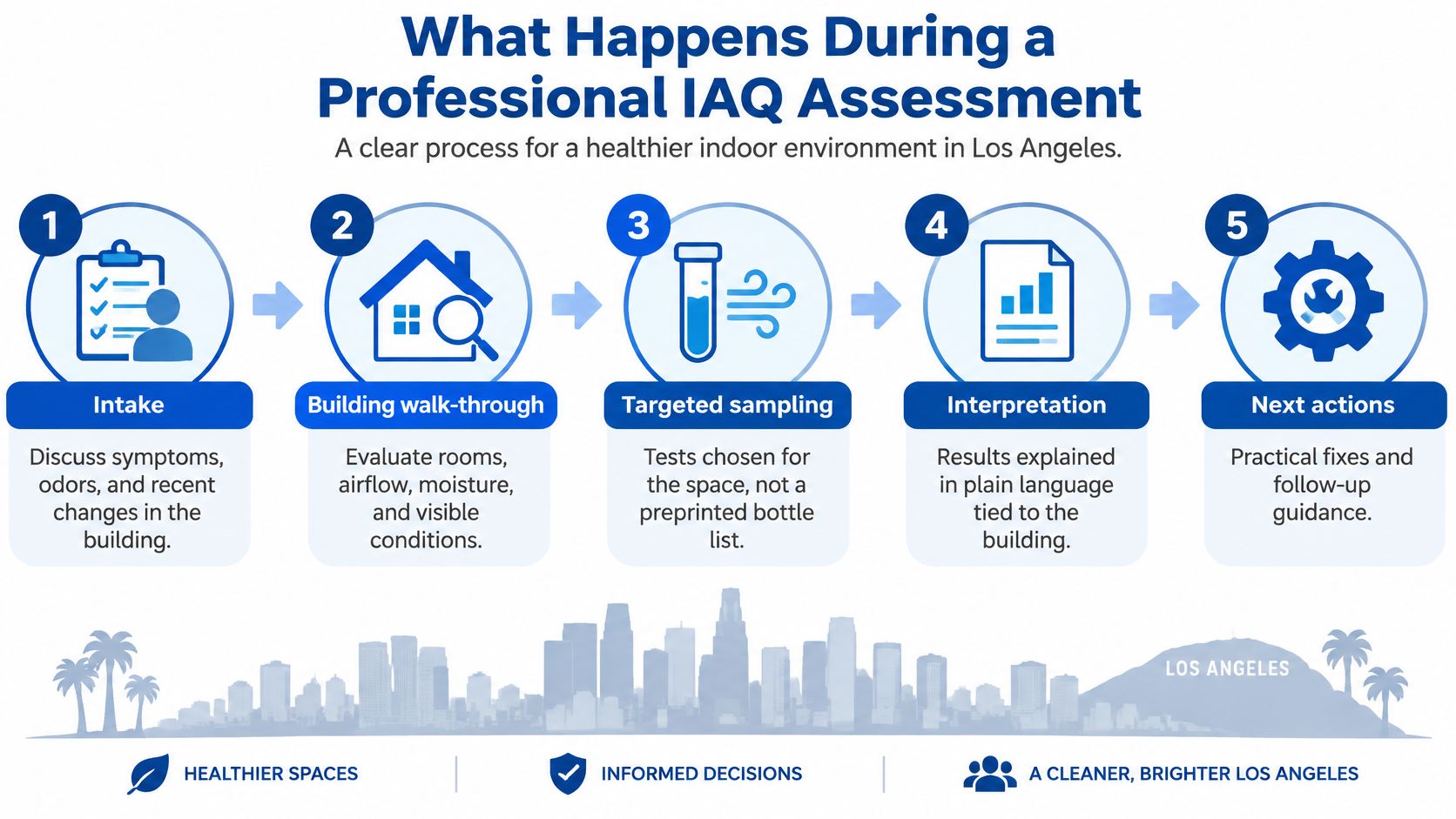
A sound assessment begins with the building, not a preprinted bottle list. Our team includes certified inspectors, and our home environmental inspection process combines a full property walkthrough, hazard identification, targeted testing, laboratory analysis, and detailed reporting with next steps.
What the site work involves
Describe the concern and its timing. Record odors, reported symptoms, occupancy, recent renovations, water intrusion, and fire or smoke history. Timing helps distinguish a persistent source from something associated with a task or operating schedule.
Walk through the relevant spaces. Inspect occupied rooms, supply and return paths, bathrooms, kitchens, and accessible supporting spaces such as crawl spaces or mechanical rooms. Stains, blocked grilles, stored chemicals, and combustion equipment provide leads that a laboratory sample alone can't supply.
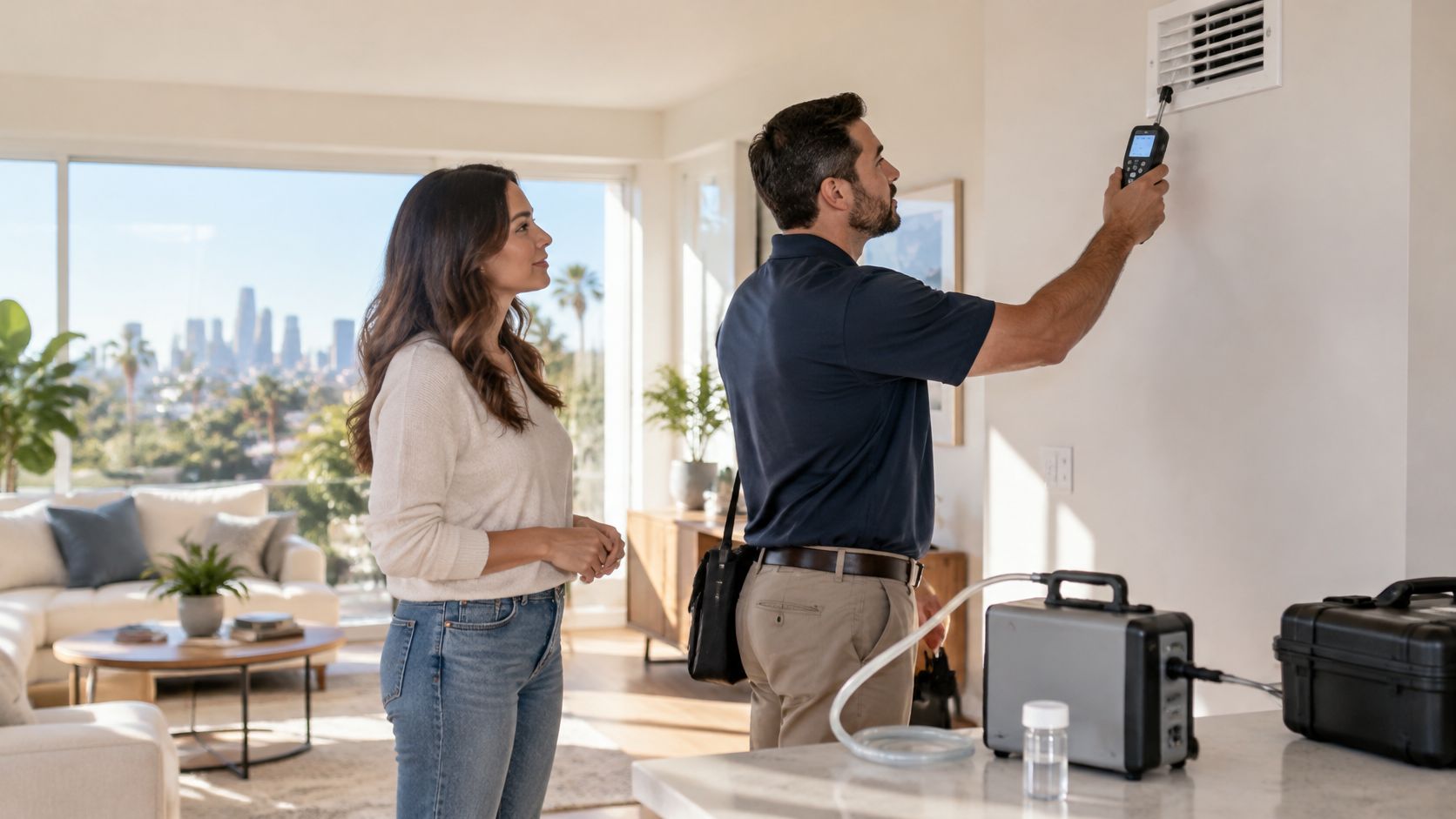
Measure basic conditions. The EPA indoor-air reference guide identifies temperature, relative humidity, air movement, airflow volume, and carbon dioxide as key field measurements, while warning that pollutant sampling requires suitable equipment, methods, and trained personnel. A thermo-hygrometer, calibrated carbon dioxide logger, and airflow instruments answer different parts of the investigation.
Document HVAC operation. Note whether equipment is running, filter condition, outdoor-air openings, exhaust operation, and relevant pressure relationships. Otherwise, the report may compare readings collected under operating conditions that were not comparable.
Collect samples that test a hypothesis. A calibrated sampling pump, spore-trap cassette, sorbent tube, or chemical-specific badge is selected for a defined question. Sample labels and chain-of-custody documentation connect each laboratory result to its collection location and method.
Preserve the context. Record photographs, sample locations, occupancy, activities, and outdoor conditions. These details allow an owner, engineer, insurer, or later investigator to understand what the measurements represent.
Compare places and operating conditions
A complaint room needs a meaningful comparison, not just another reading nearby. An inspector may compare it with a less-affected room, outdoor air, or the same room under a different operating condition.
That comparison helps separate indoor sources, outdoor entry, and ventilation deficiencies. For moisture-driven concerns, our guide to professional mold inspection for Los Angeles homes and businesses explains why building inspection belongs alongside mold sampling.
Before the visit, request a scope identifying the instruments, proposed contaminants, and exclusions. Knowing what won't be measured is part of understanding the eventual report.
How to Read an IAQ Report Without Overreacting
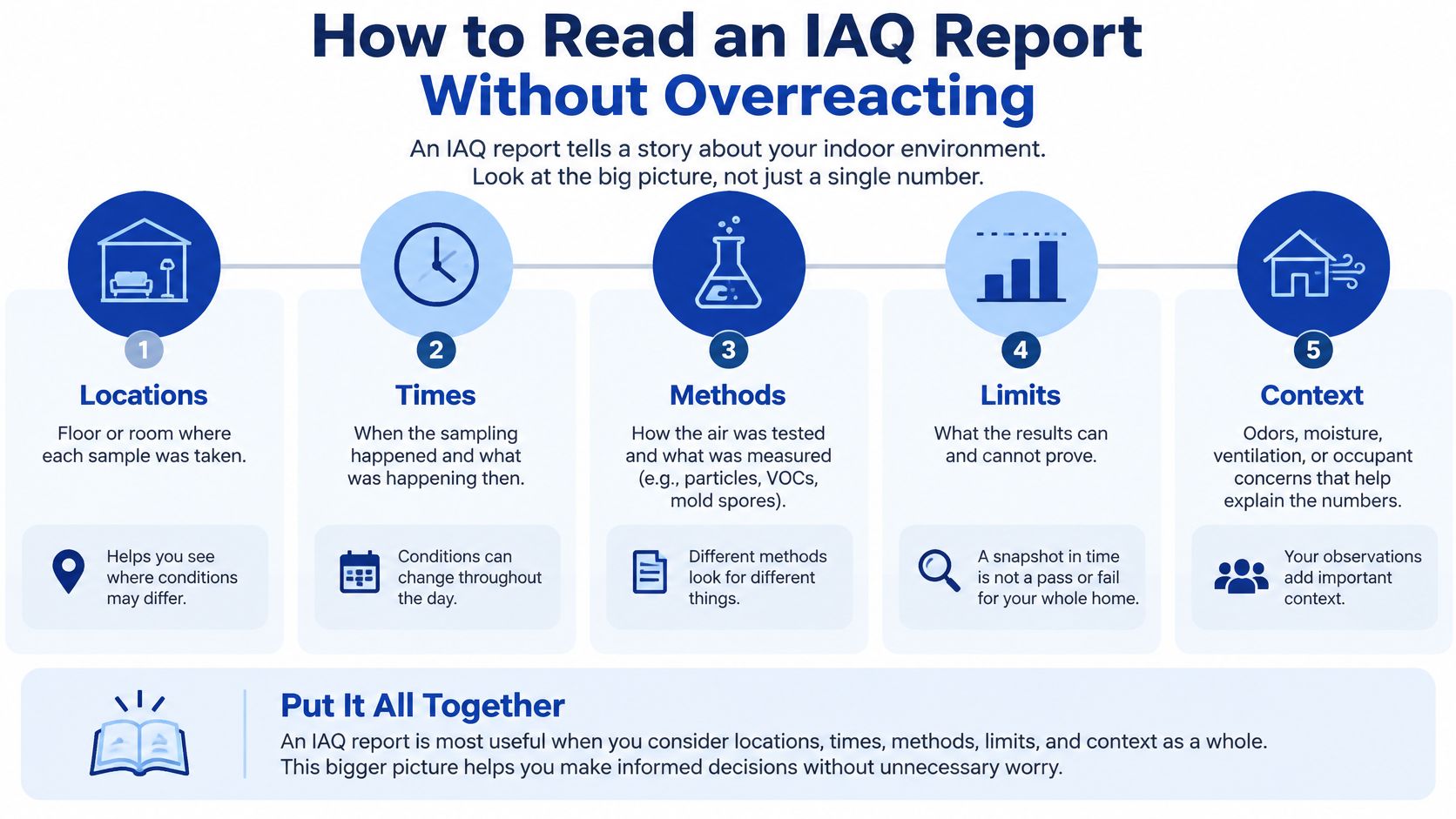
A useful report tells you where, when, how, and under what conditions the inspector collected information. It should identify rooms, occupancy, HVAC status, relevant outdoor comparisons, instrument or laboratory methods, and limitations.
Laboratory results should include units and method information, with detection or reporting limits where applicable. “Not detected” means the method didn't report the substance above its stated limit in that sample. It doesn't mean the building contains none of it.
Read reference points with their limits
How common IAQ numbers should be read
| Parameter | Context used in interpretation | What it does not mean |
|---|---|---|
| Carbon dioxide | Occupied versus unoccupied periods, with outdoor-air delivery and occupancy considered | A complete indoor air quality pass or fail |
| Carbon monoxide | EPA national ambient benchmarks of 9 ppm over 8 hours and 35 ppm over 1 hour, described in its indoor-air reference guide | That a brief spot check captured every combustion episode, or that ambient benchmarks are universal indoor clearance criteria |
| PM2.5 | Indoor versus outdoor readings, filter condition, and applicable filtration provisions, including MERV 11 or higher under specified outdoor-particle conditions in ASHRAE Standard 62.1 materials | That a stated filter rating clears the building |
| Mold spores | Indoor pattern versus outdoor air, moisture evidence, and laboratory identification | That any detection automatically requires remediation |
| Formaldehyde and other VOCs | Laboratory method, detection limit, source, ventilation rate, and exposure duration | That one sample certifies the property safe |
The ASHRAE framework requires identifying contaminants of concern, sources, concentration limits, exposure periods, and occupant acceptability objectives. That's a more demanding task than comparing every result with an unexplained red line.
For example, a crowded meeting room with a rising carbon dioxide trend calls for an occupancy and outdoor-air review. It doesn't establish that an unidentified toxic chemical caused an employee's headache.
Separate findings from recommendations
The report should distinguish observations, analytical findings, and recommended next steps. A stain is an observation; an identified spore type is an analytical finding; further investigation behind an affected finish is a recommendation.
A positive result starts a decision process. It doesn't automatically prescribe removal, establish a medical cause, or guarantee what conditions will be tomorrow.
For chemicals, interpretation may require examining source strength, outdoor concentration, air distribution, and exposure duration. In commercial buildings, a mass-balance calculation can help assess how emissions and ventilation influence a concentration.
When a result exceeds an applicable design limit or guideline, the next step should address the likely cause. That may include verifying airflow settings or air-cleaning equipment condition, followed by confirmation testing after qualified professionals make changes.
For schools, clinics, landlords, and HOAs, the best occupant communication states the finding, its limitations, and the planned follow-up. Avoid translating a limited sampling event into an unrestricted claim that the property is safe.
When a Home Air Monitor Is Not Enough
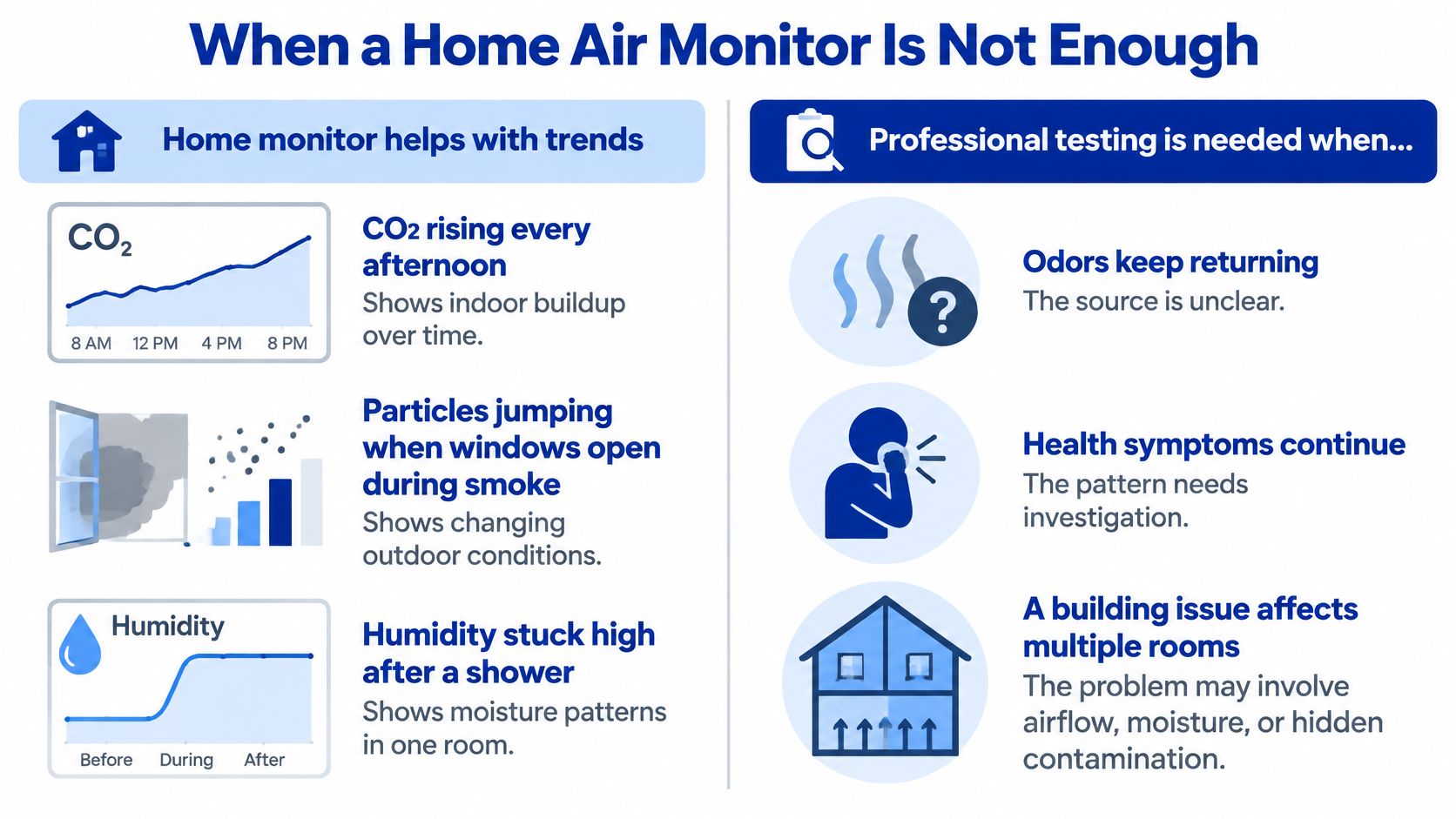
A countertop monitor can reveal useful patterns. Carbon dioxide may rise each afternoon, particles may jump when windows open during smoke, or humidity may stay high after a shower. Those observations can help determine where and when to investigate.
They aren't the same as identifying a pollutant with an appropriate laboratory method. The EPA guidance on low-cost indoor air monitors notes that monitors are generally evaluated outdoors, widely accepted indoor performance criteria don't exist for most pollutants, and placement should generally be in the breathing zone, 3–6 feet above the floor, away from restricted airflow.
Decisions that need more than a dashboard
Professional investigation becomes appropriate when the reading will influence a consequential decision:
- Tenant or workplace complaints. Document methods, locations, operating conditions, and limitations rather than circulating an unexplained screenshot.
- Insurance or transaction files. Define the environmental question and the evidence the assessment is intended to provide.
- Post-fire or post-renovation concerns. Identify the suspected contaminant category before choosing sampling media.
- Chemical-specific questions. A total-VOC display can't substitute for identifying and measuring formaldehyde or another named compound.
Recurring odors, complaints across several rooms, and persistent concerns also justify reviewing the building itself. Environmental testing can investigate conditions, but it doesn't diagnose an occupant's illness.
Understand what professional methods add
Professional work adds documented instrument checks, an appropriate written method, reporting limits, and useful comparison locations. The inspector should also explain potential interferences, such as humidity effects, and whether the recorded value represents a brief peak or an average.
A single spike may coincide with cooking, a candle, or sensor instability. Comparing instruments side by side can help evaluate consistency, but agreement between devices doesn't prove that either identifies the source correctly.
Practical rule: Use the dashboard to locate a pattern. Use a documented professional inspection when someone must act on the finding.
More sensors don't automatically produce better evidence. A smaller, well-placed set logged through occupied and empty periods can be more informative than duplicates placed in corners with poor airflow.
DIY mold kits raise separate interpretation problems. Our explanation of whether home mold test kits are reliable outlines why a kit result shouldn't be treated as equivalent to an inspection, appropriate sampling, and laboratory interpretation.
Southern California Situations That Justify Testing
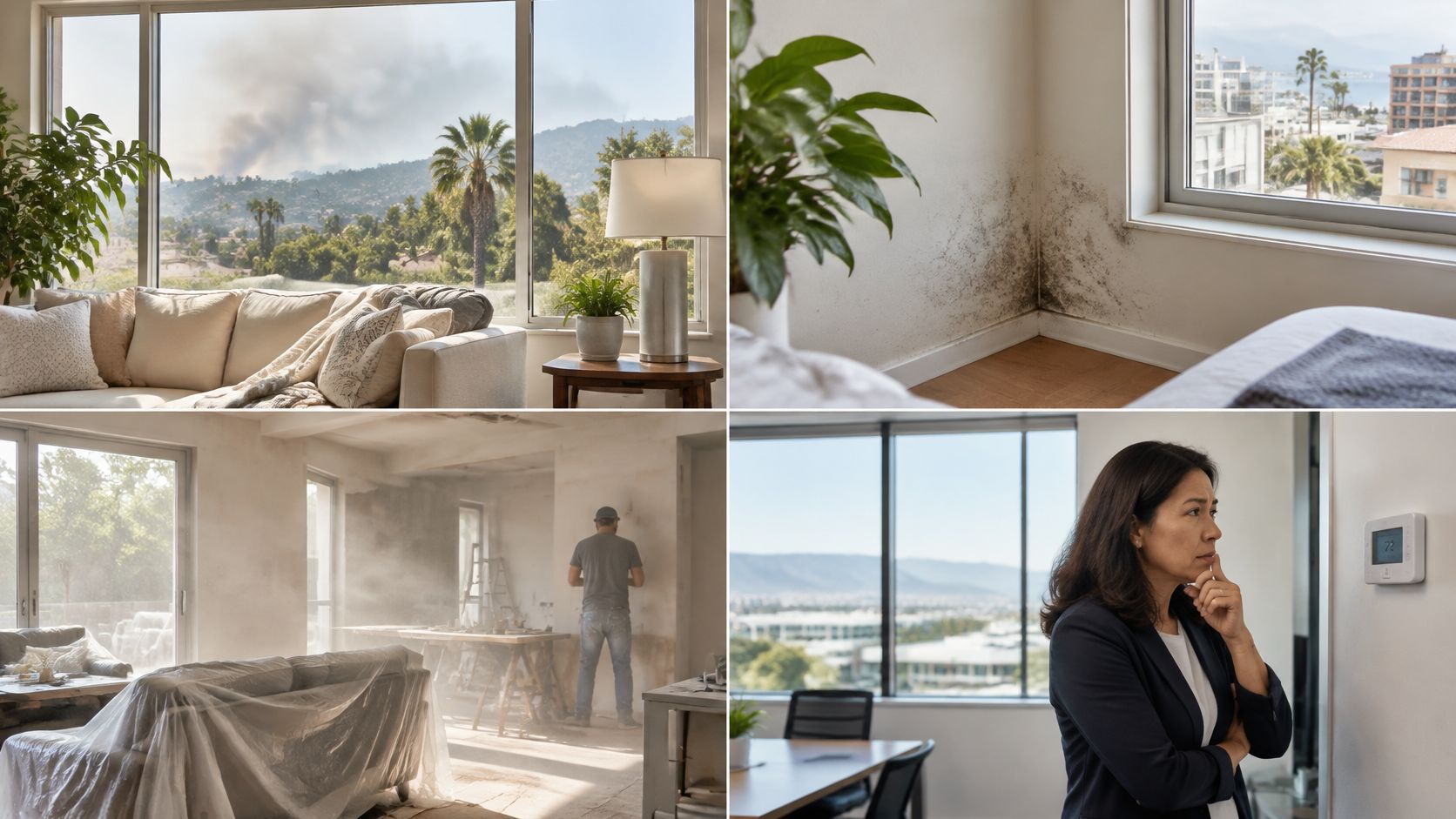
The event that changed the property should shape the investigation. A wildfire-affected home in Pasadena, a Long Beach condo with new cabinets, and a damp San Fernando Valley office don't need an identical sampling plan.
Match the trigger to the measurements
- Wildfire smoke entering the building. Track particles across relevant indoor locations, compare outdoor conditions, and document filter condition. Repeat measurements under changed smoke conditions rather than assuming a quiet interval represents the entire event.
- Water damage or musty rooms. Combine moisture investigation with justified mold sampling and the leak history. A random VOC canister won't establish the extent of a moisture problem.
- New cabinets, flooring, or adhesives. Consider formaldehyde and other targeted VOC methods, noting installation dates, product information, and ventilation during use.
- Stuffy offices, clinics, or shared corridors. Log carbon dioxide during actual occupancy and examine outdoor-air and exhaust performance.
- Post-fire odor without visible ash. Consider combustion byproducts and residue pathways instead of defaulting to mold testing. Inspection may include vents, ductwork, and crawl spaces where smoke residue can remain.
Document conditions before project decisions
Our environmental testing services include multi-contaminant testing, indoor environmental assessments, property safety evaluations, and pre-purchase or pre-construction inspections. These assessments help organize due diligence for owners, contractors, real estate professionals, and facility managers across Los Angeles County and neighboring Southern California communities.
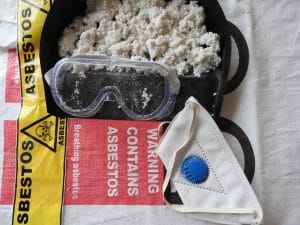
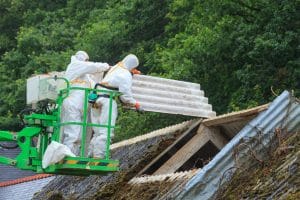
A renovation may require a separate asbestos survey rather than an airborne IAQ screen. SCAQMD Rule 1403 requires affected facilities to be thoroughly surveyed for asbestos before demolition or renovation, including inspection, material identification, quantification, and physical sampling where required. Air testing doesn't substitute for that material survey.
Building operation also changes the investigation. ASHRAE's 2025 revisions to Standards 62.1 and 62.2 address humidity control, demand-control ventilation, emergency ventilation controls, filter efficiency, and exhaust requirements, reinforcing the importance of evaluating operating conditions rather than relying only on a grab sample.
When moisture dominates, our guide to checking for mold after water damage provides a practical starting point. When ash, soot, char, or smoke residue dominates, request a fire-residue assessment and an appropriate CBP testing scope, including heavy metals when the project warrants them.
Frequently Asked Questions About IAQ Testing
How much does an IAQ assessment cost?
The scope determines the quote: building size, relevant rooms, contaminants, sampling methods, and reporting needs all affect the work. We offer a free, no-obligation consultation so you can describe the concern before deciding what environmental testing is appropriate.
How long does a visit take?
A focused walkthrough and sampling event may fit within a site visit, while logging through changing occupancy or operating conditions requires a longer monitoring period. Confirm the proposed field schedule and laboratory reporting timeline when arranging the scope.
Can I just use a DIY kit?
A kit may collect a sample, but it doesn't supply the building investigation needed to interpret it. For a disputed condition or formal documentation, professional collection methods and a clear explanation of limitations are more useful than an isolated result.
Does a mold result mean the property needs removal?
No. Owners and qualified professionals should consider the inspection, moisture source, affected materials, and analytical findings together before selecting further work.
Should I test again after changes?
Follow-up testing is appropriate when you need to verify whether a ventilation, filtration, or HVAC change achieved the intended result. Plan the comparison conditions so the follow-up can meaningfully evaluate the change.
Is IAQ testing the same as mold testing?
Not quite. Mold testing addresses microbial and moisture-related questions, while an IAQ assessment may instead focus on chemical emissions, particles, combustion products, or ventilation.
Book an IAQ Assessment in Los Angeles
Professional testing is most useful when you have a decision to make. Complaints that cluster in a room, a monitor trend that needs documentation, or a property changed by smoke, water, or renovation gives the inspector a defined starting point.
Start with a scope, not blanket sampling. Identify the affected rooms, the suspected pathway, and what the findings will help you decide. Curiosity alone doesn't necessarily justify collecting samples for unrelated contaminants.
For budgeting background, Covenant Aire Solutions on testing expenses offers a complementary resource. Your project still needs its own scope because the inspection, instruments, laboratory methods, and documentation must match the property.
Prepare for a useful consultation
Before contacting us, gather the information that can focus the visit:
- Location and timing. List the affected rooms and when the concern occurs.
- Recent changes. Note leaks, fire exposure, new finishes, occupancy changes, or HVAC work.
- Existing documentation. Keep photographs, monitor logs, product information, and prior reports available.
- The decision ahead. Explain whether you need findings for occupants, an insurer, a transaction, project planning, or further investigation.
Sensitive Environmental's testing and inspection work combines certified inspectors, targeted sampling, laboratory analysis, and written reporting. The deliverable is evidence to support appropriate next steps, not a promise of cleanup or an unrestricted safety clearance.
Homeowners, commercial owners, HOAs, contractors, and facility managers across Los Angeles and Southern California can request an appointment online or call 310-387-5404. Use the free, no-obligation consultation to describe an asbestos, lead, mold, fire-damage, water-damage, or other indoor environmental concern so the proposed assessment matches the building.
Sensitive Environmental offers professional IAQ inspections, targeted environmental sampling, laboratory analysis, and clear reporting for residential and commercial properties. Visit Sensitive Environmental or call 310-387-5404 for a free, no-obligation consultation about the rooms, operating conditions, and contaminants that belong in your Los Angeles or Southern California assessment.