The most popular advice about a Los Angeles yard is simple. If a letter says the soil was hauled away, or if one scoop from the middle of the lot looks fine, you can stop asking questions. That advice treats a document, or a single jar, as if it already knew who will touch the ground next.
Say you hold that letter after buying a house in Boyle Heights, or after a seller in Pasadena calls the yard closed. Your child still plays on the grass. You still want tomatoes along the fence. The letter does not say what sits in the top few inches, whether new fill was trucked in, or whether wildfire ash landed on the same soil that used to hold paint chips and old industrial dust. Ground contamination testing replaces that guess with samples from chosen spots and depths, laboratory measurements, and a reading tied to how people use the land.
A number on a page is not a health guarantee, and it is not a cleanup order by itself.
Table of Contents
- What Ground Contamination Testing Measures
- Which Contaminants Belong in the Test Plan
- When Los Angeles Properties Should Test Soil
- How Sampling and Laboratory Analysis Work
- How to Read Soil Results Against Screening Levels
- Lessons from Declared Clean Los Angeles Yards
- Frequently Asked Questions About Soil Testing
- Book Soil Testing Before You Rely on a Letter
What Ground Contamination Testing Measures
Start with the letter in your hand. It says contaminated soil was removed. It does not say what a child, a gardener, or the next buyer can still contact.
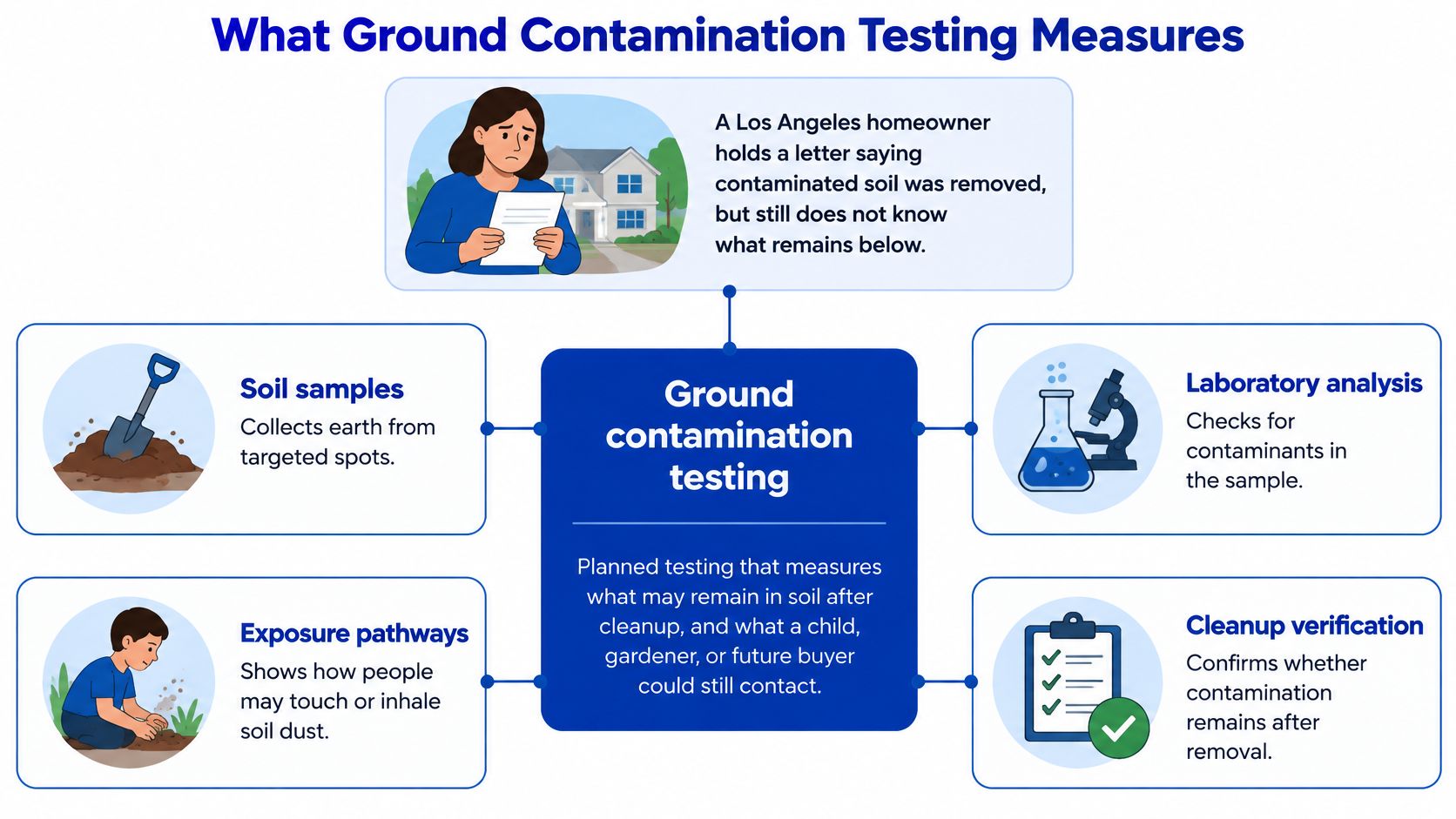
Ground contamination testing is a planned look at soil. Someone chooses locations and depths, a laboratory measures chemicals in those samples, and the results are read against how the land is used. The usual targets, in plain language, are lead and other metals, petroleum hydrocarbons from fuels and oils, solvents, polycyclic aromatic hydrocarbons from combustion and paving, and ash, soot, or char after a fire.
That is a different job from a garden soil test. A garden kit reports nutrients and pH so plants can grow. It does not answer whether dust from the same bed is a contact problem for a toddler.
Why one scoop misleads
Fill, spills, and drainage can change concentrations within a few feet. Soil under a downspout, along an old driveway, or in a low corner can look nothing like soil from the middle of the lawn. One scoop can miss a hotspot. It can also hit the worst spot and make the whole lot look worse than it is.
In Los Angeles County, buyers, landlords, HOAs, property managers, contractors, and developers use these results when a lot has unknown fill, older housing, former commercial use, wildfire debris, or digging before construction. The test supports a decision. It does not certify a property as safe, and a detection is not an automatic order to dig.
A detection is not a cleanup order. It is a reason to look at who contacts that soil, and where.
A usable test plan names the chemicals, the sample map, and the screening comparison before anyone breaks ground. Local triggers, sampling controls, and confirmation after a declared cleanup come next, because a letter about removed soil still leaves the exposure question open.
Which Contaminants Belong in the Test Plan
Bring a written list to the testing firm before anyone tells a long regulatory story. The rows below are the usual Southern California choices. Pick rows from site history and future use. Do not order every row by default.
| Contaminant group | Common local sources | Include it when | Typical lab approach |
|---|---|---|---|
| Lead | Older housing, paint chips in soil, battery or industrial history, legacy urban fill | Gardens, play areas, older lots, post-excavation checks | Metals analysis after digestion; compare with a residential screening level, not a fertility test |
| Arsenic, cadmium, chromium, other metals | Industrial use, slag, imported fill, some natural geology, debris ash | Unknown fill, former commercial parcels, burn areas | Multi-metal panel by ICP methods with reporting limits below the screening level |
| Petroleum hydrocarbons | Gas stations, heating oil, auto yards, spills | Staining, petroleum odor, former fuel use | Total petroleum hydrocarbons by gas chromatography, often split by carbon range |
| Solvents and other VOCs | Dry cleaners, degreasers, manufacturing | Chemical odor, former industrial tenants, vapor concerns near buildings | Volatile analysis by GC-MS on sealed vials, with short holding times |
| PAHs | Asphalt, creosote, combustion, burn debris | Paving or rail history, soot mixed into soil | PAH panel by GC-MS |
| Fire ash, soot, and char | Wildfire and structure-fire debris | Burned yards, demolition ash, smoke residue in soil | Metals plus combustion-related organics; sample burn scars separately from background yards |
How to pick rows
Lead belongs on almost every older residential lot where children play or someone gardens. Paint chips and legacy urban fill are common reasons, even when the house looks renovated. Arsenic, cadmium, chromium, and other metals matter when fill is unknown, a parcel used to be commercial, or ash from debris is mixed into the yard. Some of those metals also occur in local geology, so a hit still needs site context.
Petroleum hydrocarbons fit a former gas station, an auto yard, heating-oil history, or dark staining with a fuel smell. Solvents and other volatile organic compounds fit a dry cleaner, a degreasing shop, or a chemical odor near a building. Those samples need sealed containers and short holding times. A jar left open in a truck can lose the very chemicals you paid to measure.
Polycyclic aromatic hydrocarbons fit asphalt, creosote, rail beds, and combustion residue worked into soil. Fire ash, soot, and char are their own row. Sample the burn scar apart from a yard that only looks dusty from the neighborhood. Add pesticides only when history includes agriculture or heavy landscaping, not as a standard extra.
A basic heavy-metals panel, or one composite from the whole lot, answers a different question than discrete samples at a stain, a play area, or a burn scar. A metals result is hard to use if the laboratory reporting limit sits above the screening level the project cares about. The method has to see the number you will compare.
Indoor lead dust on floors and sills is a separate question from lead in yard soil. Lead testing in Los Angeles covers paint, dust, and surfaces. Combustion residue on walls and contents is also not a soil-panel job. If the parcel has a private well, soil results still will not describe what comes out of the tap. A well-water checklist for land buyers is a useful companion when the purchase includes groundwater, not a substitute for the soil list.
Match the analyte list to history and to the next use, whether that is a garden, a lease, or a foundation. The laboratory report comes later. Interpretation waits until the right chemicals were requested.
When Los Angeles Properties Should Test Soil
Order the work when the decision is still yours, not after crews have already mixed the layers.
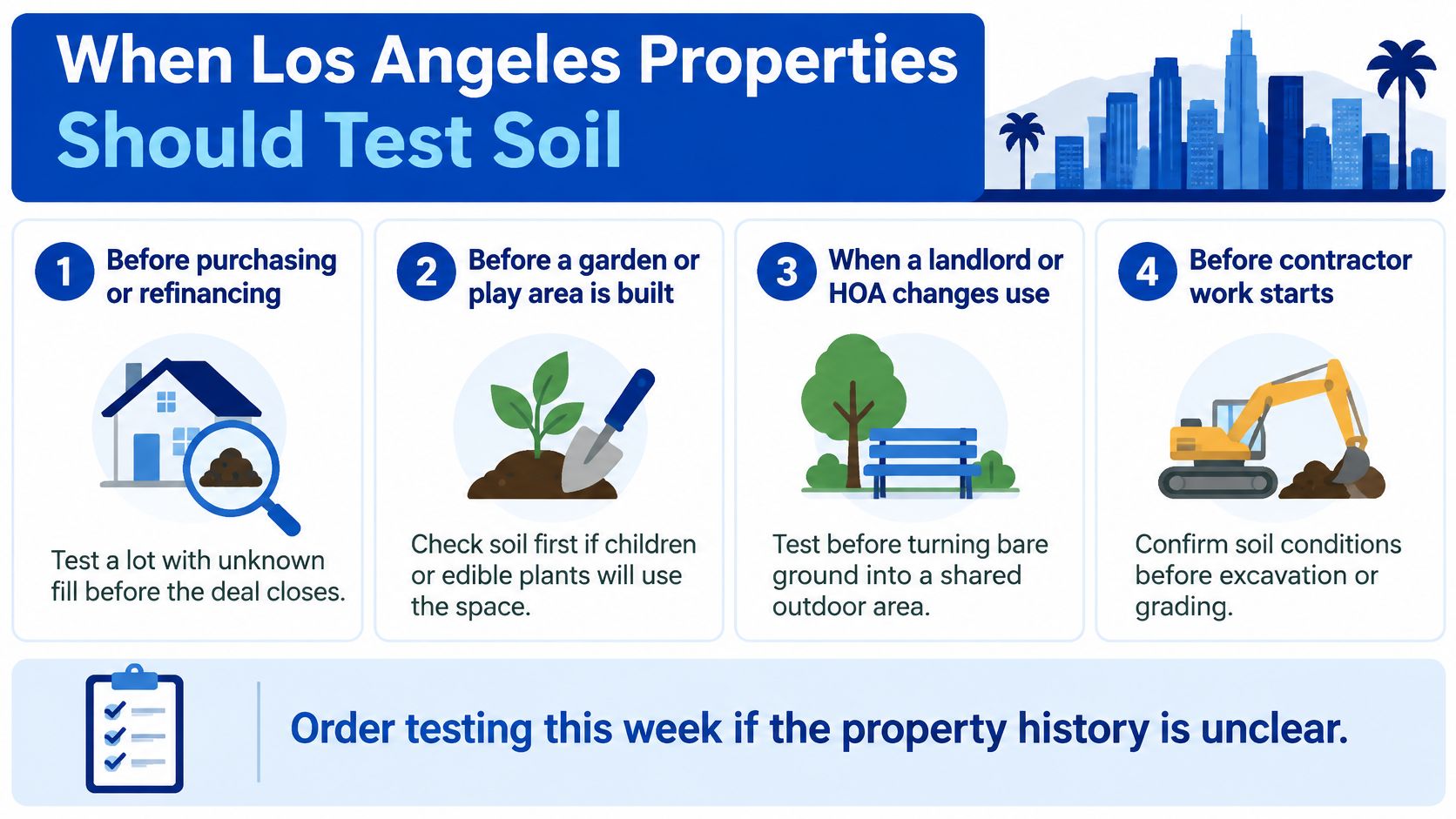
Use this checklist this week if you are a buyer, a landlord, an HOA board, or a contractor:
- Before purchase or refinance: Test a lot with unknown fill before the deal closes, especially older housing and former commercial parcels.
- Before a garden or play area: Check soil first if children or edible plants will use older urban ground.
- When something looks wrong: Staining, a chemical or petroleum odor, or buried drums are reasons to stop guessing.
- When history points to industry: A former gas station, dry cleaner, auto yard, or factory changes the analyte list.
- When grading exposes buried layers: Soil that was deep yesterday can be the new surface after a trench or a cut.
- When burned yards are replanted or rebuilt: Ash-covered communities in Los Angeles County need samples before new planting or new foundations.
Two reasons that get mixed up
Recent Los Angeles-area work tested approximately 600 soil samples from 250 residents and found that many Southern California communities already had legacy lead and other toxic metals unrelated to fires, while burn-area programs have also expanded where ash, soot, char, and building debris can introduce or redistribute metals and organic contaminants, according to an EPA fact sheet on innovative soil testing. Those are two sampling reasons, not one story.
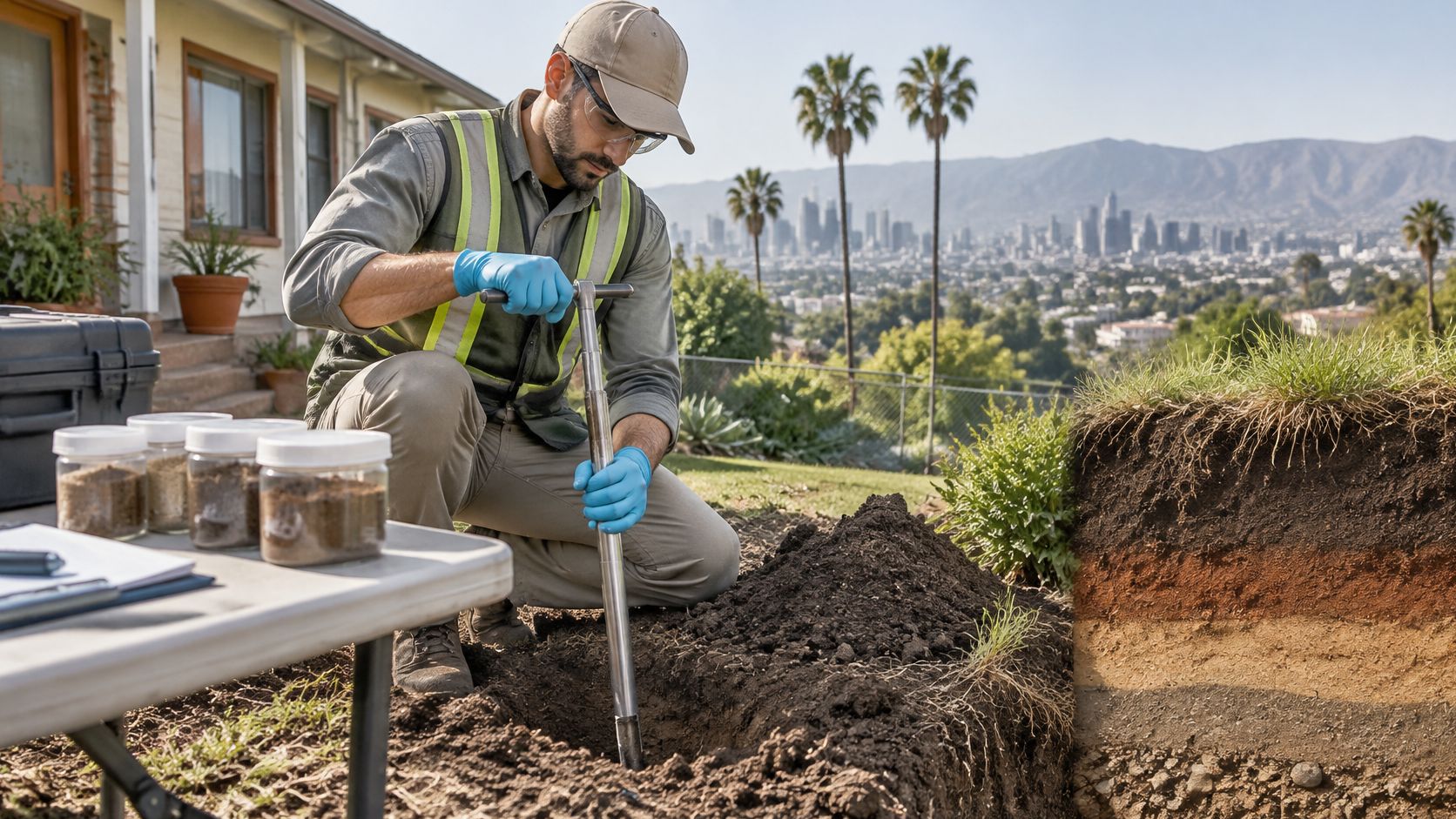
Separate background samples from visibly impacted soil. Record coordinates and land use. Test surface soil, and go deeper where soil was graded or trenches were dug. One composite, or a generic metals panel, is a weak answer to what the test should include.
Portable X-ray fluorescence can screen metals in the field. Laboratory analysis is still the confirmation step. Concentration alone also skips bioavailability and who contacts the soil. A number in a fenced side yard is a different conversation from the same number in a sandbox.
Building work has its own boundary. Planned renovation or demolition triggers asbestos survey requirements under South Coast AQMD Rule 1403. That survey does not replace soil testing, and soil testing does not replace it. Our asbestos inspections before renovation follow that district requirement and stay on building materials, not on the yard. History plus intended use sets the soil analyte list, not a hunch. Yards affected by recent fires are a related but separate sampling question from indoor fire damage and residue concerns.
How Sampling and Laboratory Analysis Work
A professional sequence is not a bag of dirt from the hardware store. Each step exists because a skipped control can make a chemically tidy number unusable.
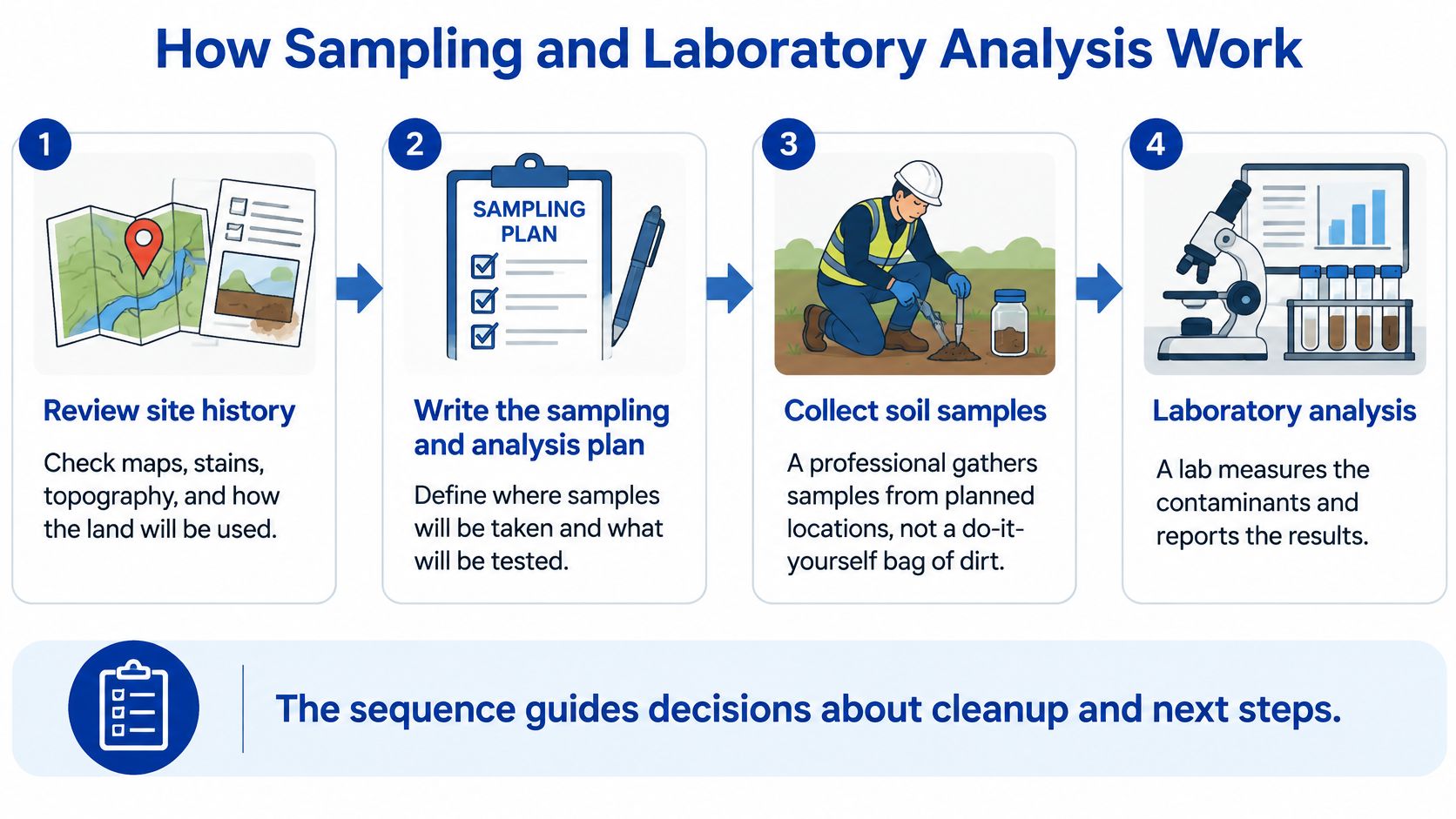
- Review site history. Maps, stains, topography, and future use tell you where soil is likely to differ. Skip this and the grid lands on clean grass while the spill sits by the alley.
- Write a sampling and analysis plan. EPA soil screening guidance calls for data-quality objectives, site history, visible staining, topography, suspected sources, and depth intervals, rather than only a uniform grid. A grid with no question behind it collects bottles, not decisions.
- Choose discrete or composite samples on purpose. Composites can screen an area, but mixing can dilute a small hotspot. Discrete samples fit a maximum concentration, a source zone, or a disposal decision.
- Collect enough soil the right way. Samples should generally be prepared as material smaller than 2 mm, in enough volume to reduce short-range variability, with clean tools and labels. A garden trowel used on the last job can contaminate this one.
- Add quality-control samples. Field blanks catch contamination from collection or transport. Equipment rinsates check decontamination. Trip blanks matter for volatiles. Co-located duplicates measure field precision. EPA soil-sampling guidance recommends allocating approximately 20% of a monitoring program's sample load to QA/QC, with roughly 15% tied to sampling and 5% to analysis, and commonly identifies one co-located replicate for approximately every 20 samples.
- Protect identity and holding time. Chain of custody, preservation, temperature, and holding times have to be recorded. A correct chemical result is still unusable if nobody can prove which hole it came from, or if the vial sat too long.
- Demand limits that can see the benchmark. Quantitation limits must sit below the screening level. A result cannot be interpreted against a benchmark the method cannot see. In certain screening programs, EPA also recommends confirmatory analysis of at least 10% of discrete and composite samples.
A home kit or a single untracked jar usually fails locations, custody, and reporting limits. For a property assessment, our inspection pattern is a walkthrough, targeted sampling, accredited laboratory analysis, and a written report. On a whole commercial parcel, pair that soil work with the wider questions in commercial property due diligence essentials, then ask the testing scope to match the deal, not a generic panel.
Ask the report for a map, depths, methods, detection limits, and the quality-control results. Without those, the table of numbers has no anchor.
How to Read Soil Results Against Screening Levels
The common mistake is treating any detection as a failure. A laboratory can measure chemicals at very low levels. Measurement is not the same as a decision that soil must be removed.
In 1996, the EPA Superfund Soil Screening Guidance set a tiered, risk-based framework for contaminated soil at National Priorities List sites where future residential use is anticipated. The screen uses toxicity, exposure pathway, land use, soil characteristics, and who might contact the soil. Screening levels are decision-support tools, not universal cleanup standards. They help clear areas, pathways, or chemicals that need no further evaluation, and they flag conditions that need a closer look.
| Benchmark | Reference value | Use it to | Do not treat it as |
|---|---|---|---|
| Residential soil lead screening level | 200 mg/kg (200 ppm) where children live and play | Decide if more evaluation is warranted | An automatic cleanup standard |
| Cancer risk screening target | 1 in 1,000,000 excess cancer risk | Screen chemicals or pathways in or out | A site-specific cleanup number |
| Noncancer hazard quotient | 1 | Flag a pathway for a closer look | Proof that any detection is harmful |
| Reporting limit above the screening level | Method cannot see the benchmark | Stop and use a more sensitive method | A pass or a fail |
EPA's current Regional Screening Levels generally correspond to a target excess cancer risk of 1 in 1,000,000 or a noncancer hazard quotient of 1. The agency's 2024 guidance recommends a residential soil-lead screening level of 200 mg/kg (200 parts per million) where children live and play. An exceedance means look closer or refine the exposure picture. It does not mean abatement is automatically required.
A worked lead comparison
Picture two results from the same lot. The planted bed shows 80 mg/kg of lead. The top two inches of the play area show 350 mg/kg. The bed sits under mulch that gardeners rarely disturb. The play area is bare soil where a child sits. The pathway and the person change the conversation, even though both numbers came from one yard. The play-area result is above the residential screening level, so more evaluation is warranted. The bed result is not a free pass for the whole property, and neither number is a dig order by itself.
California oversight may involve local agencies or the Department of Toxic Substances Control. This table does not replace that agency's determination. Background metals in Southern California soil can be naturally or historically high, so every number needs the map, the depth, and the use beside it.
If the reporting limit is higher than the benchmark, the laboratory did not pass or fail the soil. The method never looked low enough.
Lessons from Declared Clean Los Angeles Yards
A clearance letter feels final. In one Los Angeles case, it was not the same thing as knowing what people could still contact.
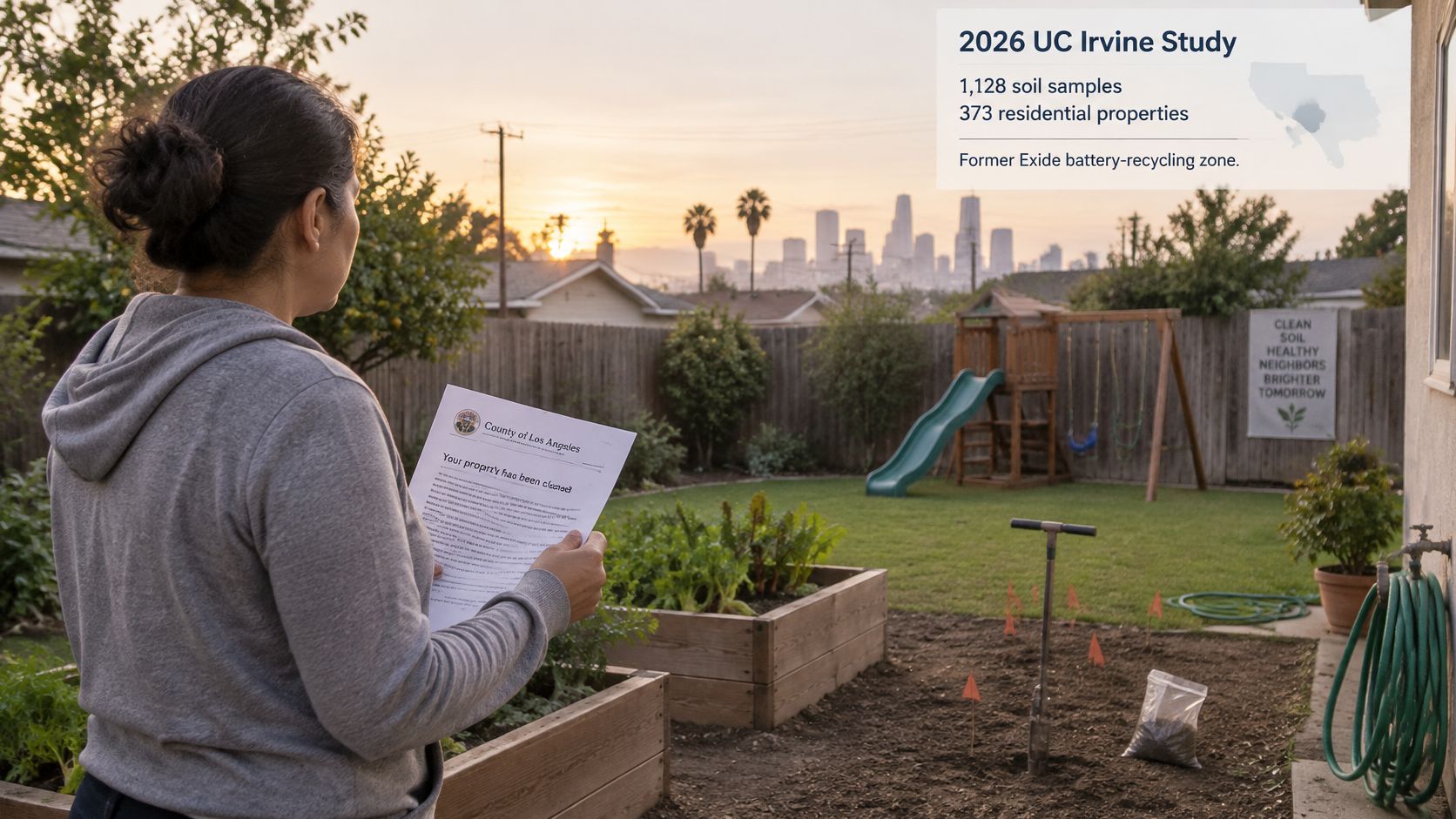
A 2026 UC Irvine study collected 1,128 soil samples from 373 residential properties in the former Exide battery-recycling contamination zone and reported dangerous lead levels at homes previously declared clean. The cleanup plan had not required verification testing after the work. That does not prove every cleaned yard in the county is unsafe. It does show why "soil removed" is not the same phrase as "exposure risk resolved."
What confirmation sampling is
Confirmation sampling is a new, independent round after excavation or soil replacement. Useful locations include the floor and sidewalls of an excavation, the replaced surface where children play, and deeper points where fill was imported. Use enough locations to represent the yard, not a single courtesy sample by the gate. The laboratory still needs detection limits that can see the screening level you care about.
Send the report to the owner, the buyer, the lender or insurer, and the contractor who needs to know whether further digging would reach impacted soil. An unverified cleanup can leave residual contamination, feed a liability dispute, and weaken confidence in a file that looked finished.
People mix up three phrases:
- Regulatory closure means an agency ended its process under its own rules.
- Consultant sign-off means the firm that managed the work stated its opinion.
- Independent post-work laboratory evidence means new samples, with a map and detection limits, collected after the soil moved.
Those are not interchangeable. Legacy lead also shows up in Los Angeles neighborhoods that were not part of one battery-plant zone and were not defined by recent wildfire ash. Order confirmation testing before you rely on an old clearance for a sale, a lease, a garden, or a construction start. The sample round answers a question. It does not prescribe excavation.
Frequently Asked Questions About Soil Testing
What does soil testing cost, and how long does it take? Pricing follows the number of samples, the analytes, site access, and whether the design uses discrete or composite samples. Ask for a written scope that itemizes laboratory analysis and report preparation, and confirm turnaround with the firm before you schedule. There is no single countywide price or clock.
Is a home test kit enough? A kit can suggest that a question exists. It usually lacks documented sampling locations, chain of custody, reporting limits below the screening levels, and a laboratory report a buyer, a lender, or a permit reviewer can use. It will not carry a sale, a lease, or a permit decision.
Does a clean result mean the property is safe? No. Testing characterizes the sampled locations and depths against stated benchmarks. It cannot certify a whole property as safe, and a non-detect in one hole does not speak for unsampled soil.
When should yards burned in a wildfire be tested? Before replanting, rebuilding, or cleanup crews disturb the soil. Collect background samples from unaffected areas in the same effort so fire debris is not confused with older urban metals.
Book Soil Testing Before You Rely on a Letter
Book professional ground contamination testing when you are buying, leasing, gardening, rebuilding after fire, or digging in Los Angeles or elsewhere in Southern California, and the only evidence you have is an old letter, a stain, or a guess. Ask for a written scope before any site visit. It should name the analyte list, the sample map and depths, discrete versus composite design, and the reporting limits.
Results help you and qualified professionals decide next steps. A reported concentration does not by itself mean removal is required, and it does not mean a property is safe. Sensitive Environmental provides soil and ground contamination sampling, laboratory analysis, and clear reporting for homeowners, managers, and project teams. After a fire, pair yard samples with lead and combustion-byproduct questions rather than stretching one panel. When the issue covers more than a single yard, our environmental testing for complex property challenges is the place to start the testing conversation, not a removal pitch.
We offer a free, no-obligation consultation for environmental testing. Call 310-387-5404 or request an appointment online to schedule soil testing through sensitiveenvironmental.com.
Sensitive Environmental provides soil and ground contamination testing, targeted sampling, laboratory analysis, and clear reports for homes and project sites across Los Angeles and Southern California. If you are about to buy, garden, rebuild, or dig and a closure letter is all you have, visit Sensitive Environmental to schedule professional soil testing and talk through a written scope before anyone treats that letter as the last word.