You've noticed a musty bedroom after rain, a chemical smell since the renovation, or an office that feels stuffy by afternoon. You buy an air monitor, watch the display change, and immediately face another question: what does that number tell you?
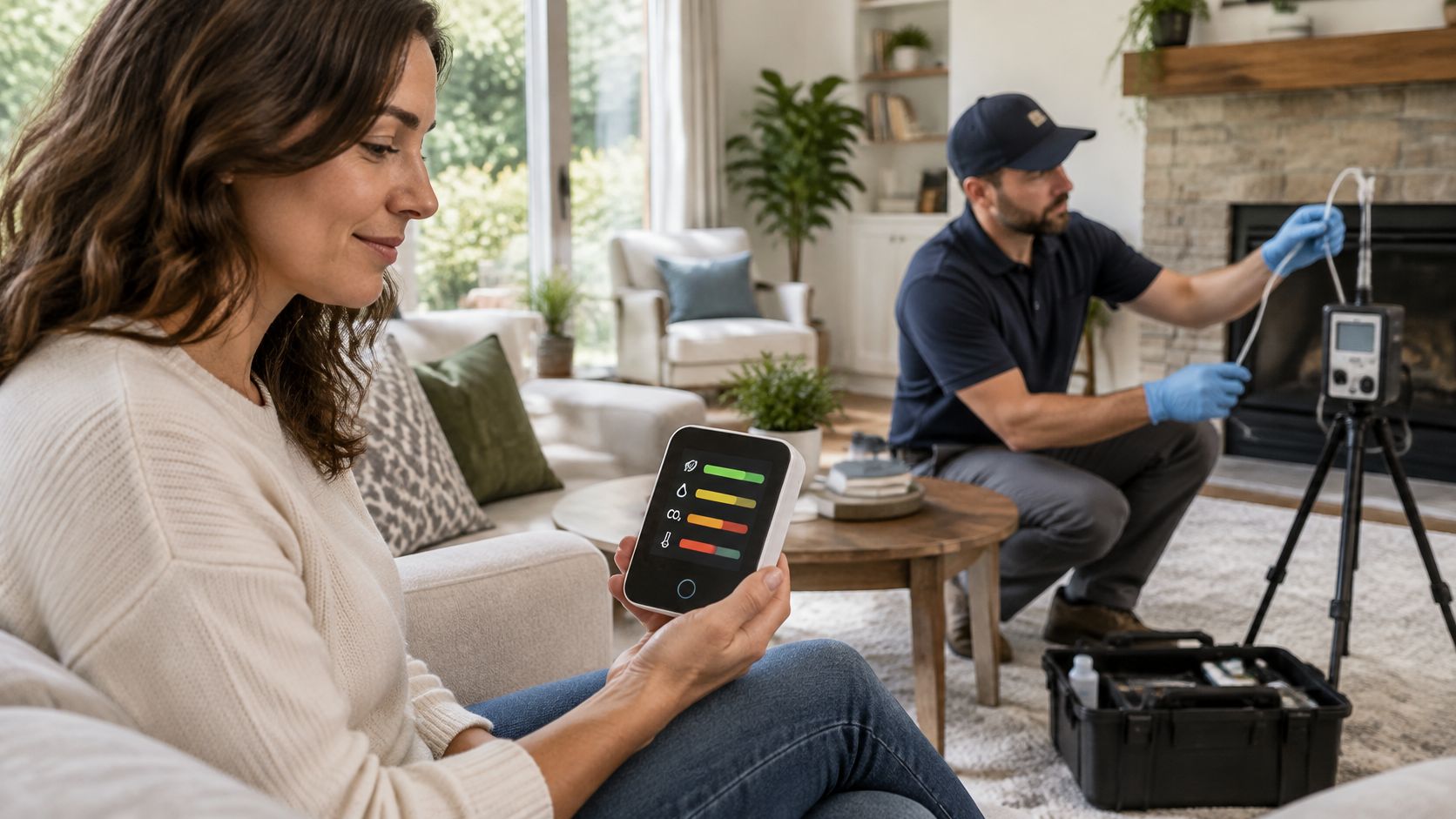
Learning how to test indoor air quality starts with deciding what you're investigating, not buying the most elaborate device. A useful screen connects each reading to its location, HVAC operation, occupancy, activities, and comparison conditions. Professional testing adds targeted sampling and laboratory analysis when a monitor can't answer the question or when someone needs to rely on the results.
Table of Contents
- Pollutants Worth Testing and the Right Tool for Each
- How to Run a DIY Air Quality Screen Step by Step
- Measurement Mistakes That Skew Indoor Air Readings
- Reading Monitor Numbers Against Reference Points
- Choosing a Testing Provider and Reading the Report
- When to Bring In a Professional and Act on Results
Pollutants Worth Testing and the Right Tool for Each
A musty room after a leak calls for a different investigation than dust following wildfire smoke. Likewise, a particle monitor won't explain a renovation odor, and a carbon dioxide monitor can't identify mold. Choose the pollutant before choosing the instrument.
The NIST residential indoor air quality program illustrates why a layered approach matters: investigators combined laboratory analysis of individual VOCs and formaldehyde, radon kits, sampling across indoor and outdoor locations, and ventilation evaluation. That combination answers questions no single dashboard can resolve.
Common indoor pollutants, sources and testing tools
| Pollutant | Typical sources | DIY screening tool | Professional or lab method |
|---|---|---|---|
| Fine particulates (PM2.5, PM10) | Dust, cooking, candles, wildfire smoke | Laser particle monitor | Direct-read instruments plus filter sampling analyzed in a lab |
| Carbon dioxide (CO2) | Occupant breath, low fresh-air supply | NDIR CO2 monitor | Logged CO2 across rooms and HVAC zones with ventilation review |
| Carbon monoxide (CO) | Gas appliances, fireplaces, attached garages | CO alarm or monitor | Qualified combustion appliance inspection with direct-read data |
| Total VOCs (TVOC) | Paints, cleaners, adhesives, new furniture | Consumer TVOC meter | Sorbent tube or SUMMA canister with lab identification of individual compounds |
| Formaldehyde | Pressed-wood products, renovation materials | Consumer formaldehyde monitor | DNPH cartridge sampling analyzed in a lab |
| Mold spores | Water intrusion, condensation, hidden moisture | Surface swab or air cassette kit | Spore-trap air samples, bulk samples, moisture mapping, lab identification |
| Radon | Soil gas entering basements and slab-on-grade floors | Charcoal or alpha-track kit | Multi-day or longer-term testing with lab analysis |
What the tools can actually establish
A laser particle monitor tracks changes in airborne particles, not their chemical identity. An NDIR monitor, which uses nondispersive infrared sensing, measures carbon dioxide rather than estimating it from a VOC sensor. Check that distinction before purchasing.
Consumer TVOC and formaldehyde readings deserve particular caution. Responses to mixed chemicals can complicate interpretation, while laboratory methods target named compounds. Mold kits also require context: finding spores doesn't establish where growth is occurring or how extensive it is.
For moisture concerns, our guide to checking for mold after water damage explains what to inspect before selecting samples. AMPM Restoration Services' resource on when to call a mold professional offers additional context for deciding when a moisture concern needs outside evaluation.
Practical rule: A monitor is useful for tracking a pattern. It isn't a substitute for identifying a contaminant that its sensor cannot distinguish.
How to Run a DIY Air Quality Screen Step by Step
Treat a DIY screen as a small investigation with a written question and a repeatable setup. Don't deliberately generate smoke, disturb suspect materials, or recreate an exposure to see whether the monitor responds.
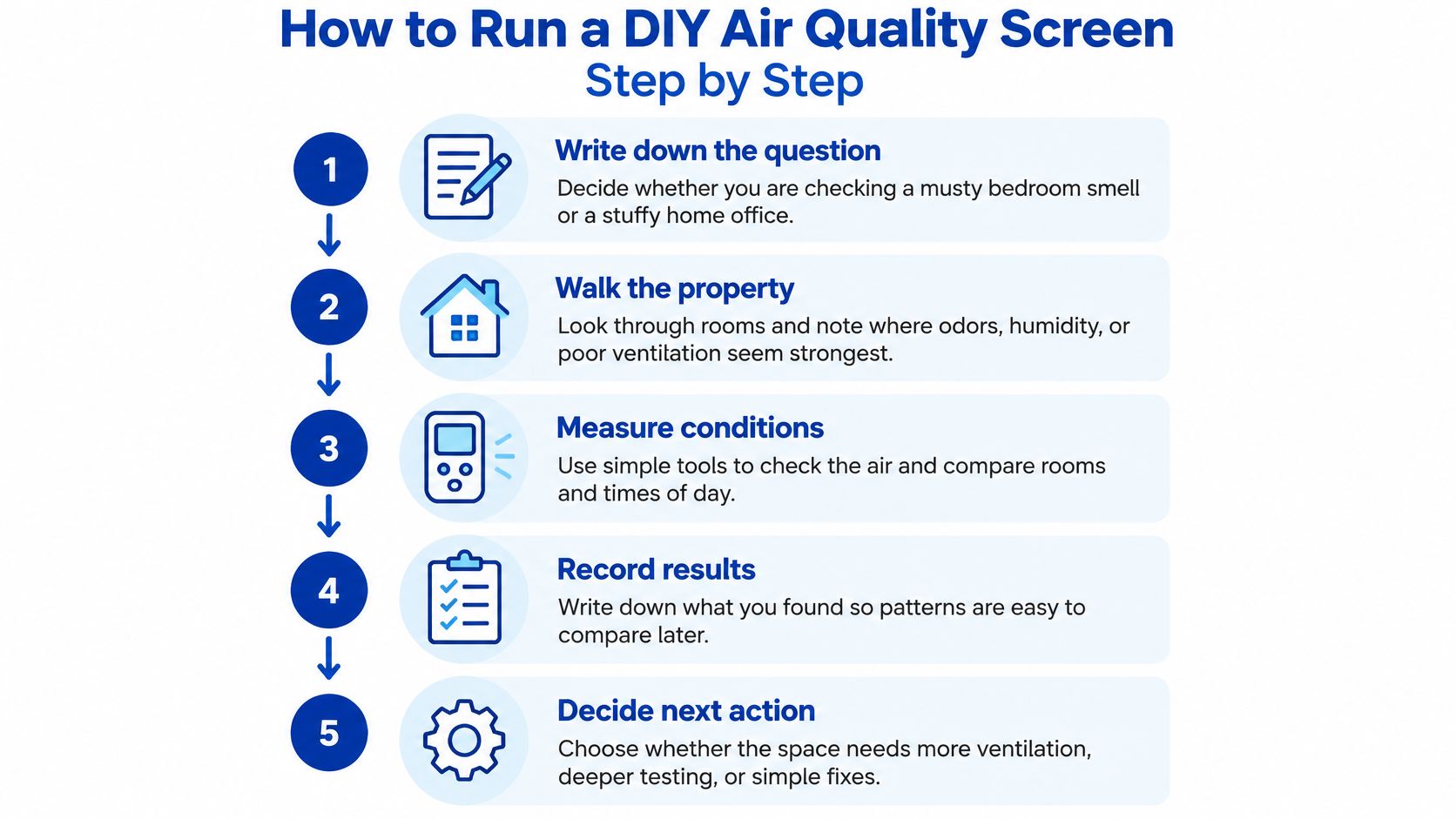
Set up the screen
Write down the question. Use something specific, such as “Does the bedroom's stuffiness increase while occupied?” or “Do particles rise indoors when outdoor smoke arrives?” Avoid an unanswerable objective such as proving the whole property is safe.
Walk through the property before turning on equipment. Note odors, visible moisture, occupancy, recent cleaning, cooking, renovations, and water events. Record whether the HVAC is heating, cooling, circulating air, or off, because those conditions affect the comparison.
Match the monitor to the concern. Review the manufacturer's sensor specifications, calibration information, operating limits, and warm-up instructions. Confirm that the device measures the pollutant directly rather than displaying an estimated substitute.
Position the instrument where people breathe, without placing it directly beside a face, supply vent, open window, or cooking plume. An EPA building-testing specification defines its indoor breathing-zone sampling height as approximately 4 to 7 feet above the floor. For a home screen, follow the instrument's placement instructions and record the actual height.
Collect a useful comparison
Establish a reference location. Use an appropriate outdoor-rated instrument outdoors, or choose an unaffected indoor control room with comparable use. Don't expose an indoor-only monitor to rain, condensation, or temperatures outside its operating range.
Log ordinary routines across occupied and unoccupied periods. Include different household schedules where practical, and annotate cooking, cleaning, showers, window opening, and HVAC changes. The duration should match the question and the test method, rather than an arbitrary universal schedule.
Export the readings if the device allows it. Compare timelines rather than isolated peaks, checking whether the concern room changes alongside outdoor conditions or only after an indoor activity.
Keep the original record. Save the date, time, room, instrument identity, height, HVAC status, occupancy, weather, and event notes with the data file. A screenshot without that context is much harder to interpret later.
A useful screen produces a clear question, comparable observations, and notes explaining unusual changes. It may justify further investigation, but it doesn't establish a building-wide conclusion. Before collecting mold samples yourself, review whether home mold test kits are reliable so you understand what the result can and cannot support.
Measurement Mistakes That Skew Indoor Air Readings
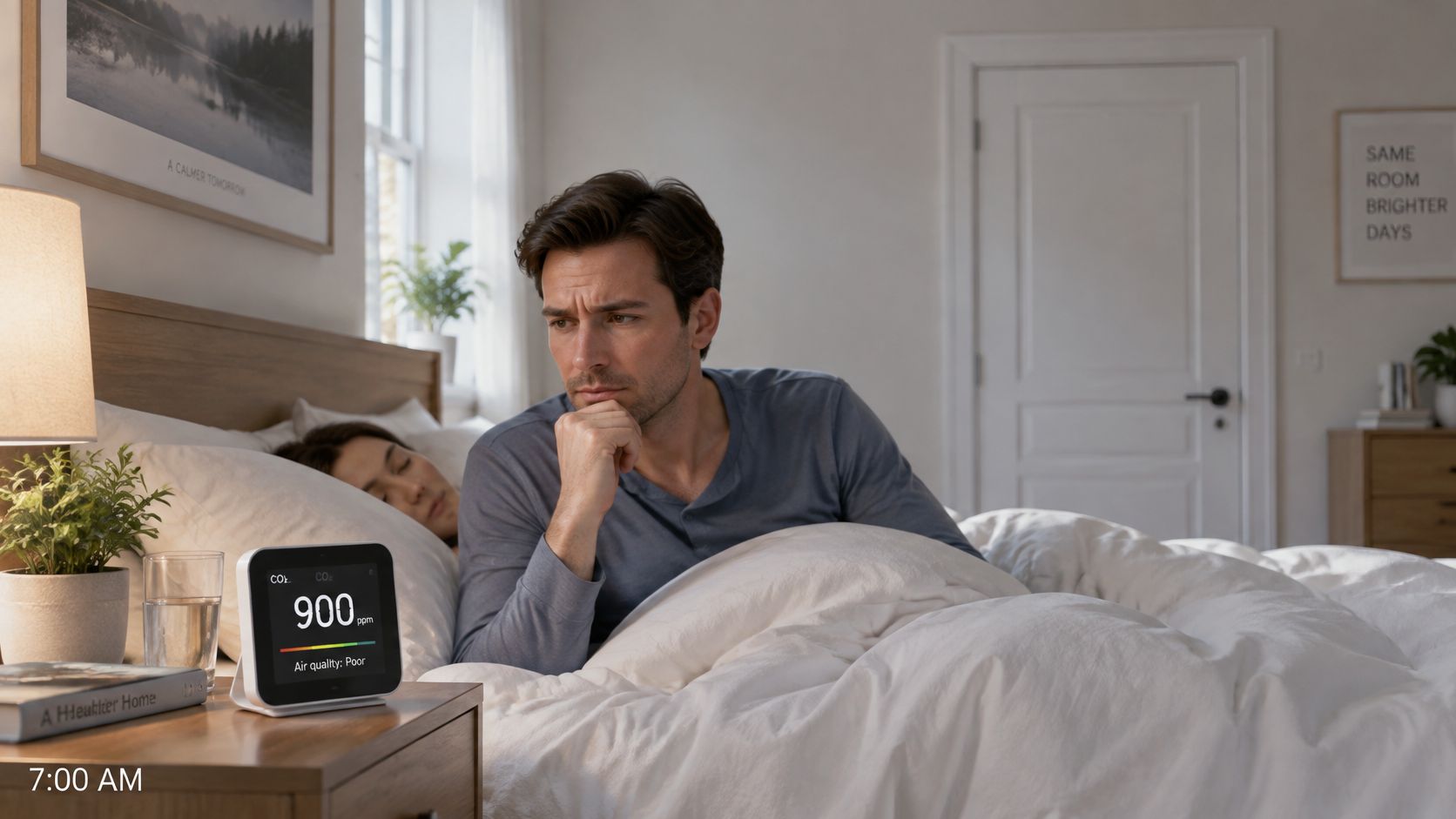
Suppose a bedroom CO2 monitor shows a high reading early in the morning. The door has been closed overnight, and the occupants have been sleeping inside. That result raises a ventilation question, but it doesn't, by itself, establish that the room's air is unhealthy.
The investigation changes if someone held the monitor near their face, the HVAC was off, or the room was unusually crowded. Without those details, an apparently precise reading can support the wrong conclusion.
Fix the conditions before judging the number
The EPA's indoor air quality measurement guidance recommends comparing CO2 patterns among rooms and HVAC zones while recording occupancy, system settings, and weather. It also calls for measurements away from exhaled breath and for baseline or control locations.
Several avoidable errors deserve attention:
- Sampling personal breath: Move the monitor away from occupants' faces and allow readings to stabilize according to its instructions.
- Choosing an atypical day: A vacant office or a house full of visitors may not represent the conditions behind the original complaint.
- Ignoring HVAC operation: Identify whether the system was running and which areas it served. A fan setting alone doesn't establish the outdoor-air supply.
- Trusting an unchecked sensor: Review maintenance and calibration requirements. Don't assume a new display is automatically accurate.
- Overreading a reassuring result: Low CO2 doesn't demonstrate that particles, mold spores, or chemicals are controlled.
Keep a reviewable field record
With every reading or logged interval, preserve:
- Place and time: Room, sampling position, height, date, and clock time.
- Building conditions: HVAC mode, windows, doors, occupancy, and recent activities.
- Environmental conditions: Temperature, relative humidity, weather, and the reference location.
- Instrument details: Model, measured pollutant, units, maintenance status, and any quality checks.
For laboratory samples, the record must also connect the sample to its collection method, measured air volume where applicable, and chain of custody. Chain of custody documents sample identification and handling from collection through laboratory receipt.
CO2 is primarily a ventilation diagnostic, not an overall indoor air quality clearance test.
A professionally defensible interpretation considers the pollutant, exposure period, building use, and measurement method. It doesn't assign a universal healthy or unhealthy label to an entire property from a single display.
Reading Monitor Numbers Against Reference Points
A reference point might be outdoor air measured during the same period, the same room under documented conditions, or a criterion that applies to the project. These comparisons serve different purposes. An outdoor baseline helps investigate sources; a project criterion helps evaluate a defined requirement.
Don't confuse a benchmark with a universal residential health limit. The NIST discussion of ventilation and indoor air quality standards emphasizes the importance of contaminant measurement, analysis, and interpretation within the building's ventilation context.
Reference points for common indoor readings
| Reading | Reference point | What it may suggest | Next check |
|---|---|---|---|
| CO2 sustained above the expected occupied-room pattern | Occupancy-adjusted ventilation expectations and outdoor CO2 | Fresh-air supply may be low for the number of occupants | Compare rooms and review air-handler and vent operation |
| PM2.5 steady and below outdoor levels | Outdoor PM2.5 from the same hours | Lower indoor particle levels, potentially reflecting filtration or limited entry | Log cooking and cleaning periods to check short spikes |
| PM2.5 well above outdoor for many hours | Simultaneous outdoor readings using comparable instruments | Persistent indoor source or ineffective particle control | Investigate sources, filters, and relevant outdoor entry pathways |
| CO elevated or triggering an alarm | Instrument instructions and applicable contaminant-specific criteria | Possible combustion exposure | Treat an alarm as urgent; leave the affected space and seek emergency assistance |
| TVOC or formaldehyde above outdoor baseline | Outdoor air and the same room after a documented ventilation change | Possible emissions from materials, cleaning products, or renovation activity | Use sorbent or DNPH sampling for compound-specific evaluation |
| Radon average flagged by the laboratory or test protocol | Applicable radon assessment criteria | Possible soil-gas entry requiring follow-up | Complete protocol-directed confirmation and obtain professional interpretation |
Compare like with like
Before comparing results, check units, averaging periods, and measurement methods. A brief peak isn't equivalent to a time-weighted average, and a TVOC estimate isn't the same as a laboratory concentration for a named chemical. Instruments with different sensor responses may also disagree without either proving the source.
For particles, annotate ordinary activities rather than deleting inconvenient peaks. A rise during cooking and a sustained elevation while the property is unoccupied lead to different investigative questions. Outdoor comparison data should cover the relevant hours, not an unrelated daily summary from a distant location.
For CO, don't wait to assemble a perfect dataset when an alarm sounds. A consumer air-quality investigation must never delay an emergency response.
An elevated result is a reason to investigate its cause and significance, not proof that a particular repair or removal project is necessary.
A radon kit has its own placement and exposure instructions. Follow that protocol rather than treating it like a portable monitor that can be moved between rooms. Similarly, ventilation changes can help explore a chemical-emission pattern, but the resulting change doesn't identify the chemical or establish its health significance.
Choosing a Testing Provider and Reading the Report
Before accepting a proposal, establish what decision the testing must support. Investigating a musty bedroom, documenting wildfire residue for an insurance claim, and evaluating workplace exposure require different scopes. A package labeled “air testing” may not answer any of those questions adequately without further definition.
Our inspection process includes a property walkthrough, identification of potential environmental hazards, targeted sampling, laboratory analysis, and detailed reporting with next steps. That sequence keeps the sampling connected to what the inspector finds rather than treating sample collection as the entire investigation.
Compare the scope and quality controls
Use these questions when reviewing a proposed investigation:
- Pollutants and rationale: Which contaminants will be evaluated, and why do they match the concern?
- Locations and duration: Which occupied areas, HVAC zones, and reference locations are included?
- Methods and laboratory: Which collection and analytical methods will be used, and does the laboratory's accreditation cover the relevant analyses?
- Qualifications: Do the inspector's credentials fit the inspection and any regulatory requirements?
- Quality assurance: Are calibration records, field blanks, duplicates, and custody documentation appropriate to the method?
Not every sample requires every quality-control measure. The proposal should explain the controls that make the selected method reliable, rather than listing technical terms without a purpose.
For moisture-related projects, why professional mold inspection matters for Los Angeles properties provides additional context for evaluating the inspection component, not just the sample count.
Read beyond the laboratory attachment
A useful report separates observations, analytical findings, and interpretation. Look for a site description, sample-location diagram, collection heights, methods, HVAC and occupancy conditions, laboratory results, detection limits, comparison criteria, and recommended next steps.
A detection limit describes the method's reporting capability. A result reported below that limit doesn't mean the substance could never be present, and a detected substance doesn't automatically explain an odor or occupant complaint.
The report should also state its limitations and identify unanswered questions. Consumer-monitor logs can support the interpretation, especially when they document recurring events, but they shouldn't replace compound-specific samples where those are needed.
Compare proposals on their investigative scope, methods, and reporting, not price alone. A smaller sampling package isn't a bargain if it cannot support the decision you need to make.
When to Bring In a Professional and Act on Results
Professional help becomes appropriate when the question exceeds a monitor's capabilities or the consequences require defensible documentation. Water damage with suspected hidden moisture, recurring odors, persistent occupant concerns, and post-fire residue all justify a more deliberate assessment.
If symptoms persist, seek medical advice as well as evaluating the building. Environmental testing can investigate conditions; it cannot diagnose a person or establish that a building caused a medical condition.
Recognize when the scope must expand
For Los Angeles properties affected by wildfire smoke, an ordinary particle reading may leave important questions unanswered. Wildfire contamination testing and combustion byproduct assessment can involve evaluating ash, soot, char, smoke residue, and relevant heavy metals. Inspection may need to extend beyond room air to affected surfaces, vents, ductwork, and crawl spaces.
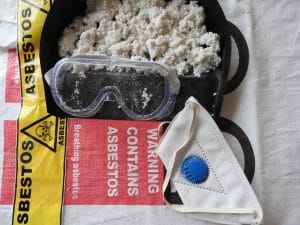
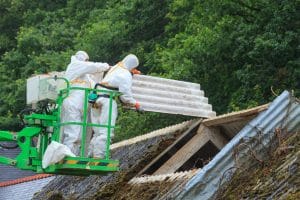
Renovation creates another boundary. A monitor can't identify asbestos in materials or lead in paint. The South Coast AQMD Rule 1403 compliance advisory requires prior asbestos surveys before demolition and before renovation activities that may disturb asbestos-containing material, subject to the rule's stated provisions and exceptions. Arrange the applicable material inspection before disturbance, not after dust appears.
Lease, sale, insurance, and contractor disputes also call for traceable evidence. Schools, healthcare facilities, offices, and industrial settings may require project-specific or exposure-focused protocols rather than household screening methods.
DIY screen versus professional assessment
| Factor | DIY screen | Professional assessment |
|---|---|---|
| Pollutant coverage | Consumer monitors covering selected pollutants | Targeted lab methods for specific compounds and spores |
| Sampling design | Selected rooms, routine observations, a control location | Defined zones, repeated sampling, outdoor reference points |
| Documentation | Personal log of readings and events | Appropriate calibration records, blanks, duplicates, chain of custody, and written report |
| Best use | Preliminary screening and spotting trends | Compliance, insurance, disputes, and post-fire or post-water documentation |
For high-consequence work, repeatability matters. An EPA project testing specification describes sampling on three consecutive days and averaging the cycle for each air-handling zone. That is a defined project protocol, not a universal rule for every home investigation.
Turn findings into proportionate next steps
Confirm that the method answered the original question, review unexplained peaks, and investigate likely sources or moisture pathways. Then decide whether additional sampling or consultation with a qualified contractor is warranted. A mold finding or increased VOC result doesn't automatically require removal or any particular corrective work.
Ventilation changes also need building-specific evaluation. For readers comparing terminology, Trickle Vent Installation Costa Blanca's persiana ventilation installation describes a ventilation service, not environmental testing or evidence that such an installation suits a Southern California property.
Our IAQ testing evaluates mold spores and microbial contaminants, VOCs, allergens, airborne particles, and ventilation or air-circulation issues. Mold investigations address hidden growth, airborne spores, moisture intrusion, and the type and concentration of mold present, helping owners determine appropriate next steps without promising a universally “safe” result.
Sensitive Environmental provides professional indoor air quality testing, mold testing, and moisture-related assessments across Los Angeles and Southern California, with targeted sampling, laboratory analysis, and clear reporting. Visit Sensitive Environmental, call 310-387-5404, or request an appointment online to discuss your monitor results and schedule an environmental testing inspection.