A contractor in Los Angeles has just opened a wall during a tenant improvement project. Dust is spreading through the work area, the schedule is already tight, and nobody can say whether the joint compound, flooring adhesive, or insulation contains asbestos. The project pauses while the owner, contractor, and consultant work out what should have happened before demolition began.
That situation is exactly why SCAQMD Rule 1403 must be treated as a project workflow, not as a form completed at the last minute. For property owners, general contractors, facility managers, developers, and landlords in the South Coast Air Basin, the right sequence usually begins with a professional asbestos survey, representative sampling, laboratory analysis, clear documentation, and only then notification and construction planning.
Table of Contents
- Why SCAQMD Rule 1403 Exists and Where It Came From
- Who Rule 1403 Actually Applies To
- The Pre-Work Asbestos Survey Requirement
- Notifications, Forms, and Compliance Timelines
- Understanding the Procedure 5 Alternative Pathway
- Step-by-Step Compliance Workflow for a Rule 1403 Project
- Common Pitfalls and How to Avoid Costly Penalties
- How Sensitive Environmental Supports Rule 1403 Compliance
Why SCAQMD Rule 1403 Exists and Where It Came From
Asbestos can become an air-quality concern when renovation or demolition disturbs asbestos-containing material. A material that appears stable during ordinary occupancy may release fibers when workers cut, break, remove, or demolish it. Rule 1403 was created to limit asbestos emissions from these activities, including the removal, handling, storage, disposal, and landfilling of asbestos waste.
The South Coast Air Quality Management District Governing Board adopted Rule 1403 on October 6, 1989, and later amended it on January 14, 1994 and October 5, 2007. The 2007 amendment remains the current major milestone reflected in the rule book and compliance materials. The history matters because this isn't a new requirement that only applies to large demolition sites. It's a long-standing regional air-quality program with established survey, notification, and work-practice obligations. South Coast AQMD Rule 1403
How the rule fits with other requirements
SCAQMD Rule 1403 operates within the South Coast Air Basin and addresses the local process contractors and owners must follow before regulated renovation and demolition work. Federal asbestos requirements, including NESHAP provisions, and Cal/OSHA workplace rules may also apply. These frameworks address different parts of the project, so a local Rule 1403 notification doesn't replace a required workplace assessment or other applicable documentation.
In practical terms, the rule turns asbestos control into a sequence:
- Survey the affected facility or components before work begins.
- Identify and quantify friable asbestos and Class I and Class II non-friable asbestos-containing materials.
- Submit the required notification when the project qualifies.
- Use appropriate controls and qualified professionals for the work.
- Document findings and project conditions.
Practical rule: If the crew is already opening walls or removing building components before the asbestos survey is complete, the project sequence has started too late.
For a commercial building in Downtown Los Angeles, a school in the San Fernando Valley, or an older industrial property in Riverside County, the local question isn't whether asbestos might be present. The question is whether the project team has defensible testing and documentation before materials are disturbed.
Who Rule 1403 Actually Applies To
The rule reaches more projects than many owners expect. It can affect the owner or operator of a facility, a landlord directing renovation, a general contractor managing demolition, and other parties controlling or carrying out the work. The property's label, residential or commercial, doesn't by itself answer the compliance question.
The most misunderstood issue is the single-family-owner exception. The South Coast AQMD FAQ describes an exemption for the legal owner of a single-unit family dwelling who is a permanent resident and personally performs the renovation. That narrow situation shouldn't be treated as a general exemption for every house, every homeowner, or every small project. South Coast AQMD Rule 1403 FAQ
Property type and project conditions matter
Condominiums, townhouses, and apartments don't receive that exemption because people live in them. An owner renovating a unit in a condominium may still be working within a regulated property context, particularly where the work affects common components or involves contractors. Multifamily buildings and mixed-use properties create even more gray areas because ownership, occupancy, and project control can be divided among several parties.
The project scope also matters. A small-looking bathroom renovation may disturb several homogeneous materials, such as flooring, mastic, wallboard, texture, or pipe insulation. A property manager shouldn't decide that a project is exempt based only on the room size or the contractor's visual impression.
| Property / Project Type | Rule 1403 Applies? | Key Condition |
|---|---|---|
| Owner-performed work in an eligible single-unit family dwelling | Possibly exempt under the limited exception | The legal owner must be a permanent resident and personally perform the renovation |
| Condominium or townhouse renovation | Don't assume an exemption | The FAQ states that condominiums and townhouses aren't covered by the single-family exemption |
| Apartment or multifamily project | Generally reaches the project | Ownership and occupancy don't create the single-family-owner exception |
| Commercial renovation | Yes, when the work falls within the rule | Survey and project-specific notification duties must be evaluated before disturbance |
| Demolition of a regulated facility | Yes | Demolition notification requirements can apply even when the asbestos scope isn't obvious |
A project can be modest in size and still require professional evaluation. “Small” is not a substitute for a documented scope review.
For owners and contractors in Los Angeles County, the safest first question is not “Do we think this building is exempt?” It's “Who owns and controls the facility, what materials will be disturbed, and has a qualified consultant documented the answer?”
The Pre-Work Asbestos Survey Requirement
Before renovation or demolition, the affected facility or components must be thoroughly surveyed for asbestos. Rule 1403 requires the survey to identify and quantify friable asbestos, along with Class I and Class II non-friable asbestos-containing materials. South Coast AQMD also states that renovation and demolition work in the basin must be preceded by an asbestos survey performed by a Cal/OSHA Certified Asbestos Consultant, commonly called a CAC. South Coast AQMD contractor requirements
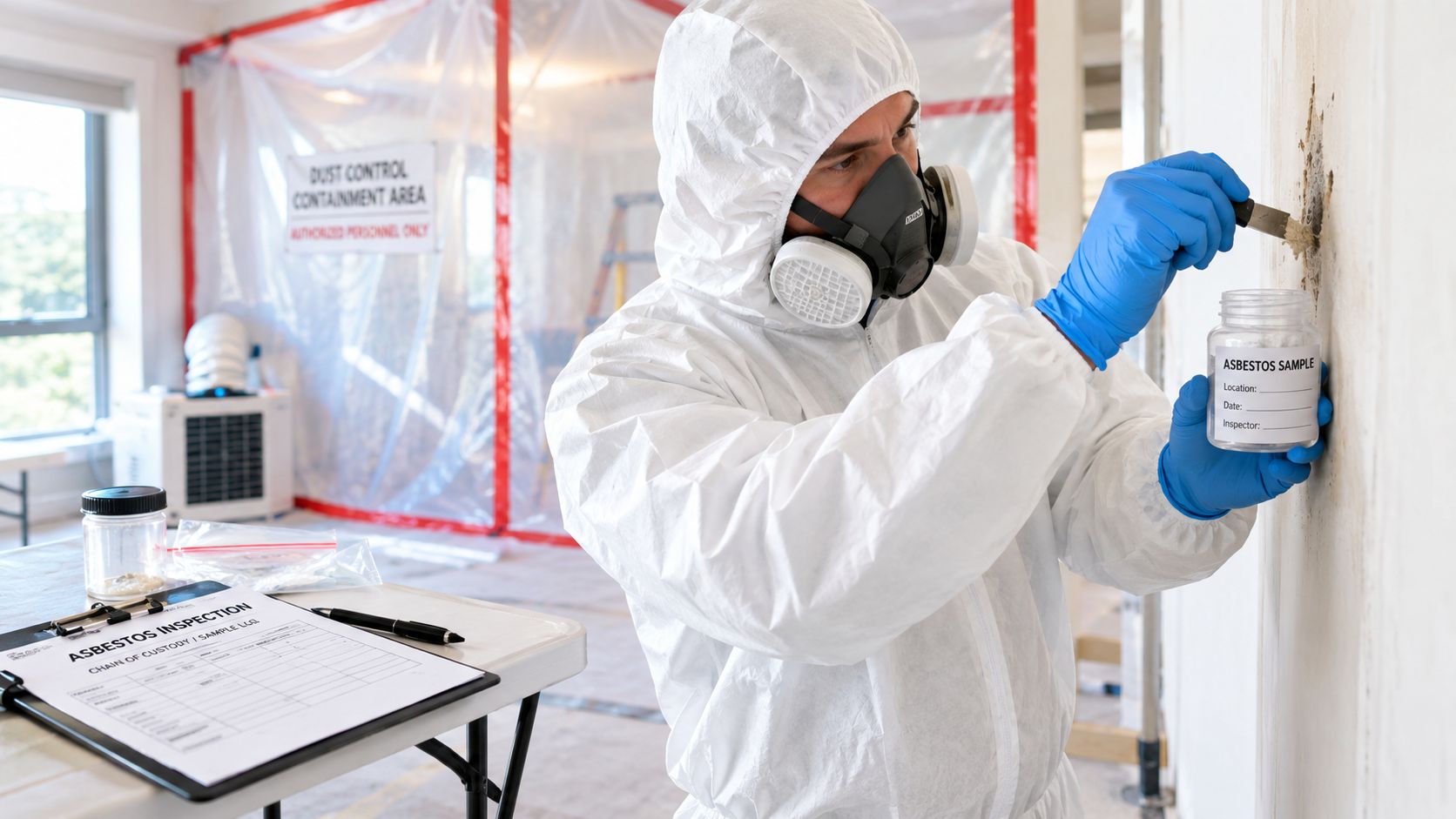
A professional survey isn't just a visual walkthrough. The consultant identifies suspect materials connected to the planned work, defines homogeneous areas, collects representative bulk samples, and arranges laboratory analysis. Bulk sample identification relies on polarized light microscopy under 40 CFR Part 763, Appendix A, Subpart F, while the survey process must be designed around the affected materials and the actual demolition or renovation scope. Rule 1403 technical requirements
Why the laboratory result changes the workflow
The key classification line is 1.0% asbestos. A homogeneous material reported at or above that threshold is classified as asbestos-containing material for the relevant Rule 1403 decision. If sampling misses a material, uses an unrepresentative location, or treats several visually similar materials as one without support, the report may produce the wrong compliance path.
The report should give the project team enough information to act, including:
- Location: Where the material is found and which planned work may disturb it.
- Material description: What the building component is, such as flooring, mastic, wallboard, insulation, roofing, or textured finish.
- Laboratory result: The asbestos percentage and analytical method used.
- Condition and friability: Whether the material is damaged, friable, or non-friable under the applicable definitions.
- Quantity: The estimated amount affected, expressed in the appropriate area or length measurement.
- Response information: Practical recommendations for sequencing, additional investigation, or qualified next steps.
A negative result doesn't mean every part of the building has been tested. It means the sampled materials and locations produced the reported findings. That distinction is especially important in older commercial buildings where hidden layers, mechanical chases, concealed finishes, or inaccessible areas may require additional planning.
For an explanation of the project-planning value of this work, see why asbestos testing is essential before a commercial renovation project in Los Angeles. Professional asbestos testing gives owners and contractors a documented basis for deciding what can proceed, what needs further assessment, and which qualified professionals must be involved.
Notifications, Forms, and Compliance Timelines
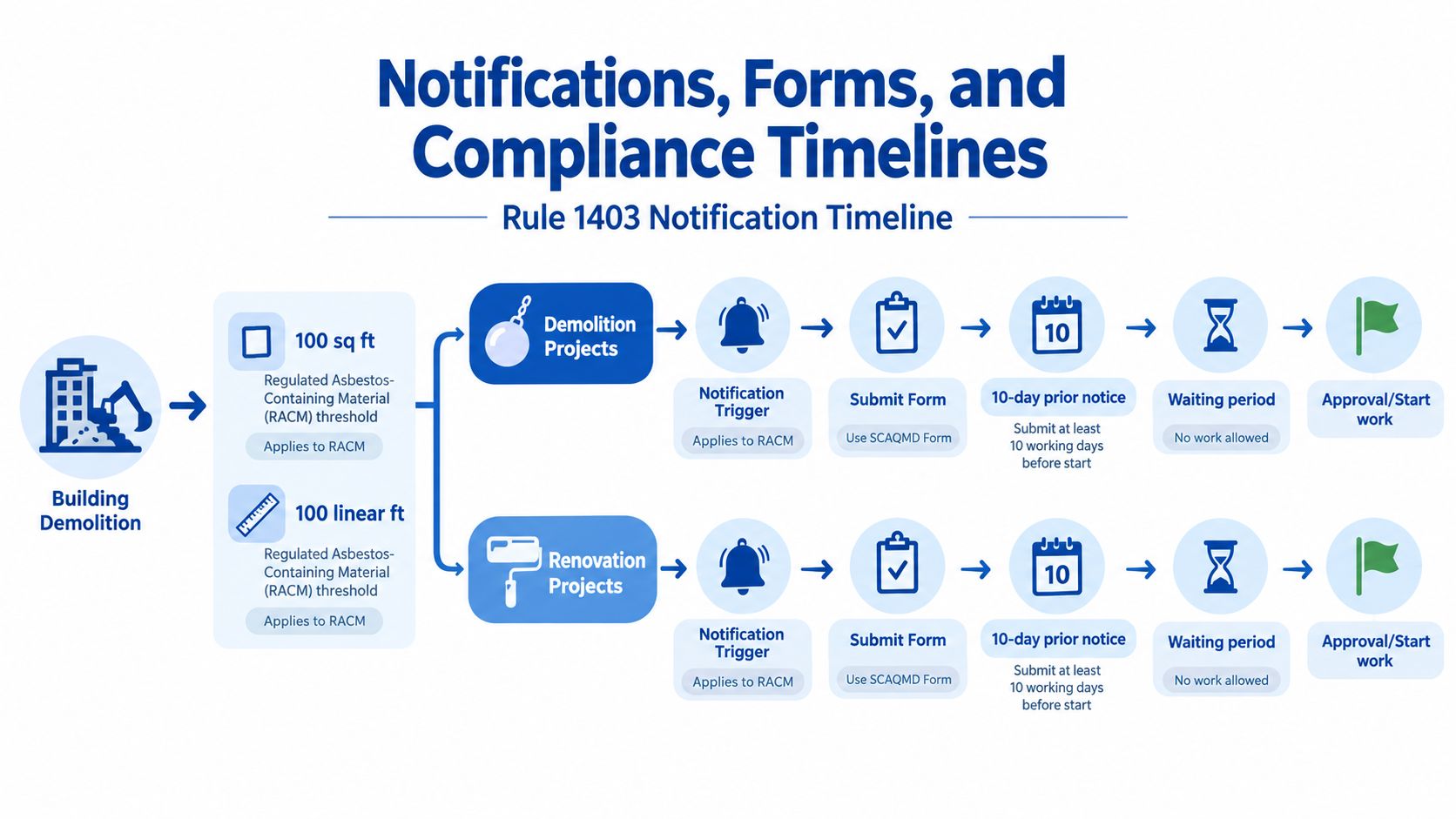
A contractor can finish the survey, confirm the work area, and still lose a week because the notification account is not ready. South Coast AQMD guidance identifies a 100-square-foot trigger for certain asbestos-related work, with an exception for some small-scale residential work below that amount. Electronic notification must be submitted 10 working days, or 14 calendar days, before demolition or removal of more than 100 square feet of intact asbestos. South Coast AQMD Rule 1403 web application guidance
Build the filing sequence in this order:
- Complete the asbestos survey and laboratory analysis.
- Confirm the project scope and affected material quantities.
- Decide whether demolition or renovation notification is required.
- Set up the facility and user information in the web application.
- Submit the notification and required fee electronically.
- Preserve the required lead time before qualifying work begins.
Why portal setup becomes the bottleneck
Since November 1, 2016, Rule 1403 asbestos removal and demolition notifications and fee payments have been submitted online through the South Coast AQMD web application. Mailed, faxed, and emailed submissions are no longer accepted. The South Coast AQMD notification application requires practical onboarding before filing: obtain or confirm the Facility ID, register the user account, complete the required agreements, and prepare the project information and payment details. A first-time filer who starts these steps shortly before construction may not have enough time to correct account or facility records.
Plan with working days rather than a casual calendar count. Weekends and non-working days affect the calculation, and an incomplete submission may require correction before the project can rely on it. Emergency demolitions and renovations can follow different timing rules, but an emergency does not automatically erase notification responsibilities. Procedure 5 work also has its own approval process, so the team should identify that pathway before choosing a start date.
The 100-square-foot threshold does not answer every compliance question. Project scope, material condition, property type, and the applicable residential exception must be reviewed together. A survey decision and a notification decision are related, but they are not identical. That distinction helps owners avoid treating a possible notification exception as permission to skip the investigation or other required controls.
Understanding the Procedure 5 Alternative Pathway
Procedure 5 isn't a generic cleanup option or a shortcut around Rule 1403. It is an engineering-controls pathway that requires written approval from the Executive Officer before an approved alternative combination of techniques or engineering controls is used. AQMD materials describe Procedure 5 plans in connection with asbestos site cleanups, open-air abatement, and demolitions where asbestos remains in place. Procedure 5 guideline
A damaged or disturbed ACM condition changes the workflow. South Coast AQMD states that a Procedure 5 cleanup plan prepared by a CAC must be completed when asbestos-containing material is found in debris or damaged structures, and a registered asbestos abatement contractor must be hired to address the material before electronic notification is submitted. The compliance advisory states that a Procedure 5 cleanup plan must be submitted whenever damaged or disturbed ACM is present, regardless of project size, and work can't begin until SCAQMD staff approve the plan in writing. Rule 1403 compliance advisory
| Factor | Standard Rule 1403 | Procedure 5 |
|---|---|---|
| Basic use | Ordinary renovation and demolition compliance | Approved alternative controls for unusual or damaged-material conditions |
| Approval | Follows the standard notification process when applicable | Requires written Executive Officer approval before use |
| Planning basis | Survey, classification, quantities, and notification | Site-specific engineering controls and an approved plan |
| Work timing | Protect the required notification lead time | Wait for written approval before abatement begins |
| Validity | Tied to the project notification and scope | A pre-approved plan is valid for 12 months at the designated facility |
| Submission route | Rule 1403 web application | Procedure 5 plans are submitted through the same web application |
A Procedure 5 plan must match the actual facility and conditions. It isn't portable approval for unrelated properties, and incomplete materials can prolong review. Sensitive conditions, including fire-damaged structures or asbestos left in place during a controlled demolition, deserve early CAC involvement rather than last-minute form preparation.
Step-by-Step Compliance Workflow for a Rule 1403 Project
A workable project sequence starts before permits, demolition mobilization, or interior stripping. Owners and contractors should document each decision so the survey report, laboratory results, notification, and field work describe the same scope.
The six practical stages
Define the project. Mark the rooms, systems, building components, and structural areas that workers will disturb. Include planned access points and areas that may be concealed.
Select a qualified CAC. Confirm that the consultant is appropriate for the planned asbestos survey and can provide signed documentation suitable for the project and regulatory review.
Collect representative samples. The consultant identifies suspect homogeneous materials, collects bulk samples, and sends them for laboratory analysis using the applicable analytical protocol. Sampling should be tied to material type, location, condition, and the actual work limits.
Prepare the survey report. The report should connect sample identifiers and laboratory findings to location diagrams, material descriptions, conditions, friability, quantities, and project recommendations. A report that can't be understood in the field creates avoidable coordination problems.
Submit the notification. Use the SCAQMD web application, complete the facility information, attach the required documents, and protect the 10-working-day lead time where it applies. Keep confirmation and submission records with the project file.
Coordinate execution and documentation. Qualified contractors handle any required asbestos work under the applicable controls. The project team should maintain site records, monitoring documentation, laboratory reports, approvals, and final project materials rather than relying on informal emails.
Before the first notice is filed, check that the survey covers the complete disturbance area, sample results are clearly labeled, quantities are internally consistent, the Facility ID information is available, and the planned work date respects the applicable notice period. Sensitive Environmental's asbestos testing and documentation services can support the inspection, sampling, analysis, and reporting portion of that process. The testing consultant doesn't replace the contractor responsible for regulated field work, but good documentation helps every party understand its role.
Common Pitfalls and How to Avoid Costly Penalties
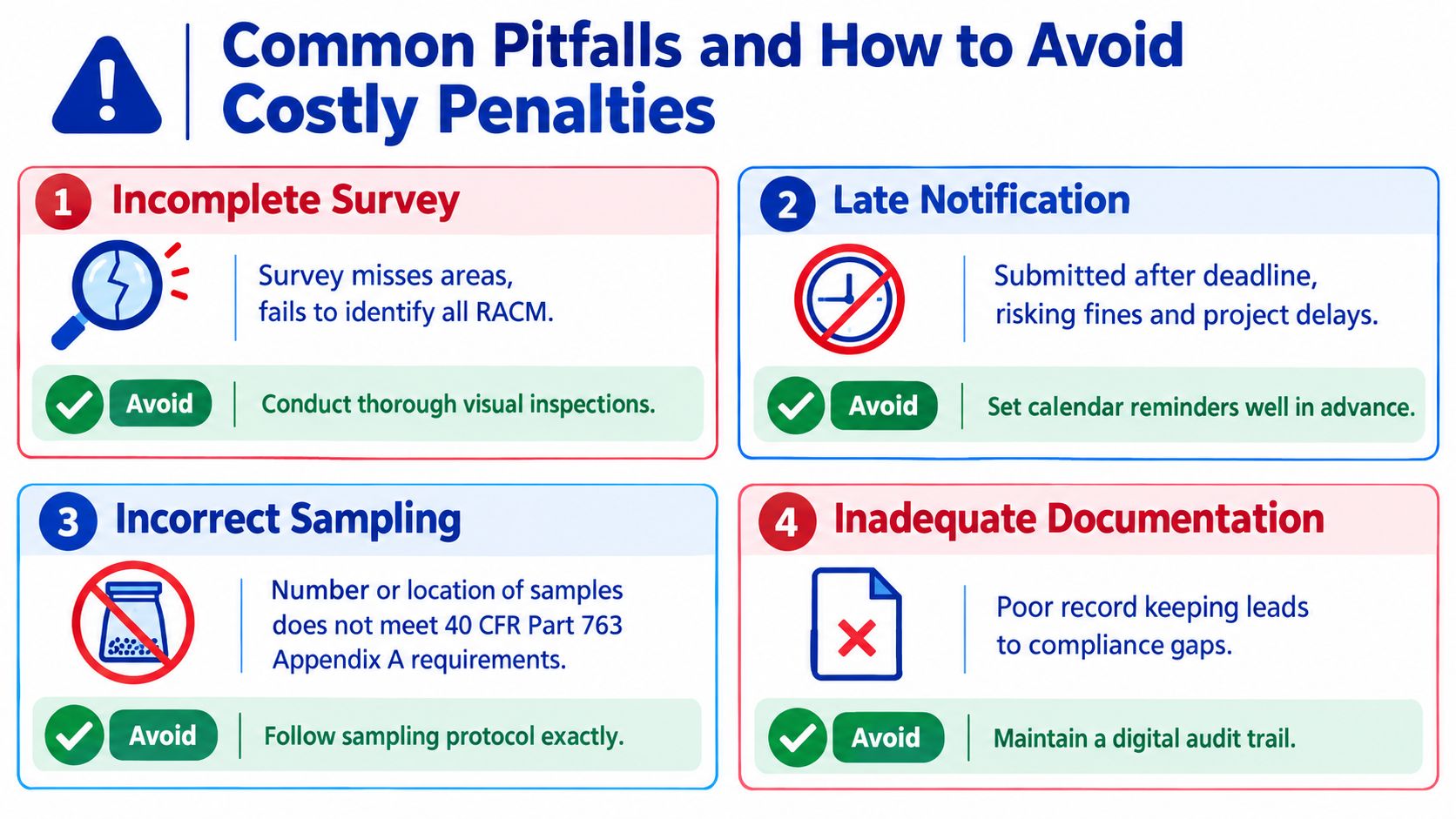
Most compliance failures begin before anyone submits a form. A project team may have a report, but the report may not cover the complete scope, may use weak sampling logic, or may arrive after the construction schedule has already been fixed.
Four failures that repeatedly disrupt projects
Incomplete survey: A consultant or contractor may inspect visible finishes but miss concealed materials behind walls, beneath floors, or in mechanical spaces. Avoid that gap by comparing the survey limits with the demolition drawings and planned access.
Late notification: Teams sometimes treat a small renovation as automatically exempt, then discover that the affected materials, property type, or total work scope requires a different analysis. Set the notification workflow in motion as soon as the scope is defined, not after mobilization is scheduled.
Incorrect sampling: A single convenient sample may not represent every homogeneous area. Sampling location, material layers, condition, and laboratory documentation all affect whether the result supports a defensible classification under the applicable protocol.
Inadequate records: Missing diagrams, laboratory reports, portal confirmations, approvals, or field documentation can create a compliance gap even when the physical work was carefully managed. Keep a digital audit trail that the owner, consultant, contractor, and facility manager can access.
Why non-friable materials deserve attention
Non-friable ACM can become friable when demolition fractures or damages it. That change can alter the work conditions and require the team to stop, reassess, and follow the appropriate pathway. A material's original appearance isn't enough to predict how it will behave once workers use saws, breakers, grinders, or heavy equipment.
The cheapest time to discover a missed asbestos material is before the crew arrives, not after demolition dust fills the work area.
South Coast AQMD can issue compliance notices and require corrective action when project teams fail to follow applicable requirements. A shutdown can also create scheduling, tenant, insurance, and financing problems, even when the original testing decision looked like a minor administrative expense. Because penalties and project costs depend on the facts and enforcement circumstances, owners should obtain project-specific regulatory advice instead of relying on an informal dollar estimate.
How Sensitive Environmental Supports Rule 1403 Compliance
A Rule 1403 project depends on a connected chain of evidence. The initial inspection identifies suspect materials, sampling supplies representative evidence, laboratory analysis classifies the samples, and the survey report translates those findings into a construction decision. If one link is incomplete, the owner may have difficulty defending the project scope or explaining why work proceeded.
Sensitive Environmental provides environmental testing and inspection services for that documentation chain. Its work can include CAC-led asbestos surveys, bulk sampling, laboratory coordination, and reporting for renovation and demolition projects in Los Angeles and Southern California. The company also supports testing and documentation related to SCAQMD Rule 1403, AQMD requirements, Notices to Comply, and Procedure 5.
What the testing process should give the project team
A useful consultant relationship should produce more than a laboratory result. Property owners, contractors, schools, hospitals, facility managers, and developers generally need:
- A defined inspection scope that matches the planned disturbance.
- Representative sample locations tied to homogeneous materials and building areas.
- Clear laboratory results that identify the analytical outcome for each sample.
- A readable survey report with locations, conditions, quantities, and recommendations.
- Regulatory documentation support when the findings require notification or a Procedure 5 evaluation.
- A record set that can be shared with project participants and retained for future property decisions.
Sensitive Environmental's broader services also include lead testing, mold inspections and sampling, indoor air quality testing, commercial environmental testing, industrial hygiene assessments, environmental site assessments, and fire-related testing for ash, soot, char, smoke residue, combustion byproducts, and heavy metals. Those services can be relevant when a renovation follows water damage, a fire, a wildfire event, or a change in building use, but the appropriate testing depends on the property history and planned work.
For owners planning renovation or demolition in Los Angeles, Orange, Riverside, San Bernardino, or Ventura County, arrange the asbestos survey before the schedule is locked. Asbestos testing and related project documentation in Los Angeles can help clarify what must be sampled, what the laboratory results mean, and which compliance questions should be addressed before construction begins.
Schedule a pre-renovation or pre-demolition asbestos survey with Sensitive Environmental to coordinate professional inspection, representative sampling, laboratory analysis, and clear Rule 1403 documentation. Contact the team before work starts so your Los Angeles or Southern California project can be planned around its actual environmental findings and notification needs.