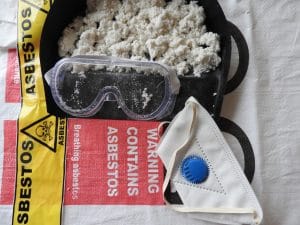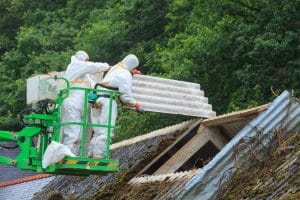
A Los Angeles homeowner is often standing at the same decision point: the contractor is ready to scrape a popcorn ceiling, cut an access panel for wiring, or remove drywall, but nobody knows whether the ceiling contains asbestos. The texture may look ordinary, and the room may have no unusual odor. That doesn't answer the question. The only reliable confirmation comes from laboratory analysis of a properly collected bulk sample, not from appearance or a quick visual inspection. EPA homeowner guidance on identifying asbestos explains why suspect materials shouldn't be identified by sight alone.
Learning how to test for asbestos in ceiling materials safely means understanding the complete process: identify homogeneous areas, prepare the room, collect full-thickness samples, preserve chain of custody, obtain laboratory results, and connect those results to the Los Angeles renovation workflow. A single chip mailed to a laboratory may provide information, but it often doesn't provide the survey documentation a contractor, property manager, or permitting team needs.
Table of Contents
- Why Testing an Older Ceiling Before Disturbing It Matters
- When Ceiling Materials Are Most Likely to Contain Asbestos
- Preparing the Space Before Any Sample Is Taken
- How Bulk Ceiling Samples Are Actually Collected
- Chain of Custody and What Happens at the Laboratory
- DIY Sampling Versus a Professional Asbestos Survey
- Connecting Ceiling Testing to LA-Area Compliance Workflows
Why Testing an Older Ceiling Before Disturbing It Matters
A Los Angeles renovation can change direction within minutes. The contractor starts sanding a popcorn finish, drilling for wiring, or cutting an access opening, and suspect material begins shedding dust. Airflow can carry that dust toward HVAC returns and into areas outside the immediate work zone. Once disturbance has occurred, work may stop while the ceiling, nearby surfaces, and planned controls are assessed.
Appearance, odor, and a quick field check cannot confirm asbestos in ceiling material. A white textured finish, gray acoustic coating, decorative plaster, or smooth skim coat may each require sampling when they represent different suspect material areas. EPA bulk-sampling guidance treats materials with different textures, colors, fiber types, or compositions as separate homogeneous areas, and recommends checking equivalent materials elsewhere in the building. The EPA bulk asbestos sampling guidance supports that sampling framework.
Practical rule: Decide whether testing is needed before renovation begins, not after tools are already working.
What the early decision prevents
A late discovery creates pressure at the worst point in the schedule. Furniture may already be moved, walls opened, HVAC components adjusted, and other trades booked. If disturbance has started, the owner may face a shutdown, added documentation, and a more difficult review of where contaminated dust could have traveled.
A pre-renovation survey defines the material scope before those decisions are made. It documents which ceiling fields were sampled, the location of each sample, and whether cavities, repairs, or adjacent materials require separate evaluation. That documentation becomes particularly important when the project must fit SCAQMD Rule 1403 requirements and Procedure 5 reporting, because the work involves more than mailing one piece of texture to a laboratory. The number and location of samples should match the homogeneous areas and planned disturbance.
Owners comparing broader building risks can also review asbestos roof repair versus replacement costs, since the right response depends on material condition, planned work, and the records required for the job.
An intact ceiling that will remain untouched may not warrant sampling that creates avoidable damage. A damaged ceiling, or one that renovation will penetrate, should be evaluated by qualified personnel before work starts.
When Ceiling Materials Are Most Likely to Contain Asbestos
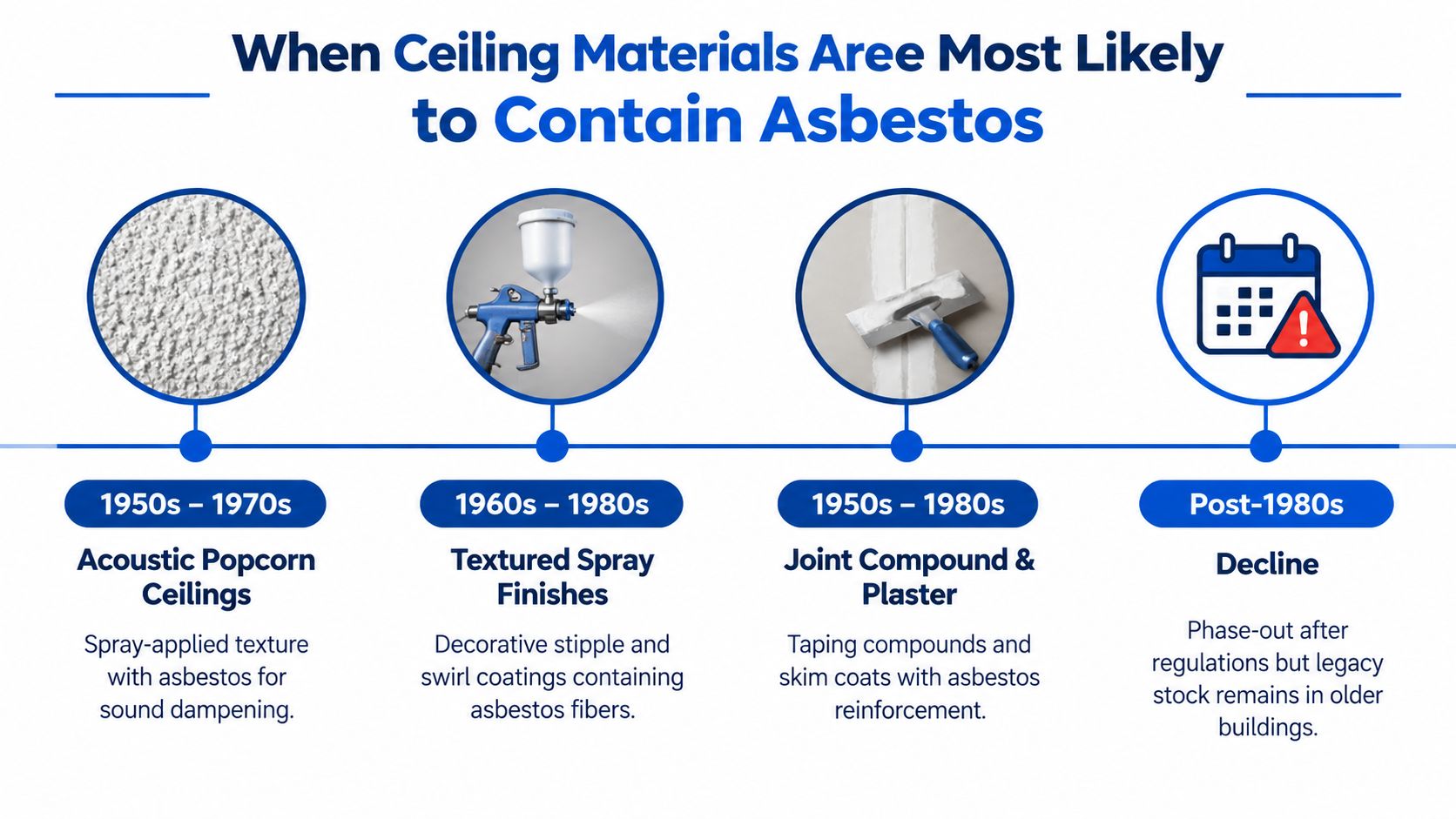
Ceiling age is a screening clue, not a laboratory result. In Los Angeles, inspectors commonly treat ceiling materials in buildings constructed before 1980 as suspect until bulk sampling demonstrates otherwise, particularly when the finish is textured, sprayed, layered, or damaged. EPA-related historical information describes a regulatory phase-out rather than one universal cutoff date. Spray-applied asbestos ceiling materials were first restricted in 1973, broader limits on spray-applied surfacing materials tightened in 1978, and a later 1989 EPA rule attempted to ban most asbestos-containing construction products. Historical asbestos-use timeline and regulatory context
Common suspect materials include:
- Acoustic popcorn finishes: Spray-applied textures used for appearance and acoustic properties.
- Decorative spray coatings: Stipple, swirl, and other textured finishes that may have been applied over plaster or drywall.
- Joint compounds and skim coats: Layered materials used over seams, repairs, or broad ceiling surfaces.
- Plaster patching compounds: Localized repairs can differ from the surrounding ceiling field.
- Ceiling tiles: Older tiles and their adhesives may require separate evaluation from the substrate above them.
A post-1980 installation is generally less likely to contain asbestos, and materials installed after the mid-1990s are considered far less likely to contain it. That doesn't turn the installation date into proof. Remodeling records may be incomplete, ceilings may have been patched with older stock, and a single room may contain several products installed at different times.
Why appearance doesn't settle the question
Asbestos fibers are microscopic. Texture, color, age, and pattern can help an inspector decide where to look, but they can't confirm content. A ceiling that looks exactly like a known asbestos-containing texture may test negative, while a smooth or repaired area may contain asbestos in a concealed layer.
That distinction matters for homeowners, landlords, and contractors planning work in communities such as Pasadena, Long Beach, Glendale, and the San Fernando Valley. Treating a suspect ceiling as unconfirmed until laboratory analysis is available is more reliable than relying on a visual guess.
Preparing the Space Before Any Sample Is Taken
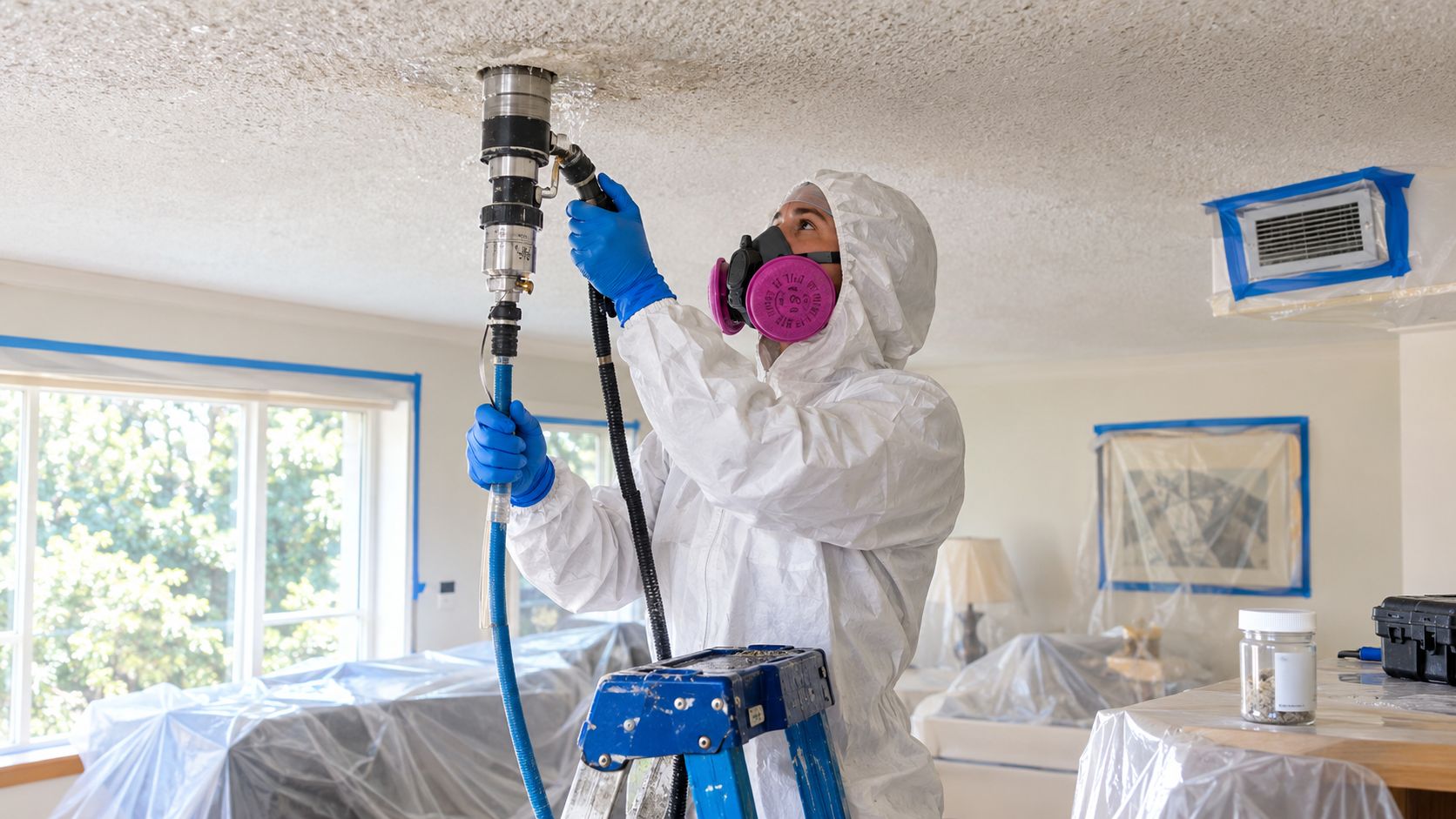
A professional ceiling sample starts with room control, not with a knife. The sampling area should be isolated so occupants, pets, furniture, and HVAC systems aren't exposed to unnecessary dust. Move furniture out when practical, or cover it with polyethylene sheeting. Cover the floor, tape the edges, close doors and windows, and restrict access to adjacent rooms.
HVAC control deserves special attention. Supply and return registers in or near the work area should be sealed with plastic and tape, and the system should be turned off during sampling when the work plan calls for it. This limits the chance that disturbed dust will circulate through the building.
The controlled setup
A sampling professional typically uses a fine-mist pump sprayer with amended water or a surfactant solution to wet the target area. Wetting helps suppress dust during the cut. The sample isn't taken from a dry, scraped surface because dry disturbance can release more particulate material and may fail to capture the complete assembly.
Expected personal protective equipment includes:
- Respiratory protection: A properly fitted P100 respirator or better, used within an appropriate respiratory-protection program.
- Disposable clothing: A Tyvek suit or comparable disposable coverall to limit transfer of dust.
- Hand and eye protection: Nitrile gloves and protective eyewear during cutting and handling.
- Cleaning equipment: A HEPA vacuum and wet-wiping materials for the sample point and nearby surfaces.
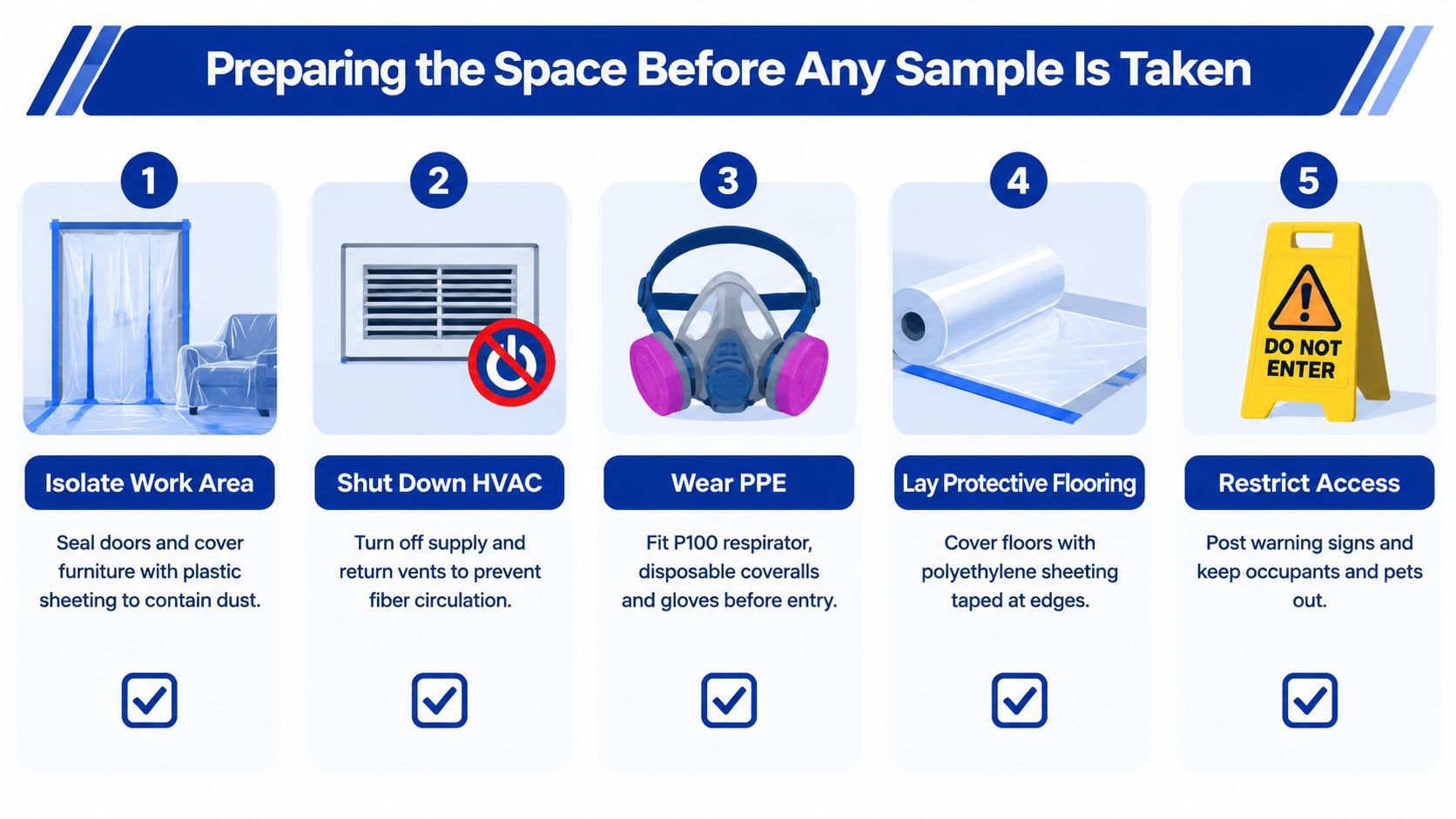
Don't vacuum or dry sweep the ceiling before sampling. Those actions can aerosolize settled material and create a problem before the controlled collection even begins. A professional instead limits disturbance, wets the location, collects the sample, seals the penetration, and cleans the area with HEPA vacuuming or wet wiping.
Why preparation affects the result
The room setup protects more than the sampler. It also preserves the credibility of the event. A documented, controlled sampling process gives the property owner a clearer record of what happened, where it happened, and how the sample was handled. That becomes especially important when a ceiling survey supports renovation planning or South Coast AQMD documentation.
How Bulk Ceiling Samples Are Actually Collected
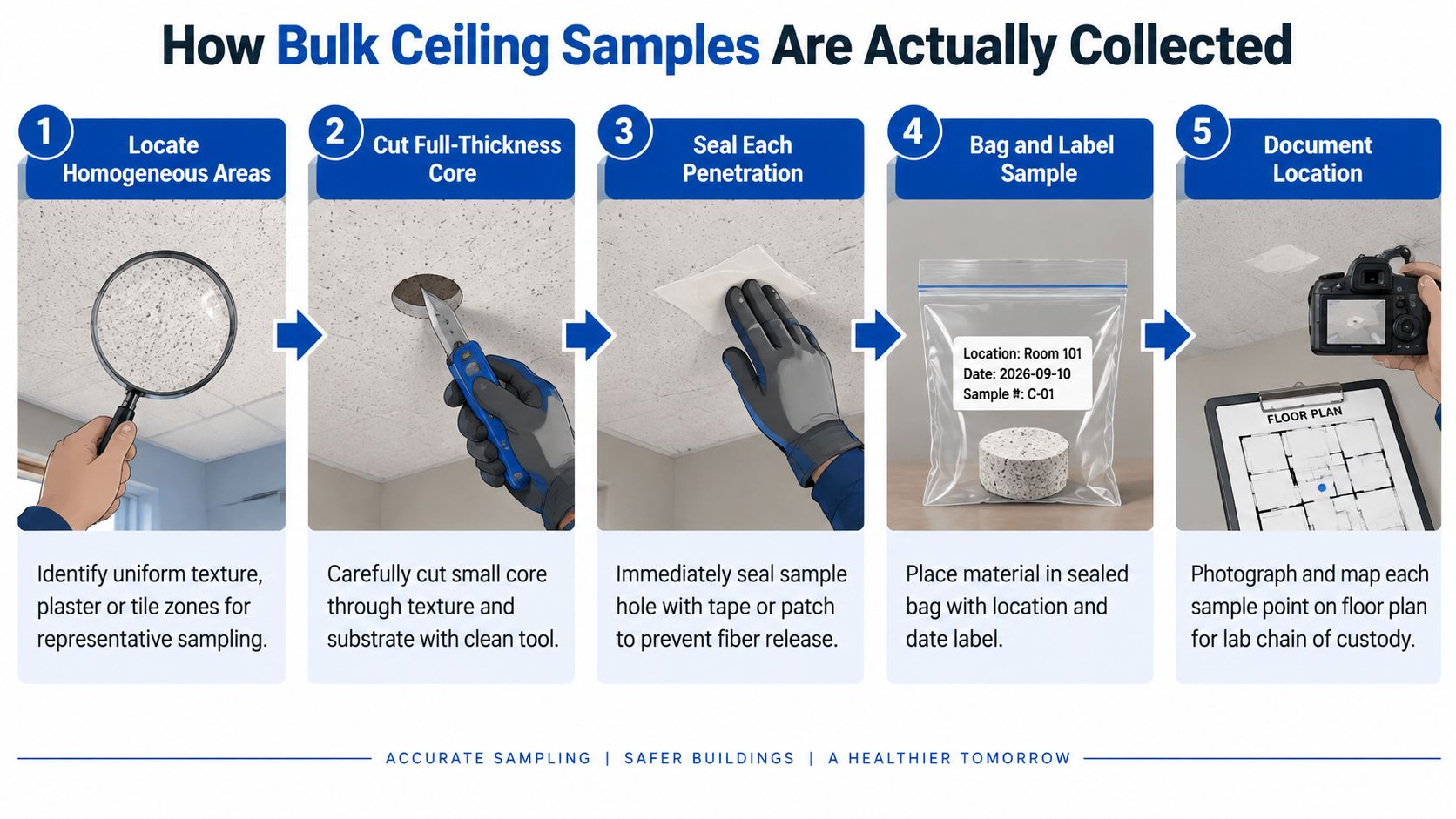
A ceiling sample is planned around the material, the area, and the work that may disturb it. The sampler first separates homogeneous material areas, meaning sections that appear consistent in composition, texture, color, and application. A repaired patch, smooth border, sprayed field, or ceiling tile assembly may require separate evaluation. One room can contain several distinct products, even when the differences are difficult to see from the floor.
For a sprayed acoustic ceiling, the sampler cuts or scrapes through the complete finish down to the drywall or plaster below. A surface-only scoop may miss an asbestos-containing layer or fail to represent the assembly that renovation will affect. EPA guidance describes a representative sample of about one tablespoon or roughly one cubic inch, approximately 15 cubic centimeters, so the laboratory receives enough material for analysis. EPA guidance on full-thickness asbestos samples
Sample count follows the material area
Sample numbers depend on the size and consistency of the surfacing material. The commonly used 3-5-7 minimum-sample rule calls for 3 samples in areas smaller than 1,000 square feet, 5 samples for areas from 1,000 to 5,000 square feet, and 7 samples for areas larger than 5,000 square feet. These counts are described in EPA bulk sampling guidance.
The rule does not mean dividing every ceiling into equal squares. Patchwork repairs, separate applications, and changes in texture can create additional material areas that need their own samples. National survey guidance also describes collecting at least 2 separate samples per ceiling or wall surface and 1 sample per 25 square meters for large areas. That approach shows why a single homeowner sample may not answer the renovation question. National asbestos survey sampling guidance
The collection itself follows a controlled sequence:
- Locate the area: Mark a representative point in each homogeneous ceiling field.
- Wet the surface: Apply amended water or surfactant while limiting spread to nearby surfaces.
- Cut full thickness: Use a clean tool to collect the texture and underlying layers.
- Seal the penetration: Apply encapsulant, patching material, or another suitable seal promptly.
- Clean the point: HEPA vacuum or wet-wipe the area, then place the sample in sealed packaging.
- Record the location: Photograph and map the point on a floor plan or survey sketch.
For a Los Angeles property owner preparing for renovation, Sensitive Environmental asbestos testing services may handle the inspection and laboratory-analysis process. Testing documents what was sampled and where. Qualified professionals then use those results to assess regulated work under the applicable project requirements.
Chain of Custody and What Happens at the Laboratory
After collection, each sample is sealed and labeled with information that connects the material to the survey record. The label typically identifies the project, sample number, building or room, precise location, material description, collection date, and sampler. The chain-of-custody form records who relinquished and received the sample, the requested analysis, and the condition of the package.
The laboratory's job begins with the material as submitted, not with a photograph of the ceiling. For bulk asbestos analysis, polarized light microscopy, or PLM, is the initial analytical method identified in EPA documents. The laboratory examines the submitted layers and reports whether asbestos is detected and, where applicable, the type and estimated concentration.
Why the sample must represent the assembly
A ceiling can have a textured finish over a skim coat, joint compound, plaster, or another substrate. If the sampler sends only loose surface granules, the result may not answer the renovation question. Layered systems should be evaluated as separate layers when their composition or planned disturbance differs.
Results are reported by homogeneous material area, not as a blanket conclusion based on one convenient piece from one location. A negative result applies to the material represented by the collected samples and documented area. It doesn't automatically clear an unrelated repair, hidden cavity component, or different ceiling product elsewhere in the building.
When PLM needs more investigation
PLM is the starting point for bulk materials. If the result is ambiguous or the project requires additional analytical confidence, point-counting or transmission electron microscopy may be considered by the laboratory and project team. The correct method depends on the sample, the question being asked, and the applicable regulatory or project requirements.
The owner should receive a signed laboratory report linked to the survey documentation. The report is useful because it translates a controlled sampling event into a written record that can support renovation planning, property records, and regulatory review. It shouldn't be treated as permission to disturb every ceiling surface in the building.
DIY Sampling Versus a Professional Asbestos Survey
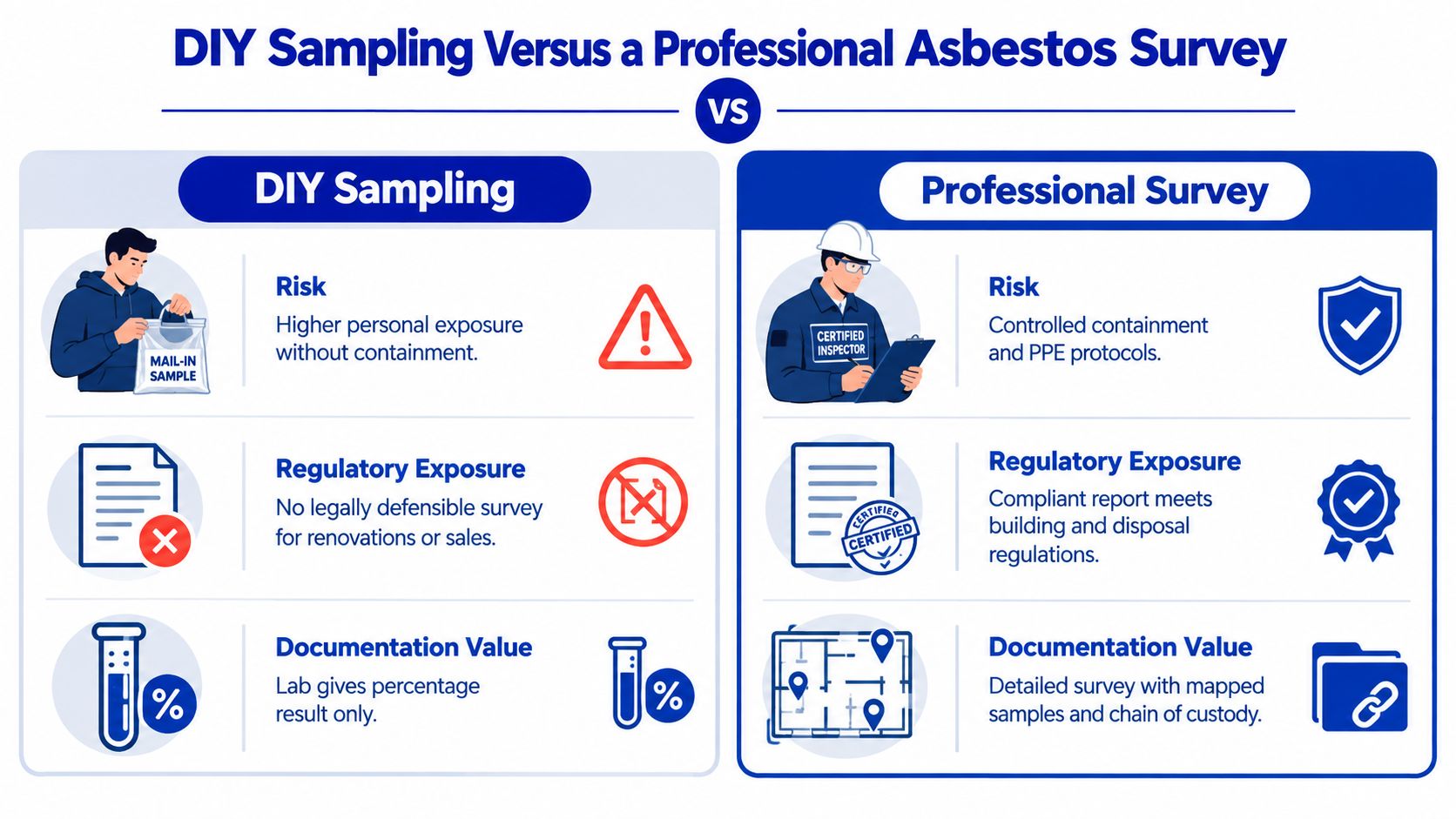
A mail-in kit can appear straightforward. A homeowner cuts a piece of popcorn texture, seals it in a bag, and receives a laboratory percentage. The problem is that a laboratory result alone may not document the entire ceiling assembly, the sampling locations, the condition of the material, or the boundaries of the area represented.
Professional sampling addresses the part most DIY instructions understate: the act of disturbing the ceiling. Without containment, wetting, respiratory protection, controlled access, and cleanup, a person can create dust while trying to answer whether dust is present. A poorly chosen sample can also produce a result that is technically accurate for that fragment but irrelevant to another ceiling field.
Where the trade-off appears
DIY sampling may provide a preliminary indication for a homeowner who isn't planning to disturb the ceiling and only wants information. It usually won't provide the defensible survey package required for a Los Angeles renovation or demolition project. A professional survey can connect sample points to a floor plan, distinguish homogeneous areas, document friability and condition, and preserve chain of custody.
| Consideration | DIY sample | Professional survey |
|---|---|---|
| Physical risk | The homeowner controls containment and may create dust during collection. | The sampler uses controlled preparation, wet methods, PPE, and cleanup. |
| Coverage | Often limited to one convenient location. | Based on material areas, layers, condition, and project scope. |
| Documentation | Usually a sample label and laboratory result. | Survey report, mapped locations, photographs, chain of custody, and lab analysis. |
| Project use | May not satisfy renovation or demolition requirements. | Can support regulatory review when performed by appropriately qualified personnel. |
A professional environmental testing company such as Sensitive Environmental can handle inspection, sampling, laboratory coordination, and reporting. For contractors and property managers also evaluating how technology supports customer communication, 24/7 AI for home service companies may be a separate operational resource, but automation doesn't replace a qualified asbestos surveyor or laboratory analysis.
Homeowners who are considering a kit can also review whether asbestos can be tested at home before deciding. The key question isn't whether a sample can be mailed. It's whether the result answers the project's regulatory and technical question.
Connecting Ceiling Testing to LA-Area Compliance Workflows
In Los Angeles County and surrounding South Coast Air Quality Management District jurisdictions, ceiling testing often sits inside a larger pre-renovation or pre-demolition workflow. SCAQMD Rule 1403 requires an affected facility or facility component to be thoroughly surveyed before demolition or renovation, with inspection, identification, quantification, and physical sampling of friable and certain non-friable asbestos-containing materials. The rule also addresses material in wall or ceiling cavities when necessary to identify and sample affected components. South Coast AQMD Rule 1403
That requirement changes the meaning of “test the ceiling.” The task isn't merely to identify popcorn texture from the room below. The surveyor must consider what the planned work will disturb, including layered assemblies, penetrations, concealed spaces, and adjacent materials. A ceiling survey for a light fixture installation may not have the same scope as a full interior demolition survey.
The regulatory sequence
A practical Los Angeles workflow usually looks like this:
- Define the planned disturbance. The owner, contractor, architect, or project designer identifies ceilings, walls, cavities, finishes, and building components that may be affected.
- Inspect suspect materials. The surveyor records material type, location, condition, and whether the material appears friable.
- Collect representative samples. Sampling follows the material-area logic and applicable requirements, with full-thickness collection where layers matter.
- Use an appropriate laboratory. Rule 1403 identifies PLM and SCAQMD Method 300-91 as analytical pathways and requires analysis by NVLAP-accredited laboratories.
- Prepare the written report. The report connects sample numbers, locations, material descriptions, laboratory results, photographs, and the project scope.
- File required documentation. The compliance package may include a Rule 1403 notification, survey report, chain of custody, and laboratory analysis.
The AQMD compliance advisory states that an onsite asbestos survey must be conducted and documented before renovation, subject to a narrow single-unit residential exemption involving less than 100 square feet of ACM removed or stripped. It also states that there are no exceptions for demolition and identifies qualified personnel, including a Cal/OSHA-certified inspector or, in some circumstances, a person with an unexpired AHERA Building Inspector certificate from a Cal/OSHA-approved course. AQMD Rule 1403 compliance advisory
How a result changes the project
A negative result doesn't mean every material in the building has been cleared. It means the sampled and documented homogeneous area was not found to contain asbestos under the laboratory's analytical process. The project team should retain the report with renovation records, especially if future owners, contractors, insurers, or regulators may need to understand why work proceeded.
A positive result doesn't automatically dictate one universal response. It tells the owner and qualified project professionals that the affected material requires a controlled decision about the planned disturbance. The next steps may include stopping work, confirming the scope, obtaining proposals from appropriately licensed contractors for regulated work, and arranging any required follow-up testing or clearance through the responsible project team.
In Procedure 5 matters, documentation becomes more specific. AQMD guidance identifies a completed Rule 1403 notification, a site survey report documenting sampling and analysis of suspect materials to be addressed, the sample chain of custody, and the laboratory analysis report as parts of the formal submission. If damaged or disturbed asbestos-containing material is present, a Procedure 5 cleanup plan must be submitted and approved in writing before cleanup begins, and the approved plan is valid for 12 months. AQMD Procedure 5 guideline
Ceiling Test Result Decision Path
| Lab Result | Immediate Action | Documentation Required |
|---|---|---|
| Negative for the sampled homogeneous area | Keep the report tied to the exact area and planned scope before work proceeds. | Signed laboratory report, sample locations, material description, photographs, and survey record. |
| Positive for asbestos | Stop disturbance of the affected material and have qualified project professionals determine the regulated work scope. | Survey report, laboratory analysis, chain of custody, mapped locations, condition assessment, and applicable Rule 1403 or Procedure 5 documents. |
| Inconclusive or ambiguous | Don't treat uncertainty as clearance. Consult the laboratory and surveyor about additional analysis or representative sampling. | Original sample record, laboratory findings, supplemental analytical documentation, and updated survey conclusions. |
Some compliance decisions also depend on the concentration threshold applicable to the material and rule. For friable materials, the 1 percent threshold is a key regulatory reference point in asbestos determinations, but the laboratory report should be interpreted with the project requirements rather than reduced to a single number detached from material condition and scope. If PLM findings are ambiguous, EPA point-count analysis may provide an additional analytical path. The appropriate test isn't chosen by the homeowner alone. It depends on the sample and the regulatory question.
A properly documented survey gives the general contractor a defensible basis for planning interior demolition, but it doesn't replace the responsibilities of the owner, project designer, licensed contractors, or regulators. It also doesn't transform a positive result into an automatic order for removal. Results support decisions about control, avoidance, encapsulation, abatement, or other qualified next steps.
For commercial owners, facility managers, developers, and contractors, asbestos testing before a commercial renovation in Los Angeles is part of due diligence, not paperwork added after the schedule is set. A ceiling survey should be scheduled before permits, demolition sequencing, and trade mobilization make changes difficult.
Have the ceiling's approximate age, affected square footage, material type, visible damage, building location, and planned scope ready when requesting a survey. That information helps the environmental testing team determine whether the project needs a focused ceiling assessment or a broader pre-renovation or pre-demolition asbestos survey.
Sensitive Environmental provides professional asbestos inspections, ceiling sampling, laboratory coordination, and reporting for residential and commercial renovation projects in Los Angeles and Southern California. To plan a documented pre-renovation ceiling survey, visit Sensitive Environmental and request testing based on your building age, ceiling materials, and planned work.