For a confirmed asbestos popcorn ceiling in Los Angeles, budget roughly $4 to $20 per square foot for abatement scope, with a typical small-room project often landing near $1,500 to $3,300. The final popcorn ceiling asbestos abatement cost depends on more than ceiling size, because testing, containment, regulated disposal, clearance, and refinishing can each appear as separate charges.
You may be looking at a dated textured ceiling before a renovation, a buyer's request for documentation, or a contractor who has stopped work after spotting a suspicious material. The first mistake is treating the ceiling as ordinary drywall texture. Once testing confirms asbestos, you need a defensible scope based on professional sampling, laboratory analysis, regulatory requirements, and the ceiling's condition. The positive result informs the next decision, but it doesn't automatically dictate full removal.
Table of Contents
- Why a Popcorn Ceiling Positive Test Changes the Whole Project
- Breaking Down the Abatement Invoice
- Encapsulation or Full Removal and When Each One Wins
- Los Angeles Compliance Steps That Sit Between Testing and Work
- Square Footage, Layout, and Access That Move the Per-Square-Foot Number
- Common Misconceptions About Testing Results and DIY Removal
- Your Decision Path From First Concern to Professional Testing
Why a Popcorn Ceiling Positive Test Changes the Whole Project
A suspicious popcorn ceiling can stop an ordinary renovation before demolition begins. Testing, regulated asbestos work, and restoration require different professionals, records, and cost allowances, so a positive laboratory result changes the project budget and schedule.
Professional testing starts with an inspection of the ceiling and nearby areas, followed by representative bulk samples from homogeneous materials. A qualified laboratory analyzes those samples using polarized light microscopy, commonly called PLM. The written report should identify the sampled material, sampling locations, laboratory findings, and assessment limitations. Keep that report with the project records. It supports the work plan and gives contractors a defined material to address.
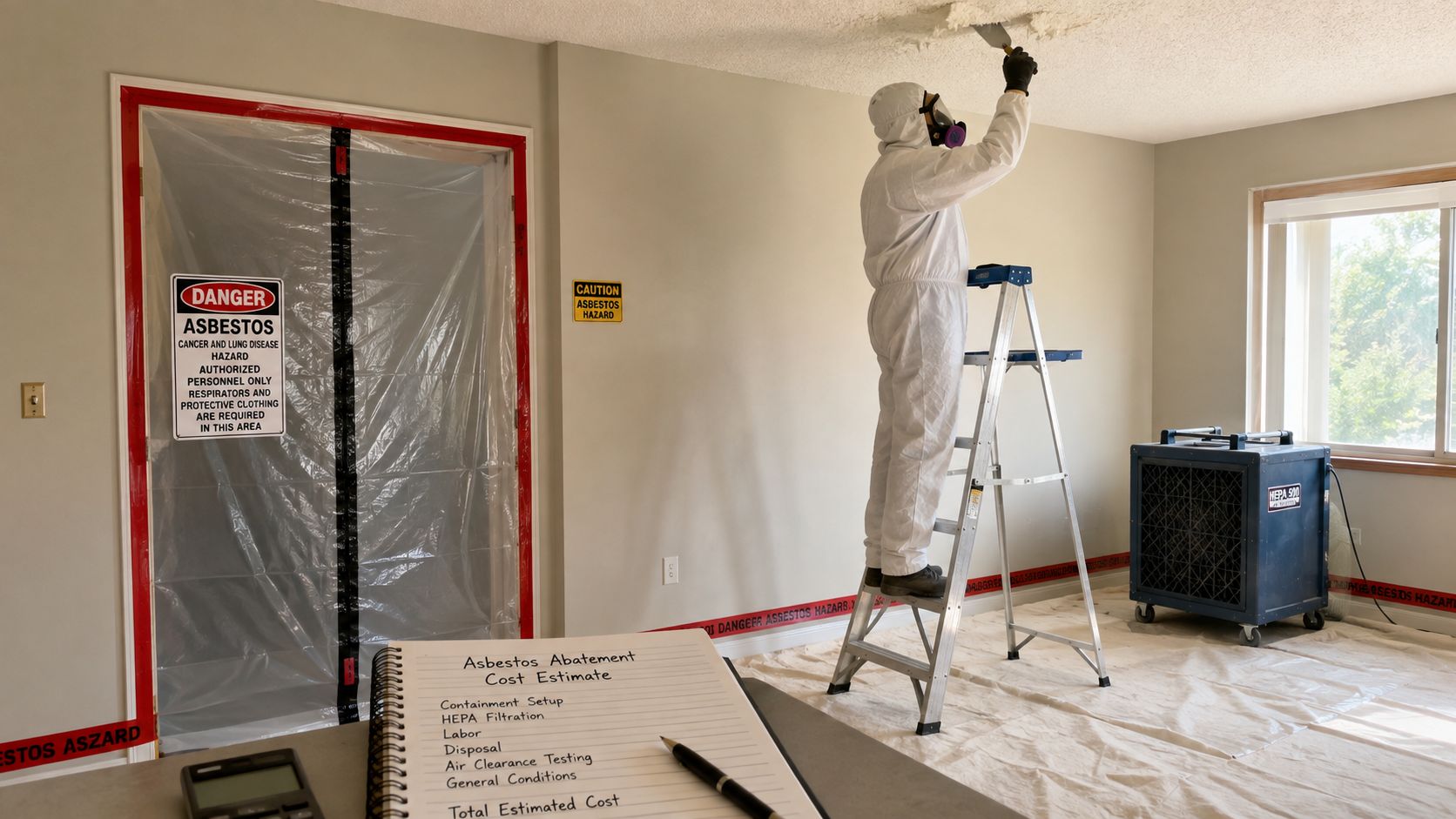
A confirmed result does not automatically require scraping. If the ceiling will be disturbed, the physical work typically enters a controlled abatement scope. A licensed abatement contractor may need sealed containment, negative-pressure equipment, HEPA-filtered exhaust, wet methods, protective equipment, regulated waste packaging, and transport to an authorized disposal facility. Scraping, sanding, drilling, or demolition can spread contaminated debris beyond the original ceiling, which is why ordinary drywall procedures do not belong in this scope.
Why each control affects the estimate
Containment adds setup labor and equipment. Negative air directs airflow into the work area instead of occupied rooms. Wet methods limit airborne dust during disturbance, while protective equipment and regulated packaging support worker safety and disposal compliance. Waste handling also brings transportation and permitted-disposal logistics. Before refinishing or reoccupancy, a qualified third party may perform a visual inspection and air clearance.
The market reflects these requirements. One cost guide lists popcorn ceiling asbestos work at $9 to $20 per square foot, with most homeowners paying $1,200 to $3,300 for a single area and a national average near $2,200 (asbestos abatement cost guide). A broader guide places ceiling asbestos removal at $4 to $20 per square foot, showing why a single national figure is a weak budgeting tool (ceiling asbestos removal cost ranges).
Practical rule: Do not compare a cosmetic scraping quote with a regulated asbestos scope. They cover different work, controls, and liabilities.
Review the estimate line by line. It should identify inspection and sampling, laboratory analysis, containment, waste, clearance, and surface restoration. If those items are missing, request a revised proposal before approving the work.
Breaking Down the Abatement Invoice
A positive popcorn ceiling test divides the budget into three separate jobs: testing and reporting, regulated abatement, and restoration. Keep them separate in the estimate. Current pricing guidance places asbestos testing around $250 to $850, while confirmed abatement can range from $3 to $20 or more per square foot, depending on scope and market (asbestos inspection cost breakdown).
The six line items I want to see
| Line Item | Typical Range | Notes |
|---|---|---|
| Pre-abatement bulk-sample testing | $30 to $75 per sample, plus $50 to $150 site fee | Confirms whether suspect ceiling material contains asbestos |
| Mobilization and containment setup | $400 to $900 per job | Covers setup, barriers, negative-air equipment, and site preparation |
| Regulated removal labor | $3 to $8 per square foot | Wet removal of the popcorn texture within controlled conditions |
| Waste hauling and disposal | $150 to $400 per drum | Covers regulated packaging, transport, and permitted disposal |
| Third-party inspection and PCM clearance | $200 to $500 | Documents visual conditions and post-work air results |
| Refinishing | $1.50 to $4 per square foot | May include retexturing, priming, and painting |
These are planning ranges, not a substitute for a written, property-specific proposal. A small bathroom can have a high effective per-square-foot cost because mobilization, documentation, containment, and clearance do not shrink in proportion to ceiling area. The crew still must establish a controlled work zone, protect nearby spaces, manage waste, and complete closeout tasks.
Ask what the quote excludes
A quote may include containment and disposal while leaving laboratory testing outside the price. Another may cover removal but assign clearance testing and restoration to the owner. Request separate pricing for:
- Inspection and sampling: Confirm the number and locations of samples, the laboratory method, and the report format.
- Regulated work: Ask whether labor, containment equipment, PPE, cleanup, and waste handling are included.
- Clearance: Confirm who performs the visual inspection and air clearance, and whether that provider is independent.
- Restoration: Determine whether the ceiling will be patched, retextured, primed, and painted.
- Permit and notification support: Establish who prepares compliance documents where required.
For practical guidance on regulated waste handling, review these asbestos disposal requirements. Sensitive Environmental provides testing and documentation, while the licensed abatement contractor performs the physical removal.
The most reliable budget uses three headings: testing and reporting, abatement, and restoration. If the proposal combines them into one lump sum, ask the contractor to identify every assumption before you approve the work.
Encapsulation or Full Removal and When Each One Wins
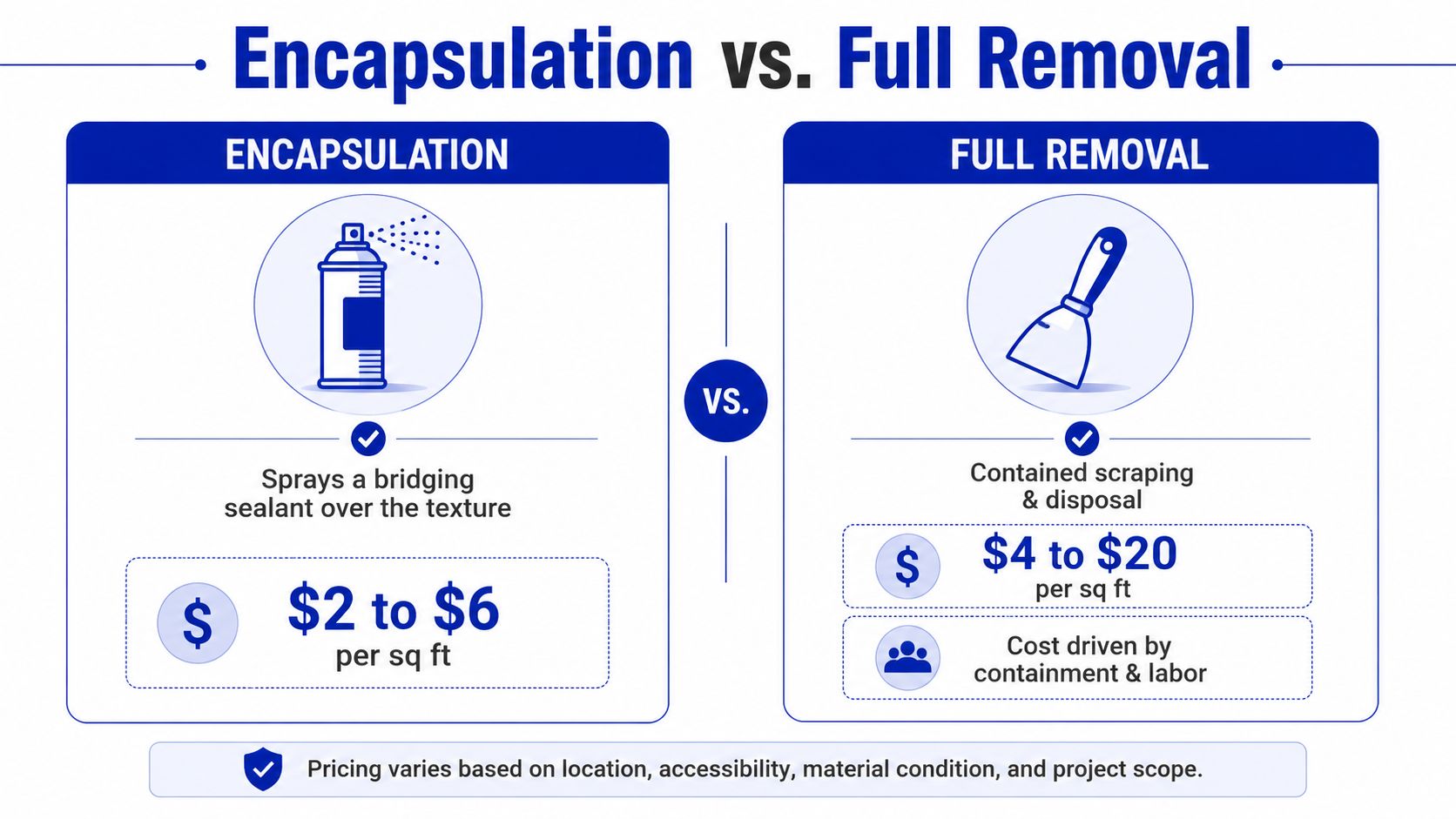
Encapsulation and removal solve different problems. Encapsulation applies a bridging coating over the existing textured material. Full removal takes the material out under containment and sends the waste through regulated disposal channels.
Published cost guidance places encapsulation around $2 to $6 per square foot, compared with roughly $4 to $20 per square foot for removal (asbestos removal and encapsulation cost ranges). Price alone shouldn't decide the method. The ceiling's condition, the planned renovation, access, occupancy, and future disclosure obligations matter more.
When encapsulation is defensible
Encapsulation may be reasonable when the texture is intact, firmly bonded, dry, and unlikely to be disturbed. It preserves the original material in place, which can reduce immediate disturbance and avoid some removal-related work. The owner still needs clear documentation, because future contractors must know that the ceiling remains asbestos-containing material sealed beneath a coating.
Encapsulation is a poor fit for a ceiling with crumbling texture, water damage, peeling sections, or planned work that will penetrate the surface. It can also complicate a later sale if buyers, lenders, inspectors, or property managers want the material removed rather than managed in place.
When removal makes more sense
Full removal generally becomes the stronger option when the ceiling is deteriorating or when renovation will disturb it. It may also be preferred when the owner wants to eliminate the material from the property and simplify future work. That choice carries a larger upfront invoice because containment, labor, waste, and clearance all become part of the scope.
A qualified environmental consultant should document the material's condition and the proposed disturbance before you choose. A positive result does not automatically mean removal is required, and encapsulation is not an automatic loophole. The correct recommendation depends on the inspection findings and the work you plan to perform.
Lifecycle question: Are you reducing today's invoice, or are you reducing the number of restrictions future contractors and buyers will face?
For owners in Los Angeles, the downstream restoration can affect the decision as much as the asbestos work. Replacing damaged ceiling finishes, repainting multiple rooms, relocating occupants, and coordinating permits can change which option is financially sensible. Get the testing and condition assessment first, then compare complete scopes rather than isolated per-square-foot prices.
Los Angeles Compliance Steps That Sit Between Testing and Work
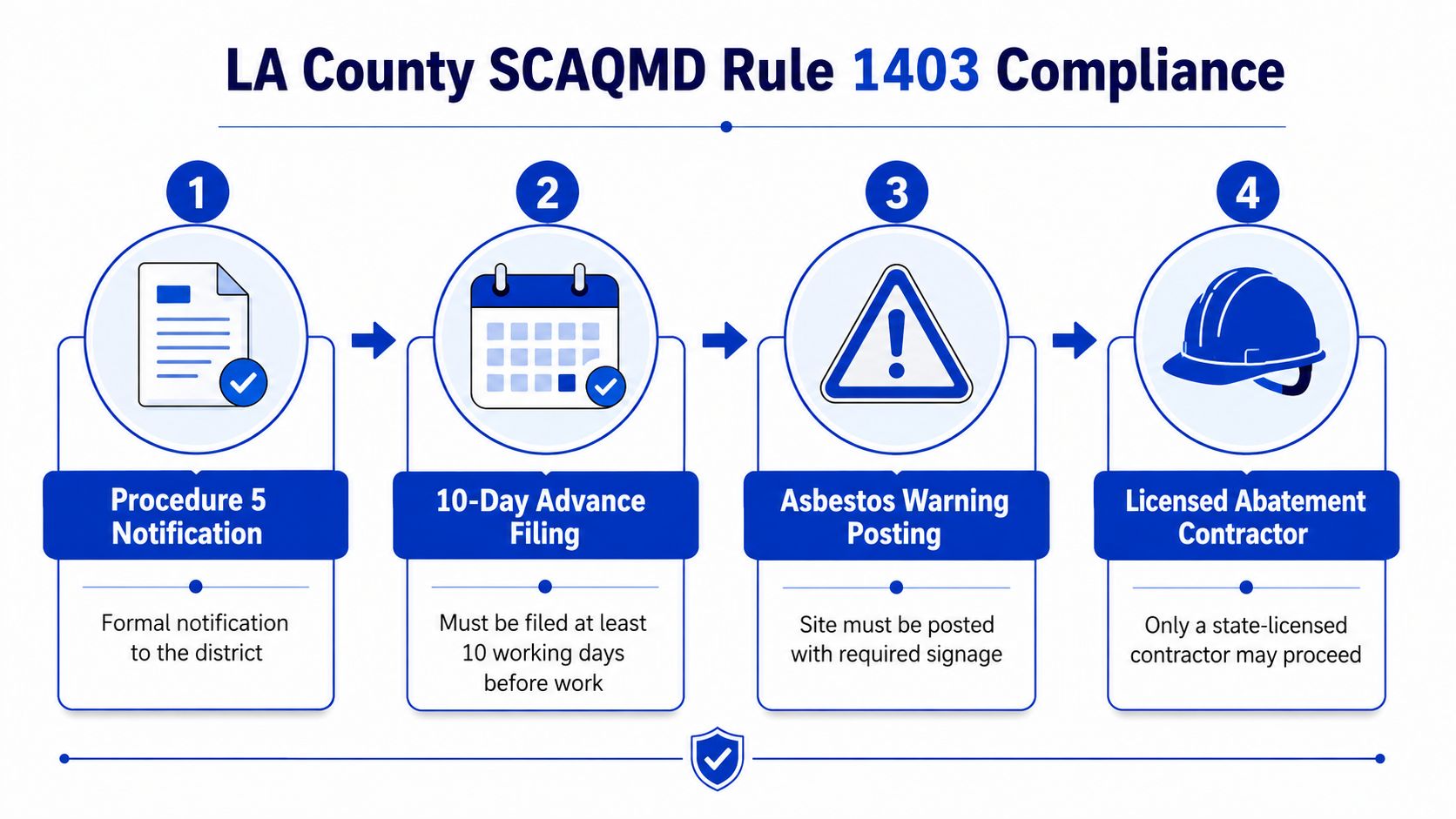
A positive popcorn ceiling result starts a compliance process before any scraping, demolition, or renovation begins. In the Los Angeles area, projects that fall under the South Coast Air Quality Management District's Rule 1403 framework require an onsite asbestos survey and documentation. A single-unit residential structure may qualify for an exception when less than 100 square feet of asbestos-containing material is removed or stripped, but demolition still requires a survey (South Coast AQMD Rule 1403 compliance advisory).
The survey records the location, condition, and quantity of suspected friable and Class I or Class II non-friable asbestos-containing materials. Where appropriate, it also includes physical sampling and laboratory analysis. That report gives the owner, contractor, and permitting authorities a defined scope before the regulated work is priced or scheduled.
Notification and sequencing
South Coast AQMD requires demolition or renovation notifications 10 working days, or 14 calendar days, before the project starts (South Coast AQMD Rule 1403 frequently asked questions). For demolition projects, the District identifies this order:
- Complete the asbestos survey.
- Remove asbestos-containing material as required.
- Submit the South Coast AQMD notification.
- Obtain the building and safety demolition permit.
Procedure 5 materials call for a site survey report covering the sampling and analysis of suspect asbestos-containing building materials proposed for abatement (South Coast AQMD Procedure 5 guideline). The report must be based on field sampling and laboratory analysis. It cannot be completed after ceiling work has started.
Cal/OSHA worker-protection rules apply alongside district notification requirements. PPE, work practices, containment, and air control must accompany a proper survey and AQMD filing. Coordinate the testing firm, qualified contractor, and permitting path before scheduling ceiling disturbance.
For an overview of Los Angeles asbestos abatement requirements, review guidance that separates testing, documentation, and physical removal. Sensitive Environmental can assist property owners with inspection, sampling, laboratory analysis, and reporting needed to define the regulated work.
Square Footage, Layout, and Access That Move the Per-Square-Foot Number
The floor area is only the starting point. A 1,200-square-foot 1965 ranch with popcorn ceilings in three bedrooms, a hallway, and a living room will not price like one open room. Each bedroom may need its own setup, sealing, protection, and clearance work. An open great room can usually use one efficient containment area, while closets, doorways, furnishings, and separate work zones raise labor and preparation time.
Why layout changes labor
Every ceiling interruption adds preparation. Closets and built-ins make poly barriers harder to install. Hallways connect the containment area to occupied rooms and may require added protection. Stairwells and cathedral ceilings can require specialized access equipment. Second-story work may add ladder, scaffold, and material-handling time.
Ceiling condition changes the work plan as well. Firmly bonded, painted texture may respond differently during controlled wet work than chalky or deteriorating material. Water-stained or crumbling popcorn requires closer assessment because its condition affects containment, handling, and the chance of fiber release. The contractor should price the actual access and material conditions, not apply one flat rate to every room.
Worked planning example
Use the assigned scenario to separate room pricing from the overall project budget:
| Room Profile | Square Footage | Price per SF | Subtotal |
|---|---|---|---|
| Bedrooms with separate containment zones | 800 | $11 | $8,800 |
| Open living space | 400 | $5 | $2,000 |
| Hallway containment allowance | Not separately stated | Not stated | $400 |
| Illustrative project total | 1,200 | Mixed pricing | $11,400 |
The bedrooms account for $8,800, the living area for $2,000, and hallway containment for $400, producing an illustrative $11,400 project total. Multiplying 1,200 square feet by $5.33 per square foot suggests a $6,400 budget, which leaves a substantial shortfall.
Treat this as a planning illustration, not a market-wide quote. Ask the estimator to identify every containment zone, ceiling height, furniture-protection requirement, material-condition concern, and restoration standard. The testing report defines the suspect material and its locations. The abatement contractor then prices the regulated work, access, and setup needed for those conditions.
The practical recommendation is simple: compare estimates by scope, not by unit price alone. A higher per-square-foot figure may reflect separate rooms, difficult access, or deteriorated material rather than inflated pricing.
Common Misconceptions About Testing Results and DIY Removal
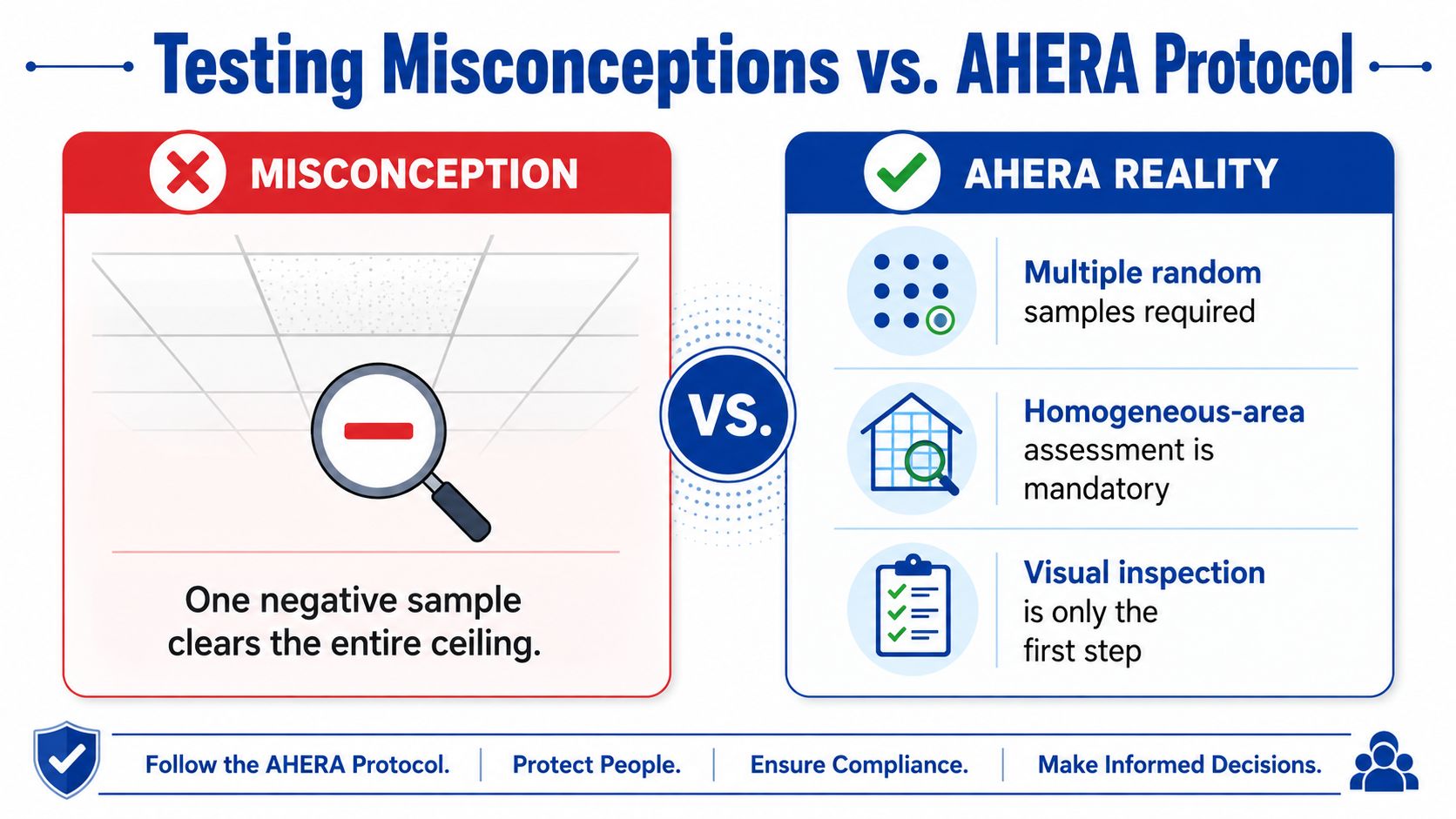
One negative sample doesn't automatically clear an entire ceiling. A competent inspector assesses whether the ceiling is one homogeneous area or whether different rooms, repairs, coatings, or substrate conditions require separate sampling. Sampling plans should represent the areas that may be disturbed, not merely the easiest spot to reach.
Visual inspection and laboratory analysis answer different questions. The inspector evaluates material continuity, condition, locations, and disturbance risk. The laboratory analyzes submitted samples. A lab-only service may provide a PLM result, but legal and project defensibility also depends on who collected the sample, how the sample locations were documented, and whether the inspection addressed the actual renovation scope.
Why DIY removal is a bad bargain
Wet scraping without proper containment, negative air, protective equipment, waste controls, and clearance can spread debris into adjacent rooms, ductwork, and attic insulation. The risk isn't limited to the patch you're scraping. Once material migrates, the scope can expand from a planned ceiling project into broader environmental assessment and corrective work.
The cost figures often used to justify DIY work also omit professional testing and documentation. A confirmed result should trigger a scope review, not a rush to remove everything and not an assumption that the owner can manage the work with a spray bottle and scraper.
Positive does not equal automatic full removal
Encapsulation may be appropriate for intact material that won't be disturbed. Conversely, deteriorating or water-damaged material may require a different decision. Local requirements, renovation plans, property condition, and the needs of future occupants all belong in the evaluation.
The test result is an input to the work plan, not the work plan itself.
Ask the inspector whether the report identifies every relevant homogeneous area, records visible damage, and maps the sampled locations. Those details help a qualified contractor prepare an accurate scope and help the owner distinguish a necessary control from an unnecessary upgrade.
Your Decision Path From First Concern to Professional Testing
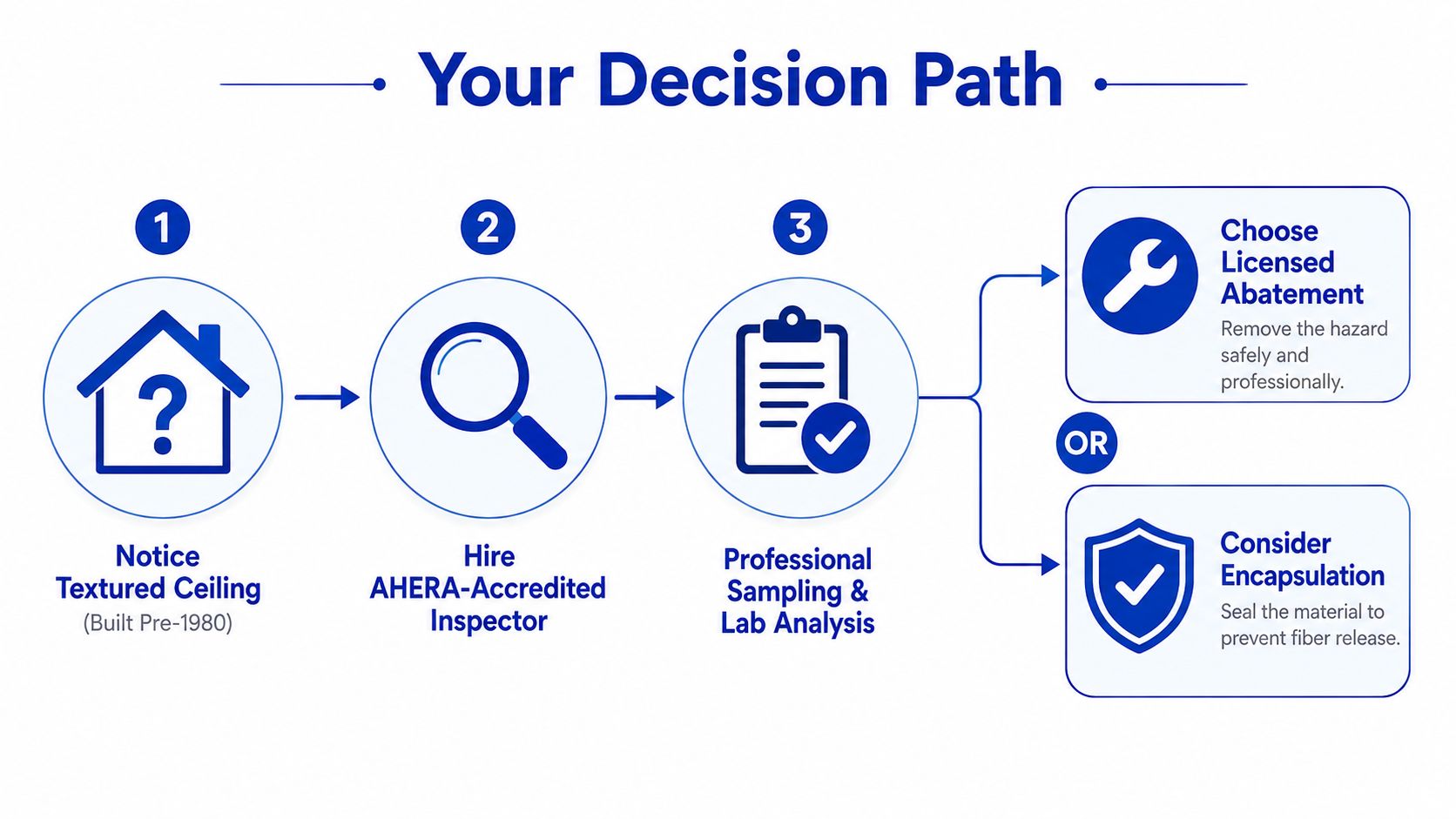
Start with the facts you can verify. Identify the ceiling texture, determine the building's construction history where records are available, and stop any planned disturbance until the material has been evaluated. Building permits and renovation records can help establish context, but they can't replace sampling.
A practical sequence
- Document the concern. Photograph the ceiling without scraping, drilling, sanding, or taking an unplanned sample. Note water staining, peeling, repairs, and the rooms included in the renovation.
- Hire an independent inspector. Choose an appropriately qualified asbestos building inspector who can inspect the relevant areas, collect representative samples, and document the chain of custody.
- Confirm the laboratory process. Ask which laboratory will analyze the samples, whether the report identifies sample locations, and whether the findings address each homogeneous area.
- Match the report to the work. A renovation that removes light fixtures or cuts into the ceiling may have a different scope from a project that leaves the surface untouched.
- Compare next-step options. If asbestos is present, obtain advice on management in place, encapsulation, or regulated removal from qualified professionals. The testing firm shouldn't steer you to a particular abatement contractor.
For practical homeowner guidance, see how to test for asbestos in a popcorn ceiling. Ask about PLM turnaround, laboratory qualifications, sample coverage, written reporting, and whether the documentation is suitable for your permitting or contractor coordination needs.
Sensitive Environmental provides asbestos testing, inspections, sampling, laboratory coordination, and reporting for residential and commercial properties in Los Angeles and Southern California. The same type of environmental consulting process can also address lead testing, mold sampling, indoor air quality, commercial environmental testing, industrial hygiene assessments, and fire-related testing for ash, soot, char, smoke residue, combustion byproducts, and heavy metals when those concerns affect the property.
Schedule a professional asbestos inspection and sampling review with Sensitive Environmental before disturbing a popcorn ceiling in Los Angeles or Southern California. The team can help document the material, coordinate laboratory analysis, and provide a clear report so you can budget testing, compliance, and qualified next steps with fewer surprises.