Occupants of damp or moldy buildings may face up to a 75% greater risk of respiratory symptoms and asthma, according to the WHO guidelines for indoor air quality on dampness and mould. The same publication notes that damp environments can support hundreds of species of bacteria and fungi, releasing spores, cell fragments and chemicals into the air people breathe indoors.
None of that turns a mold inspection report into a medical verdict. It does explain why the document exists: to record where moisture is entering, which materials it has wetted, what was tested, and what still isn't known.
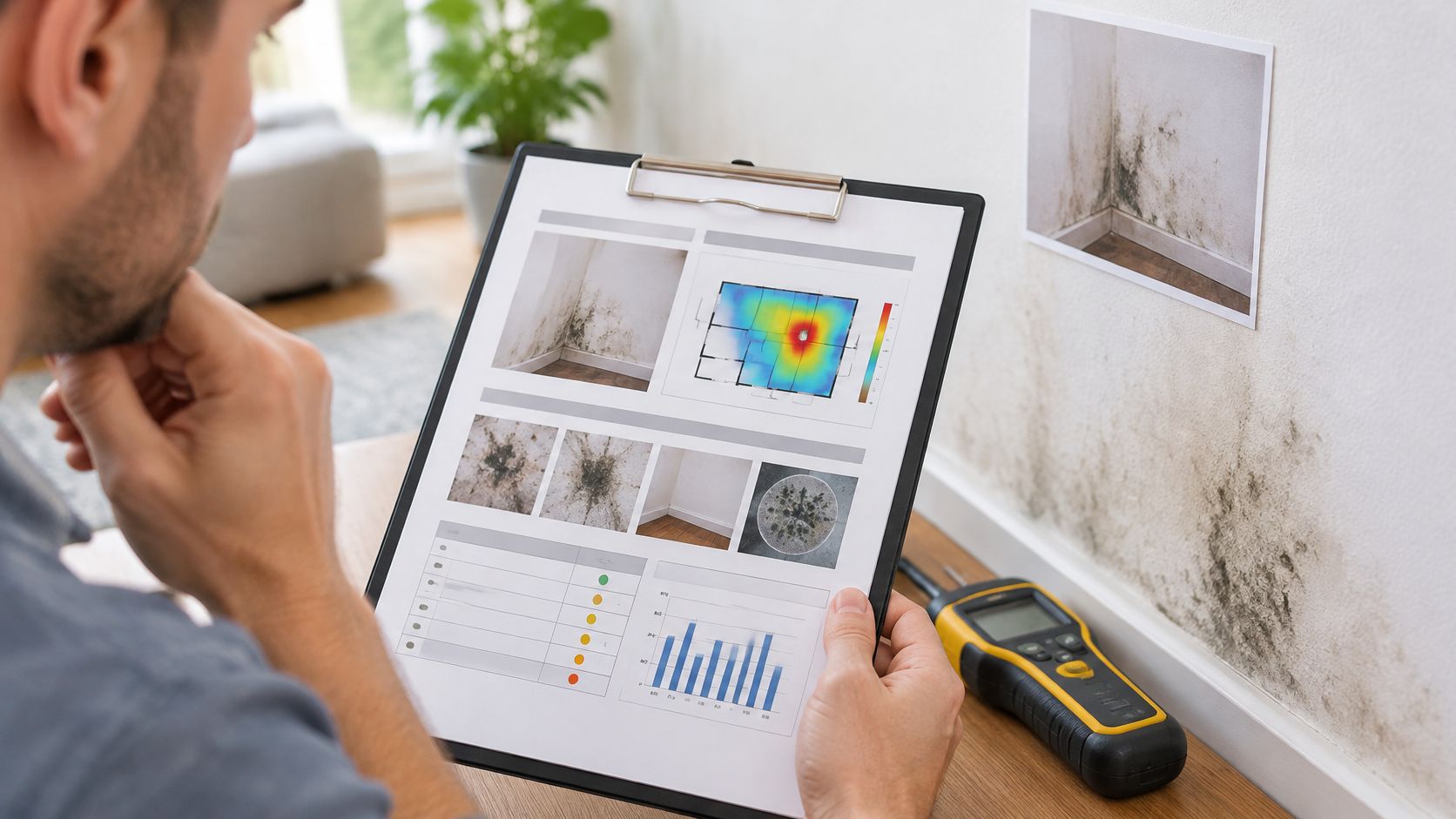
A mold inspection report is a moisture and building condition assessment before it's a laboratory sheet. The species list arrives near the end and usually carries less weight than the sentence naming a failed shower pan or condensation on a cold bedroom wall. Read in the right order, the report tells you what was examined, what was found, how confident the inspector is, and what should happen next. Read out of order, it pushes you toward the wrong question, which is whether one number is high.
Table of Contents
- The Sections of a Mold Inspection Report at a Glance
- How to Read the Observations and Moisture Findings
- Sampling Decisions and Reading Lab Results
- Common Findings and the Follow-Up They Point To
- Professional Inspection Versus DIY Testing in California
- Schedule a Mold Inspection With Sensitive Environmental
- Mold Inspection Report FAQs
The Sections of a Mold Inspection Report at a Glance
Start with the structure rather than the results. Each part of the document answers a different question, and a report missing one of them can't be repaired by rereading the others more carefully.
| Report section | What it should document | Question it answers |
|---|---|---|
| Scope and purpose | Why the inspection was requested, areas covered and areas excluded | What was and was not examined? |
| Inspector and methodology | Inspector qualifications, inspection date, instruments such as moisture meters, and procedures used | Who inspected, when and how? |
| Building background | Property type, age, occupancy, prior water events and repairs | What history could affect moisture? |
| Visual observations | Visible growth, staining, odors and damaged materials, with locations | Where is growth or damage seen? |
| Moisture readings and map | Readings compared with dry reference areas, with locations | Where is moisture present? |
| Likely moisture source | Leak, condensation, ventilation or humidity pathway, with a confidence level | What allowed growth to start? |
| Sampling plan and results | Sample types, locations, dates, lab method and what each result does and does not show | What was tested and why? |
| Limitations and recommendations | Inaccessible areas, hidden cavities and specific follow-up actions | What remains unknown and what comes next? |
The document moves from the general to the specific and back out again: what the building is, what was seen, what the instruments read, what probably caused it, what was sampled, and what stays unresolved. That final section isn't boilerplate. It's where an honest inspector tells you which walls were never opened.
Where the Scope Section Earns Its Keep
In a sale, an insurance claim or a tenant dispute, the scope paragraph is the part most likely to be argued over, because it fixes the boundary of every conclusion that follows. A report scoped to visible surfaces inside one unit can support statements about those surfaces. It can't support a statement about the cavity behind the tile or the attic above the second bedroom.
Building background does similar work. A 1962 ranch house with a bathroom remodel two winters back, a slab that has never flooded, a rooftop air handler that drips in August: each detail tells the inspector where moisture is likely to have entered and which materials are worth probing. Reports that skip this read like generic checklists, and they're much harder to defend later.
Practical rule: Find the scope and limitations sections before you read a single result. If either is missing or vague, you're holding a set of observations, not a document you can rely on when someone challenges it.
Confirm all eight sections are present before you judge the findings themselves. A report without a stated methodology or a stated set of limits is difficult to lean on even when the numbers look clear, and it's nearly impossible to hand to a contractor, an adjuster or a lawyer as the basis for a decision.
How to Read the Observations and Moisture Findings
Mold growth follows moisture. That single fact explains why the observation and moisture sections of a report usually matter more than the species list, and why a report that finds an active leak stays useful even when the air samples look unremarkable. EPA's remediation guidance for schools and commercial buildings puts identifying and correcting the water or moisture problem at the very start of the sequence, ahead of drying, cleaning or discarding affected materials, and requires the plan to be reconsidered if hidden mold turns up.
The checklist below is the order worth following when you sit down with the pages.
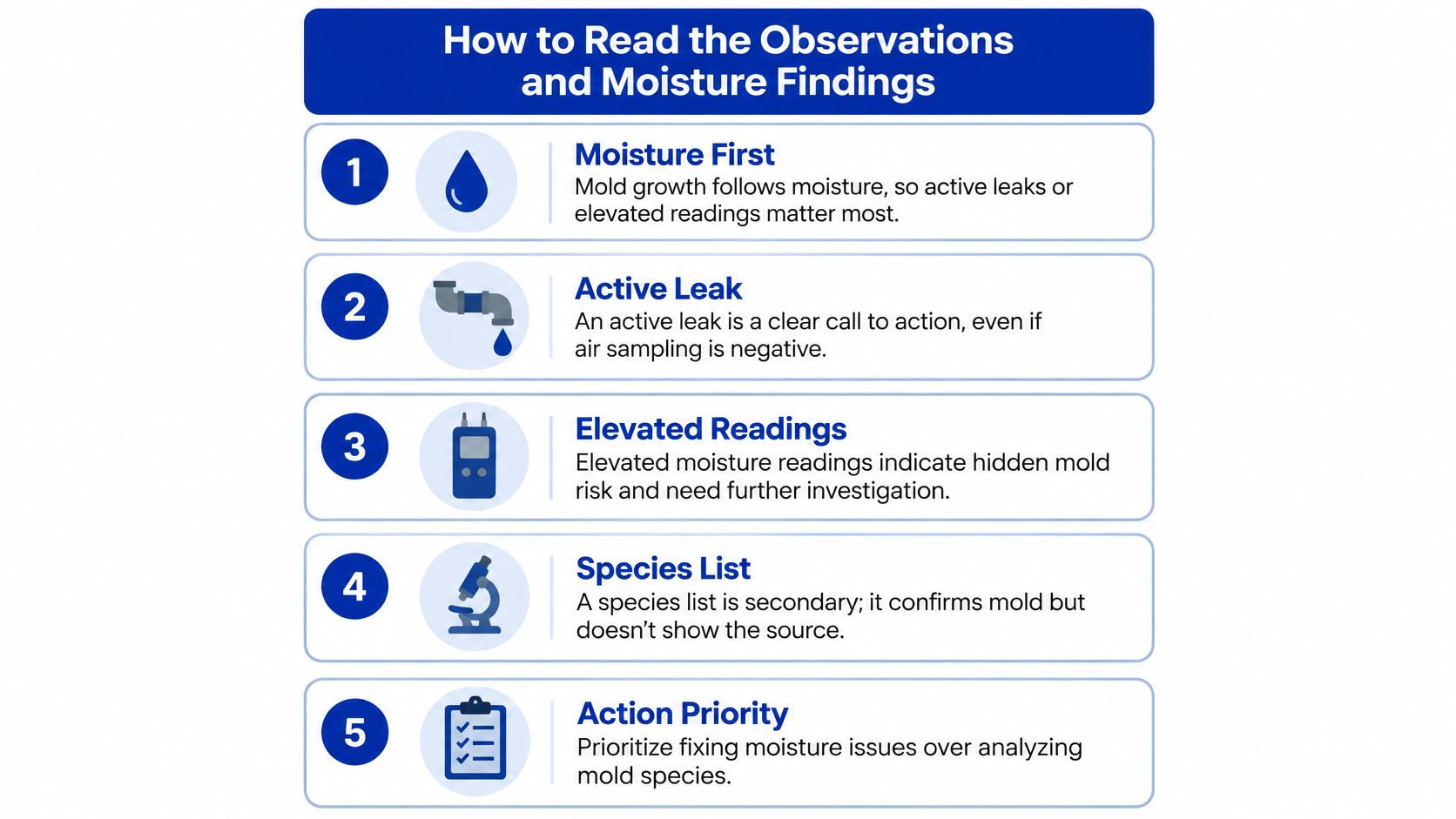
- Confirm the dates and the scope. A report from a dry month describes a different building than one from the week after a storm. The common slip is assuming the attic was inspected because the attic appears somewhere in the narrative.
- Match every observation to a named location. "Growth at the north wall of bedroom two, roughly two square feet" is usable. "Growth in bedroom" forces the next reader to guess. The slip here is treating a room list as a mold map when the report only says "hallway".
- Compare moisture readings against dry reference areas. A reading of 24% means little on its own; sitting beside a dry reference reading of 11% in the same room, it means a wet assembly. The slip is trusting a number taken on a surface that was recently cleaned, painted or sun-warmed.
- Find the likely source and the confidence attached to it. Strong reports separate confirmed findings from suspected ones. The slip is reading a water stain as proof of an active leak, when a dried stain from a repaired leak looks identical on the day of inspection.
- List what wasn't opened. Wall cavities, ceiling voids, the subfloor under tile, the interior of ductwork. The slip is reading "no growth observed" as "no growth present".
- Check photographs against the descriptions. Photos should locate the finding and show its extent. An unlabeled photo can't be tied to a room, and a tight close-up can make a small patch look like a wall.
Facts and interpretations belong in different sentences. "Staining on the ceiling below the upstairs bath" is a fact. "Consistent with a past overflow from that bath" is an interpretation, and a careful inspector labels it as one.
A well-supported observation section reads like a set of coordinates: named locations, measured readings, a moisture pathway, and a plain statement of limits. If the report points to recent water intrusion, how to check for mold after water damage covers where growth tends to appear first and what to photograph before anything is disturbed. And when the findings include an odor you can't trace or a leak that keeps returning, when to call a mold professional sets out the warning signs that justify bringing someone in rather than waiting another season.
Sampling Decisions and Reading Lab Results
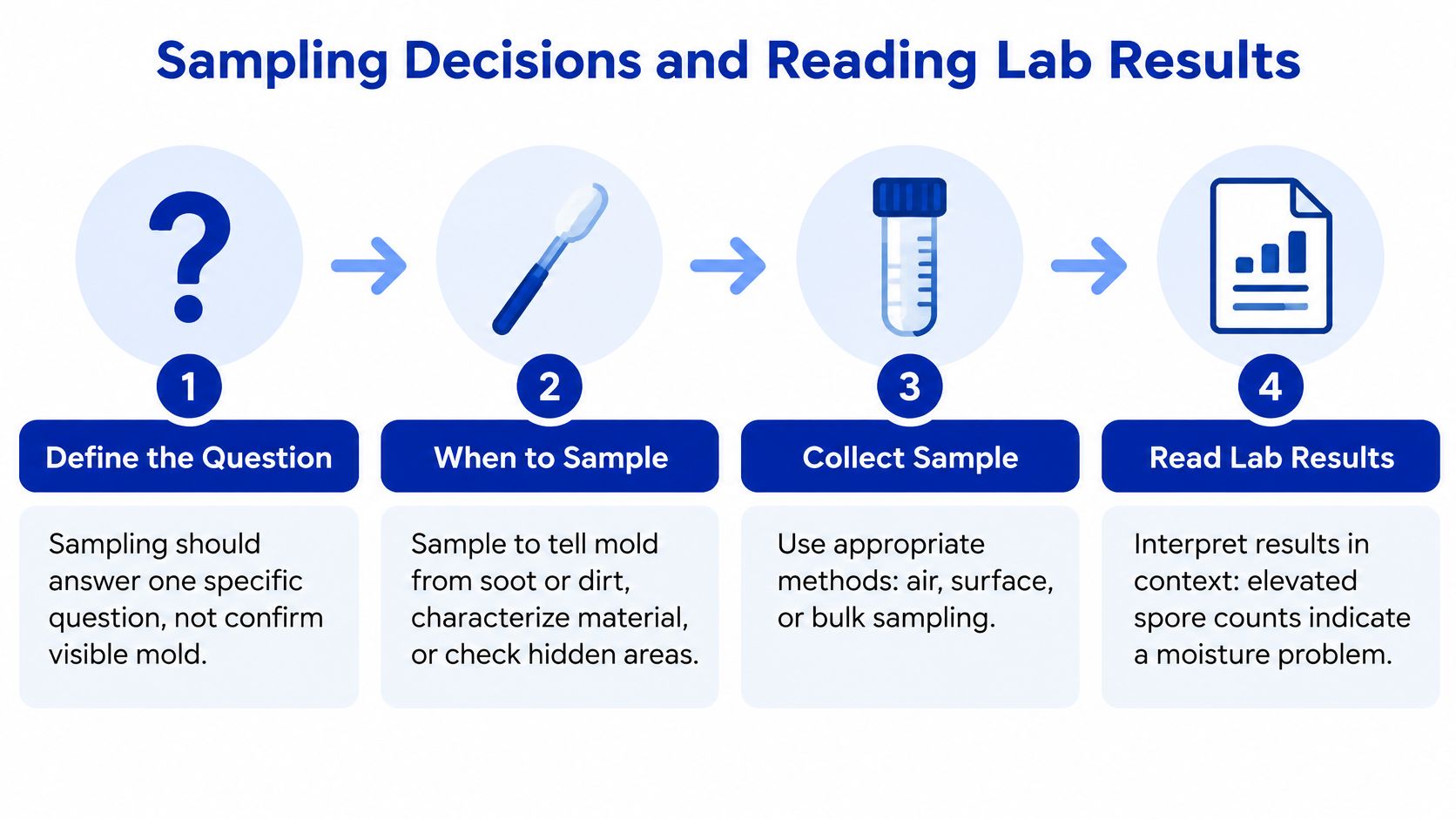
One sample is one moment in one place. That's the whole discipline of reading lab results, and it's why a report should tell you exactly what question each sample was collected to answer.
The Sequence Behind a Defensible Sample
- Define the question first. "Is this black staining mold or soot from a candle?" is a question a sample can settle. "Is the house safe?" isn't.
- Choose locations, including comparison points. Indoor sampling without an outdoor reference on the same day leaves the reader with a number and no baseline.
- Collect with documentation. Method, location, date and time, and the media used should all appear on the chain of custody.
- Use an accredited laboratory with a stated analytical method. The method matters as much as the result, because different methods count different things.
- Interpret each result against the question it was meant to answer. A result that answers a different question than the one you asked is trivia.
What No Sample Can Prove
EPA's guidance on mold sampling and testing states that visible mold generally makes sampling unnecessary, because no federal limits exist for indoor mold or airborne spores. An analytical result therefore can't establish federal compliance and can't, by itself, prove a building is safe. Sampling earns its cost when the question is specific: telling mold apart from soot or dirt, characterizing contamination in a material, or evaluating whether a cleaned area was adequately addressed. EPA also recommends that sampling be designed and interpreted by professionals experienced in mold protocols and analyzed using methods recommended by organizations such as AIHA or ACGIH.
A pass or fail threshold on a mold report is invented. No federal standard sits behind it, so treat any single number presented as a verdict with suspicion.
The same page is direct about what a report should document instead of chasing a threshold: the extent and location of visible growth, affected materials, musty odors, water intrusion, humidity or condensation conditions, and the likely moisture source.
Sample Types and Their Limits
| Sample type | What it captures | Main limitation |
|---|---|---|
| Air sample | Airborne spores present during the sampling window | Reflects only the sampling moment and the conditions at that time |
| Surface tape or swab | Spores and fragments on one specific surface | Shows a single spot, not the whole room |
| Bulk material sample | A physical piece of material such as drywall, carpet or insulation | Destructive to the material and shows only that point |
| Settled dust sample | Mold and particles that have accumulated on surfaces over time | Depends on how long dust has settled and whether cleaning occurred |
| Outdoor reference sample | Background spores in outdoor air on the same day | Outdoor levels vary by season and weather and are not an indoor standard |
Air sampling gets the most attention and deserves the most caution. CDC/NIOSH's guidance on mold testing and remediation notes that short-term sampling, especially a negative result, may not represent actual exposure, and that thorough visual inspection or the detection of musty odors is often more reliable. A low airborne concentration can sit alongside concealed or intermittently aerosolized growth. High outdoor spore levels can push indoor numbers up without any indoor source at all.
For that reason, a useful report records the conditions surrounding each sample: sampling duration, flow rate or sampled volume, the indoor and outdoor comparison locations, weather and building operating conditions, occupant activity, and any departure from normal HVAC operation. In a hospital, a school or another sensitive facility, the report should also state the decision question and the boundaries of the investigation, because detecting a species or a spore level at one location doesn't establish the source of anyone's symptoms.
Read every result next to the visual observations and the moisture map, never on its own. The number is one data point in a building investigation, and it means what the surrounding evidence says it means.
Common Findings and the Follow-Up They Point To
The finding that shows up most often is also the easiest to read: visible growth on drywall or a ceiling. It confirms that moisture has been present long enough to support growth. It doesn't tell you whether the leak is still active, how far the contamination runs behind the paint, or what the repair involves.
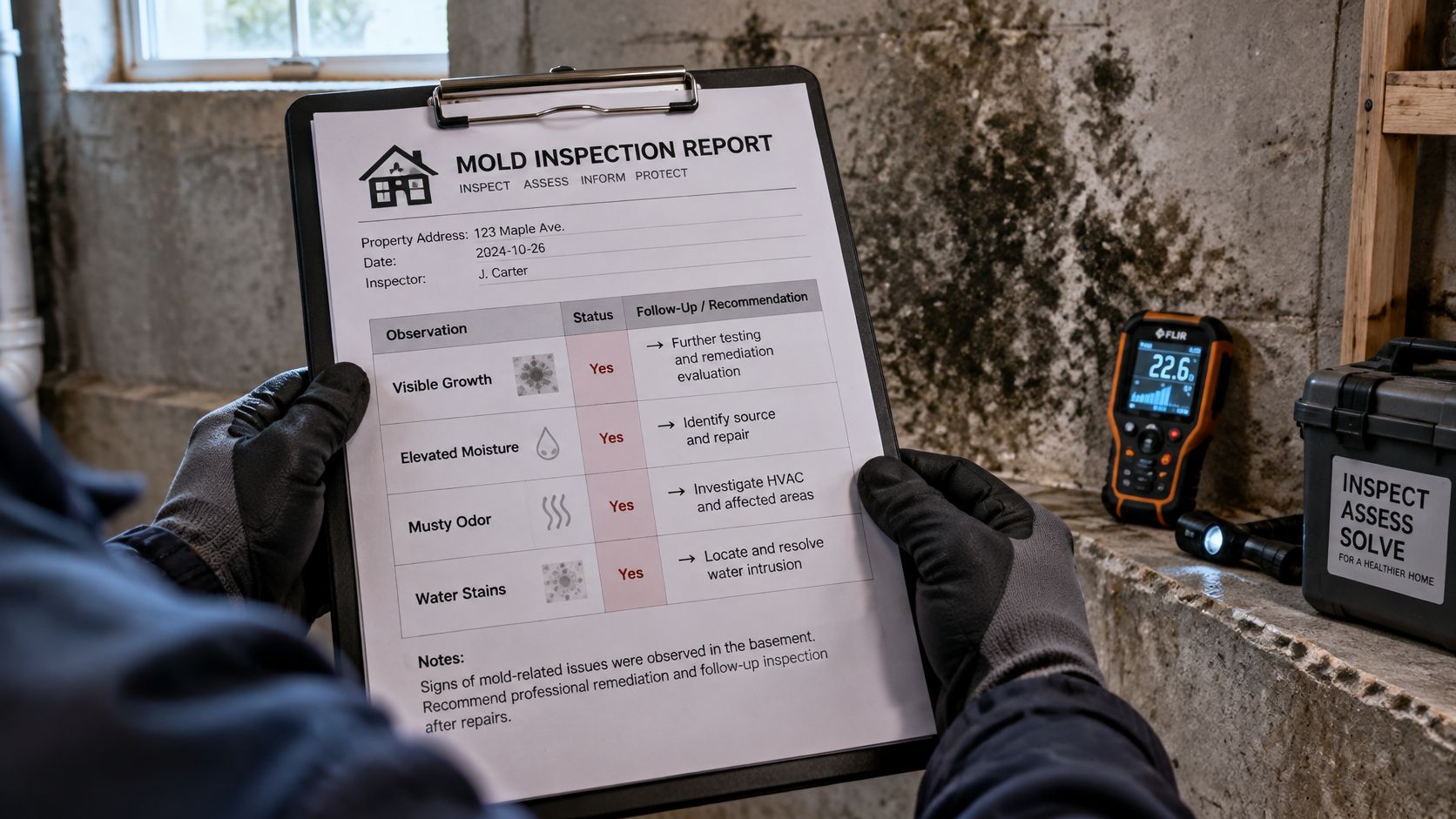
Use the table as a diagnostic guide: find the finding as it's written in your report, read what it may indicate, then check what a qualified professional would typically do to confirm it. None of these follow-ups is an automatic work order.
| Finding in the report | What it may indicate | Typical follow-up |
|---|---|---|
| Visible growth on drywall or a ceiling | Past or active moisture exposure | Confirm the moisture source, then evaluate the extent before any plan is made |
| Musty odor with no visible growth | Possible concealed growth or moisture | Inspect hidden cavities where accessible and recheck moisture readings |
| Elevated moisture near plumbing | Possible leak or water intrusion | Confirm the pathway with a licensed plumber, then re-test moisture |
| Condensation on windows or cold walls | Humidity or ventilation imbalance | Review ventilation, humidity control and HVAC operation |
| Growth on soft or porous materials | Materials may hold contamination | Assess whether materials can be cleaned or need further evaluation |
| Indoor sample results higher than outdoor | Possible indoor source, but not proof of harm | Compare locations and species, then correlate with building findings |
| Negative sample with visible growth | The sample missed the problem | Rely on the visual findings and don't treat the negative result as clearance |
A positive finding doesn't mean abatement is required. It means the condition is documented, and owners and qualified professionals can now decide what the next step is with something factual in hand. A re-test after drying or repair is the usual way to check whether the moisture problem is resolved.
What "Done" Looks Like
EPA's mold course chapter on remediation describes a practical endpoint for judging whether work is complete: moisture corrected, mold-damaged materials removed, no visible mold or musty odor remaining, and, where sampling is used, indoor mold types and concentrations broadly similar to outdoor air. That's a condition statement, not a safety certificate, and it's fair to ask any report to be explicit about the difference.
When the Fix Becomes a Renovation
If the follow-up involves opening a wall or removing material, a second requirement joins the project. In Los Angeles County, SCAQMD Rule 1403 requires a written asbestos survey before demolition or renovation, covering friable material and Class I and Class II non-friable material, with physical sampling where required and inspection inside wall or ceiling cavities when needed for identification.
Ask the inspector to name the recommended follow-up and explain the reasoning behind it. A report that says "further evaluation recommended" without saying which area, which question or which trade should handle it leaves you paying for the same guesswork twice. If the findings raise the question of what triggers repair work rather than assessment, when mold remediation is required explains how that decision is usually made.
Professional Inspection Versus DIY Testing in California
Indoor air is where people spend their time. EPA's indoor air quality data reports that Americans spend roughly 90% of their time indoors, and that concentrations of some indoor pollutants are commonly 2 to 5 times higher than typical outdoor concentrations. EPA also lists inadequate ventilation or air conditioning among the conditions that raise indoor moisture and mold-growth potential. The California Department of Public Health, cited on that same page, states that California has no state regulations specifically governing mold inspection, assessment or remediation, and no legal requirement for assessors or remediators to hold state training, licensing or certification.
That last point changes what you should look for. With no state license to check, report quality rests on methodology you can read: dates and locations inspected, instruments used, moisture readings, observed conditions, sampling rationale, lab methods, limitations and recommendations.
| Factor | Professional inspection | DIY test kit |
|---|---|---|
| Inspection scope | Full walkthrough, moisture mapping and hidden areas checked where accessible | Usually one sample at one location |
| Sampling design | Locations chosen to answer a defined question, with comparison samples | Chosen by the user, often without a comparison sample |
| Laboratory analysis | Accredited laboratory with a stated analytical method | Often an online lab reporting without building context |
| Report documentation | Photographs, locations, methods, limitations and recommended next steps | A single result sheet |
| Interpretation | Connects findings to the moisture source and building condition | Often a simple pass or fail style result |
| Credentials | Varies, since California requires no state license for mold assessors, so check training and experience | Not applicable |
Where a Kit Still Helps
A kit can flag that something is present. What it can't do is reveal a slow supply line leak inside a cabinet, map moisture across a floor assembly, or compare an indoor room against outdoor air on the same afternoon. A homeowner who photographs a stain, notes the date it appeared and records humidity readings over a few weeks has built something useful for a later inspection.
For Los Angeles area transactions, insurance claims and habitability disputes, the documentation standard is higher. A dated, photographed report with stated methods is what an adjuster, buyer or landlord can respond to. If you're weighing a kit against an inspection, are home mold test kits reliable sets out what each approach can and can't establish.
Worth knowing from the other side of the question: professional mold removal in Florida covers how a documented assessment feeds into the decision to bring in a contractor, which is the same handoff a California report needs to support. Ask any provider for a sample report before you book, and read it the way you'd read a contractor's scope of work.
Schedule a Mold Inspection With Sensitive Environmental
A little preparation makes the inspection sharper and the report more useful. Before you call anyone, put these four things together.
- Gather what already exists. Prior report pages, inspection notes, contractor invoices, phone photos of the stain on the day you noticed it.
- List the areas of concern in plain language. Bathroom ceiling, closet wall behind the hanging rod, the window line in the spare room, the baseboard by the water heater.
- Write down dates. When the leak happened, when the odor started, when the stain came back after cleaning.
- Name the decision the report has to support. A lease dispute, a home sale, an insurance claim or a renovation plan each call for different documentation.
Sensitive Environmental provides mold testing and mold inspections for homeowners, property managers and commercial clients across Los Angeles County and Southern California. Inspections can be scoped around the decision on your list, so the report answers the questions that matter to it rather than confirming what was already visible. Call 310-387-5404 to schedule, or request an appointment online, and ask about the free, no obligation consultation if you're still deciding whether testing is warranted.
One request worth making before you book: ask to see a sample of the company's report format. You'll see immediately how observations, sampling, limitations and recommendations are laid out, and whether the document gives you enough to hand to a contractor or an adjuster.
Mold Inspection Report FAQs
Does a negative sample mean the home is mold-free?
No. A negative result reflects one sample taken at one time, and it can't clear visible growth or a musty odor. The visual findings still govern.
Should I re-test after repairs?
A re-test after drying or repair is the usual way to check whether the moisture problem is resolved. Read the new result against the original question, not against a threshold.
Is a DIY kit enough?
A kit gives you one result with no moisture map and no comparison sample. A dated log of stains, odors and humidity readings supports a professional inspection but doesn't replace one.
Does a positive report mean remediation is required?
Not automatically. Results help owners and qualified professionals decide the next step, and the next step depends on the moisture source, the materials involved and the use of the space.
What warning signs justify a professional inspection?
Visible growth, a persistent musty odor, stains that return after a leak is repaired, condensation that keeps coming back, or a sale, lease dispute or insurance claim that needs documentation.
What should I ask a provider first?
Ask for a sample report and confirm it includes methodology, limitations and recommended follow-up. Those three parts separate a usable document from a page of numbers.
Sensitive Environmental provides mold inspections, mold sampling and indoor air quality testing for homes, commercial buildings, schools and healthcare facilities throughout Los Angeles County and Southern California. If you're holding a report you don't fully understand, or you need one built to answer a specific question about a leak, an odor or a pending transaction, our team can walk you through the scope before anything is scheduled. Visit Sensitive Environmental to request a free consultation and see how the findings, limits and next steps are presented.