Most residential mold inspections take about 2 to 6 hours on site in a single visit, with a focused check of one problem area closer to 1 to 2 hours and a whole-structure investigation running up to 6 hours. If air, surface or bulk samples go to a laboratory, add roughly 3 to 10 business days before results are in your hands.
The second number is the one that catches people. Booking a mold inspection means booking two clocks, and only one of them is measured in hours. The visit is the part you can plan an afternoon around. The laboratory, the written report and the decisions that follow run on a different schedule, and knowing both is what keeps a small moisture problem from turning into a missed escrow date or a repair that gets done twice.
Table of Contents
- How Long a Mold Inspection Really Takes
- What Happens During a Mold Inspection
- What Makes an Inspection Take Longer
- When You May Not Need Mold Sampling at All
- How Long Lab Results and Reports Take
- Should You Book Fast or Start Drying First
- Schedule Your Mold Inspection in Los Angeles
How Long a Mold Inspection Really Takes
A residential mold inspection is a single site visit, and the on-site portion typically runs about 2 to 6 hours, according to Redfin's guide to mold inspection timelines. The bottom of that range belongs to a smaller property or a focused investigation into one suspected area. The top belongs to a whole-structure inspection, where the inspector works through multiple rooms, accessible building components, moisture conditions, ventilation areas, and locations tied to past leaks or water damage.
No industry body publishes a required inspection length, so the number is set by property size, building complexity, the number of affected areas, and how much diagnostic work the visit demands. A 900 square foot condo in Santa Monica with one stained ceiling corner and a 4,000 square foot house in Encino with a converted garage, two musty bathrooms and a slab leak from years ago aren't the same job. A quote that treats them as one is telling you something about the quote.
Published estimates land in the same band. HomeGuide puts a mold inspection at 2 to 5 hours on average, and Michaelis Corporation puts most inspections at 2 to 4 hours on site. Independent numbers clustering this closely usually mean the range is real and the variable is the building.
| Situation | Typical on-site time | Visits | What happens next |
|---|---|---|---|
| Apartment or condo, one visible problem area | 1-2 hours | 1 | Findings reviewed at the visit; sampling only if the source is unclear |
| Single-family home, standard inspection | 2-4 hours | 1 | Moisture readings plus a written report; lab results in 3-10 business days if sampled |
| Large home, additions or several damp rooms | 4-6 hours | 1 | Whole-structure check of attics, crawlspaces and HVAC before the report |
| Musty odor or hidden leak with no visible mold | 3-6 hours | 1 | Extra time tracing moisture behind walls, under floors and in ceilings |
| Commercial suite, school or multi-unit building | Half day to multiple visits | 1 or more | Scope set per floor or system by the inspection plan |
To use that table, walk the property in your head before you call anyone. Count the rooms with visible growth or water staining. Count the rooms that smell musty even when nothing is visible. Check whether the attic hatch and the crawlspace access open, and whether the air handler or any ductwork has been wet. That count, more than square footage, decides whether you're booking a short visit or a long one.
One caveat matters more than any other. The table describes on-site time only. When the inspector collects air, surface or bulk samples, laboratory analysis adds business days to the final answer, and that part of the timeline gets its own breakdown further down.
What Happens During a Mold Inspection
A mold inspection isn't somebody walking around with a flashlight hunting for black patches. The backbone is a systematic visual and sensory assessment: finding where water gets in, checking the places water hides, noting odors, and documenting the conditions that keep materials damp. Here's where the hours go, in the order they happen.
- Intake and walkthrough (15 to 30 minutes). The inspector reviews water-damage history, past repairs, musty-odor complaints and visible growth room by room. Have the timeline ready: when the leak started, what was dried, what was replaced.
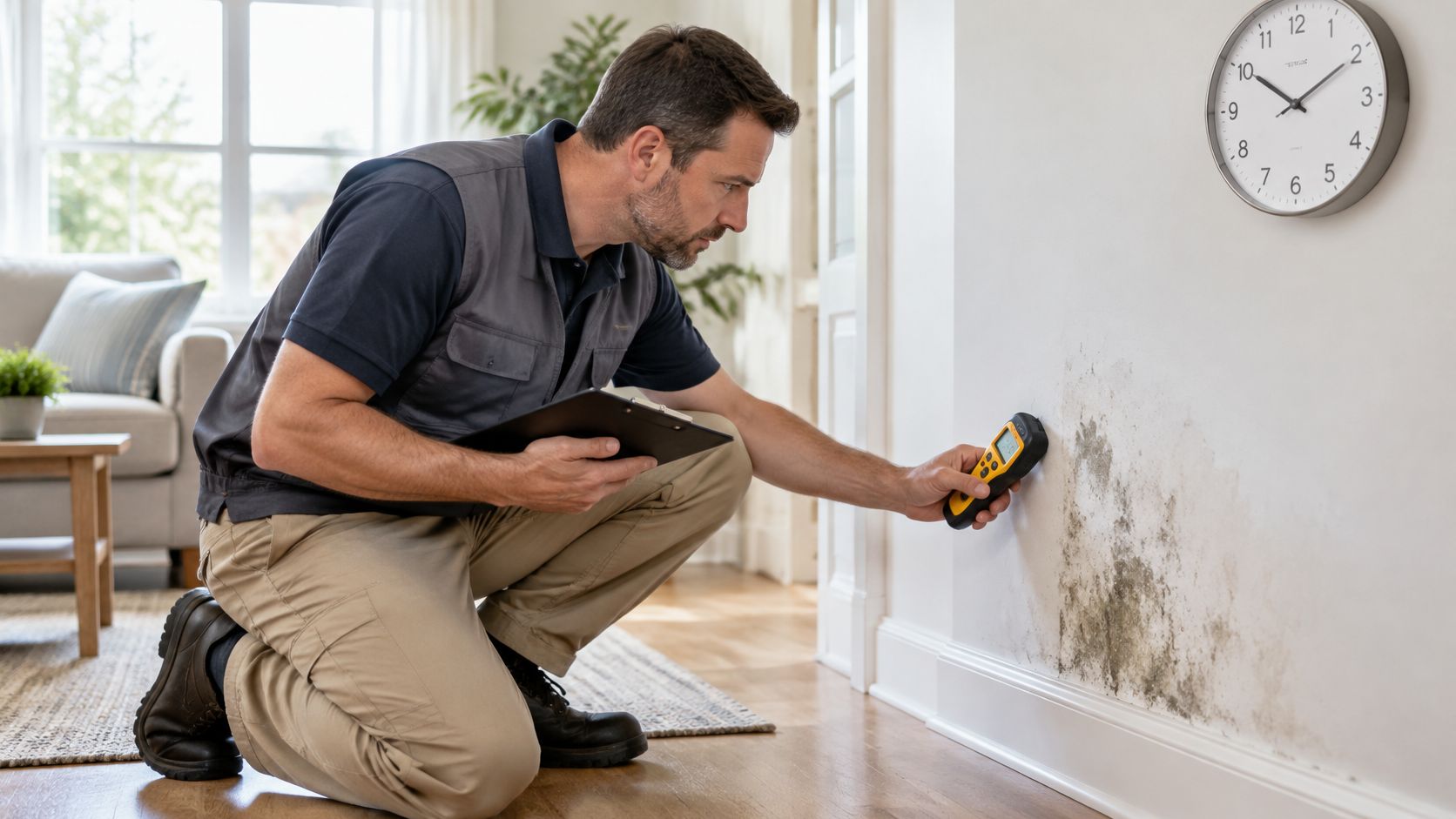
- Moisture mapping (30 to 90 minutes in a typical home). Readings across walls, floors, ceilings and window sills locate dampness that hasn't yet surfaced as mold. This is the stage that finds the problem behind the paint.
- Concealed-area checks (often the longest stage, 45 minutes to 2 hours). Under sinks, behind toilets, attic insulation, crawlspaces, HVAC vents and ductwork, washer connections, water heaters, and the wall cavity below any window that has leaked.
- Documentation (runs alongside the visit). Photos, meter readings, odor notes and a map of water staining. This is what makes the report usable later for an insurer, a buyer or a contractor.
- Sampling, when the question calls for it (15 to 20 minutes per location plus setup). Air samples drawn at about 15 liters per minute for 5 minutes, producing a 75-liter sample volume per location, plus an outdoor comparison sample, plus surface tape lifts or bulk material samples, all logged under chain of custody, as EPA's mold course chapter on sampling describes.
- Close-out (15 to 30 minutes). A findings summary on site, then laboratory analysis and a written report with recommended next steps.
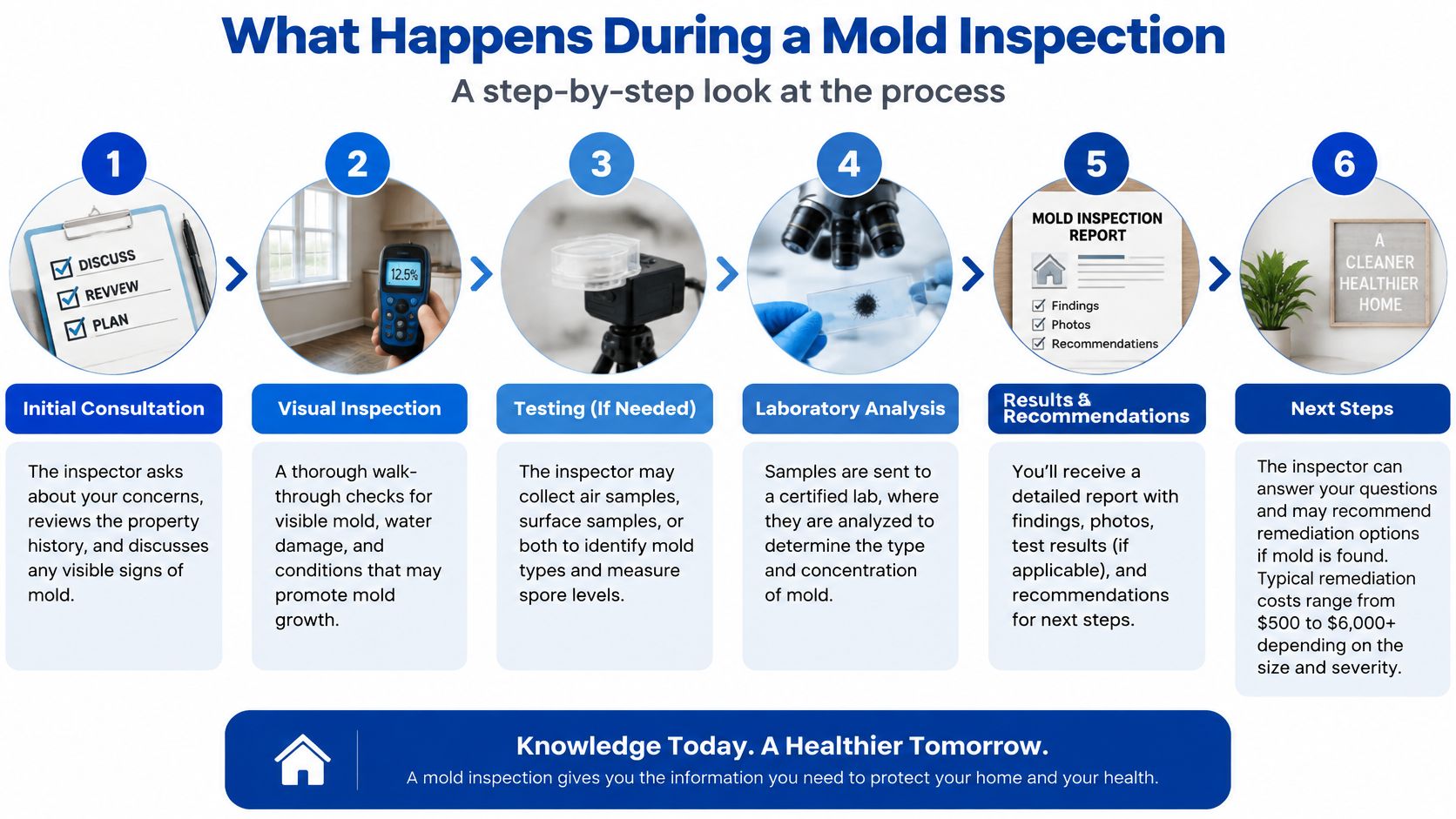
That sequence mirrors how we run a home environmental inspection: a full property walkthrough, identification of environmental hazards, targeted sampling and testing, laboratory analysis, and detailed reporting with next steps. The walkthrough and the moisture work are inseparable. An inspector who skips straight to sampling has skipped the part that explains the result.
When the report lands, the next question is usually what the findings mean for the building. PostDamage's mold testing and remediation guidance is a useful plain-language reference for how documented conditions translate into a scope of work, and it helps to read it before you start collecting bids so you can compare them on equal terms.
Two stages dominate the clock in practice: concealed-area access and moisture mapping. If your property has a crawlspace hatch nailed shut, a mechanical closet behind a stack of stored boxes, or a tenant who needs notice before entry, those two stages are where the extra hour appears on the invoice.
What Makes an Inspection Take Longer
Scope, not speed, drives the clock. Six factors add time, roughly in this order of impact.
The number of suspected areas. Each additional room means another walkthrough, another set of moisture readings across four surfaces, more photographs and more writing. Three affected rooms can double a visit that would otherwise finish in two hours.
Property size and layout. Square footage matters, but layout matters more. Additions with their own rooflines, split levels, converted garages, basement units and homes that have been re-plumbed in stages all create junctions where water moves in ways the floor plan doesn't show.
Accessibility. Attic access, crawlspace clearance, locked mechanical rooms and occupied units that need scheduling all convert into time. A low, cluttered crawlspace can consume forty minutes on its own.
Moisture history. Past slab leaks, roof leaks, flooding or a prior remediation that has to be verified all require tracing whether the source was fixed. History is the single best predictor of a long visit.
HVAC complexity. Ductwork and air handlers spread contamination questions across the whole building. A system with multiple returns, flex duct in an attic and a wet evaporator coil takes real time to assess.
Sampling. Collecting samples adds a separate stage and laboratory coordination, and the results land days after the visit rather than at the end of it.
Commercial and institutional buildings break the residential model entirely. A school, hospital, office floor or multi-unit property can't be quoted as one standard appointment, and the work is often scoped per floor, per wing or per mechanical system, across more than one visit. EPA's guidance on mold and indoor air quality in schools treats mold evaluation as an ongoing building-management process built on routine walkthroughs, which is the right frame for a facility with hundreds of rooms.
Ask what the quoted time includes, in writing. Visual inspection only, or moisture mapping too? Sampling, or inspection alone? Laboratory turnaround? Written report? Follow-up verification after any work? A quote that sounds fast may simply be quoting a shorter list.
EPA guidance on this topic is really guidance about moisture: the priority is investigating moisture sources, odors, water stains, leaks and HVAC conditions rather than treating mold as a visible surface problem. An inspection limited to the visible growth you already found can be quick and still miss the reason it grew. If you're tracing a leak that has already been repaired, how to check for mold after water damage covers the areas worth flagging before the inspector arrives.
The practical takeaway is to compare quotes on scope rather than on promised minutes. Two inspectors quoting three hours can be selling very different visits.
When You May Not Need Mold Sampling at All
More testing doesn't automatically mean more answers. When mold is visible and the moisture source is obvious, the California Department of Public Health's mold frequently asked questions make the case plainly: measuring the amount or identifying the type of mold generally doesn't provide additional useful health information, and the department doesn't recommend the consumer surface and air-sampling kits sold in hardware stores. Its priority is locating the moisture source and correcting the cause.
Federal guidance points the same direction. NIOSH's mold testing and remediation page reports that thorough visual inspection and odor detection are more reliable for identifying indoor dampness concerns than short-term mold-spore air sampling, and it doesn't recommend routine air sampling for general building evaluations, because concentrations swing substantially over time and there are no health-based standards to interpret the numbers against.
So when does a sample earn its cost and its days? These situations, mostly.
- A musty odor with nothing visible. Odor is evidence of moisture or growth somewhere you can't see, and sampling can help confirm whether the air is carrying spores from an interior source.
- An unclear or hidden moisture source. When several areas are plausible and the repair budget is finite, testing narrows where to open.
- A dispute. Landlord and tenant disagreements, insurance claims and pre-litigation positions all benefit from documented, chain-of-custody laboratory results.
- Health concerns raised by occupants. A physician or occupant who needs a record of conditions is a legitimate reason to test even when growth is visible.
- Defining the extent of contamination before bids. Contractors price from scope, and a documented extent keeps bids comparable.
- Pre-purchase due diligence. A buyer who wants an independent read on a property before closing is buying information, not reassurance.
Professional sampling differs from a do-it-yourself kit in ways that matter to anyone who will rely on the result: chain-of-custody handling, accredited laboratory analysis, an outdoor baseline for air samples, and interpretation tied to the moisture conditions found during the visit. If you're weighing a store-bought kit, are home mold test kits reliable explains where they fall short.
Because the scope is set by your question, agree on it before the visit. "Test for mold" is not a scope. "Find out whether the musty smell in the hallway is coming from the bathroom remodel or the HVAC" is.
How Long Lab Results and Reports Take
If no samples are collected, the timeline is short. Findings and moisture readings are usually explained at the end of the visit, and the written report follows within a few business days.
If samples are collected, the clock restarts when the laboratory receives them, not when the inspector leaves your driveway. Turnaround varies by lab and by service level, but standard analysis typically runs several business days after sample receipt, and faster rush options exist at added cost. Shipping, logging, weekends, holidays, sample complexity and the analysis requested all shift the delivery date.
| Option | Typical turnaround | When it makes sense |
|---|---|---|
| Visual-only inspection | Findings reviewed at the end of the visit; written report to follow | Visible mold with an obvious moisture source and no dispute over extent |
| Standard laboratory analysis | Several business days after the lab receives samples | Routine inspections with no urgent deadline |
| Complex or multi-contaminant analysis | Longer than standard; depends on the tests requested | Projects with many samples or several contaminant types |
| Expedited or rush analysis | Priority turnaround at added cost | Escrow closings, insurance claims and occupied or sensitive buildings |
Ask which option your quote includes before a deadline makes the decision for you. An escrow closing, an insurance adjuster's timeline or a family sleeping in a guest room all argue for a different answer, and rush pricing exists precisely because the baseline is measured in business days rather than hours.
The rule to plan around: a straightforward inspection is hours on site, while a sampling-based assessment is a multi-day process. Book with the report date in mind, not just the appointment slot.
Should You Book Fast or Start Drying First
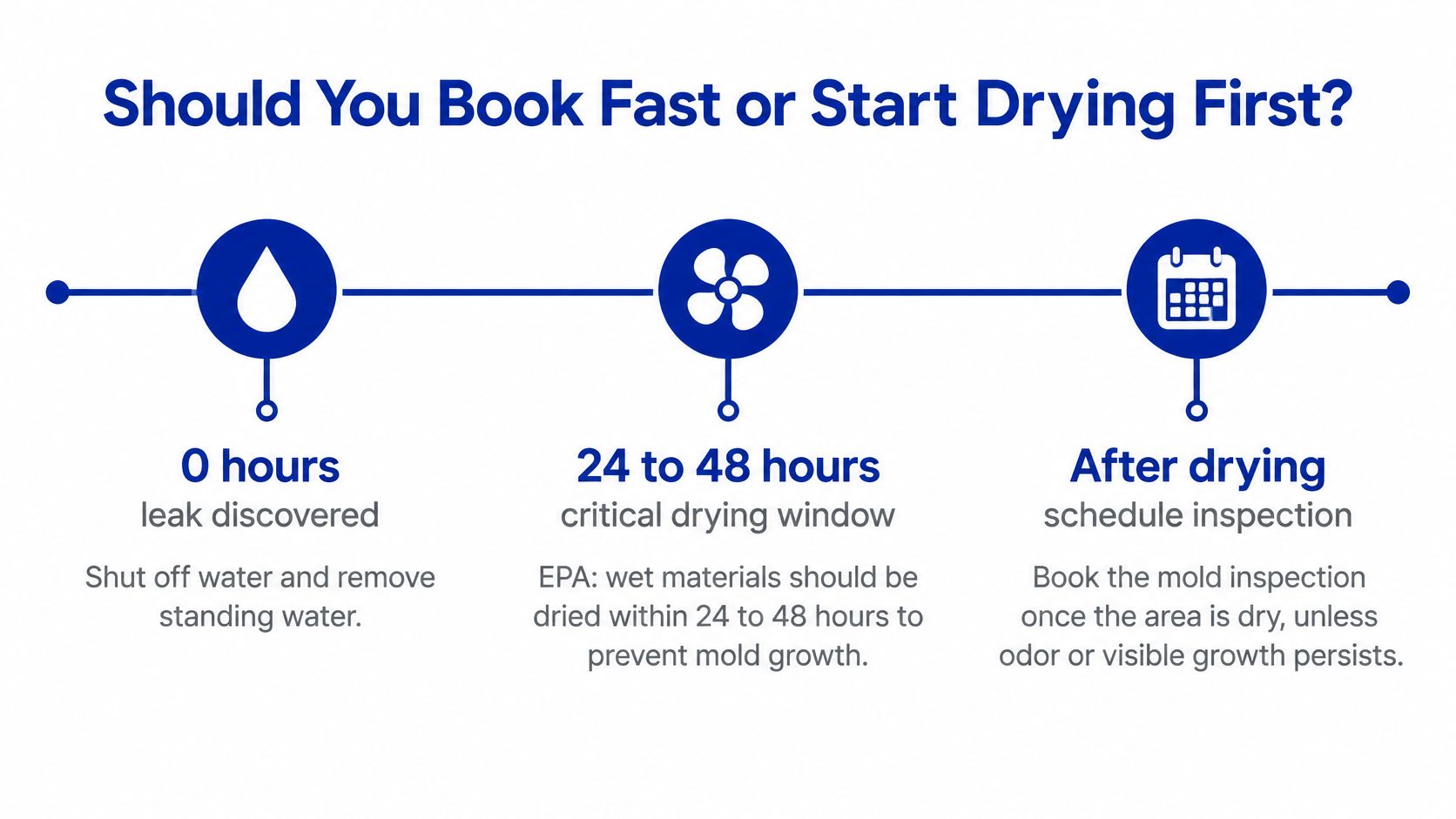
Speed isn't automatically the better choice. The EPA's guide to caring for your air identifies the critical timeline as drying wet materials within 24 to 48 hours, not completing an inspection within a particular number of minutes. After a fresh leak, water extraction, drying and fixing the source outrank waiting for a lengthy mold-focused appointment.
That gives a usable decision rule for three common situations.
Active water, burst pipe or a soaked wall. Extract and dry first, and book the inspection in parallel so the visit happens once the materials have had a chance to dry or once it's clear they won't. The same guide recommends keeping indoor relative humidity below 60 percent, ideally 30 to 50 percent, and checking regularly for leaks, moisture and HVAC problems.
Persistent dampness, a recurring musty odor, or a leak you suspect was never fully dried. Book a thorough inspection without waiting for visible growth. Time doesn't improve this situation.
A small patch of visible mold with an obvious old source that has been fixed. A standard visit is fine, on a normal schedule.
While you wait, document what you can safely observe: leak location and date, photographs before anything is moved, odor notes with the rooms they occur in, humidity readings if you have a hygrometer, the materials affected, and any prior remediation records. That packet serves the inspector, the insurer and the laboratory equally, and it costs nothing to assemble.
Southern California produces a few distinct urgency profiles. Storm-driven roof and window leaks tend to arrive in clusters, so scheduling competes with everyone else's. Plumbing failures under slabs and in second-floor bathrooms can go unnoticed for weeks. Wildfire-related building closures leave structures sealed with moisture inside. Air-conditioning condensation and clogged drain lines keep a slow drip going all summer. If you're managing the drying stage yourself, how long to run fans after water damage sets realistic expectations for equipment and timing.
Match the speed to the moisture, the size of the building, who lives or works in it, and whether you suspect concealed damage. The fastest appointment isn't automatically the best one.
Schedule Your Mold Inspection in Los Angeles
Three numbers answer the original question. Expect about 2 to 6 hours on site for the visit, a few business days for a visual-only report, and roughly 3 to 10 business days more when laboratory sampling is involved. Everything else is scope.
Have four things ready when you call: the property type and approximate size, the areas you suspect, the water-damage history, and any hard deadline such as an escrow closing, an insurance claim or a renovation start date. Those four items let an inspector tell you whether you need a two-hour visit or a full day. If mold may be hidden, say so upfront. A survey that maps moisture and identifies the full extent of growth takes longer to plan than a visual check of one known wall, and the earlier the inspector knows, the more accurate your time estimate will be.
Sensitive Environmental brings over 30 years of experience to each asbestos, lead and mold project. For a known mold location, we can work with you on a budget and build a scope of work together. We also offer a free, no obligation consultation for environmental testing or for an existing asbestos, lead or mold problem.
Call 310-387-5404 or request an appointment online to schedule mold inspection and testing across Los Angeles County and Southern California, from Santa Monica bungalows and Glendale condos to commercial suites Downtown and in Irvine. What you get is a defined inspection plan: what will be checked, whether sampling is justified, when the report arrives, and what the results can and cannot tell you.
Mold testing and inspection at Sensitive Environmental follows a documented process: a full property walkthrough, moisture mapping, targeted sampling where it changes the answer, laboratory analysis, and a report that states clearly what was found, what was not checked, and what to do next. If you're facing a musty odor, a recent leak or a report you need to rely on, visit Sensitive Environmental to request an appointment for mold inspection and testing anywhere in Los Angeles County and Southern California.