Mold can begin developing on damp building materials within 24 to 48 hours of water exposure, so the first two days after a leak are the window that decides how the rest of the job goes. Past that point, the question shifts from preventing growth to finding out how far it has already spread.
Here's where the number is often misread. People treat 24 to 48 hours as a growth clock, a countdown to the instant mold appears. It isn't. It's a drying milestone, the amount of time wet material is allowed to stay wet before the risk becomes something you manage instead of something you prevent. This guide walks the timeline stage by stage, then shows where it bends.
Table of Contents
- Mold Timeline After Water Damage at a Glance
- Factors That Speed Up or Slow Mold Growth
- Benchmark Limits and How Timelines Diverge
- Commercial Properties and Documenting Water Losses
- Frequently Asked Questions About Mold After Water Damage
- When to Schedule Professional Mold Testing in Los Angeles
Mold Timeline After Water Damage at a Glance
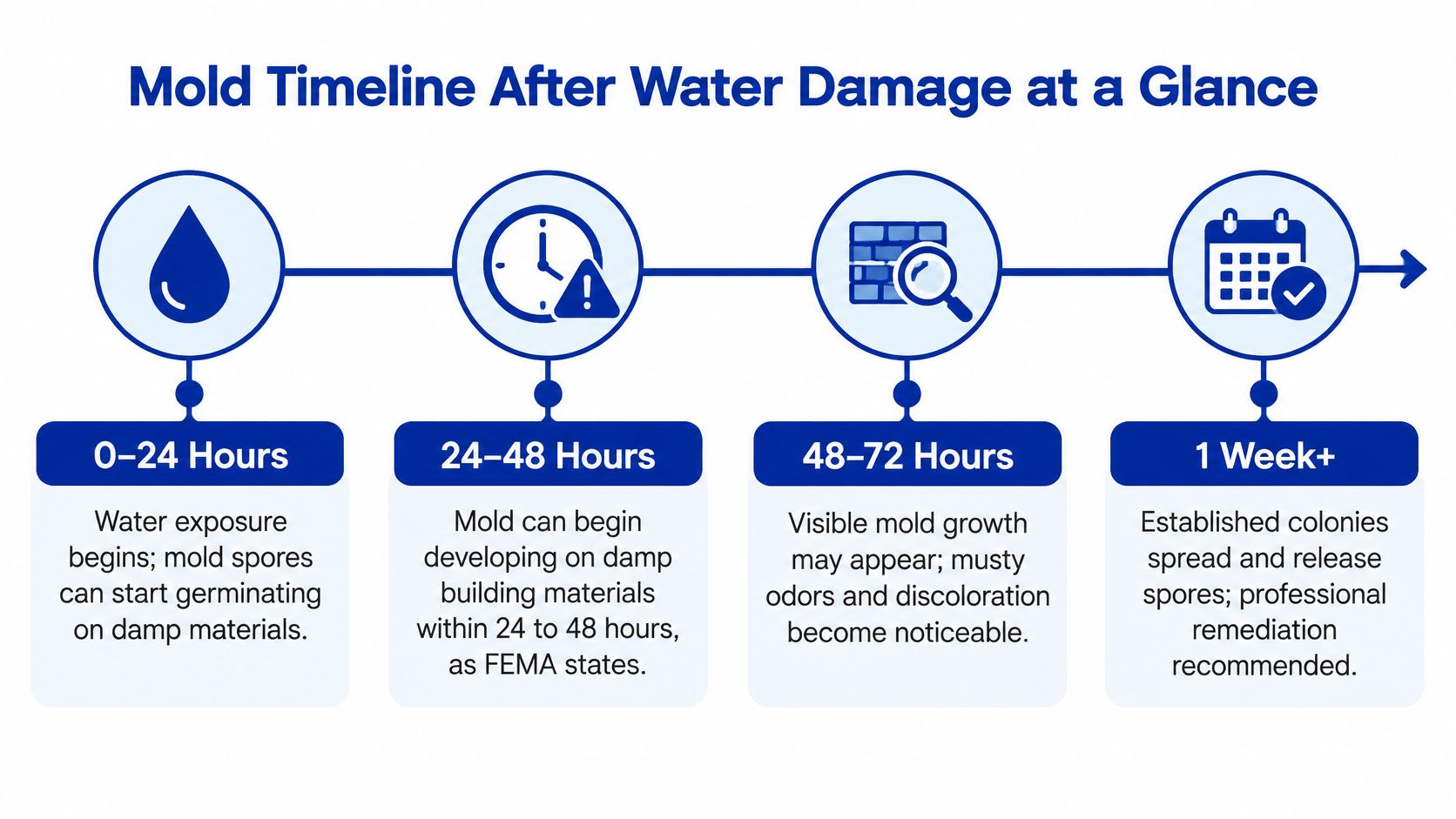
The U.S. Federal Emergency Management Agency (FEMA) states that mold colonies may start developing on a damp surface within 24 to 48 hours of water exposure, including after flooding, plumbing leaks, roof leaks, sewage backups or ordinary indoor moisture problems, as its mold recovery brochure sets out. Federal guidance points owners at the same target, which is to dry affected areas and belongings inside that window to reduce the likelihood of growth.
Treat those hours as a prevention target, not a stopwatch. Mold doesn't appear at hour 24 because a rule says so, and it isn't guaranteed absent at hour 23. What the number does is mark the point where drying stops being routine cleanup and starts being a decision about materials.
| Time since water exposure | What is happening | Key action |
|---|---|---|
| 0 to 24 hours | Water soaks into porous materials, and spores landing on damp surfaces begin to settle | Extract water, remove wet materials that can't be dried, start dehumidifiers and fans |
| 24 to 48 hours | Colonies may begin developing on damp surfaces, especially hidden ones | Complete drying as the target; check carpet, subfloor and drywall edges |
| 48 to 72 hours | Growth may already be established where materials stayed wet, and materials wet past this point are evaluated under mold-remediation procedures | Arrange a professional inspection and moisture assessment |
| One week or more | Staining, musty odor and visible growth are common where moisture persisted | Document conditions and get testing before cleanup or repairs |
The practical rule: the deadline is about the moisture, not the mold. Get the material dry and the growth question mostly answers itself.
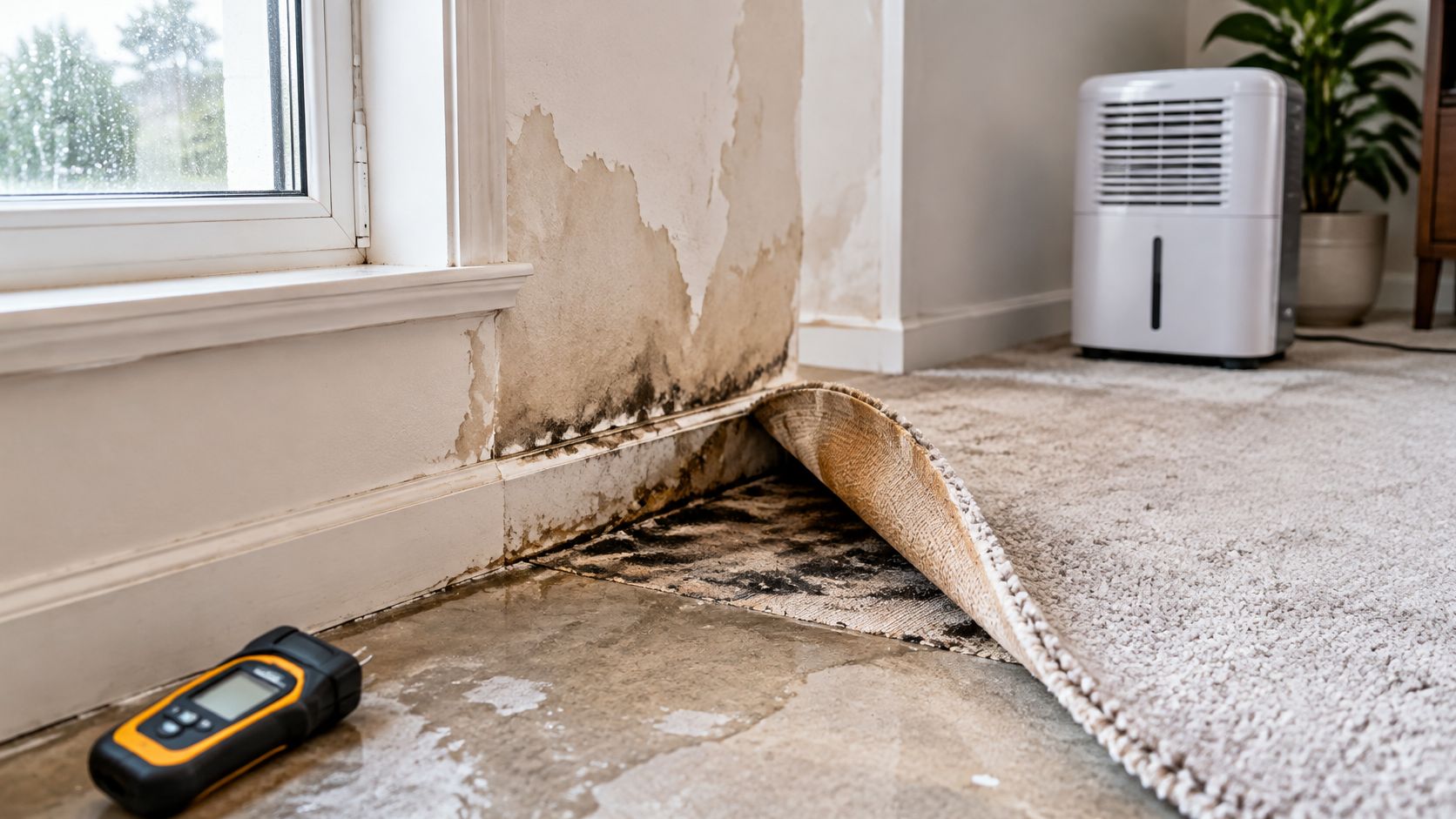
Here's the part that trips up owners. Carpet, carpet backing, drywall, insulation and upholstered furniture hold water long after the surface reads dry to the touch, and growth develops inside or behind them. A room can look finished while the drywall's paper face, the carpet pad and the subfloor underneath are still damp. The clock doesn't stop because your hand says it should.
Three moves start the process, in this order:
- Stop the source. Shut the supply valve, tarp the roof or replace the appliance line. Drying a space that's still taking on water wastes the equipment.
- Remove standing water. Extraction comes first, because a dehumidifier pulls moisture out of air, not off a floor.
- Start air movement and dehumidification together. Fans alone push wet air around the room; pair them with a dehumidifier and keep the space closed enough for the equipment to work.
Delays past the second day raise the odds that a straightforward water cleanup becomes a documentation and remediation question. That's the reason the number gets repeated so often.
Factors That Speed Up or Slow Mold Growth
A sponge left in a sink stays soaked for days. Sit the same sponge on a rack in the sun and it's dry by afternoon. Nothing about the sponge changed. What changed was how fast the water could leave it, and mold growth runs on exactly that logic.
| Factor | Faster growth when | Slower growth when |
|---|---|---|
| Temperature | Indoor temperatures are warm and stay warm | Spaces are cooler, though cool conditions slow growth without stopping it |
| Indoor humidity | Relative humidity stays high after the leak | Air is dehumidified and kept dry |
| Material type | Carpet, carpet pad, drywall, insulation or upholstery holds water | Surfaces are hard and non-porous, so they dry fully |
| Water volume | Large volumes or standing water remain | Small amounts are removed quickly |
| Airflow | Enclosed cavities and still air | Fans and ventilation keep air moving |
| Drying time | Materials stay wet beyond 48 hours | Materials are dried within 24 to 48 hours |
Material type is the factor readers underestimate. The CDC guide for homeowners and renters takes the conservative line: when a flooded home and its contents couldn't be dried within that 24 to 48 hour window, assume growth may be present, and remove materials that can't be completely cleaned and dried in that interval. For carpet and backing, the standard approach is water extraction, dehumidification and air movement rather than a fan aimed at the surface.
Check Moisture, Not Appearance
Touch tells you about the surface. A meter tells you about the assembly. Probe the drywall near its bottom edge, the carpet backing and pad, the subfloor beneath, and the framing behind a wet wall, then write down the readings with the time and location.
- Control the room, not just the material. Keep indoor humidity down while drying, because humid air slows evaporation and lets unaffected materials drift upward in moisture content.
- Move air through cavities. Toe kicks, cabinet backs and wall voids trap still air, and still air is where growth gets its head start.
- Keep a record. Dated readings showing a downward trend are what prove the building was dried, not just that it felt dry.
Cool temperatures slow growth but don't stop it. A cold building with trapped moisture stays at risk, which is why shutting off the heat and closing up a vacant unit over a wet weekend doesn't solve anything.
Southern California splits this in two directions. Inland summers in the San Fernando Valley and the Inland Empire dry materials quickly but also hold the warm temperatures growth likes, while coastal humidity in Long Beach or Santa Monica slows evaporation and makes dehumidification the deciding tool. Winter air helps drying in some rooms and does little in a closed-up suite. If you're working out how long equipment should run, how long to run fans after water damage covers the equipment side in detail. For a comparison from a much drier climate, this walkthrough of Phoenix flood cleanup and mold prevention shows how fast the same window closes when the air is working with you.
Benchmark Limits and How Timelines Diverge
The 24 to 48 hour figure is an emergency benchmark used by agencies, not a measured growth rate. EPA guidance for schools and commercial buildings says wet materials should be dried within that window and notes that materials wet for more than 48 hours should be evaluated under mold-remediation procedures.
That same guidance is careful in both directions. EPA cautions that mold may already have developed even when materials are dried within 48 hours, and that mold won't necessarily occur merely because 48 hours has passed. The Centers for Disease Control and Prevention takes a similarly conservative line for flooded homes: when a building and its contents couldn't be dried within 24 to 48 hours, occupants should assume growth may be present and proceed with complete drying, cleanup and correction of the moisture source.
The window measures how long moisture is allowed to stay, not how long mold takes to appear.
That distinction matters because visual inspection answers a narrower question than people think. Growth in wall cavities, under flooring, behind baseboards and inside insulation stays out of sight while it develops. A clean walk-through of baseboards and ceilings confirms that the visible surfaces look fine, nothing more.
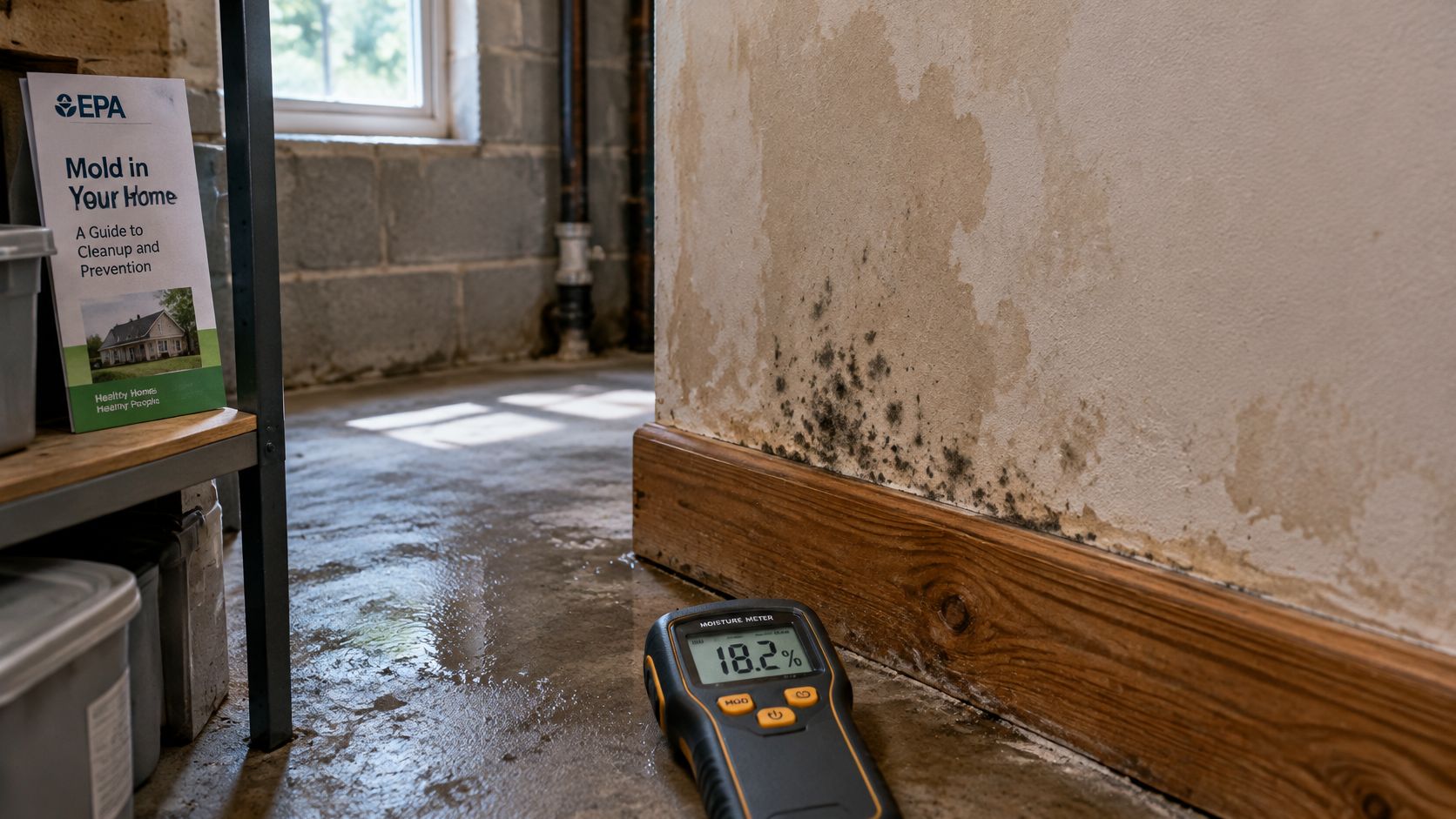
A moisture reading at the base of a damp wall tells you far more than a flashlight tour does, and it's the reading that decides whether an inspection is needed.
Three Leaks, Three Timelines
Example one. The kitchen supply line. A slow leak under the sink runs for a day before anyone notices, and the floor gets mopped before the cabinet base is checked. The surface dries in hours; the subfloor and the cabinet toe kick stay damp, and moisture shows up behind the cabinets days later. The timeline changed at the mop, because that's when the visible evidence disappeared.
Example two. The storm leak into attic insulation. Water tracks along a roof deck and into batt insulation above a bedroom ceiling. Air movers dry the roof framing in about three days and the sheathing reads fine, but the insulation holds water against the ceiling drywall. The turning point is the decision to inspect the assembly before the ceiling is closed up, rather than trusting the framing readings above it.
Example three. The office sprinkler line. A failed line soaks a carpeted suite overnight. Extraction starts the next morning, which is the right call, but a carpet pad under quarter-inch carpet can hold water after the carpet face is dry to the touch. The timeline shifted when moisture mapping of the pad and subfloor was finished before staff returned, not when the carpet felt dry underfoot.
The lesson is the same in all three. One leak can produce wildly different outcomes depending on the material it reached, how much air moved through the assembly, and whether anyone verified the drying with measurements instead of a hand on the wall.
Commercial Properties and Documenting Water Losses
For property managers, facility managers, general contractors and adjusters, a water event produces two deliverables. One is a dry building. The other is a file that answers questions six months later, when a tenant complains about an odor or an insurer asks what was done and when.
Build that file as the work happens:
- Log the clock. Record when the water was discovered, when the source was stopped, and when extraction began. Those three timestamps carry more weight than any narrative summary.
- Photograph with dates. Wide shots of each affected room, close shots of staining or swelling, and images of equipment placement with the day visible.
- Map moisture by location. Readings for each assembly, labeled by room and material, repeated over successive days until values return to dry standard.
- Note the decision point. When materials moved past the drying window, write down why, what was evaluated, and who made the call.
- Check the air systems. If water reached ductwork or an air handling unit, the inspection scope should include those components, since they distribute spores through a whole floor plate.
Schedule environmental testing before cleaning or reconstruction covers the evidence. Sampling in an occupied office, school or medical suite documents conditions at a specific moment, which supports both occupant questions and the owner's due diligence. For larger portfolios, our commercial mold testing and assessment in Los Angeles work is built around that kind of reporting, with findings delivered in a form insurers and contractors can use. Testing documents conditions. It doesn't replace the restoration contractor's scope of work, and it shouldn't be treated as a substitute for it.
Frequently Asked Questions About Mold After Water Damage
Can mold grow within 24 hours
It can begin on damp materials in as little as 24 hours, which is why the 24 to 48 hour drying target exists. No single exact timing applies to every building, material or season.
The carpet looks dry after two days. Is it safe
A dry surface doesn't confirm dry materials underneath. Moisture should be measured in the backing, the pad and the subfloor, and no test can guarantee that a property is safe.
Is a store-bought test kit enough
DIY kits read visible surfaces. Professional testing adds inspection of hidden areas, moisture mapping, laboratory analysis and a written report you can hand to a landlord, insurer or contractor.
Does a positive result mean removal is required
No. Results describe what's present and where. Owners and qualified professionals use that information to decide next steps, which may range from better drying to further assessment.
Will testing require opening walls
It depends on where the moisture and suspect growth sit. An inspector will explain access needs before any work begins, so you know what the visit involves.
What if someone has breathing or allergy symptoms
Speak with a doctor, and mention the water event and any test results to them. Medical questions belong with a medical professional.
When to Schedule Professional Mold Testing in Los Angeles
Some water damage announces itself. Much of it doesn't. If you smell mold, see it, or have had a water leak, there may be mold, and the fastest way to stop guessing is a documented inspection.
The warning signs that justify a call:
- A musty smell that returns after cleaning, especially in closets, cabinets or a closed-up room.
- Staining or discoloration on walls, ceilings or flooring, even if it looks dry now.
- Water that couldn't be dried within 48 hours, or a leak whose source nobody pinned down.
- Recurring dampness in a basement, crawl space, bathroom wall or below-grade unit.
- Peeling paint, bubbling drywall or lifting flooring, which usually means moisture behind the finish.
The window is the time to dry materials. Any water that stayed longer than that warrants an inspection rather than a second round of guessing.
- Stop the water source.
- Document the damage with dated photos.
- Keep drying equipment running.
- Request professional mold testing before cleaning or repairs cover the evidence.
What a Visit Involves
A Sensitive Environmental inspection starts with a walk-through of every affected area, then moisture mapping to locate hidden pockets of water behind walls and beneath floors. Where it's warranted, we collect samples and send them to a laboratory for analysis, which identifies the type and concentration of mold present along with the moisture intrusion behind it. You get a written report that landlords, insurers and contractors can work from.
A positive result does not automatically require removal. It tells you what's there, how far it reaches, and what the options look like.
| Task | DIY check | Professional testing |
|---|---|---|
| Visible growth | Can spot staining or fuzz on exposed surfaces | Inspector examines hidden areas such as wall cavities and under flooring |
| Moisture | Basic meter readings on accessible surfaces | Moisture mapping across the property to locate hidden pockets of water |
| Air or surface sampling | Not reliable without laboratory equipment | Samples sent to a laboratory for analysis |
| Documentation | Photos and notes | Written report usable by landlords, insurers and contractors |
| Interpreting results | Hard to judge without reference data | Report explains findings and options, without automatically requiring removal |
We inspect and test residential and commercial properties across Los Angeles and Southern California, from single-family homes in the Valley to multi-tenant buildings on the Westside. You can request a consultation through the website by selecting mold as the problem type, and our mold testing service in Los Angeles explains how sampling and reporting are handled. Testing documents conditions at a point in time. It cannot guarantee a property is safe, and anyone who promises that is selling you something else.
Water that sat longer than a weekend, a musty smell behind a wall you can't open, or a leak you only found after the floor started lifting all point to the same next step: find out what is there before cleanup or reconstruction seals it in. Sensitive Environmental provides mold inspections, moisture mapping, sampling and laboratory analysis for homes, offices and commercial properties throughout Los Angeles and Southern California, with written reports built for owners, landlords, contractors and insurers. Visit us to schedule a mold inspection or request a free consultation and select mold as the problem type.