Most residential mold inspections with lab testing run about $250 to $600, while larger properties or extensive sampling packages reach $800 to $1,200. That range is wide because you're rarely buying one fixed service. You're buying a combination of inspection time, sample count, laboratory work, reporting, and sometimes verification after cleanup.
The number that changes how you should read every quote is smaller. Thumbtack's 2025 listing puts residential mold testing at $250–$350, including an inspection, report, and two mold tests. Once a quote moves well beyond that level, you should be able to see exactly what extra work you're paying for. If you can't, the price is soft, even if the total looks precise.
That's the central problem with mold inspection and testing cost in Los Angeles and Southern California. Two firms can quote very different totals for the same property and both can be defensible, because one priced two samples and a brief report while the other priced moisture mapping, hidden area checks, an outdoor reference, and clearance planning. The cheaper quote isn't automatically weaker evidence. It may have less scope. Your job is to find out which scope answers your decision, then stop there.
Table of Contents
- Mold Inspection and Testing Cost Ranges
- What the Price Covers Inspection and Lab Testing
- When Sampling Adds Cost Without Adding Answers
- Factors That Raise or Lower Your Mold Testing Price
- Cost-Saving Moves and the Risks of Skimping
- Getting an Accurate Quote and Booking Your Inspection
Mold Inspection and Testing Cost Ranges
Most residential mold inspections with lab testing fall between about $250 and $600, with higher totals tied to larger properties, more areas, or more samples.
Use the table as a starting point, not a price list. RestoreAdvisor's published estimates range from about $250–$500 for air and surface sampling to approximately $303–$1,075 for a broader inspection, while standard professional testing is commonly reported around $300–$600. The same source notes clearance testing listed separately at roughly $200–$500, which explains why a low first quote can grow after cleanup.
Mold Inspection and Testing Cost by Service Level
| Service | Typical price | What it usually includes |
|---|---|---|
| Basic residential mold testing | $250-$350 | Inspection, report and two mold tests |
| Air and surface sampling package | $250-$500 | Sample collection and laboratory analysis |
| Standard inspection with lab testing | $300-$600 | Visual and moisture inspection, samples and written report |
| Broader inspection, larger or complex property | $303-$1,075 | Moisture mapping, hidden-area checks and reporting |
| Inspection and testing package, extensive sampling | $800-$1,200 | Multi-area sampling, lab analysis and detailed interpretation |
| Post-remediation clearance testing | $200-$500 | Verification sampling after cleanup, usually quoted separately |
| DIY test kit | $10-$50 | One sample and result without professional interpretation |
These are market ranges, not fixed prices. Scope decides where your job lands. A lower price may buy a site visit and two samples, while a higher price may buy moisture mapping, hidden area investigation, laboratory analysis, and a written interpretation of findings. Both totals can be honest. They aren't interchangeable.
Practical rule: Compare deliverables before totals. A quote that names sample type, sample count, report contents, and clearance tells you more than a lower total that names none of them.
Before you call anyone, write down four details. Note the property type, approximate size, whether growth is visible, and whether a sale, lease, insurance claim, or dispute is involved. Then match your situation to the rows. A standard Los Angeles home with one affected bathroom and two samples belongs in a different row than a multi-unit building where a property manager needs dated documentation for tenants, insurers, or a transaction.
What the Price Covers Inspection and Lab Testing
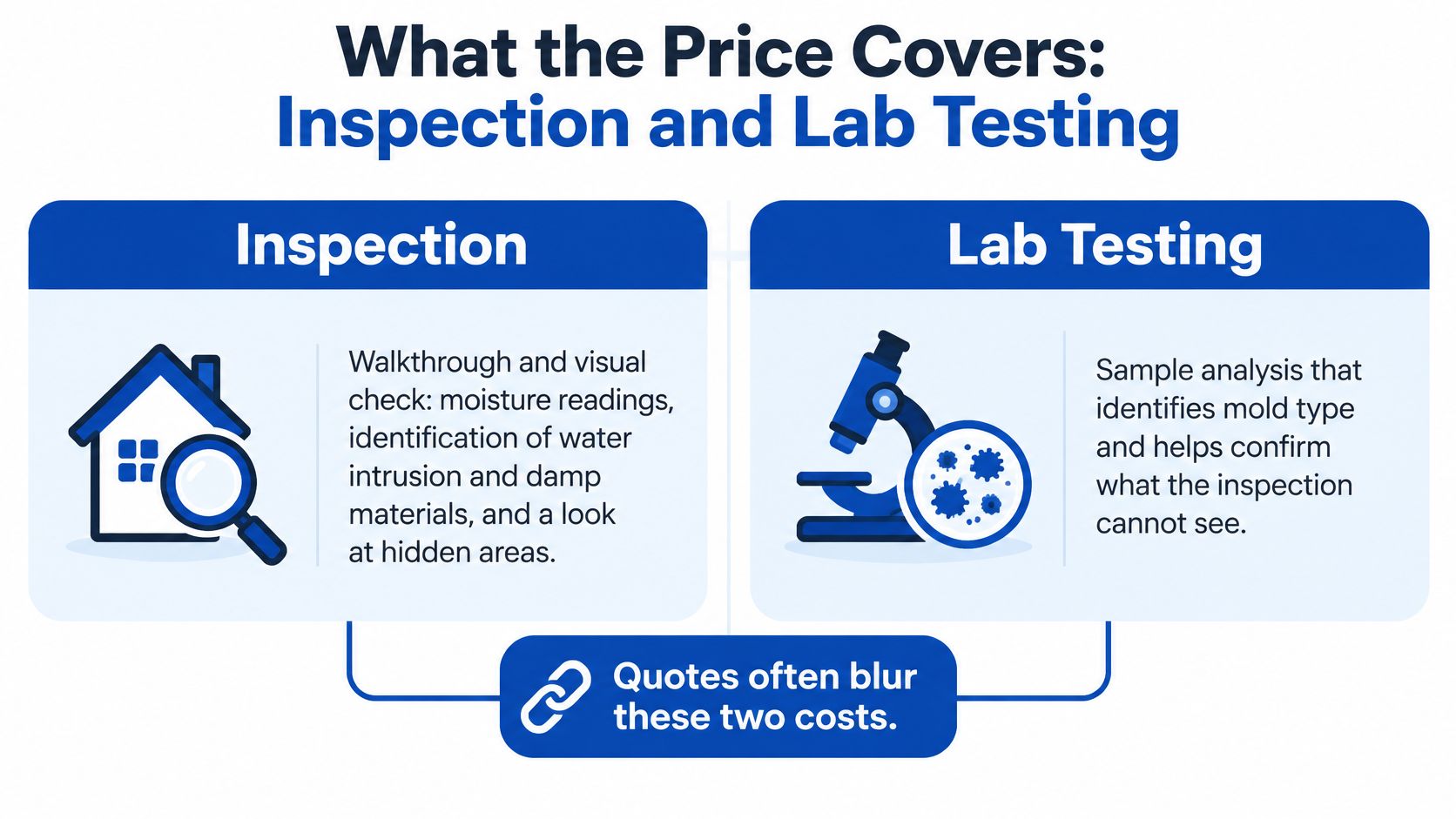
Inspection and testing answer different questions, even when a quote combines them. An inspection identifies moisture problems and likely mold locations. Laboratory testing analyzes collected samples to identify the type and concentration of mold. Comparing the services separately shows what the total buys.
What the Inspection Buys
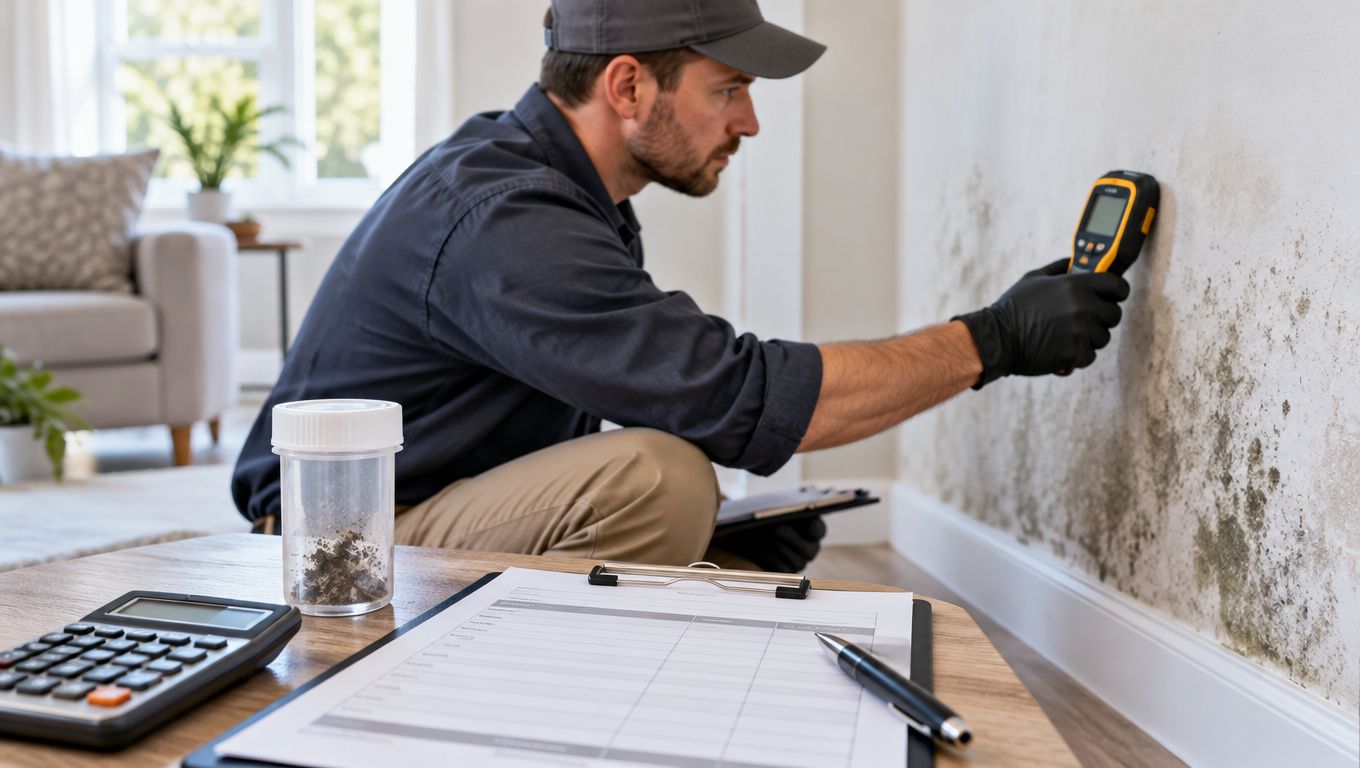
The inspection scope covers a property walkthrough and visual assessment. It can include moisture readings, checks for water intrusion and damp materials, and examination of accessible areas where mold may be hidden. Sensitive Environmental's mold survey identifies the presence, extent, and potential causes of mold to support remediation and prevention strategies.
For budgeting, ask whether the quote specifies the areas examined and the reporting provided. A finding helps determine next steps, but a test result alone does not decide whether cleanup is needed. Review guidance on when mold remediation may be required before treating a laboratory result as a cleanup instruction. If renovation is planned, mold inspection tips before drywall repairs may also help clarify the timing of inspection and repair work.
What Lab Testing Adds
The testing scope begins with sample collection and adds laboratory analysis, interpretation, and reporting. The EPA tabular overview lists indicative laboratory charges of approximately $50 for tape samples, $60 for air samples, and $100 for bulk material samples. These are lab charges, not the full cost of a professional service.
The final invoice may also include labor, equipment, reporting, travel, and overhead. Ask how many samples are included, what types will be collected, and whether interpretation is part of the price. The number and medium of samples affect the cost, but more samples do not automatically make the answer more useful.
Each sample should address a defined question: whether indoor air differs from an outdoor reference, whether a stained material contains mold, or whether contamination extends into nearby materials. If the quote does not explain what each sample is meant to establish, request that explanation before approving the work. Testing can identify mold and characterize samples; it cannot, by itself, determine the full extent of contamination behind unopened walls or confirm that cleanup is complete.
When Sampling Adds Cost Without Adding Answers
Some testing buys nothing. That's the uncomfortable point most cost guides skip, and it's where you can save the most money without weakening your decision.
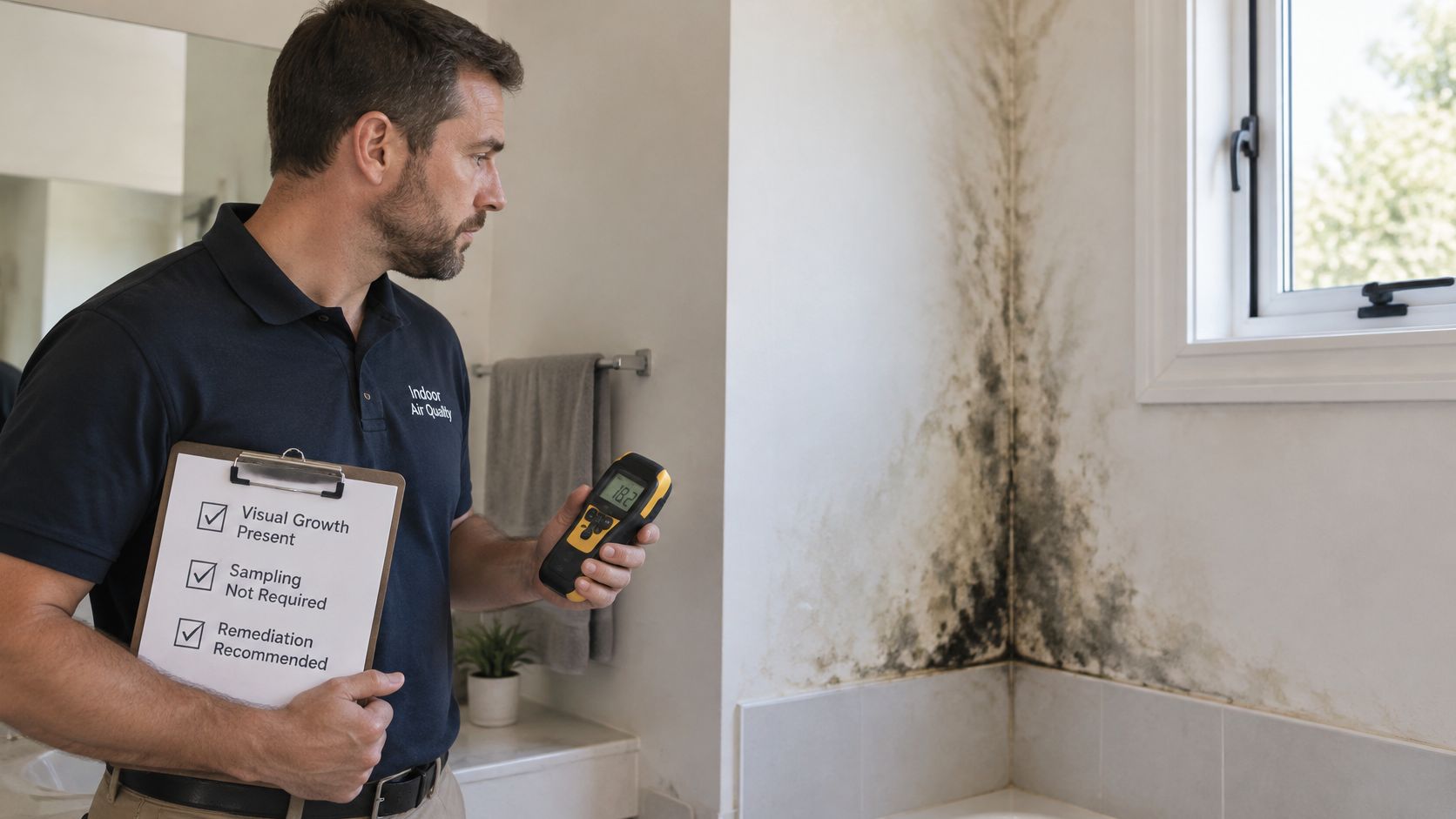
The U.S. Environmental Protection Agency's brief guide to mold, moisture, and your home states that, when visible mold is already present, routine sampling is usually unnecessary because the visible condition provides direct evidence of contamination. It also notes the federal government has established no regulatory limits for indoor mold or airborne mold spores, so laboratory results can't determine compliance with a federal mold standard.
Sampling earns its cost for narrower purposes. It can identify a hidden source, distinguish mold from soot or dirt, determine which species may be present, or verify whether remediation was effective. EPA recommends sampling by professionals experienced in protocol design, sample collection, and interpretation, with analysis following methods recommended by organizations such as the American Industrial Hygiene Association.
Testing Purpose and the Least Expensive Defensible Service
| Testing purpose | Least expensive defensible service | What sampling adds |
|---|---|---|
| Visible growth, source already clear | Visual and moisture inspection | Usually nothing; sampling is often unnecessary |
| Hidden source suspected | Moisture mapping with targeted sampling | Locates the water or growth source |
| Mold versus soot or dirt | Bulk or tape sample of the material | Confirms what the deposit is |
| Documenting conditions for a claim or dispute | Inspection with outdoor-referenced air samples | Dated, defensible evidence |
| Verifying cleanup effectiveness | Post-remediation clearance inspection with samples | Indoor results compared with outdoor conditions |
| Explaining health symptoms | Medical evaluation; CDC does not recommend mold testing for this | Sampling cannot set a health threshold |
Health questions need separate handling. A guide summarizing CDC and EPA positions on mold exposure notes the CDC does not recommend mold testing to answer a health question because there are no established standards defining an acceptable quantity of indoor mold, and individual responses vary. You can spend on professional inspection and laboratory testing and still receive no health risk threshold or definitive explanation for symptoms.
That limitation runs both ways. A negative air sample doesn't prove a building is risk free, and a positive sample doesn't by itself establish illness or causation. For landlords, insurers, and facility managers, value lies in evidence for a specific decision, not a generic mold score. If you're deciding after a leak, practical steps for checking for mold after water damage help you frame that decision before you pay for samples.
What will this test change? If you can't answer that in one sentence, don't buy the sample yet.
Factors That Raise or Lower Your Mold Testing Price
Square footage matters, but it isn't the main driver. Decision complexity and sampling intensity move the price more.
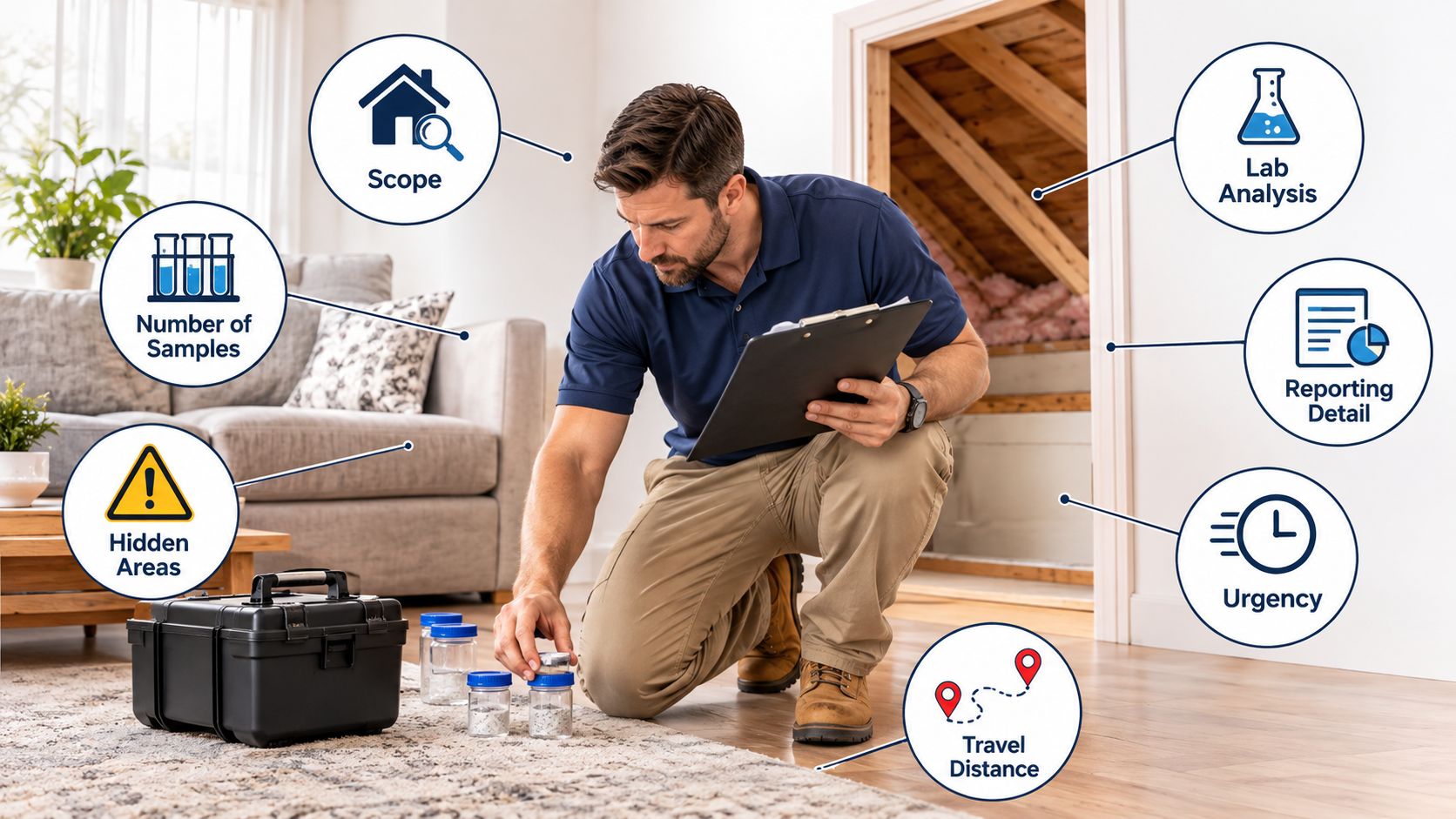
Published market benchmarks cited in a 360 Home Inspections cost guide show roughly $75–$150 per additional air, surface, or bulk sample, while inspection plus testing packages can reach approximately $300–$800 for standard homes and $800–$1,200 when properties are larger, sampling is extensive, or clearance testing is included. Every added sample creates collection time, consumables, laboratory analysis, result review, and report integration.
Seven Drivers Ranked by Impact
- Scope: A limited residential assessment with accessible areas costs far less than a commercial, multi-zone, school, healthcare, or post-fire investigation that needs representative coverage and defensible documentation.
- Sample count: Each sample adds lab and review time, so three extra samples can change the total more than a modest difference in property size.
- Laboratory method and turnaround: Accredited analysis and rush processing cost more than standard processing, and specialized methods cost more than routine microscopy.
- Report depth: Raw lab data is cheaper than a written interpretation with sample locations, moisture findings, photos, and an indoor and outdoor comparison.
- Access: Hidden areas can require destructive openings, lifts, containment, or return visits, each of which adds labor beyond sampling itself.
- Urgency: Emergency or same-day visits carry a premium because they displace scheduled work and compress lab timelines.
- Air sampling conditions: Results depend on location, occupancy, ventilation, recent cleaning, and outdoor conditions, so a defensible plan uses an outdoor control and strategically selected indoor locations rather than indiscriminate sampling.
Technical specifications add real work too. EPA's indoor air quality specification puts baseline testing in the breathing zone, approximately 3 to 6 feet above the finished floor, for at least four hours, with a field-blank filter cartridge after every eighth sample. Longer collection, simultaneous indoor and outdoor readings, and blank checks all consume technician and equipment time.
Surface samples also have a firm limit. They identify conditions at a specific spot and can't establish whole building airborne exposure. Paying for several surface samples to answer an air question wastes money. Each cost line should answer a question, and the best quote answers yours at the lowest defensible scope.
Cost-Saving Moves and the Risks of Skimping
Real savings remove work that answers no question. False savings remove the evidence you'll need later.
Start with visual and moisture inspection when growth is obvious, and skip samples that won't change the decision. Bundle inspection and any justified testing into one visit instead of paying for separate trips. Schedule ahead to avoid emergency premiums, and decide before cleanup begins whether clearance will be needed for an insurer, buyer, tenant, or internal file.
Fixing the water source is also cost control. Samples taken while materials are still wet may need repeating after drying. If the source is a hidden plumbing problem, Encano Plumbing & Drainage leak detection illustrates the kind of leak-finding work that can stop repeat moisture, and any qualified local plumber can do the same before you resample. For kits specifically, review whether home mold test kits are reliable before treating a low kit price as a substitute.
DIY Test Kit Versus Professional Testing
| Factor | DIY kit | Professional testing |
|---|---|---|
| Typical cost | $10-$50 | $250-$600 for a standard residential job |
| Outdoor-adjusted baseline | No | Yes, with outdoor reference samples |
| Written interpretation | No | Yes, in a report with locations and findings |
| Documentation for insurers, landlords or courts | Generally not sufficient | Commonly used as documentation |
| Post-cleanup verification | Not designed for it | Clearance inspection with samples |
A DIY kit can show spores are present, which is rarely the question. Spores are present in normal indoor air. What you usually need is whether indoor conditions differ from outdoors, where moisture is feeding growth, and whether documentation will hold up with an insurer, landlord, buyer, or court.
Post-cleanup skimping carries a specific risk. EPA's mold remediation guidance recommends comparing post-remediation indoor mold results with local outdoor conditions rather than applying a universal pass or fail limit, and states a negative laboratory report should not replace a visual inspection. It also explains air sampling represents conditions only at the moment of collection.
A single air cassette after cleanup isn't clearance. Defensible clearance pairs visual and moisture checks with strategically selected indoor and outdoor samples.
A low quote that omits clearance can mean paying twice, once for cleanup that can't be verified and again for testing to confirm it. The cheapest option is the one matched to your decision, not the one with the fewest line items.
Getting an Accurate Quote and Booking Your Inspection
A useful quote makes clear what the inspection will answer, what testing it includes, and what happens if the findings point to more work. Compare the deliverables, not just the total.
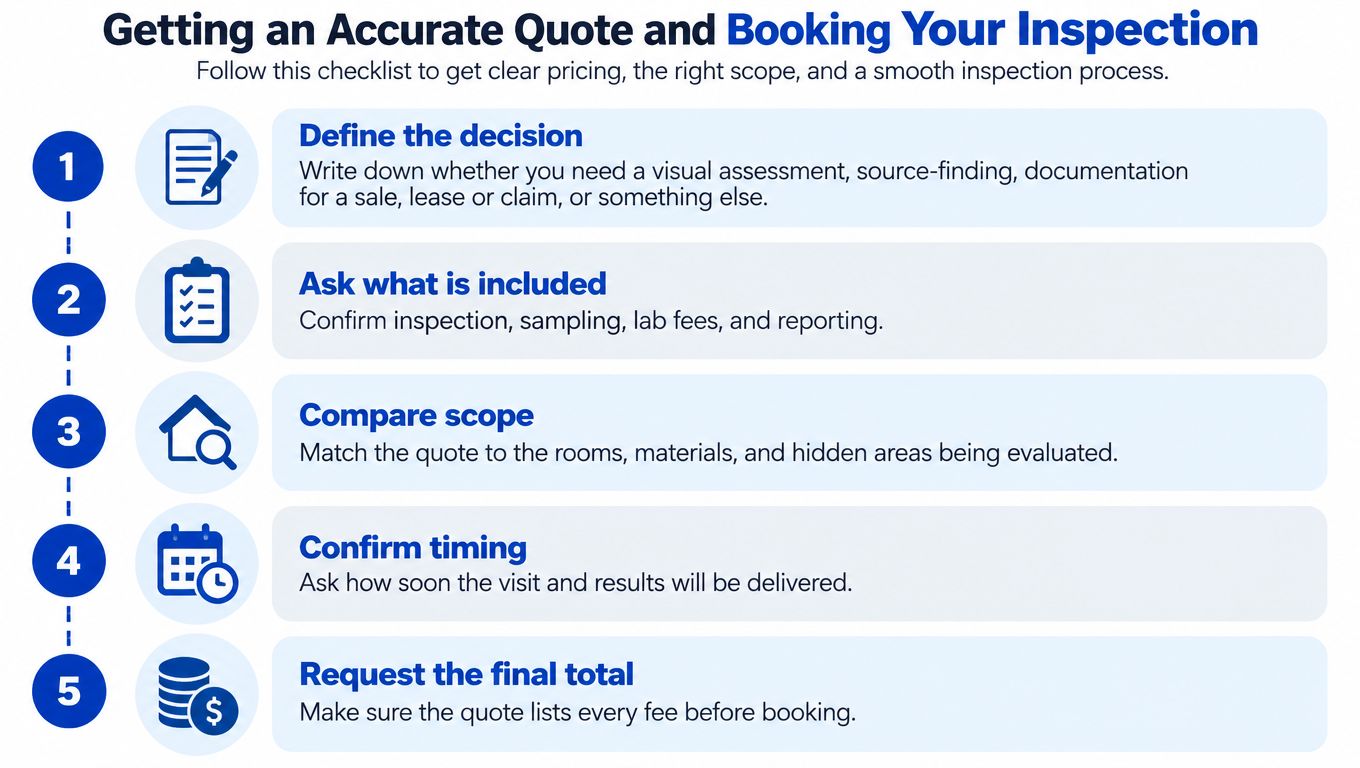
Eight Steps Before You Sign
- Define the decision: State whether you need a visual assessment, help locating a moisture source, documentation for a sale, lease, or claim, or clearance after cleanup. This determines what the inspection needs to cover.
- Record what you know: Note visible growth, odor, leaks or past water damage, property type, approximate size, access limits, and previous testing. These details help the inspector set an appropriate scope.
- Request separate line items: Ask for the inspection, moisture mapping, each laboratory sample by type and count, outdoor reference samples, rush processing, destructive investigation, travel, and clearance to be priced separately.
- Ask about the laboratory: Confirm the sampling method, whether the laboratory is accredited, and the turnaround time included in the quote.
- Confirm report contents: Ask whether the report will include the sampling plan, sample locations, indoor and outdoor results, visible conditions, moisture findings, and a written interpretation. Raw laboratory results alone may not answer your question.
- Ask about independence: Find out whether the testing firm also performs cleanup. That relationship may affect how the scope is set and how others view the documentation.
- Compare deliverables: Match each quote line by line. A report with two samples is not equivalent to multi-area sampling and a stated clearance plan.
- Price exclusions before signing: Ask what inaccessible areas, additional samples, return visits, and clearance will cost. A low initial total can leave important follow-up work unpriced.
For a mold problem, Sensitive Environmental can work with a customer on a budget to create a scope of work together, provided the mold's location is known at the start. The company also offers a free, no obligation consultation for environmental testing or an existing asbestos, lead, or mold problem.
Once the scope is clear, call 310-387-5404 or request an appointment online to schedule an environmental testing inspection. Have your property details and questions about the quote ready. Before sampling begins, confirm the scope, sample count, laboratory method, turnaround time, and report contents. This makes it easier to compare the approved cost with the work included.
For mold inspection and testing in Los Angeles or Southern California, Sensitive Environmental provides testing and reporting for residential and commercial properties. Visit Sensitive Environmental to request a free consultation and confirm an itemized scope for your home or commercial property.