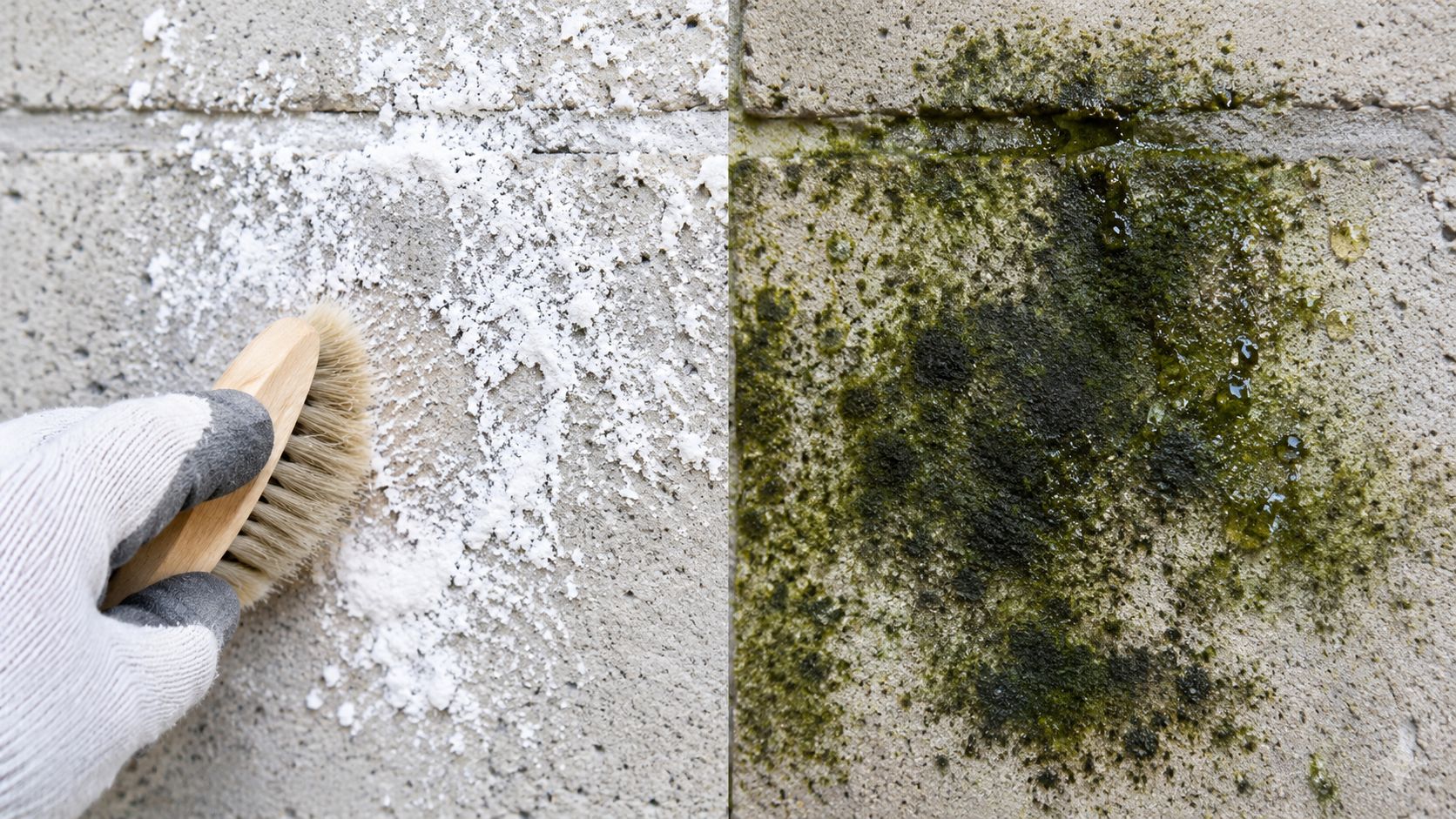
A white, powdery substance on masonry is more consistent with efflorescence than mold, but reliable confirmation requires a professional moisture assessment and, when warranted, laboratory analysis. Room humidity below 60% doesn't settle the question because moisture can remain inside the wall.
You might be staring at a chalky patch along your garage floor, wondering whether to ignore it or schedule mold testing. Don't make that decision from color alone. The useful questions are where the water came from, which materials it reached, and whether the visible deposit represents the whole problem.
Table of Contents
- Why This Question Comes Up So Often in Southern California
- What Efflorescence and Mold Actually Are
- Side-by-Side Comparison of Visual and Structural Cues
- Why the Same Leak Can Produce Both Conditions
- How Professionals Verify What the Surface Is Showing
- Real Situations That Change the Right Next Step
- Why Professional Environmental Testing Is the Smart Move
- Your Next Step With Sensitive Environmental
Why This Question Comes Up So Often in Southern California
Consider a homeowner in Los Angeles who notices white residue on a garage stem wall after rain. Outside, the stucco looks stained near the same corner. Inside, storage boxes sit against the wall, and nobody knows whether the residue appeared recently or has been there for years.
That's a representative inspection question, not a documented case study. A property manager might encounter the same uncertainty during a rental walkthrough, while a contractor might discover it before opening a water-damaged wall.
The confusion is understandable. Both conditions involve moisture, and a white deposit doesn't identify its composition. In a building with concrete, brick, stucco, and adjoining drywall, the surface that's easiest to see may not be the material that needs the closest investigation.
The decision starts with the water history
Before deciding whether you're looking at efflorescence or mold, gather the information an inspector will need:
- Timing: Did the deposit appear after rain, irrigation, a plumbing failure, or a roof leak?
- Recurrence: Has it returned after someone previously wiped or brushed it away?
- Nearby materials: Are baseboards, drywall, framing, or stored belongings also stained or damp?
- Odor: Is there a persistent musty smell, especially when the room has been closed?
These questions separate a surface-identification problem from a broader water-damage assessment. They also prevent opposite mistakes: commissioning mold-related work for a mineral deposit, or dismissing concealed moisture because the visible residue looks ordinary.
Practical rule: Don't authorize a scope of work based solely on a photograph of a white patch.
For Los Angeles County homeowners, HOAs, and facility managers, the responsible starting point is an inspection proportionate to the evidence. A dry, unchanged deposit calls for different investigation than a recurring patch beside wet drywall.
What Efflorescence and Mold Actually Are
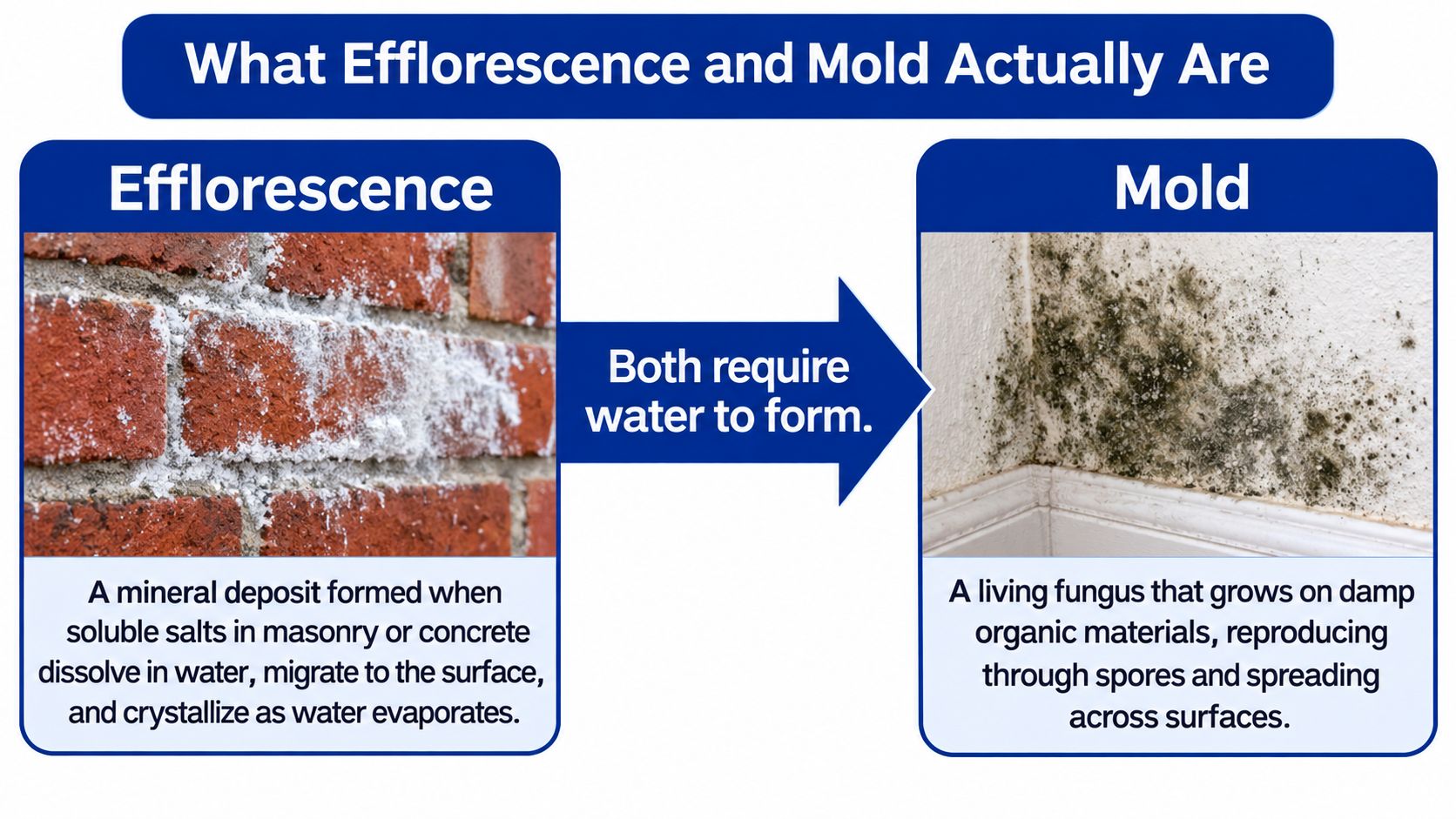
Efflorescence is an inorganic mineral deposit. Water dissolves soluble salts within or around porous masonry, carries the solution toward an exposed surface, and leaves crystals behind as it evaporates. It isn't a fungus, and it doesn't reproduce.
The Concrete Masonry & Hardscapes Association's efflorescence guidance describes the necessary combination of soluble salts, transporting moisture, and a pathway that brings the solution to the surface. Commonly associated salts involve sodium, potassium, and calcium. Uniform light deposits can reflect ordinary moisture loss, while concentrated streaks or recurring deposits warrant investigation of localized water entry.
Mold is biological growth. It requires moisture and a usable carbon source from building materials. Unlike a mineral residue, fungal growth indicates that conditions have supported a biological process rather than the movement and evaporation of water.
What the distinction means for an assessment
An environmental testing report should distinguish the identity of the deposit from the condition of the building material. Confirming mineral salts answers what was sampled. It doesn't establish that adjoining drywall, insulation, or framing is unaffected.
Likewise, identifying fungal material on a surface doesn't automatically determine the extent of damage or prescribe a particular response. The inspector still needs to evaluate the location, moisture history, affected materials, and limits of access.
- A mineral finding supports an explanation involving salt transport and evaporation.
- A fungal finding supports an explanation involving microbial growth on the sampled material.
- A mixed or uncertain condition calls for a sampling plan that addresses separate materials rather than treating the whole wall as one uniform surface.
The terminology matters because owners often receive reports containing observations, moisture readings, and laboratory findings together. Those are different kinds of evidence. A careful consultant explains which conclusion each supports and what remains unverified.
Side-by-Side Comparison of Visual and Structural Cues
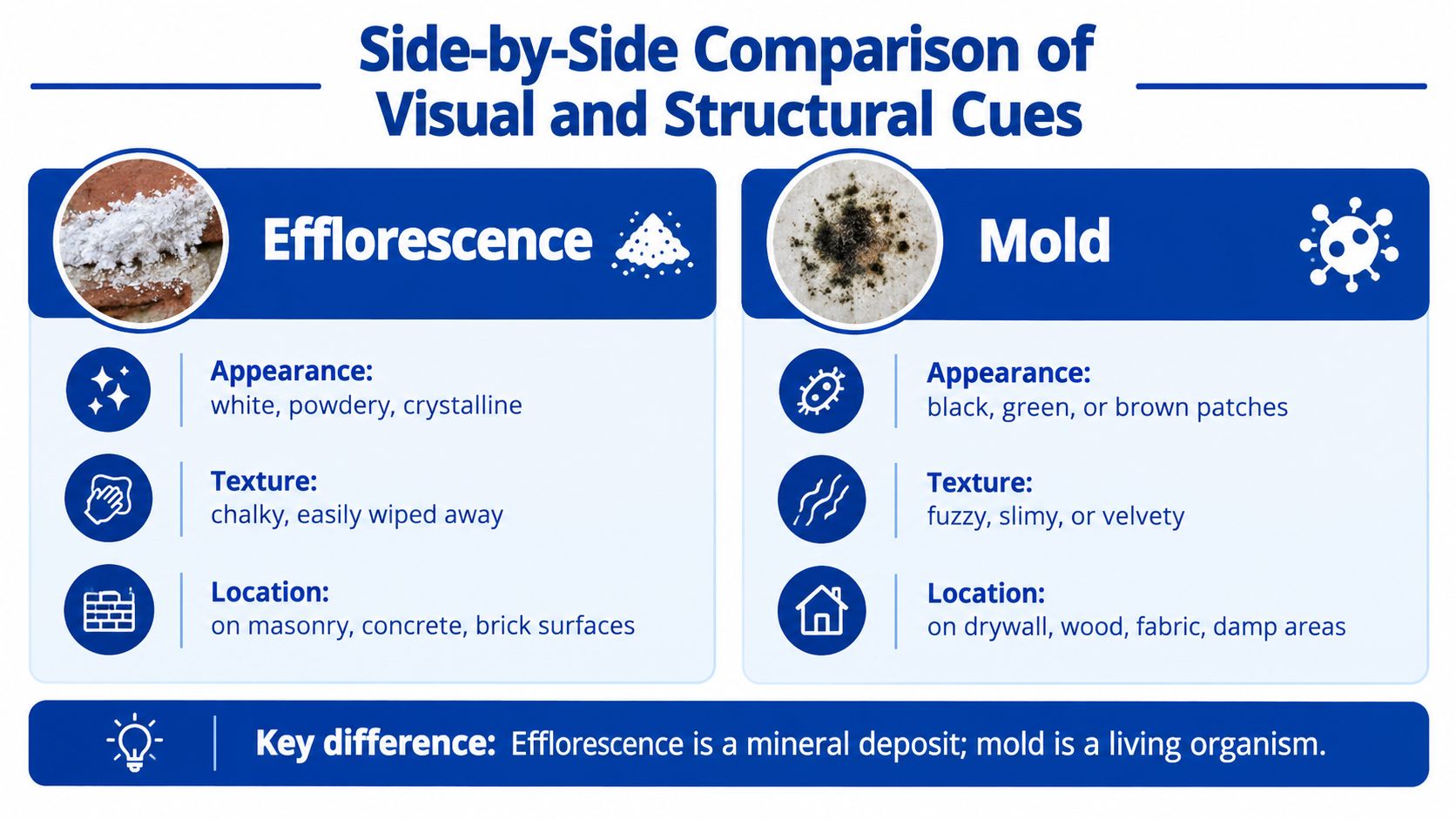
Use appearance to develop a working explanation, not a final diagnosis. White, crystalline residue on exposed concrete points toward efflorescence. A patch on damp drywall deserves a different assessment, even if it's also white.
Efflorescence Compared With Mold at a Glance
| Feature | Efflorescence | Mold |
|---|---|---|
| Composition | Inorganic, water-soluble mineral salts | Biological fungal growth |
| Typical appearance | White, powdery, or crystalline deposit | Varied colors and textures |
| Most useful location clue | Exposed masonry, mortar, brick, or concrete | Damp materials with an available carbon source |
| Moisture relationship | Records water transporting salts to the surface | Indicates conditions that supported growth |
| Odor interpretation | A mineral finding doesn't explain a musty room | Mold odor warrants moisture investigation |
| Health interpretation | Doesn't establish fungal exposure | Requires context, not a color-based risk judgment |
| Building-condition question | Where did the transporting water enter? | Which materials became wet, and how far does growth extend? |
Read the pattern, not just the color
The location of the residue often provides more useful evidence than its shade. Look along mortar joints, cracks, wall-floor connections, and transitions between masonry and finished materials. Concentrated white streaks below mortar joints can help an inspector prioritize possible moisture pathways.
Document the pattern before disturbing it. Take a wide photograph showing the wall and nearby features, followed by closer photographs of the deposit. Include adjacent baseboards, painted surfaces, and any staining rather than photographing only the whitest spot.
Texture is supporting evidence
A dry, chalky residue that releases readily is consistent with mineral deposition. Fuzzy, slimy, or adherent material should raise a different question. Neither behavior is laboratory confirmation, and unknown deposits shouldn't be aggressively brushed, scraped, or handled to prove a theory.
Water-soluble salts may dissolve when wetted, but adding water to a wall isn't a substitute for testing. A water-droplet observation can't establish whether fungal growth exists nearby or behind the surface. Bleach reactions are also not a defensible identification method.
For examples of staining and affected materials, the explanation of what water-damage mold can look like provides useful context. Compare the material and water history, not just the photograph.
A mineral deposit on concrete and a suspicious patch on adjoining drywall are separate inspection targets, even when they share the same wall.
Structural conclusions require similar restraint. Surface residue alone doesn't establish the condition of a foundation or wall assembly. If you see cracking, material loss, or deterioration, document those observations and have the appropriate building professional evaluate them alongside the environmental findings.
Why the Same Leak Can Produce Both Conditions
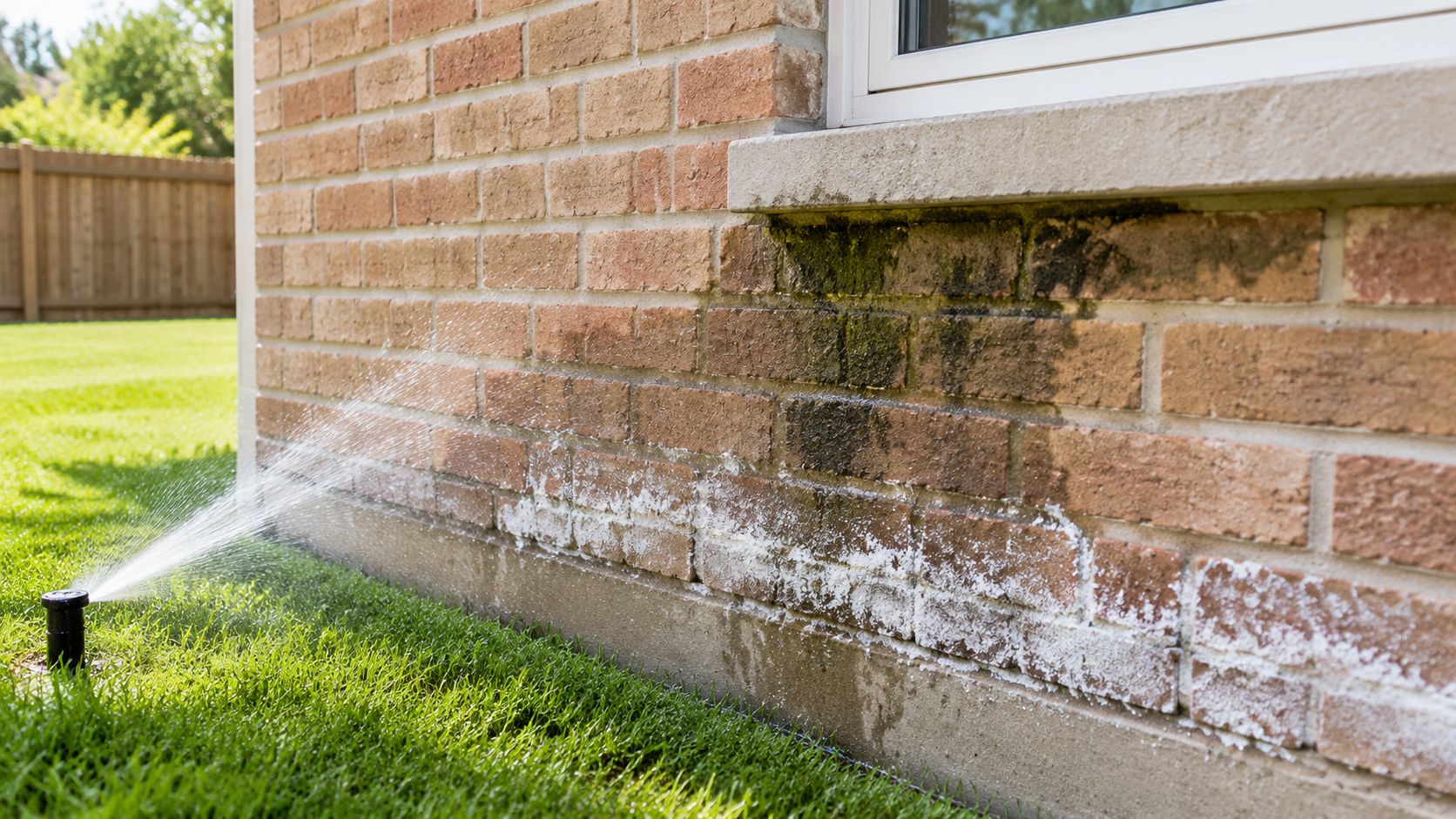
Suppose irrigation repeatedly wets an exterior wall. Water may travel through a masonry pathway and leave salts on an exposed face while also reaching adjoining materials inside the assembly. In that situation, identifying the visible powder doesn't answer whether concealed materials remained wet.
A plumbing leak behind a garage wall creates a similar assessment problem. The concrete surface may show a mineral deposit, while the backside of drywall, nearby framing, or insulation requires a separate investigation. These are representative moisture pathways, not claims about a particular property.
Why concealed dampness deserves attention
The World Health Organization's dampness and mould guidance announcement reported that occupants of damp or moldy buildings may face up to a 75% greater risk of respiratory symptoms and asthma compared with occupants of dry buildings. That finding concerns building conditions across populations, not a diagnosis for someone who finds a white patch.
Research on building dampness scores and measured microbial conditions found higher microbial measurements and maximum material moisture in buildings with higher dampness or mold scores. The practical recommendation is to investigate wet materials and mold odor rather than stopping at the most visible surface.
Ask the inspector to connect observations across the assembly:
- Entry point: Where could rain, plumbing water, or irrigation enter?
- Travel path: Which joints, cavities, or material transitions could carry that water?
- Receiving materials: What lies behind or beside the visible masonry?
- Verification limits: Which areas can be evaluated without opening the assembly?
A focused guide to checking for mold after water damage can help owners organize the event history before an inspection.
If a separate restoration contractor is involved, the Purified Air Duct Cleaning restoration guide is a related resource to review when discussing the broader project. Keep environmental assessment distinct from restoration planning: the testing scope should establish what needs verification, and qualified project professionals can use those findings to determine their next steps.
How Professionals Verify What the Surface Is Showing
Professional verification should begin with a question the proposed method can answer. “What is this deposit?” is different from “Is the wall still wet?” or “Did the leak affect adjoining occupied space?” Ordering samples without defining the question produces results that may be technically valid but practically unhelpful.
Start with non-destructive documentation. A flashlight inspection along mortar joints and baseboards, photographs, and a record of previous leaks give the consultant useful context. A small wipe or water-droplet observation may offer a clue where appropriate, but don't disturb uncertain material or add moisture merely to force an answer.
Match the tool to the question
- Moisture meters: Assess selected materials and compare locations. Readings need interpretation in the context of the material; they don't independently prove the leak source.
- Hygrometers and humidity logging: Record room-air conditions over time. They don't establish that a wall cavity is dry.
- Surface swabs or tape lifts: Collect material from a defined location for laboratory examination. Their findings apply to the sampled surface, not every adjoining cavity.
- Air sampling: Addresses an airborne assessment question. It shouldn't replace inspection of a suspicious wall.
- Deposit analysis: Chemical analysis, ion chromatography, petrographic examination, or X-ray diffraction may be considered when identifying mineral composition would change the decision.
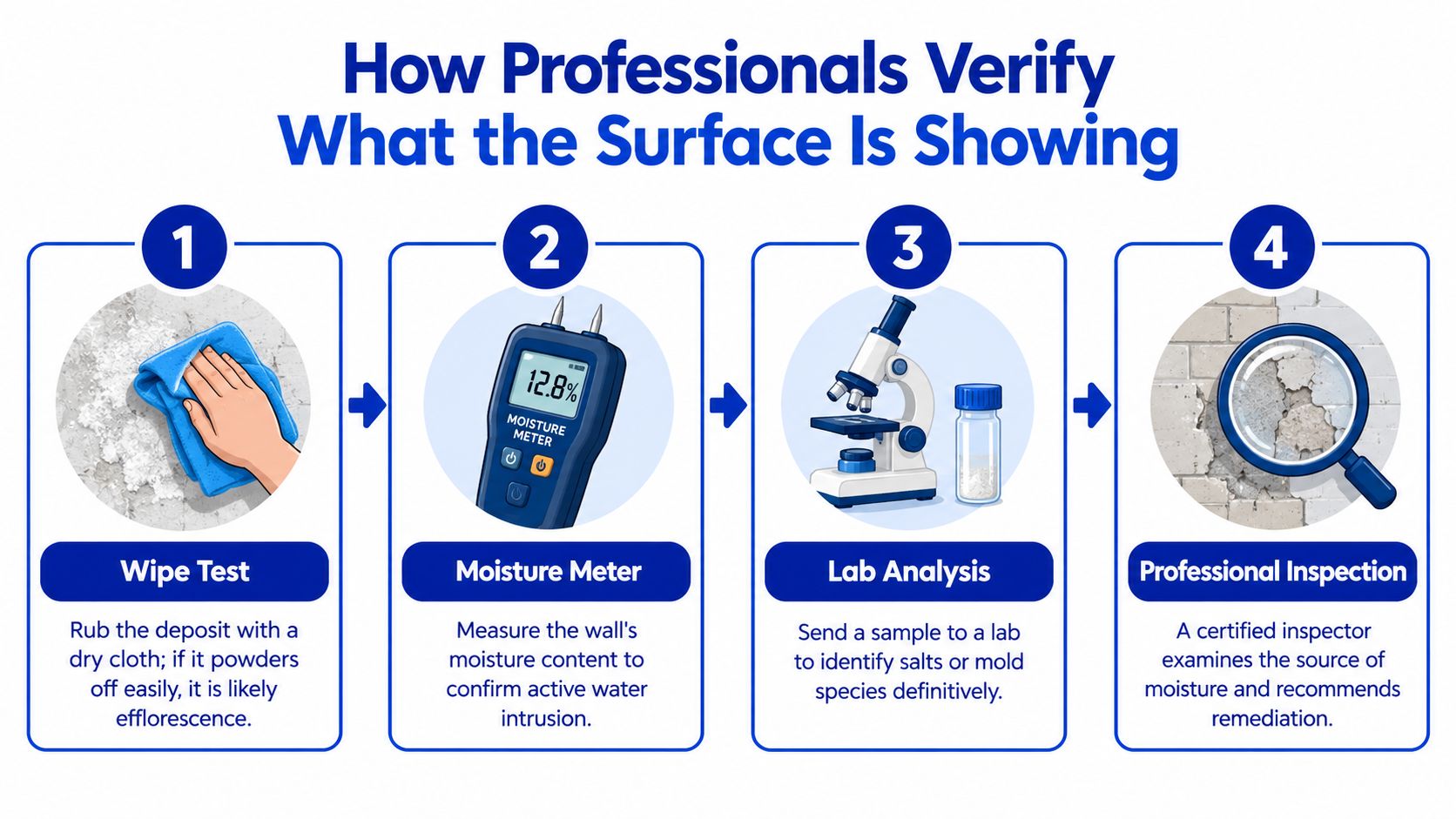
The workflow isn't rigid. Professional inspection comes before choosing laboratory methods, not merely after receiving a result. A moisture reading doesn't automatically confirm active intrusion, and a laboratory finding doesn't automatically require remediation.
Interpret air conditions and material conditions separately
EPA moisture-control guidance recommends indoor relative humidity below 60%, ideally between 30% and 50%, while CDC/NIOSH guidance recommends drying wet materials within 24–48 hours because excess moisture is generally the major cause of indoor mold growth. Those recommendations support prompt moisture attention; they aren't a timetable that diagnoses growth.
Direct microscopy, targeted identification, or molecular methods such as polymerase chain reaction may be discussed when appropriate to the assessment question. Don't assume every project needs species identification or every available laboratory technique.
The explanation of professional mold inspection for Los Angeles homes and businesses can help you evaluate a proposed scope. Ask for sample locations, method selection, access limitations, and an explanation of what each result can and cannot establish.
Real Situations That Change the Right Next Step
The right service depends on the event and the decision you need to make. A homeowner deciding whether to investigate a garage wall needs a different scope from a contractor preparing to disturb water-damaged finishes.
Recurring residue and post-leak odor
White residue returns on a garage stem wall after rain. Mineral deposition is a reasonable working explanation. Prioritize a moisture assessment of the wall and adjoining materials; request deposit analysis if its identity remains uncertain or would change project planning.
A musty smell follows a plumbing leak. Don't limit the inspection to visible powder. The more useful scope evaluates affected porous materials, possible concealed moisture, and whether targeted surface or air sampling would resolve an unanswered question.
A room humidity reading shouldn't close either investigation. Ask where readings were taken and which materials remain inaccessible.
Rental documentation and planned construction
For water staining discovered before lease turnover, request a written assessment that distinguishes observations from laboratory findings. That gives the owner and property manager a clearer basis for tenant communication and contractor coordination than an undocumented verbal opinion.
- Pre-renovation asbestos assessment: South Coast AQMD Rule 1403 requires a thorough asbestos survey of affected facility materials before renovation or demolition. Moisture-related openings can involve hidden materials, so plan the survey before disturbance.
- Lead-painted surfaces: The EPA Renovation, Repair and Painting requirements apply to covered paid work disturbing painted surfaces in homes and child-occupied facilities built before 1978. A mold assessment doesn't replace the required lead determination.
A sale alone isn't the same regulatory trigger as renovation. For real estate due diligence, define the environmental questions and documentation needs rather than ordering construction-compliance testing indiscriminately.
Post-flood assessments should follow the water's reach through the property. After fire or wildfire exposure, white or dark residue may require a separate combustion-byproduct assessment, potentially including ash, soot, char, smoke residue, or heavy-metal testing. Neither circumstance should be reduced to an efflorescence-or-mold photo comparison.
Why Professional Environmental Testing Is the Smart Move
Professional testing is worthwhile when it resolves uncertainty that affects a property decision. Recurring deposits, unexplained odor, wet materials, sensitive occupants, and planned construction justify more than a quick visual opinion.
DIY observations can help document the problem, but they don't establish concealed conditions. A consumer sampling kit also doesn't automatically provide a defensible assessment. The owner still needs a relevant sampling location, an appropriate collection method, laboratory interpretation, and a record connecting the result to the property.
An air count isn't a health verdict
Health-based indoor mold standards don't exist, and CDC/NIOSH cautions against interpreting short-term air-sample counts as health thresholds. The material-moisture research relevant to fungal-growth assessment also underscores why ambient air conditions alone don't settle material-related risk.
That's why a consultant should explain why air sampling is proposed and how it fits the inspection findings. A high result doesn't automatically prescribe a response, and an unremarkable result doesn't exclude concealed wet materials.
Ask before approving samples: What decision will this result help us make that the inspection alone cannot?
Documentation is part of the service
A useful environmental report should give homeowners, insurers, facilities teams, and contractors a traceable explanation of the assessment:
- Scope and access: What was inspected, and what couldn't be reached?
- Sampling record: Where were samples collected, and which methods were used?
- Findings and limitations: What did the laboratory identify, and how narrowly should that result be interpreted?
- Next-step rationale: What additional investigation or professional consultation is supported?
If room-air moisture management is also being considered, the Home Dehumidifier Reviews whole house guide is a related equipment resource to review separately. Choosing a dehumidifier isn't verification that the building assembly has dried.
The value of professional assessment is a reasoned, documented answer. It isn't a guarantee of health, a blanket declaration that a property is safe, or an automatic recommendation for removal.
Your Next Step With Sensitive Environmental
Choose the assessment around the uncertainty you have. If the question is the deposit's identity, discuss targeted surface sampling or mineral analysis. If the question is an unresolved leak, prioritize moisture investigation and the condition of adjoining materials.
Before calling, assemble photographs, the location of the residue, a description of odor or staining, and any plumbing, roofing, or water-damage records. Explain whether you're planning a sale, lease turnover, renovation, or insurance-related evaluation. Those details help the consultant propose a relevant scope instead of a generic sampling package.
Ask for a defined deliverable
Your proposal should explain the inspection area, proposed sampling, laboratory work, and reporting. For residential, commercial, and institutional properties across Los Angeles County and Southern California, the scope should also account for occupancy, access, and upcoming work.
- For an isolated deposit: Ask what would justify sampling rather than observation alone.
- For recurring moisture: Request an assessment of the pathway and affected materials.
- For construction planning: Identify separate asbestos or lead-testing needs before disturbance.
Keep the conclusion proportionate to the evidence. A confirmed mineral deposit answers an identification question; fungal findings require interpretation within the assessment. Neither result should be turned into a broader claim than the inspection and samples support.
You don't need to diagnose the wall before seeking help. You need to explain what changed, what you've observed, and which decision you're trying to make.
Sensitive Environmental offers mold inspections, moisture assessments, appropriate sampling, laboratory analysis, and indoor air quality testing for properties in Los Angeles and Southern California. If you're unsure whether a recurring deposit is efflorescence or mold, visit Sensitive Environmental to discuss a targeted mold inspection or water-damage environmental assessment.