You're a Los Angeles property owner, manager, or contractor with a musty room, a history of leaks, or a laboratory report that says “no mold detected.” The natural question is simple: is the building safe, or should you order another test?
Environmental testing for mold rarely answers that question with one number. A useful investigation connects the building's history, visible conditions, moisture readings, air movement, affected materials, sampling plan, and laboratory results. That approach helps homeowners, schools, offices, landlords, and commercial property teams make defensible decisions without treating a short air sample as a medical verdict.
Table of Contents
- When Mold Testing Becomes the Right Next Step
- Why Moisture Drives Every Mold Investigation
- Types of Mold Sampling and What Each One Answers
- What a Negative Mold Sample Does Not Tell You
- How Professional Mold Inspections Pair Sampling with Moisture Data
- Common Situations That Justify Mold Testing in Los Angeles
- Reading a Mold Lab Report Without Misreading It
- Turning Mold Testing Results into the Right Next Steps
When Mold Testing Becomes the Right Next Step
A property manager in Beverly Hills may notice a musty odor after a tenant moves out. A homeowner in Pasadena may find a swollen kitchen baseboard beneath a slow leak. A facilities director in Mid-Wilshire may be dealing with stained ceiling tiles after a roof leak. Each situation raises a different testing question.
The first question isn't always, “Which mold test should I buy?” It's, “What decision must this investigation support?”
Situations that deserve closer evaluation
Testing or a professional inspection may be appropriate when:
- Visible growth keeps returning: Repeated discoloration suggests that the moisture source may still be active or that concealed materials remain damp.
- An odor exists without visible growth: Musty odors can justify an inspection for hidden growth behind drywall, beneath flooring, inside cabinets, or near HVAC components.
- Water damage affected porous materials: Plumbing failures, roof leaks, condensation, and flooding can leave moisture in assemblies that appear dry at the surface.
- A renovation or property transaction is approaching: A baseline inspection can document conditions before walls, flooring, ceilings, or mechanical systems are disturbed.
- Occupants report recurring concerns: Complaints about odors or respiratory symptoms don't prove that mold caused illness, but they can help define an environmental investigation.
- Documentation matters: Insurance claims, tenant disputes, legal proceedings, and post-work verification may require written inspection findings and laboratory records.
Visible mold often provides enough information to prioritize a building investigation without collecting an air sample. The EPA's mold and moisture guidance explains that sampling is generally not necessary when visible mold is already present, because correcting moisture and addressing affected materials are more useful decisions than identifying a species alone.
If you're researching the physical condition of affected drywall, a general resource on how to remove black mold from drywall can help explain why porous materials require careful evaluation. It doesn't replace a site-specific environmental assessment.
Practical rule: Order testing to answer a defined property question, not simply to obtain a reassuring piece of paper.
The scope may involve a visual inspection only, moisture mapping, targeted surface sampling, air sampling, bulk material analysis, or a broader indoor air quality assessment. A professional environmental testing company should explain what each option can establish and what it cannot.
Why Moisture Drives Every Mold Investigation
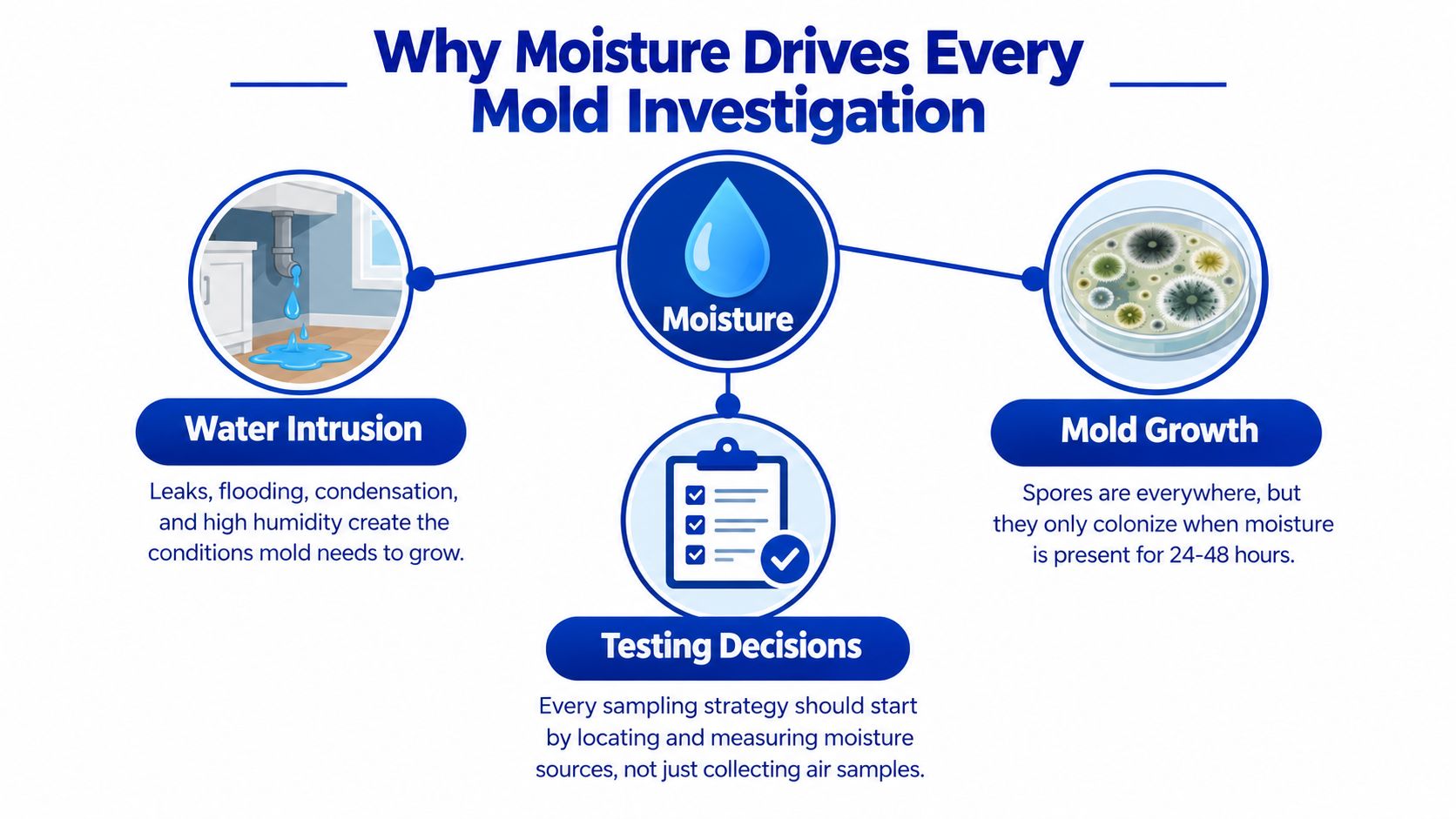
Mold spores are common in indoor and outdoor environments. Persistent moisture is what allows fungal growth to become an indoor building problem. Water intrusion, condensation, high humidity, plumbing leaks, roof failures, and wet building materials can create conditions where growth develops or remains concealed.
The World Health Organization's guidance on dampness and mould established a foundational principle for environmental assessment: investigations should examine moisture, ventilation, water intrusion, condensation, and building materials rather than rely on an air sample alone. WHO also identified visible mold, mold odors, condensation, and a history of leaks or water damage as practical indicators of dampness and microbial growth.
Why Southern California buildings still develop moisture problems
Los Angeles buildings can experience localized dampness even in a dry climate. A cooling coil may produce condensation. A single-pane window may collect moisture when indoor and outdoor temperatures differ. An unvented bathroom can raise humidity near ceilings and wall corners. A slow supply-line leak can wet a cabinet or wall cavity without producing an obvious puddle.
EPA recommends keeping indoor relative humidity below 60%, ideally between 30% and 50%, because higher humidity supports moisture accumulation and microbial growth. Those values come from EPA guidance on mold and moisture, but a humidity reading alone can't rule out a wet wall cavity, floor assembly, insulation, or HVAC component.
For a practical overview of how outdoor moisture and building surfaces can interact, the Water Works Power Washing mold guide offers useful background. Inside a property, however, investigators need to connect conditions to the building envelope, plumbing, ventilation, and affected materials.
After a leak, owners can also review these urgent steps after water damage in a Los Angeles home while arranging an appropriate inspection. The environmental question remains source-focused: where did moisture enter, where did it travel, and which materials or air pathways could be involved?
Types of Mold Sampling and What Each One Answers
Professional sampling works best when each sample answers a specific question. The three common categories are air sampling, surface sampling, and bulk sampling. They don't provide interchangeable information.
| Sampling Type | What It Best Reveals | Typical Use Case |
|---|---|---|
| Air sampling | Airborne fungal structures during the sampling period | Comparing selected indoor areas with outdoor air or evaluating a defined air-quality question |
| Surface sampling | Mold present on a particular surface | Investigating a discoloration or documenting conditions on a specific material |
| Bulk sampling | Mold or fungal material within a physical building-material piece | Characterizing damaged, hidden, or suspect material |
Air samples
A spore-trap cassette draws a known volume of air across a collection surface. A laboratory can examine the collected material microscopically and report categories or genera observed. This is generally a non-viable analysis, meaning the laboratory evaluates structures whether or not they can grow in culture.
Culture-based analysis uses a growth medium and reports organisms that develop under the laboratory's conditions. Because different organisms grow differently, culture results don't represent every airborne particle present. Outdoor comparison samples can add context, especially when investigators are evaluating whether indoor findings differ from the surrounding environment.
Short-term air sampling can support an investigation, but it doesn't measure every exposure pathway or establish a health threshold.
Surface samples
Tape lifts and swabs collect material from a defined surface. They can help determine whether a suspicious discoloration contains mold, characterize material from a particular location, or support post-work documentation.
A surface result applies to the sampled area. It doesn't establish conditions inside a wall, beneath flooring, or throughout an entire building.
Bulk samples
A bulk sample is a physical piece of material sent to a laboratory. Investigators may use this approach when drywall, insulation, carpet, ceiling material, or another building component is damaged or suspected of containing concealed growth.
Bulk sampling can identify what is present in the material collected, but the result still depends on sample location and representativeness. Cutting into a building assembly should be coordinated carefully, particularly when renovation, asbestos, lead-based paint, or other hazards may also be involved.
Homeowners comparing professional work with consumer kits can review whether home mold test kits are reliable. The central issue isn't whether a kit can collect a sample. It's whether the sampling plan addresses the actual source and decision.
What a Negative Mold Sample Does Not Tell You
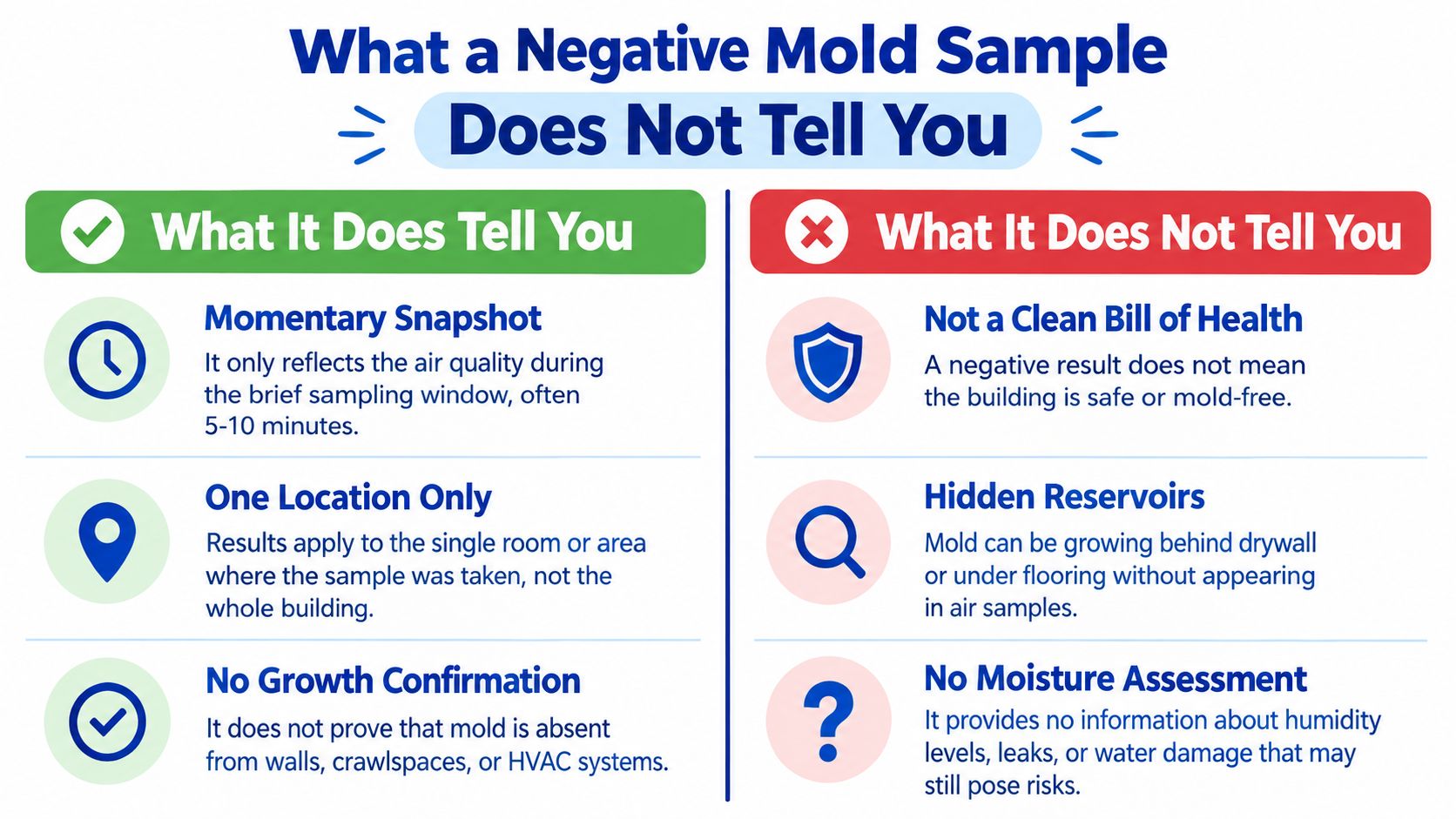
A negative mold sample can be accurate and still fail to answer the property owner's real concern.
A short-term air sample captures conditions during a limited sampling window, in one location, under the building conditions present at that moment. Air movement, occupant activity, HVAC operation, settled dust, weather, and the timing of a moisture event can all influence what reaches the collection device.
A result is not a building-wide verdict
CDC and NIOSH state that there are no health-based standards for indoor mold or other biological agents that allow investigators to classify a single indoor concentration as universally safe or unsafe. Their guidance on mold testing and remediation also explains that brief air samples and spore counts don't capture the full range of exposure, and that even a negative result may not represent actual exposure.
The same limitation applies to other sample types:
- A negative air result: Mold may remain concealed in a wall, crawlspace, flooring assembly, or HVAC component.
- A negative surface result: Mold wasn't detected on the particular area sampled. It says nothing about an adjacent surface that wasn't sampled.
- A negative bulk result: The collected piece didn't contain detected mold. Another section of the material may differ.
Ask whether the sample addressed the suspected source
EPA recommends developing a confirmable theory about sources and routes of exposure before sampling. If a tenant reports an intermittent odor near a return grille, a sample from the center of an unrelated room may provide little decision value. If a leak affected a wall cavity, an air sample in the living room may not evaluate the damp assembly.
A negative laboratory finding can describe the sample correctly while leaving the building question unanswered.
The better response to a negative result is not automatic panic or automatic reassurance. Review the inspection notes, sample locations, moisture readings, HVAC conditions, outdoor comparison, building history, and the reason sampling was selected.
How Professional Mold Inspections Pair Sampling with Moisture Data
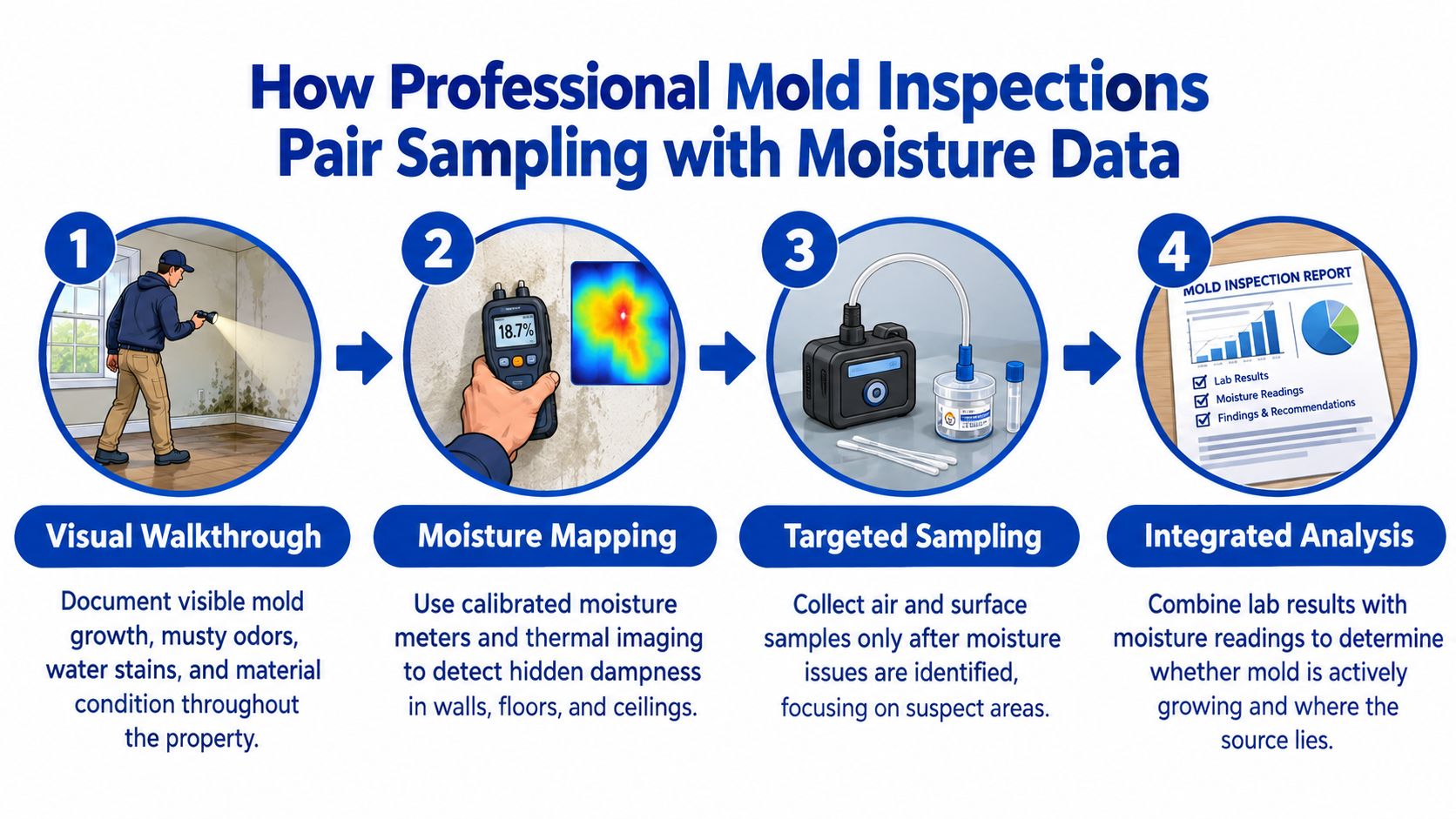
A defensible mold inspection starts with the property, not the laboratory form. The investigator walks through accessible areas, documents visible growth and staining, records odors, reviews water history, and examines the condition of walls, ceilings, floors, windows, plumbing penetrations, furnishings, and ventilation components.
The inspection sequence
A typical investigation may combine:
- Visual walkthrough: The inspector records water staining, damaged finishes, visible growth, musty odors, and areas where building materials appear altered.
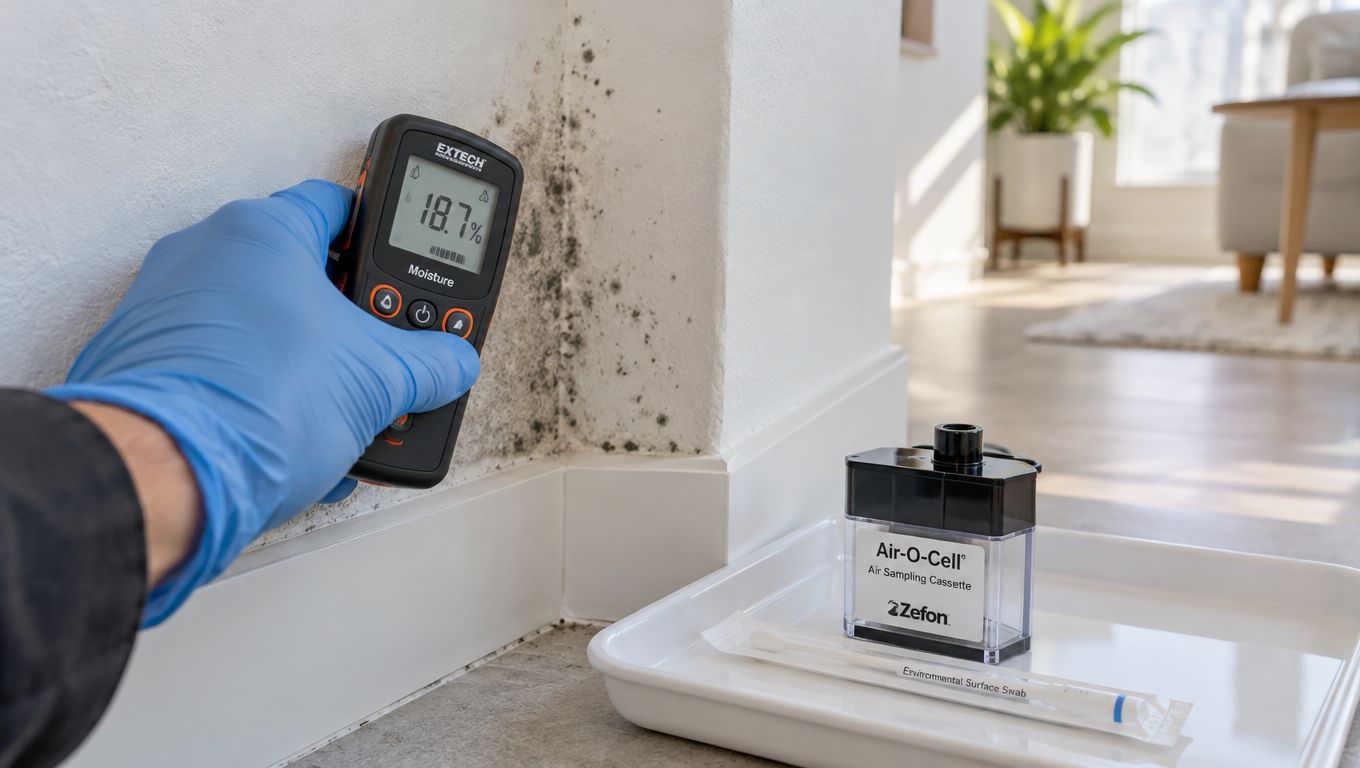
- Moisture mapping: Calibrated moisture meters help identify abnormal readings in walls, floors, ceilings, and other accessible materials. Thermal imaging may help identify temperature patterns associated with concealed moisture, but it doesn't replace physical verification.
- HVAC and ventilation review: Supply and return locations, condensate components, filters, insulation, duct surfaces, bathroom exhaust, and outdoor-air pathways can influence odor and particle movement.
- Targeted sampling: Air, surface, or bulk samples are collected only when they address a defined question, such as suspected hidden growth, a questionable surface, or post-work documentation.
- Integrated reporting: Laboratory findings are interpreted alongside building observations, moisture conditions, sample locations, and project objectives.
NIOSH's Dampness and Mold Assessment Tool illustrates a systematic way to assess rooms and components, including ceilings, walls, floors, windows, furnishings, ventilation systems, pipes, and stored materials. The tool records mold odor, water damage or staining, visible mold, and wet or damp materials. A score of 3 for damage or stains, visible mold, wetness, or mold odor triggers immediate attention under its prioritization approach.
A professional mold inspection in Los Angeles should produce more than a species list. It should help the owner understand where moisture may be present, what was examined, why samples were selected, and which limitations apply.
Common Situations That Justify Mold Testing in Los Angeles
The right scope depends on the decision behind the request. A homeowner investigating a wet baseboard doesn't need the same project as a developer preparing a commercial building for demolition.
Water damage and building complaints
After a plumbing leak, roof failure, HVAC condensate problem, or flood, an inspection can identify damp materials and areas requiring closer evaluation. Surface or bulk sampling may help characterize a questionable material, while air sampling may be considered when the source is unclear or when a defined comparison is needed.
Persistent odor without visible growth is a different problem. The investigator may focus on concealed cavities, cabinetry, flooring, return-air pathways, and areas where moisture comes and goes.
Transactions, insurance, and documentation
During a real estate transaction, buyers or sellers may want a documented baseline for a known odor, prior leak, or visible concern. The useful deliverable may be an inspection report with photographs and moisture findings, with sampling added only when it clarifies an unresolved question.
Insurance and restoration professionals may need records before or after work. A pre-work assessment can document affected areas. A post-work inspection can evaluate visible conditions, moisture status, material cleanliness, and targeted samples where the project criteria call for them. EPA notes that post-work indoor conditions should be comparable to local outdoor air when sampling is used, not necessarily completely free of mold.
Renovation, commercial properties, and fire events
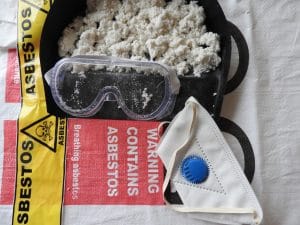
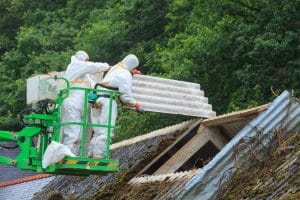
Renovation and demolition projects may disturb concealed building materials. Mold testing can be one part of environmental due diligence, but Los Angeles-area projects may also require asbestos and lead evaluations. Under SCAQMD Rule 1403, an asbestos survey must be completed and documented before demolition and before renovation work, subject to a narrow exemption for certain single-unit residential work involving less than 100 square feet of asbestos-containing material.
After a fire or wildfire, soot, ash, char, smoke residue, and water used during fire response can create several investigation questions. Mold testing may address moisture-related fungal concerns, while combustion byproduct testing can evaluate fire residues and heavy metals. A commercial environmental testing scope should separate these questions instead of treating one sample as a complete post-fire assessment.
Schools, healthcare facilities, offices, and multi-unit housing may also need industrial hygiene or indoor air quality testing when complaints persist. The sampling plan should identify whether the concern involves mold, ventilation, VOCs, particles, combustion products, HVAC conditions, or another contaminant.
Reading a Mold Lab Report Without Misreading It
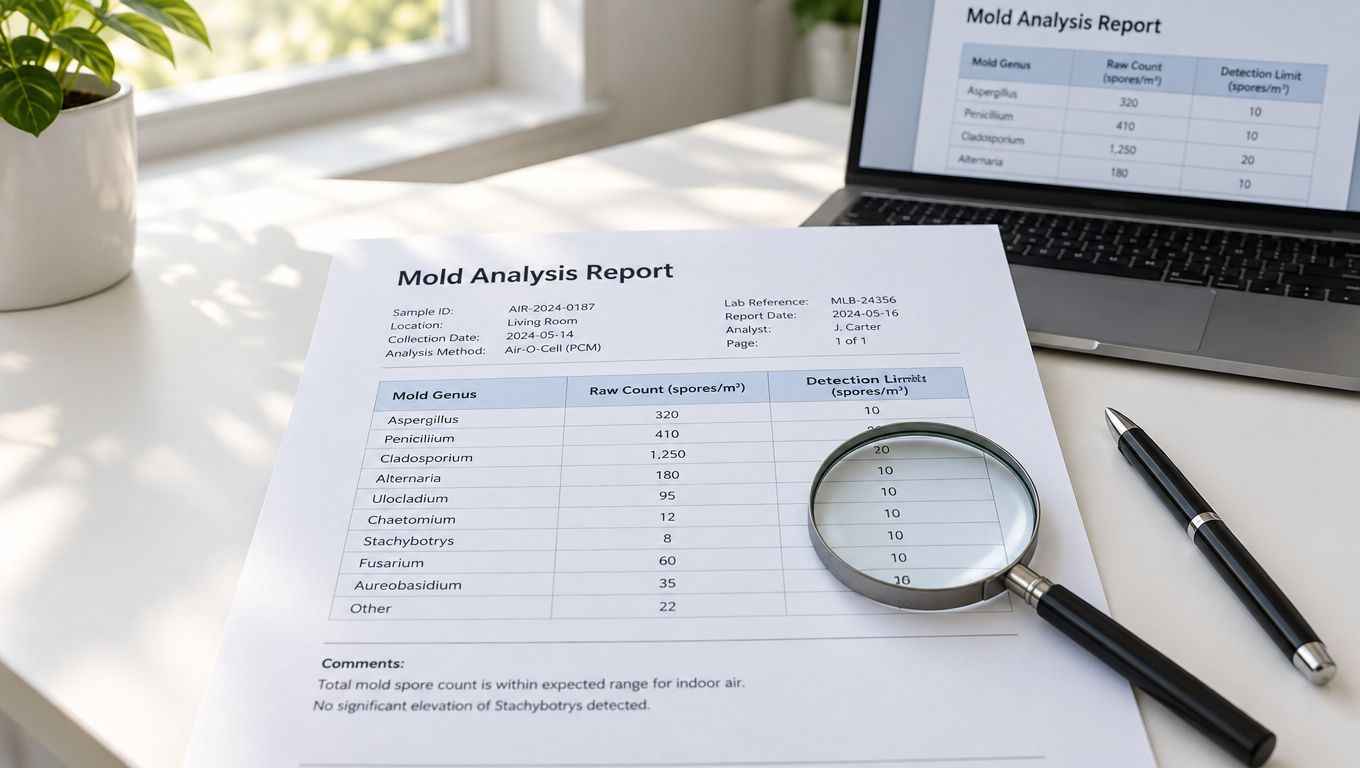
A laboratory report usually begins with project information, sample identifiers, collection dates, locations, analytical methods, and laboratory details. It may then list detected genera or species, raw counts or colony counts, detection limits, and analyst observations.
Start with location and method
Before interpreting a result, confirm where the sample came from. An indoor air sample from a bedroom, a tape lift from a window sill, and a bulk sample from damaged drywall are different lines of evidence.
Then identify the analytical approach. A non-viable spore-trap report and a culture report may describe different portions of the fungal material present. A surface result may identify material on the sampled spot, while a bulk report describes the submitted piece.
Compare patterns, not isolated labels
For air samples, indoor and outdoor comparisons may provide useful context. An indoor result that differs substantially from the outdoor baseline can prompt further investigation, particularly if the finding matches the building history, odor, visible condition, or suspected source.
Terms such as Chaetomium, Stachybotrys, or Aspergillus may attract attention, but a genus or species name isn't a diagnosis. The report identifies what the laboratory observed in the submitted sample. It doesn't prove that the organism caused a person's symptoms, establish the full extent of growth, or identify a universal health-risk concentration.
WHO did not recommend a universal health-based numerical threshold for acceptable indoor mold concentrations because the relationship between measured microbial exposure and health effects cannot be quantified precisely. Laboratory numbers therefore need to remain tied to sample location, building conditions, and the question the investigator was trying to answer.
Report-reading habit: Ask what was sampled, where it was collected, how it was analyzed, and what building condition supports or contradicts the result.
A clear report should also state limitations. If it doesn't explain whether the findings represent one room, one surface, one material, or a comparison between indoor and outdoor air, ask the consultant to clarify before using the document for a transaction, claim, dispute, or project decision.
Turning Mold Testing Results into the Right Next Steps
A mold report becomes useful when it supports a documented decision. If the inspection identifies an active leak, condensation problem, wet material, or ventilation issue, the first priority is source correction and drying. A positive sample doesn't automatically dictate a specific remediation or abatement action, and a negative sample doesn't eliminate the need to address known moisture.
The next step may be a written baseline for an insurance file, a targeted investigation of hidden materials, a comparison after corrective work, or documentation for a real estate or legal matter. The appropriate path depends on the source, material condition, affected area, occupant concerns, and project requirements.
For overlapping hazards, owners may also need separate asbestos testing, lead testing, indoor air quality testing, or post-fire environmental assessment. Asbestos survey records must connect inspection, material identification, quantification, sampling, laboratory analysis, and qualified personnel documentation under applicable requirements. For paid renovation work disturbing painted surfaces in homes, apartments, and child-occupied facilities built before 1978, EPA's Lead Renovation, Repair and Painting program may require certified firms, trained workers, and lead-safe practices unless appropriate documentation establishes that affected paint isn't lead-based.
Sensitive Environmental provides mold inspections, moisture-focused assessments, sampling, laboratory coordination, indoor air quality testing, asbestos surveys, lead testing, commercial environmental testing, industrial hygiene assessments, and fire-related testing for ash, soot, char, smoke residue, combustion byproducts, and heavy metals throughout Los Angeles and Southern California.
Contact Sensitive Environmental to discuss a mold inspection or targeted environmental testing plan for your Los Angeles property. Share the building history, affected areas, odors, water or fire damage, renovation plans, and documentation needs so the investigation can match the decision you need to make.