A commercial property environmental inspection isn't a single test. It's a layered process, and a Phase I report may need to be completed or updated within 180 days before acquisition, while asbestos, lead, mold, air-quality, and fire-related work requires separate inspection and sampling decisions.
A renovation schedule rarely leaves much room for uncertainty. In Los Angeles, a facility manager may have approved plans, a contractor ready to mobilize, and a lender waiting for environmental due diligence, only to discover that the building's age, former use, or post-fire condition creates additional testing requirements. A property owner preparing for a sale can face similar questions about historical contamination, lead dust, indoor air, or materials that construction could disturb.
The practical answer is to match the inspection to the property's history, current use, transaction requirements, and planned work. Federal due-diligence rules, OSHA sampling expectations, EPA guidance, and Southern California air-district requirements each address different risks. A defensible program combines records review, site inspection, targeted sampling, laboratory analysis, and clear reporting rather than relying on one broad visual walkthrough.
Table of Contents
- Why Commercial Property Environmental Inspection Matters
- What Commercial Property Environmental Inspection Covers
- The Phased Approach to Environmental Assessment
- Southern California Regulatory Requirements
- Sampling Methodology and Laboratory Analysis
- Interpreting Results and Planning Next Steps
- Emerging Issues and Complex Questions
Why Commercial Property Environmental Inspection Matters
A Los Angeles tenant-improvement project can stall when an architect asks whether concealed materials were surveyed, while a lender requests environmental due diligence because the property once supported industrial operations. A general property-condition inspection cannot answer both questions. The owner needs evidence that connects the site's history, current use, planned work, and regulatory exposure.
Environmental risk follows that history rather than the building's appearance. The EPA defines brownfields as properties whose redevelopment or reuse may be complicated by hazardous substances, pollutants, or contaminants. A 2004 Government Accountability Office estimate identified approximately 450,000 to 1 million brownfield properties nationwide, a range the EPA continues to cite as its best available national estimate (EPA brownfields frequently asked questions). The 2002 Brownfields Amendments to CERCLA also broadened eligibility beyond abandoned or underused industrial and commercial sites to include residential and other property types.

Risk appears in more than one place
Urban commercial properties often combine redevelopment pressure with complex site histories. EPA data show that 88% of brownfield properties recorded in its funding database were in counties within a metropolitan or micropolitan statistical area, including 74% in metropolitan statistical areas. That concentration is relevant to Los Angeles County, where former manufacturing, automotive, service, and storage uses can affect redevelopment, refinancing, leasing, and property transfers.
A Phase I Environmental Site Assessment reviews historical uses, current operations, adjoining properties, regulatory records, interviews, and visible conditions to identify potential recognized environmental conditions. It generally does not establish contaminant concentrations. If the findings indicate a potential release, a targeted Phase II investigation may be appropriate. That additional work can affect the project scope, sampling schedule, contractor controls, and decisions about whether to proceed with acquisition or construction.
Building materials create a separate decision point. EPA's historical asbestos survey estimated that about 2.7 million U.S. buildings contained sprayed or trowelled friable materials or friable materials used in pipe wrap, boiler insulation, or ceiling tiles, including approximately 733,000 buildings containing asbestos-containing friable material, while asbestos-containing floor tiles appeared in 42% of surveyed buildings, or 1,526,000 buildings (EPA asbestos technical bulletin). The figures support a practical conclusion: material surveys should precede work that could disturb older building components.
Practical rule: Treat environmental inspection as project planning, not paperwork added after the scope and schedule are fixed.
For Los Angeles projects, owners must align environmental findings with contractor controls, OSHA exposure concerns, EPA due-diligence expectations, and applicable South Coast Air Quality Management District requirements. Commercial asbestos management guidance can help connect survey results with building operations, renovation sequencing, and documentation.
What Commercial Property Environmental Inspection Covers
Commercial property environmental inspection should match the decision, the work planned, and the people who may be exposed. A lender, demolition contractor, and facility manager require different evidence, so ordering one generic inspection can leave a critical gap.
Building materials and occupant exposure
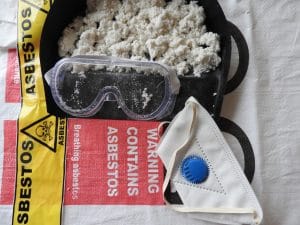
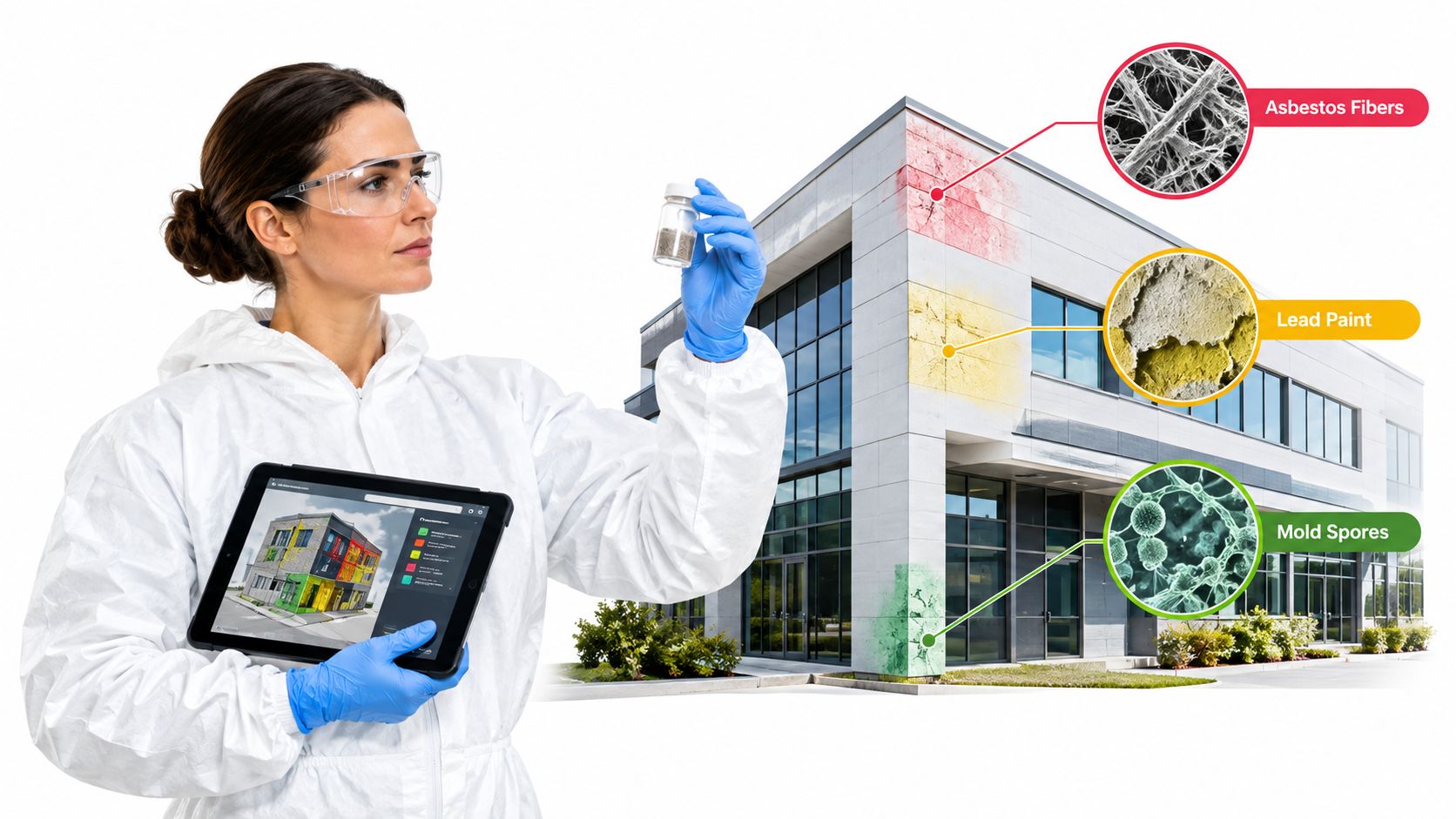
Asbestos testing addresses suspect materials that renovation, demolition, drilling, cutting, or maintenance could disturb. A professional survey may examine thermal-system insulation, surfacing materials, flooring, ceiling systems, wall and ceiling cavities, and other concealed components. Appearance cannot reliably identify asbestos. Where appropriate, a qualified professional collects bulk samples for laboratory analysis and records the material's location and condition.
Lead testing may cover painted surfaces, settled dust, or building components. Renovation work requires room-specific dust clearance samples and laboratory analysis, rather than a visual conclusion that the work area appears clean. Lead-based paint inspections and dust testing deserve particular attention in older commercial and multifamily properties, especially where workers, tenants, or maintenance staff will occupy nearby areas.
Mold and indoor air quality testing answer related but separate questions. A mold inspection examines moisture sources, affected materials, building conditions, and whether air or surface sampling would clarify the findings. IAQ testing may assess airborne contaminants, ventilation concerns, VOCs, or other parameters selected for the building's use and complaint history. Sampling should support a management decision, not substitute for correcting an active water source.
Site and environmental conditions
A Phase I ESA reviews historical and current environmental conditions in a transaction. It may identify a possible release or threatened release, while physical sampling generally requires separate, targeted work. A Phase II investigation can examine soil, groundwater, soil vapor, or building materials when the Phase I findings support that scope.
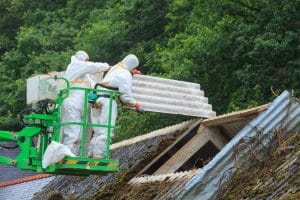
Industrial hygiene testing adds a workplace perspective. It can evaluate exposure conditions linked to construction activities, building operations, airborne contaminants, dust, fibers, or chemical use. In Southern California, the results may need to inform OSHA controls and, where demolition or renovation is involved, the South Coast Air Quality Management District pathway, including applicable Rule 1403 asbestos requirements.
Fire and wildfire contamination testing may examine ash, soot, char, smoke residue, combustion byproducts, and heavy metals after fire damage or deposited debris. The findings help determine cleaning methods, personal protective equipment, waste handling, and re-entry controls.
The assessment should follow the immediate decision:
- A transaction may start with a Phase I ESA and proceed to targeted Phase II sampling.
- A renovation or demolition may require asbestos, lead, mold, or indoor-air testing before disturbance, alongside applicable SCAQMD requirements.
- A water-damaged building may need moisture mapping, mold inspection, air or surface sampling, and written reporting.
- A fire-affected property may need combustion-byproduct and material testing before occupants or contractors re-enter affected areas.
- An operating workplace may need industrial hygiene testing tied to specific tasks, exposure pathways, and OSHA controls.
Match the assessment type to the decision: a lender needs a Phase I, a demolition contractor needs a Rule 1403 survey, and a facility manager needs material and air testing tied to the planned work.
The Phased Approach to Environmental Assessment
A commercial property purchase can stall when a records search raises concerns but the team has no defensible basis for sampling. The practical sequence is to begin with broad due diligence, then test only the media and locations connected to documented conditions. Invasive work too early can produce poorly placed samples, while stopping at databases can leave a buyer without enough information to manage risk.
Start with Phase I due diligence
Under ASTM E1527-21 and the EPA's All Appropriate Inquiries framework, a Phase I ESA must be completed by an environmental professional and documented in a written report (ASTM E1527-21). The assessment considers potential releases or threatened releases, significant data gaps, the professional's qualifications, and whether additional investigation is warranted.
The work generally combines:
- Records research covering historical property use and regulatory information.
- A site reconnaissance of the property and adjoining properties.
- Interviews with owners, operators, occupants, and other knowledgeable parties.
- A written report identifying recognized environmental conditions and limitations.
For an acquisition, interviews, environmental-lien searches, federal, state, tribal, and local record reviews, visual inspection, and the environmental professional's declaration must be completed or updated within 180 days before acquisition. Other AAI components generally must be completed within one year, as required by the standard.
Escalate only when the evidence supports it
A Phase I identifies a potential environmental condition. It does not prove contamination or establish an indoor exposure. If records show a former dry-cleaning operation, a storage area, a release notice, or another concern, the next step should be a sampling plan tied to that condition.
A Phase II investigation may collect soil, groundwater, soil-vapor, or building-material samples. Before fieldwork, the consultant should define sampling locations, analytes, laboratory methods, quality-control procedures, and reporting criteria. Linking the Phase II scope to the Phase I finding makes the investigation easier to defend and the results more useful for decisions.
A database flag is a reason to ask better questions, not proof that a property has a confirmed release.
The same discipline applies to building hazards. A clean Phase I cannot determine whether flooring or pipe insulation contains asbestos, whether lead dust remains after renovation, or whether water damage has affected indoor air. Those questions require separate inspections and, where appropriate, laboratory analysis. Before renovation disturbs suspect materials, commercial asbestos testing in Los Angeles should be scheduled before the Phase II decision. For regional planning context, commercial asbestos removal in Phoenix illustrates how asbestos concerns can affect commercial construction, while Los Angeles projects must follow applicable local requirements.
A targeted approach prevents two costly errors: false reassurance from an assessment that was not designed to answer the facility's question, and broad testing triggered by a record that has not been evaluated in site context.
Southern California Regulatory Requirements
Los Angeles-area commercial renovation and demolition work can trigger requirements that a general environmental report won't satisfy. The South Coast Air Quality Management District, or SCAQMD, applies specific asbestos procedures in the South Coast Air Basin, and the project team needs the survey and documentation before work begins.
Rule 1403 starts with an onsite survey
Under SCAQMD Rule 1403, an onsite asbestos survey is required before all demolitions and before renovations, subject to a limited exception for certain single-unit residential structures involving less than 100 square feet of asbestos-containing material (SCAQMD Rule 1403 compliance advisory). The survey must be completed by a Cal/OSHA-certified asbestos inspector or, where permitted, an employee with an unexpired AHERA Building Inspector certificate from a Cal/OSHA-approved course.
The written report should identify every asbestos-containing material that may be disturbed, describe its condition, and determine whether it is friable. A survey limited to visible surfaces may not be sufficient. SCAQMD-related survey requirements include affected facility components, friable materials, Class I and Class II non-friable materials, and physical sampling where appropriate. The scope can extend through flooring layers to the joist level and into wall or ceiling cavities when necessary to identify and sample materials (California Air Resources Board asbestos rule document).
Procedure 5 addresses unexpected disturbance
Fire, explosion, natural disaster, or accidental disturbance can change the compliance pathway. SCAQMD Procedure 5 applies when asbestos-containing material has been damaged or disturbed. A Procedure 5 cleanup plan must be approved in writing before abatement begins, regardless of project size (SCAQMD Procedure 5 guideline).
The submission includes a Rule 1403 notification, site survey, sampling and analysis, chain-of-custody records, laboratory results, a site map, and available photographs. It also addresses the material's condition, type, quantity, location, containment, contamination-migration controls, work practices, and emission controls.
For owners and contractors, timing is the operational issue. Don't wait until demolition crews are scheduled to determine whether the survey covered concealed flooring, cavity materials, or a fire-affected area. A written scope, qualified inspector, laboratory plan, and report review should happen while design and procurement decisions can still change.
Legal questions may require separate advice from real estate counsel for landlords, particularly when environmental findings affect leases, disclosure, access, or transaction obligations. Environmental consultants provide testing and documentation, but they don't replace legal counsel or the agency's requirements.
Sampling Methodology and Laboratory Analysis
A negative result is useful only when the sample represents the material or exposure under review. One accessible corner cannot establish that a commercial building is free of asbestos, mold, lead dust, or airborne contaminants. Sampling must follow the work scope, building history, and regulatory pathway that could apply in Southern California.
Match samples to the work and material
OSHA guidance calls for representative asbestos exposure monitoring based on the activity being performed. Monitoring may include full-shift samples to estimate the 8-hour time-weighted average and 30-minute samples for operations most likely to exceed the excursion limit (OSHA asbestos guidance).
For bulk asbestos sampling of homogeneous surfacing areas, OSHA's interpretation specifies:
- Three bulk samples for areas under 1,000 square feet.
- Five bulk samples for areas from 1,000 to 5,000 square feet.
- Seven bulk samples for areas exceeding 5,000 square feet.
- One sample may apply to a homogeneous thermal-system-insulation area under six square or linear feet.
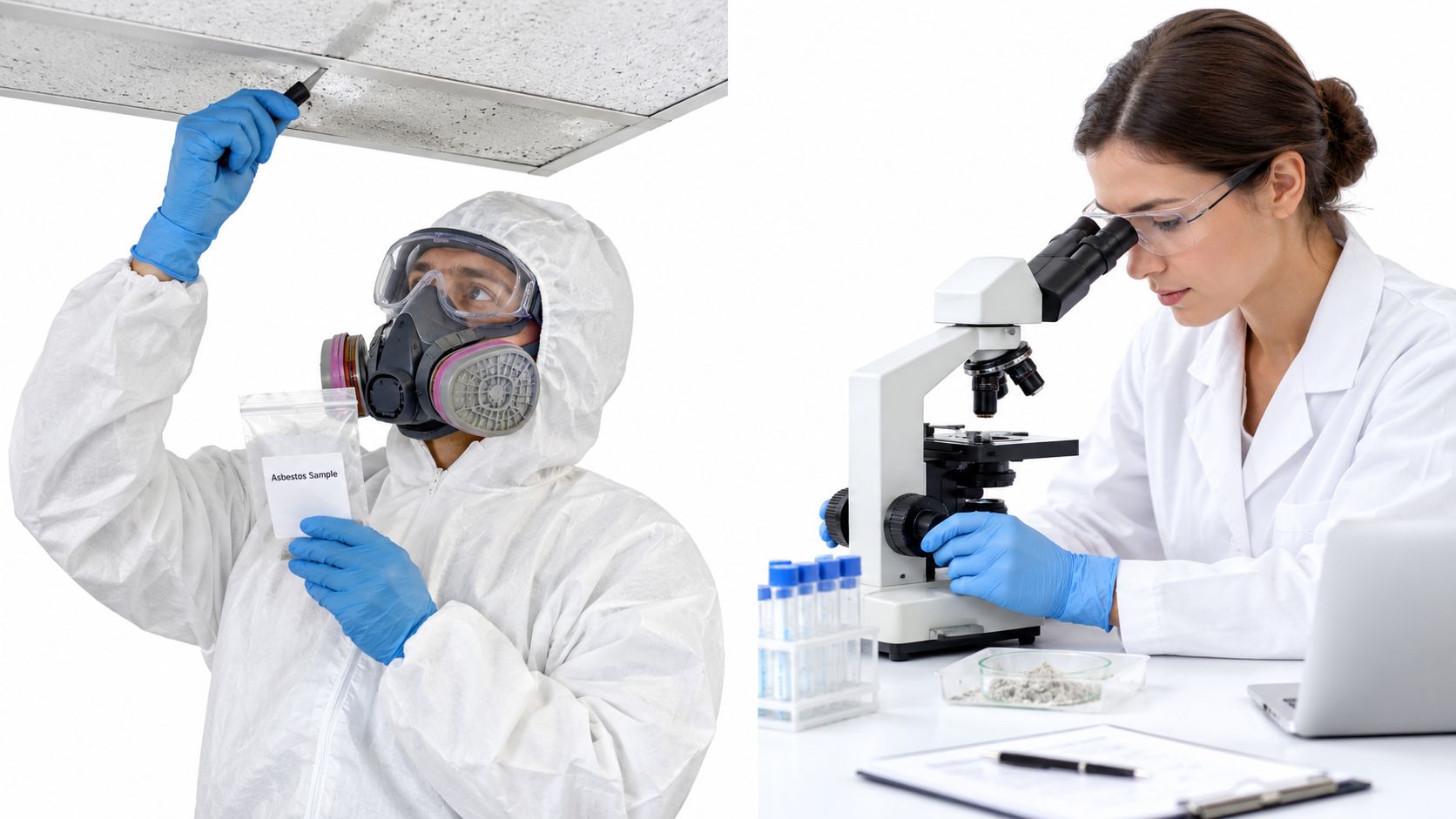
These counts do not replace a building survey. The inspector must define homogeneous areas, evaluate visually distinct or separately installed materials independently, and record inaccessible locations as limitations. A flooring system with multiple layers may require sampling of each layer, not only the exposed finish.
Preserve the chain from field to report
A defensible sample record identifies the location, material, condition, sample number, and planned disturbance. The laboratory receives the material with chain-of-custody documentation and applies a method suited to the analyte and sample type. If the work may trigger SCAQMD or EPA requirements, those records also help connect field findings to the required compliance decision.
For mold and indoor-air-quality investigations, building operation is part of the causal picture. OSHA guidance supports controlling moisture, correcting leaks, and maintaining approximately 30% to 60% relative humidity, while wet materials should be dried within 24 to 48 hours. These practices do not establish a universal mold threshold. They help identify conditions that can sustain or repeat a moisture problem.
EPA guidance supports comparing indoor-air mold types and concentrations with outdoor air after remediation. Post-remediation sampling is therefore more useful when paired with moisture-source verification than when treated as a pass or fail test against a universal indoor limit.
The same sampling logic applies to VOCs, combustion byproducts, smoke residue, and heavy metals. Select analytes according to the fire history, building materials, occupancy, and likely exposure pathway. For projects requiring coordinated fieldwork and reporting, Sensitive Environmental provides environmental testing services that include professional inspection, sampling, laboratory analysis, and reporting for commercial and other properties.
Interpreting Results and Planning Next Steps
Lab results guide decisions about control, repair, or further investigation. They do not, by themselves, require removal or closure. Interpretation depends on the material, location, condition, accessibility, planned disturbance, building use, and applicable rules. In Southern California, the project team may also need to align the response with SCAQMD requirements, EPA renovation rules, or OSHA exposure controls.
An asbestos-positive result confirms asbestos in the sampled material. It does not select the remedy. Qualified professionals assess whether planned work will disturb it, then determine whether abatement, encapsulation, management in place, or another control fits the condition and governing requirements. The same finding can produce different actions in an occupied office, a vacant building, or a demolition project.
Read lead clearance by room
EPA lead-renovation clearance testing uses room-specific dust samples and laboratory analysis. For interior work, collect a floor sample in each room where work occurred, up to a maximum of four rooms, plus a floor sample outside the work-area entrance. Collect window-sill and window-trough samples in each affected room where those surfaces exist (EPA lead renovation clearance guidance).
Under this EPA guidance, lead dust at or above these levels fails clearance:
| Surface | Clearance level |
|---|---|
| Floors | 40 micrograms per square foot |
| Window sills | 250 micrograms per square foot |
| Window troughs | 400 micrograms per square foot |
If a sample reaches or exceeds the applicable level, clean and retest until the relevant limit is met. Visual inspection alone cannot establish clearance.
Turn findings into a controlled work plan
A useful report states what was tested, where, which laboratory analyzed it, what limitations apply, and what decision the result supports. That record lets owners coordinate with architects, contractors, industrial hygienists, regulators, and counsel.
The next action depends on the property decision. A commercial property manager may revise demolition sequencing. A lender may request targeted investigation before closing. A facility manager may restrict disturbance, notify affected workers, and update building records under the applicable OSHA or EPA pathway. Where SCAQMD rules affect renovation or demolition, confirm notification, work-practice, and documentation requirements before mobilizing.
A positive result requires a response proportionate to the evidence and governing requirement. Treating every detection as a removal order can waste money, while ignoring a material that will be disturbed can create exposure, schedule, and compliance problems.
Emerging Issues and Complex Questions
PFAS vapor intrusion shows how quickly conventional commercial environmental inspection guidance can become incomplete. EPA research indicates that vapor intrusion from volatile PFAS warrants consideration where shallow soil or groundwater contains high concentrations, although the concentration that should trigger investigation remains unclear (PFAS vapor intrusion science and data gaps).
As of September 2025, the Interstate Technology and Regulatory Council reported that subsurface-to-indoor-air transport of vapor-forming PFAS had not been conclusively demonstrated in laboratory or field studies. Standardized, validated methods for soil-gas analysis were also unavailable. That uncertainty makes blanket PFAS testing difficult to justify.
Use a site-specific decision framework:
- What was the historical use? Identify operations that may have involved particular PFAS compounds.
- Where are the shallow groundwater and soil-gas concerns? Review existing data instead of assuming a pathway.
- How is the building constructed? Examine slabs, utility penetrations, occupied areas, and ventilation.
- What decision must the investigation support? Distinguish a database listing or historical use from confirmed indoor-air exposure.
- What testing is proportionate? Use phased sampling when site facts support a defined question.
The investigation should also match the applicable compliance pathway. SCAQMD requirements may control work during renovation or demolition, while EPA and OSHA requirements can affect environmental controls, worker protection, notifications, and documentation.
PFAS is now within the ASTM Phase I framework as a potential recognized environmental condition. Industry databases may identify approximately 120,000 facilities associated with sectors that could handle or generate PFAS, but database inclusion does not establish a release. Depending on site facts, a consultant may classify some findings as de minimis (Reuters Practical Law environmental due diligence discussion).
For buyers, lenders, and facility managers, the useful result is a documented decision about whether historical use, site conditions, building pathways, and available evidence justify targeted testing.
Sensitive Environmental provides commercial asbestos surveys, SCAQMD Rule 1403 and Procedure 5 testing documentation, lead testing, mold and indoor air quality assessments, Phase I and targeted environmental investigations, industrial hygiene testing, and fire-residue testing. For a Los Angeles or Southern California acquisition, renovation, demolition, or post-fire evaluation, visit Sensitive Environmental to discuss the required inspection and sampling scope.