A homeowner in Echo Park may be preparing to repaint a 1940s bungalow when a contractor points to peeling trim and asks whether the paint contains lead. A toddler chews the window sill, the kitchen renovation will disturb painted surfaces, and a buyer's agent wants lead-based paint disclosure information. Suddenly, a routine project has become a question of which testing method is valid, what the results mean, and which documents the project requires.
A landlord in Pasadena can face a similar decision before renovating a pre-1978 duplex. Southern California's older housing stock makes lead testing relevant for property owners, contractors, landlords, tenants, and buyers. The EPA reports that 87% of homes built before 1940 contain some lead-based paint, while 24% of homes built between 1960 and 1978 contain some lead-based paint. Homes built after 1978 are unlikely to contain lead-based paint, according to the historical and housing context summarized by the Medical College of Wisconsin and Children's Hospital of Wisconsin.
The sensible question isn't whether lead is present. It's how to investigate the property responsibly, whether you need XRF testing, laboratory analysis, dust or soil sampling, and what level of documentation your renovation, transaction, or occupancy decision calls for.
Table of Contents
- A Familiar Situation for Los Angeles Property Owners
- What Professional Lead Testing Services Include
- Comparing XRF, Lab Analysis, and Field Test Kits
- How Lead Testing Is Performed From Start to Finish
- Federal and California Standards for Lead Results
- Reading Your Lab Report and Planning Around Turnaround
- Common Misconceptions About Lead Testing
- Deciding When Professional Lead Testing Makes Sense
A Familiar Situation for Los Angeles Property Owners
The contractor wants to remove an old window in the Echo Park bungalow. The owner sees cracked paint around the frame and remembers that the child in the home often puts fingers on the sill and then in their mouth. The contractor pauses before disturbing the surface because sanding, cutting, or replacing painted components can spread contaminated dust.
The owner buys a hardware-store test kit, swabs the trim, and waits for a color change. The result looks negative, but it doesn't answer several important questions. Was the correct layer tested? Did the kit detect lead reliably? Is dust present on the floor or sill? Could soil outside contain residue from deteriorated exterior paint? And would the result support a buyer disclosure file or a regulated renovation project?
Practical rule: A quick indication isn't the same as a defensible environmental assessment.
Lead testing services developed because visual inspection alone can't identify every hazard. The scientific history is also longer than many owners realize. Earlier diagnostic work involving protoporphyrin dates to the 1930s and 1960s, and physicians at the Medical College of Wisconsin and Children's Hospital of Wisconsin developed the first rapid, accurate screening test for lead poisoning in 1972, as documented in the historical record of lead screening development. Modern environmental testing builds on that tradition by looking for exposure or contamination before severe symptoms appear.
For a Pasadena landlord, the concern may be different. The duplex has original doors, window assemblies, and painted trim, and a renovation crew needs to know which surfaces require controlled work practices. For a buyer, the priority may be location-specific disclosure information. For a tenant, deteriorating paint near a child's sleeping or play area may justify professional evaluation.
Owners sometimes also need to investigate drinking water separately from paint, dust, or soil. If the concern involves plumbing materials or possible lead in water, a property owner may consult Praz Pure Water for water-quality testing information. A qualified environmental tester can then help define whether the property also needs paint, dust, or soil sampling.
What Professional Lead Testing Services Include
Professional lead testing is a structured investigation, not a single swab. The scope depends on the building's age, painted surfaces, occupancy, condition, renovation plans, and the question the client needs answered.
The inspection begins with context
A technician reviews the property history and walks through visible conditions. Peeling, chalking, cracking, or friction damage can identify areas where paint may be deteriorating or generating dust. A visual assessment doesn't prove that paint contains lead, but it helps the technician choose representative locations and recognize conditions that deserve closer attention.
A Silver Lake craftsman undergoing window replacement may need dust sampling near the work area. Window friction can disturb painted components, while construction activity can redistribute settled dust across floors and interior sills. Sampling helps determine whether contamination is present where occupants or workers may contact it.
Paint, dust, and soil answer different questions
Paint testing identifies lead in a coating or painted component. A Long Beach rental scheduled for renovation may require paint-chip analysis from doors, trim, walls, or other components, or an XRF inspection that evaluates surfaces without removing a chip.
Dust sampling measures settled contamination. Technicians may collect wipe samples from floors, interior windowsills, and, when applicable, window troughs. EPA guidance specifies these locations for clearance sampling and requires comparison with applicable clearance benchmarks. The EPA lead dust sampling guide identifies benchmarks of 10 µg/ft² for floors, 100 µg/ft² for interior windowsills, and 400 µg/ft² for window troughs.
Soil testing addresses exterior conditions. A Glendale property with bare earth near the foundation, a children's play area, or a vegetable garden may need soil samples if deteriorated exterior paint or past construction could have contributed contamination.
The report should support a decision
A useful report identifies the sampled or tested locations, describes the method, records concentrations where applicable, and explains how results relate to the project question. It should help an owner decide whether additional assessment, work controls, clearance sampling, or consultation with a qualified professional is appropriate.
A positive finding doesn't automatically dictate one universal response. The result's location, concentration, condition, occupancy, and regulatory context all matter.
Comparing XRF, Lab Analysis, and Field Test Kits
The right method depends on what you need to prove. XRF, laboratory analysis, and field test kits aren't interchangeable, even when each is marketed as lead testing.
XRF testing
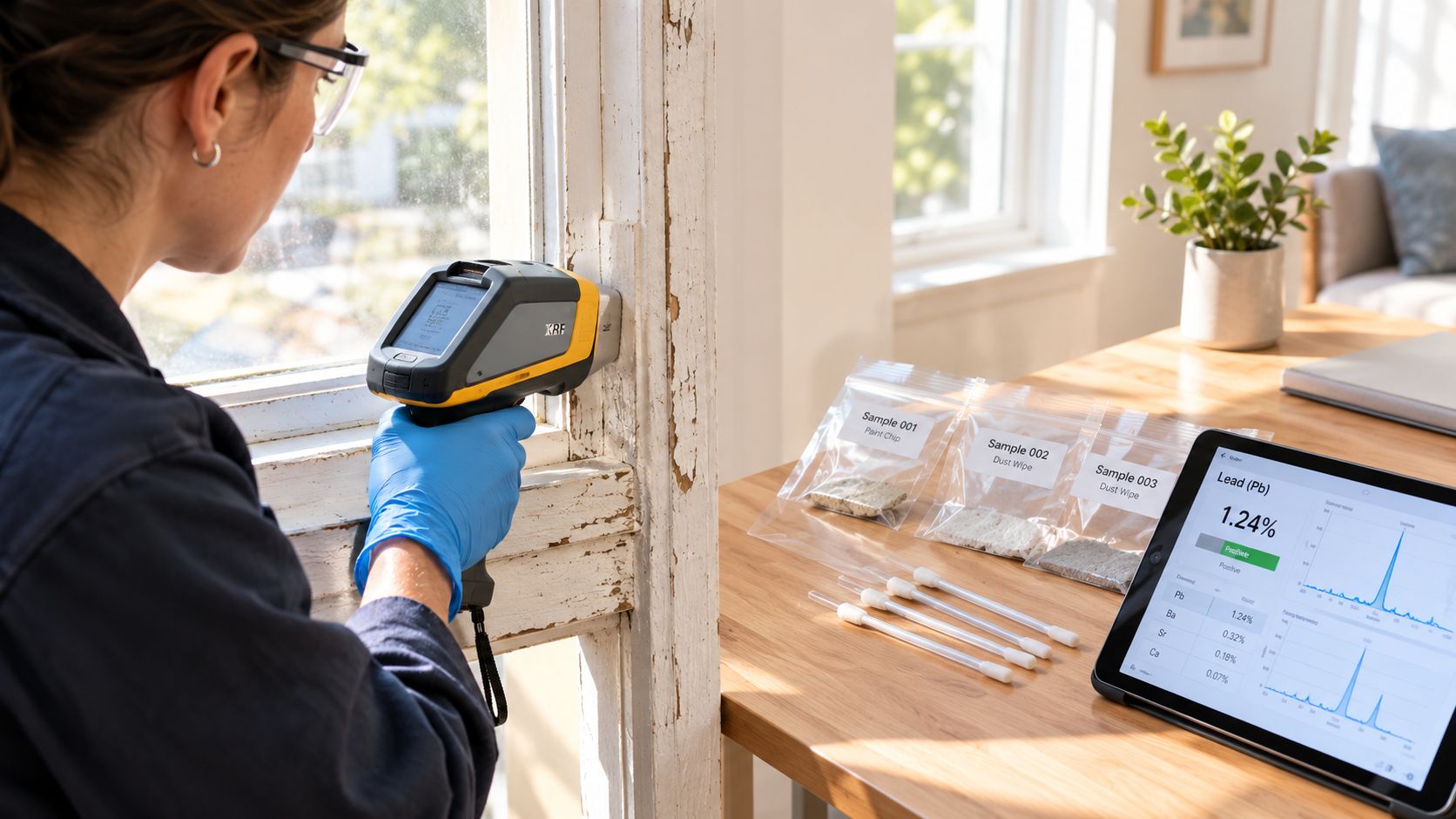
An X-ray fluorescence analyzer is held against a painted surface and reads elemental lead concentration on site. It can evaluate many painted components without removing paint, making it useful for inspecting intact doors, windows, walls, trim, and other surfaces across a property.
XRF works best when the question concerns the distribution of lead-based paint across building components. The technician records the component, location, substrate information where relevant, and instrument result. The method can be efficient for a pre-renovation or property inspection, but it must be performed by a properly qualified professional using controlled procedures.
Laboratory analysis
Laboratory analysis begins with physical sample collection. A technician may collect paint chips, dust wipes, soil, or water samples, then label, seal, document, and submit them to an appropriate laboratory. EPA guidance says lead paint, soil, and dust samples should be analyzed by an NLLAP-recognized laboratory, making laboratory accreditation and method control part of service quality.
Laboratory analysis is especially important when the project needs precise measurements, formal documentation, or clearance results. EPA's updated post-abatement dust-lead action levels are 5 µg/ft² for floors, 40 µg/ft² for interior windowsills, and 100 µg/ft² for window troughs, as stated in the EPA hazard standards and clearance-level guidance. The analytical method must match the sample matrix and required detection capability. For lead in water, expert laboratory guidance identifies ICP-MS, graphite furnace AAS, and anodic stripping voltammetry as valid high-sensitivity approaches.
Field test kits
Chemical field kits provide a rapid preliminary indication, but EPA says home test kits aren't reliable enough for accurate lead detection in paint, dust, or soil. They also generally aren't accepted as the sole basis for compliance documentation.
| Method | XRF Testing | Lab Analysis | Field Test Kits |
|---|---|---|---|
| Primary use | On-site evaluation of painted components | Precise measurement of collected paint, dust, soil, or water samples | Preliminary screening |
| Physical sample | Usually non-destructive surface reading | Collected and submitted for analysis | Chemical swab or reagent response |
| Documentation value | Useful when performed by a qualified inspector | Strongest option for formal analytical records and clearance | Limited |
| Main limitation | Requires trained operation and appropriate interpretation | Requires proper sampling, chain of custody, and laboratory control | Results may be unreliable and aren't generally accepted for compliance |
For a Los Angeles owner selling or renovating an older property, professional XRF testing, laboratory analysis, or a combination is usually more appropriate than relying on a consumer kit.
How Lead Testing Is Performed From Start to Finish
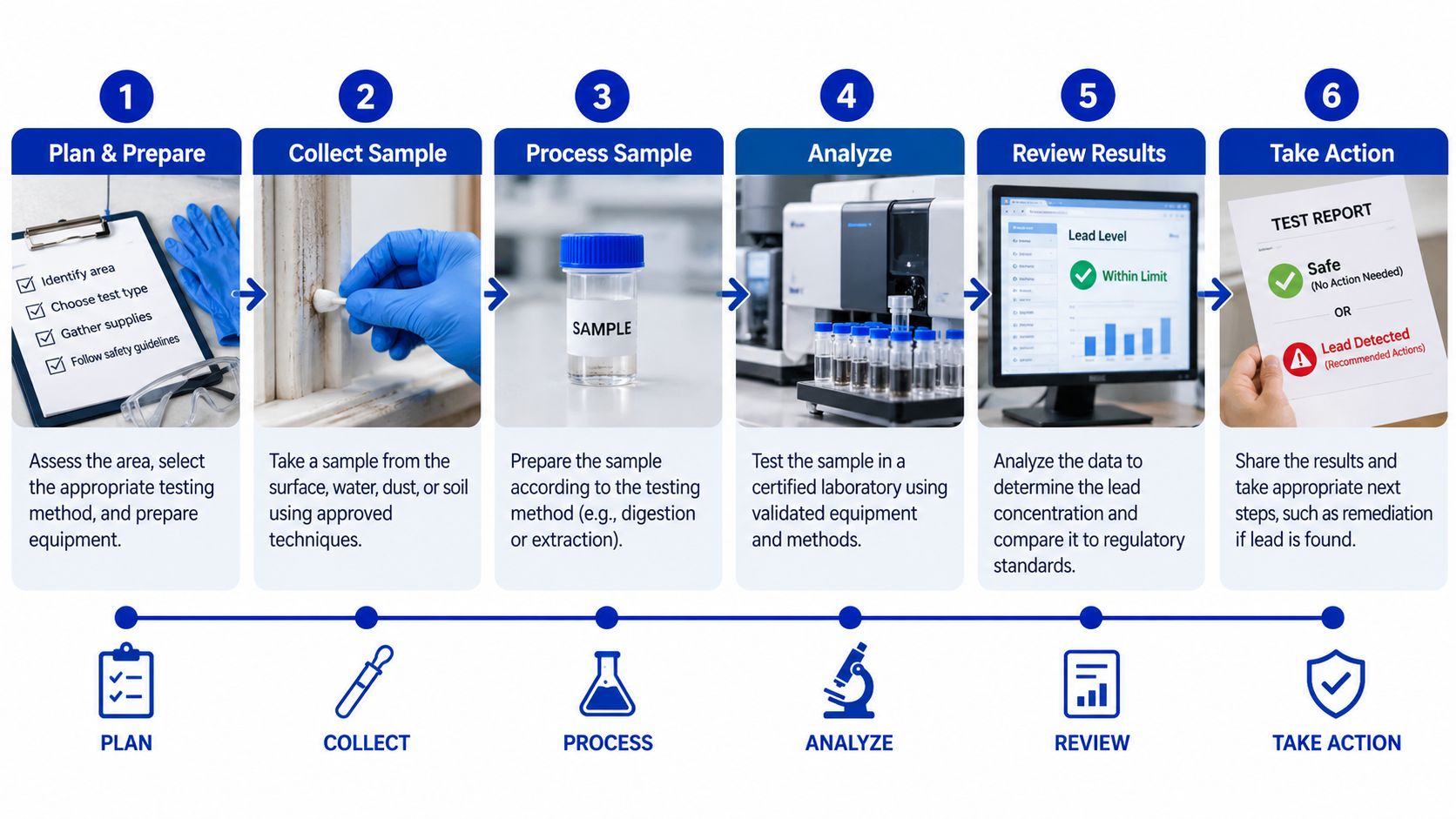
A professional appointment starts before anyone touches a wall. The technician asks about the property's construction period, occupancy, renovation history, planned work, visible paint deterioration, and the reason for testing. A home inspection, a renovation survey, a tenant concern, and a post-work clearance request can require different sampling plans.
The site visit
The technician performs a visual assessment and maps relevant areas. That may include high-friction surfaces such as windows and doors, child-accessible components, deteriorated paint, renovation zones, exterior soil, and water service line materials when water exposure is part of the concern.
For XRF testing, the instrument is placed firmly against the selected surface. The technician follows the instrument's operating and calibration procedures, records readings by component, and documents the precise location. The goal isn't to test random spots. It's to create a representative record tied to the property's actual construction and planned use.
For laboratory sampling, the technician uses the appropriate collection method for each medium. Dust wipes are collected from defined areas, paint chips are gathered from selected coatings, and soil is collected from targeted exterior locations. Each sample receives an identification number and is sealed for transport.
Chain of custody and reporting
Chain-of-custody records connect the sample collected in the field to the laboratory result. They document sample identifiers, collection details, transfers, and laboratory receipt. That paperwork matters when a general contractor, property manager, buyer, insurer, or regulatory reviewer needs to understand how the result was produced.
A final package may include photographs, a sampling diagram, field notes, laboratory certificates, XRF records where applicable, and an interpretation of findings. Sensitive Environmental provides lead testing in Los Angeles as part of its environmental testing and inspection services. The client should receive information that is clear enough to guide the next project decision without turning the report into an unexplained spreadsheet.
Federal and California Standards for Lead Results
Lead results only make sense when paired with the correct medium, threshold, and project trigger. Paint concentration, dust loading, and soil concentration use different units and answer different questions.
For federal lead-based paint work, the benchmark definition is at least 1.0 milligrams per square centimeter, 0.5% by weight, or 5,000 ppm, as reflected in the California Department of Public Health regulation text. California Title 17 uses the same core lead-based paint definition within its broader framework for evaluating lead hazards in public and residential buildings, as shown in the California Title 17 regulation.
Those values don't mean every detected amount creates the same obligation. A painted surface result, a dust clearance result, and a soil result must be interpreted under the rule applicable to the work and property.
| Medium | Standard | Threshold | What It Means |
|---|---|---|---|
| Painted surface | Lead-based paint definition | 1.0 mg/cm², 0.5% by weight, or 5,000 ppm | Identifies paint that meets the applicable lead-based paint benchmark |
| Floor dust | EPA clearance guidance | 10 µg/ft² | Benchmark identified for clearance sampling in EPA guidance |
| Interior windowsill dust | EPA clearance guidance | 100 µg/ft² | Benchmark identified for applicable clearance sampling |
| Window trough dust | EPA clearance guidance | 400 µg/ft² | Benchmark used when window trough sampling applies |
| Updated post-abatement floor dust | EPA action level | 5 µg/ft² | Tighter post-abatement action level |
| Updated post-abatement windowsill dust | EPA action level | 40 µg/ft² | Tighter post-abatement action level |
| Updated post-abatement window trough dust | EPA action level | 100 µg/ft² | Tighter post-abatement action level |
California construction planning adds an occupational consideration. CDPH states that when lead-related construction in a residential or public building can expose workers to airborne lead at or above the 8-hour permissible exposure limit of 50 µg/m³, workers must be trained and CDPH LRC-certified, according to CDPH's lead-related construction certification requirements.
Reading Your Lab Report and Planning Around Turnaround
A laboratory report should let you trace each result back to a location and a sample. Start with the sample ID, collection date, sample description, analytical method, units, and reported concentration. Then find the comparison value, such as an applicable action level or clearance benchmark.
The analytical method matters because different materials require different preparation and instrumentation. A report may identify an EPA method such as SW-846 3050B, but the client should confirm that the selected method and laboratory are appropriate for the matrix and project purpose. The report should also identify the laboratory and include relevant quality-control information.
The document trail
Chain-of-custody paperwork confirms how samples moved from collection to laboratory receipt. It doesn't prove that a property has no lead. It supports sample identity and handling, which helps a reviewer evaluate the reliability of the reported result.
Keep the full package with the property file. A landlord may need it for tenant communications or future renovation planning. A contractor may need location-specific findings when preparing a work scope. A buyer, seller, insurer, or facility manager may need the report to document the condition evaluated at a particular time.
Timing depends on the method
XRF readings can be available during the site visit because the instrument evaluates the surface on location. Laboratory turnaround depends on sample type, laboratory workload, shipping, review, and whether rush service is available. A responsible provider should confirm the expected schedule before sampling and explain whether expedited reporting still meets the documentation needs of the project.
Don't schedule demolition, window removal, or tenant re-occupancy around an assumed result date. Build time for field collection, laboratory analysis, report review, and questions. If the project also involves potential lead-related construction exposure, environmental documentation should be coordinated with the contractor's safety planning. Testing is separate from lead abatement information for older homes and buildings, but clear results can help qualified professionals determine what comes next.
Common Misconceptions About Lead Testing
A color-changing swab doesn't establish that a property is free of lead. EPA says home test kits aren't reliable enough for accurate lead detection in paint, dust, or soil, and a negative result can create false reassurance when the sampling location or paint layer doesn't represent the broader condition.
The opposite assumption is also wrong. A positive finding doesn't automatically mean every painted component must be removed or that one response applies to every property. The result must be considered with its location, concentration, paint condition, occupancy, planned work, and applicable federal or California requirements.
Context changes the decision
A pre-1978 Los Angeles rental with intact paint may need a different evaluation from a home with peeling window trim and a renovation scheduled next week. A daycare, school, apartment building, or commercial property may also require more formal documentation than a private owner seeking an initial screening.
Renters can raise concerns about deteriorated paint or dust with the property owner or manager and request that the condition be evaluated. Owners shouldn't assume that a newer building eliminates every lead question either. Later renovations can expose older substrates, and imported fixtures or industrial coatings may require separate evaluation based on the property's history.
The useful question is not, “Did the swab turn red?” It's, “What decision must this result support?” A professional inspection, XRF survey, dust sampling, soil analysis, or laboratory paint-chip test can be selected around that answer. Sensitive Environmental's lead testing services can include professional inspection, sampling, and laboratory analysis, depending on the property and assignment.
Deciding When Professional Lead Testing Makes Sense
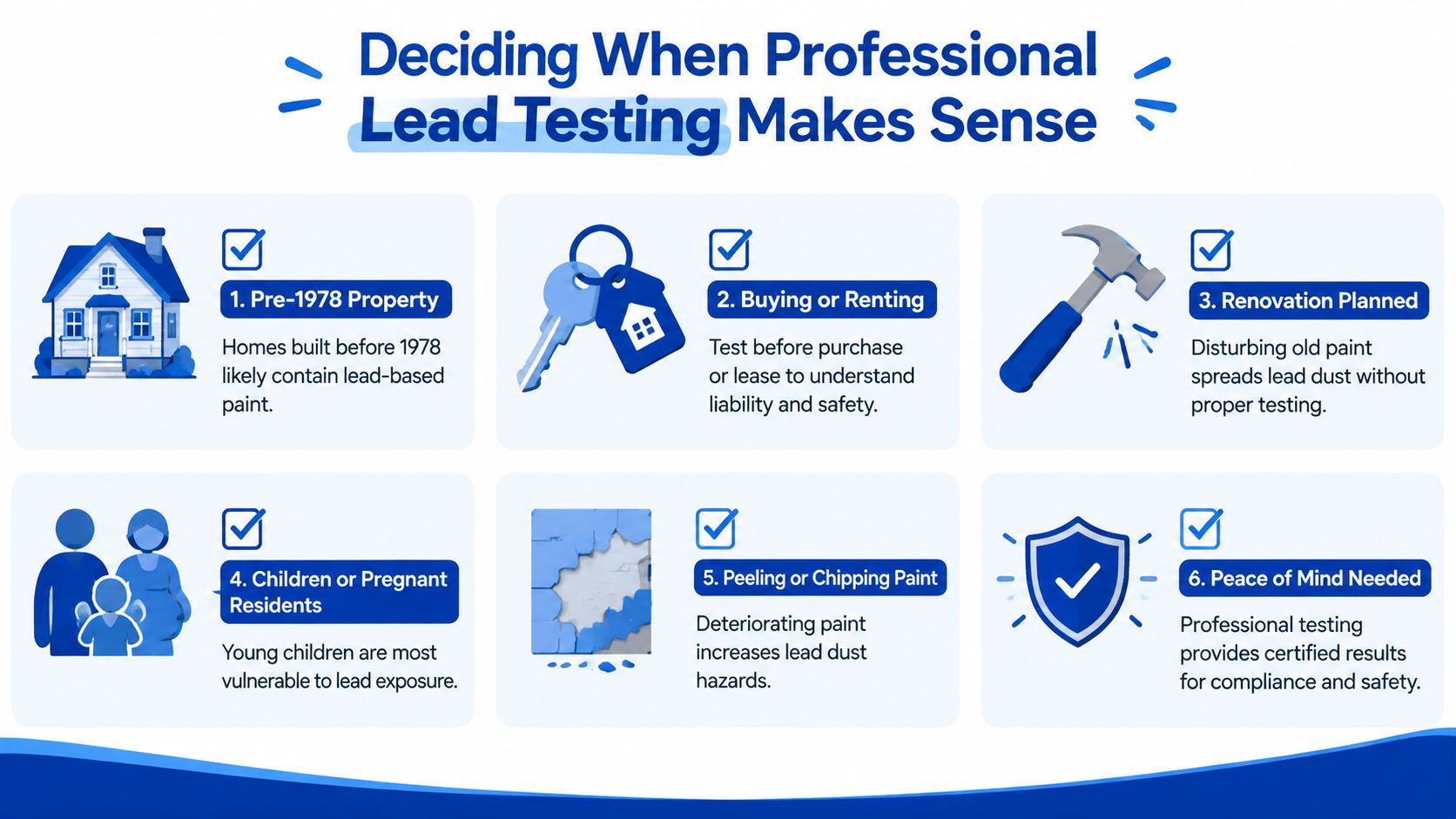
A short decision checklist can prevent both unnecessary testing and risky guesswork:
- Older painted property: A pre-1978 building with original paint deserves careful consideration before renovation, sale, or turnover.
- Planned disturbance: Window replacement, door work, sanding, scraping, demolition, or other construction can justify a lead-based paint survey before work begins.
- Children or child-occupied spaces: A daycare, school, family home, or rental with young children may warrant dust, paint, or soil evaluation based on the observed conditions.
- Visible deterioration: Peeling, chalking, cracking, or friction damage calls for an assessment of both the coating and nearby settled dust.
- Documentation needs: A transaction, contractor bid, insurance file, tenant complaint, or regulatory review may require a written report rather than an informal observation.
- Post-work verification: Clearance sampling can help determine whether a defined work area meets the applicable clearance criteria before re-occupancy.
If your concern involves drinking-water plumbing, separate the question from paint testing. Homeowners can review a resource such as pipe identification for Big Bear homeowners while arranging appropriate water sampling when the property's plumbing history warrants it.
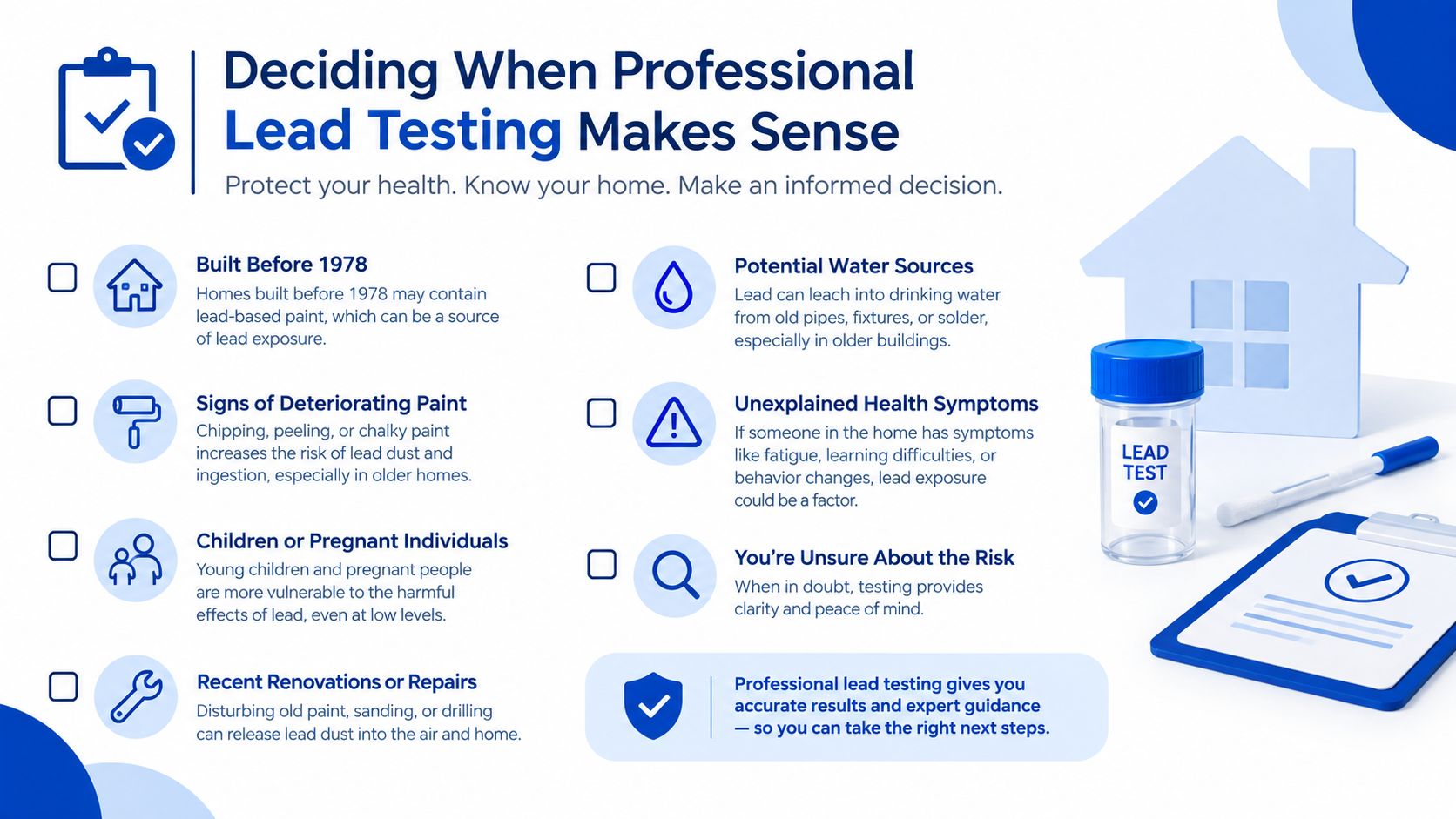
You don't need to guess between XRF, laboratory analysis, and a field kit. The property's age, occupants, visible conditions, planned work, and documentation requirements point toward the appropriate service level.
Sensitive Environmental provides professional lead inspections, XRF evaluation, dust, paint, soil, and related environmental sampling with laboratory analysis and clear reporting for Los Angeles and Southern California properties. Visit Sensitive Environmental to discuss the testing approach that fits your renovation, transaction, occupancy, or compliance needs.