You're preparing to renovate an older Los Angeles home, and the contractor has suggested scraping the popcorn texture from the ceiling. The surface may look ordinary, but appearance can't tell you whether asbestos is present. Before sanding, drilling, scraping, painting, or removing anything, treat the ceiling as a material that needs professional evaluation.
The safest answer to “how to remove asbestos ceiling popcorn” often begins with a different question: does the ceiling need to be disturbed at all? Testing identifies what you're dealing with, while an inspection and compliance survey help determine which options are appropriate for the property, occupants, and planned work.
Table of Contents
- Why Popcorn Ceilings in Older Homes Need Testing First
- Should You Remove Encapsulate or Leave Your Popcorn Ceiling
- How Professional Asbestos Testing and Sampling Works
- Los Angeles Rules for Popcorn Ceiling Work and SCAQMD Rule 1403
- What Licensed Abatement Involves and Why DIY Removal Is Risky
- Next Steps to Get Your Popcorn Ceiling Tested in Southern California
Why Popcorn Ceilings in Older Homes Need Testing First
A stained popcorn ceiling appears during a kitchen remodel in an older Los Angeles home. The contractor proposes smoothing it, a property manager needs the unit ready for a tenant, or a buyer wants a complete inspection file. Scraping may seem like the fastest answer, yet the safer sequence is to identify the material before disturbing it.
The U.S. EPA first restricted spray-applied asbestos materials in 1973 and later closed a loophole involving decorative spray-on surfacing materials in 1978. Popcorn ceilings installed before the late 1970s may therefore contain asbestos and should be tested before removal work begins. (Background on asbestos popcorn ceilings)
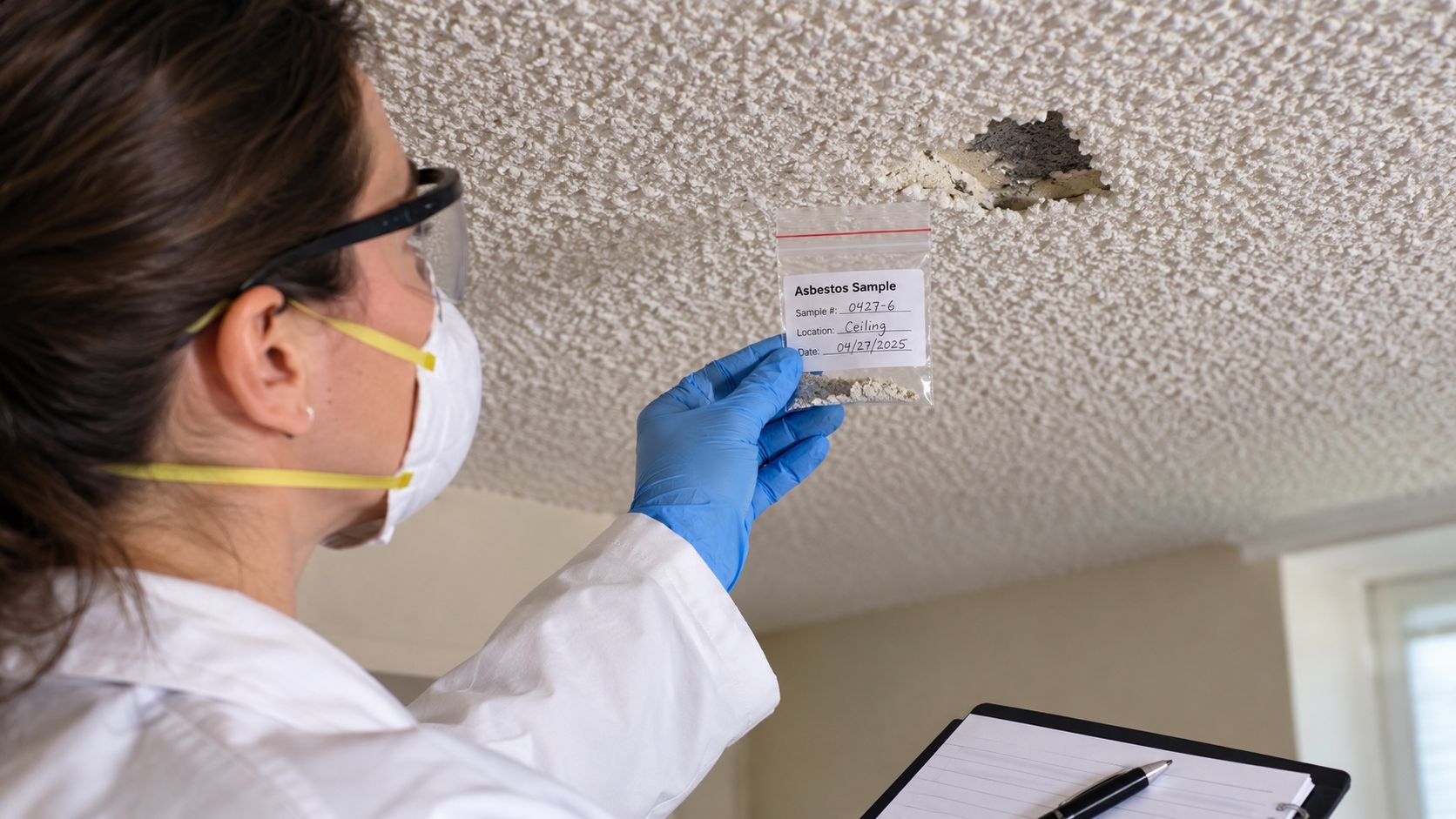
Why visual inspection isn't enough
Asbestos-containing texture can look identical to texture without asbestos. Color, pattern, discoloration, and texture density cannot identify microscopic fibers. A visual inspection records the ceiling's condition and helps identify potential sampling locations, but only laboratory analysis can address the material question.
The decision also depends on condition and planned work. An intact ceiling that will remain untouched presents a different management issue from one that is flaking, water-damaged, drilled into, or scheduled for renovation. Scraping may release fibers, while nearby HVAC returns can carry contamination beyond the immediate work area. For a rental, sale, renovation record, or commercial project, clear documentation helps owners, contractors, and future decision-makers understand what was tested and why.
A simple rule protects the project: do not let a worker scrape a suspect ceiling to “see what's underneath.” Sampling comes first.
Sensitive Environmental can inspect suspect materials, collect appropriate samples, coordinate laboratory analysis, and prepare documentation for property owners and contractors in Los Angeles and Southern California. Owners managing renovation records may use LiveDocument for real estate to organize property documentation and transaction files. This guide explains testing asbestos in a popcorn ceiling in more detail.
Should You Remove Encapsulate or Leave Your Popcorn Ceiling
A positive asbestos result doesn't automatically mean removal is required. In many situations, the least disruptive compliant choice is to leave the material alone or cover it rather than disturb it.
Three choices with different consequences
Leaving the ceiling in place may be appropriate when the texture is intact, stable, and outside the scope of planned work. This option creates the least disruption and avoids disturbing the material. It isn't a reason to ignore leaks, impact damage, loose texture, or future electrical and remodeling work. A condition assessment remains important when the ceiling has deteriorated or when building occupants have concerns.
Encapsulation or overcladding places a compatible coating or a new finish over the existing material so the suspect surface isn't scraped away. Overcladding with drywall may create a smooth ceiling while avoiding the dust and disruption associated with removal, but the assembly, fasteners, added weight, and future access points need evaluation by qualified building and asbestos professionals. In occupied apartments, schools, healthcare spaces, and offices, reducing disturbance can be a major planning advantage.
Full removal is the most disruptive option. It may make sense when the ceiling is damaged, when other construction requires access, or when the owner needs the material removed for a documented project reason. Removal should be planned and performed by an appropriately licensed asbestos abatement contractor, not by a general handyman or an untrained homeowner.
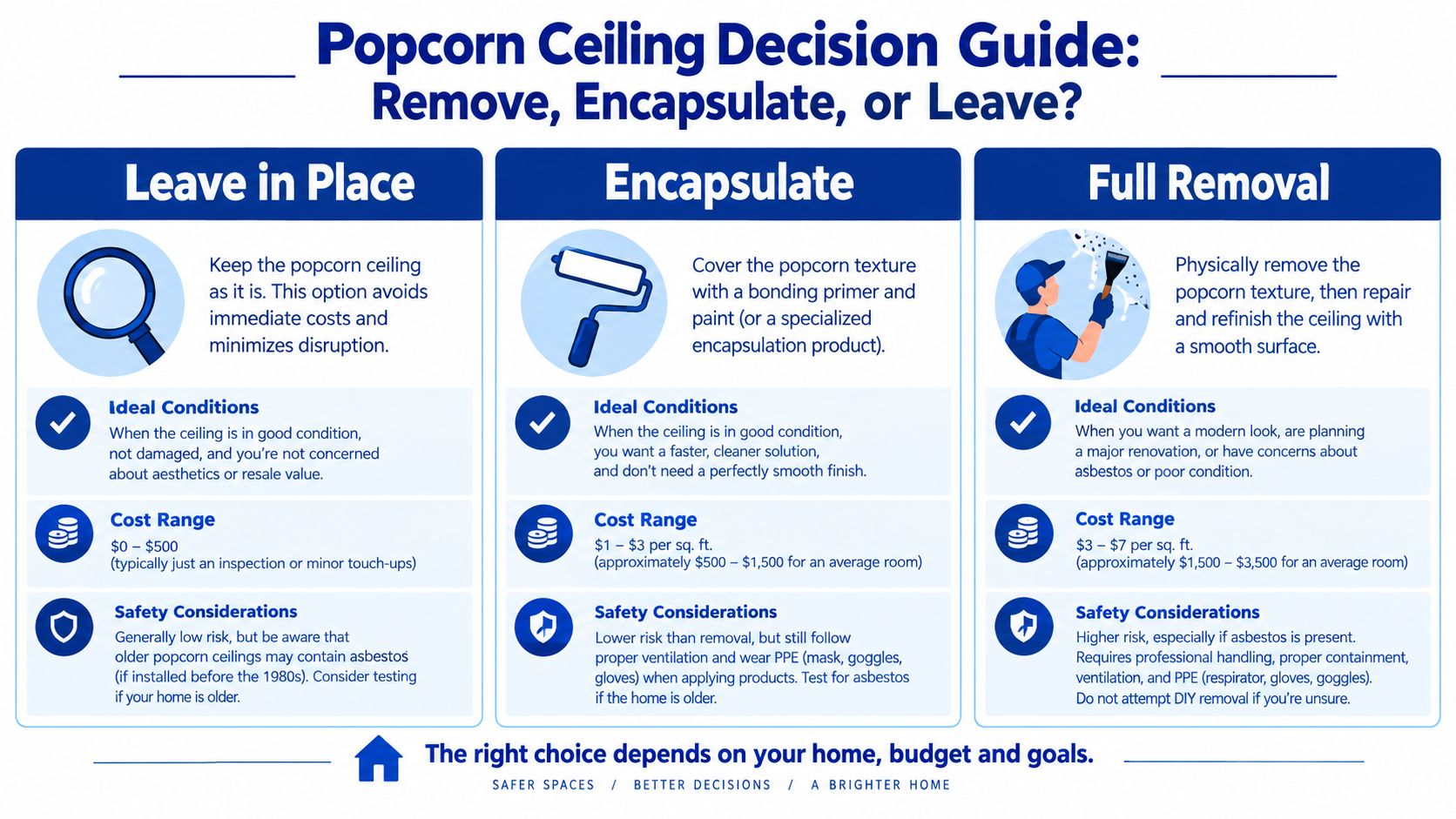
| Popcorn Ceiling Options Compared | Best When | Disruption and Risk | Testing Need |
|---|---|---|---|
| Leave in place | The ceiling is intact and no work will disturb it | Lowest disruption, but condition should be monitored | Testing is appropriate before planned disturbance |
| Encapsulate or overclad | The owner wants a new finish while limiting disturbance | Lower disruption than removal, but design and future access require planning | Testing and condition documentation help define the assembly |
| Full removal | Renovation or damage makes removal necessary | Highest disruption and requires controlled asbestos work | A survey and material characterization are essential |
The decision also depends on occupancy. A single-family home, a multi-unit building, a school, and a hospital may have different scheduling, containment, communication, and documentation needs. Property managers and HOAs should avoid selecting removal solely because it produces a smooth ceiling. Testing lets the owner compare the condition, project scope, and compliance obligations before choosing a method.
How Professional Asbestos Testing and Sampling Works
Professional asbestos testing starts with more than collecting a random piece of texture. The inspector first reviews the building history, renovation plans, ceiling condition, and areas that workers may disturb. The inspection maps homogeneous areas, meaning surfaces that appear to share the same material composition and installation history.
Inspection and sample planning
Sampling density matters because one portion of a ceiling may not represent every ceiling texture in a property. EPA guidance for friable ceiling and wall materials calls for at least five samples per homogeneous work site or one sample per room, whichever is greater. (EPA sampling guidance)
An inspector may distinguish between original texture, patched areas, painted sections, replacement drywall, and adjacent materials. If planned work could expose ceiling cavities or connected assemblies, the survey may need to examine those areas rather than stopping at the visible popcorn finish.
Controlled collection and laboratory analysis
The sampler uses methods designed to limit disturbance, collects representative material, seals each sample, and records its location. A DIY kit may provide a laboratory result for the piece submitted, but it doesn't necessarily establish that the sample represents every material that a contractor will disturb. It also doesn't provide the same project documentation as a professional survey.
The laboratory analyzes samples using recognized polarized light microscopy methods. Under common asbestos control guidance, material containing 1% asbestos by weight is generally treated as asbestos-containing material for regulatory purposes. (Industry summary of the asbestos threshold)
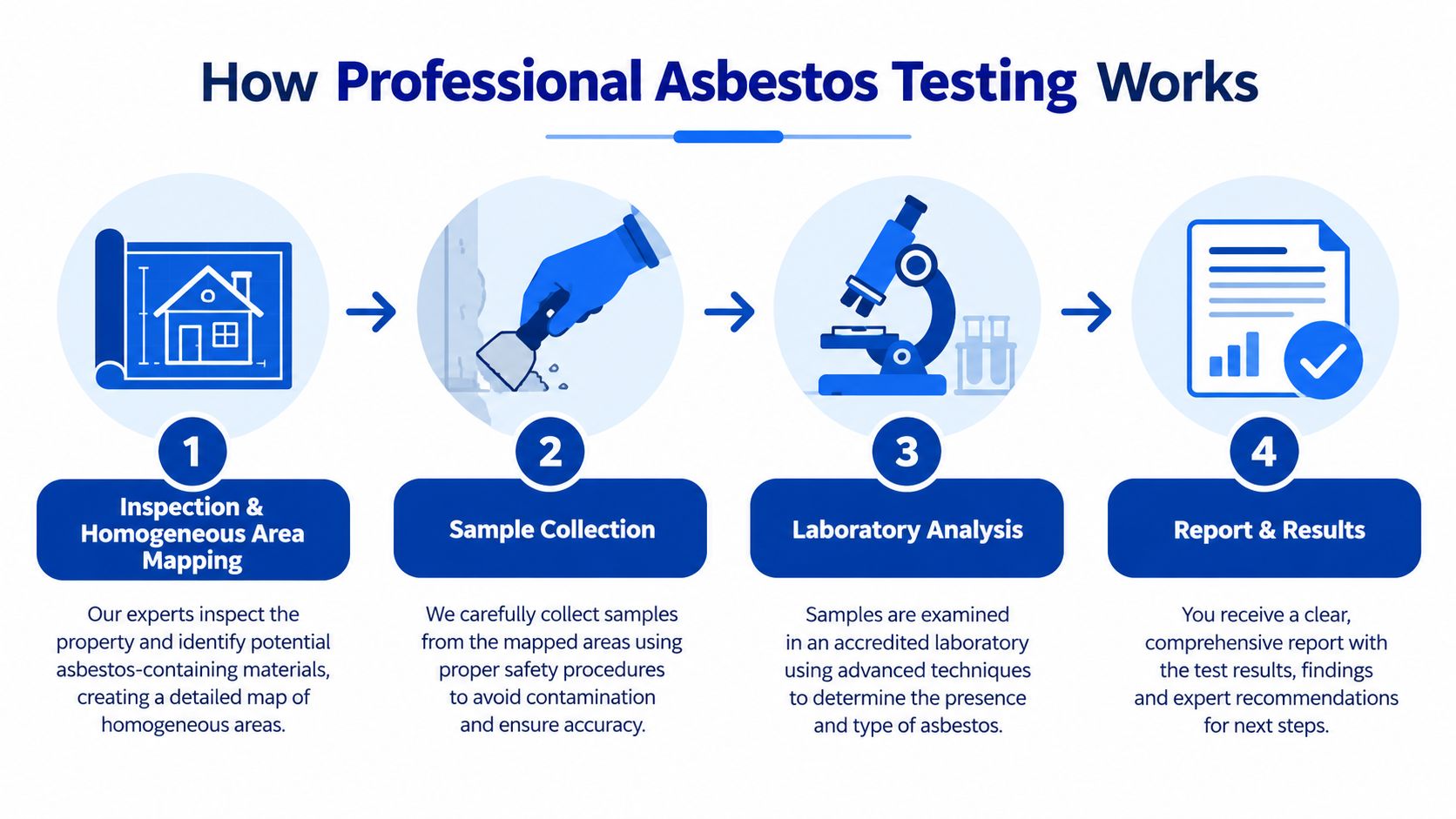
A report can identify whether asbestos was detected, describe the sampled material, record sample locations, and support decisions about renovation, encapsulation, removal, or leaving the ceiling undisturbed. A negative result applies to the sampled material and area. It doesn't authorize unrelated work on materials that were never inspected.
Sensitive Environmental provides asbestos inspections, sampling, laboratory coordination, and reporting for residential and commercial properties. The same disciplined process can support broader environmental questions, including lead testing, mold sampling, indoor air quality testing, VOC evaluation, industrial hygiene assessments, and fire-residue testing when those conditions are present.
Los Angeles Rules for Popcorn Ceiling Work and SCAQMD Rule 1403
A ceiling can look intact and still require regulatory planning before renovation. In Los Angeles County, projects may fall under South Coast Air Quality Management District requirements. SCAQMD Rule 1403 requires the affected facility or facility components to be thoroughly surveyed for asbestos before demolition or renovation activity. The survey identifies, measures, and characterizes friable and Class I or Class II non-friable asbestos-containing materials.
If the planned work reaches wall or ceiling cavities, those spaces may need inspection as well. Sampling must follow 40 CFR Part 763.86. Analysis must use SCAQMD Method 300-91 or EPA Appendix A polarized light microscopy methods through NVLAP-accredited laboratories. (SCAQMD Rule 1403)
What the survey must document
Rule 1403 compliance guidance calls for an onsite asbestos survey before demolition and, except for a limited single-unit residential situation involving less than 100 square feet of asbestos-containing material removal or stripping, before renovation. The inspector must be a Cal/OSHA-certified inspector or an approved employee with a current AHERA Building Inspector certificate. The report identifies materials that renovation may disturb, records their condition, and determines whether they are friable. (SCAQMD compliance advisory)
Federal asbestos rules also use project thresholds of 160 square feet, 260 linear feet, or 35 cubic feet for regulated material disturbed during renovation or demolition. A project below those amounts may not require prior removal under the Asbestos NESHAP. That does not cancel applicable work-practice or documentation requirements.
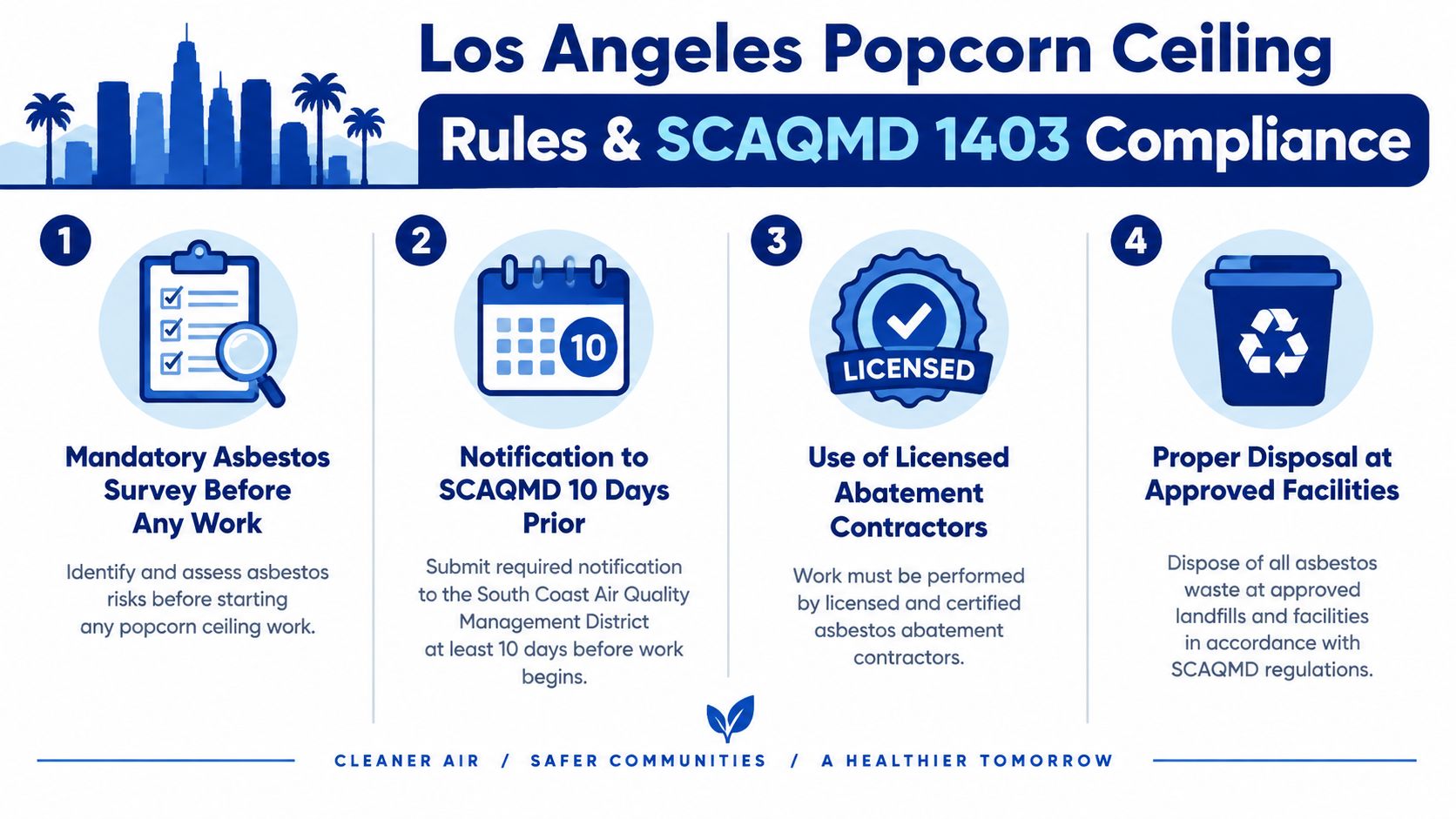
SCAQMD does not recommend abating undamaged asbestos-containing materials, including intact popcorn ceilings. Leaving the ceiling alone can therefore be the appropriate choice. Encapsulation may be considered when the material needs protection without disturbance. Removal becomes the last option when renovation or demolition will affect it.
Assuming a material contains more than 1% asbestos can eliminate sample collection and analysis, but documentation of its condition and quantity still remains necessary. (SCAQMD asbestos questions and answers)
What Licensed Abatement Involves and Why DIY Removal Is Risky
Once removal is selected, the environmental testing phase and the abatement phase have different responsibilities. Sensitive Environmental is not a removal or abatement contractor. Its role is to provide testing, inspection, sampling, laboratory analysis, and documentation that help owners and qualified abatement teams understand the materials involved.
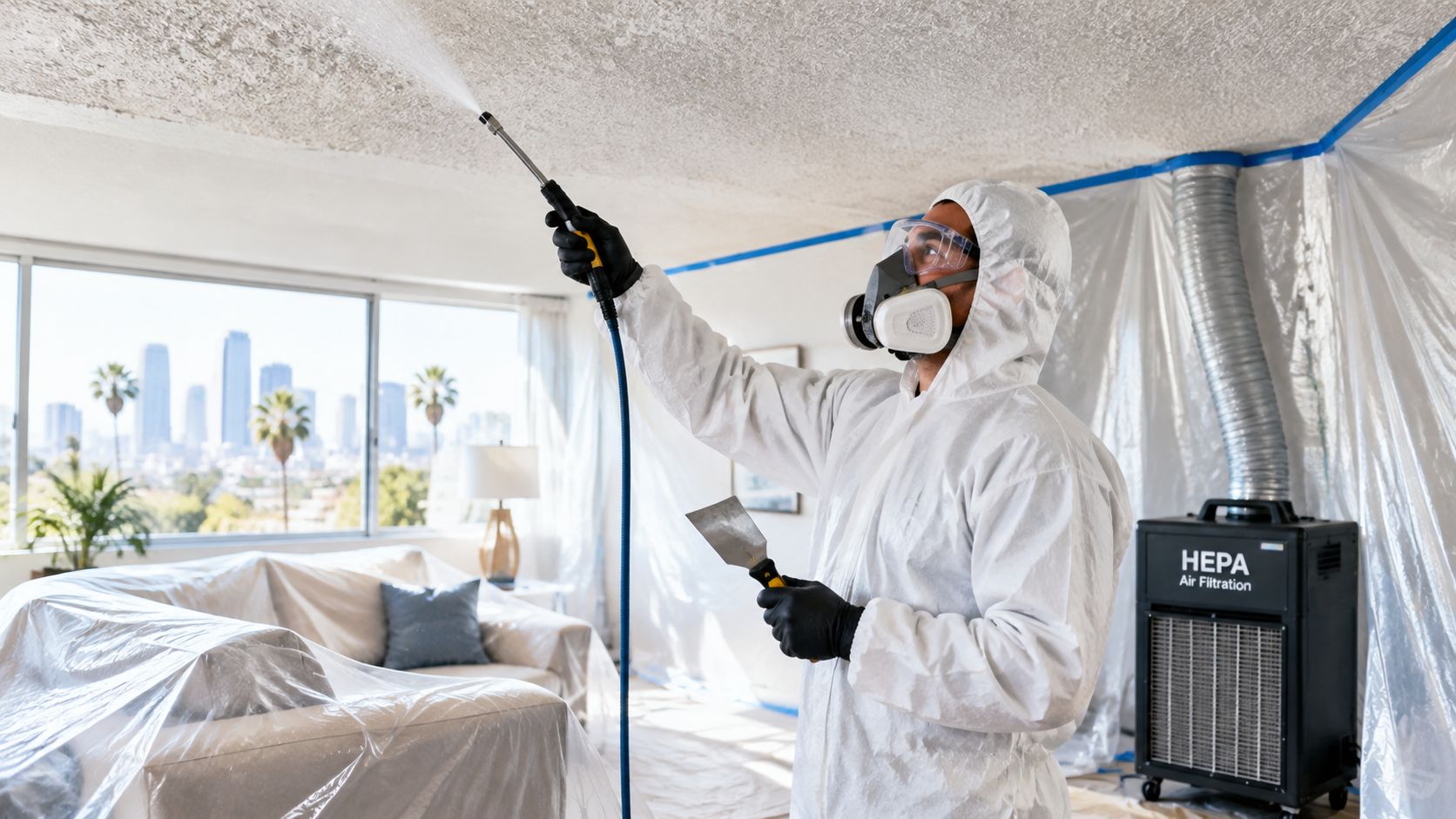
Licensed asbestos abatement contractors generally plan the work area before disturbing the ceiling. Their controls may include regulated-area boundaries, containment, protective equipment, negative-air systems where appropriate, decontamination procedures, waste handling, and disposal documentation. The exact controls depend on the material, building, scope, and applicable requirements.
Why wet methods matter
Authoritative asbestos removal guidance calls for saturating asbestos-containing material with low-pressure amended water before removal, keeping it wet during stripping and bagging, and removing it in sections rather than dry-scraping. Dry removal is limited to special situations and may require written approval. High-pressure spraying is discouraged because it can increase airborne fiber release and create runoff that leaves dry patches. (NASA asbestos control guidance)
A practical wetting benchmark described in asbestos removal guidance is an amended-water solution of about 0.16%, roughly 1 ounce per 5 gallons, or an equivalent surfactant mixture. Low-pressure garden sprayers and coarse-mist equipment are favored over high-pressure water. (Safe Work Australia asbestos removal code)
Why homeowners shouldn't improvise
Dry scraping, sanding, aggressive drilling, and high-pressure spraying can disperse material beyond the immediate ceiling. If fibers enter HVAC returns, wall cavities, furnishings, or occupied rooms, the project can become far more complicated than the original ceiling work. A contractor who discovers suspect material after starting should stop, isolate the area, and arrange professional testing rather than continue.
For an overview of how qualified professionals address removal after testing, see asbestos abatement considerations in Los Angeles. The key boundary is simple: testing determines what is present; licensed abatement professionals determine how regulated removal or control work is performed.
Next Steps to Get Your Popcorn Ceiling Tested in Southern California
Start before the first tool reaches the ceiling. Testing should be scheduled before sanding, scraping, drilling, renovation, or demolition, particularly in older Los Angeles homes and buildings with original spray-applied texture.
A practical project checklist
- Pause ceiling disturbance: Tell workers not to scrape, sand, drill, or mechanically remove the texture until the material has been assessed.
- Gather property information: Note the building age, known remodels, water damage, ceiling repairs, planned work areas, and whether the property is occupied.
- Define the work scope: A contractor's drawings or renovation description helps the inspector identify ceiling materials and adjacent assemblies that may be disturbed.
- Arrange professional sampling: An inspector evaluates homogeneous areas, selects representative samples, documents locations, and uses appropriate handling procedures.
- Request laboratory analysis and reporting: The report should connect results to the sampled locations and planned work, rather than offering an isolated result with no project context.
- Use the results for planning: A qualified owner, contractor, architect, or abatement professional can compare leaving the material in place, encapsulation, overcladding, or controlled removal.
A positive result doesn't automatically dictate one response. An intact ceiling may be managed without removal, while damaged material or planned renovation may require additional controls and coordination. A negative result also has boundaries, because it applies to the materials and areas represented by the sampling.
For homeowners, landlords, general contractors, developers, facility managers, school districts, healthcare organizations, HOAs, and restoration or insurance professionals, asbestos testing in Los Angeles can provide the inspection and documentation needed before project decisions are made. If fire, water damage, mold, lead, ash, soot, char, smoke residue, heavy metals, VOCs, or indoor air quality concerns are present, the same property assessment may identify additional testing needs.
Sensitive Environmental provides professional asbestos testing, pre-renovation and pre-demolition surveys, SCAQMD Rule 1403 documentation, sampling, laboratory coordination, and clear environmental reports for properties throughout Los Angeles and Southern California. Contact Sensitive Environmental to schedule a popcorn ceiling assessment before any work begins and determine the appropriate next step for your property.