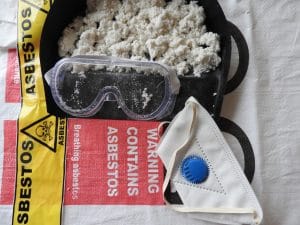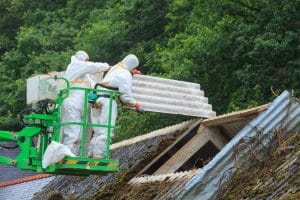
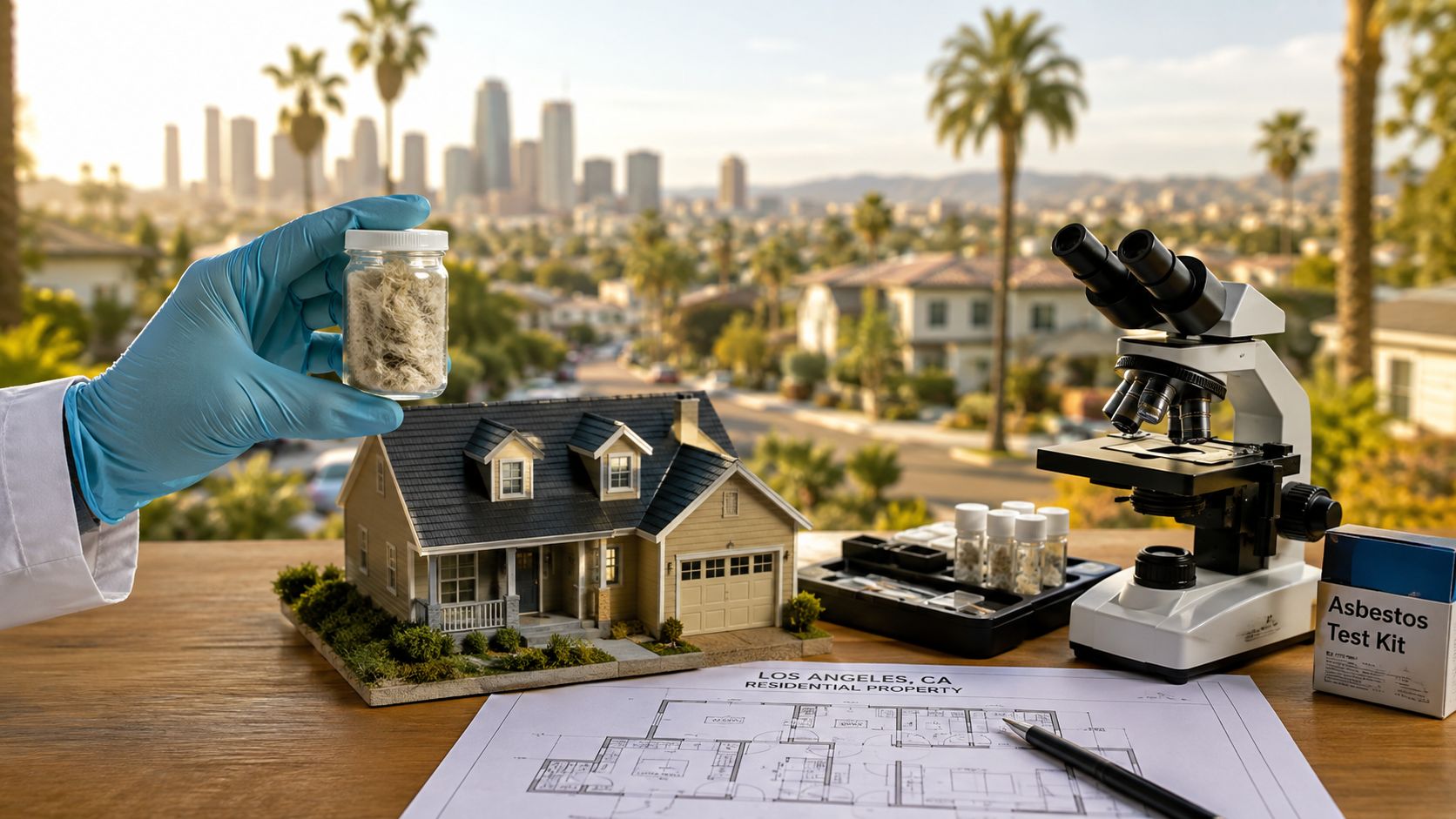
A professional asbestos inspection with laboratory analysis typically costs $250 to $850, with national averages near $482 to $501. The final price depends on how many materials must be sampled and whether you need bulk testing, air testing, or a broader survey.
A Los Angeles homeowner may discover this issue while planning to remove a popcorn ceiling, replace flooring, open a wall, or update an older property before listing it. A contractor may need documentation before renovation can begin, while a property manager may need a report that supports project planning and compliance. In each situation, the question is the same: how much does asbestos testing cost, and what exactly is included?
The answer isn't one flat fee. A single suspect material verified through bulk sampling is a different assignment from a multi-area inspection, an air-monitoring project, or a pre-demolition survey for a commercial building. The difference is similar to comparing a single blood test with a complete medical workup. Both involve laboratory analysis, but the time, sampling plan, documentation, and number of results can vary considerably.
This guide breaks the cost into the decisions property owners and project teams face. It explains what professional asbestos testing includes, how sample count changes pricing, why Southern California compliance requirements can expand the scope, and how to request a quote that reflects the work.
Table of Contents
- Introduction What to Expect to Pay for Asbestos Testing
- Understanding What Asbestos Testing Includes and Why It Matters
- How Much Asbestos Testing Costs by Sample Type and Scope
- Key Factors That Affect Your Asbestos Testing Price
- Residential vs Commercial Costs and Los Angeles Compliance Requirements
- Smart Ways to Budget and Plan for Asbestos Testing
- Schedule Professional Asbestos Testing in Los Angeles and Southern California
Introduction What to Expect to Pay for Asbestos Testing
A homeowner in Los Angeles County might call an environmental testing company after a contractor asks whether the flooring adhesive, ceiling texture, or insulation contains asbestos. The renovation schedule may already be forming, but the testing budget remains unclear. A property manager faces a similar situation when a tenant improvement project requires documentation before work proceeds.
For a typical professional inspection that includes visual assessment, sampling, and laboratory analysis, the commonly cited U.S. benchmark is $250 to $850, while broader market summaries place the national average near $482 to $501 (The Asbestos Institute's residential asbestos testing cost guide). These figures describe testing and inspection work, not asbestos removal, remediation, or construction.
Practical rule: A quote becomes useful only when it states the expected number of samples, the testing method, laboratory fees, and report deliverables.
Southern California projects often require more than an answer to “is this material positive or negative?” A contractor may need a survey that identifies suspect materials throughout the planned work area. A commercial owner may need documentation aligned with the South Coast Air Quality Management District, commonly called SCAQMD. That added scope can affect both the price and the schedule.
The most important budgeting distinction is between testing a material and surveying a property or work area. A limited assignment may focus on one flooring system. A larger assignment may examine several layers, ceiling finishes, pipe insulation, roofing products, wall systems, or other materials that could be disturbed.
The cost also depends on whether the project needs bulk material analysis or air testing. Bulk testing answers whether asbestos is present in a physical building material. Air testing evaluates airborne conditions and may be appropriate for clearance or other project-specific purposes.
Sensitive Environmental provides environmental inspections, sampling, laboratory coordination, and reporting for residential and commercial properties in Los Angeles and Southern California. The right starting point is a clear description of the planned work, not a guess based only on square footage.
Understanding What Asbestos Testing Includes and Why It Matters
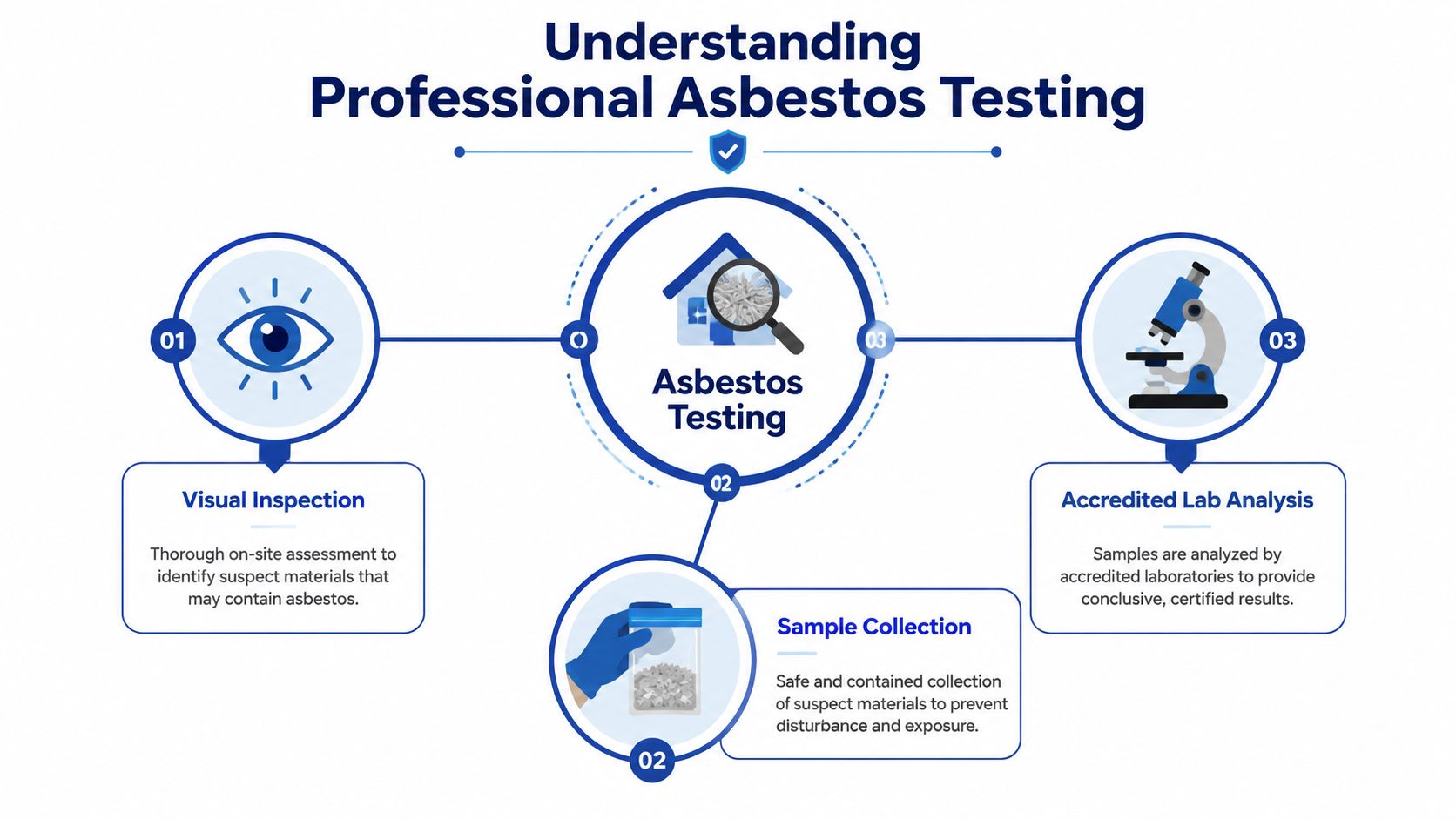
Professional asbestos testing usually combines three activities: a visual inspection, controlled sample collection, and laboratory analysis. The inspector first examines the situation, collects the appropriate specimen, and sends it to a qualified laboratory for a result that can't be determined reliably by appearance alone.
The three parts of a professional assessment
Visual inspection identifies materials that may contain asbestos and considers where renovation, demolition, repair, or maintenance could disturb them. Common suspect materials can include textured ceiling finishes, flooring and adhesives, insulation, pipe coverings, roofing materials, and other older building components. A visual inspection doesn't confirm asbestos content by itself.
Sample collection involves gathering small portions of selected materials using appropriate containment and handling practices. The inspector considers whether separate layers, locations, or visibly different materials need individual samples. A piece of flooring and the adhesive beneath it may not be treated as the same material because they appear to be part of one system.
Laboratory analysis examines the submitted material using the method required for the assignment. The result can identify whether asbestos is detected in the sampled material and can support decisions about work planning, documentation, and additional evaluation. The laboratory report is only as representative as the sample selection and collection process that preceded it.
Why timing matters before construction
Testing is often appropriate before renovation or demolition because construction activities can disturb materials that appear ordinary. A property owner may want an inspection before replacing floors, cutting into walls, removing ceiling finishes, or altering mechanical systems. Commercial projects may require a more systematic survey so the contractor knows which materials fall within the planned disturbance area.
Asbestos is a specific contaminant, separate from lead, mold, volatile organic compounds, and combustion byproducts. If a building also has water damage, fire damage, or indoor air quality concerns, the project may require other services such as professional asbestos hazard information, mold sampling, lead testing, IAQ testing, or fire residue assessment. Those are different investigations and shouldn't be bundled into an asbestos price without defining the scope.
Professional sampling versus DIY kits
DIY kits may appear less expensive because they separate the kit or laboratory fee from the inspection and collection work. They don't necessarily provide the site-wide evaluation, sampling strategy, chain-of-custody documentation, or project-specific report that a contractor, owner, agency, or real estate professional may need.
A professional assignment connects the field observations to the laboratory results. That connection matters when several materials look similar, when access is difficult, or when a report must document what was sampled and where. A positive result also doesn't automatically dictate one specific response. It gives the owner and qualified project professionals information for determining appropriate next steps.
How Much Asbestos Testing Costs by Sample Type and Scope
The most practical way to estimate asbestos testing cost is to identify the assignment type first. A single-material verification, a multi-sample inspection, a full-home survey, and air clearance testing each require different amounts of fieldwork and documentation.
| Testing Scope | Typical Cost Range | What Drives Price |
|---|---|---|
| Single-sample PLM material testing | $200 to $450 | One material, collection requirements, laboratory analysis, and reporting |
| Multi-sample inspection | $350 to $700 | Multiple locations or materials, added collection time, and additional laboratory results |
| Full-home survey | $500 to $900 | Property size, survey coverage, access, sampling plan, and report detail |
| Air clearance testing | $200 to $800 | Number of air samples, building size, project conditions, and clearance documentation |
These ranges are based on a practical asbestos-testing cost breakdown from Peerless Environmental. They show why the phrase “asbestos test” can be misleading. The price reflects the work package, not just the laboratory instrument.
One suspect material
A homeowner who plans to disturb one clearly defined material may need a limited bulk sample assignment. For example, the question may concern one flooring layer in a small renovation area. The cost can remain toward the lower end when the material is accessible, the scope is narrow, and no broader survey is required.
That limited result may not answer questions about other materials elsewhere in the building. If the renovation expands into another room or involves different materials, additional sampling may be appropriate.
Several materials or locations
A multi-sample inspection costs more because the inspector must evaluate and document several locations, collect representative samples, manage separate laboratory submissions, and connect each result to a specific material. A building with similar-looking ceiling finishes in multiple areas may still require a defined sampling plan rather than one casual scrape.
Market summaries commonly place residential testing around $230 to $850, with an average near $482 to $500, and describe additional samples as a major pricing factor (The Asbestos Institute's 2022 asbestos testing cost overview).
Air testing and full surveys
Air testing is a different service from bulk material testing. It may be used when airborne conditions need evaluation, including project-specific clearance work. The building size, number of air samples, and required documentation can move the price within the stated range.
A full-home or pre-renovation survey takes a broader view. It may identify suspect materials throughout the areas affected by planned work, rather than answering a single material question. For contractors and property managers, that broader report can be more valuable than ordering isolated tests and discovering later that the original scope was incomplete.
Key Factors That Affect Your Asbestos Testing Price
Two properties can receive different quotes even when they appear similar from the outside. The price follows the work required to produce a dependable result, including field time, access, samples, analysis, and reporting.
Number of suspect materials
Each additional material can require separate collection and laboratory handling. A popcorn ceiling, vinyl floor tile, mastic, pipe insulation, and textured wall finish may represent different sampling decisions. Testing only the ceiling won't answer whether the flooring adhesive contains asbestos.
The laboratory portion can be relatively modest compared with the total field assignment. Angi's asbestos testing cost analysis describes per-sample laboratory analysis as ranging from $20 to $150, while on-site collection can add roughly $200 to $400. The practical lesson is that a low laboratory fee doesn't equal a low total project price.
Property size and access
A larger home, apartment building, school, office, or industrial facility generally takes more time to review. The inspector may need to cover more rooms, levels, systems, or work areas. Difficult access can also increase field time, particularly when materials are located in crawlspaces, attics, mechanical areas, ceiling plenums, or other restricted locations.
Access should be discussed before the appointment. If a renovation plan identifies only an easily reached floor but the contractor later needs to open a concealed wall, that new location may require additional work.
Laboratory turnaround
Standard laboratory processing and expedited processing can involve different fees and scheduling constraints. A project with a fixed construction start date should identify the required result date before fieldwork begins. Rushing a submission after the inspection can create avoidable cost and schedule pressure.
Inspection and report complexity
A simple result sheet may not satisfy a project that needs a documented survey. Reports can become more involved when they must identify sampling locations, describe materials, connect results to planned disturbance areas, and support contractor or regulatory review.
Air monitoring requirements
Air testing requires different equipment, sampling decisions, and interpretation than bulk material analysis. It can also require more than one air sample, depending on the building and purpose of the assignment. HomeAdvisor's asbestos testing guidance places professional residential inspection and analysis broadly within $250 to $850, while noting that sample count, property size, and the scope of the report affect the final amount.
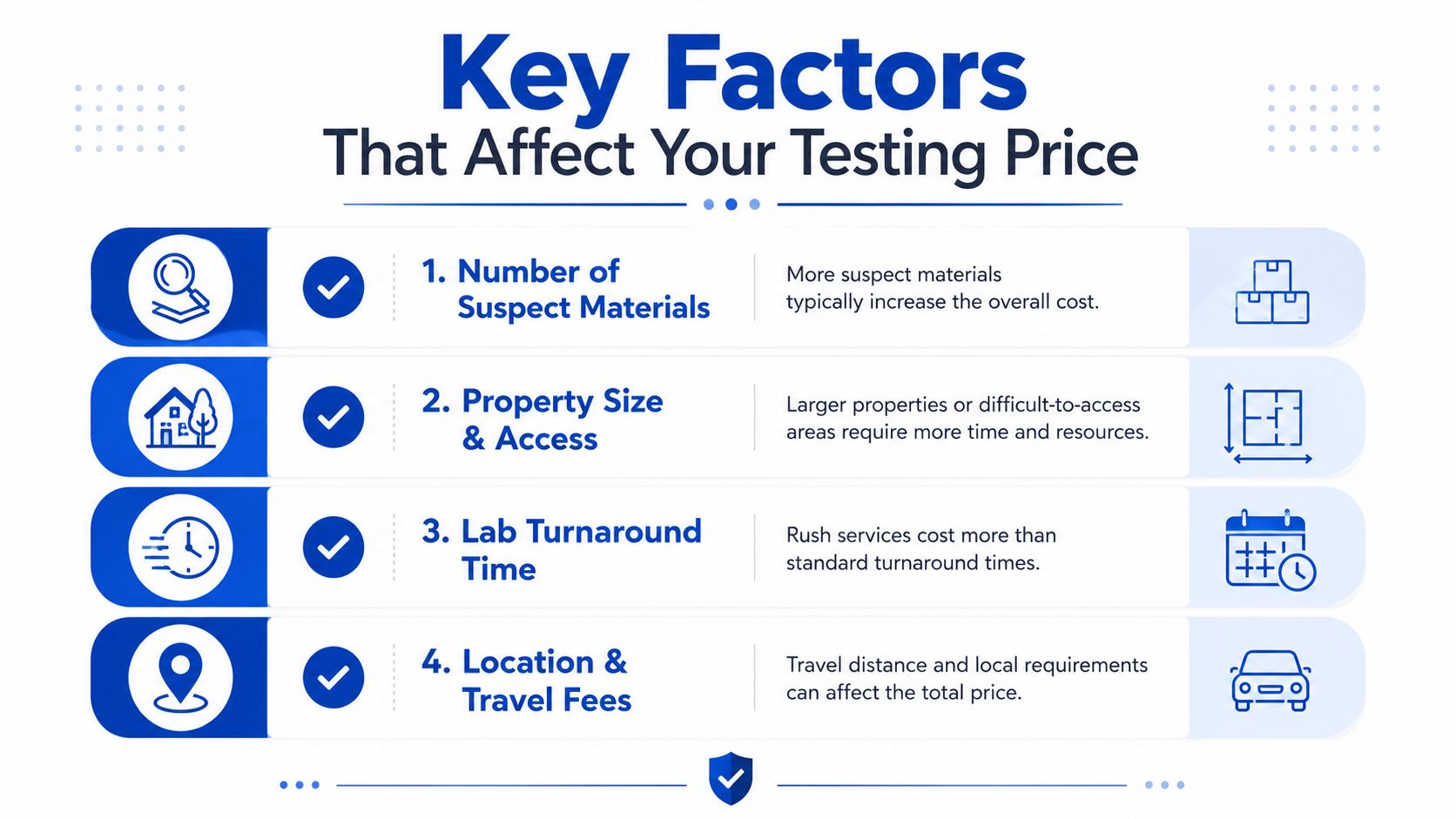
Budgeting insight: Ask whether the quote covers only laboratory analysis or the complete service, including inspection, sampling, chain of custody, and reporting.
Residential vs Commercial Costs and Los Angeles Compliance Requirements
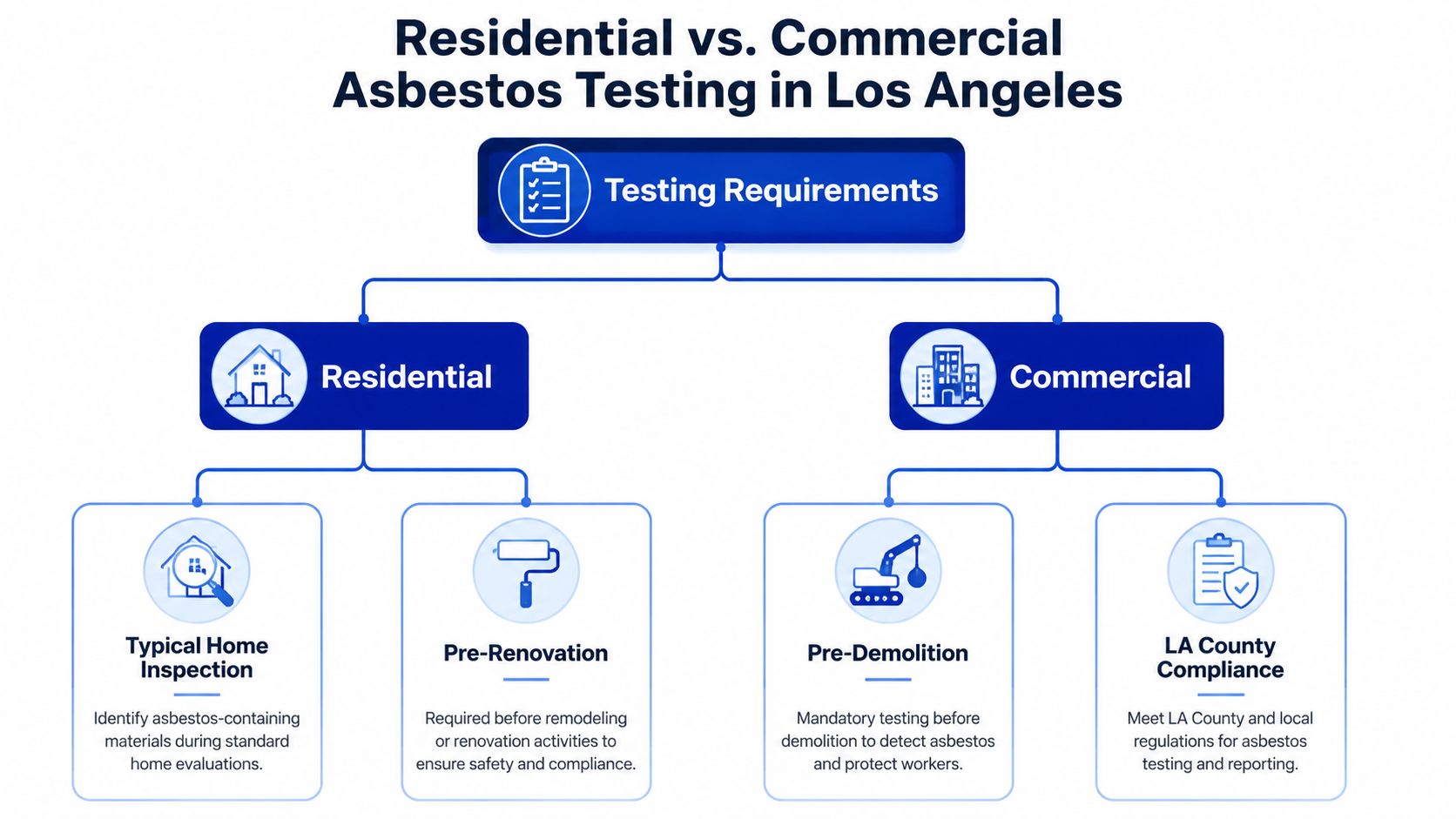
A residential inspection often begins with a focused concern, such as flooring, ceiling texture, insulation, or a planned alteration. Commercial testing usually involves more rooms, materials, systems, stakeholders, and documentation. The difference isn't the size of the building. It's the purpose of the survey and the consequences of incomplete coverage.
A contractor preparing for work in Los Angeles County may need a pre-renovation asbestos survey that documents suspect materials within the disturbance area. A developer planning demolition may need a broader pre-demolition asbestos survey. A property manager may also need records that can be shared with contractors, owners, tenants, inspectors, or agencies.
What SCAQMD Rule 1403 adds
For projects subject to SCAQMD Rule 1403, asbestos sampling must follow 40 CFR Part 763.86. Analyses must use either SCAQMD Method 300-91 or the polarized light microscopy method in Appendix A, Subpart F of 40 CFR Part 763. The laboratory performing the analysis must be NVLAP-accredited, as specified in the SCAQMD Rule 1403 requirements.
These requirements affect scope because the project team needs more than an informal visual opinion. The sampling plan, laboratory method, accreditation, and records must align with the applicable compliance process. A quote should identify whether it includes the documentation needed for the project, rather than assuming that one laboratory result will satisfy every requirement.
Why Procedure 5 matters
SCAQMD Rule 1403 Procedure 5 guidance requires a site survey report documenting the sampling and analysis of suspect asbestos-containing building materials to be abated. That report requirement can add preparation and review time beyond sample collection and laboratory fees. The California asbestos real estate disclosure information can also help property professionals understand why asbestos information matters during transactions and planning.
A useful scope comparison
A homeowner may need a focused inspection before a limited remodel. A commercial owner may need a documented survey covering several areas before a contractor can finalize the work plan. In Southern California, the second assignment can cost more because it includes broader coverage, compliance-oriented sampling, and a formal report.
This is why contractors, architects, engineers, developers, and facility managers should provide renovation drawings, demolition limits, building access information, and agency requirements when requesting a quote. The testing company can then price the actual assignment instead of guessing from the building's general description.
Smart Ways to Budget and Plan for Asbestos Testing
Good budgeting starts before the inspector arrives. Give the testing company the renovation or demolition plan, identify every area that may be disturbed, and list materials that appear different in color, texture, layer, or installation period.
Request an itemized scope
Ask the quote to identify:
- Field inspection: Which rooms, systems, or exterior areas will the inspector evaluate?
- Sample count: How many materials and locations are included?
- Laboratory analysis: Which method and laboratory services are covered?
- Reporting: Will the deliverable be a laboratory result, an inspection report, or a compliance-oriented survey?
- Additional work: How will inaccessible areas, extra samples, or air testing be handled?
This approach helps prevent a common budgeting mistake. A property owner may approve a single sample, then learn that the contractor's actual work affects several materials. Ordering a second visit can cost more than defining the complete scope at the outset.
Coordinate timing with the project team
Schedule testing early enough to allow for laboratory processing, report review, and any follow-up questions. Contractors should provide the exact disturbance limits, especially when work involves flooring layers, ceiling systems, walls, mechanical insulation, or concealed materials.
Property managers should keep the final report with the project records. Developers, facility managers, and commercial owners may also need documentation for due diligence, contractor coordination, notices, or permit-related planning.
Good documentation prevents duplicate work. A clear report lets the next professional understand what was sampled, where it was collected, and what the laboratory found.
Testing doesn't automatically mean that abatement or another specific response is required. Results provide information that property owners and qualified professionals can use to determine appropriate next steps for the planned work and the condition of the material.
Schedule Professional Asbestos Testing in Los Angeles and Southern California
The answer to how much asbestos testing costs becomes clearer when you define the decision in front of you. A single bulk sample, a multi-sample inspection, an air-testing assignment, and a full survey have different field and laboratory requirements. Most standard professional jobs cluster in the mid-hundreds, while broader scope, difficult access, additional samples, or compliance documentation can increase the total.
Los Angeles projects deserve particular attention because renovation and demolition work may require documentation connected to SCAQMD Rule 1403 and Procedure 5. A report that clearly identifies sampled materials, locations, laboratory analysis, and applicable project scope gives homeowners, contractors, property managers, and commercial owners a more practical basis for planning.
Sensitive Environmental offers asbestos testing, inspections, sampling, laboratory analysis, and reporting for residential and commercial properties throughout Los Angeles County and Southern California. The company can also discuss related environmental testing needs, such as lead testing, mold inspections, indoor air quality testing, industrial hygiene assessments, and fire residue testing, when a property has multiple concerns. Asbestos testing remains separate from asbestos abatement services in Los Angeles, and the appropriate next step depends on the documented results and project requirements.
If you're planning a renovation, demolition, property transaction, or compliance-sensitive project, contact Sensitive Environmental before work begins. Share your project plans and suspect materials to discuss professional asbestos testing or a pre-renovation survey and receive a scope-based estimate.
Contact Sensitive Environmental to arrange asbestos testing, sampling, laboratory analysis, or a documented pre-renovation survey in Los Angeles and Southern California. Their team can review the materials and work areas involved, explain whether bulk testing, air testing, or a broader survey fits your project, and help you plan the required environmental documentation.