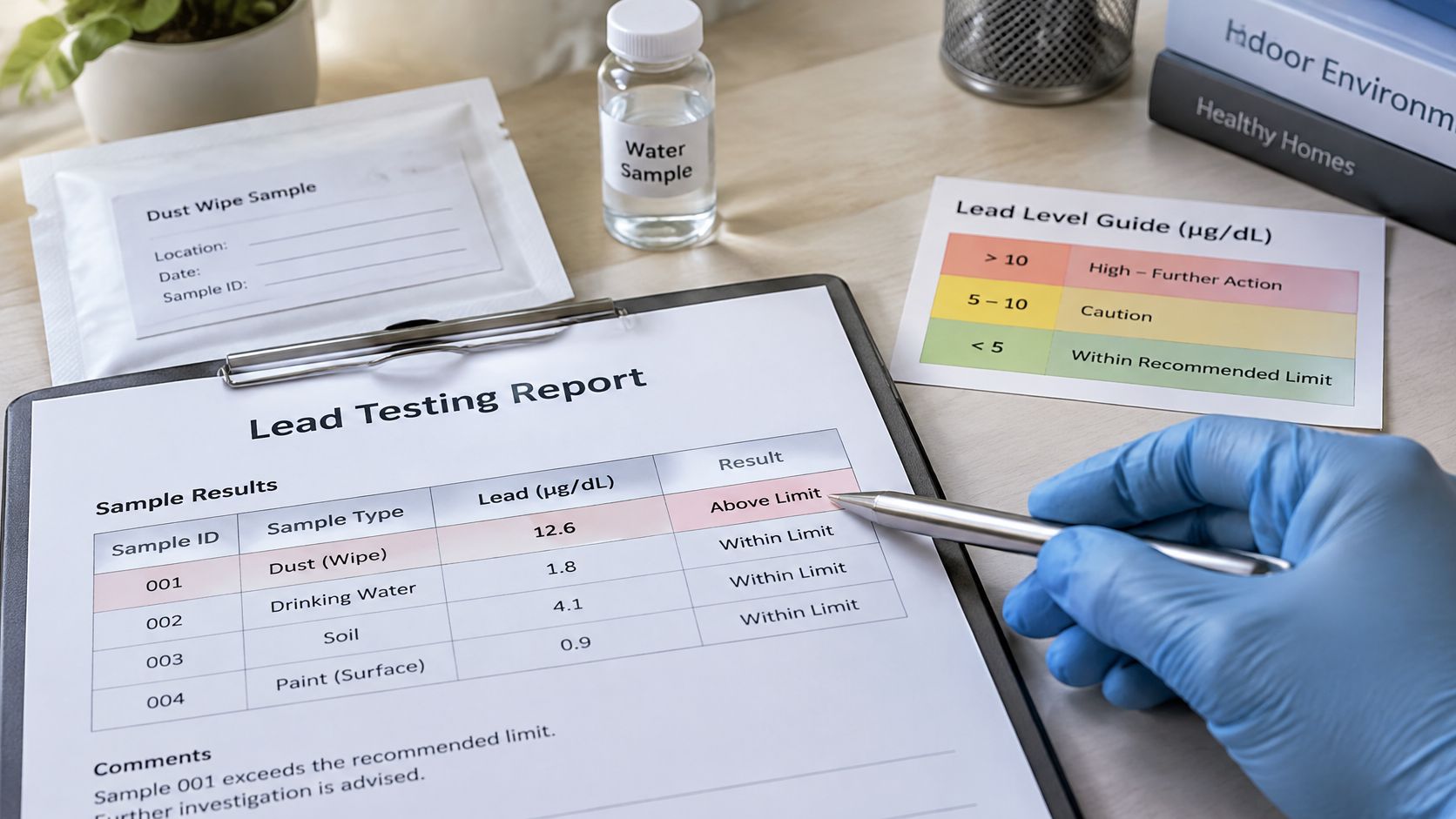
If a lead report says 2.0, is that good news, bad news, or no news at all? Readers often compare that bare number with the first threshold they find online, and that's where reading goes wrong. A 2.0 in blood, a 2.0 on a dust wipe, and a 2.0 in paint measure completely different things.
Learning how to read lead test results starts with slowing down. You need the sample type, the unit beside the number, the surface or person sampled, and the purpose of the test before any comparison makes sense. For Los Angeles homeowners, landlords, contractors, and property buyers, that discipline prevents two expensive mistakes, treating a document problem as a health verdict and treating a failing surface as if it passed because another room looked fine.
Table of Contents
- Start With the Unit and Sample Type
- Set Each Result Against the Right Threshold
- Read Dust, Soil and Lab Report Fields Together
- Next Steps for Each Result Range
- California and Los Angeles County Lead Rules
- Schedule Professional Lead Testing in Los Angeles
Start With the Unit and Sample Type
A lead number means nothing until you can name what's being measured. Blood testing measures lead circulating in a person, dust wiping measures lead sitting on a surface, soil testing measures lead mixed into ground material, and paint analysis measures lead inside a coating. You can't line those numbers up and rank them.
The federal lead-based paint rule at 24 CFR 35.1320 illustrates why purpose matters too, because federal rules distinguish risk-assessment, lead-hazard-screen, reevaluation, and clearance thresholds, and dust results use µg/ft², soil uses ppm or µg/g, and blood uses µg/dL. Those numbers can't be compared or converted into a personal health result.
Lead Result Units by Sample Type
| Sample type | Typical unit | What the number measures | Where it appears |
|---|---|---|---|
| Blood lead | µg/dL (micrograms per deciliter) | Lead circulating in the body | Blood test report for a child or adult |
| Dust wipe | µg/ft² (micrograms per square foot) | Lead loading on a floor, window sill or window trough | Dust sampling report |
| Soil | µg/g or ppm | Lead concentration in soil | Soil laboratory report |
| Paint | % by weight or mg/kg (lab); mg/cm² (XRF reading) | Lead content of the paint sampled | Paint analysis or XRF inspection report |
| Air | µg/m³ | Airborne lead concentration | Air sampling report |
| Drinking water | µg/L (ppb) | Lead concentration in tap water | Water laboratory report |
Use a three-step check before you look at any threshold. First, find the sample type in the report header. Second, confirm the unit printed beside the number, not the unit you expected. Third, note the collection and report dates, because an older report may quote an older reference value.
You'll also see ND, which means nondetect. That doesn't mean zero lead. It means the laboratory didn't measure a value above its reporting limit, the smallest value it can quantify with that method. If the reporting limit sits close to the threshold you're comparing against, ND gives you less certainty than a low numeric result does.
Practical rule: If you can't state the sample type, unit, location, and date in one sentence, you're not ready to judge the number yet.
Keep this checklist beside any report:
- Sample identified: Blood, dust, soil, paint, air, or water is named in the header.
- Unit confirmed: The unit matches the sample type in the table.
- Location recorded: The room, surface, or person is clear.
- Dates checked: Collection and reporting dates tell you which standards applied.
Set Each Result Against the Right Threshold
Thresholds only work when you pick the right row first. Match the sample type, then the surface or area, then the purpose of the test, and only then read the number.
Lead Thresholds by Sample, Surface and Framework
The table collects the thresholds most often cited on residential reports, and the framework column matters as much as the number. When a report names an agency rule or a contract standard, that citation controls which row applies.
| Sample and surface | Threshold | Framework or purpose | Meaning at or above the value |
|---|---|---|---|
| Child blood lead, ages 1–5 | 3.5 µg/dL | CDC blood lead reference value (2021) | Higher than most children; follow-up advised |
| Child blood lead | 10 µg/dL | Former CDC level of concern | Triggered medical and public-health response under earlier guidance |
| Floor dust wipe | Any reportable level | EPA dust-lead hazard standard (2024 rule) | Hazard for residential interpretation |
| Floor dust wipe | 5 µg/ft² | EPA post-abatement clearance (2024 rule) | Fails clearance; re-clean and retest |
| Interior window sill dust wipe | Any reportable level | EPA dust-lead hazard standard (2024 rule) | Hazard for residential interpretation |
| Interior window sill dust wipe | 40 µg/ft² | EPA post-abatement clearance (2024 rule) | Fails clearance; re-clean and retest |
| Window trough dust wipe | 400 µg/ft² | HUD clearance | Fails clearance |
| Window trough dust wipe | 100 µg/ft² | EPA post-abatement clearance (2024 rule) | Fails clearance; re-clean and retest |
| Bare residential play area soil | 400 µg/g | HUD soil guideline | Exceeds guideline |
| Non-play yard soil, averaged | 1,200 µg/g | HUD soil guideline | Exceeds guideline |
Blood Results Are a Population Reference, Not a Safety Line
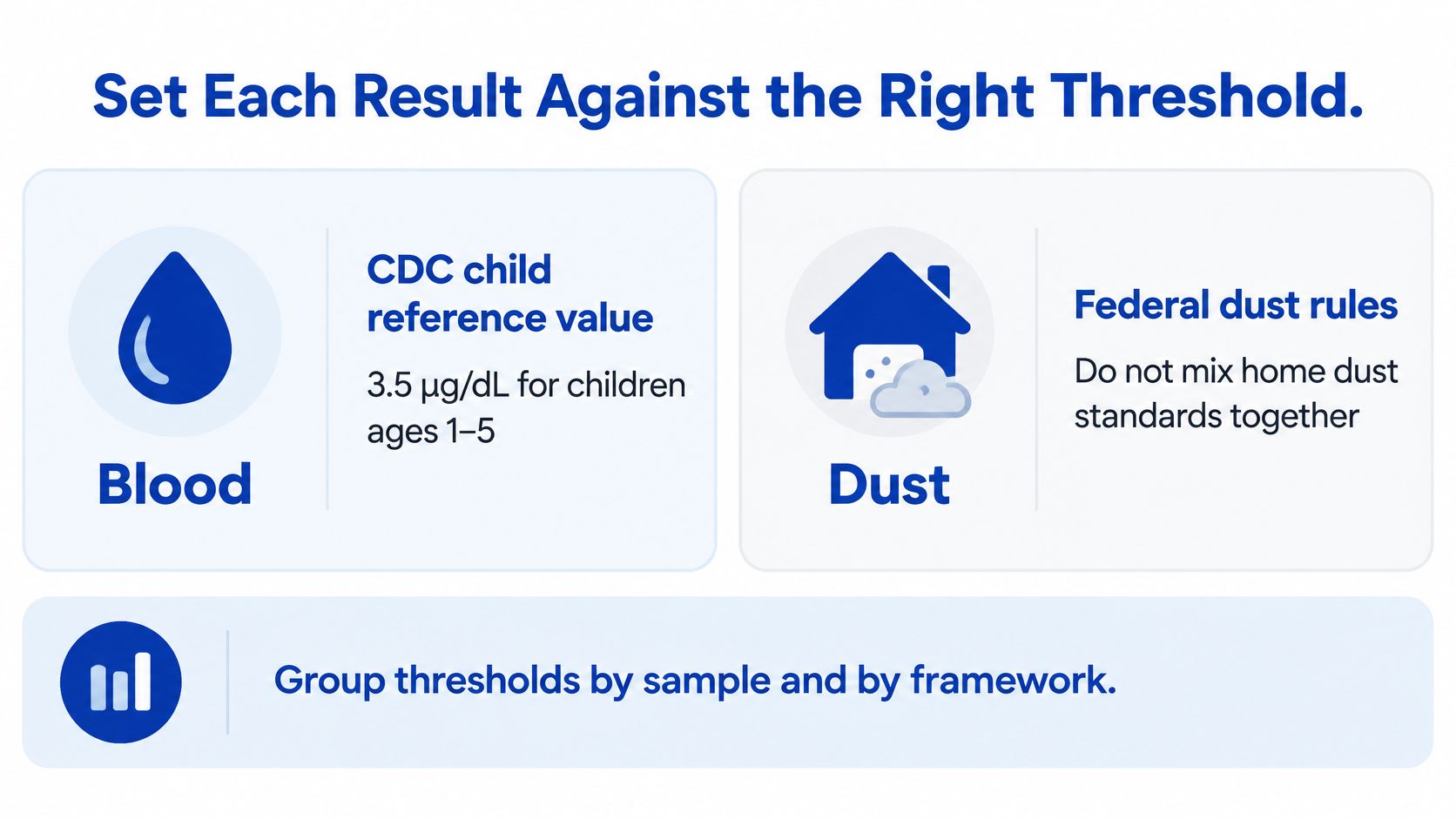
Parents often read 3.5 µg/dL as a pass or fail line. It isn't. The CDC update on its blood lead reference value explains that on October 28, 2021, CDC lowered the value for children from 5.0 to 3.5 µg/dL, calculated from NHANES data collected during 2015–2016 and 2017–2018 using the 97.5th percentile among U.S. children ages 1–5.
A result at or above 3.5 µg/dL places a child among approximately the highest 2.5% of measured levels in that age group. Don't read 2.0 µg/dL as proof of zero risk. The value is a screening reference. It marks where a child sits relative to peers, and it does not identify a toxicity cutoff or a point below which exposure is proven harmless.
The 10 µg/dL level of concern comes from earlier CDC guidance and sits in a different category. A result between the reference value and that level still calls for medical follow-up and a look at likely sources. The gap between those numbers confuses many families, so ask the clinician two separate questions: what does this number show today, and what follow-up does this range trigger.
Dust and Soil Frameworks Don't Mix
Dust creates the most confusion because hazard levels and clearance levels answer different questions. A hazard level asks whether settled dust in a home presents a hazard under a residential rule. A clearance level asks whether an area can pass after work and cleaning, and it works like the cleanliness check a crew must clear before the job is signed off. The same floor can sit below one value and above the other, and both statements can be true at once.
The table keeps the hazard rows separate from the tighter post-abatement clearance rows, and the HUD clearance row sits apart from the 2024 EPA rows. Older reports may quote earlier numeric hazard values for floors and sills, so the report date tells you which version applied.
Soil works the same way, by area rather than by surface. Bare soil where children play gets judged differently from other yard areas, and the non-play value applies as an average across qualifying areas rather than to every single scoop of soil. A report that doesn't say where the soil came from leaves you unable to pick the right row.
Exceeding a threshold triggers a documented next step. It doesn't hand you a final verdict about a person's exposure, and it doesn't, by itself, dictate a specific scope of work. Write down the row you used, the framework named on the report, and the date, so anyone reviewing the file later can follow your reasoning.
Read Dust, Soil and Lab Report Fields Together
Open a dust report and resist the urge to hunt for the biggest number first. The fields around the number decide what it means. Work through them in order.
- Sample type and units: Confirm the report names a dust wipe, soil, paint, or blood sample and shows the matching unit.
- Surface and room: Each dust result should name the floor, sill, or trough and the room or work area.
- Single-surface or composite: Note how many subsamples went into one laboratory result.
- Reporting limit and ND: Check the smallest value the lab could quantify.
- Laboratory accreditation: Look for the lab's name and credentials, including EPA National Lead Laboratory Accreditation Program recognition where federal lead-based paint work applies.
- Blanks, recovery, and chain of custody: Confirm dates, signatures, and quality-control entries are complete.
Why the Surface Changes the Answer
The EPA page on hazard standards and clearance levels for lead in paint, dust and soil notes that in October 2024 EPA reduced post-abatement dust-lead action levels from 10 to 5 µg/ft² on floors, from 100 to 40 µg/ft² on window sills, and from 400 to 100 µg/ft² on window troughs for pre-1978 homes and childcare facilities. EPA also changed the hazard definition so any reportable level measured by an EPA-recognized laboratory can qualify as hazardous under the applicable rule.
Here's the worked example that makes this concrete. A 20 µg/ft² result exceeds the floor action level but remains below the window-sill action level, while a 60 µg/ft² result exceeds both, as the EPA hazard standards page example shows. So "is 20 high?" has no answer until you say which surface it came from.
A number that passed under an older standard may now fail. If you're comparing a new report with one from a few years ago, check which version of the level each report used before you conclude conditions got worse.
Composite Samples and Coverage
The HUD lead-based paint hazard guidance document sets clearance thresholds at 40 µg/ft² for floors, 250 µg/ft² for interior window sills, and 400 µg/ft² for window troughs under the HUD/EPA framework it describes. For a composite of two to four subsamples, that guidance divides the applicable standard by one-half the number of subsamples, so a four-subsample composite is compared with one-half of the listed threshold.
Treat a result equal to the limit as a failure, not as a near miss. And keep each result inside the area it represents. Representative coverage means floor and sill samples in each sampled room or work area, with trough samples where relevant. Averaging unrelated rooms into one low value can hide the one failing location, which is exactly the location a child may crawl across.
A passing sample in the kitchen doesn't offset a failing sample in the nursery.
For clearance work, the sequence matters as much as the number. The area gets a visual inspection and final cleaning first, dust collection happens no sooner than one hour after cleaning so airborne dust can settle, and then each result is compared with its action level. A failed area is re-cleaned and retested, not balanced out by passing samples elsewhere.
Soil reports need the same discipline. The report should state whether the sample came from a play area, bare soil, or a non-play yard, and whether several samples were averaged. Without that, you can't tell which benchmark applies.
Paint results belong in this review too, and our page on what lead-based paint looks like helps you connect visual clues with sampling decisions. We recommend having paint chip samples analyzed for the most accurate lead paint results, rather than relying on an XRF gun reading alone. A field reading tells you where to sample, a laboratory chip result gives you a number another party can review.
Next Steps for Each Result Range
A result starts a decision. It doesn't settle one. Each range below points to a different conversation, whether that's with a pediatrician, a testing firm, a landlord, or a contractor planning work.
Next Steps by Lead Result Range
| Result range | What it indicates | Typical next step |
|---|---|---|
| Blood below 3.5 µg/dL | Below the population reference; not proof of zero exposure | Follow medical guidance; retest if exposure is suspected |
| Blood 3.5 to under 10 µg/dL | Above most children's levels | Medical follow-up and investigation of possible sources |
| Blood 10 µg/dL or higher | Level of concern | Prompt medical and public-health response |
| Dust at or above hazard level | Hazard under the applicable residential rule | Professional assessment and source identification |
| Dust below action level | Passing result for that surface only | Confirm all sampled surfaces and rooms were covered |
| Clearance result at or above action level | Represented area fails clearance | Re-clean and retest that area |
| Paint result positive | Lead is present in the paint sampled | Qualified assessment of paint condition; not automatically removal |
A blood result below the reference value calls for proportion, not dismissal. If your child spends time in an older home with peeling paint, recent renovation dust, or bare soil in a play area, tell the clinician about that exposure history even when the number is low. Ask whether the sample was a capillary fingerstick screen or a confirmatory venous draw. A high screening result often gets confirmed with a venous sample before anyone acts on it.
For results above the reference value, two tracks run at the same time. The medical track covers follow-up testing, nutrition and developmental questions, and reporting where required. The environmental track looks for sources: deteriorated paint, household dust, soil, and drinking water. That second track is what interrupts exposure. Skipping it leaves the likely source in place while the next test measures it again.
Dust results call for a more mechanical response. A hazard-level result points to professional assessment and source identification, because wiping a surface clean today does nothing if friction at a window keeps generating new dust tomorrow. A below-action-level result clears only the surface sampled, so confirm coverage room by room before describing the property as passing.
A failed clearance has a narrower meaning than many owners assume. It doesn't prove anyone was exposed. It means the represented area didn't meet the standard the project required, so that area gets re-cleaned and retested. Keep occupants, scheduling, and payment decisions tied to that specific area rather than the whole building, unless the governing document says otherwise.
Paint results mislead in the opposite direction. A positive result proves lead is present in the paint sampled. It doesn't automatically mean removal is required, because intact paint in good condition is a different situation than peeling, chipping, or friction-damaged paint. Homes built before 1978 can be assumed to have lead paint, so the useful question is usually condition and planned disturbance, not presence alone. If you're weighing how a positive paint finding affects planned work in an older Los Angeles building, our overview of lead abatement considerations in Los Angeles explains how testing informs decisions before occupants or workers are put at risk.
Good records help beyond testing, too. The same habit of matching a problem to the right professional applies when families deal with unrelated matters, such as asesoría tras un choque en Lake Elsinore from LA Law Group, APLC. Keep every report organized and complete.
Use this table as a starting point for a conversation with a qualified professional. Bring the full report, not a screenshot of one number, and be ready to say what changed in the property since sampling.
California and Los Angeles County Lead Rules
A Southern California reader may meet several layers of rules on the same property. The federal EPA and HUD framework covered here applies broadly to older housing and childcare facilities. State and county requirements can add their own obligations for rental housing, schools, and childcare-related property, and those obligations may arrive as a notice, an order, or a condition inside a permit or funding program.
That's where reports get misread. A state or county document may use a different sample design, a different comparison value, or a different reporting form than the federal table you found online. If you force a county-ordered result into a federal row, you may conclude a property passes when the agency that ordered the test expects something else entirely.
Run three questions before comparing any number:
- Property type: Is it a single-family home, rental unit, school, childcare facility, or commercial space?
- Who requested it: Did an agency, a lender, a buyer, a school district, or the owner commission the test?
- Purpose: Is this a clearance, a risk assessment, a hazard screen, or a routine inspection?
Write the answers on the front of the file. Then look for the rule the report itself cites, in the laboratory narrative, the inspector's cover letter, or the agency notice that prompted the work. That citation, not a general web search, tells you which standard governs.
Bring the agency notice with the lab report. One document without the other often can't be interpreted.
Be careful with state-specific thresholds quoted from memory or from old handouts. Quote them only from current primary sources, because forms, reporting duties, and reference values change over time and an outdated printout can send a landlord or school in the wrong direction. If a Los Angeles County or city jurisdiction issued a notice, bring that notice and the full laboratory report to your consultation so the reviewer can confirm which standard applies before recommending new sampling.
For landlords and property managers, keep tenant communications factual and tied to the documents. State what was sampled, what the laboratory reported, and what step comes next. Don't promise that a single passing result proves a property is safe, and don't tell a tenant a result requires work that no qualified assessment has yet determined.
Schedule Professional Lead Testing in Los Angeles
DIY lead kits have one legitimate use, a rough first look for your own curiosity. They fall short the moment another party must rely on the result. A landlord, school, buyer, or contractor needs certified laboratory analysis, documented sample locations, a chain of custody, and a formal report, and a store-bought swab provides none of that. It also can't tell you how much lead is present, only that a color changed.
Professional lead testing in Los Angeles starts with a property walkthrough and a lead paint inspection, followed by lead dust and surface sampling, exposure risk assessments, and certified laboratory analysis. You receive written reporting with sample locations, units, comparison values, and clear next steps, which is what lets you act on the number rather than argue about it. Our lead testing in Los Angeles, CA page describes how that process works for residential and commercial properties across Los Angeles County and Southern California.
We provide testing, documentation, and reporting. Decisions about any later work are made after that assessment, by qualified contractors, based on what the results and paint condition show. That separation protects you, because the firm reading your report has no interest in inflating the scope of work that follows.
If part of your concern is tap water rather than paint or dust, it's reasonable to compare home water testing options from Praz Pure Water, Inc. alongside your other sampling, so each potential source gets tested with the right method and unit.
Take one concrete step today. Gather these items before you call:
- The full lab report: Include every page, not just the results summary.
- Sample details: Dates, rooms, and surfaces sampled.
- Project timeline: Renovation, cleaning, or occupancy dates.
- Property background: The year the property was built and any agency notices.
We offer a free, no obligation consultation for environmental testing or for an existing asbestos, lead, or mold problem. You can call 310-387-5404 or request an appointment online to schedule an environmental testing inspection, and bring the documents above so we can tell you whether your existing report can be read as it stands or whether new sampling is needed.
If a lead report has left you unsure which threshold applies, whether a composite result really passed, or whether a positive paint finding requires further assessment, Sensitive Environmental can review the documents, inspect the property, and collect properly documented samples for certified laboratory analysis. Reach out for a free, no obligation consultation and bring your lab report, sample dates, and any agency notice, so your next decision rests on numbers that are matched to the right unit, surface, and rule.