Your contractor is ready to replace the window trim and pull up the kitchen floor, but someone asks whether the old materials contain asbestos or lead. Suddenly, a straightforward renovation needs an environmental testing plan. The useful question isn't just whether asbestos and lead paint are present. It's which materials the work will disturb, what testing can establish, and what information your project team needs before proceeding.
For Los Angeles property owners, treating these hazards as one renovation decision helps avoid gaps between separate inspections. A coordinated assessment can connect the painted trim, underlying wall finishes, flooring, and adhesives to the actual construction scope without assuming every positive result requires removal.
Table of Contents
- Where Asbestos and Lead Paint Overlap in Older Buildings
- How Asbestos and Lead Exposure Affects Health
- How Professional Testing Works for Each Hazard
- Reading Lab Results for Both Hazards
- Asbestos and Lead Rules in Southern California
- How to Sequence Work When Both Hazards Are Present
- Confirm the Testing Scope Before Renovation Begins
Where Asbestos and Lead Paint Overlap in Older Buildings
A renovation in a home built in the 1960s might involve replacing painted window trim and removing kitchen flooring, including its adhesive. The trim and floor are different materials, yet they belong in one project assessment if the work will disturb both. Testing should follow the renovation scope, not treat each hazard as an unrelated checklist.
Homes built before 1978 can be assumed to have lead paint. This is a planning assumption, not proof that every painted surface contains lead. Asbestos requires a separate material-based evaluation. In most cases, you cannot identify it by sight alone, so an old-looking finish or a material in good condition cannot confirm whether it contains asbestos.
The U.S. Environmental Protection Agency reports that HUD's American Healthy Homes Survey II estimated 34.6 million U.S. homes, or 29.4% of housing units, still contain lead-based paint applied before the residential ban. That broader estimate does not establish what is present in a particular home.
Likelihood of each hazard by building component
Use these categories to identify materials that may warrant attention, not to diagnose a property. Lead paint testing and appropriate asbestos sampling are needed to establish what the materials contain.
| Building component | Lead paint | Asbestos | Why it matters during work |
|---|---|---|---|
| Window sashes, trim and troughs | Common | Less common, possible in glazing putty | Friction or sanding can create lead dust near occupied rooms |
| Interior walls and ceilings | Common in pre-1978 homes | Possible in textured coatings and joint compound | Sanding or demolition may disturb either hazard |
| Floor tile, mastic and sheet flooring | Unlikely on tile | Common in older suspect products | Cutting, scraping or removal can disturb suspect materials |
| Pipe, boiler and duct insulation | Unlikely | Common in older suspect insulation | Disturbance may release asbestos fibers |
| Exterior siding and trim | Common | Possible in cement siding and shingles | Weathering and renovation can affect paint and underlying material |
| Roofing and flashing | Possible on metal flashing | Common in older asbestos-cement roofing | Repairs may disturb more than one suspect material |
Trace the contractor's work from windows through walls, floors, mechanical systems and exterior components. New finishes can conceal older layers, so include any underlying material the project will expose. The guide to what lead-based paint looks like can help identify possible warning signs, but appearance alone cannot confirm lead content.
Environmental testing can inform whether older features are preserved, repaired or replaced before the construction scope is fixed. For broader context on renovation decisions, see historic house remodeling costs and trade-offs.
Planning tip: Mark every component the work will touch, including hidden layers. Where planned work crosses different materials, coordinate the assessment around those disturbance points.
How Asbestos and Lead Exposure Affects Health
An intact asbestos-containing sheet is loosely comparable to a sealed jar: its contents are less accessible until someone damages the container. Cutting or sanding can open that container. The analogy explains the importance of disturbance, but it doesn't establish that an intact material poses no exposure concern.
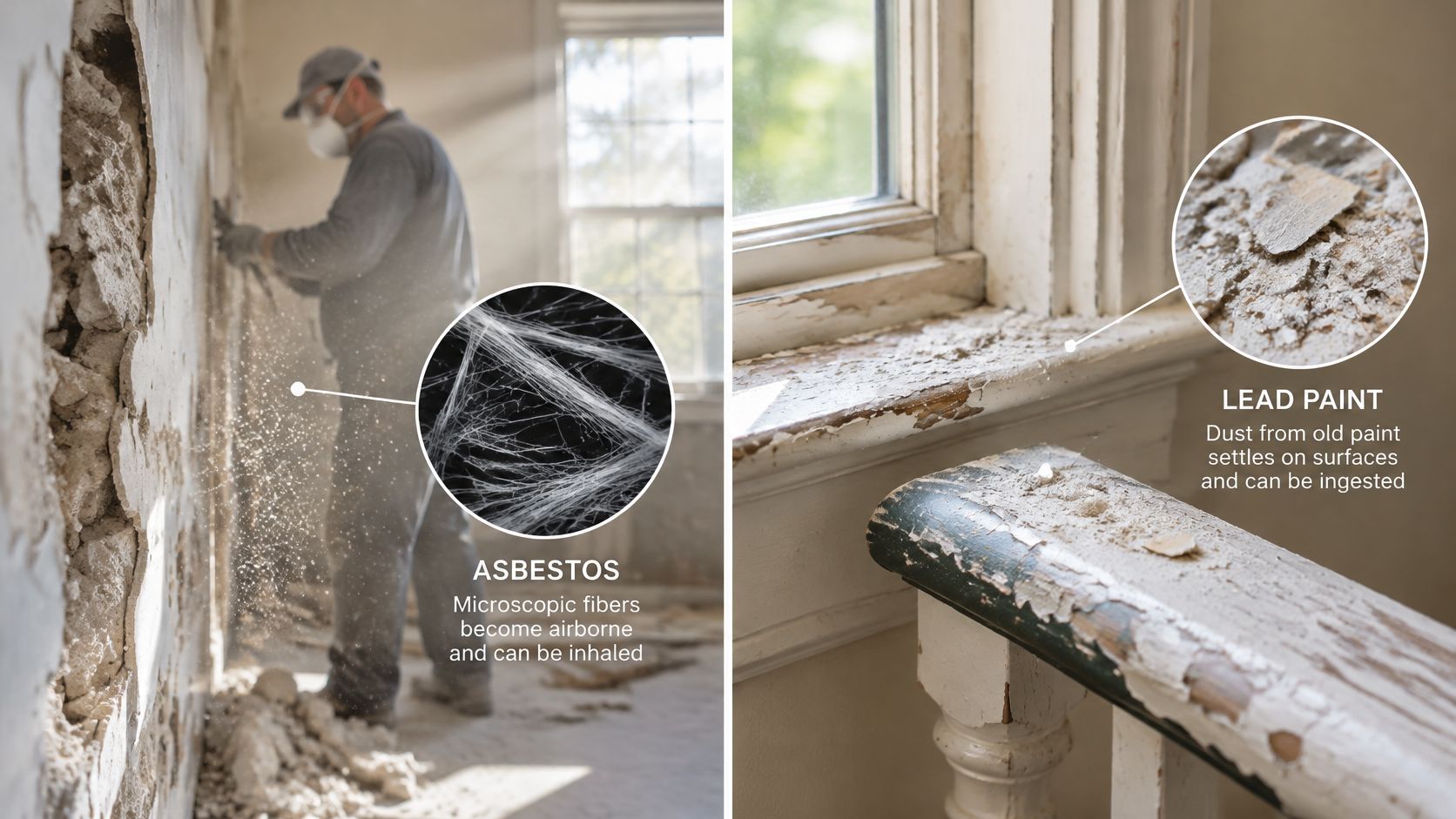
Asbestos and lead follow different pathways. Asbestos fibers are primarily an inhalation concern, while lead-contaminated dust can be swallowed or inhaled. An assessment needs to consider both the material and the route by which people could encounter it.
Asbestos fibers and breathing exposure
The World Health Organization identifies asbestos exposure as a cause of asbestosis, lung cancer, mesothelioma, and cancers of the larynx and ovary, and, using joint WHO–International Labour Organization estimates for 2016, attributes more than 200,000 deaths worldwide each year to occupational exposure. That's a global occupational estimate, not a prediction of risk from a particular home.
Construction and building-maintenance workers can encounter fibers when they disturb asbestos-containing products. Occupants may also be exposed when damaged or friable materials release fibers. Friable means material can readily crumble, making its condition important to the inspection.
Our explanation of why asbestos is dangerous provides additional context for understanding fiber release without treating every suspect material as an immediate emergency.
Lead dust and everyday contact
A stable painted wall is like a closed book; rubbing window parts and deteriorating paint are more like pages coming loose. Lead-bearing particles can settle on surfaces people touch, including floors and window sills. Children deserve particular attention because floor play and hand-to-mouth activity create opportunities to swallow dust.
The environmental testing question is therefore more specific than whether an old finish exists. It's whether the planned activity or current condition could create an exposure pathway, and which samples can meaningfully evaluate that concern.
How Professional Testing Works for Each Hazard
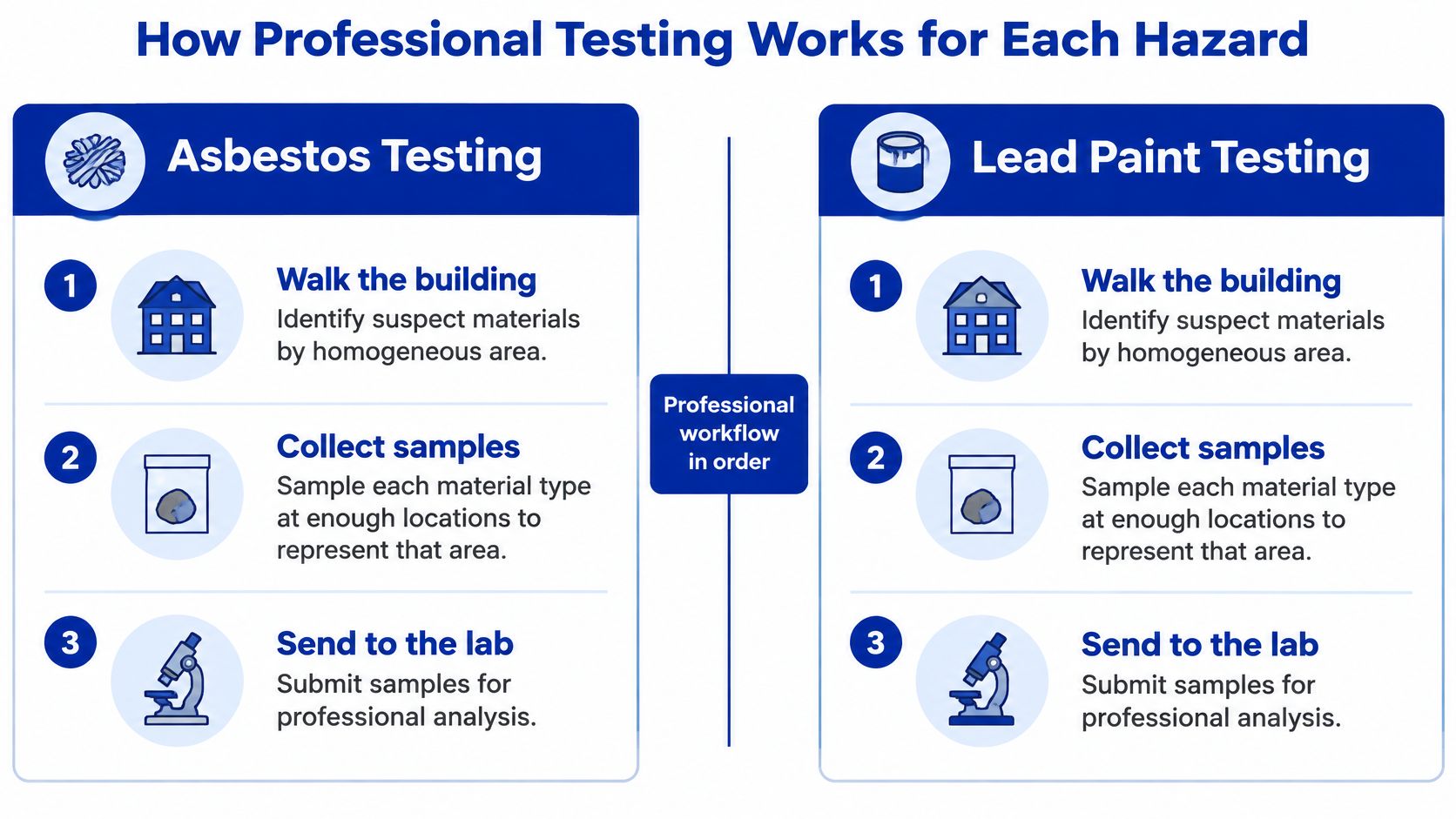
A professional assessment starts with the work plan, not a random sample. The inspector needs to know whether workers will repaint a surface, cut through it, remove it entirely, or expose material underneath it.
The inspection and sampling workflow
- Walk the building and map suspect materials. Identify components and group apparently uniform materials into homogeneous areas, meaning areas with similar appearance and installation characteristics.
- Select representative sampling locations. Collect enough samples to address each material area and its relevant layers. Similar-looking finishes installed during different renovations may need separate evaluation.
- Submit material samples for laboratory analysis. Bulk asbestos samples and paint chips go to an appropriately accredited laboratory with documented sample identification and chain of custody.
- Evaluate exposure-related sampling needs. Dust wipes, air sampling, or an industrial hygiene assessment may be appropriate when the concern involves occupants, work activities, or residual contamination.
- Connect results to the project. The written report should identify sample locations, methods, findings, limitations, and their relationship to planned work.
In most cases, asbestos can't be identified by looking at it. Recognizable applications include asbestos-insulated ducting and white asbestos tape on air-handling systems, but visual recognition isn't a substitute for documented identification.
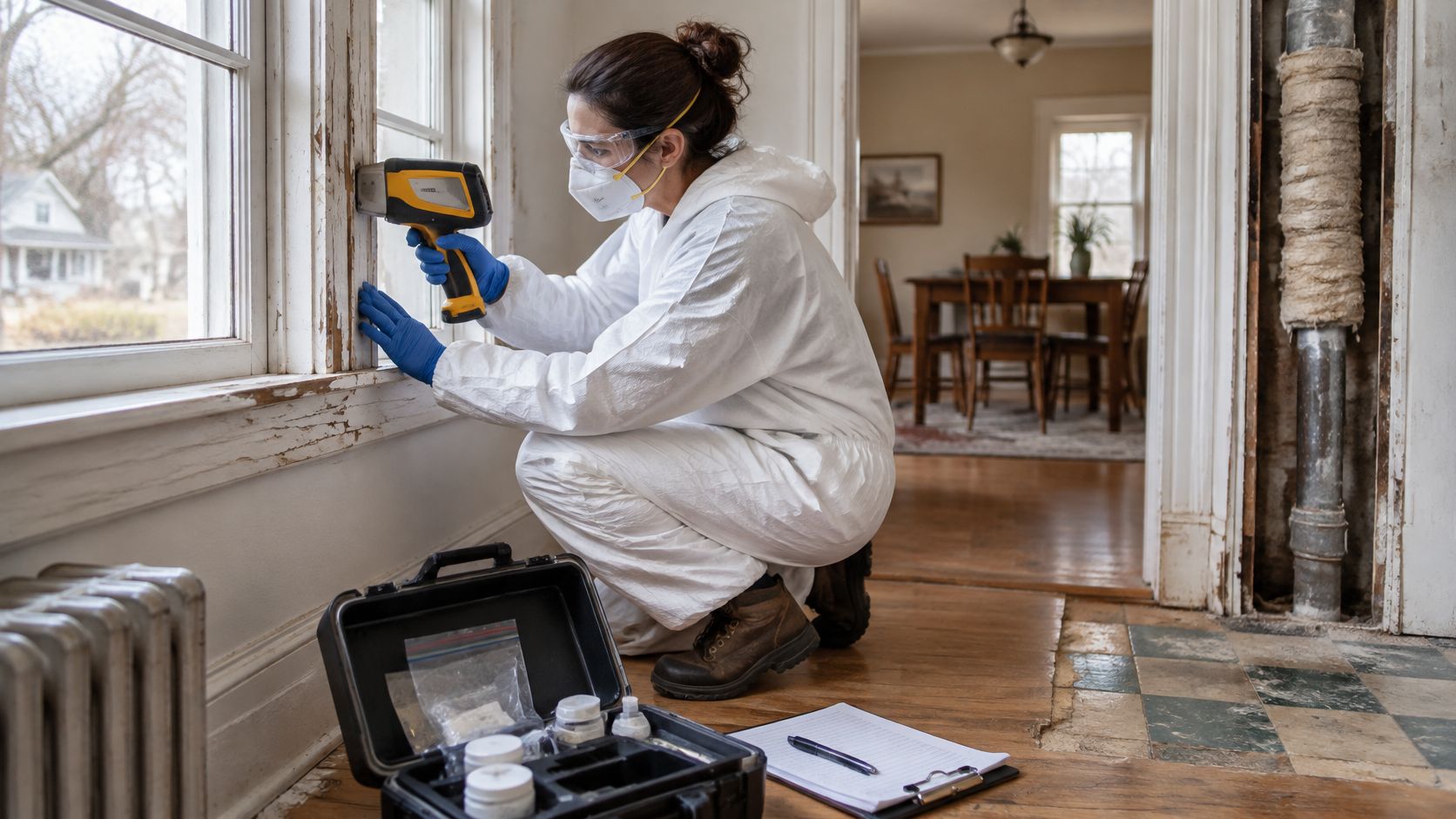
For lead paint, X-ray fluorescence, or XRF, provides useful instrument readings without collecting paint at every reading location. We recommend paint-chip laboratory analysis for the most accurate lead-paint results rather than relying on an XRF gun reading alone.
Sampling methods and what each one can show
| Hazard | Sampling method | What it reveals | What it cannot show |
|---|---|---|---|
| Asbestos | Bulk material sample analyzed by polarized light microscopy | Whether the sample contains asbestos and its estimated content | Whether fibers are airborne during work |
| Asbestos | Air sampling during disturbance | Airborne fiber levels during the sampling period, subject to the analytical method | Composition of materials that weren't sampled |
| Lead paint | XRF reading | Lead presence on a painted component at the reading location | Exact lead content of every paint layer |
| Lead paint | Paint-chip laboratory analysis | Lead content of the collected paint layers | Dust or soil contamination |
| Lead dust | Dust-wipe sample from floors, sills and troughs | Lead dust loading on sampled surfaces | The source of the dust |
| Lead in soil | Soil sample from yards and play areas | Lead concentration in sampled exterior soil | Conditions inside the building |
The ATSDR asbestos public health statement explains the importance of airborne exposure and controls around handling asbestos. A bulk sample answers a composition question; an air sample addresses conditions during a particular sampling period.
DIY testing doesn't provide the same project documentation. A consumer kit may indicate a reaction on a tested surface, but it doesn't replace a defensible component list, professional sample selection, chain of custody, or laboratory reporting. The right method follows the question you need answered.
Reading Lab Results for Both Hazards
A laboratory report describes the submitted sample, not the entire building. Read the sample identifier, collection location, analytical method, result, units, and any reporting limit together. A result without a clear location is difficult to apply to a construction decision.
Not detected isn't the same as absent everywhere. It means the laboratory didn't detect the target substance in that sample using the stated method and reporting limits. A positive finding is similarly specific: it identifies a tested material or surface, not an automatic requirement to remove everything nearby.
Common lab results and the next question to ask
| Result | What it means | Next question to ask |
|---|---|---|
| Asbestos not detected in a sample | No asbestos found in that sample | Were all similar materials in the work area adequately evaluated? |
| Asbestos detected in a material | The material contains asbestos at the reported level | How much of this material will be disturbed, and how? |
| Lead paint positive on XRF reading | Lead detected on that surface at the reading location | Would paint-chip laboratory confirmation help resolve the affected component? |
| Lead paint negative on XRF reading | No lead detected above the instrument's applicable limit at that point | Was every affected component tested, not just a representative surface? |
| Lead dust wipe above clearance level | Residual lead dust requires further attention | Has the area been recleaned and retested? |
| Inconclusive or insufficient sample | The sample lacked sufficient material or quality for a reportable result | What resampling will answer the project question? |
A valid XRF determination doesn't universally require paint-chip confirmation. Confirmation is particularly useful when readings are inconclusive, surface conditions complicate interpretation, or the project needs additional laboratory documentation.
Clearance is a separate question
A paint result identifies lead in paint; a post-abatement dust wipe evaluates residual lead dust. The EPA's dust-lead hazard standards and clearance guidance sets post-abatement clearance levels at 5 micrograms per square foot for floors, 40 for interior window sills, and 100 for window troughs; results at or above these levels don't meet the cited clearance criteria.
Those criteria shouldn't be confused with a universal testing endpoint for every renovation. The assessment must identify which verification requirements apply to the project.
A positive result helps owners and qualified professionals choose appropriate next steps. It doesn't automatically mean removal is required.
Asbestos and Lead Rules in Southern California
A renovation in an older home can involve both asbestos-containing material and lead-painted components. The rules address different hazards, so a lead evaluation does not answer the asbestos question, and an asbestos survey does not establish whether painted surfaces contain lead.
In the South Coast Air Quality Management District's jurisdiction, asbestos testing is required before renovations regardless of a building's age. SCAQMD Rule 1403 asbestos testing should be part of planning before materials are disturbed. Sensitive Environmental recommends that home buyers planning renovations have a Certified Asbestos Consultant test all materials the work will affect.
Testing triggers by rule and project type
| Requirement | Applies when | Testing or documentation must cover |
|---|---|---|
| EPA asbestos emission standard | Regulated asbestos-containing material reaches at least 260 linear feet on pipes, 160 square feet on other components, or 35 cubic feet when it can't be measured by area or length | Quantity and location of regulated material |
| EPA Renovation, Repair and Painting Rule | Covered renovation for compensation in homes or child-occupied facilities built before 1978, as explained in the EPA's lead-testing guidance | Presumed lead status or an appropriate lead-free determination for each affected painted component |
| Minor repair exception | Whether the activity qualifies depends on the work and applicable requirements. Don't assume a small disturbed area qualifies. See the EPA's covered-renovation guidance | The work being done and the painted components it affects |
The asbestos quantities in the first row are regulatory thresholds, not health-based safe amounts. They also do not replace stricter regional requirements. Related material elsewhere in a project may affect the total regulated quantity, so a small visible patch should not be assessed in isolation.
For covered lead work, a project team may presume that affected paint contains lead and follow applicable requirements, or establish its status through recognized testing. A lead-free finding applies only to the components evaluated, not automatically to the whole room.
Keep compliance records tied to the scope
A small work area does not, by itself, make an activity eligible for the minor-repair exception. Window replacement, demolition of painted surfaces, and prohibited work practices are not covered by that exception because the disturbed area is limited. Project cost also does not determine whether the exception applies.
For real estate transactions, California asbestos disclosure considerations relate to disclosure, not authorization to disturb suspect materials. A disclosure form or general home inspection is not a substitute for renovation testing.
Confirm current California, regional, and local requirements with the project's environmental professional. Keep the survey, component inventory, laboratory results, and applicable compliance documents together. That gives contractors a shared record of which materials were assessed and what the planned work may disturb.
How to Sequence Work When Both Hazards Are Present
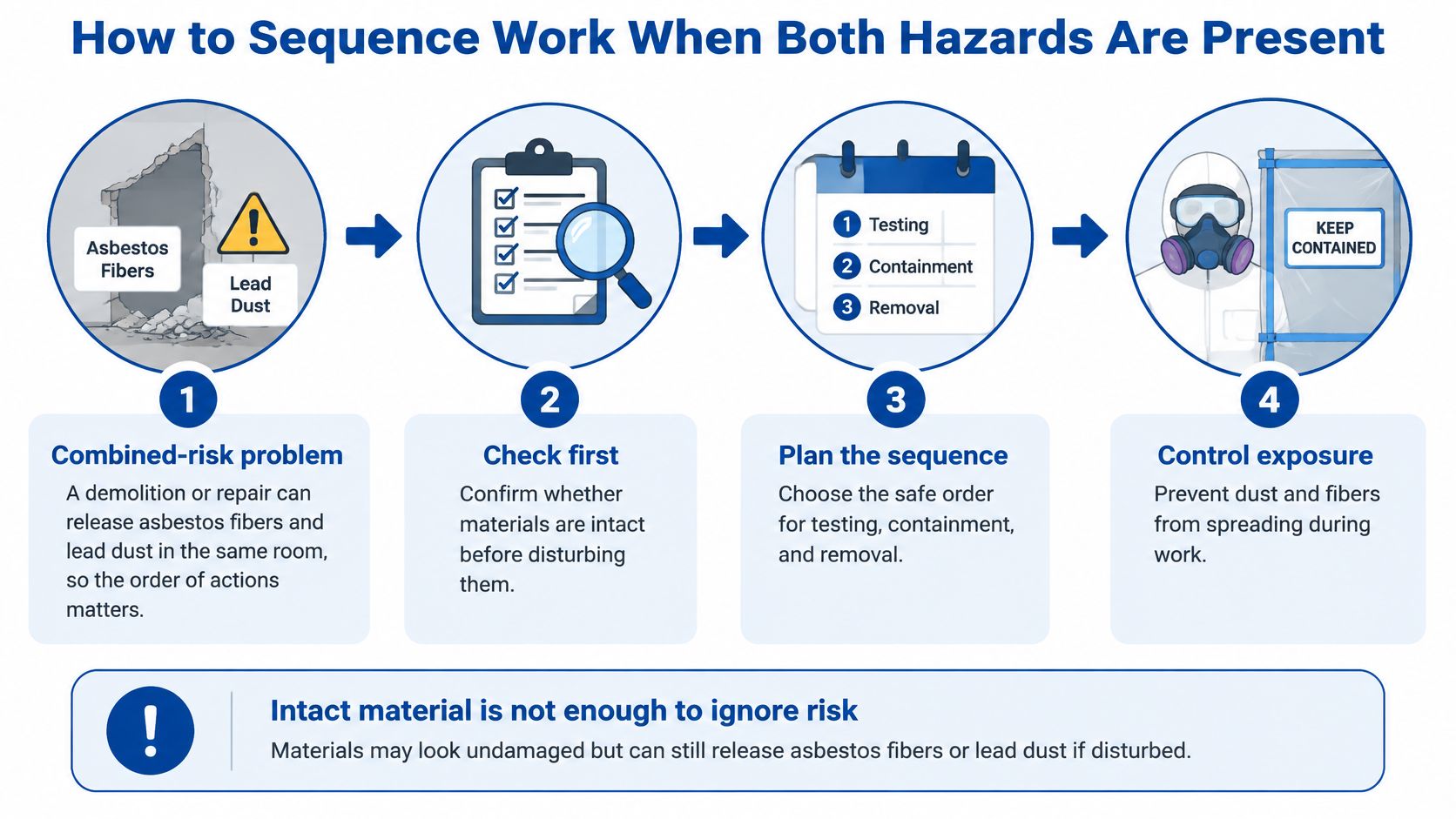
A repair can disturb asbestos-containing wall material and lead-painted trim in the same room. That makes the sequence a coordination problem, not a contest over which contaminant is more serious. The first decision is what information the team needs before anyone changes the materials' condition.
There's no universal asbestos-first or lead-first rule. A consultant needs to evaluate access, material condition, planned disturbance, occupants, and applicable requirements before the construction team selects its work sequence.
Follow a coordinated decision sequence
Stop work in the affected area and restrict access. If unexpected suspect materials appear, don't continue opening the assembly to see how far they extend. Keep occupants and unrelated trades out while the conditions are assessed.
Prevent dust and debris from spreading. Avoid dry sweeping, ordinary household vacuuming, and uncontrolled demolition. Don't carry loose fragments through occupied areas or handle debris just to make the room look cleaner.
Identify every component the revised work may disturb. Include secondary disturbance, such as removing trim to reach a wall cavity or cutting flooring to access damaged plumbing. Photographs and marked plans help the inspector distinguish untouched materials from already disturbed areas.
Commission hazard-specific professional evaluation. Coordinate asbestos and lead assessment, but retain separate sample identification and findings for each hazard. If damage has already occurred, the assessment may need to address debris or exposure conditions as well as remaining building materials.
Confirm the work boundary and professional control plan. The consultant and qualified contractors should determine how one task could affect another material. For example, accessing suspect insulation behind painted framing may require a different approach from replacing an accessible painted component.
Verify conditions after the applicable work and retain the records. Arrange the required clearance or follow-up sampling for the project, rather than assuming a visual inspection answers every question. Keep results with the construction file and document any exclusions or inaccessible areas.
Emergencies still need an assessment strategy
The EPA's guidance on debris and damaged buildings warns that disturbance can release asbestos fibers and lead-contaminated dust and states that emergency renovations in pre-1978 buildings must use lead-safe work practices. Disaster response doesn't automatically excuse uncontrolled paint disturbance.
Fire or water damage may also change the sampling question. An assessment may need to distinguish contamination on surfaces from hazardous ingredients within the materials beneath them.
Communication matters: Tell occupants and contractors what was tested, what remains untested, and which activities are paused. Don't translate a limited result into a building-wide safety claim.
The professional assessment determines the sequence. Testing provides the information needed to plan work; it doesn't itself control exposure or guarantee future conditions.
Confirm the Testing Scope Before Renovation Begins
Before arranging an inspection, gather a few practical details. A precise description of the work is more useful than asking for a general test of an older building.
- Building history: Provide the construction year, known additions, previous renovations, and available environmental reports.
- Component-level scope: List what workers will cut, drill, sand, remove, or expose in each room.
- Photographs: Include wide views and close-ups taken without disturbing materials.
- Occupancy details: Explain whether residents, tenants, employees, patients, or students will remain nearby.
- Project documents: Share drawings, contractor scopes, regulatory notices, and any planned changes to access or demolition boundaries.
Match the assessment to the actual project
A limited renovation doesn't automatically need the same assessment as a full-building demolition. However, the scope must address all materials the work will impact, including concealed layers when they become accessible. If the contractor changes the plan, the environmental scope may need revision before the added disturbance begins.
We recommend that home buyers planning renovations have a Certified Asbestos Consultant test all materials that will be impacted. We bring over 30 years of experience to asbestos, lead, and mold projects, with an emphasis on appropriate sampling and understandable documentation.
Western Bathroom Renovations' guide to planning a period home renovation offers broader context for coordinating changes to an older property. Environmental assessment should be incorporated while those decisions are still flexible, not after materials have been opened.
Request documentation that contractors can use
Across Los Angeles and Southern California, our testing services include pre-renovation and pre-demolition asbestos surveys, Rule 1403 compliance testing, lead-based paint inspections with paint-chip laboratory analysis, dust-wipe sampling, and written reporting. Indoor air quality testing may be appropriate when the concern involves airborne contaminants rather than material composition alone.
When a project involves a Notice to Comply or Procedure 5 issue, provide that information at intake so the assessment can address the specific documentation need. Don't assume a standard material test answers a regulatory notice.
You can request a free consultation by selecting asbestos, lead, mold, fire damage, water damage, or other as the problem type. Send the building year, planned scope, and occupancy details early enough to arrange testing before renovation or demolition contracts are signed.
Sensitive Environmental provides coordinated asbestos and lead-paint inspections, sampling, laboratory analysis, and clear reports for renovation planning throughout Los Angeles and Southern California. Visit Sensitive Environmental to request a free consultation, share your proposed work, and schedule the appropriate testing before materials are disturbed.