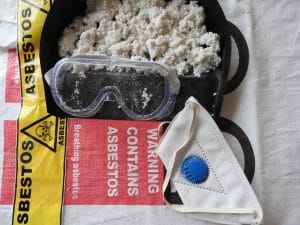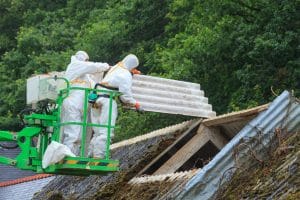
An owner-occupant exemption under South Coast AQMD Rule 1403 is not a free pass to skip testing. It can excuse certain notification and work-practice provisions when you personally renovate a qualifying single-family home, and it still leaves waste handling, damaged material, and a proper survey in play. Treat asbestos siding shingles replacement as a testing decision first. The date on the wall, the condition of the panels, and what the job will do to them decide the next step.
Table of Contents
- Screen Your Siding Before Any Work Starts
- Testing Steps From Survey to Lab Report
- Rule 1403 Requirements by Property Type
- Choosing Removal Methods That Limit Fiber Release
- When Damage Turns a Project Into a Procedure 5 Plan
- Disposal Records and Post-Removal Verification
- Schedule Asbestos Testing Before Siding Work Begins
Screen Your Siding Before Any Work Starts
The siding's age can raise a question, but its condition and the work planned determine what needs attention before a project begins.
Asbestos-cement siding combined Portland cement and asbestos fibers to form rigid, fire-resistant, weather-resistant panels. These products were used in homes during the twentieth century, including through the 1970s. A home sided during that period warrants closer assessment before anyone cuts, drills, or removes panels.
Appearance cannot confirm asbestos. Similar products were made with and without asbestos, so a permit date or a previous owner's recollection is not proof. Professional sampling and laboratory analysis can identify asbestos-containing material and help determine an appropriate work and disposal approach.
| Condition or plan | What it signals | Next step |
|---|---|---|
| Installed before 1981 | Age alone does not confirm asbestos | Have the material assessed before cutting, drilling, or removing panels |
| Installed 1981 or later with records | Records help establish the installation date but do not identify the material | Consider sampling if planned work will disturb it |
| Intact, undisturbed, staying in place | Leaving the panels undisturbed limits handling | Record their condition and assess them before work that could disturb them |
| Cracked, broken, or impact-damaged | Handling could release fibers | Stop work, secure the area, and contact a Certified Asbestos Consultant |
| Scraping, drilling, cutting, or full tear-off planned | The work will disturb the siding | Arrange an assessment before work begins |
| Unknown age or look-alike products | Appearance cannot identify asbestos | Use professional sampling and laboratory analysis |
The practical distinction is between siding that will remain untouched and siding that the project will disturb. Before choosing a replacement approach, identify which panels and related materials the work will affect.
Testing Steps From Survey to Lab Report
Professional testing is a sequence, not a single swipe of a shingle. In the Los Angeles region, South Coast AQMD Rule 1403 requires the affected facility or components to be thoroughly surveyed before renovation or demolition begins.
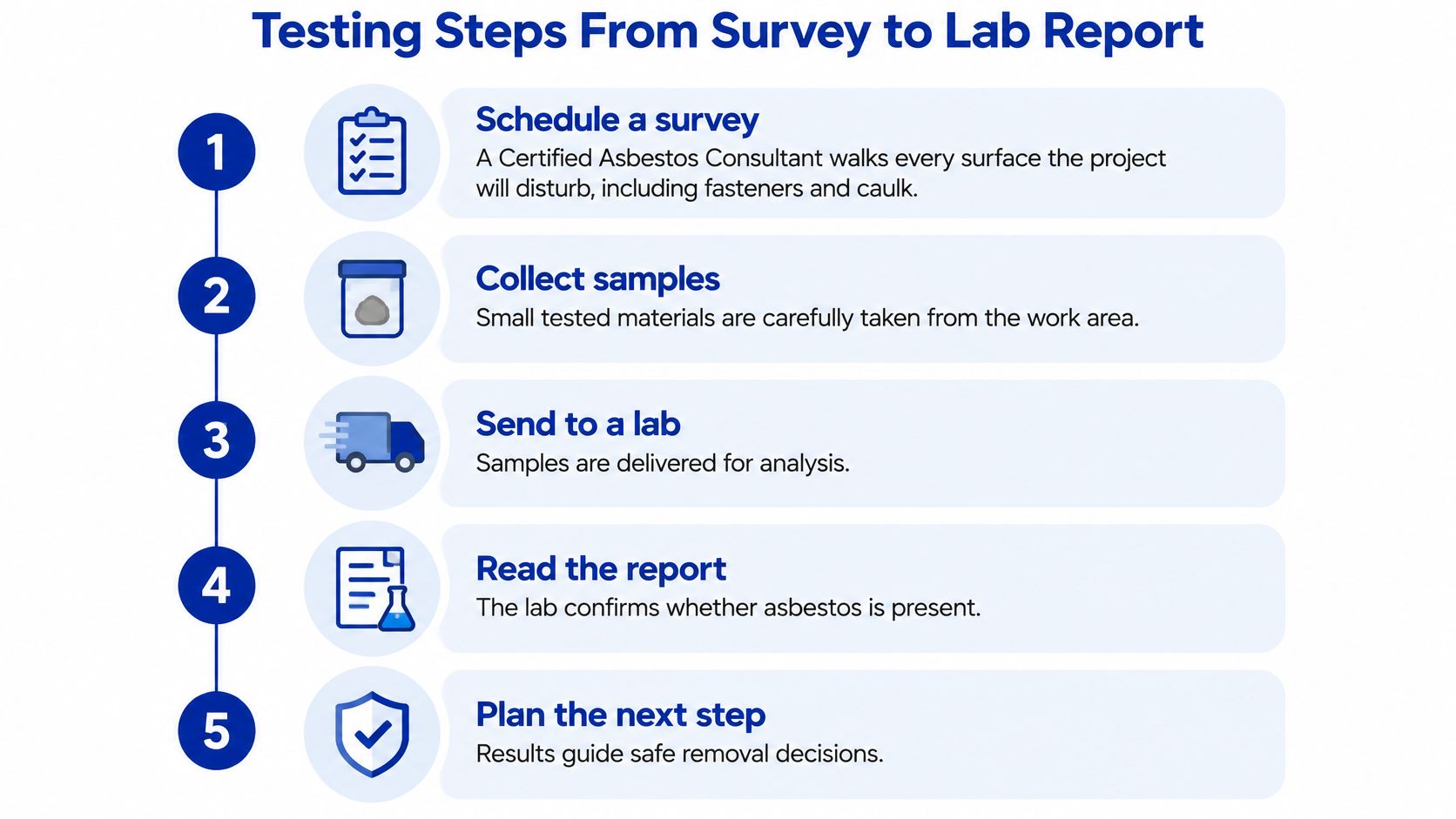
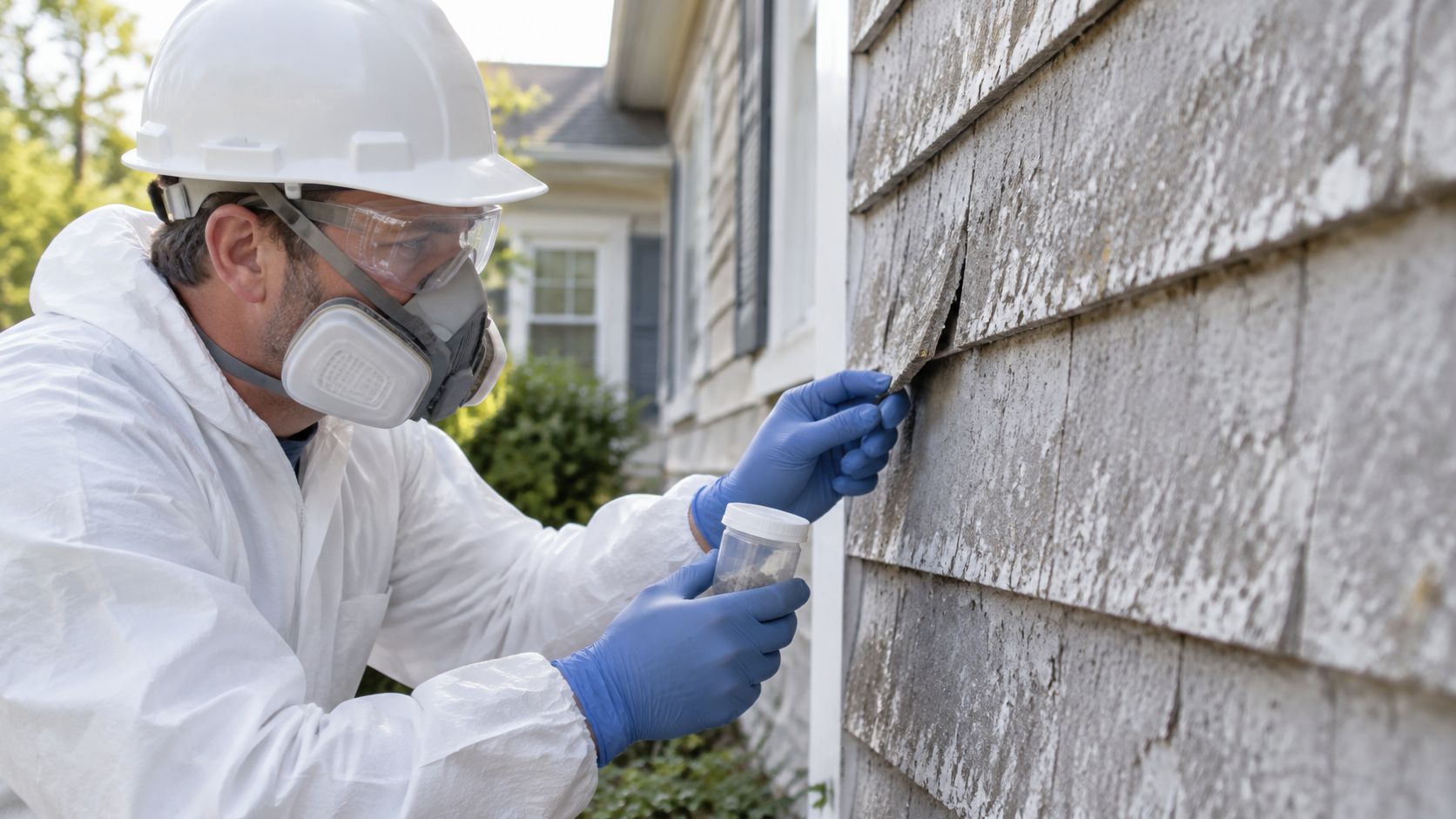
Schedule a survey with a Certified Asbestos Consultant. The consultant walks every surface the project will disturb, including fasteners, caulk, underlayers, and wall cavities where access is needed to identify and sample them. A siding assessment can't stop at the cracked shingle you can see.
Identify suspect materials and record them. Location, extent, and condition go into the notes before any sample is cut. The survey must identify and quantify friable asbestos-containing material, plus Class I and Class II non-friable ACM, with physical sampling where needed.
Collect representative samples with methods that limit extra breakage. The goal is enough material for the lab, not a DIY demolition. Homeowners who chip a shingle themselves can release fibers and still miss the layer that matters. If you're weighing a home kit against a consultant visit, read whether you can test for asbestos at home before you open a wall.
Send the samples to an accredited laboratory for polarized light microscopy. PLM is the standard bulk method that confirms whether asbestos is present and which fiber type is in the cement matrix. Turnaround is typically several business days, and rush service is a scheduling choice, not a shortcut around the survey.
Read a written report that lists each material, its quantity, its friability, and whether it is damaged or disturbed. Sensitive Environmental's inspection report includes the amount and location of asbestos in the building, which is the documentation permit reviewers and contractors use.
Use the report to choose a compliance pathway. A positive result identifies the material. It doesn't, by itself, require one removal approach. A negative result only covers what was sampled. Thin coverage of one elevation doesn't clear a garage, a dormer, or siding hidden under later vinyl.
What to have ready before the visit
Year built and any re-side dates you can document. Photos of each elevation, including cracked courses and areas already painted or covered. Notes on prior repairs, window changes, and added penetrations. Drawings or a simple sketch of the walls in the scope. The planned work, stated plainly: cover-over, spot repair, or full tear-off.
Practical rule: A homeowner sample can be the wrong piece and can spread fibers during collection. A written survey is what tells you whether the siding can be handled under applicable work practices or needs regulated abatement.
Rule 1403 Requirements by Property Type
The owner-occupant case is where people misjudge the rule. South Coast AQMD's owner guidance exempts an owner-occupant who personally renovates a qualifying single-family home from certain Rule 1403 provisions. That exemption doesn't apply to rentals, vacant homes, business-use properties, or work performed by hired laborers, friends, or family members.
Even when the exemption applies, asbestos-containing waste placed outside the home remains subject to Rule 1403 handling, storage, and disposal requirements. AQMD also says it doesn't recommend that homeowners remove asbestos themselves, because of exposure and cross-contamination risks. EPA guidance in that same discussion adds that exterior siding and roof shingles may contain asbestos, that structures should be wetted to reduce airborne fiber migration, and that debris should be wrapped or otherwise contained, moved in covered vehicles, and delivered to an authorized landfill.
| Project case | Rule 1403 position | Key condition |
|---|---|---|
| Owner-occupant, single-family home, personal work | Certain provisions may be exempt | Exemption does not cover waste placed outside the home |
| Rental, vacant, or business-use property | Exemption does not apply | Full requirements apply, including survey |
| Work by hired laborers, friends, or family | Exemption does not apply | Full requirements apply, including survey |
| Single-unit residence, under 100 sq ft of intact material removed | Survey not required | Does not apply to demolition or to damaged material |
| Contractor-led renovation | Survey by a Certified Asbestos Consultant and Rule 1403 notification | Survey must cover all materials that could be disturbed |
| Demolition at any scale | Asbestos-containing material removed before demolition | Full requirements apply |
The 100-square-foot trap
South Coast AQMD's Rule 1403 FAQ describes a narrow renovation exception for a single-unit dwelling: a survey isn't required only when less than 100 square feet of intact, undamaged material is removed or stripped. It doesn't apply to demolition. It doesn't apply when suspected asbestos-containing material is damaged. If damaged suspected ACM is found, work stops regardless of the amount, the area is secured and stabilized, and a Certified Asbestos Consultant assesses the damage and surveys the site.
For contractor-led renovation or demolition in the South Coast basin, the contractor needs an asbestos survey by a Certified Asbestos Consultant and a Rule 1403 notification before the work starts. The most common mistake is reading the owner-occupant exemption as permission to skip both the survey and the waste rules.
Confirm the property category with a consultant before the first panel is touched. A Pasadena rental, a vacant Long Beach bungalow, and an owner-occupied home in the San Fernando Valley are not the same file.
Choosing Removal Methods That Limit Fiber Release
The removal method follows the survey, not the look of the shingles. Replacing asbestos-cement siding is regulated by the risk of fiber release during disturbance, not by the mere presence of intact material. OSHA's construction asbestos training materials classify removal of asbestos-containing siding shingles as Class II asbestos work. OSHA sets an airborne permissible exposure limit of 0.1 asbestos fibers per cubic centimeter of air as an 8-hour time-weighted average, and a 1.0-fiber-per-cubic-centimeter excursion limit averaged over 30 minutes.
Those numbers are occupational exposure standards. They aren't proof that a project is safe without controls, and they don't replace air-district, waste, or notification rules. OSHA's exterior-removal requirements prohibit cutting, abrading, or breaking cementitious siding unless a lower-release method can't be used, and they require each panel or shingle to be sprayed with amended water before removal. Ordinary tasks such as drilling and cutting holes in siding can create exposure too.
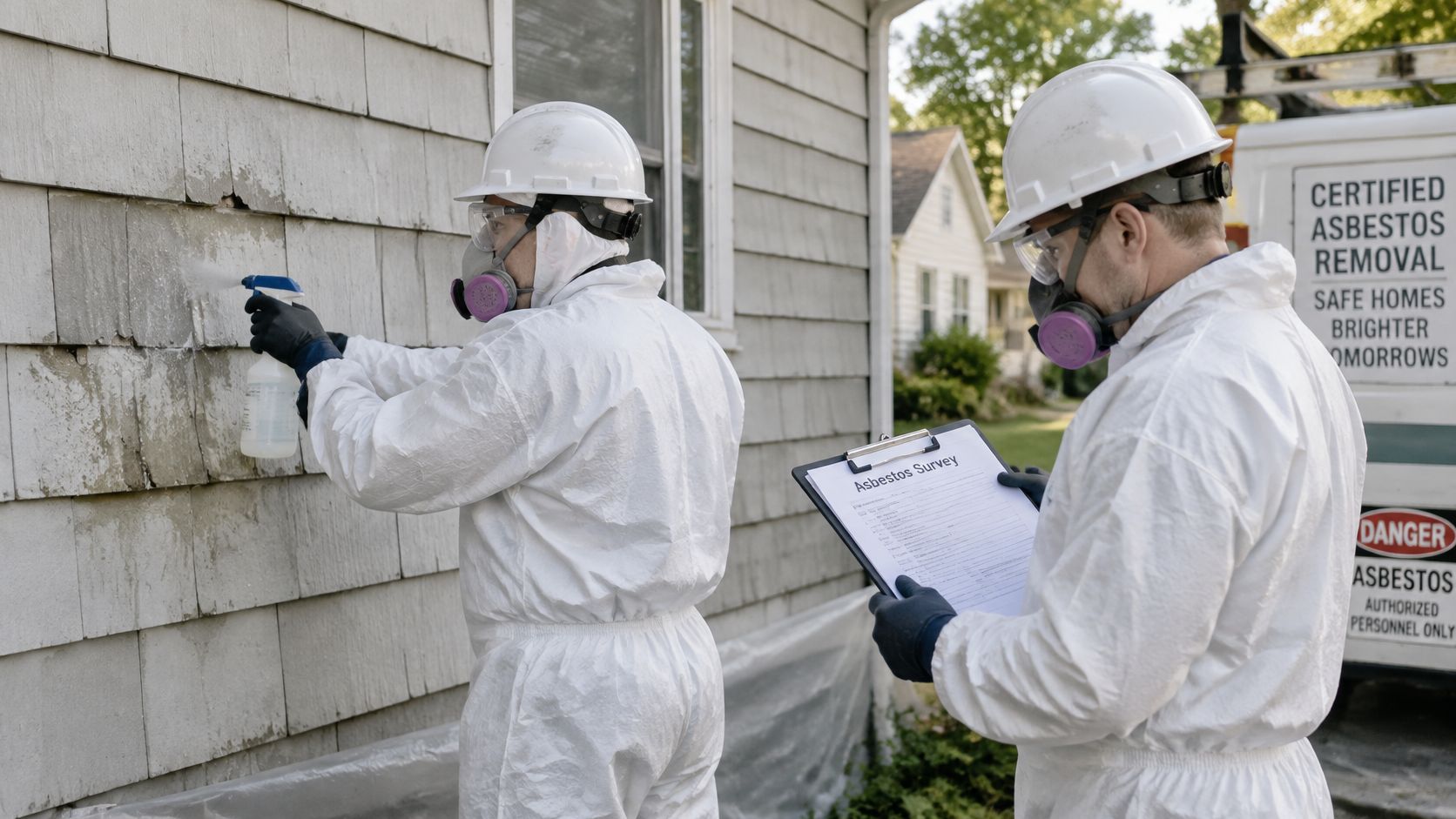
South Coast AQMD compliance materials sort abatement into five procedures. The survey report has to identify ACM that will be disturbed, describe whether it is damaged or disturbed, and determine friability. Appearance alone doesn't pick the row.
| Procedure | Typical use | Key control |
|---|---|---|
| Procedure 1 | Friable asbestos-containing material | Total enclosure with HEPA filtration and negative pressure |
| Procedure 2 | Small projects | Glove bags |
| Procedure 3 | Non-friable asbestos-containing material | Adequate wetting |
| Procedure 4 | Wetting would create a hazard | Dry removal as an approved alternative |
| Procedure 5 | Damaged or disturbed material | Approved cleanup plan, approved in writing before abatement |
Intact cover versus a full tear-off
Leaving sound siding in place and installing a compatible cover over it avoids breaking the cement matrix. Scraping, pressure-washing, drilling, or a full tear-off is the exposure pathway. Where removal is the plan, keep panels whole, wet before any cut, use protective equipment suited to Class II work, and bag and label debris as you go. A deeper look at why wetting and containment matter sits in this guide to safer asbestos work around a home.
New damage found halfway through the job changes the procedure. That's a stop, not a faster pace.
When Damage Turns a Project Into a Procedure 5 Plan
Say you're pulling one cracked shingle on a Saturday and the edge powders in your hand. The instinct is to keep going so the wall looks finished. That instinct is the mistake.
When asbestos-containing siding is damaged or disturbed outside a controlled work area, South Coast AQMD's Procedure 5 materials require the owner or operator to stop the related activity, secure and stabilize the area, survey for ACM and asbestos-contaminated materials, and obtain an approved Procedure 5 plan before cleanup proceeds. A Procedure 5 cleanup plan is required for damaged or disturbed ACM regardless of project size. Abatement can't begin until AQMD staff approve the plan in writing. It isn't a preferred method for big jobs. It's the response to disturbed material, including damage discovered mid-replacement.
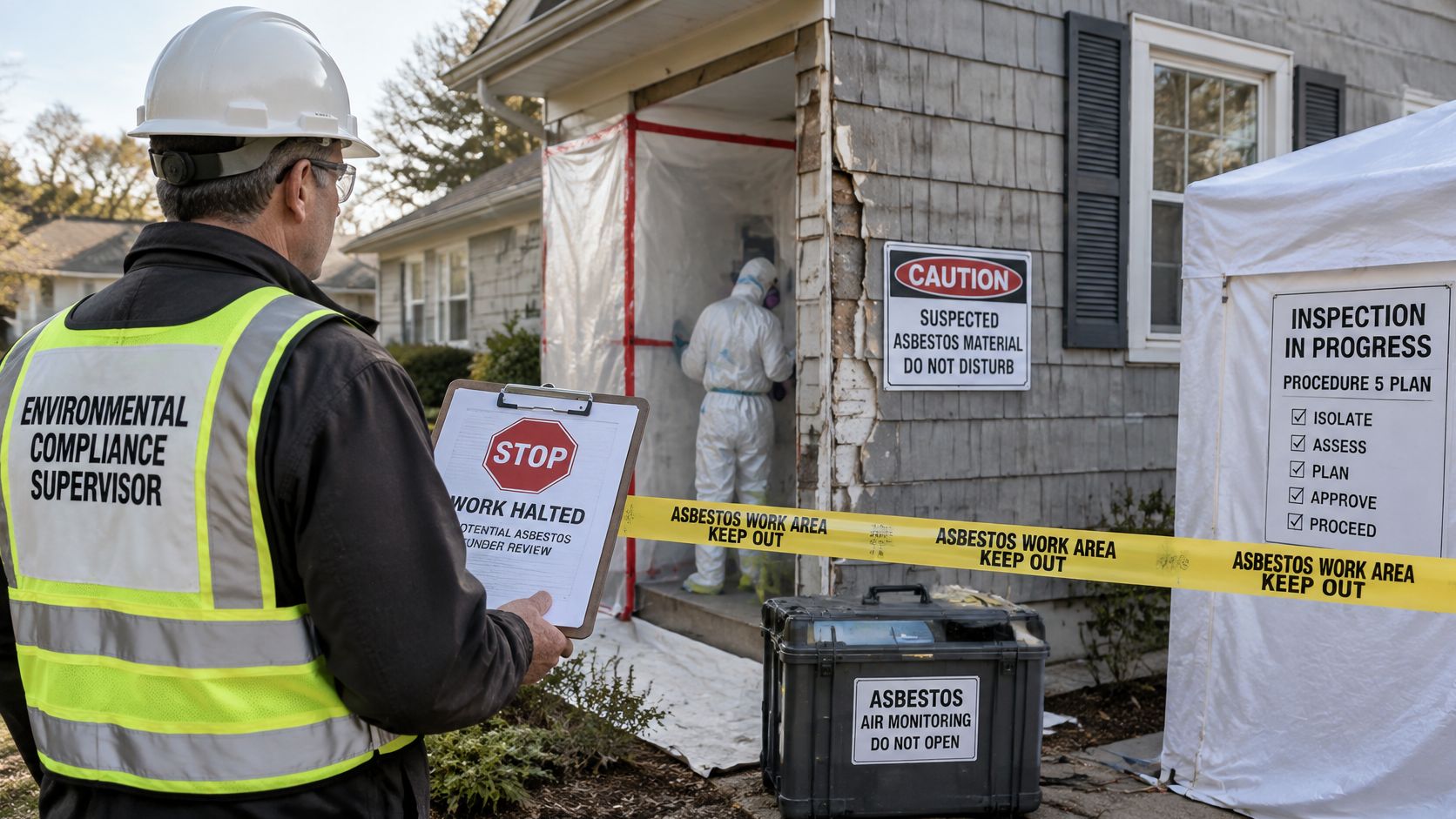
- Stop the activity. Put the pry bar down. Quantity doesn't reopen the exception once damage is found.
- Keep people out and cover the area. Secure and stabilize so foot traffic and wind don't spread debris across the yard.
- Wet the debris so loose material stays down while you wait for an assessment.
- Call a Certified Asbestos Consultant for survey and sampling of the damaged material and anything the break contaminated.
- Prepare a Procedure 5 plan that sets out the cleanup approach and the controls. If a consultant finds ACM that is damaged or significantly damaged, it may be classed as a Procedure 5, and the cleanup plan is written by that consultant.
- Wait for written approval before any cleanup. Starting early is the violation, not a head start.
A positive lab result doesn't mean the whole house must be stripped. Results tell owners and qualified professionals which materials and which waste need management, and which intact courses can stay. Narrow exemptions that might have covered a tiny repair of sound shingles don't survive once damage is on the ground.
Older cement shingles fail in similar ways outside California. Exterior repair guidance for older Utah homes is a useful contrast on leaving sound courses alone versus forcing a tear-off, even though Los Angeles projects still answer to Rule 1403.
Disposal Records and Post-Removal Verification
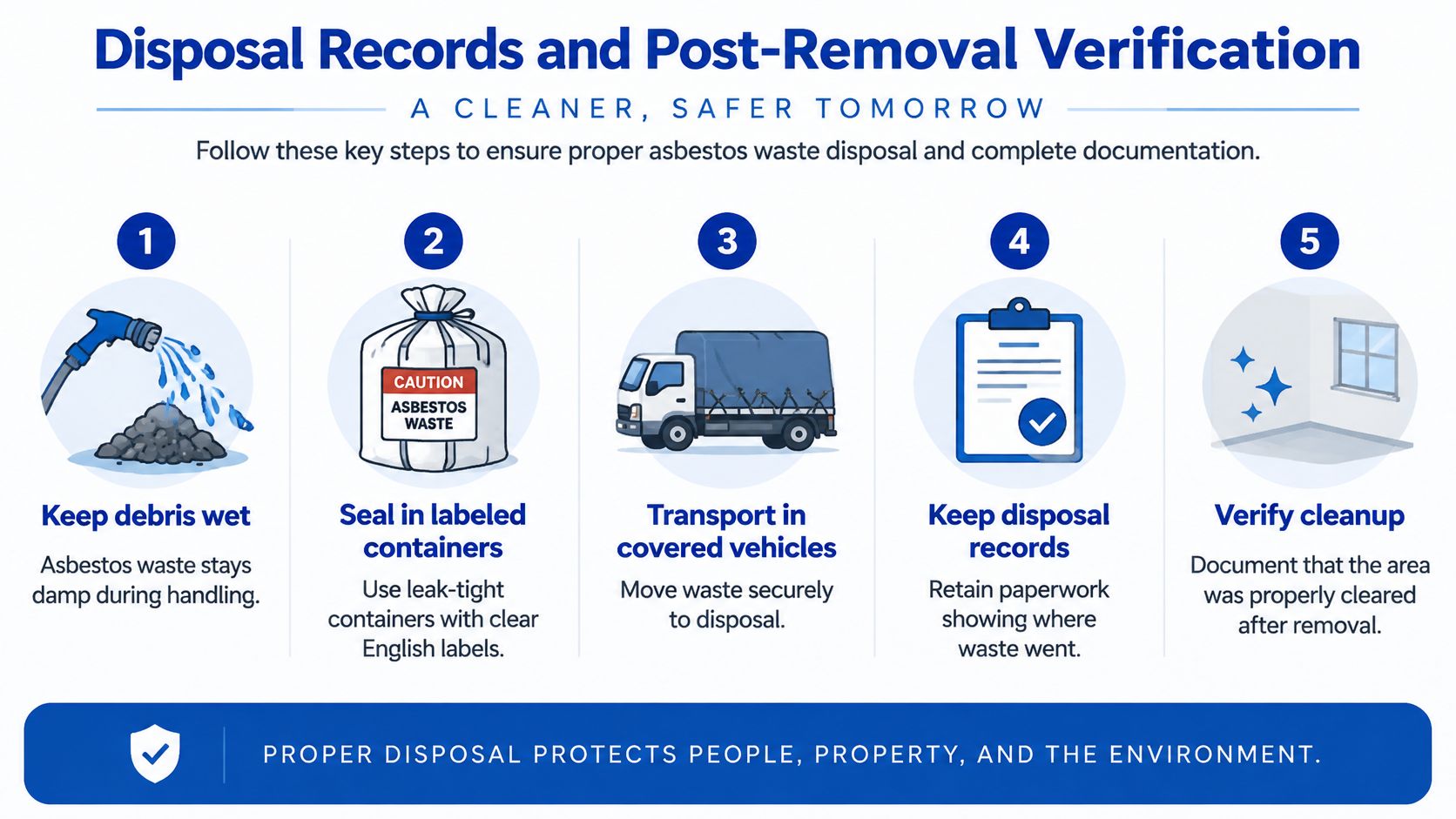
The file is what shows the job was handled correctly. Debris stays wet, goes into sealed leak-tight labeled containers, travels in a covered vehicle, and is delivered to an authorized landfill. We pack collected asbestos wet in plastic bags and seal those bags in leak-tight plastic containers. Every container is weighed, and its weight and exposure details are noted, before transport. We choose a disposal site near the property from dumping sites in Los Angeles rather than sending waste into ordinary trash.
Checks before the waste leaves the site
Confirm the license. Before you hire an abatement company, check that it holds a valid C-22 or C-Asb license, and be cautious of abatement work subcontracted through an HVAC contractor.
Match the bags to the survey. Labels in clear English should tie containers to the materials the lab already identified, not to a generic "construction debris" line.
Ask who is doing clearance. An independent consultant can sample after the work and report the results. Confirm with that consultant which post-work testing applies under current AQMD requirements. A test doesn't certify that a building is safe. It documents the conditions that were sampled.
More on packaging and where waste can legally go is in how to dispose of asbestos.
What belongs in the property file
- Survey report: Material locations and quantities, so a later buyer or inspector isn't guessing which wall was tested.
- Sampling and laboratory results: The basis for calling a material asbestos-containing or not.
- Rule 1403 notification and any written approvals: Proof the district was notified when notification applied.
- Procedure 5 plan, if one applied: The approved cleanup approach, not a verbal promise.
- Disposal receipts or landfill documentation: Where the waste went, and how much.
- Contractor license details: The C-22 or C-Asb record you checked before hiring.
- Post-removal test report: Clearance or other sampling the consultant said applied.
Keep that packet with the house records. Sales, insurance claims, and later inspections all ask for it, and a missing receipt is harder to replace than a missing shingle.
Schedule Asbestos Testing Before Siding Work Begins
Schedule the siding survey before anyone cuts, drills, scrapes, or removes a panel. Give the consultant the property's age, elevation photos, records of prior repairs, planned work, and target dates. Identify whether it is owner-occupied, rented, or part of a contractor-led project, since Rule 1403 requirements can depend on the property and project.
The survey should cover materials the work may disturb, such as siding, fasteners, caulk, underlayers, and wall cavities where access is needed. A written report records material locations, quantities, and condition, giving owners and contractors a basis for decisions and pricing. Testing informs the work plan; it does not select a removal method or guarantee that a building is safe.
Budget for testing before requesting removal bids. The survey helps contractors price the identified work rather than guess at what lies beneath the siding. Sensitive Environmental brings over 30 years of experience to asbestos, lead, and mold projects. Request a free consultation by selecting asbestos, lead, mold, fire damage, water damage, or other as the problem type.
For a Los Angeles County home or another Southern California property, describe the siding work and location when requesting a survey. A general exterior replacement scope, such as siding replacement services in Marietta, does not address local asbestos requirements. Arrange testing before the first panel comes off.
Sensitive Environmental provides asbestos testing, pre-renovation surveys, sampling, and laboratory reporting for siding projects across Los Angeles and Southern California, including documentation related to SCAQMD Rule 1403. For asbestos siding shingles replacement, a written survey identifies what the project may disturb before work begins. Visit Sensitive Environmental to request asbestos testing or a property survey.