Approximately 22.3 million U.S. housing units have deteriorated lead-based paint and lead-contaminated household dust, according to CDC housing guidance. That's why lead paint inspections shouldn't stop at asking whether an old coating contains lead. Homeowners and property managers also need to understand what was tested, what wasn't, and whether the findings answer their actual question.
For a Los Angeles homeowner planning new windows, that question concerns the surfaces workers will disturb. For a property manager investigating dust near deteriorating windows, it concerns exposure. The purpose of the evaluation determines how useful the result will be.
Table of Contents
- Why Older Homes Need Testing and Which Lead Service Fits
- When Testing Is Needed and Who Should Do It
- How Sampling and Laboratory Analysis Work
- Reading Lab Results and Current Dust Action Levels
- DIY Test Kits Versus Certified Lead Testing
- Schedule a Lead Inspection Before Your Next Decision
Why Older Homes Need Testing and Which Lead Service Fits
Residential lead-based paint was banned in 1978, but HUD's American Healthy Homes Survey II estimated that 34.6 million U.S. homes, or 29.4% of all housing units, contain paint applied before the ban, as summarized in EPA's lead-based paint program guidance. The same guidance reports that approximately 87% of homes built before 1940 contain some lead-based paint, compared with 24% of homes built from 1960 through 1978.
Lead services and the question each one answers
| Service | Question it answers | Typical output | Who performs it |
|---|---|---|---|
| Lead-based paint inspection | Is lead-based paint present, and where? | Component-by-component report of painted surfaces | Certified lead-based paint inspector |
| Risk assessment | Do deteriorated paint, dust or soil create exposure pathways? | Hazard findings and recommended controls | Certified risk assessor |
| Renovation-specific determination | Do surfaces disturbed by planned work contain lead-based paint? | Scope-of-work determination for affected components | Certified inspector or risk assessor |
| Clearance examination | Has lead dust been reduced to acceptable levels after work? | Dust sample results compared with applicable current criteria | Certified inspector or risk assessor |
Match the service to the decision
Homes built before the residential ban can be assumed to have lead paint for planning purposes. That's a precautionary approach, not a laboratory finding and not proof that every painted component contains lead.
An inspection identifies coatings. A risk assessment investigates how someone could encounter lead through deteriorated paint, settled dust, or contaminated soil. As EPA's household lead guidance explains, friction and impact surfaces such as windows, doors, stairs, and floors deserve attention because everyday use can generate contaminated dust.
Say you're buying a house with intact painted walls but sticking wooden windows. Testing the walls alone won't explain what happens when those windows open and close. The assessment needs to address the components and exposure pathways relevant to occupancy.
Practical rule: Ask what decision the report will support before deciding which material to sample.
Understand the boundaries of a result
A visual walkthrough can identify peeling coatings, worn edges, and dust accumulation. It cannot establish that a property is lead-free. Likewise, a result from a bedroom wall doesn't characterize a window trough, exterior soil, or a different painted substrate.
Older buildings can also require separate evaluations for other materials. Our explanation of whether lead and asbestos are the same helps owners keep those testing questions separate rather than treating an older-building inspection as a single universal test.
General painting resources can help organize a project, but testing must precede potentially disruptive preparation. For example, preparation advice from Painters North Shore can be considered alongside a project plan, not as permission to sand or scrape suspect coatings before they're evaluated.
The useful sequence is straightforward: identify the decision, establish the testing scope, collect appropriate samples, and interpret the findings within that scope. Building age identifies a reason for caution. The planned activity and property conditions determine the service.
When Testing Is Needed and Who Should Do It
Testing requirements follow the building's age, the proposed work or transaction, and the people occupying the space. Don't assume that every older property needs the same evaluation, or that a transaction disclosure substitutes for an inspection.
Lead testing by situation
| Situation | Testing typically needed | Qualified tester |
|---|---|---|
| Sale of a pre-1978 home | Disclosure of known lead information; buyer may obtain an independent inspection before signing | Certified lead-based paint inspector |
| Rental of a pre-1978 property | Disclosure of known lead-based paint or hazards; no evaluation required solely because of age | Certified inspector or risk assessor if an evaluation is chosen |
| Renovation touching painted surfaces | Test disturbed surfaces or treat them as lead-based paint; a limited minor-work exception may apply | Certified renovator for recognized test kits; certified inspector or risk assessor for XRF |
| Window replacement or demolition | Not covered by the minor-work exception; affected surfaces must be tested or treated as lead-based paint for covered work | Certified inspector or risk assessor |
| Child-occupied facility or school | Inspection or risk assessment when required by the applicable program or project | Certified inspector or risk assessor |
| Deteriorating paint or dust concerns in an occupied home | Risk assessment with appropriate dust and surface sampling | Certified risk assessor |
Renovation needs a work-specific answer
Under EPA's Renovation, Repair and Painting contractor guidance, minor repair and maintenance work is generally excluded from lead-safe work-practice requirements when it disturbs no more than 6 square feet per interior room or 20 square feet on the exterior; window replacement and demolition aren't covered by that exception.
For covered renovation, contractors must establish that affected coatings don't contain regulated lead-based paint or treat them as though they do. The exception isn't a finding that a small project has no lead exposure potential.
A negative test from an unrelated room won't resolve a kitchen renovation scope. Include trim, doors, painted cabinetry, and coated surfaces concealed beneath wallpaper wherever the work will disturb them.
Transactions and occupancy raise different questions
EPA's renovation guidance distinguishes documented representative sampling from renovation determinations and explains that known lead information must be disclosed for covered rentals, while age alone generally doesn't require landlords to evaluate or remove lead paint. Disclosure tells the next occupant what's known; an evaluation develops additional information.
For Los Angeles multifamily buildings, schools, and older commercial facilities, document actual use rather than relying only on the property's label. A commercial building may contain a child-occupied space, while a school project may involve particular rooms, common areas, or exterior components.
California and Los Angeles-area compliance should be confirmed for the specific assignment:
- State qualifications: Verify current California certification requirements for the lead-related inspection, assessment, or sampling work.
- Landlord obligations: Verify applicable city and county requirements concerning deteriorated paint, housing conditions, and notices.
- School obligations: Verify current state, county, and district requirements before defining the evaluation scope.
Before arranging testing, gather the construction history, proposed disturbance, occupant information, and transaction deadline. Our guide to what lead-based paint looks like can help describe visible concerns, but appearance doesn't replace testing.
How Sampling and Laboratory Analysis Work
A result is only as useful as the collection method and the location it represents. Professional lead paint inspections connect field observations, sample identification, laboratory analysis, and the decision the owner needs to make.
Define the scope and collect representative material
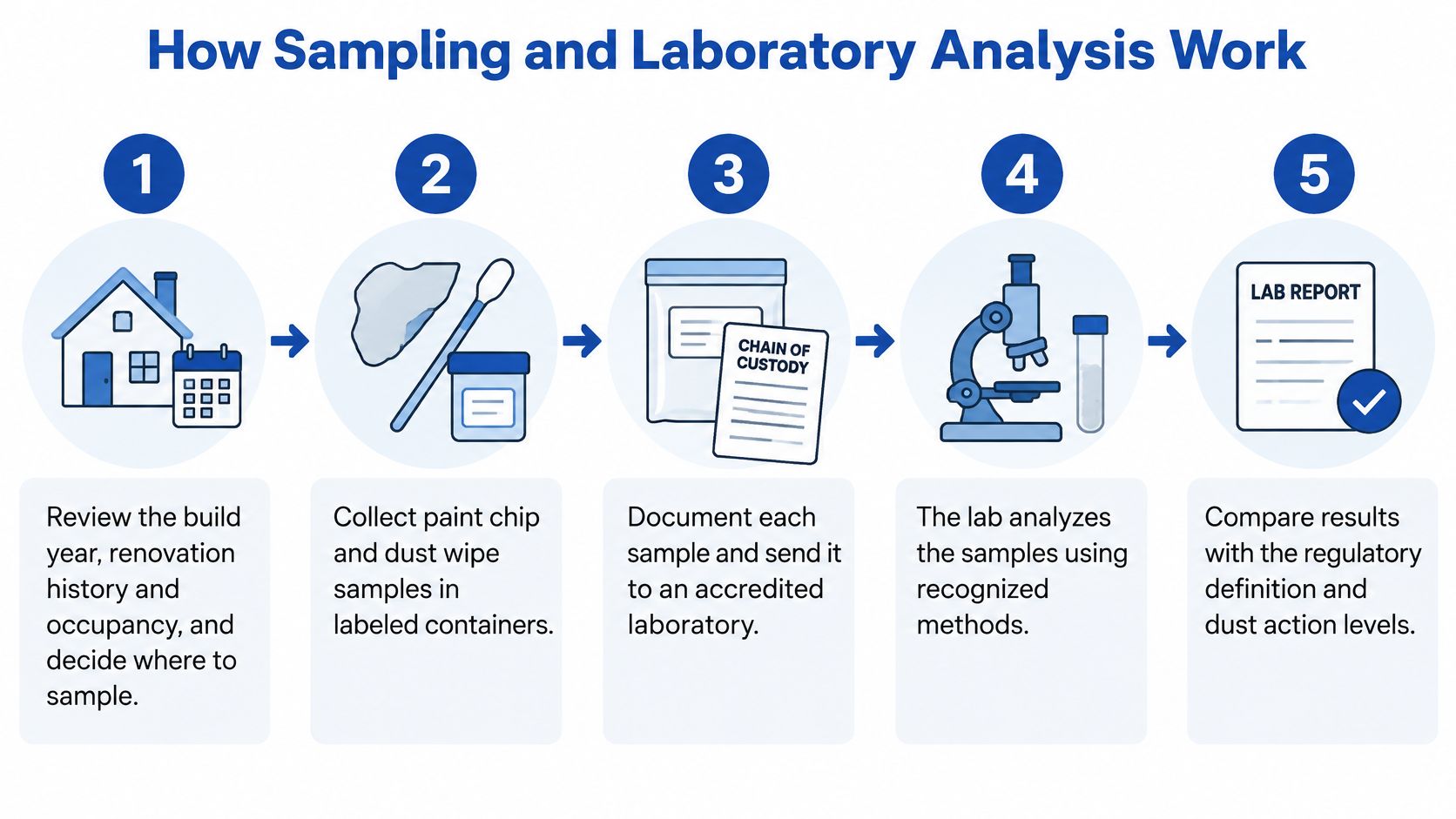
Review the property history. The inspector reviews construction information, renovation records, occupancy, and planned work. A common mistake is treating the original building and a later addition as though they share the same coating history.
Walk through the relevant areas and record painted components, their condition, and friction or impact points. Window sash, door edges, stair components, and damaged trim need identifiable locations, not a general note saying that paint was observed.
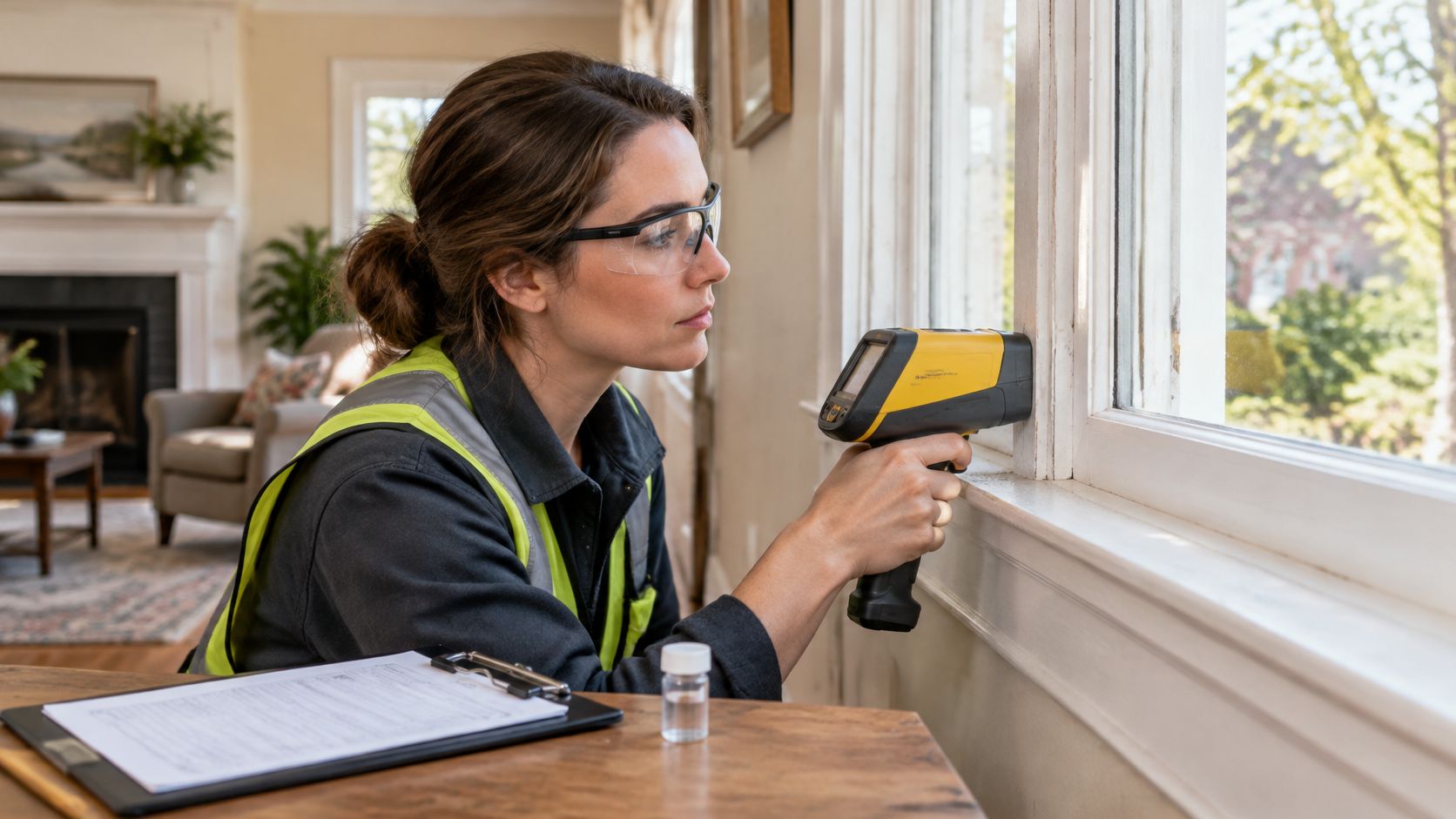
Screen coatings with XRF when appropriate. A portable X-ray fluorescence instrument measures lead in place and helps evaluate multiple components without collecting a chip from each location. The inspector must account for substrate, surface geometry, instrument performance, and readings that need confirmation.
Collect paint chips where laboratory confirmation is appropriate. HUD's inspection guidance states that approximately 4 square inches, or 25 square centimeters, generally provides sufficient sample material, with smaller samples acceptable only when the laboratory confirms the quantity and the sampled area is documented. Collecting a convenient loose flake without identifying its source can undermine interpretation.
Collect dust using the applicable sampling design. For the selected dwelling units or common areas covered by federal lead-housing sampling provisions, the design includes at least two composite samples, one from floors and one from interior window sills, each containing four individual samples from different rooms or areas. That's a specific regulatory design, not a universal instruction for every residential inspection.
Sample bare soil where the assessment calls for it. Children's play areas and other exposed yard locations should be identified separately so the report preserves the meaning of each result.
Preserve the sample's identity through reporting
Submit labeled samples with chain-of-custody documentation. The paperwork should match field records and identify the material, location, requested analysis, and relevant sampled area. Laboratory methods must suit the sample type and applicable regulatory program.
Issue a report connecting each result to a component or sampling location. The interpretation should explain the finding, its limitations, and the next decision rather than leaving the owner with an unexplained laboratory attachment.
Sensitive Environmental recommends paint-chip laboratory analysis for the most accurate lead paint results, rather than relying on an XRF gun reading alone. XRF and laboratory analysis provide different kinds of information, so confirmation should resolve the actual uncertainty, not merely add another test.
A sample label such as “living room, south wall, painted wood window sill” gives a result practical meaning. “Paint sample” doesn't.
Owners can help by providing access, available plans, previous reports, and the contractor's proposed scope before sampling begins. Don't scrape or collect material in advance unless the testing professional has established how that collection will meet the evaluation's requirements.
Reading Lab Results and Current Dust Action Levels
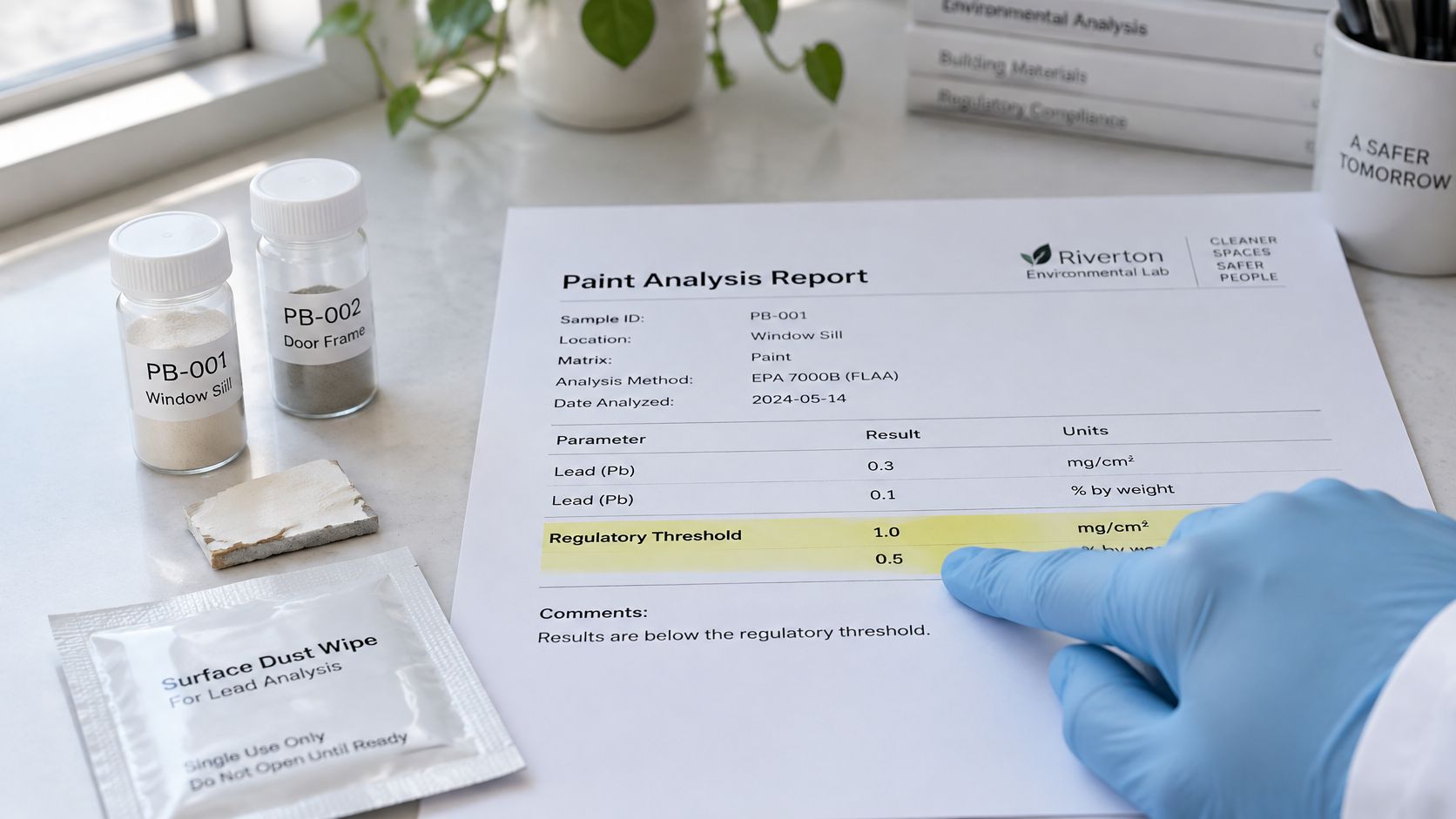
A single property can generate several kinds of lead numbers, and each one answers a different question. Paint concentration tells you whether a coating meets the regulatory definition of lead-based paint. Under HUD's definition, lead-based paint contains lead at or above 1.0 milligram per square centimeter or 0.5 percent by weight, as set out in HUD's lead hazard evaluation and control guidelines. Dust loading tells you how much lead is sitting on floors and window surfaces right now. Confusing the two is the fastest way to misread a report.
Current dust-lead action levels compared with former thresholds
The following values, in micrograms per square foot, are established in EPA's revised household lead guidance supplement, which states that the rule became effective January 13, 2025, and the revised reportable and action-level requirements applied January 12, 2026.
| Surface | Former threshold (µg/ft²) | Current action level (µg/ft²) |
|---|---|---|
| Floors | 10 | 5 |
| Interior window sills | 100 | 40 |
| Window troughs | 400 | 100 |
Each surface gets its own yardstick. Floor dust is held to the tightest level because settled dust at foot level is where exposure happens most directly. Interior sill results must be evaluated against the sill criterion rather than the floor criterion. Window troughs have their own action level, so a trough reading shouldn't be averaged into a sill result to make it look better or worse.
Read the result in its regulatory context
An action level is a comparison line, not a measure of what the laboratory can find. A report may show detectable lead even when the applicable action level isn't exceeded, and the assessor should explain both the analytical finding and the regulatory conclusion. Those are two separate statements on the same page.
A paint result below the regulatory definition doesn't clear the property either. It means that particular coating, at that location, fell under the threshold. Deteriorating or disturbed paint below the definition can still contribute lead to settled dust, which is exactly why dust carries its own action levels. Read each number against its purpose: paint defines the coating, dust describes current exposure conditions.
Soil follows a separate comparison again. EPA's soil guidance treats children's play areas more strictly than other bare yard soil, and soil concentration measurements aren't interchangeable with dust loading or paint concentration. Three media, three yardsticks, three different decisions.
An older clearance report may have been valid under the criteria applied at the time, yet still need review before anyone relies on it for a current project. Later renovation, changed conditions, and the revised action levels above can all affect whether that document still answers today's question.
Check the report before acting
- Sampled surface: Identify whether the result concerns paint, floor dust, a sill, a trough, or soil.
- Sampling location: Match the sample identifier to a room, component, drawing, or photograph.
- Laboratory method: Confirm that the analysis and reported units suit the material and intended comparison.
- Report date: Review the collection date and which action levels applied then, rather than assuming the forwarded file reflects current criteria.
Interpretation matters: A laboratory result describes the submitted sample. A professional conclusion explains what that result means for the evaluated property conditions.
A positive finding opens a decision about condition, exposure, occupancy, and planned disturbance. Depending on those factors, the right response can range from monitoring and maintenance to interim controls or regulated removal work, and the report should give owners and qualified professionals enough context to choose among them.
DIY Test Kits Versus Certified Lead Testing
A homeowner may use a consumer test kit to screen an accessible spot before deciding to arrange professional testing. That can prompt a useful conversation, but it shouldn't become the basis for property-wide clearance or permission to disturb suspect coatings.
DIY lead screening versus certified lead testing
| Factor | DIY test kit | Certified inspection or risk assessment |
|---|---|---|
| Scope | One surface or spot check | Representative sampling across components, with dust and soil as needed |
| Method | Consumer kit reading | Documented field methods and laboratory analysis where appropriate |
| Documentation | Personal notes | Report linking results to locations, components, and recommended next steps |
| Who acts on results | Homeowner interprets the screening result | Certified professional develops findings for the defined transaction, renovation, or occupancy question |
Common assumptions that cause trouble
A few paint chips clear the property. They don't unless the sampling design supports the specific conclusion being made. Representative sampling requires a documented basis for selecting components, not just convenient collection points.
A clean-looking wall proves there's no lead. Appearance describes condition, not chemical composition. Fresh paint can also conceal older layers that matter when work reaches beneath the surface.
A positive kit means the coating must come off. The immediate need is a defensible evaluation of the relevant condition and proposed activity. Don't begin scraping to investigate further.
An old clearance report settles a new project. Check whether its scope, property conditions, and comparison criteria fit the present decision. A report from completed work doesn't automatically cover later disturbance elsewhere.
When professional involvement is the better choice
Stop relying on informal screening when the result will guide:
- A purchase or rental decision: Obtain documentation suited to due diligence and known-condition disclosures.
- Renovation beyond minor work: Establish the affected components and appropriate testing pathway.
- Occupied-space dust concerns: Arrange an assessment that considers exposure pathways.
- A child-occupied facility: Use qualified professionals and the applicable program requirements.
Consumer screening and professional testing aren't competing versions of the same document. They serve different purposes, and a homeowner's kit reading doesn't substitute for required certified work.
Schedule a Lead Inspection Before Your Next Decision
A lead inspection works best when the scope is set by the decision it has to support. Before the consultation, be ready to describe when the building was constructed, including additions and major alterations; what purchase, lease, renovation, or post-work verification is planned; and who uses the space, such as children's activities, shared areas, and access limits. For a pre-1978 property, start from the assumption that lead paint may be present, then ask which components will be sampled and what each result will and will not establish.
The proposal should turn those answers into a defined assignment: paint inspection, risk assessment, renovation determination, or clearance examination. It should name the sampling locations, whether dust or surface sampling is included, and how the report will be read against current dust action levels. An intact coating can look clean while nearby dust still matters, so ask what decision the result will support.
Prepare for a report you can use
Gather previous laboratory reports, floor plans, photographs of deteriorated areas, and the contractor's written scope. Keep an incomplete report anyway; its locations and methods can show what remains unevaluated. Our lead testing includes lead paint inspection, lead dust and surface sampling, exposure risk assessments, and certified laboratory analysis. Sensitive Environmental's team includes certified inspectors serving residential and commercial properties in Los Angeles and Southern California.
If a finding leads to next steps, our guide to lead abatement in Los Angeles for older homes and buildings gives context for that path. The starting point is an evaluation that establishes what is present and what the results mean.
Request a consultation before signing a purchase, lease, or renovation contract so the testing scope can support your decision rather than arrive after it.
Sensitive Environmental offers a free, no-obligation consultation to discuss lead paint inspection, dust sampling, and assessment needs for residential and commercial properties in Los Angeles and Southern California. Call 310-387-5404 or visit Sensitive Environmental to request an appointment online and explain the property conditions or planned work your testing needs to address.