
You've just received a thick environmental assessment report for a property in Los Angeles. The lender wants a quick answer, the contractor is waiting to plan work, and the executive summary appears to say there are no immediate concerns. Yet the report contains historical maps, database records, photographs, interview forms, and technical appendices. The important question isn't whether the document is long. It's what each section proves, what it leaves uncertain, and what decision it supports.
An environmental assessment report may address a real estate transaction, a renovation, a demolition project, a tenant complaint, a fire loss, water damage, or regulatory documentation. Sensitive Environmental provides professional inspections, sampling, laboratory analysis, and reporting for asbestos, lead, mold, indoor air quality, fire residues, heavy metals, and broader commercial environmental concerns throughout Los Angeles and Southern California. The right report doesn't always produce a simple yes-or-no answer. Sometimes its most responsible conclusion is that more investigation or monitoring is needed.
Table of Contents
- Why the Report in Your Hand Looks the Way It Does
- Two Report Families You Need to Know
- The Phase I ESA Workflow Inside the Report
- Anatomy of a Phase I Environmental Site Assessment Report
- How Phase II Reports Build on Phase I Findings
- Appendices Most Readers Skip but Should Verify
- Contaminant-Specific Reports for California Properties
- How to Read Findings Without Misreading Them
- California and AQMD Rules That Shape the Report
- From Report to Next Steps on a Real Project
- What an Environmental Assessment Report Does Not Tell You
Why the Report in Your Hand Looks the Way It Does
A property owner may open a lengthy Phase I Environmental Site Assessment and wonder why a straightforward decision requires so many pages. The structure follows a defined due-diligence process. ASTM E1527-21 covers records review, site reconnaissance, interviews, and the consultant's evaluation and reporting, as described in Intertek's overview of ASTM E1527-21.
That format creates a defensible record for lenders, buyers, and future owners. It shows which historical sources were checked, including Sanborn or other historical maps, regulatory databases, prior property uses, site photographs, interviews, and supporting records available when the assessment was prepared. A conclusion stating that no Recognized Environmental Conditions were identified still rests on that evidence. A report identifying several RECs uses the same foundation. Page count reflects the evidence package, not automatically the seriousness of the findings.
Use the structure as a navigation tool
Read the executive summary first, then trace each conclusion to its supporting section. If the summary says a former auto-service use does not qualify as a REC, check the historical-use narrative, database findings, site observations, and reasoning that support that judgment.
The standardized format separates facts, professional opinions, limitations, and recommendations. That separation helps a reader decide whether to proceed, request clarification, commission additional investigation, or address a condition before financing, acquisition, redevelopment, or insurance review.
Practical rule: Judge an environmental assessment report by whether its conclusions connect to dated records, documented observations, interviews, and clearly stated limitations, not by its thickness.
Two Report Families You Need to Know
Most property owners confuse reports because they use “environmental assessment” as a catch-all term. The first step is to identify the decision the document supports.
Transactional reports
A Phase I ESA under ASTM E1527-21 is generally prepared for property acquisition, refinancing, lender due diligence, or ownership risk review. It's primarily non-intrusive. The consultant reviews records, visits the site, interviews knowledgeable parties, and evaluates whether current or historical uses indicate a Recognized Environmental Condition.
A Phase II ESA is a targeted investigation that may follow when the Phase I identifies a REC or another concern requiring physical evidence. It can involve soil, groundwater, soil vapor, or building-material sampling, depending on the suspected source and exposure pathway. Phase II doesn't replace Phase I. It tests a specific hypothesis raised by the earlier assessment.
Project and operational reports
A project-specific hazardous-materials survey serves a different purpose. A general contractor planning renovation or demolition may need pre-renovation asbestos testing, pre-demolition asbestos testing, lead testing, mold sampling, or fire-residue testing. These reports focus on materials or conditions that workers may disturb, not on the full environmental history of a parcel.
Operational assessments can also be broader than a transaction report. ISO 14031 provides guidance for environmental performance evaluation using condition, operational, and management performance indicators, according to the International Organization for Standardization. That approach can help facilities evaluate compliance, resource use, and improvement trends, but it isn't a substitute for a Phase I ESA.
The reports form a sequence rather than competing options:
- Define the decision. Acquisition, financing, renovation, demolition, occupancy, or complaint response requires different evidence.
- Order the appropriate assessment. A lender may request a Phase I, while a contractor may need an asbestos survey.
- Investigate flagged conditions. A REC may support Phase II sampling. Suspect building materials may require bulk asbestos or lead samples.
- Use the findings to plan next steps. Results can guide design, scheduling, additional testing, regulatory documentation, or professional remediation planning.
The Phase I ESA Workflow Inside the Report
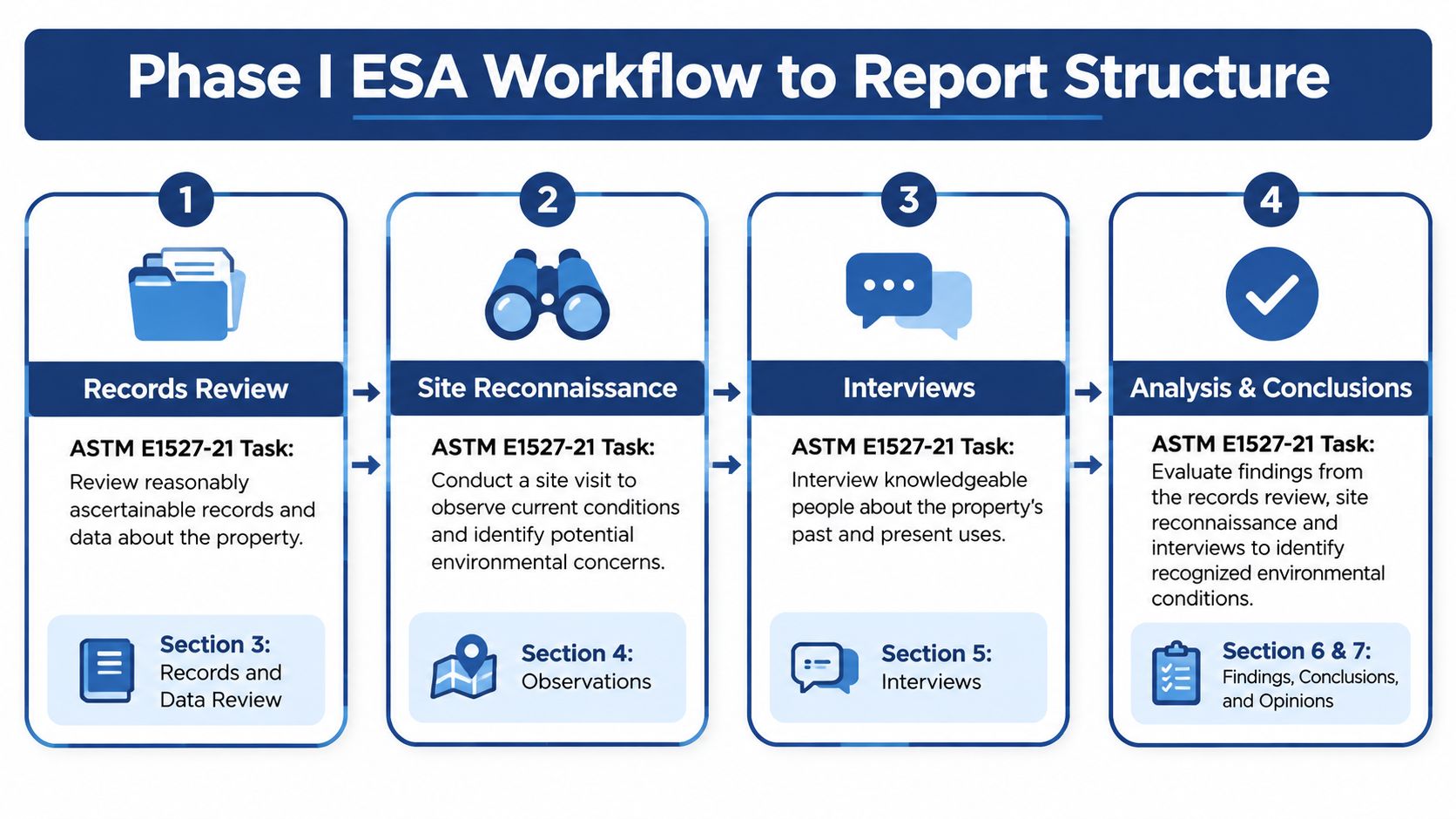
A well-prepared Phase I report lets a reader follow the consultant's reasoning from evidence to opinion. ASTM E1527-21 organizes the core inquiry around records review, site reconnaissance, interviews, and evaluation/reporting.
Records review
The consultant examines historical sources, regulatory databases, maps, aerial photographs, and other available records. The final report may include a narrative describing prior uses, database tables identifying nearby sites, and a discussion of whether historical activities could have affected the property.
Records don't all carry the same meaning. A dry-cleaning listing nearby may deserve a different evaluation from a former industrial use on the subject parcel. The consultant considers location, use, chemicals, pathways, and available agency information.
Site reconnaissance
The site visit produces the current-condition description and photograph log. The consultant may document building use, storage areas, drains, tanks, stained surfaces, waste handling, transformers, chemical storage, and adjoining properties.
Photographs should support the written observations. A photo of a stained floor, for example, needs a caption and location that allow the reader to connect it to the relevant discussion.
Interviews and evaluation
Interviews with owners, occupants, operators, and other knowledgeable parties can reveal information missing from public records. If an interview couldn't be completed, the report should identify that limitation as a data gap, not fill it with an assumption.
The final evaluation connects all four steps. It distinguishes RECs, Controlled RECs, Historical RECs, de minimis conditions, and unresolved uncertainties. Missing information can affect the confidence of the conclusion, which is why a credible report explains what remains unknown.
Anatomy of a Phase I Environmental Site Assessment Report
A Phase I report becomes easier to use once you understand the order of its sections. The exact layout varies by consultant, but the core content should be recognizable.
Begin with the opinion, then verify it
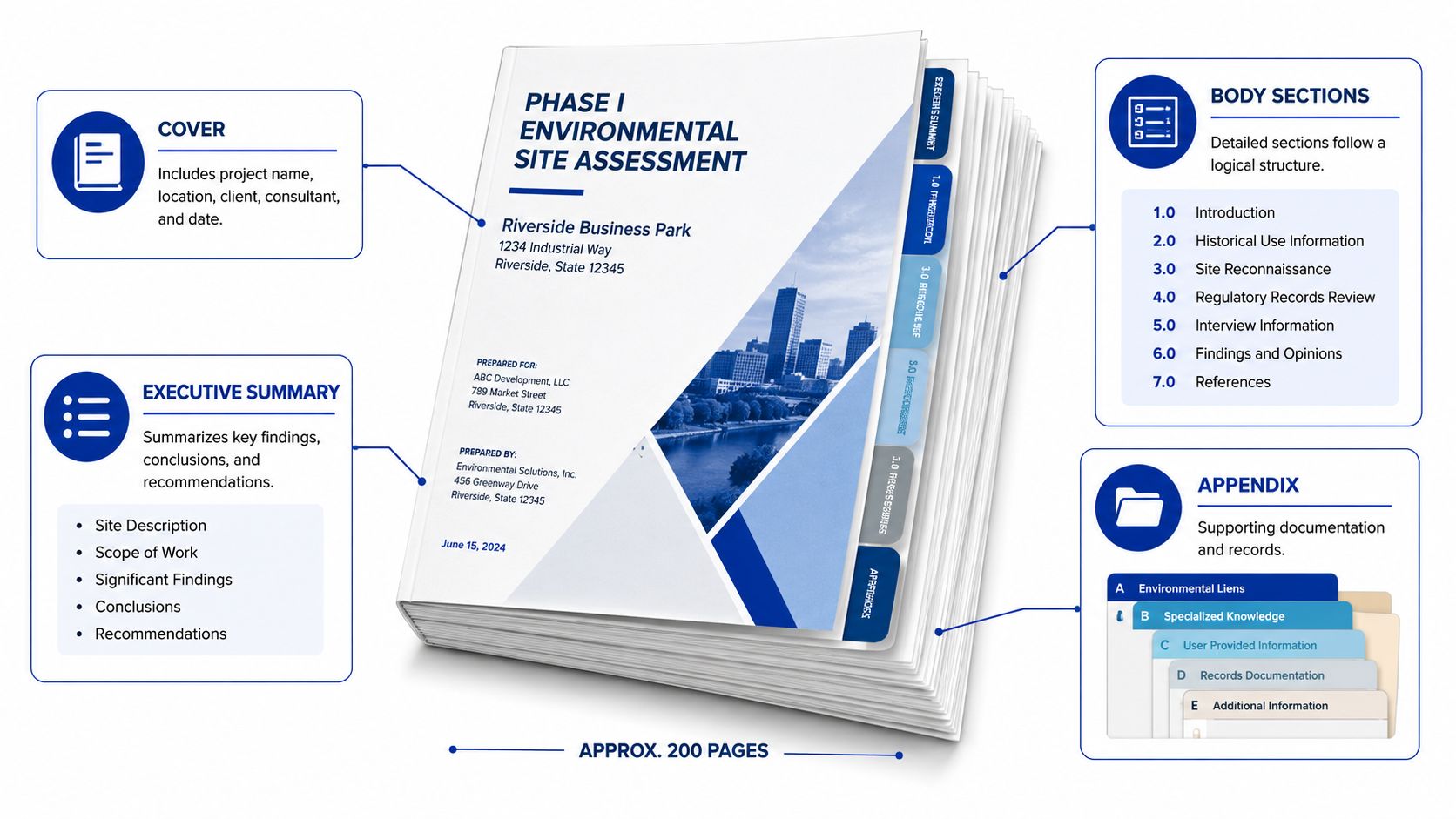
The cover page identifies the property, client, consultant, and report date. The executive summary gives the high-level opinion regarding Recognized Environmental Conditions, Controlled RECs, Historical RECs, and recommendations.
Don't stop there. Treat the summary as an index to the evidence, not as the complete assessment.
The site description usually covers location, current use, improvements, access, topography, drainage, utilities, and surrounding properties. These details provide context for understanding how a suspected release could move through soil, groundwater, vapor, stormwater, or building systems.
Follow the historical and regulatory evidence
The historical-use section may draw from aerial photographs, Sanborn fire insurance maps, city directories, property records, and other sources. The purpose is to identify uses that could have involved petroleum, solvents, metals, waste, or other hazardous substances.
The regulatory database review may include commercial environmental database products and public resources such as EnviroStor and GeoTracker. A listing isn't automatically proof of contamination at the subject property. The report should explain the listing's location, status, relationship to the property, and relevance to the consultant's opinion.
Understand findings and limitations
The site reconnaissance narrative records observed conditions and access limitations. The de minimis conditions discussion addresses minor issues that generally don't represent a significant environmental concern, such as a small spill handled through ordinary housekeeping.
The data gaps section is equally important. It should state what couldn't be verified, whether the missing information affects the assessment, and whether further investigation is appropriate.
Conclusions and recommendations may state that no additional work is warranted, recommend a Phase II ESA, identify a need for specialized testing, or call for monitoring. A report that says “more investigation needed” isn't necessarily defective. It may be accurately describing the limits of available evidence.
How Phase II Reports Build on Phase I Findings
A Phase II ESA starts with a question raised by the Phase I. If historical records indicate a former fueling operation, the investigation may test soil, groundwater, or soil vapor for petroleum-related compounds. If a former industrial use suggests solvent handling, the sampling plan may target volatile organic compounds. The report should connect each analyte to a suspected source and environmental medium.
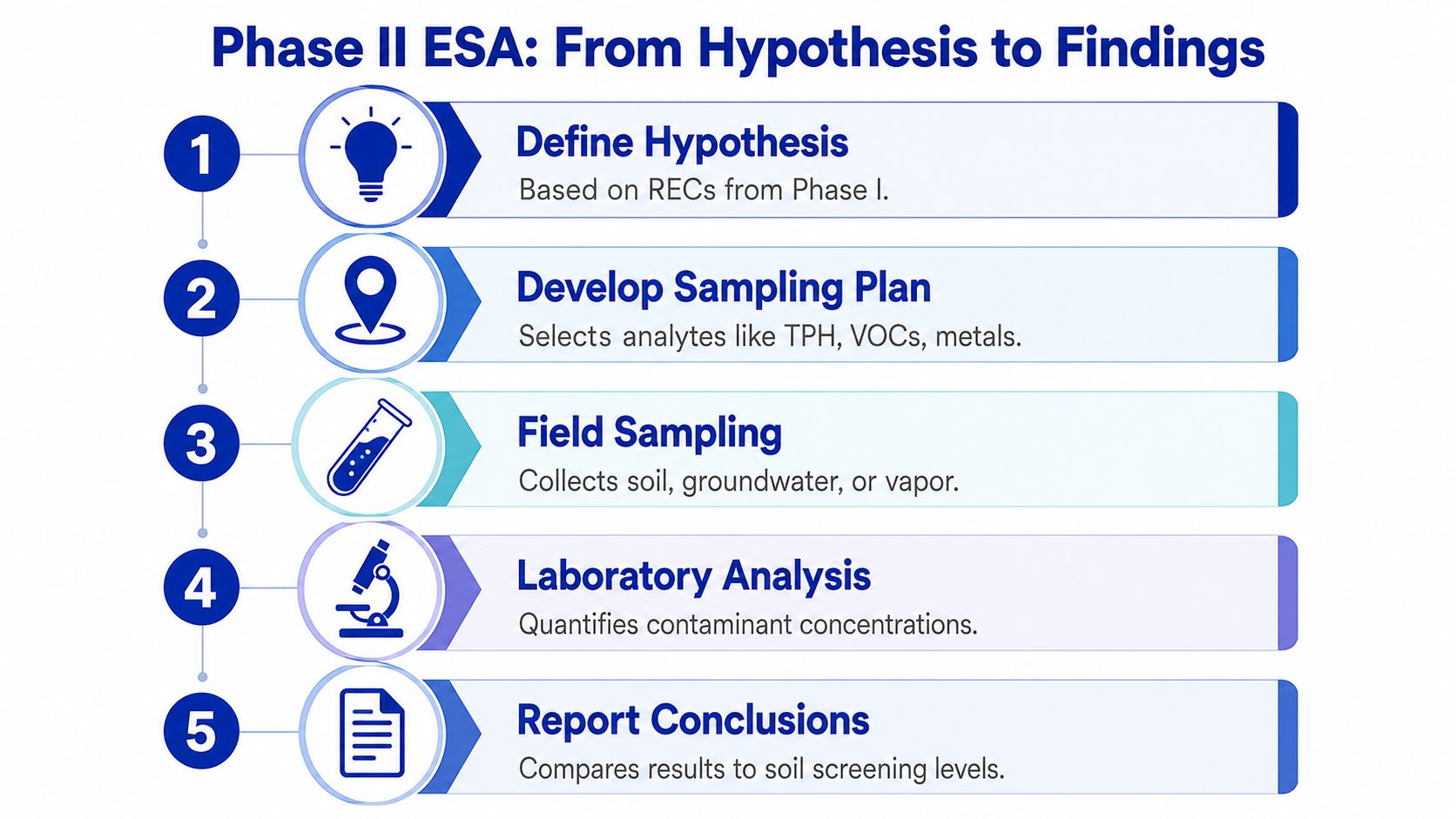
The five-part investigation
- Sampling plan: The consultant identifies target analytes, locations, depths, media, quality controls, and laboratory methods. Common targets may include total petroleum hydrocarbons, volatile organic compounds, and heavy metals.
- Field methods: The report documents boring locations, sample collection, equipment, well installation where applicable, decontamination procedures, and field observations.
- Laboratory analysis: Certified laboratories quantify detected compounds using appropriate methods, which may include EPA methods such as 8260B or 6010 when suitable for the investigation.
- Results tables: Tables show detected concentrations, reporting limits, sample locations, and comparisons to applicable California Human Health Screening Levels or EPA Regional Screening Levels.
- Conclusions: The consultant explains whether the results support the original concern, whether concentrations exceed relevant screening criteria, and what additional evaluation may be appropriate.
A Phase II narrows the question. It can help determine whether a suspected release is present, where it may be located, which media are affected, and whether the available results justify further action. It shouldn't be ordered as a reflex when a Phase I identifies a concern. The sampling should be designed around the actual REC.
Property owners planning this type of investigation can review Sensitive Environmental's environmental testing services to understand how professional sampling, laboratory analysis, and reporting fit together.
Appendices Most Readers Skip but Should Verify
The appendix package often contains the evidence that makes an environmental assessment report useful. Readers should compare the appendices with statements in the body rather than assuming the cover page tells the whole story.
What to inspect
- Regulatory database report: Check the listed properties, search radius, addresses, status descriptions, and relationship to the subject site.
- Photograph log: Confirm that photographs include dates, locations, captions, and enough context to identify the observed condition.
- Historical records: Review Sanborn maps, aerial photographs, city directories, and other source documents cited in the historical-use narrative.
- Questionnaire and interviews: Look for completed forms, signatures, dates, and notes explaining unavailable interviewees or unanswered questions.
- Phase II laboratory package: Verify the chain of custody, sample IDs, laboratory analytical reports, method detection limits, quality-assurance flags, and certification information.
A rushed appendix can reveal problems that a polished executive summary hides. Missing photograph dates weaken the timeline. Missing signatures reduce confidence in the user questionnaire. A broken sample ID on a chain-of-custody form can make it difficult to connect a laboratory result to the field location.
Documentation matters: A laboratory result is only useful when the report shows what was sampled, where it was collected, how it was preserved, which method was used, and how the result connects to the conclusion.
For owners evaluating multiple properties, an environmental report can be paired with a broader portfolio risk assessment tool to organize property-level information. That type of resource doesn't replace professional inspection or laboratory analysis, but it can help identify where more detailed review may be warranted.
Contaminant-Specific Reports for California Properties
A Phase I or Phase II ESA addresses broad site conditions. California properties also require focused reports for individual hazards. Choosing the wrong document can leave a contractor, lender, or property manager without the evidence needed for a specific decision.
Asbestos and lead documents
An asbestos survey identifies suspect materials, sample locations, material descriptions, condition, and laboratory results. For renovation and demolition work, the survey must address the materials that may be disturbed. South Coast AQMD Rule 1403 requires a thorough asbestos survey before demolition or renovation, and its requirements differ from a general real estate environmental assessment.
Lead inspections and clearance reports focus on lead-based paint or lead dust. HUD policy uses measurable dust-load thresholds, including 40 µg/ft² for floors, 250 µg/ft² for interior windowsills, and 400 µg/ft² for window troughs, as stated in the HUD lead-based paint policy. These results come from sampling and laboratory analysis, not visual appearance alone.
Mold, IAQ, and fire-related testing
A mold inspection evaluates moisture conditions, visible growth, building materials, and sampling needs. Mold sampling may involve air samples, surface samples, or material samples, depending on the question. A visual walkthrough alone may not answer whether airborne conditions or hidden moisture require further assessment.
An indoor air quality report may evaluate mold-related indicators, VOCs, carbon dioxide, particulates, combustion byproducts, or other airborne contaminants. It answers an occupancy and ventilation question, not the historical land-use question answered by a Phase I ESA.
After a wildfire or building fire, testing may target ash, soot, char, smoke residue, heavy metals, and other combustion byproducts. Water damage can also justify mold and environmental testing before materials are disturbed or occupancy decisions are made.
How to Read Findings Without Misreading Them
Many readers turn directly to the conclusions page and stop when they see “no Recognized Environmental Conditions.” That conclusion may be favorable, but it doesn't mean the property was tested for every possible hazard or that every uncertainty disappeared.
Learn the vocabulary
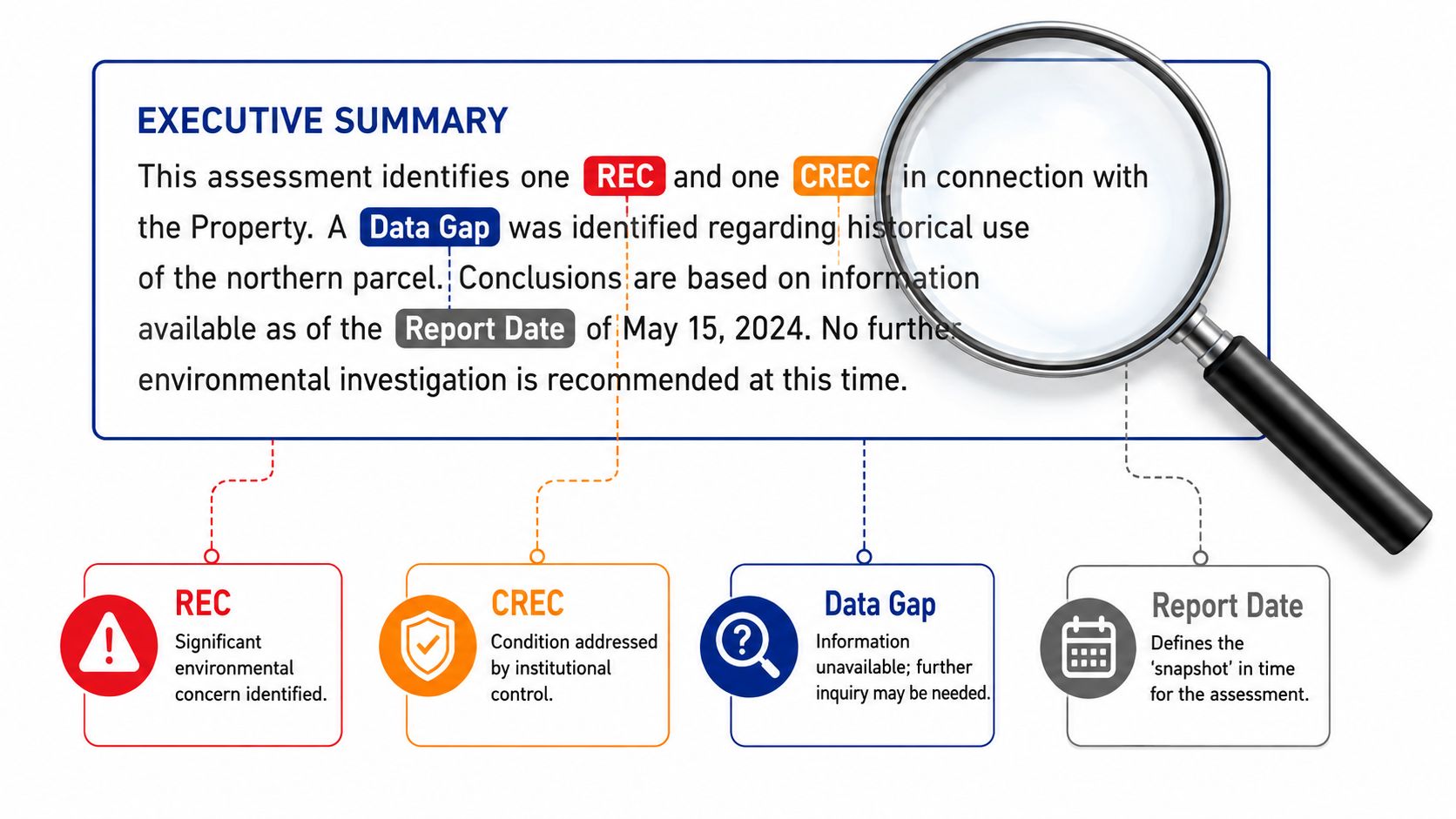
- REC: A recognized environmental condition indicates a significant concern involving the presence or likely presence of hazardous substances or petroleum products.
- CREC: A Controlled REC is a recognized condition addressed through activity or use limitations, institutional controls, engineering controls, or other established measures.
- HREC: A Historical REC refers to a past release that has been addressed to the satisfaction of the applicable regulatory authority, with no current REC under the assessment framework.
- De minimis condition: A minor condition that generally doesn't represent a significant environmental concern and doesn't require the same level of response as a REC.
- Data gap: Information needed for the inquiry wasn't available or couldn't be verified, so the consultant must explain its effect on the conclusion.
A hypothetical former gas station may have no current REC because a regulatory agency approved closure, yet the report could still identify a CREC tied to an activity or use limitation. The exercise is simple: find the conclusion, locate the supporting historical and regulatory sections, and check whether the condition is described as controlled rather than absent.
Check the snapshot date
For transaction use, key components of a Phase I report must remain current within 180 days, according to ASTM E1527-21 guidance summarized by Intertek. Check the report date, the date of the site visit, the date of interviews, and the timing of the records review. An outdated report may need updating before a lender or buyer can rely on it.
Review three areas closely: the historical-use table, the regulatory database search, and site reconnaissance limitations. Those sections often show whether the favorable conclusion depends on missing records, restricted access, unavailable interviews, or unresolved neighboring conditions.
California and AQMD Rules That Shape the Report
Federal due-diligence standards provide a framework, but Southern California projects often involve additional asbestos and lead requirements. SCAQMD Rule 1403 is especially important for renovation and demolition in the South Coast Air Basin.
Before work begins, the facility or affected components must be thoroughly surveyed for asbestos. For non-emergency projects, notifications must be submitted at least 10 working days before demolition or renovation, as stated in the South Coast AQMD Rule 1403 text. When damaged asbestos-containing material requires stabilization, the owner or operator must secure, stabilize, and survey the affected area, and an approved Procedure 5 plan is required before cleanup begins.
The rule's compliance guidance identifies five procedures, including total enclosure with HEPA filtration for friable material, glovebag work for small projects, adequate wetting for non-friable material, an approved dry-removal alternative when wetting creates a hazard, and Procedure 5 for damaged or disturbed material. Procedure 5 requires prior written approval, as explained in South Coast AQMD's asbestos compliance advisory.
EPA asbestos NESHAP guidance uses thresholds of 15 square meters, or 160 square feet, of regulated asbestos-containing material, and 80 linear meters, or 260 linear feet, on pipes, which is why surveys must quantify material precisely in the EPA asbestos guidance.
For a property owner planning a disclosure or transaction, California asbestos real estate disclosure information can help clarify why a general Phase I doesn't replace a project-specific asbestos survey.
From Report to Next Steps on a Real Project
The report should lead to a decision, but the decision depends on the finding and the quality of supporting evidence.
If a current Phase I identifies no RECs and its data gaps are acceptable, the buyer and lender may proceed with the transaction using the report within its applicable reliance period. The owner should still confirm whether separate asbestos, lead, mold, IAQ, or fire-related testing is needed for planned work or occupancy.
When a REC is identified, commission a Phase II ESA designed around the suspected contaminant and medium. Soil, groundwater, soil vapor, and building materials require different sampling approaches. The report should define the locations and analytes rather than recommend vague “additional testing.”
If laboratory results exceed applicable screening criteria, the file may need review by qualified environmental professionals, engineers, regulators, lenders, and legal advisers. The appropriate response depends on the substance, concentration, pathway, land use, and regulatory context. A positive result doesn't automatically dictate one outcome.
For asbestos-containing material identified before demolition or renovation, Rule 1403 documentation and notification requirements should be addressed before disturbance. For mold, testing results may support a written remediation plan and post-work clearance sampling. These are separate professional activities, and testing should remain independent enough to document the condition clearly. Sensitive Environmental's environmental remediation services information can help readers understand how testing findings may connect to later project planning without treating a positive test as an automatic directive.
What an Environmental Assessment Report Does Not Tell You
A Phase I ESA doesn't certify that a property is clean. It documents a defined level of environmental due diligence and identifies recognized conditions based on available records, site observations, interviews, and professional evaluation.
It also doesn't automatically assess every building or environmental hazard. Unless separately scoped, a Phase I generally isn't a mold inspection, asbestos survey, lead inspection, indoor air quality study, radon test, structural assessment, building-systems review, zoning review, or code-compliance inspection.
The report won't predict a future spill, a new owner's operations, or every possible vapor-intrusion condition from an off-site release. It may identify a potential concern and recommend specialized testing, but it can't replace laboratory analysis when physical evidence is necessary.
Uncertainty is part of the result
A strong report states what the consultant couldn't verify. That may include inaccessible areas, unavailable records, incomplete user information, missing interviews, or conditions outside the agreed scope. The Evidence Review Note on environmental impact assessment highlights weaknesses such as disjointed report structure, poor connection between strategic and project-level assessments, weak mitigation tracking, and data gaps that should be disclosed rather than concealed.
The OECD also emphasizes stronger quality control, independent oversight of ex ante assessments, and systematic consideration of compliance costs in its environmental policy assessment report. For a property owner, the practical lesson is clear: a report's value lies not only in what it finds, but in how it defines uncertainty and follow-up needs.
A useful conclusion may be “more investigation needed.” That answer gives the buyer, owner, contractor, or lender a clearer basis for the next decision than an unsupported promise of certainty.
Sensitive Environmental provides professional environmental assessments, asbestos surveys, lead testing, mold inspections and sampling, indoor air quality testing, industrial hygiene assessments, and fire-related testing for ash, soot, char, smoke residue, combustion byproducts, and heavy metals in Los Angeles and Southern California. Review your environmental assessment report with the team at Sensitive Environmental, and schedule the targeted inspection or laboratory testing needed to turn uncertain findings into documented next steps.