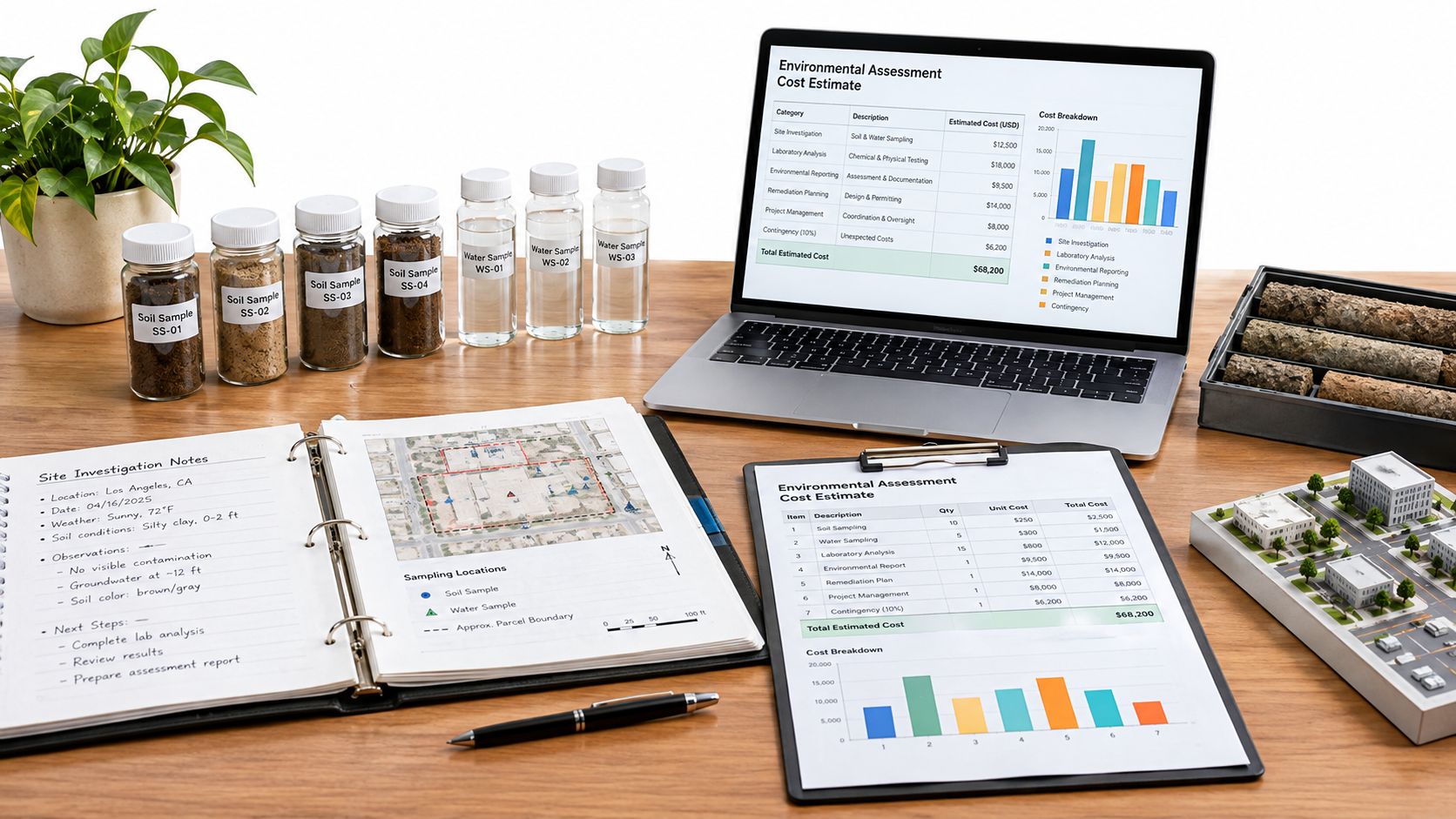
Most Phase I Environmental Site Assessments in Los Angeles run about $2,000 to $5,000, while a Phase II with sampling can climb from $5,000 to $35,000 or far higher when contamination is identified. The same word, “assessment,” covers dramatically different scopes, from a records review to invasive sampling, laboratory analysis, regulatory documentation, and contamination delineation.
A buyer closing on a Silver Lake duplex may only need a transaction-driven environmental review. A contractor preparing a Mid-City demolition may need asbestos surveys, lead inspections, and agency documentation before work starts. A landlord dealing with a water leak in a Koreatown storefront may need mold, indoor air quality, or targeted material testing instead. Each person may search for environmental assessment cost, but they aren't shopping for the same service.
The right budget follows the trigger, not just the property address. Lender requirements, renovation plans, suspected contamination, fire damage, water intrusion, and regulatory mandates each create different testing obligations and reporting needs. Below, I'll separate the seven practical scopes Los Angeles property owners and project teams commonly pay for, so you can budget for the work you need.
Table of Contents
- What Drives the Environmental Assessment Cost You Will Pay
- The Main Types of Environmental Assessments Explained
- Key Factors That Move an Assessment Quote Up or Down
- Typical Cost Ranges for Each Assessment Type
- Choosing the Right Level of Assessment for Your Project
- Regulations That Shape LA and Southern California Pricing
- Smart Budgeting Tips Before You Hire an Environmental Consultant
What Drives the Environmental Assessment Cost You Will Pay
A Silver Lake duplex buyer, a Mid-City demolition contractor, and a Koreatown landlord may all request an environmental assessment. They are not buying the same service. The buyer may need lender due diligence, the contractor may need asbestos or lead testing before disturbance, and the landlord may need a focused response to moisture damage.
The trigger determines the scope and the budget. A standard Phase I Environmental Site Assessment reviews historical records, environmental databases, aerial imagery, directories, and available regulatory information. The consultant also inspects the property and documents visible conditions. No physical sampling occurs in a standard Phase I ESA, so the fee covers research, site reconnaissance, professional judgment, and report preparation rather than drilling or laboratory analysis.
The trigger controls the scope
Owners should match the quote to the question the consultant must answer:
- Phase I baseline: Records review and site inspection, commonly about $2,000 to $5,000 for a standard property. Site history and complexity can move the fee higher (ConsultFees' environmental consultant fee survey).
- Phase II sampling: Soil, groundwater, soil-gas, or another physical investigation after a recognized environmental condition. Published ranges extend from $5,000 to $35,000, with contamination-driven work rising much higher.
- Targeted single-issue testing: Lead paint, asbestos, mold, ash, soot, heavy metals, VOCs, or a defined indoor air quality concern. Sample count and laboratory requirements set the price.
- Industrial hygiene surveys: Air, dust, fiber, particulate, or chemical exposure evaluations for construction, occupancy, or post-incident work.
- Pre-renovation and pre-demolition surveys: Asbestos and lead inspections tied to the materials scheduled for disturbance.
- Mold and moisture assessments: Visual inspection and moisture evaluation, with air or surface sampling when testing answers a specific question.
- Full contamination delineation: Multi-media sampling, repeated field activities, wells, laboratory analysis, and documentation for agency review.
The cheapest assessment is the one that answers the defined project question without adding irrelevant work. Ask the consultant to identify the trigger, testing methods, assumptions, and deliverable before comparing prices. A quote without a clear scope is not a meaningful comparison.
Federal environmental reviews show how far costs can move when the scope expands. A government review found that agencies did not routinely track the cost of National Environmental Policy Act analyses. The Department of Energy's median contractor cost for EISs from 2003 through 2012 was $1.4 million, while a 2003 task force estimated a typical EIS at $250,000 to $2 million (Congressional document on NEPA analysis costs). These figures concern major federal reviews, not ordinary property due diligence. They demonstrate why “assessment” cannot support one useful average price.
The Main Types of Environmental Assessments Explained
A property owner facing a purchase, refinance, renovation, leak, or agency request is not buying one generic “environmental assessment.” The trigger determines the scope. Identify what the consultant must establish, how the information will be collected, and who will rely on the report. A lender, contractor, public agency, property manager, and insurer may require different documents for the same site.
Phase I and Phase II ESAs
A Phase I ESA is a non-invasive due diligence review. The consultant examines historical and regulatory records, considers adjoining properties, completes a visual site visit, and prepares written findings about potential recognized environmental conditions. The work commonly follows ASTM E1527-21 and typically takes two to four weeks (LEV's Phase I assessment guide). This is the right starting point for a property transaction when the question concerns historical use and possible contamination, not immediate sampling.
A Phase II ESA investigates physical conditions. The consultant may collect soil, groundwater, soil-gas, or other samples, then send them for laboratory analysis. The resulting report can show whether contaminants are present, identify where they occur, and define what further investigation or response may be appropriate. A Phase II usually follows a concern identified during due diligence, although a known release or project requirement can trigger it directly.
Targeted testing and industrial hygiene
Targeted testing addresses one defined concern rather than the full transaction framework. Examples include lead-based paint in a pre-1978 building, asbestos in suspect floor tile, mold sampling after a leak, or soil sampling near former chemical storage. This approach controls cost when the question is narrow and the consultant has enough site information to select defensible sampling locations.
An industrial hygiene survey focuses on potential exposure to occupants or workers. Depending on the project, it may assess indoor air quality, dust, asbestos fibers, mold spores, VOCs, combustion byproducts, or other airborne contaminants. Construction sequencing, occupancy, ventilation, and the suspected source shape the sampling plan and the final recommendations.
Asbestos and mold assessments
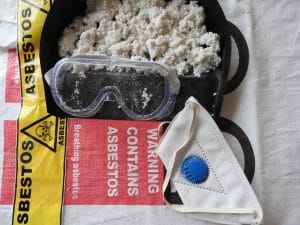
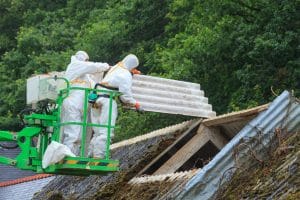
A pre-renovation or pre-demolition asbestos survey identifies suspect materials that planned work could disturb. The consultant may collect bulk samples, map material locations, and prepare documentation for the contractor and project team. In Southern California, the report may also need to support SCAQMD Rule 1403, Procedure 5 documentation, Notices to Comply, or related agency submissions.
A mold assessment should begin with visual inspection and moisture investigation. EPA guidance states that visible mold usually does not require sampling, and federal mold or mold-spore limits do not turn sampling into a compliance test (EPA mold assessment guidance). Sampling has value when it answers a specific question, such as whether conditions remain after corrective work. Property owners reviewing post-loss documentation can also consult this post-damage mold check.
Los Angeles property owners comparing scopes can review Sensitive Environmental's environmental testing services page for information on asbestos, lead, mold, indoor air quality, commercial testing, and related inspection work.
| Assessment Type | What It Covers | Typical Trigger |
|---|---|---|
| Phase I ESA | Records review, site walk, and written findings | Acquisition, refinance, or lender requirement |
| Phase II ESA | Physical sampling and laboratory analysis | Recognized environmental condition or known release |
| Targeted testing | One contaminant, material, or defined question | Lead, asbestos, mold, soil, or VOC concern |
| Industrial hygiene survey | Air, dust, fibers, particulates, and exposure conditions | Occupancy, construction, or incident response |
| Asbestos survey | Suspect building materials and planned disturbance areas | Renovation or demolition |
| Mold assessment | Moisture, visible conditions, and selected samples | Leak, water damage, odor, or occupant complaint |
Key Factors That Move an Assessment Quote Up or Down
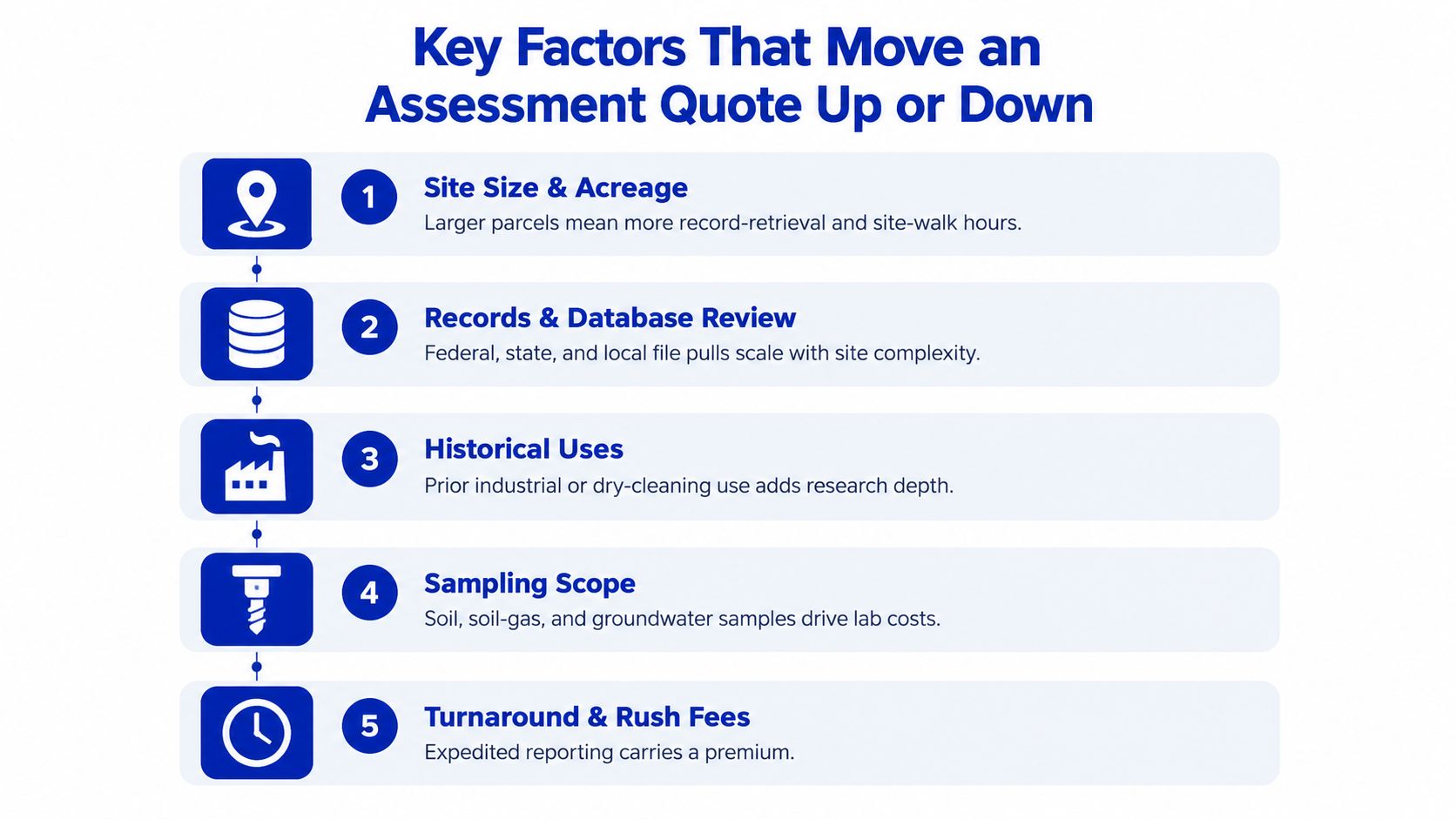
A consultant usually builds an environmental testing proposal by estimating field hours, records work, sample collection, laboratory analysis, reporting, and regulatory coordination. The property's square footage matters, but it's only one input. A small former dry cleaner can require more historical research and targeted testing than a larger building with an uncomplicated past.
The proposal levers
Site size and access come first. A compact urban lot may need limited site-walk time, while a multi-acre former industrial parcel can require more buildings, outdoor areas, adjoining properties, and records to evaluate. Locked rooms, occupied suites, active operations, and restricted roofs or crawlspaces add coordination even when the parcel itself is modest.
Records and historical use determine research depth. Former gas stations, dry cleaners, plating operations, auto repair yards, manufacturing facilities, and properties with storage tanks deserve closer review. The consultant may need to reconcile inconsistent addresses, historic business listings, old maps, agency files, and neighboring-site conditions.
Sampling scope is usually the strongest cost driver once a project moves beyond a records review. Soil, groundwater, soil-gas, building materials, dust, air, ash, soot, char, and fire residue each require different collection methods and laboratory analyses. More samples create more fieldwork, analytical charges, data interpretation, and reporting.
Timing and regulatory framing
Rush work costs more because the consultant must rearrange field schedules, laboratory processing, and report review. The verified fee data supports a broad market pattern in which standard turnaround and expedited work are priced differently, but the exact premium belongs in the proposal rather than in a generic percentage.
Regulatory framing can also change the deliverable. DTSC, the Regional Water Quality Control Board, SCAQMD, Los Angeles County, HUD, Cal/OSHA, or a lender may require specific qualifications, forms, sampling protocols, or report language. Multi-site projects may reduce some per-property costs when travel and coordination are shared, while remote access, repeated mobilization, and difficult scheduling can move the quote upward.
Typical Cost Ranges for Each Assessment Type
A Los Angeles property owner does not buy one generic “environmental assessment.” The trigger determines the scope: acquisition, demolition, moisture damage, suspected contamination, or wildfire residue each requires different evidence and fieldwork. Budget the assessment that answers the actual project question.
For a Phase I ESA on a standard commercial parcel under 10,000 square feet, plan on about $2,000 to $5,000. Published consultant pricing places some commercial Phase I work between $2,200 and $4,000 (Wood Group's Phase I ESA cost discussion). Multiple addresses, industrial history, a larger parcel, or an accelerated schedule can raise that baseline.
A Phase II ESA adds physical investigation. Typical work runs about $5,000 to $35,000, while contamination-driven projects can reach $200,000 when invasive sampling, laboratory analysis, and extensive reporting are required (LEV's Phase II assessment cost range). Large infrastructure reviews can carry much larger environmental-analysis budgets, including costs from $76,000 to $2.4 million and environmental review costs ranging from 0.2% to 7.8% of capital costs, with an average of 1.4% (Congressional review of environmental analysis costs). Those figures apply to major regulated projects, not routine property inspections.
| Assessment Type | Los Angeles Trigger | Typical Cost Range |
|---|---|---|
| Phase I ESA | Commercial acquisition or financing, standard parcel under 10,000 sq ft | About $2,000 to $5,000 |
| Phase II ESA | Suspected contamination requiring soil, soil-gas, or groundwater sampling | About $5,000 to $35,000, potentially much higher |
| Asbestos survey | Renovation or demolition of an existing building | Depends on building size, materials, and sample count |
| Mold assessment | Water damage, odor, or a moisture complaint | Depends on inspection and sampling scope |
| Lead inspection | Older housing, renovation, or demolition planning | Depends on property and testing scope |
| Industrial hygiene survey | Worker exposure or construction concern | Depends on air, dust, fiber, and chemical testing |
| Fire and wildfire testing | Ash, soot, char, smoke residue, or heavy metals | Depends on media and sample count |
For real estate due diligence, a consultant fee survey lists Phase I at $2,000 to $7,500 and Phase II at $5,000 to $35,000 (ConsultFees' Phase I and Phase II pricing survey). Treat those figures as planning ranges, not a substitute for a written scope.
A property owner preparing demolition should request a separate asbestos scope rather than assume it belongs in a Phase I. Sensitive Environmental's asbestos testing in Los Angeles resources cover surveys, sampling, and documentation for renovation and demolition planning.
Choosing the Right Level of Assessment for Your Project
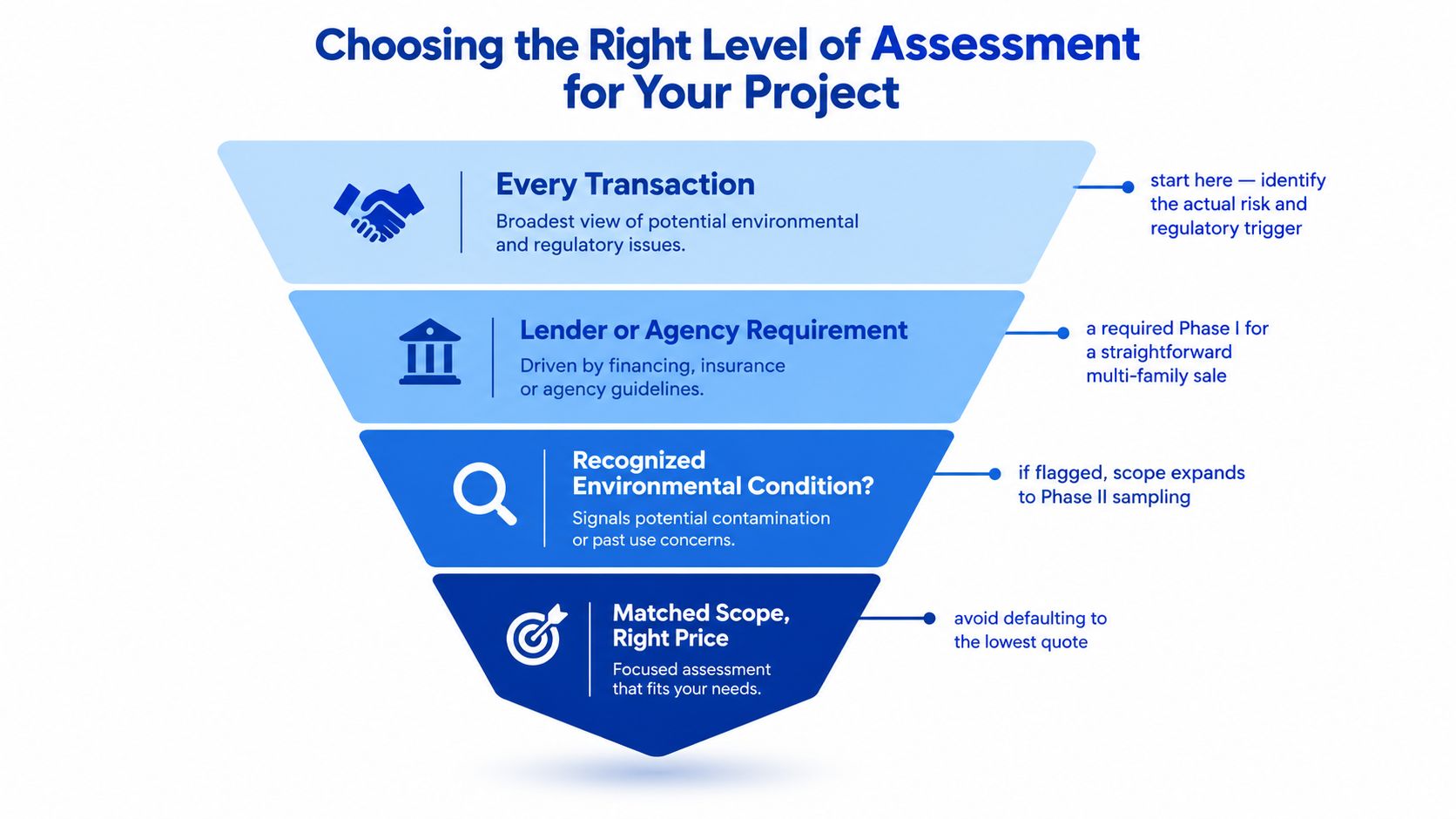
The cheapest assessment is often the wrong assessment. A narrow quote may omit the fieldwork, sample types, regulatory documentation, or reporting language that your lender, contractor, insurer, or agency needs.
Match scope to the actual trigger
For a residential resale requiring lender financing, begin by confirming whether the lender wants a Phase I ESA or a narrower environmental screen. If the property has no unusual history, a baseline review may be enough. If records identify a recognized environmental condition, the upgrade path is targeted Phase II sampling, not an automatic assumption that the property requires extensive work.
For a Downtown Los Angeles commercial property that was formerly a dry cleaner, a standard Phase I should be treated as the starting point. The historical use may justify focused review of solvent-related concerns and, if warranted by findings, soil, soil-gas, or groundwater sampling. A quote that ignores the former use isn't a bargain. It's incomplete.
A pre-demolition or major renovation project needs a building-material survey before disturbance. Asbestos sampling, lead-based paint inspection, and project-specific documentation may be necessary. The number of structures, materials, floors, and planned disturbance areas determines the field scope.
A post-fire rebuild may require testing of ash, soot, char, smoke residue, heavy metals, combustion byproducts, and indoor air conditions. The correct work plan depends on where debris settled, whether building systems were affected, and what documentation the insurer, owner, contractor, or agency needs. Positive results inform next steps, but they don't independently dictate a particular cleanup or abatement action.
A landlord responding to a mold complaint should first document moisture sources and visible conditions. EPA says visual assessment is generally the primary approach, and sampling is most useful when it answers a defined question rather than serving as a substitute for inspection (EPA mold course guidance). The budget should cover the inspection and only the sampling needed to resolve uncertainty.
Budget position: Spend first on the scope that answers the decision in front of you. Don't purchase a broad report that fails to satisfy the actual lender, agency, construction, or insurance requirement.
A properly matched assessment can prevent rework, lender delays, contractor change orders, and repeated mobilization. The cost difference between a suitable baseline and an under-scoped report is usually smaller than the cost of discovering the mismatch after closing or after demolition has begun.
Regulations That Shape LA and Southern California Pricing
Regulations influence environmental assessment cost because they turn general concern into defined procedures, qualifications, notifications, sampling methods, and documentation. The consultant isn't charging only for collecting a sample. The invoice may also cover material inventories, chain-of-custody records, laboratory coordination, agency forms, project maps, and a report that another party must be able to rely on.
Asbestos requirements
Los Angeles County's Rule 1403 guidance states that Procedures 4 and 5 require prior written AQMD approval. Procedure 5 plans apply to asbestos disturbances, site cleanups, decontaminations, excavations, and demolitions involving asbestos. The county fee sheet lists a $916.15 Procedure 5 plan evaluation fee, plus an expedited Procedure 4 or 5 evaluation fee of $458.06 when the request is postmarked less than 14 calendar days before the project start date (Los Angeles County AQMD demolition and asbestos forms).
Those agency fees are separate from the consultant's survey, sampling, laboratory, and documentation charges. A contractor preparing a demolition budget should ask whether the quote includes the survey, sample analysis, plan preparation, notification support, and any required revisions.
Lead, mold, and project oversight
HUD identifies the federal lead-based paint disclosure standard as 1.0 milligram per square centimeter or 0.5% by weight. EPA says buyers of pre-1978 housing must receive a 10-day opportunity to conduct a paint inspection or risk assessment, and sellers and landlords must disclose known lead information and provide available hazard reports (HUD lead-based paint guidance).
HUD's compliance toolkit also lists dust and soil thresholds commonly used in inspection and clearance work, including 400 µg/gram for children's play areas, 2,000 µg/gram for other bare-soil areas over 9 square feet, and 5,000 µg/gram for abatement-required soil. It defines de minimis disturbance levels as 20 square feet on exterior surfaces, 2 square feet in an interior room or space, or 10% of a small-surface component (HUD lead hazard compliance toolkit).
DTSC, the Regional Water Quality Control Board, HUD, Cal/OSHA, OSHA, and local agencies may impose additional project-specific requirements. The practical recommendation is simple. Give the consultant the property history, planned work, agency correspondence, lender instructions, and project schedule before requesting a final price.
Smart Budgeting Tips Before You Hire an Environmental Consultant
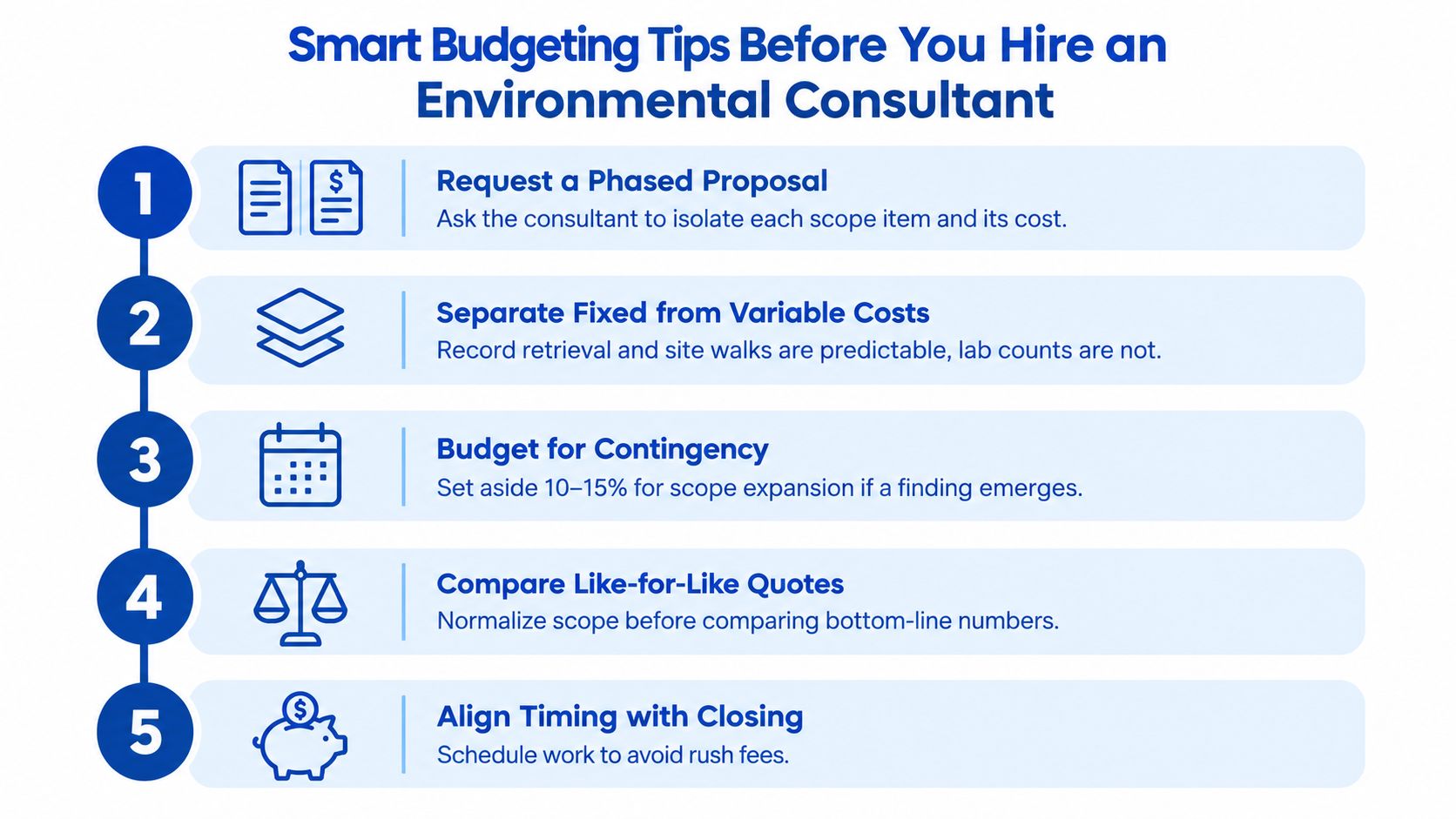
Good budgeting starts with a scope that can be audited line by line. Ask for a proposal that separates records review, site inspection, sampling, laboratory analysis, reporting, agency coordination, and optional follow-up. A single lump sum makes it difficult to understand what changes when a field condition appears.
Five questions to ask before signing
- Request a phased proposal: Separate the baseline inspection from optional sampling, laboratory analysis, and follow-up reporting.
- Verify qualifications and laboratories: Confirm who will conduct the fieldwork, who will sign the report, and which laboratory will analyze samples.
- Identify variable billing: Ask whether regulatory correspondence, custom data tables, additional site visits, revised plans, or expanded recommendations cost extra.
- Confirm the schedule: Standard work and rush work aren't interchangeable. A tight closing or construction date can affect availability and laboratory coordination.
- Compare like with like: Put sample counts, media, laboratory methods, report format, agency support, and turnaround beside each other before comparing totals.
The most common surprise costs arise when a Phase II requires additional borings, monitoring wells, vapor intrusion sampling, repeated mobilization, or broader laboratory analysis. Fire-related work can also expand when ash, soot, char, smoke residue, combustion byproducts, or heavy metals appear in more locations than the initial inspection suggested.
Use the published figures as planning anchors, not promises. Phase I work commonly sits in the low-thousands, while Phase II can move from a targeted investigation into a much larger program when contamination is identified. An international study found environmental review costs as a share of capital costs ranged from 0.2% to 7.8%, with an average of 1.4%, reinforcing that major-project pricing must be tied to project scale and complexity (Congressional document summarizing international environmental review cost findings).
Sensitive Environmental focuses on environmental testing, inspections, sampling, laboratory analysis, and reporting. Remediation planning may involve other qualified professionals, and you can review broader project coordination considerations in this Los Angeles environmental services resource, while keeping your testing scope clearly defined.
A low quote isn't automatically poor, and a high quote isn't automatically thorough. Compare the actual field hours, sample plan, laboratory methods, qualifications, report deliverables, regulatory support, and assumptions. That is how you protect both the project budget and the defensibility of the final environmental assessment.
If you're buying, renovating, demolishing, managing, or investigating a property in Los Angeles or Southern California, contact Sensitive Environmental for a scope-specific environmental assessment, asbestos or lead inspection, mold and indoor air quality testing, industrial hygiene evaluation, or fire-residue sampling plan. Share the property type, project trigger, location, schedule, and any lender or agency requirements so the team can recommend the right testing and reporting scope before costs escalate.