A 2026 benchmark puts popcorn or textured asbestos ceiling removal at roughly $9 to $20 per square foot, so a 500-square-foot ceiling can cost about $4,500 to $10,000 before testing and repairs. The final cost of removing an asbestos ceiling depends on the survey findings, containment, access, disposal, compliance requirements, and the condition of the ceiling after the material is removed.
You may be looking at a popcorn ceiling in a Los Angeles home, comparing two quotes that seem to describe the same work. One contractor may quote a low square-foot price, while another includes inspection, containment, waste transport, air monitoring, and documentation. Those aren't minor details. They determine what work can legally and safely proceed, and they can change the final bill substantially.
The most useful budgeting step comes before removal: arrange a professional asbestos inspection and sampling survey. A laboratory result can establish whether the textured ceiling contains asbestos, while a broader pre-renovation or pre-demolition survey can identify other suspect materials that might be disturbed by the project. In Los Angeles County, environmental testing may also support SCAQMD Rule 1403 documentation, Procedure 5 requirements, or a Notice to Comply, depending on the property and scope of work.
Table of Contents
- What a Ceiling Asbestos Quote Actually Covers
- Why Professional Ceiling Testing Comes First
- Typical Price Ranges for Asbestos Ceiling Removal
- Key Factors That Move Your Ceiling Removal Quote
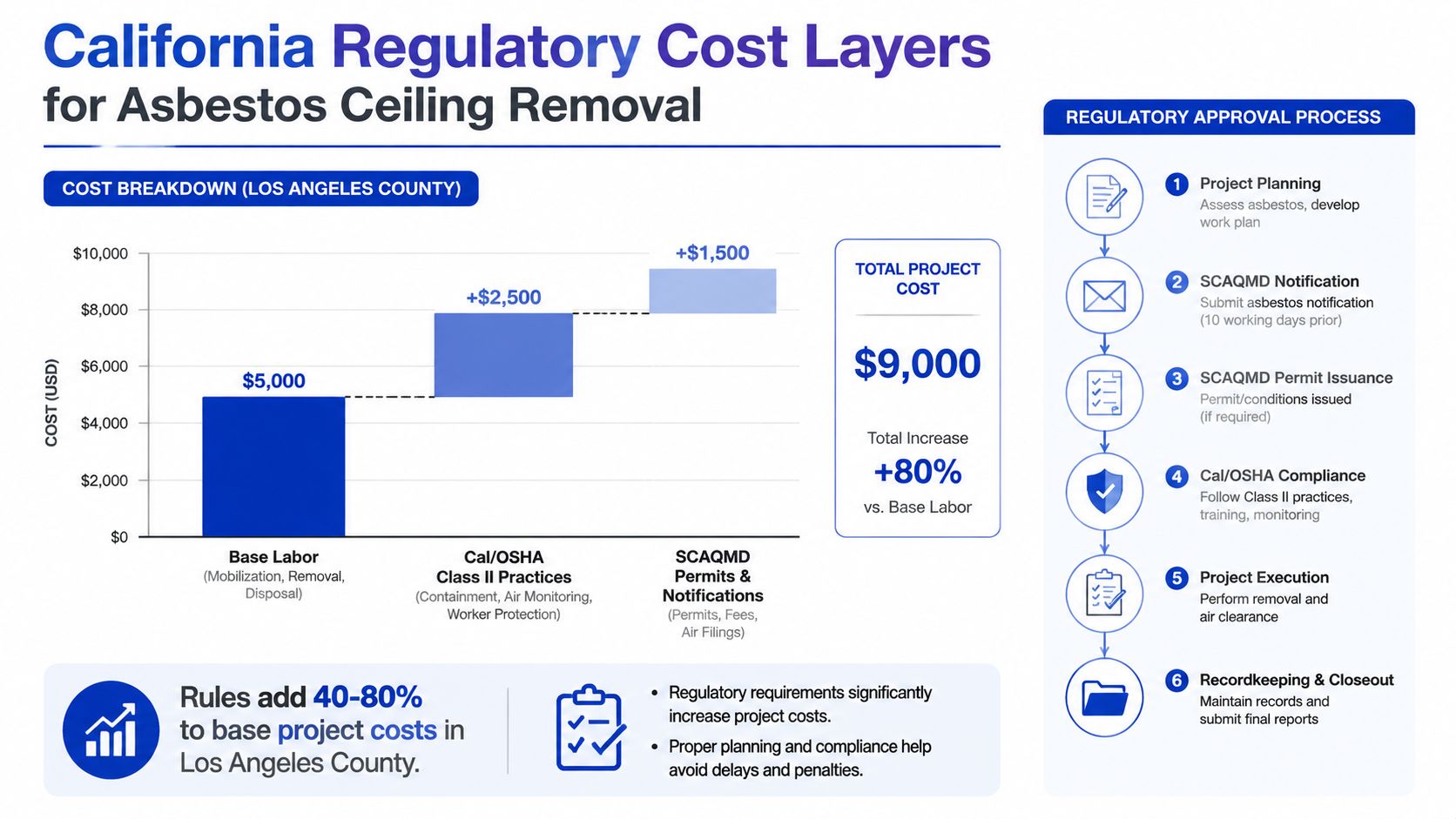
- How California and SCAQMD Rules Add Cost
- Removal Versus Encapsulation on a Budget
- Why DIY and Unlicensed Removal Usually Cost More
- Smart Ways to Plan and Budget Your Project
What a Ceiling Asbestos Quote Actually Covers
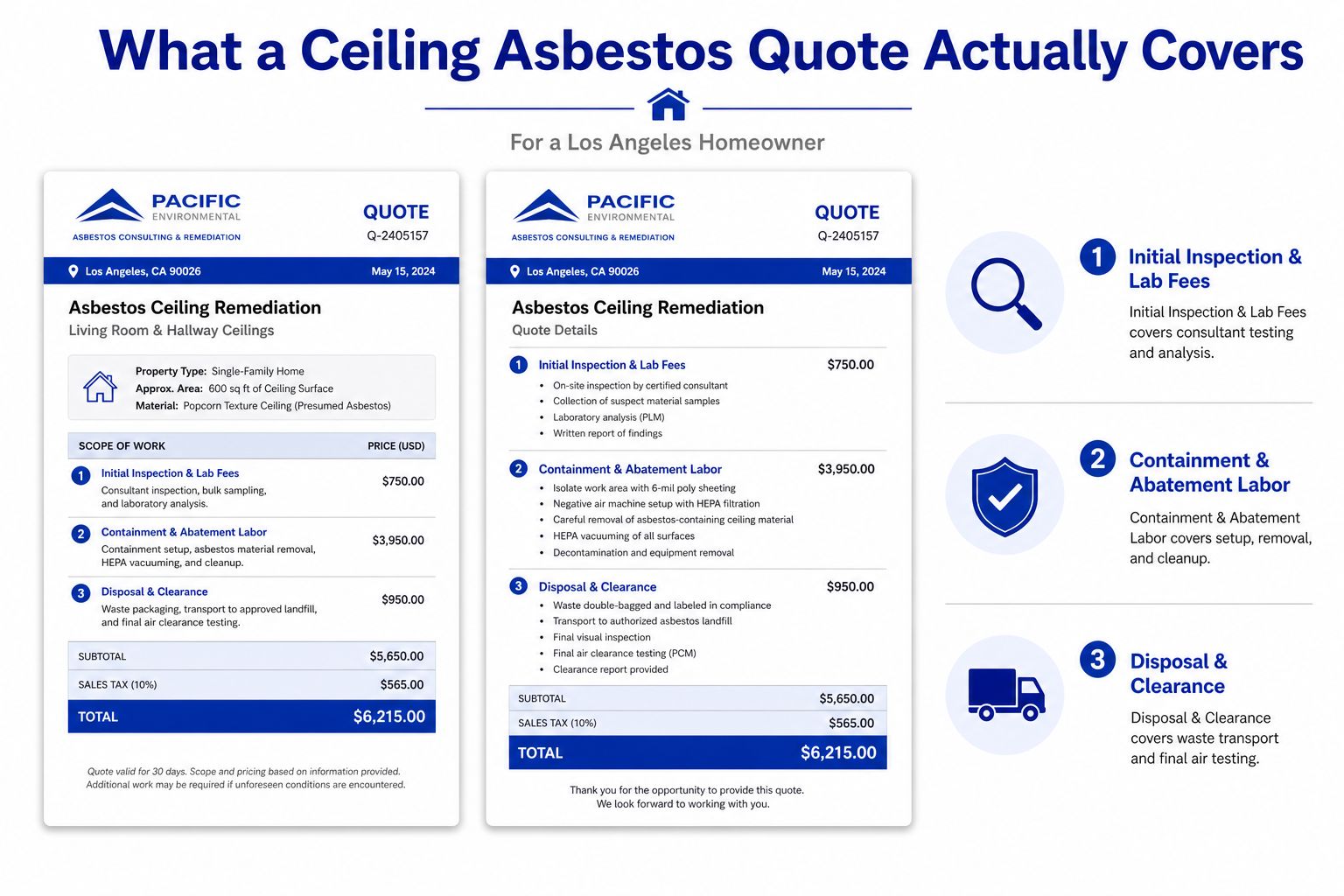
A Los Angeles homeowner sits at the kitchen table with two popcorn ceiling quotes open side by side. Both mention removal, but one is several thousand dollars higher. At first glance, the difference looks like a contractor markup. After reading the scopes, the homeowner finds that the higher quote includes the inspection, sealed containment, negative air pressure, HEPA cleaning, waste transport, and clearance testing. The lower quote covers only the removal labor.
That comparison shows why the cost of removing asbestos ceiling material isn't a labor rate multiplied by square footage. A professional quote usually represents a controlled work package with several separate functions:
- Initial inspection and sampling: A consultant evaluates the ceiling, collects representative bulk samples, and sends them for laboratory analysis. The result determines whether the work should be treated as asbestos-related.
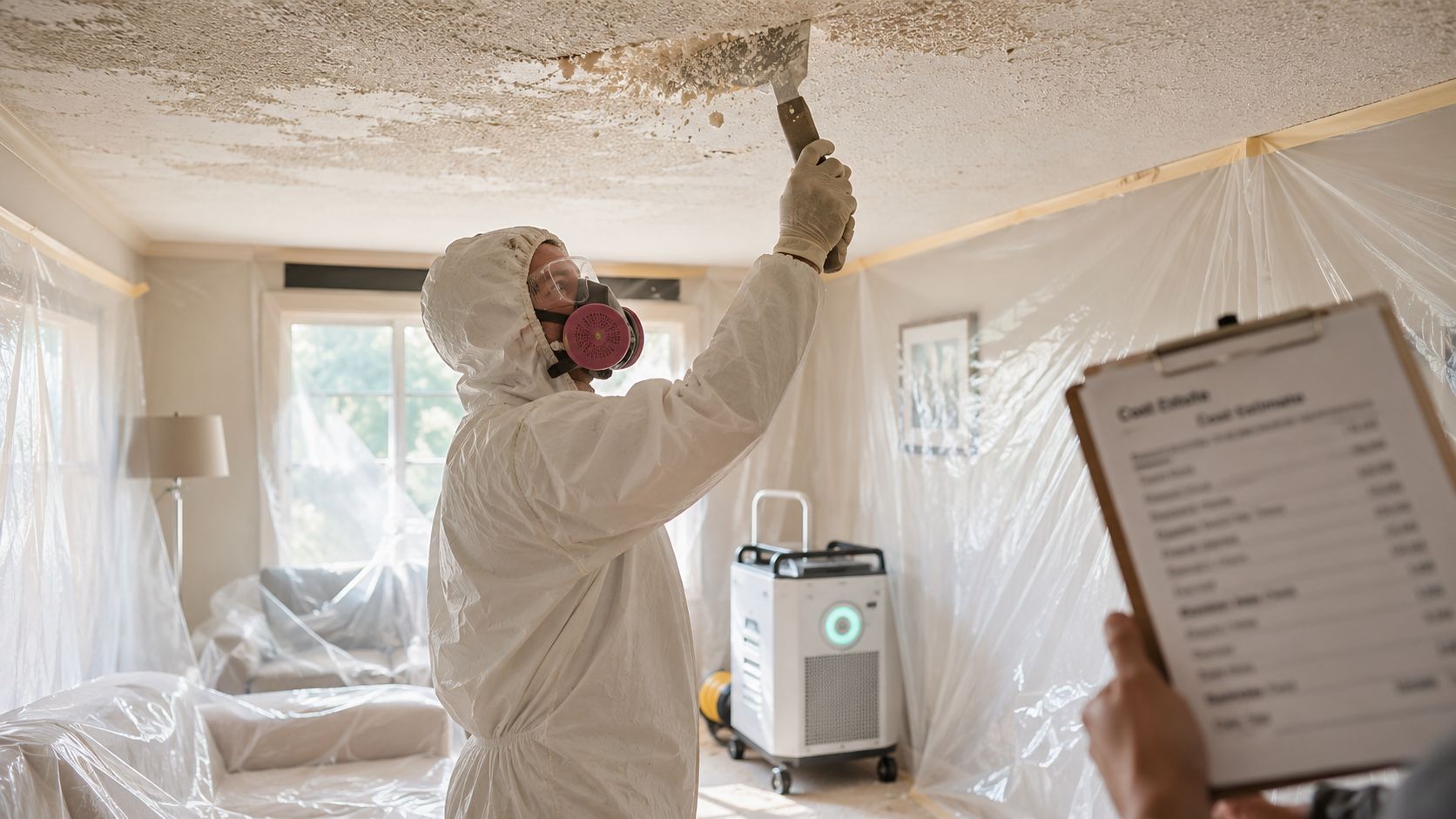
- Containment setup: Workers may seal the room with plastic sheeting, isolate openings, and use negative-air equipment to control potential fiber movement.
- Removal labor: The contractor prices the work according to the ceiling area, material condition, height, access, and required work practices.
- HEPA cleaning: Specialized vacuuming and detailed cleaning address residual dust and debris after the visible texture is gone.
- Waste handling and disposal: Contaminated materials must be packaged, transported, and sent through an appropriate disposal pathway rather than placed in ordinary construction waste.
Why project minimums matter
Small rooms can look expensive on a per-square-foot basis because mobilization, equipment delivery, supervisor time, containment setup, and minimum trip charges don't shrink in proportion to the room. Contractors often bundle those items into a project minimum instead of listing each one separately.
Practical rule: Compare the written scope, not just the price per square foot. Ask whether testing, containment, cleanup, disposal, air testing, and finish restoration are included or excluded.
For a homeowner, the survey is the first cost-control decision. For a general contractor, developer, property manager, or facility manager, it also creates documentation that supports project planning. A qualified environmental testing company can define the material and provide a report before removal pricing is finalized.
Why Professional Ceiling Testing Comes First
A ceiling can look like ordinary popcorn texture and still require asbestos testing before renovation or demolition. Visual inspection alone can't confirm the material's composition. A professional asbestos consultant examines the ceiling, notes its condition and extent, identifies areas that may be disturbed, and collects bulk samples from representative locations.
For friable surfacing material under EPA inspection rules, an accredited inspector must collect at least three samples from each homogeneous area of 1,000 square feet or less, with the minimum increasing for larger areas. The applicable EPA inspection rules for friable surfacing materials explain why sampling scope depends on the size and consistency of the material, rather than on a homeowner's visual impression.
What the inspection produces
The consultant typically records the ceiling's location, texture, condition, accessibility, and relationship to planned work. Bulk samples are then submitted to a qualified laboratory for analysis, often using polarized light microscopy for building-material identification. The written report should connect the laboratory findings to the areas inspected and explain any limitations.
That report can change the project path:
- A non-asbestos result may allow the owner and qualified contractor to plan ordinary ceiling work, subject to other hazards and local requirements.
- An asbestos-positive result may require asbestos-specific work practices, notifications, containment, waste controls, and clearance procedures.
- An inconclusive or limited result may call for additional sampling before anyone disturbs the ceiling.
For Los Angeles projects, the survey may also need to identify and quantify friable and non-friable asbestos-containing materials in accordance with local demolition-related requirements. Los Angeles Rule 1403 survey requirements describe inspection, identification, quantification, and physical sampling as parts of that compliance process.
Homeowners planning a renovation can review this guide to testing for asbestos in a popcorn ceiling before deciding whether a simple sample or a broader pre-renovation asbestos survey is appropriate. Testing doesn't automatically mean removal is required. It gives the owner and qualified project professionals information for choosing the next step.
Typical Price Ranges for Asbestos Ceiling Removal
The 2026 benchmark for popcorn or textured asbestos ceiling removal is about $9 to $20 per square foot, according to Angi's asbestos removal cost guide. That range generally reflects the controlled procedures required to manage a ceiling that could release fibers during scraping, wetting, or demolition.
A 500-square-foot ceiling therefore falls at approximately $4,500 to $10,000 before ceiling repair or repainting. A separate market guide places ceiling asbestos removal at $4 to $20 per square foot, which reinforces the central point: containment, filtration, labor, disposal, and finish restoration can matter as much as the area itself.
The table below uses the verified removal range and shows how the cost conversation is usually assembled. Inspection, air clearance, and repair amounts must be confirmed through project-specific proposals, because they vary by scope and provider.
2026 Asbestos Ceiling Removal Cost Ranges by Project Size
| Project Size | Inspection & Sampling | Removal ($/ sq ft) | Air Clearance Testing | Ceiling Repair | Estimated Total |
|---|---|---|---|---|---|
| 150 sq ft bedroom | Project-specific | $9 to $20 | Project-specific | Project-specific | Removal portion: $1,350 to $3,000, plus other listed services |
| 500 sq ft living area | Project-specific | $9 to $20 | Project-specific | Project-specific | Removal portion: $4,500 to $10,000, plus other listed services |
| 1,200 sq ft whole-home ceiling | Project-specific | $9 to $20 | Project-specific | Project-specific | Removal portion: $10,800 to $24,000, plus other listed services |
For context, a 2026 guide to the average cost to remove a popcorn ceiling can help readers compare ordinary popcorn ceiling work with asbestos-related work. The comparison matters because a non-asbestos ceiling doesn't require the same asbestos containment and disposal pathway.
The table shouldn't be read as a final quote. A small bedroom may have a high effective unit cost because setup and mobilization are spread over a limited area. A larger project may dilute some fixed costs while increasing the overall amount of labor, waste, and documentation. The only reliable starting point is a survey that defines what material is present and where it occurs.
Key Factors That Move Your Ceiling Removal Quote
Two ceilings with the same measured area can produce very different proposals. A vacant bedroom with a flat eight-foot ceiling is easier to isolate than a vaulted great room with built-in cabinetry, stair access, fragile lighting, and furniture that can't be moved easily.
Comparing the main cost drivers
| Cost Driver | Lower Cost Scenario | Higher Cost Scenario | Typical Price Swing |
|---|---|---|---|
| Ceiling height | Standard-height room with clear floor access | Tall or vaulted ceiling requiring additional access equipment | Can shift the quote from the lower to the higher end of the verified range |
| Room access | Empty room, wide doorway, simple layout | Occupied room, stairways, tight hallways, or fixed furnishings | Adds labor and setup complexity |
| Containment | One isolated room with straightforward sealing | Multiple connected rooms or a more elaborate enclosure | Increases equipment, preparation, and supervision needs |
| Material condition | Intact, firmly bonded texture | Damaged, deteriorated, or more friable material | Requires more cautious handling and controls |
| Finish restoration | Minor patching after removal | Extensive drywall repair, skim coating, or repainting | Adds a separate repair scope |
| Waste volume and handling | Limited material with simple loading access | Bulky debris, difficult carrying route, or restricted vehicle access | Raises packaging, handling, transport, and disposal effort |
The condition of the ceiling deserves special attention. Friability describes how readily a material can crumble or release dust when disturbed. A ceiling with water damage, cracking, flaking, or previous repairs may require a different work plan from an intact textured coating.
Access also affects the quote before removal begins. A contractor may need to protect walls and floors, move contents, build a controlled entry area, or use equipment to reach the ceiling. Those activities don't appear in a square-foot measurement, but they consume labor and equipment time.
A low square-foot price can be misleading if the proposal excludes access preparation, final cleaning, disposal, or repairs.
Disposal isn't limited to the visible texture. Packaging, transportation, and regulated disposal pathways all contribute to the project. Owners can review how asbestos disposal works so they know what documentation and waste controls to ask about, without confusing environmental testing with the separate removal or disposal scope.
How California and SCAQMD Rules Add Cost
A ceiling removal quote can change after the survey, even when the measured area stays the same. In Los Angeles, the material identified, the building type, the work method, and whether the project is treated as renovation or demolition can determine which regulatory steps apply. That is why the pre-removal survey often affects the final bill more than square footage alone.
Cal/OSHA work practices address employee protection and asbestos-related construction activity. The South Coast Air Quality Management District adds regional air-quality requirements for asbestos renovation and demolition. For Los Angeles County projects, owners and contractors may need to address SCAQMD Rule 1403 asbestos testing and compliance, along with Rule 1408, Rule 1408.1, Procedure 5, or a Notice to Comply when applicable. Homeowners can review these Los Angeles asbestos abatement guidelines to understand the broader compliance process.
What compliance costs can include
- Survey and documentation: A pre-renovation or pre-demolition survey identifies suspect materials and records sample locations and laboratory findings.
- Notifications: Depending on the work classification and jurisdiction, the project may require an Asbestos Notification Form or another submission before work begins.
- Work-area controls: Containment, negative pressure, wet methods, protective equipment, decontamination procedures, and regulated waste handling can all add labor, equipment, and setup time.
- Air monitoring and clearance: Independent or specified testing may be required during or after the work before the area can be reoccupied.
- Notice to Comply response: If an agency identifies a compliance issue, additional testing, documentation, monitoring, or corrective work may be needed before removal proceeds.
Clearance and containment testing are formal procedures, not casual visual checks. EPA work-area control guidance describes a framework using five samples inside the work site and five outside the work site for certain environmental testing and clearance-style evaluations. EPA work-area control guidance explains that sampling approach.
Schools face another layer through AHERA. Suspect asbestos-containing material must be treated as ACM unless sampling and analysis show it is non-asbestos under the rule. EPA guidance describes a TEM-based final air sampling method using 13 samples for certain projects. EPA's AHERA study guide shows why laboratory analysis and project records can affect the budget.
A testing company can define the survey and sampling scope. The results help contractors prepare a work plan and price the regulated removal accurately, but testing does not replace that plan or the contractor's compliance responsibilities.
Removal Versus Encapsulation on a Budget
Removal isn't automatically the right answer for every asbestos-containing ceiling. If the material is intact, unlikely to be disturbed, and compatible with the property's planned use, encapsulation or a covering system may be considered by qualified professionals.
Current UK pricing examples place textured ceiling encapsulation at about £30 per square metre, compared with roughly £50 to £60 per square metre for removal, while specialized asbestos insulating board ceilings can reach £200 to £300 per square metre and may require licensed contractors. These UK figures provide a comparison of how treatment choice and material hazard affect cost, but Los Angeles owners need a California-specific assessment and proposal. A current asbestos cost comparison discusses these distinctions.
| Option | Typical Cost per Sq Ft | 500 Sq Ft Project Estimate | Best Use Case | Key Limitation |
|---|---|---|---|---|
| Removal | $9 to $20 | $4,500 to $10,000 before testing and repairs | Planned renovation, damaged material, or work that will disturb the ceiling | Higher cost, disruption, waste, and finish restoration |
| Encapsulation or covering | Project-specific | Requires a project-specific quote | Intact material that won't be disturbed and can accept a compatible coating or overlay | Doesn't eliminate the underlying material or future disclosure considerations |
The decision should follow testing, not precede it. A survey can identify whether the texture is asbestos-containing, whether it appears damaged, and whether other materials could be affected by the proposed work.
Encapsulation can also create future planning issues. Covering the ceiling doesn't erase the presence of asbestos, so owners should retain the survey and treatment records and discuss disclosure obligations with the appropriate real estate and legal professionals. If a future renovation will penetrate, scrape, cut, or remove the ceiling, the covered material may still need to be managed.
Why DIY and Unlicensed Removal Usually Cost More
The apparent saving from DIY work comes from omitting the controls that make asbestos work a regulated process. That omission can shift costs into testing, corrective work, legal exposure, disposal problems, and real estate complications.
The verified material doesn't establish specific California fine amounts, medical monitoring costs, or a precise multiplier for improper work, so those figures shouldn't be presented as universal estimates. The practical risk remains clear: an owner who disturbs suspect ceiling texture without a survey may create a larger area requiring assessment and controlled cleaning than the original ceiling would have required.
Where the hidden costs appear
- Unplanned contamination: Dust may move beyond the intended room, requiring additional environmental assessment and cleaning decisions.
- Missing documentation: A future buyer, lender, insurer, property manager, or agency may ask how the material was identified and handled.
- Improper waste handling: Asbestos-related waste can't be treated like ordinary household debris. Transport and disposal records matter.
- Interrupted construction: A contractor may stop work when suspect material is discovered, leaving labor, scheduling, and trade coordination unresolved.
- Unclear reoccupancy: Without appropriate post-work evaluation, an owner may not have documentation to support returning the space to normal use.
A positive asbestos result doesn't automatically dictate one universal response. The appropriate next step can depend on the material's condition, the planned renovation, the building type, and applicable local rules. What DIY work removes is not just ceiling texture. It may also remove the owner's ability to document the work clearly.
The economical decision is the one that keeps the project defined. Testing first prevents a contractor from pricing an unknown hazard as ordinary demolition.
Owners should separate the roles involved. An environmental testing professional can inspect, sample, coordinate laboratory analysis, and prepare a report. A qualified asbestos contractor handles regulated work when removal or other construction action is selected. Keeping those responsibilities clear makes proposals easier to compare and reduces conflicts of interest.
Smart Ways to Plan and Budget Your Project
A testing-first budget begins with the ceiling survey, not a removal quote. Before contractors price scraping or demolition, identify the suspect material, define the area that will be disturbed, and determine whether the project is residential, commercial, renovation-related, or demolition-related.
For a planning estimate, the verified data supports a $9 to $20 per square foot removal range for popcorn or textured asbestos ceilings, while the inspection and sampling amount should be quoted by the environmental consultant according to the property and survey scope. Don't treat an online calculator or a contractor's verbal estimate as a substitute for laboratory-supported identification.
A practical planning sequence
- Pause disturbance. Don't scrape, sand, drill, or remove the texture before the material is evaluated.
- Commission the right survey. A limited sample may suit a clearly defined area, while a pre-renovation or pre-demolition survey may need to cover additional materials and concealed locations.
- Request a written scope. Ask each contractor to identify containment, labor, cleaning, disposal, monitoring, clearance, permits, notifications, and repair exclusions.
- Coordinate related work. If electrical, insulation, lighting, or structural work will disturb the same ceiling, sequence the work so the survey and project controls account for the full scope.
- Protect the records. Keep the laboratory report, survey, chain-of-custody information, photographs, notifications, and clearance documentation with the property's permanent files.
Small residential projects can carry fixed setup costs, while large commercial or multi-room projects may require more extensive documentation and coordination. Property managers, school districts, healthcare facilities, developers, and general contractors should also confirm whether the project requires Procedure 5 documentation, SCAQMD coordination, Notice to Comply testing, or other compliance support.
Sensitive Environmental provides asbestos testing, inspections, sampling, laboratory analysis, and survey documentation for residential and commercial properties in Los Angeles and Southern California. Results can help homeowners, contractors, property managers, and developers determine the appropriate next step before ceiling work begins.
If you're planning ceiling renovation or demolition in Los Angeles County, contact Sensitive Environmental to discuss a pre-renovation or pre-demolition asbestos survey, representative sampling, and clear laboratory-backed reporting. Schedule the testing before disturbing the ceiling so your removal, encapsulation, compliance, and repair decisions are based on documented conditions rather than a guess.